


Erhalten Sie Zugang zu diesem und mehr als 300000 Büchern ab EUR 5,99 monatlich.
- Herausgeber: Atlantic Books
- Kategorie: Religion und Spiritualität
- Sprache: Englisch
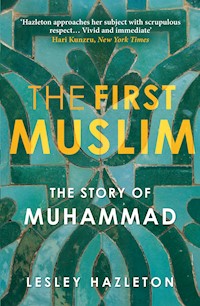
The extraordinary life of the man who founded Islam, and the world he inhabited - and remade. Muhammad's was a life of almost unparalleled historical importance; yet for all the iconic power of his name, the intensely dramatic story of the prophet of Islam is not well known. In The First Muslim, Lesley Hazleton brings him vibrantly to life. Drawing on early eyewitness sources and on history, politics, religion, and psychology, she renders him as a man in full, in all his complexity and vitality. Hazleton's account follows the arc of Muhammad's rise from powerlessness to power, from anonymity to renown, from insignificance to lasting significance. How did a child shunted to the margins end up revolutionizing his world? How did a merchant come to challenge the established order with a new vision of social justice? How did the pariah hounded out of Mecca turn exile into a new and victorious beginning? How did the outsider become the ultimate insider? Impeccably researched and thrillingly readable, Hazleton's narrative creates vivid insight into a man navigating between idealism and pragmatism, faith and politics, non-violence and violence, rejection and acclaim. The First Muslim illuminates not only an immensely significant figure but his lastingly relevant legacy.
Sie lesen das E-Book in den Legimi-Apps auf:
Seitenzahl: 550
Veröffentlichungsjahr: 2013
Das E-Book (TTS) können Sie hören im Abo „Legimi Premium” in Legimi-Apps auf:
Ähnliche














The
FIRST MUSLIM
ALSO BY LESLEY HAZLETON
After the Prophet: The Epic Story of the Shia-Sunni Split
Jezebel: The Untold Story of the Bible’s Harlot Queen
Mary: A Flesh-and-Blood Biography of the Virgin Mother
Jerusalem, Jerusalem: A Memoir of War and Peace, Passion and Politics
Where Mountains Roar: A Personal Report from the Sinai and Negev Desert
Israeli Women: The Reality Behind the Myths
First published in the United States of America in 2013 by Riverhead Books, a member of Penguin Group (USA) Inc. First published in Great Britain in 2013 by Atlantic Books, an imprint of Atlantic Books Ltd.
Copyright © Lesley Hazleton, 2013
The moral right of Lesley Hazleton to be identified as the author of this work has been asserted by her in accordance with the Copyright, Designs and Patents Act of 1988.
All rights reserved. No part of this publication may be reproduced, stored in a retrieval system, or transmitted in any form or by any means, electronic, mechanical, photocopying, recording, or otherwise, without the prior permission of both the copyright owner and the above publisher of this book.
10 9 8 7 6 5 4 3 2 1
A CIP catalogue record for this book is available from the British Library.
Hardback ISBN: 978-1-78239-229-3 Trade Paperback ISBN: 978-1-78239-230-9 Ebook ISBN: 978-1-78239-231-6
Printed in Great Britain.
Book design by Amanda Dewey Map by Jeffrey L. Ward
Atlantic Books An Imprint of Atlantic Books Ltd Ormond House 26–27 Boswell Street London WC1N 3JZwww.atlantic-books.co.uk
For Layla and Ian
Muhammad, say, “I am the first Muslim.”
—QURAN
The inner meaning of history . . . involves speculation and an attempt to get to the truth, subtle explanation of the causes and origins of existing things, and deep knowledge of the how and why of events.
— IBN-KHALDUN
I do not accept the claim of saintliness . . . I am prone to as many weaknesses as you are. But I have seen the world. I have lived in the world with my eyes open.
—MAHATMA GANDHI
Contents
Part One
ORPHAN
Part Two
EXILE
Part Three
LEADER
Acknowledgments
Notes
Bibliography
Index
Part One
ORPHAN
One
If he weren’t standing lonely vigil on the mountain, you might say that there was no sign of anything unusual about him. The earliest sources describe him with infuriating vagueness for those of us who need images. “He was neither tall nor short,” they say. “Neither dark nor fair.” “Neither thin nor stout.” But here and there, specific details slip through, and when they do, they are surprising. Surely a man spending night after night in solitary meditation would be a gaunt, ascetic figure, yet far from being pale and wan, he had round, rosy cheeks and a ruddy complexion. He was stockily built, almost barrel-chested, which may partly account for his distinctive gait, always “leaning forward slightly as though he were hurrying toward something.” And he must have had a stiff neck, because people would remember that when he turned to look at you, he turned his whole body instead of just his head. The only sense in which he was conventionally handsome was his profile: the swooping hawk nose long considered a sign of nobility in the Middle East.
On the surface, you might conclude that he was an average Meccan. At forty years old, the son of a man he had never seen, he had made a far better life for himself than had ever seemed possible. The child born an outsider within his own society had finally won acceptance, and carved out a good life despite the odds against him. He was comfortably off, a happily married business agent with the respect of his peers. If he was not one of the movers and shakers of his prosperous city, that was precisely why people trusted him to represent their interests. They saw him as a man with no axe of his own to grind, a man who would consider an offer or a dispute on its merits and decide accordingly. He had found a secure niche in the world, and had earned every right, in middle age, to sit back and enjoy his rise to respectability. So what was he doing alone up here on one of the mountains that ringed the sleeping city below? Why would a happily married man isolate himself this way, standing in meditation through the night?
There was a hint, perhaps, in his clothing. By now he could certainly have afforded the elaborate embroidered silks of the wealthy, but his clothing was low-key. His sandals were worn, the leather thongs sun-bleached paler than his skin. His homespun robe would be almost threadbare if it hadn’t been so carefully patched, and it was hardly enough to shield him against the night-time cold of the high desert. Yet something about the way he stood on the mountainside made the cold irrelevant. Tilted slightly forward as though leaning into the wind, his stance seemed that of someone who existed at an angle to the earth.
Certainly a man could see the world in a different way up here. He could find peace in the silence, with just the soughing of the wind over the rock for company, far from the feuds and gossip of the city with its arguments over money and power. Here, a man was merely a speck in the mountain landscape, his mind free to think and reflect, and then finally to stop thinking, stop reflecting, and submit itself to the vastness.
Look closer and you might detect the shadow of loneliness in the corners of his eyes, something lingering there of the outsider he had once been, as though he were haunted by the awareness that at any moment everything he’d worked so long and hard for could be taken away. You might see a hint of that same mix of vulnerability and resoluteness in his mouth, the full lips slightly parted as he whispered into the darkness. And then perhaps you’d ask why contentment was not enough. Did the fact that it had been so hard-earned make him unable to accept it as a given, never to be secure in his right to it? But then what would? What was he searching for? Was it a certain peace within himself, perhaps? Or was it something more—a glimpse, maybe just an intimation, of something larger?
One thing is certain: by Muhammad’s own account, he was completely unprepared for the enormity of what he would experience on this particular night in the year 610.
A human encounters the divine: to the rationalist, a matter not of fact but of wishful fiction. So if Muhammad had behaved the way one might expect after his first encounter on Mount Hira, it would only make sense to call the story just that: a fable concocted by piety and belief. But he did not.
He did not come floating off the mountain as though walking on air. He did not run down shouting “Hallelujah” and “Bless the Lord.” He did not radiate light and joy. There were no choirs of angels, no music of the heavens. No elation, no ecstasy, no golden aura surrounding him. No sense of his absolute, foreordained, unquestionable role as the messenger of God. Not even the whole of the Quran fully revealed, but only a few brief verses. In short, Muhammad did none of the things that might seem essential to the legend of a man who had just done the impossible and crossed the border between this world and another—none of the things that might make it easy to cry foul, to denigrate the whole story as an invention, a cover for something as mundane as delusion or personal ambition.
On the contrary: he was convinced that what he had encountered could not be real. At best it must be a hallucination: a trick of the eye or the ear, or his own mind working against him. At worst, possession, and he had been seized by an evil jinn, a spirit out to deceive him, even to crush the life out of him. In fact he was so sure that he could only be majnun, literally possessed by a jinn, that when he found himself still alive, his first instinct had been to finish the job himself, to leap off the highest cliff and escape the terror of what he had experienced by putting an end to all experience.
So the man who fled down Mount Hira trembled not with joy but with a stark, primordial fear. He was overwhelmed not with conviction, but by doubt. He was sure of only one thing: whatever this was, it was not meant to happen to him. Not to a middle-aged man who had hoped perhaps at most for a simple moment of grace instead of this vast blinding weight of revelation. If he no longer feared for his life, he certainly feared for his sanity, painfully aware that too many nights in solitary meditation might have driven him over the edge.
Whatever happened up there on Mount Hira, the sheer humanness of Muhammad’s reaction may be the strongest argument for its historical reality. Whether you think the words he heard came from inside himself or from outside, it is clear that Muhammad experienced them, and with a force that would shatter his sense of himself and his world. Terror was the sole sane response. Terror and denial. And if this reaction strikes us now as unexpected, even shockingly so, that is only a reflection of how badly we have been misled by the stereotyped image of ecstatic mystical bliss.
Lay aside such preconceived notions for a moment, and you might see that Muhammad’s terror speaks of real experience. It sounds fallibly human—too human for some, like conservative Muslim theologians who argue that the account of his trying to kill himself should not even be mentioned despite the fact that it’s in the earliest Islamic biographies. They insist that he never doubted for a single moment, let alone despaired. Demanding perfection, they cannot tolerate human imperfection.
Perhaps this is why it can be so hard to see who Muhammad really was. The purity of perfection denies the complexity of a lived life. For Muslims worldwide, Muhammad is the ideal man, the prophet, the messenger of God, and though he is told again and again in the Quran to say “I am just one of you”—just a man—reverence and love cannot resist the desire to clothe him, as it were, in gold and silver. There is a proprietary feeling about him, a fierce protectiveness all the stronger at a time when Islam itself is under such intense scrutiny in the West.
But the law of unintended consequences applies. To idealize someone is also, in a way, to dehumanize them, so that despite the millions if not billions of words written about Muhammad, it can be hard to get any real sense of the man himself. The more you read, the more liable you are to come away with the feeling that while you may know a lot about Muhammad, you still don’t know who he was. It’s as though he has been all but smothered by the accumulated mass of so many words.
Though the reverential legends about him are often magnificent, they work as perhaps all legends do: they obscure more than they reveal, and he becomes more a symbol than a human being. Even as Islam is rapidly closing on Christianity as the world’s largest religion, we thus have little real sense of the man told three times in the Quran to call himself “the first Muslim.” His is without doubt one of the most consequential lives ever lived, yet for all the iconic power of his name alone—or perhaps because of it—it is a life still to be explored.
How did this man shunted as a child to the margins of his own society (“a man of no importance,” as his opponents call him in the Quran) come to revolutionize his world? How did the infant sent away from his family grow up to redefine the whole concept of family and tribe into something far larger: the umma, the people or the community of Islam? How did a merchant become a radical re-thinker of both God and society, directly challenging the established social and political order? How did the man hounded out of Mecca turn exile into a new and victorious beginning, to be welcomed back just eight years later as a national hero? How did he succeed against such odds?
To answer such questions requires exerting the biographer’s privilege and real purpose, which is not merely to follow what happened but to uncover the meaning and relevance within the welter of events. It means weaving together the complex elements of Muhammad’s life, creating a three-dimensional portrait not so much at odds with the “authorized” version as expanding it.
The great British philosopher and historian R. G. Collingwood maintained in The Idea of History that to write well about a historical figure, you need both empathy and imagination. By this he did not mean spinning tales out of thin air, but taking what is known and examining it in the full context of time and place, following the strands of the story until they begin to intertwine and establish a thick braid of reality. If we want to understand the dynamics of what can only be described, with considerable understatement, as a remarkable life—one that would radically change his world, and is still shaping ours—we must allow Muhammad the integrity of reality, and see him whole.
His story is an extraordinary confluence of man, time, and culture, and it begs a deceptively simple question: Why him? Why Muhammad, in the seventh century, in Arabia?
Just to think in such terms is both exciting and daunting. On the one hand, these questions lead straight into a virtual minefield of deeply held beliefs, unwitting preconceptions, and cultural assumptions. On the other, they allow us to see Muhammad clearly, and to understand how he accomplished his journey from powerlessness to power, from anonymity to renown, from insignificance to lasting significance.
The constant guides through his life are two early Islamic histories: the lengthy biography of him written in eighth-century Damascus by ibn-Ishaq, on which every subsequent biography at least claims to be based, and the more politically focused history of early Islam by al-Tabari, written in late-ninth-century Baghdad, which comes to a magisterial thirty-nine volumes in translation, four of them devoted to Muhammad’s lifetime.
These early historians are conscientious. Their authoritativeness lies in their inclusiveness. They wrote after the fact, working with oral history in the full awareness of how both time and piety tend to warp memory, blurring the line between what was and what should have been. If they erred, it was deliberately on the side of thoroughness rather than judgment. Reading them, one senses their awareness that they are walking a fine line between their responsibility to history on the one side and tradition on the other. This delicate balancing act between history and faith goes hand in hand with their acknowledgment of the elusiveness of definitive fact—a quality as slippery in the hyper-documented world of today as it was in the oral tradition of theirs. Instead of aspiring to omniscience, then, they included conflicting accounts and left it to their readers to decide for themselves, though they did indicate their point of view. Throughout ibn-Ishaq’s work, for instance, there are phrases such as “it is alleged that” and “so I have been told.” In fact when several eyewitness accounts seem to contradict one another, he often sums up with “As to which of these is correct, only God knows for sure”—a statement that verges on a helpless “God knows!”
Perhaps the only other life that has been written about so much and has yet remained such a mystery is that of Jesus. But thanks to the efforts of scholarly groups like the Jesus Seminar, new studies in the past few decades have explored beyond the letter of the Gospel accounts to create not only a more human portrait of him, but also deeper insight into his impact. These scholars delved beyond theology into history, political science, comparative religion, and psychology, highlighting the radical political relevance of Jesus’ message. By looking at him in the full context of his time, they made him not less but more relevant to our own.
The parallels between Muhammad and Jesus are striking. Both were impelled by a strong sense of social justice; both emphasized unmediated access to the divine; both challenged the established power structure of their times. As with Jesus, theology and history travel side by side in any account of Muhammad’s life, sometimes as closely as train tracks, at others widely divergent. Miracle stories abound in an accretion of sacred lore built up by those treasuring what should have happened even if it didn’t. Despite the Quran’s insistent disavowal of the miraculous, there seems to be a very human need for it, and for theology to demand faith in the improbable—the impossible—as a test of commitment.
Conservative Islamic tradition thus maintains that Muhammad was destined from the start to be the messenger of God. But if that is so, then there is no story of his life. That is, it becomes a matter of the inevitable unfolding of divine will, and thus devoid of all conflict or tension. To some pious believers, this will more than suffice; the prophet’s innate exceptionalism is a given, and any biography is irrelevant. But to many others, what is compelling is not the miraculous but the humanly possible. Muhammad’s is one of those rare lives that is more dramatic in reality than in legend. In fact the less one invokes the miraculous, the more extraordinary his life becomes. What emerges is something grander precisely because it is human, to the extent that his actual life reveals itself worthy of the word “legendary.”
His story follows the classic arc of what Joseph Campbell called “the hero’s journey,” from inauspicious beginnings to extraordinary success. But this journey is never an easy one. It involves struggle, danger, and conflict, within oneself as much as with others. So to elide the more controversial aspects of Muhammad’s life does him no service. On the contrary, if we are to accord him the vitality and complexity of a man in full, we need to see him whole. This means taking what might be called an agnostic stance, laying aside piety and reverence on the one hand along with stereotype and judgmentalism on the other, let alone the deadening pall of circumspection in the middle. It means finding the very human narrative of a man navigating between idealism and pragmatism, faith and politics, non-violence and violence, the pitfalls of acclaim as much as the perils of rejection.
The pivotal point of his life is undoubtedly that one night on Mount Hira. That was when he stepped into what many think of as his destiny, which is why Muslims call it laylat al-qadr, the Night of Power. It’s certainly where he stepped into history, though that word too can be misleading. It implies that Muhammad’s story belongs in the past, when in fact it continues to have such an impact that it has to be considered a matter as much of current events as of history. What happened “then” is an integral part of what is still happening, a major factor in the vast and often terrifying arena in which politics and religion intersect.
To begin to understand this man who wrestled with the angel on the mountaintop and came down seared by the encounter, however, we need to ask not only what happened that night on Mount Hira and what it would lead to, but what led him to it. Especially since from the start, despite the legends, the signs were not promising. Indeed, any objective observer might have concluded that Muhammad was a most unlikely candidate for prophethood, since whatever stars he was born under, they seemed anything but auspicious.
Two
If you believe in omens, the fact that Muhammad was born an orphan is not a good one. Most biographers make little of it, moving on quickly as though this were just a quirk of fate not worth dwelling on. Yet his orphanhood bears the psychological weight that often determines history. Especially since if the legend of his birth is to be believed, he was almost never born at all. Just hours before he was conceived, his grandfather nearly killed his father. And as though the father had been spared only long enough to fulfill his singular role, he would then die far from home, unaware that he even had a son.
The grandfather was Abd al-Muttalib, the venerable leader of the ruling Quraysh tribe and a central figure in the short but spectacular lore of Mecca. As a young man, he had excavated the Zamzam well, a freshwater spring hard by the Kaaba sanctuary, which attracted pilgrims from all over Arabia. Rumors of the spring’s existence had existed for as long as anyone could remember. Some said that it had first been discovered by Hagar after she gave birth to Ishmael and that it had then been tapped by Abraham, only to be abandoned and filled in over the centuries, its location forgotten until Abd al-Muttalib rediscovered it. All sorts of miraculous things reportedly happened when he opened it up. By some accounts, a snake guarded the entrance so fiercely that nobody dared approach until a giant eagle swooped down to snatch it up into the sky. Others maintain that masses of treasure were found in the spring, from exquisitely wrought jewel-studded swords to life-size gazelles made out of solid gold. But by far the most chilling account is one that will be hauntingly familiar to anyone who knows the biblical story of Abraham’s near-sacrifice of his son.
Since it was he who’d rediscovered Zamzam, Abd al-Muttalib claimed that the profitable monopoly on providing its water to pilgrims belonged to his clan, the Hashims, one of the four primary extended families banded together to form the Quraysh tribe. There were other springs in Mecca of course, but none so centrally located, none with such sweet water, and none with such a powerful legend. So it was hardly a surprise when the other Quraysh clan leaders challenged his claim to control its waters, thus questioning both his motives and his honor. What did come as a surprise was his response. He silenced his critics with a terrifying vow. If he had ten sons who survived into maturity to protect him and to uphold the honor of the Hashims, he swore, he would sacrifice one of them right there in the open precinct surrounding the Kaaba, beside the spring.
The vow cowed his critics into silence. The idea of human sacrifice was terrifying, all the more since it had surely come to an end with that ancestral legend of Abraham and Ishmael. Wasn’t that why the sole thing in the forbidden interior of the Kaaba was rumored to be the horns of the ram that had taken Ishmael’s place in that foundational act of sacrifice? Besides, there was no doubt that ten sons would be an extraordinary sign of divine favor. No matter how many wives a man had, the frequency of infant mortality and maternal death in childbirth made such filial riches all but impossible. Yet by the year 570, ten sons of Abd al-Muttalib had indeed survived. And according to ibn-Ishaq, quite magnificently. “There were none more prominent and stately than they, nor of more noble profile, with noses so long that the nose drank before the lips,” he would write, celebrating the feature so admired in a society that scorned snub noses, considering them as effeminate as the pale skin of Byzantine Greeks, referred to derisively as “yellow men.”
It was time for Abd al-Muttalib to fulfill his vow. A man’s word was his bond, and he had given his. He had no choice in the matter if he was to hold his head high. The only question was which son to sacrifice, and since this was an impossible choice for any father to make, the traditional way would decide for him. He would consult the totemic icon of the Quraysh tribe: the sacred stone of Hubal, which loomed alongside the Kaaba and acted as a kind of consecration stone. Oaths were made and deals sealed at its foot, vows of both friendship and vengeance solemnized in its shadow. And when hard decisions had to be made or intractable disputes settled, the stone served as an oracle. Approached the right way, Hubal expressed the will of God—of al-Lah, “the high one,” the great lord of the sanctuary, who was so remote and mysterious that he could be consulted only through intermediaries.
Lest there be any doubt that these were matters of life and death, Hubal spoke through arrows. Each one would be inscribed with an option tailored to the specific occasion. If there was a question of when to act, for instance, three arrows might be used, marked “now,” “later,” or “never,” or with specific times such as “today,” “in seven days,” “in a month.” Invocations were then made and a sacrifice offered—a goat or even a camel—and finally Hubal’s priestly custodian would bundle the arrows together, balance them on the ground pointing upward, and then, in much the same way as the ancient Chinese consulted the I Ching using yarrow stalks, let them fall. Whichever arrow fell pointing most directly at Hubal, the inscription on it would be the judgment.
This time there were ten arrows, each inscribed with the name of one of the ten sons. The whole city gathered to witness the ceremony, simultaneously excited and horrified by what was at stake. The murmur of anticipation swelled to a raucous clamor as the decisive moment neared, only to give way to abrupt silence as the custodian let the arrows fall. Everyone pressed in close, eager to be the first to hear which name was on the arrow pointing toward the huge stone, and when it was announced, a horrified gasp rippled back through the crowd. With the inevitability of Greek tragedy, the arrow pointing toward Hubal was the one marked with the name of Abd al-Muttalib’s youngest and favorite son, Abdullah.
If the father’s beard had not already been white with age, it would have turned white at that moment. But he had no choice. Not only was his own honor at stake, but so too was that of his clan, the Hashims. His other sons stood stock still as their father prepared to kill their brother. It was not for sons to question their father, after all, and besides, each may have been overwhelmed with relief that the choice had not fallen on him. If they still hoped for some sudden last-minute stay from Hubal, however, none came. They recovered their wits only when Abd al-Muttalib had already ordered Abdullah down on his knees in front of him and taken the knife in his hand. This may not have been what Hubal intended, they finally ventured. Its will might be more subtle than any of them was capable of grasping. Surely there could be nothing lost by consulting a kahin, one of the handful of priest-like seers—their title the Arabic equivalent of the Hebrew cohen—who could enter spirit trances and understand the mystery of their signs. And if so, who better than one of the most revered in all of Arabia?
The woman so famous that she was known simply as the kahina, the priestess, lived not in Mecca but in the oasis of Medina, two hundred miles to the north. The distance alone meant that Medina was to all intents and purposes another country, which was in itself an assurance of objectivity. The spirits that spoke through her were those of another people—not the Quraysh tribe but the Khazraj. Since only spirits could truly understand one another, hers might cast new light on Hubal’s judgment and thus free Abd al-Muttalib from his terrible vow. “If the kahina commands you to sacrifice Abdullah, you will do so,” the other sons persuaded him. “But if she commands something that offers relief, then you will be justified in accepting it.”
Father and sons saddled their fastest camels and were in Medina within seven days, bearing gifts for the kahina and her spirits. They watched anxiously as her eyes fluttered closed and she went into her trance; waited as her body trembled and shuddered with the force of the invisible encounter; held their breath as incomprehensible whispers and inhuman moans escaped her lips. Then there was the long, tense silence as she finally became still. Her eyes opened and slowly regained their focus on this world instead of another, and at last the faculty of human speech came back to her. Not with the expected words of wisdom, however, but with a strangely practical question: What was the customary amount Meccans paid in blood money, the compensation for taking a man’s life?
Ten camels, they replied, and she nodded as though she’d known it all along. “Go back to your country,” she said, “bring out the young man and ten camels in front of your sacred stone, and cast the arrows anew. If they fall a second time against the young man, add ten more camels to your pledge and do it again. If they fall against him a third time, then add more camels and do it yet again. Keep adding camels in this manner until your god is satisfied and accepts the camels in lieu of the young man.”
They did as she had said, adding ten camels with every throw of the arrows against Abdullah. Time and again, the oracle ruled against him, finally accepting the substitution only when one hundred camels had been offered—an extraordinary number that had the whole city abuzz, not just with the news of Abdullah’s salvation, but with the idea that his life was worth ten times that of any other man.
That evening, Abd al-Muttalib celebrated. He had no need of a Freud to remind him of the deep connection between Eros and Thanatos, the life force and the death force, and moved instantly to mark his favorite son’s new lease on life by ensuring that it be passed on. Within hours of the camels’ being slaughtered, he presided over the wedding of Muhammad’s father and mother, Abdullah and Amina.
Some people would swear that there was a blaze of white light on Abdullah’s forehead as he went to his new bride that night, and that when he emerged in the morning, it was no longer there. Blaze of light or no, Muhammad was conceived either that night or on one of the following two, because three days later Abdullah left on a trade caravan to Damascus, only to die in Medina on the way back, ten days short of home. If anyone thought it an ironic turn of the spirit world that he should die near the kahina who had saved his life, none would comment on it. After all, arduous caravan treks over hundreds of miles of desert took a regular toll on human life. Accident, infection, scorpion sting, snakebite, disease—any of these and more were common on such journeys, so exactly what killed Abdullah is not recorded. All we are told is that he was buried in an unmarked grave, leaving his bride a widow and his only child an orphan in the womb.
But like so many stories of the births of heroes, this one cuts two ways. The logic of legend is rarely kind, so even as this one gives Muhammad noble status, it deprives him of it. It insists that he was born into the very center of Meccan society, with a deep blood tie through his father and grandfather to the central events in the making of the city. Yet by the same token, it relegates him to the margins. Intended to establish a miraculous aspect to his birth, it instead singles out what may well be the central existential aspect of his life: in a society that venerated fathers, he was born without one. And sixth-century Mecca was not kind to either widows or orphans.
To be born without a father was to be born without an inheritance, or any hope of one. A son could not inherit until he had reached maturity; if his father died before that, everything he possessed went to an adult male relative, who would then assume the responsibility for the family left behind. In traditional tribal society, this had worked well. On the assumption that there was no such thing as personal wealth, only the good of the tribe, it assured that no member of the tribe was abandoned and that everyone was cared for. But in boom-era Mecca, newly wealthy from the caravan trade and management of the pilgrimage to the Kaaba sanctuary, the old values had been seriously eroded. In just a few decades, wealth had become concentrated in the hands of a few. It was every man for himself, and an orphaned infant, no matter how well-born, was more burden than blessing.
At least the child’s gender offered some protection. If Muhammad had been born female, he might have been left out in the desert for the elements or predators to dispose of, or even quietly smothered at birth, since the focus on male heirs meant that female infanticide was as high in Mecca as in Constantinople, Athens, and Rome—a practice the Quran was to address directly and condemn repeatedly. As it was, Muhammad seemed destined to be what his Meccan opponents would later call him: “a nobody.” And this destiny seemed only to be confirmed by the fact that for the first five years of his life, he would be raised by what the Quraysh elite regarded as another kind of nobody: a Beduin foster mother, far from Mecca and what was thought of as civilized society.
It was a drought year, and strange as it may sound, this was Muhammad’s good fortune, since the lack of rain brought a young woman called Halima into Mecca in search of an infant to foster. Without her, he might well not have survived infancy.
To speak of drought in the desert may strike many people as redundant, but few areas within the world’s deserts receive no rain at all. Most, like the upland steppes of north and central Arabia, get a few inches a year. Sudden winter downpours, however brief, turn the parched desert pavement into a sea of green fuzz within hours, dormant seeds seizing on the moisture to spring to life and provide fodder for livestock. But some years, like this one, those brief winter rains never came. No matter how far afield the Beduin herded their goats and camels, there was no grazing to be had and nothing to do but watch as the animals became gaunt, their udders shriveling and their milk drying up. In the worst droughts, when the rains skipped two or even three years in a row, the animals died, and the nomads were forced toward the outskirts of settled areas like Mecca. There they became an underclass of cheap labor, proud people reduced to begging for work. You might even say that they were reduced to the level of slaves, except that slaves were at least under the protection of their owners.
Like many Beduin women, Halima avoided this fate by hiring herself out as a wet nurse. This is what poor women did for the rich everywhere in the world at the time. They did it until well into the twentieth century, when the widespread availability of baby formula and the breakdown of traditional rural life made wet-nursing obsolete in most societies, to be replaced by nannies and boarding schools. But until then, from early biblical times on through the Greek and Roman empires, the Dark Ages, the Renaissance, and the Enlightenment, urban children born to well-to-do families were regularly sent to wet nurses in the country until weaning. This was partly a matter of status—“what one does”—but it also served the interests of the wealthy in a very specific way.
The prime role of an aristocratic wife was to produce male heirs, but with infant mortality so high that barely half of all infants born alive survived into adulthood, this was not easy. Obviously the chances were improved the more often a wife became pregnant, so it was important that she be fertile again as quickly as possible after giving birth. Since nursing inhibits ovulation, the best way to ensure this was for someone else to breast-feed her infant. (The obverse was that the peasant and nomad women who served as wet nurses had far fewer pregnancies. The ugly upper-class stereotype of the lower class “breeding like rabbits” was in fact quite the reverse: the upper class were the breeders, and the lower class the feeders.)
By her own account, Halima was one of the hardest hit of the Beduin women trying to find a foster infant in the late spring of the year 570. She was from one of the semi-nomadic clans eking out a subsistence living in the arid steppelands over the mountains from Mecca. Like all those living on the edge, her clan was fighting for survival. Even the donkey she rode was weak and emaciated. There was hardly any milk in her breasts, so that her own infant cried through the night for hunger. She knew she presented a poor prospect to elite Meccans looking for a good healthy wet nurse but she tried nonetheless, only to watch enviously as others she had come with found infants to foster, and the available market dwindled. Soon “every woman who came into Mecca with me had gotten a suckling except for me,” she’d remember. There was just one child left, but “each of us refused when she was told he was an orphan, because we wanted to get payment from the child’s father. We said ‘An orphan? With no father to pay us?’ And so we rejected him.”
Halima had clearly heard nothing of the things people would later swear to: the flash of white light on Abdullah’s forehead as he went to Amina on their wedding night, or the way her pregnant belly was said to glow so brightly that “you could see by its light as far as the castles of Syria.” It would be at least a hundred years until such stories became widely circulated. So far as she and the other wet nurses were concerned, this was just an infant nobody wanted. Not even his grandfather. Though in principle Amina and her newborn son were under his protection as head of the Hashim clan, the aging Abd al-Muttalib evidently considered the fate of yet another grandson, and an orphaned one at that, no business of his, certainly not worth the payment for the customary two years of fostering until he was weaned.
Neither Amina nor Halima had statistics at their fingertips, of course, but they both knew that in the city, any child’s chances of surviving into adulthood were not good unless he could be sent away to a wet nurse. In fact to survive infancy at all before the age of modern medicine was itself an achievement. At the height of Rome’s power, for instance, only one third of those born in that city made it to their fifth birthday, while records for eighteenth-century London show that well over half of those born were dead by age sixteen. Whether in Paris or in Mecca, something as simple as a rotten tooth or an infected cut could kill you. Between disease, malnutrition, street violence, accidents, childbirth, bad water, and spoiled food, not to mention warfare, only ten percent made it beyond age forty-five. It wasn’t until the early twentieth century, when the role of germs became clear and antibiotics were first developed, that life spans began to increase to what we now take for granted.
One statistic stands out from from this dismal record, however: throughout the world, infant survival was higher in rural areas than in cities. If the specific reasons weren’t understood, the concept of fresh air was. Cities were not healthy places to be, and for all its new prosperity, sixth-century Mecca was no different. At the height of summer, when daytime temperatures regularly reached well over a hundred degrees Fahrenheit, the air was barely breathable. Fumes from cooking fires were held in by the ring of mountains around the city, and vultures wheeled above the dung heap on the edge of town, a noxious dump where refuse rotted and fermented, earning it the name “mountain of smoke.” Hyenas snuffled and scavenged there by night, and the narrow alleys echoed with their howls. With no sewage system or running water, infections spread rapidly. Earlier that same year of Muhammad’s birth, there’d been one of the localized outbreaks of the smallpox that ravaged the Middle East as though by whim, disappearing as suddenly as it had arrived. Cities were thus dangerous places for vulnerable newborns, and Amina must have been desperate to find a wet nurse who’d take her only son to the safety of the high desert. Why else would she settle on so poor a prospect as a woman who had barely enough milk for her own child, let alone someone else’s? And equally to the point, why did Halima settle for an orphan child?
Perhaps she caved in and took Muhammad simply because she didn’t want to be the only one of her group to return across the mountains without a foster child. Perhaps she took him out of pity, or in open-hearted good faith, or impelled by a certain peasant pride: she had come to find an infant to nurse and was stubborn enough not to leave without one. She certainly claimed no special foresight. Instead, as she’d tell it, “When we decided to depart, I said to my husband, ‘By God, I do not like the idea of returning without a suckling; I will go and take that orphan.’ He replied, ‘Do as you please. Perhaps God will bless us on his account.’ So I went back and took him for the sole reason that I could not find any other infant.”
The story reverberates with echoes of the Christian nativity story. Halima and her husband are the humble shepherds, and if there are no tales of wise men bringing gifts or of comets streaking across the night sky or of paranoid retaliation by a vicious king, popular belief demands its share of omens nonetheless. So the moment Halima decides to take Muhammad, the whole tone of her speech as relayed by ibn-Ishaq changes. The chatty style, the exchanges with her husband, the donkey’s pathetic gauntness all disappear, and her story becomes a miracle one. Her breasts fill with milk, as do the udders of a she-camel they had brought with them, so that Halima and her family now drink all they want. The donkey is suddenly strong and fast, and when they arrive back at their encampment in the high desert, their sheep and goats are thriving, producing unprecedented amounts of milk even as the drought persists. It is clear to Halima that her decision to adopt Muhammad has brought her family divine good fortune. Or at least it was clear in retrospect, by the time she told the story—or by the time it was elaborated in the re-telling by others, turned into the apocryphal tale that piety and reverence demanded, much as the miracle stories of the infancy of Jesus were and still are treasured items of popular belief.
Something in us still believes that far more than nutrition and antibodies are involved in the act of breast-feeding. In ancient Rome, for instance, it was believed that a baby with a Greek wet nurse would drink in her language along with her milk and thus grow up speaking Greek as well as Latin (which was often the case, since the child was surrounded by the sounds of Greek for its first two years of life). Today we talk of the physiology and psychology of mother-child bonding, but we also tend to think of breast-feeding as somehow more authentic than using baby formula, giving it moral value as more honest and more natural. In this respect, sixth-century Meccans may not have been so very different. They believed that there was a kind of rudimentary, earthy vitality in the milk of Beduin wet nurses, and that this vitality went far beyond the physical. As Amina saw it, what her son would drink in with Halima’s milk was authenticity: the essence of what it was to be a son of the desert, or as the Meccans called the Beduin, arabiya, Arab.
Honor, pride, loyalty, independence, defiance of hardship—these were the core values of Beduin culture, celebrated in the long narrative poems that were the most prized form of entertainment throughout the Arabian peninsula, everywhere from royal courts where cosseted bards were handed purses of gold in payment, to camel-hair tents where children would fall asleep to the rhythmic lullaby of an elder’s chanted verses. If most people could neither read nor write, that did not mean they were insensitive to words. On the contrary, oral culture had a passion for language, for the music and majesty of it in the hands of a master. And what people lacked in literacy, they more than made up for in memory. Hours-long poems were recited by heart—an apt phrase for memory when it went to the heart of culture. Bards mourned ancestral tribes that had all but disappeared in the proverbial mists of time. They celebrated the great battles fought in the constellations of the night sky, and the ones fought on earth just beyond living memory. They immortalized warrior legends of courage and self-sacrifice for the greater good, and in the process created a literary tradition so strong that the best-known of their work, “the seven golden odes,” are classics of Arabic literature to this day, epic tales alive with the particulars of sexual bravado, death-defying adventure, the pain of lost greatness, and the ache of lost love. And if the sense of loss was a recurring one, that made their work all the more hauntingly memorable.
To the urban elite of Mecca, Beduin poetry spoke to everything they wished to be and were uneasily aware that they were not. Their passion for it was fueled by nostalgia: a longing for a highly romanticized idea of a purity that once was, for a strong moral code uncontaminated by the exigencies of trade and profit. The Beduin warrior was a simpler, more honorable man for a simpler, more honorable time. Much as eighteenth-century Europe romanticized the presumed simple life of shepherds and shepherdesses, and twentieth-century America idealized the strength and flinty honor of the John Wayne cowboy, so sixth-century Meccans saw the Beduin as the human bedrock of Arabia.
But actual shepherds and shepherdesses, like actual cowboys, were something else. However pure and noble their past, real flesh-and-blood Beduin were considered primitive in the present. The phrases “boorish Beduin” and “Beduin rabble” appear often in the early Islamic histories, always spoken by privileged urbanites who saw those still living in tents as unsophisticated rubes, mere goat and camel herders good enough for child care and as caravan guides, but not much more. For most of the Meccan aristocracy, the Beduin were an uncomfortable reminder that for all their urbanized airs, they themselves were only five generations “off the farm,” as it were.
Yet Mecca could not have existed without them. It relied on them not only for purebred horses and riding camels but for the mules and pack camels without which the trade caravans could never have crossed hundreds of arid miles at a time to make the city a major mercantile hub. And the Beduin produced the animal products so essential to everyday life: everything from harnesses and saddles to clothing and blankets, preserved dairy and meat staples, sandals and water-skins. Townspeople and nomads were caught in a symbiotic relationship that was valued and resented in equal measure by both sides. On the part of the Meccans, it was not unlike the way American political oratory still celebrates “the heartland” even while considering it relevant only at election times, when it is beholden on all candidates for political office, if they can, to hark back to their grandfathers living a hardscrabble life in middle America, thus celebrating the presumed virtues of hard work, perseverance, and thrift. If Meccans valued the Beduin past even as they abandoned its values, they were no more ambivalent in this respect than their modern Western counterparts.
In a way, then, it was perfect that Muhammad should spend the first five years of his life with the Beduin. Like him, they were valued and yet ignored, central and yet marginalized. Like those Roman infants hearing Greek and then speaking it, he absorbed Beduin values as naturally as that legendary mother’s milk. A respect for the power and mystery of the natural world; the idea of communal property where personal wealth was meaningless; the music and grandeur of poetry and history echoing in his dreams—all these and more would form the core of the man he would become, and would inevitably place him at odds with the city of his birth.
Three
Halima had taken Muhammad despite the fact that he was an orphan, yet this was also precisely the reason he would stay with her not just the customary two years, but far longer. This is not the accepted explanation, however. That is the one given by Halima herself: her family saw the child as a kind of goodluck charm, allowing them to thrive despite the ongoing drought. “We recognized this as a bounty from God for two years, until I weaned him,” she’d say. “Then we brought him to his mother in Mecca, though we were most anxious to keep him with us because of the good fortune he brought us. I said to her: ‘It would be best if you were to leave your little boy with us until he is older, safe from diseases here in Mecca,’ and we persisted until she agreed.”
If it’s easy to imagine the peasant woman cannily crafting her argument that the boy would be safer with her, it’s equally tempting to imagine the tearful mother reaching her arms out to her toddler and hugging him close, torn between the desire to have him with her and concern for his well-being. But there is no record of any such scene, which is almost certainly more twenty-first-century sentiment than sixth-century reality. Amina had more than her son’s physical health in mind when she accepted the offer to extend his fostering and sent him back with Halima to the high desert.
The stark fact is that she had not married again. Traditionally, a newly widowed woman, especially one in her early twenties with a newborn infant, would have remarried very quickly. If need be, one of her husband’s brothers would have stepped up. Even as a second or third wife, she’d thus be ensuring both her own protection and the child’s status. But in newly prosperous Mecca, the old rules were breaking down. In principle, Amina was under the protection of her father-in-law, Abd al-Muttalib, but after the trauma of having nearly killed his own son, that legendary leader of Mecca was aging fast. With his decline, his Hashim clan was also beginning to wane in influence and wealth. The Umayyad clan was in ascendance, and though the Hashims were hardly reduced to the status of poor cousins, at least not yet, there was no advantage for anyone in marrying Amina and adopting a son with no inheritance. She was destined to remain a widow, and her son an only child without even half-brothers and half-sisters, cut off from the dense tangle of family relationships that defined Meccan society. She must have felt she had no option but to leave him with his foster family, especially since they were still willing to postpone that matter of a fee.
Muhammad was taken back over the mountains, and Beduin life would become deeply ingrained in him. “Give me a child until he is seven, and I will give you the man,” said Francis Xavier, the co-founder of the Jesuits, anticipating modern psychology by several centuries, and so it was with Muhammad. His Beduin childhood would play a major role in making him who he was.
The much-touted purity of desert life was essentially the purity of near-poverty, with no room for indulgence. Once weaned, he’d eat the regular Beduin fare of camel milk along with grains and pulses grown in winter pastures—a sparse diet for a sparse way of life, with an animal slaughtered for meat only for a big celebration or to honor a visiting dignitary. There were no luxuries, not even the sweetness of honey and dates. But if it was a sparse life, it was also a healthy one, spent almost entirely outdoors.
The high-desert steppe was an early education in the power of nature and the art of living with it: how to gauge the right time to move from winter to summer grazing and back again; how to find water where there seemed to be none; how to adjust the long black camel-hair tents to give shade in summer and create warmth on winter nights. Every child did whatever work he or she was capable of. As soon as he could walk, Muhammad was sent out to herd the flocks under the protective wing of one of his foster sisters, Shayma. As older children do with youngsters in large families, she carried him on her adolescent hip when his legs gave out, and kept a watchful eye on him. He in turn watched her, learning how to handle the goats and camels and becoming to all intents and purposes a Beduin boy except that he was always called “the Qurayshi,” the one from the Quraysh tribe.
The name was a constant reminder that though he was living with Halima’s clan, he was not one of them; he belonged somewhere else, on the other side of the forbiddingly jagged mountain chain aptly called the Hijaz, “the barrier.” Though Mecca was only fifty miles away, it could as well have been a thousand. The Beduin talked of the place with a shudder. All those people hemmed in by walls with no space to roam? Even something as basic as the open horizon blocked by mountains all around? How could anyone live that way? Yet there was an undertone of grudging respect in acknowledgment of their economic reliance on the townspeople—a reliance of which Muhammad himself was a daily reminder.
By the time he was five, he could handle the animals by himself. He’d wait by a well while the camels drank seemingly endlessly, their humps fattening as the red blood cells in them hydrated; fight sleep as he stood night watch, guarding the flocks against hyenas howling at the scent of prey; listen for the rustle of desert foxes in the brush or the restless anxiety of his charges as a mountain lion prowled silently nearby, its tracks clear in the dust the next morning. He didn’t need to be told that the desert was a lesson in humility, stripping away all pretense and ambition. He knew in his body how large and alive the world was, and how small a human being within it.
Even the sun-seared desert rock seemed to breathe as it released the accumulated heat of day into the cold night air. The vast canopy of stars moved overhead, each constellation playing out its story, impervious to the boy below. It was a world inhabited by spirits, palpable presences all around. How else explain a solitary tree defying all probability to stand tall in an otherwise barren valley? Or the landmark of a singular stone monolith standing out as though dropped from above by a giant hand? Or the way a spring hidden deep in the cleft of a rock wall suddenly came to life, bubbling as you bent down to drink from it as though it were speaking to you? The spirits of these places, the jinns, were unpredictable, capriciously capable of either good or evil. Either way, they demanded respect. In much the same way as Christians might cross themselves to ward off evil, travelers camping for the night would chant an incantation: “Tonight I take refuge in the lord of this valley of the jinn from any evil that may lie here.” And if you were ever tempted to take this world for granted, there were times when the ground itself would remind you of your folly and the rock you thought so solid would began to shake and tremble, even to groan, leaving you no place to hide or take cover from what felt like the wrath of God.
In the desert, nobody needed to preach that there was a higher power than the human. Whether you think of it as natural or supernatural—and in the sixth century there was no difference between the two—anyone unaware of it did not survive. But how, then, was Muhammad to survive when this whole world was abruptly taken from him? Without warning, the five-year-old was separated from the only brothers and sisters he’d ever have, taken over the mountains to a city that seemed an unutterably foreign country, and handed over by the only mother he’d ever known. It would be fifty-five years until he saw any of his foster family again.
The traditional story of why Halima brought Muhammad back to Mecca tells of a kind of divine open-heart surgery. Ibn-Ishaq narrates it first in Halima’s voice: “He and his foster brother were with the lambs behind the tents when his brother came running to us and said, ‘Two men clothed in white have seized that Qurayshi brother of mine and thrown him down and opened up his belly, and are stirring it up.’ We ran toward him and found him standing up, his face bright red. We took hold of him and asked him what was the matter. He said ‘Two men came and threw me down and opened my belly and searched in it for I don’t know what.’ ”
Two later versions of the same story are told in the adult Muhammad’s own reported words. In the first, he doesn’t say how old he was when it happened: “Two men came to me with a gold basin full of snow. Then they seized me, opened up my belly, extracted my heart, and opened it up. They took a black drop from it and threw that drop away, and then they washed my heart with the snow until it was thoroughly clean.”
In the second and more ornate of these later versions, however, Muhammad places the angelic visitation not in childhood but in adulthood, after he’d left Mecca for Medina. “Two angels came to me while I was somewhere in the valley of Medina,” he said. “One of them came down to earth, while the other remained between heaven and earth. The one said to the other, ‘Open his breast,’ and then, ‘Remove his heart.’ He did so, and took a clot of blood which was the pollution of Satan out of my heart, and threw it away. Then the first said, ‘Wash his heart as you would a receptacle, and his breast as you would a covering.’ Then he summoned the sakina




