


1,99 €
Niedrigster Preis in 30 Tagen: 1,99 €
Niedrigster Preis in 30 Tagen: 1,99 €
Mehr erfahren.
- Herausgeber: DigiCat
- Kategorie: Gesellschafts- und Liebesromane
- Sprache: Englisch
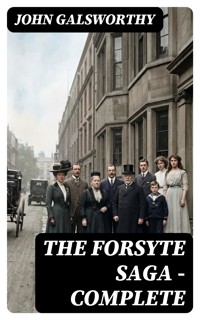
John Galsworthy's "The Forsyte Saga - Complete" presents a profound exploration of the rise and fall of a wealthy English family over three generations, encapsulating the societal changes of the late 19th and early 20th centuries. Crafted in a richly detailed prose style, Galsworthy employs a narrative structure that intertwines personal and collective histories, reflecting on themes such as property, class, and the constraints of social convention. This comprehensive saga comprises nine novels and interludes, offering a panoramic view of an evolving society, marked by the tensions between individual desires and familial loyalty amid the backdrop of an industrializing England. Galsworthy, a keen observer of human behavior and a member of the Forsyte family's class, was profoundly impacted by the social dynamics of his time. Born into a prosperous family, he articulated the struggles of a bourgeois class caught between tradition and modernity. His own experiences with the intricacies of wealth, love, and social expectation deeply informed the characters and conflicts within this saga, allowing him to weave a narrative that resonates with authenticity and critique of his contemporaries. I highly recommend "The Forsyte Saga" to readers who appreciate sagacious literature rich in character development and social commentary. Galsworthy's insightful portrayal of the complexities of familial bonds and the moral dilemmas of wealth ensures that this work remains relevant and engaging, offering both historical resonance and timeless human insight. In this enriched edition, we have carefully created added value for your reading experience: - A comprehensive Introduction outlines these selected works' unifying features, themes, or stylistic evolutions. - The Author Biography highlights personal milestones and literary influences that shape the entire body of writing. - A Historical Context section situates the works in their broader era—social currents, cultural trends, and key events that underpin their creation. - A concise Synopsis (Selection) offers an accessible overview of the included texts, helping readers navigate plotlines and main ideas without revealing critical twists. - A unified Analysis examines recurring motifs and stylistic hallmarks across the collection, tying the stories together while spotlighting the different work's strengths. - Reflection questions inspire deeper contemplation of the author's overarching message, inviting readers to draw connections among different texts and relate them to modern contexts. - Lastly, our hand‐picked Memorable Quotes distill pivotal lines and turning points, serving as touchstones for the collection's central themes.
Das E-Book können Sie in Legimi-Apps oder einer beliebigen App lesen, die das folgende Format unterstützen:
Veröffentlichungsjahr: 2022
Ähnliche





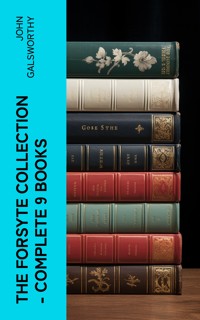

The Forsyte Saga - Complete
Table of Contents
Introduction
The Forsyte Saga - Complete gathers the whole of John Galsworthy’s original Forsyte sequence—three novels linked by two brief interludes—into a single, continuous reading experience. First published piece by piece between 1906 and 1921 and later issued together in three volumes, these works trace a single English family across a period of rapid social and moral change. This collection retains Galsworthy’s preface and the author’s dedications, presenting the texts in their established order so that the architecture of the saga, with its alternation of expansive narratives and quiet intervals, may be felt as he designed it.
Within this volume are The Man of Property, Indian Summer of a Forsyte, In Chancery, Awakening, and To Let. The principal works are novels; the interludes are short fictions that function as lyrical bridges; the preface is an authorial essay of orientation. No plays, poems, or letters appear here, only prose fiction and the prefatory matter surrounding it. The arrangement respects the traditional three-volume presentation, in which Indian Summer follows The Man of Property and Awakening precedes To Let. The inclusion of chapter divisions, parts, and dedications preserves the documentary texture of the original publications.
The saga’s action unfolds from late Victorian London into post–First World War England, observing an upper-middle-class clan whose name has become shorthand for possessive individualism. Galsworthy’s canvas includes the drawing rooms and dinner tables of the capital, the precincts of the law, and a suburban house that becomes a touchstone for aspiration and taste. Without disclosing later turns, it may be said that business, marriage, and inheritance interlock throughout. By bringing these books together, the collection enables readers to perceive continuities of image, motif, and argument that are less apparent when the volumes are approached in isolation.
The Man of Property opens the family chronicle and offers the foundational premise: a prosperous solicitor, attentive to investment and reputation, commissions a country house while navigating the obligations of kinship and marriage. Early scenes at a patriarch’s home, the opera, and a formal dinner table introduce the clan’s solidarity and its strains. Galsworthy’s emphasis falls on the psychology of possession and the language of taste, on architecture and art as mirrors of character, and on the social choreography of visits and calls. The book’s three-part design foreshadows the saga’s pattern of advance, pause, and repercussion.
Indian Summer of a Forsyte, a brief interlude, turns inward and slows the tempo. It centers on an elder figure in a season of late contentment, taking stock of family feeling and private duty. The piece stands between the first and second novels as a tonal hinge, gathering themes of affection, stewardship, and the quiet dignity of age. Its brevity is integral: the interlude acts as a chamber piece after a symphonic movement, preparing the reader for the renewed conflicts of law and conscience that animate the sequence’s middle panel without disclosing the outcomes those conflicts will shape.
In Chancery resumes the family story in an era of heightened legal and social scrutiny. The title signals both literal proceedings and the sense of being held in constraint while desires and obligations are tested. The narrative follows the Forsytes through changes in legislation and custom affecting property, marriage, and personal liberty. City offices, chambers, and drawing rooms structure the action, and the novel’s pacing alternates deliberation with sudden social pressure. It develops the saga’s central inquiry into what can and cannot be owned in a changing society, while leaving the consequences for the family’s future to later pages.
Awakening, the second interlude, is notable for its delicacy of perspective. It offers a brief, luminous view of childhood and early sensibility within the Forsyte world, tracing how a new generation begins to perceive beauty, kinship, and difference. The piece balances the legal and social weight of the preceding novel with a study in fresh consciousness, showing how feeling and imagination germinate within a household shaped by prudence and ceremony. Its economy of scale and gentle irony prepare the stage for the final novel’s exploration of inheritance, memory, and desire without revealing the specific entanglements that will ensue.
To Let brings the saga into postwar modernity and concentrates on heirs who must live with the legacies—material and emotional—bequeathed by their elders. The premise is simple yet potent: younger Forsytes encounter the residues of earlier choices, confronting questions of taste, loyalty, and freedom in a world unsettled by new rhythms and values. Settings shift between London and the countryside, and familiar houses and landscapes acquire altered meanings. The novel completes the original sequence’s arc from acquisition to relinquishment, from building to the possibility of parting, while leaving the reader to register continuities that endure beyond any single decision.
Although organized as fiction, the collection reads as social history in miniature. It records the manners of a class at its zenith and the tremors of its adaptation, registering how money, the law, and public opinion shape private life. Galsworthy’s characters move through clubs, parks, galleries, and tearooms, noting the nuances of costume, address, and decor that mark belonging. The legal vocabulary of contracts and settlements, and the rhythms of the City, coexist with moments of aesthetic encounter. Through these juxtapositions, the saga explores the tension between security and vitality, between the safe enclosure and the summons of beauty.
Galsworthy’s stylistic hallmarks are restraint, irony, and a humane exactness of observation. He often employs a poised, omniscient narration tempered by free indirect discourse to color events with his characters’ thought. Descriptive precision anchors moral inquiry: rooms, fabrics, weather, and the look of faces become instruments for reading motive and value. Dialogues are measured, implying more than they declare, while recurring images—houses, pictures, music, animals, and the play of light in parks—bind scattered scenes into an intelligible pattern. The prose is lucid without austerity, critical without cruelty, and animated by a steady sympathy for flawed lives.
The unifying themes—possession and its limits, family loyalty and personal freedom, continuity and change—give the saga its lasting resonance. The Forsytes exemplify a recognizable ethic of prudence and accumulation, yet Galsworthy keeps them from caricature by revealing conscience in conflict with habit. His attention to women’s experience within customary constraints, and to the young as interpreters of a new order, complicates any simple opposition between property and feeling. The sequence has been praised as a landmark of English social realism, and its author’s achievement was recognized internationally when he received the Nobel Prize in Literature in 1932.
This edition’s purpose is clarity and completeness. By presenting the novels and interludes in their customary order, with the preface and dedications intact, it invites a measured progress through the family’s world, allowing its values and pressures to accumulate naturally. Readers may move steadily from book to book or pause at the interludes to consider how time’s passage alters understanding. Without foretelling particular outcomes, this introduction commends the saga as both narrative and mirror: a sustained examination of what is gained and lost when property, love, taste, and law contend within lives that are, like our own, bound by time.
Author Biography
John Galsworthy (1867–1933) was an English novelist, short‑story writer, and playwright whose cool, exact prose examined the claims of property, class, and conscience in modern Britain. Writing from the late Victorian era through the interwar years, he became a principal architect of English social realism, balancing moral inquiry with formal clarity. Best known for The Forsyte Saga, he portrayed the intricate pressures of respectability and possession without caricature. His drama likewise took on questions of justice and responsibility. In 1932 he received the Nobel Prize in Literature, international recognition for a body of work that wed disciplined craft to a persistent, humane critique of his age.
Born at Kingston Hill in Surrey into a prosperous environment, Galsworthy was educated at Harrow and New College, Oxford. Trained in law and qualified for the bar, he chose not to practice, turning instead to travel and eventually to literature. A long sea voyage in the 1890s brought friendship with Joseph Conrad, whose example reinforced his professional ambitions. His earliest books appeared under the pseudonym “John Sinjohn,” but he soon wrote under his own name, moving from impressionistic sketches toward social analysis. The critic and editor Edward Garnett championed him early; the dedication “To Edward Garnett” in The Man of Property signals that lasting debt.
Galsworthy’s reputation first took firm root in the theatre. The Silver Box (1906) and Strife (1909) brought him notice for plain-spoken realism and even‑handed treatment of class conflict. Justice (1910) stirred public debate about solitary confinement and the penal system, exemplifying his belief that art could illuminate social wrongs without sermonizing. Subsequent successes, including The Skin Game (1920) and Loyalties (1922), broadened his range to land hunger, moneyed power, and prejudice. His stagecraft—spare, pointed dialogue; balanced scenes; moral ambiguity—helped modernize English drama while keeping it accessible to wide audiences, and it informed the narrative poise of his fiction.
With The Man of Property (1906) Galsworthy began the Forsyte chronicle that would define his standing as a novelist. The sequence expanded over many years to include the interlude Indian Summer of a Forsyte (1918), the novel In Chancery (1920), the interlude Awakening (1920), and To Let (1921). These books, represented in this collection, chart three generations of an upper‑middle‑class family whose habits, investments, marriages, and houses become a lens on English society. Without spoilers, it is enough to say that legal structures, taste, and the possessive spirit press upon private lives, and that change—economic, aesthetic, and emotional—tests a seemingly impregnable clan.
Technically, Galsworthy favored a measured, often ironic omniscience that moves with ease among characters, cool in tone yet compassionate in judgment. He excelled at the social panorama—dinners, offices, opera boxes, auction rooms—while shaping intimate moments of hesitation and resolve. Architectural and legal details supply both texture and metaphor: houses and contracts become outward forms of inward desire and fear. The Forsyte books exemplify this method, staging conflicts of security versus freedom, duty versus feeling, and inheritance versus individuality. His prose, lucid and rhythmically controlled, supports a narrative ethics that neither flatters nor condemns, instead inviting the reader’s steady moral attention.
Public engagement matched his literary labor. Galsworthy supported prison reform and other humane causes, and he lent his authority to the emerging international defense of writers. In 1921 he became the first president of PEN (later PEN International), helping to shape its ethos of fellowship and free expression. He declined a wartime knighthood, preferring independence, but accepted the Order of Merit in 1929. The Nobel Prize in Literature followed in 1932, honoring the distinction of his narrative art, particularly The Forsyte Saga. Throughout, he maintained a belief that literature could scrutinize institutions without sacrificing fairness to individuals.
Galsworthy continued to publish novels, stories, plays, and essays into the early 1930s, refining themes first laid down in his major cycles. He died in 1933, leaving a canon that has endured in print and in many adaptations for stage, radio, and television. The Forsyte family, in particular, became a cultural shorthand for acquisitive respectability and its discontents, while his plays remain models of sober, persuasive social drama. Today his work is read for its compositional lucidity and ethical tact, and the collection here—The Man of Property, Indian Summer of a Forsyte, In Chancery, Awakening, and To Let—shows why his vision retains its bite and balance.
Historical Context
John Galsworthy’s Forsyte Saga was conceived and written between 1906 and 1921, but it surveys English society from the high Victorian 1880s through the Edwardian years and into the unsettled, post–First World War present. A lawyer by training and a major Edwardian novelist and playwright, Galsworthy brought to fiction the social conscience visible in plays like Strife (1909) and Justice (1910). The collection here—framed by a Preface and comprising The Man of Property, the interludes Indian Summer of a Forsyte and Awakening, and the novels In Chancery and To Let—tracks the fortunes of a propertied London clan while reflecting national transformations in wealth, law, gender roles, and taste.
The Man of Property (1906) is steeped in the late Victorian prosperity that accompanied London’s explosive suburban growth. Railways and omnibus routes pushed the city’s edge outward; new villa districts promised privacy and status to the upper middle class. Property speculation, leasehold arrangements, and mortgage finance multiplied fortunes faster than landowning or manufacturing for certain families. Chapters such as “Projection of the House” and “Plans of the House” dramatize the era’s building mania, revealing how brick, timber, and title deeds carried moral meanings. The Forsytes’ intense guardianship of capital, caution in investment, and meticulous concern for respectability mirror broadly shared middle-class ideals of the 1880s.
Victorian marriage and property law form the collection’s central legal backdrop. The Married Women’s Property Acts (1870 and 1882) granted wives increasing control over earnings and assets, yet divorce and separation remained slow, costly, and scandalous under the Matrimonial Causes framework established from 1857. In Chancery’s very title evokes equity jurisdiction and, colloquially, a state of legal entanglement. The narrative scrutinizes trusteeship, settlements, and the intersection of marital rights with property claims—issues that shaped real lives well into the early twentieth century. Only in 1923 would grounds for divorce be equalized for wives and husbands; the Saga depicts the constraints that preceded that change without reducing them to mere background.
Cultural debates over beauty and utility also inflect the collection. The late-century Aesthetic and Arts and Crafts movements—associated with figures like Ruskin and Morris—challenged ostentation and machine-made ornament with principles of craftsmanship, harmony, and simplicity. The architect central to The Man of Property introduces forms and interiors that unsettle conservative eyes. The opera, soirées, and cultured talk that thread through chapters such as “Old Jolyon Goes to the Opera” signal a class eager to display connoisseurship, yet Galsworthy contrasts acquisitive collecting with art’s unruly, transformative power. Architecture and décor become testing grounds for whether wealth serves possession or experience, fashion or feeling.
Shifts in gender expectation underwrite the Saga’s generational arc. Late Victorian “separate spheres” ideology—public life for men, domestic virtue for women—was being queried by higher female literacy, women’s colleges, and new employment avenues. The fin-de-siècle “New Woman” debates made autonomy and desire discussable, if controversial. Across figures such as June, Irene, and later Fleur, the texts register changing norms of courtship, companionship, and self-expression. Without foreclosing outcomes, Galsworthy situates his characters at pressure points where personal dignity collides with patriarchal control and social surveillance, foreshadowing reforms in suffrage (partial enfranchisement in 1918) and family law that would reshape British society.
The imperial context is present as assumption and atmosphere. Late Victorian confidence drew upon Britain’s global reach, while anxieties about the nation’s stamina sharpened in the 1890s. The Second Boer War (1899–1902) tested patriotic rhetoric, exposed class health disparities, and stirred debate over militarism and civil liberties. In Chancery includes chapters—“The Colt and the Filly,” “Val Hears the News,” “Jolly Sits in Judgment”—that align young men’s formation with schoolboy codes of loyalty and duty, the very ethos empire relied on. The Saga does not preach policy; it shows how imperial moods permeated drawing rooms, newspapers, and family expectations.
Money’s movement—dividends, rents, mortgages, and securities—structures Forsyte experience. The City of London’s late nineteenth-century ascendancy linked provincial savers to imperial ventures and domestic infrastructure. Trusteeship scenes—“Jolyon Prosecutes Trusteeship,” “On Forsyte ‘Change”—capture a culture that prized steady yield and legal prudence, wary of speculation yet eager for advantage. The Chancery Division’s oversight of trusts exemplified an ethic of cautious stewardship. This economic rationality delivered comfort and influence, but it could also turn inward, making family feeling subordinate to asset protection. Galsworthy’s legal precision here reflects his training and a public conversant with lawsuits, settlements, and probate.
The Saga’s geographies map social aspiration. The West End’s clubs and drawing rooms, the City’s counting houses, and coherent addresses like Green Street signify rank and ritual. Excursions to the Zoological Gardens, the Botanical Gardens at Kew, and Richmond Park tie leisure to ordered nature, a Victorian ideal. Meanwhile, the imagined suburban site of Robin Hill—central from The Man of Property through To Let—embodies a late-century retreat from the sooty metropolis into designed landscapes. This movement anticipates garden suburb ideals and the early twentieth-century search for healthier domestic environments, asserting that where one lives indexes not just wealth but moral and aesthetic commitments.
Technological change quietly quickens the narrative tempo. Gaslight yields to electricity; the telephone invades private space; horse-drawn cabs share streets with motorcars. Innovations reshaped work rhythms, news circulation, and forms of sociability. Parties assemble faster; scandals travel further; households depend on an increasingly strained servant class as alternative employment expands. Such shifts appear in casual detail rather than manifesto, but they alter what characters can do and how swiftly consequences arrive. By the time To Let unfolds, automobiles, improved roads, and new consumer goods help signal a modernity that neither the most cautious nor the most romantic Forsyte can entirely command.
Galsworthy’s London is a theater of social ritual. “Dinner at Swithin’s,” “Afternoon at Timothy’s,” and “Dance at Roger’s” reveal how visiting hours, dress, table talk, and patronage encoded belonging. The opera and private concerts domesticate high culture as status display, while Sunday gatherings reinforce clan solidarity and discretion in handling rumor. Even the zoo, the museum, and the auction room serve as moral stages. These institutions—Victorian in origin or expansion—trained citizens to read interiors, bodies, and voices, a literacy essential to upward mobility. The Saga, attentive to gesture and tone, catalogs these ceremonies with both affection and skepticism.
The Great War’s rupture gives To Let its historical keel. Wartime losses, inflation, and dislocation altered marriage markets, accelerated women’s wage work, and shook faith in inherited hierarchies. Government policies—from the 1915 rent restrictions to postwar housing promises—acknowledged scarcity and social demand. The short, sharp slump of 1920–21 further unsettled fortunes. Without rehearsing plot, one can say that To Let’s post-1918 setting registers grief, nostalgia, and impatience in equal measure. Characters trained to think in terms of safe investments and managed appearances confront a society revaluing risk, candor, and personal happiness, even as old property reflexes persist.
Galsworthy’s reformist temper shapes the Saga’s ethical frame. Although not a propagandist, he wrote powerfully about prison conditions (Justice, 1910) and labor conflicts (Strife, 1909), and in 1921 became the first president of PEN, a writers’ organization advocating freedom of expression. The Forsytes’ quarrels over possession and autonomy read, in this light, as a humane inquiry into the costs of respectable cruelty. The narrative’s sympathy often inclines toward those cramped by law and convention rather than those enforcing them. This does not vilify the class under study; it anatomizes a temperament—“the property sense”—that had achieved national dominance.
The collection’s interludes calibrate historical feeling. Indian Summer of a Forsyte (1918) returns to the 1890s with elegiac calm, contemplating late-Victorian gentility in a key of afternoon light. It values steadiness without denying its blind spots. Awakening (1920) is slighter, a transitional piece about a child’s sensibility at Robin Hill, poised between Edwardian ease and looming upheaval. Together they soften the trilogy’s narrative hinges, offering psychological and seasonal textures that remind readers how historical time is experienced as climate, habit, and mood rather than mere dates and statutes.
Legal publicity and the culture of scandal come to the fore in Part III of The Man of Property and in In Chancery. The late nineteenth and early twentieth centuries saw a voracious press capitalize on divorce trials and society cases, while strict libel laws and codes of respectability compelled careful speech. Chapters like “The Trial” and “Mrs. Macander’s Evidence” dramatize how litigation exposes private life to public consumption. The term “in chancery” also evoked delay and cost; Galsworthy’s plots register the psychological toll of drawn-out proceedings without sensationalism, placing readers inside the ethical ambiguities of testimony, evidence, and institutional decorum.
Taste—what to buy, hang, wear, and build—becomes a history lesson in miniature. The heavy draperies and bibelots of high Victorian interiors give way to cleaner lines and curated spaces. Old master paintings and English landscapes compete with modern pieces; auctions and dealers mediate value. Chapters such as “Goya” in To Let show collecting as aspiration and argument. The change is not only aesthetic: it encodes a movement from possession-as-display toward possession-as-experience, a shift accelerated by travel, illustrated periodicals, and new museums. Galsworthy traces how refinements of taste can both liberate and mask the drive to own.
Reception history confirms the Saga’s diagnostic power. The Man of Property created immediate discussion in 1906; the full trilogy with its interludes was gathered in 1922 and cemented Galsworthy’s standing, later recognized by the Nobel Prize in Literature in 1932. Mid-century readers often valued the books for their portrait of “Victorian” manners; the 1967 BBC television adaptation revived interest by visualizing interiors and speech rhythms. Subsequent adaptations and scholarship have read the series as a study in class formation, the gendered politics of privacy, and the tensions between liberal humanism and possessive ethics in a society modernizing unevenly.
Across its volumes, the Saga records reforms and continuities: from the 1880s’ cautious respectability to Edwardian experimentation, through wartime fracture to the uncertain 1920s. It notes how law modifies custom slowly; how technology unsettles distance; how taste reforms self-image. Without reducing characters to theses, Galsworthy reveals a culture where property promised safety yet often curtailed empathy. Later readers—attuned to feminist critique, post-imperial perspectives, and the study of consumer culture—find in these books both a time capsule and a mirror. As a collected work, The Forsyte Saga offers a sustained historical commentary on modern Britain’s emergence, arguing that private life is itself a public record.
Synopsis (Selection)
Preface
Galsworthy frames a panoramic chronicle of an upper-middle-class English family whose identity is bound to property, respectability, and possession. He signals a blend of irony and sympathy, setting the stage for a study of how private desires strain against social codes across generations.
The Man of Property
In late-Victorian London, Soames Forsyte—defined by ownership—commissions a country house that becomes the focal point of tensions within his marriage to Irene and the wider clan. As the architect Bosinney enters their orbit, questions of beauty, autonomy, and control unsettle the Forsyte ideal of stability. The tone mixes social satire with close psychological observation, inaugurating the saga’s central conflict between possession and human feeling.
Indian Summer of a Forsyte
This interlude follows old Jolyon in a reflective season at Robin Hill, where the quiet of late life invites memories and reconciliations. The piece softens the earlier satire into an elegiac, pastoral mood, deepening the saga’s compassion for characters caught between duty and desire. It widens the moral lens, suggesting that beauty and kindness can briefly outshine family pride.
In Chancery
The saga shifts into the Edwardian era as legal and emotional entanglements tighten around the Forsytes, bringing the language of property and the courts into intimate life. Soames’s pursuit of security and legacy collides with changing social attitudes, while the younger generation begins to claim its own paths. The novel blends drawing-room realism with the chill of litigation, tracing how the will to possess turns into a contest over freedom and identity.
Awakening
A brief, lyrical interlude seen largely through a child’s world at Robin Hill, it captures the tenderness of domestic routine and the first stirrings of awareness. The calm surface hints at buried histories and future crossings, using small gestures to foreshadow larger reckonings. The tone is intimate and luminous, a pause before the family’s next upheaval.
To Let
The final novel centers on a new pair from the Forsyte lines whose sudden attraction revives past grievances and tests the limits of family loyalty. Set against a changing England, it weighs youth’s spontaneity against inherited claims, with houses, art, and memories becoming bargaining chips in a more fluid world. The mood is poised between irony and poignancy, closing the arc from possession toward the necessity—and cost—of letting go.
The Forsyte Saga - Complete
PREFACE:
“The Forsyte Saga” was the title originally destined for that part of it which is called “The Man of Property”; and to adopt it for the collected chronicles of the Forsyte family has indulged the Forsytean tenacity that is in all of us. The word Saga might be objected to on the ground that it connotes the heroic and that there is little heroism in these pages. But it is used with a suitable irony; and, after all, this long tale, though it may deal with folk in frock coats, furbelows, and a gilt-edged period, is not devoid of the essential heat of conflict. Discounting for the gigantic stature and blood-thirstiness of old days, as they have come down to us in fairy-tale and legend, the folk of the old Sagas were Forsytes, assuredly, in their possessive instincts, and as little proof against the inroads of beauty and passion as Swithin, Soames, or even Young Jolyon. And if heroic figures, in days that never were, seem to startle out from their surroundings in fashion unbecoming to a Forsyte of the Victorian era, we may be sure that tribal instinct was even then the prime force, and that “family” and the sense of home and property counted as they do to this day, for all the recent efforts to “talk them out.”
So many people have written and claimed that their families were the originals of the Forsytes that one has been almost encouraged to believe in the typicality of an imagined species. Manners change and modes evolve, and “Timothy's on the Bayswater Road” becomes a nest of the unbelievable in all except essentials; we shall not look upon its like again, nor perhaps on such a one as James or Old Jolyon. And yet the figures of Insurance Societies and the utterances of Judges reassure us daily that our earthly paradise is still a rich preserve, where the wild raiders, Beauty and Passion, come stealing in, filching security from beneath our noses. As surely as a dog will bark at a brass band, so will the essential Soames in human nature ever rise up uneasily against the dissolution which hovers round the folds of ownership.
“Let the dead Past bury its dead” would be a better saying if the Past ever died. The persistence of the Past is one of those tragi-comic blessings which each new age denies, coming cocksure on to the stage to mouth its claim to a perfect novelty.
But no Age is so new as that! Human Nature, under its changing pretensions and clothes, is and ever will be very much of a Forsyte, and might, after all, be a much worse animal.
Looking back on the Victorian era, whose ripeness, decline, and 'fall-of' is in some sort pictured in “The Forsyte Saga,” we see now that we have but jumped out of a frying-pan into a fire. It would be difficult to substantiate a claim that the case of England was better in 1913 than it was in 1886, when the Forsytes assembled at Old Jolyon's to celebrate the engagement of June to Philip Bosinney. And in 1920, when again the clan gathered to bless the marriage of Fleur with Michael Mont, the state of England is as surely too molten and bankrupt as in the eighties it was too congealed and low-percented. If these chronicles had been a really scientific study of transition one would have dwelt probably on such factors as the invention of bicycle, motor-car, and flying-machine; the arrival of a cheap Press; the decline of country life and increase of the towns; the birth of the Cinema. Men are, in fact, quite unable to control their own inventions; they at best develop adaptability to the new conditions those inventions create.
But this long tale is no scientific study of a period; it is rather an intimate incarnation of the disturbance that Beauty effects in the lives of men.
The figure of Irene, never, as the reader may possibly have observed, present, except through the senses of other characters, is a concretion of disturbing Beauty impinging on a possessive world.
One has noticed that readers, as they wade on through the salt waters of the Saga, are inclined more and more to pity Soames, and to think that in doing so they are in revolt against the mood of his creator. Far from it! He, too, pities Soames, the tragedy of whose life is the very simple, uncontrollable tragedy of being unlovable, without quite a thick enough skin to be thoroughly unconscious of the fact. Not even Fleur loves Soames as he feels he ought to be loved. But in pitying Soames, readers incline, perhaps, to animus against Irene: After all, they think, he wasn't a bad fellow, it wasn't his fault; she ought to have forgiven him, and so on!
And, taking sides, they lose perception of the simple truth, which underlies the whole story, that where sex attraction is utterly and definitely lacking in one partner to a union, no amount of pity, or reason, or duty, or what not, can overcome a repulsion implicit in Nature. Whether it ought to, or no, is beside the point; because in fact it never does. And where Irene seems hard and cruel, as in the Bois de Boulogne, or the Goupenor Gallery, she is but wisely realistic—knowing that the least concession is the inch which precedes the impossible, the repulsive ell.
A criticism one might pass on the last phase of the Saga is the complaint that Irene and Jolyon those rebels against property—claim spiritual property in their son Jon. But it would be hypercriticism, as the tale is told. No father and mother could have let the boy marry Fleur without knowledge of the facts; and the facts determine Jon, not the persuasion of his parents. Moreover, Jolyon's persuasion is not on his own account, but on Irene's, and Irene's persuasion becomes a reiterated: “Don't think of me, think of yourself!” That Jon, knowing the facts, can realise his mother's feelings, will hardly with justice be held proof that she is, after all, a Forsyte.
But though the impingement of Beauty and the claims of Freedom on a possessive world are the main prepossessions of the Forsyte Saga, it cannot be absolved from the charge of embalming the upper-middle class. As the old Egyptians placed around their mummies the necessaries of a future existence, so I have endeavoured to lay beside the figures of Aunts Ann and Juley and Hester, of Timothy and Swithin, of Old Jolyon and James, and of their sons, that which shall guarantee them a little life here-after, a little balm in the hurried Gilead of a dissolving “Progress.”
If the upper-middle class, with other classes, is destined to “move on” into amorphism, here, pickled in these pages, it lies under glass for strollers in the wide and ill-arranged museum of Letters. Here it rests, preserved in its own juice: The Sense of Property. 1922.
THE MAN OF PROPERTY
by JOHN GALSWORTHY
TO EDWARD GARNETT
PART I
CHAPTER I—'AT HOME' AT OLD JOLYON'S
Those privileged to be present at a family festival of the Forsytes have seen that charming and instructive sight—an upper middle-class family in full plumage. But whosoever of these favoured persons has possessed the gift of psychological analysis (a talent without monetary value and properly ignored by the Forsytes), has witnessed a spectacle, not only delightful in itself, but illustrative of an obscure human problem. In plainer words, he has gleaned from a gathering of this family—no branch of which had a liking for the other, between no three members of whom existed anything worthy of the name of sympathy—evidence of that mysterious concrete tenacity which renders a family so formidable a unit of society, so clear a reproduction of society in miniature. He has been admitted to a vision of the dim roads of social progress, has understood something of patriarchal life, of the swarmings of savage hordes, of the rise and fall of nations. He is like one who, having watched a tree grow from its planting—a paragon of tenacity, insulation, and success, amidst the deaths of a hundred other plants less fibrous, sappy, and persistent—one day will see it flourishing with bland, full foliage, in an almost repugnant prosperity, at the summit of its efflorescence.
On June 15, eighteen eighty-six, about four of the afternoon, the observer who chanced to be present at the house of old Jolyon Forsyte in Stanhope Gate, might have seen the highest efflorescence of the Forsytes.
This was the occasion of an 'at home' to celebrate the engagement of Miss June Forsyte, old Jolyon's granddaughter, to Mr. Philip Bosinney. In the bravery of light gloves, buff waistcoats, feathers and frocks, the family were present, even Aunt Ann, who now but seldom left the corner of her brother Timothy's green drawing-room, where, under the aegis of a plume of dyed pampas grass in a light blue vase, she sat all day reading and knitting, surrounded by the effigies of three generations of Forsytes. Even Aunt Ann was there; her inflexible back, and the dignity of her calm old face personifying the rigid possessiveness of the family idea.
When a Forsyte was engaged, married, or born, the Forsytes were present; when a Forsyte died—but no Forsyte had as yet died; they did not die; death being contrary to their principles, they took precautions against it, the instinctive precautions of highly vitalized persons who resent encroachments on their property.
About the Forsytes mingling that day with the crowd of other guests, there was a more than ordinarily groomed look, an alert, inquisitive assurance, a brilliant respectability, as though they were attired in defiance of something. The habitual sniff on the face of Soames Forsyte had spread through their ranks; they were on their guard.
The subconscious offensiveness of their attitude has constituted old Jolyon's 'home' the psychological moment of the family history, made it the prelude of their drama.
The Forsytes were resentful of something, not individually, but as a family; this resentment expressed itself in an added perfection of raiment, an exuberance of family cordiality, an exaggeration of family importance, and—the sniff. Danger—so indispensable in bringing out the fundamental quality of any society, group, or individual—was what the Forsytes scented; the premonition of danger put a burnish on their armour. For the first time, as a family, they appeared to have an instinct of being in contact, with some strange and unsafe thing.
Over against the piano a man of bulk and stature was wearing two waistcoats on his wide chest, two waistcoats and a ruby pin, instead of the single satin waistcoat and diamond pin of more usual occasions, and his shaven, square, old face, the colour of pale leather, with pale eyes, had its most dignified look, above his satin stock. This was Swithin Forsyte. Close to the window, where he could get more than his fair share of fresh air, the other twin, James—the fat and the lean of it, old Jolyon called these brothers—like the bulky Swithin, over six feet in height, but very lean, as though destined from his birth to strike a balance and maintain an average, brooded over the scene with his permanent stoop; his grey eyes had an air of fixed absorption in some secret worry, broken at intervals by a rapid, shifting scrutiny of surrounding facts; his cheeks, thinned by two parallel folds, and a long, clean-shaven upper lip, were framed within Dundreary whiskers. In his hands he turned and turned a piece of china. Not far off, listening to a lady in brown, his only son Soames, pale and well-shaved, dark-haired, rather bald, had poked his chin up sideways, carrying his nose with that aforesaid appearance of 'sniff,' as though despising an egg which he knew he could not digest. Behind him his cousin, the tall George, son of the fifth Forsyte, Roger, had a Quilpish look on his fleshy face, pondering one of his sardonic jests. Something inherent to the occasion had affected them all.
Seated in a row close to one another were three ladies—Aunts Ann, Hester (the two Forsyte maids), and Juley (short for Julia), who not in first youth had so far forgotten herself as to marry Septimus Small, a man of poor constitution. She had survived him for many years. With her elder and younger sister she lived now in the house of Timothy, her sixth and youngest brother, on the Bayswater Road. Each of these ladies held fans in their hands, and each with some touch of colour, some emphatic feather or brooch, testified to the solemnity of the opportunity.
In the centre of the room, under the chandelier, as became a host, stood the head of the family, old Jolyon himself. Eighty years of age, with his fine, white hair, his dome-like forehead, his little, dark grey eyes, and an immense white moustache, which drooped and spread below the level of his strong jaw, he had a patriarchal look, and in spite of lean cheeks and hollows at his temples, seemed master of perennial youth. He held himself extremely upright, and his shrewd, steady eyes had lost none of their clear shining. Thus he gave an impression of superiority to the doubts and dislikes of smaller men. Having had his own way for innumerable years, he had earned a prescriptive right to it. It would never have occurred to old Jolyon that it was necessary to wear a look of doubt or of defiance.
Between him and the four other brothers who were present, James, Swithin, Nicholas, and Roger, there was much difference, much similarity. In turn, each of these four brothers was very different from the other, yet they, too, were alike.
Through the varying features and expression of those five faces could be marked a certain steadfastness of chin, underlying surface distinctions, marking a racial stamp, too prehistoric to trace, too remote and permanent to discuss—the very hall-mark and guarantee of the family fortunes.
Among the younger generation, in the tall, bull-like George, in pallid strenuous Archibald, in young Nicholas with his sweet and tentative obstinacy, in the grave and foppishly determined Eustace, there was this same stamp—less meaningful perhaps, but unmistakable—a sign of something ineradicable in the family soul. At one time or another during the afternoon, all these faces, so dissimilar and so alike, had worn an expression of distrust, the object of which was undoubtedly the man whose acquaintance they were thus assembled to make. Philip Bosinney was known to be a young man without fortune, but Forsyte girls had become engaged to such before, and had actually married them. It was not altogether for this reason, therefore, that the minds of the Forsytes misgave them. They could not have explained the origin of a misgiving obscured by the mist of family gossip. A story was undoubtedly told that he had paid his duty call to Aunts Ann, Juley, and Hester, in a soft grey hat—a soft grey hat, not even a new one—a dusty thing with a shapeless crown. “So, extraordinary, my dear—so odd,” Aunt Hester, passing through the little, dark hall (she was rather short-sighted), had tried to 'shoo' it off a chair, taking it for a strange, disreputable cat—Tommy had such disgraceful friends! She was disturbed when it did not move.
Like an artist for ever seeking to discover the significant trifle which embodies the whole character of a scene, or place, or person, so those unconscious artists—the Forsytes had fastened by intuition on this hat; it was their significant trifle, the detail in which was embedded the meaning of the whole matter; for each had asked himself: “Come, now, should I have paid that visit in that hat?” and each had answered “No!” and some, with more imagination than others, had added: “It would never have come into my head!”
George, on hearing the story, grinned. The hat had obviously been worn as a practical joke! He himself was a connoisseur of such. “Very haughty!” he said, “the wild Buccaneer.”
And this mot, the 'Buccaneer,' was bandied from mouth to mouth, till it became the favourite mode of alluding to Bosinney.
Her aunts reproached June afterwards about the hat.
“We don't think you ought to let him, dear!” they had said.
June had answered in her imperious brisk way, like the little embodiment of will she was: “Oh! what does it matter? Phil never knows what he's got on!”
No one had credited an answer so outrageous. A man not to know what he had on? No, no! What indeed was this young man, who, in becoming engaged to June, old Jolyon's acknowledged heiress, had done so well for himself? He was an architect, not in itself a sufficient reason for wearing such a hat. None of the Forsytes happened to be architects, but one of them knew two architects who would never have worn such a hat upon a call of ceremony in the London season.
Dangerous—ah, dangerous! June, of course, had not seen this, but, though not yet nineteen, she was notorious. Had she not said to Mrs. Soames—who was always so beautifully dressed—that feathers were vulgar? Mrs. Soames had actually given up wearing feathers, so dreadfully downright was dear June!
These misgivings, this disapproval, and perfectly genuine distrust, did not prevent the Forsytes from gathering to old Jolyon's invitation. An 'At Home' at Stanhope Gate was a great rarity; none had been held for twelve years, not indeed, since old Mrs. Jolyon had died.
Never had there been so full an assembly, for, mysteriously united in spite of all their differences, they had taken arms against a common peril. Like cattle when a dog comes into the field, they stood head to head and shoulder to shoulder, prepared to run upon and trample the invader to death. They had come, too, no doubt, to get some notion of what sort of presents they would ultimately be expected to give; for though the question of wedding gifts was usually graduated in this way: 'What are you givin'. Nicholas is givin' spoons!'—so very much depended on the bridegroom. If he were sleek, well-brushed, prosperous-looking, it was more necessary to give him nice things; he would expect them. In the end each gave exactly what was right and proper, by a species of family adjustment arrived at as prices are arrived at on the Stock Exchange—the exact niceties being regulated at Timothy's commodious, red-brick residence in Bayswater, overlooking the Park, where dwelt Aunts Ann, Juley, and Hester.
The uneasiness of the Forsyte family has been justified by the simple mention of the hat. How impossible and wrong would it have been for any family, with the regard for appearances which should ever characterize the great upper middle-class, to feel otherwise than uneasy!
The author of the uneasiness stood talking to June by the further door; his curly hair had a rumpled appearance, as though he found what was going on around him unusual. He had an air, too, of having a joke all to himself. George, speaking aside to his brother, Eustace, said:
“Looks as if he might make a bolt of it—the dashing Buccaneer!”
This 'very singular-looking man,' as Mrs. Small afterwards called him, was of medium height and strong build, with a pale, brown face, a dust-coloured moustache, very prominent cheek-bones, and hollow checks. His forehead sloped back towards the crown of his head, and bulged out in bumps over the eyes, like foreheads seen in the Lion-house at the Zoo. He had sherry-coloured eyes, disconcertingly inattentive at times. Old Jolyon's coachman, after driving June and Bosinney to the theatre, had remarked to the butler:
“I dunno what to make of 'im. Looks to me for all the world like an 'alf-tame leopard.” And every now and then a Forsyte would come up, sidle round, and take a look at him.
June stood in front, fending off this idle curiosity—a little bit of a thing, as somebody once said, 'all hair and spirit,' with fearless blue eyes, a firm jaw, and a bright colour, whose face and body seemed too slender for her crown of red-gold hair.
A tall woman, with a beautiful figure, which some member of the family had once compared to a heathen goddess, stood looking at these two with a shadowy smile.
Her hands, gloved in French grey, were crossed one over the other, her grave, charming face held to one side, and the eyes of all men near were fastened on it. Her figure swayed, so balanced that the very air seemed to set it moving. There was warmth, but little colour, in her cheeks; her large, dark eyes were soft.
But it was at her lips—asking a question, giving an answer, with that shadowy smile—that men looked; they were sensitive lips, sensuous and sweet, and through them seemed to come warmth and perfume like the warmth and perfume of a flower.
The engaged couple thus scrutinized were unconscious of this passive goddess. It was Bosinney who first noticed her, and asked her name.
June took her lover up to the woman with the beautiful figure.
“Irene is my greatest chum,” she said: “Please be good friends, you two!”
At the little lady's command they all three smiled; and while they were smiling, Soames Forsyte, silently appearing from behind the woman with the beautiful figure, who was his wife, said:
“Ah! introduce me too!”
He was seldom, indeed, far from Irene's side at public functions, and even when separated by the exigencies of social intercourse, could be seen following her about with his eyes, in which were strange expressions of watchfulness and longing.
At the window his father, James, was still scrutinizing the marks on the piece of china.
“I wonder at Jolyon's allowing this engagement,” he said to Aunt Ann. “They tell me there's no chance of their getting married for years. This young Bosinney” (he made the word a dactyl in opposition to general usage of a short o) “has got nothing. When Winifred married Dartie, I made him bring every penny into settlement—lucky thing, too—they'd ha' had nothing by this time!”
Aunt Ann looked up from her velvet chair. Grey curls banded her forehead, curls that, unchanged for decades, had extinguished in the family all sense of time. She made no reply, for she rarely spoke, husbanding her aged voice; but to James, uneasy of conscience, her look was as good as an answer.
“Well,” he said, “I couldn't help Irene's having no money. Soames was in such a hurry; he got quite thin dancing attendance on her.”
Putting the bowl pettishly down on the piano, he let his eyes wander to the group by the door.
“It's my opinion,” he said unexpectedly, “that it's just as well as it is.”
Aunt Ann did not ask him to explain this strange utterance. She knew what he was thinking. If Irene had no money she would not be so foolish as to do anything wrong; for they said—they said—she had been asking for a separate room; but, of course, Soames had not....
James interrupted her reverie:
“But where,” he asked, “was Timothy? Hadn't he come with them?”
Through Aunt Ann's compressed lips a tender smile forced its way:
“No, he didn't think it wise, with so much of this diphtheria about; and he so liable to take things.”
James answered:
“Well, HE takes good care of himself. I can't afford to take the care of myself that he does.”
Nor was it easy to say which, of admiration, envy, or contempt, was dominant in that remark.
Timothy, indeed, was seldom seen. The baby of the family, a publisher by profession, he had some years before, when business was at full tide, scented out the stagnation which, indeed, had not yet come, but which ultimately, as all agreed, was bound to set in, and, selling his share in a firm engaged mainly in the production of religious books, had invested the quite conspicuous proceeds in three per cent. consols. By this act he had at once assumed an isolated position, no other Forsyte being content with less than four per cent. for his money; and this isolation had slowly and surely undermined a spirit perhaps better than commonly endowed with caution. He had become almost a myth—a kind of incarnation of security haunting the background of the Forsyte universe. He had never committed the imprudence of marrying, or encumbering himself in any way with children.
James resumed, tapping the piece of china:
“This isn't real old Worcester. I s'pose Jolyon's told you something about the young man. From all I can learn, he's got no business, no income, and no connection worth speaking of; but then, I know nothing—nobody tells me anything.”
Aunt Ann shook her head. Over her square-chinned, aquiline old face a trembling passed; the spidery fingers of her hands pressed against each other and interlaced, as though she were subtly recharging her will.
The eldest by some years of all the Forsytes, she held a peculiar position amongst them. Opportunists and egotists one and all—though not, indeed, more so than their neighbours—they quailed before her incorruptible figure, and, when opportunities were too strong, what could they do but avoid her!
Twisting his long, thin legs, James went on:
“Jolyon, he will have his own way. He's got no children”—and stopped, recollecting the continued existence of old Jolyon's son, young Jolyon, June's father, who had made such a mess of it, and done for himself by deserting his wife and child and running away with that foreign governess. “Well,” he resumed hastily, “if he likes to do these things, I s'pose he can afford to. Now, what's he going to give her? I s'pose he'll give her a thousand a year; he's got nobody else to leave his money to.”
He stretched out his hand to meet that of a dapper, clean-shaven man, with hardly a hair on his head, a long, broken nose, full lips, and cold grey eyes under rectangular brows.
“Well, Nick,” he muttered, “how are you?”
Nicholas Forsyte, with his bird-like rapidity and the look of a preternaturally sage schoolboy (he had made a large fortune, quite legitimately, out of the companies of which he was a director), placed within that cold palm the tips of his still colder fingers and hastily withdrew them.
“I'm bad,” he said, pouting—“been bad all the week; don't sleep at night. The doctor can't tell why. He's a clever fellow, or I shouldn't have him, but I get nothing out of him but bills.”
“Doctors!” said James, coming down sharp on his words: “I've had all the doctors in London for one or another of us. There's no satisfaction to be got out of them; they'll tell you anything. There's Swithin, now. What good have they done him? There he is; he's bigger than ever; he's enormous; they can't get his weight down. Look at him!”
Swithin Forsyte, tall, square, and broad, with a chest like a pouter pigeon's in its plumage of bright waistcoats, came strutting towards them.
“Er—how are you?” he said in his dandified way, aspirating the 'h' strongly (this difficult letter was almost absolutely safe in his keeping)—“how are you?”
Each brother wore an air of aggravation as he looked at the other two, knowing by experience that they would try to eclipse his ailments.
“We were just saying,” said James, “that you don't get any thinner.”
Swithin protruded his pale round eyes with the effort of hearing.
“Thinner? I'm in good case,” he said, leaning a little forward, “not one of your thread-papers like you!”
But, afraid of losing the expansion of his chest, he leaned back again into a state of immobility, for he prized nothing so highly as a distinguished appearance.
Aunt Ann turned her old eyes from one to the other. Indulgent and severe was her look. In turn the three brothers looked at Ann. She was getting shaky. Wonderful woman! Eighty-six if a day; might live another ten years, and had never been strong. Swithin and James, the twins, were only seventy-five, Nicholas a mere baby of seventy or so. All were strong, and the inference was comforting. Of all forms of property their respective healths naturally concerned them most.
“I'm very well in myself,” proceeded James, “but my nerves are out of order. The least thing worries me to death. I shall have to go to Bath.”
“Bath!” said Nicholas. “I've tried Harrogate. That's no good. What I want is sea air. There's nothing like Yarmouth. Now, when I go there I sleep....”
“My liver's very bad,” interrupted Swithin slowly. “Dreadful pain here;” and he placed his hand on his right side.
“Want of exercise,” muttered James, his eyes on the china. He quickly added: “I get a pain there, too.”
Swithin reddened, a resemblance to a turkey-cock coming upon his old face.
“Exercise!” he said. “I take plenty: I never use the lift at the Club.”
“I didn't know,” James hurried out. “I know nothing about anybody; nobody tells me anything....”
Swithin fixed him with a stare:
“What do you do for a pain there?”
James brightened.
“I take a compound....”
“How are you, uncle?”
June stood before him, her resolute small face raised from her little height to his great height, and her hand outheld.
The brightness faded from James's visage.
“How are you?” he said, brooding over her. “So you're going to Wales to-morrow to visit your young man's aunts? You'll have a lot of rain there. This isn't real old Worcester.” He tapped the bowl. “Now, that set I gave your mother when she married was the genuine thing.”
June shook hands one by one with her three great-uncles, and turned to Aunt Ann. A very sweet look had come into the old lady's face, she kissed the girl's check with trembling fervour.
“Well, my dear,” she said, “and so you're going for a whole month!”
The girl passed on, and Aunt Ann looked after her slim little figure. The old lady's round, steel grey eyes, over which a film like a bird's was beginning to come, followed her wistfully amongst the bustling crowd, for people were beginning to say good-bye; and her finger-tips, pressing and pressing against each other, were busy again with the recharging of her will against that inevitable ultimate departure of her own.
'Yes,' she thought, 'everybody's been most kind; quite a lot of people come to congratulate her. She ought to be very happy.' Amongst the throng of people by the door, the well-dressed throng drawn from the families of lawyers and doctors, from the Stock Exchange, and all the innumerable avocations of the upper-middle class—there were only some twenty percent of Forsytes; but to Aunt Ann they seemed all Forsytes—and certainly there was not much difference—she saw only her own flesh and blood. It was her world, this family, and she knew no other, had never perhaps known any other. All their little secrets, illnesses, engagements, and marriages, how they were getting on, and whether they were making money—all this was her property, her delight, her life; beyond this only a vague, shadowy mist of facts and persons of no real significance. This it was that she would have to lay down when it came to her turn to die; this which gave to her that importance, that secret self-importance, without which none of us can bear to live; and to this she clung wistfully, with a greed that grew each day! If life were slipping away from her, this she would retain to the end.
She thought of June's father, young Jolyon, who had run away with that foreign girl. And what a sad blow to his father and to them all. Such a promising young fellow! A sad blow, though there had been no public scandal, most fortunately, Jo's wife seeking for no divorce! A long time ago! And when June's mother died, six years ago, Jo had married that woman, and they had two children now, so she had heard. Still, he had forfeited his right to be there, had cheated her of the complete fulfilment of her family pride, deprived her of the rightful pleasure of seeing and kissing him of whom she had been so proud, such a promising young fellow! The thought rankled with the bitterness of a long-inflicted injury in her tenacious old heart. A little water stood in her eyes. With a handkerchief of the finest lawn she wiped them stealthily.
“Well, Aunt Ann?” said a voice behind.
Soames Forsyte, flat-shouldered, clean-shaven, flat-cheeked, flat-waisted, yet with something round and secret about his whole appearance, looked downwards and aslant at Aunt Ann, as though trying to see through the side of his own nose.
“And what do you think of the engagement?” he asked.
Aunt Ann's eyes rested on him proudly; of all the nephews since young Jolyon's departure from the family nest, he was now her favourite, for she recognised in him a sure trustee of the family soul that must so soon slip beyond her keeping.
“Very nice for the young man,” she said; “and he's a good-looking young fellow; but I doubt if he's quite the right lover for dear June.”
Soames touched the edge of a gold-lacquered lustre.




