


1,99 €
Mehr erfahren.
- Herausgeber: Quickie Classics
- Kategorie: Geisteswissenschaft
- Sprache: Englisch
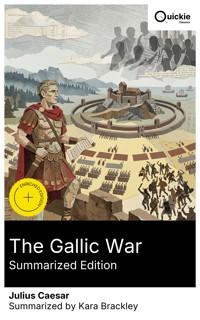
The Gallic War is Caesar's spare, commanding narrative of the campaigns in Gaul (58–50 BCE), composed in the Commentarii mode. Written in taut, paratactic Latin and the third person, it interweaves precise logistics, topography, Alesia's siegecraft, and battle order with ethnographic sketches of Gauls, Germans, and Britons, and set-piece speeches that guide interpretation. At once field report and crafted literature, it stands at the hinge of late Republican historiography, balancing annalistic clarity with authorial self-fashioning, and establishing a model for military prose. As proconsul, Gaius Julius Caesar — indebted aristocrat, consummate politician, and innovator of coalition-building — needed victories and narrative control. These Commentaries circulated rapidly in Rome to influence Senate and people, legitimating unprecedented command extensions and overshadowing rivals like Pompey. The third-person stance feigns impartiality, while selective emphasis, casualty accounting, and moral contrasts advance a persuasive defense of conquest. This book repays close reading by historians, classicists, and strategists alike. Approach it as both source and argument, ideally alongside Cicero's correspondence, Plutarch, and modern commentaries, to triangulate its claims. For lucid tactics, statecraft under pressure, and the rhetoric of empire, few ancient works are more instructive. Quickie Classics summarizes timeless works with precision, preserving the author's voice and keeping the prose clear, fast, and readable—distilled, never diluted. Enriched Edition extras: Introduction · Synopsis · Historical Context · Author Biography · Brief Analysis · 4 Reflection Q&As · Editorial Footnotes.
Das E-Book können Sie in Legimi-Apps oder einer beliebigen App lesen, die das folgende Format unterstützen:
Veröffentlichungsjahr: 2026
Ähnliche




The Gallic War (Summarized Edition)
Table of Contents
Introduction
At the intersection of conquest and self-justification, The Gallic War reveals how a commander forges empire not only with legions and fortifications but with a disciplined narrative that turns marches, councils, scouts’ reports, and encounters along Europe’s riverine and forested frontiers into a brief for authority and security, balancing claimed necessity against ambition, decisive speed against law, and the shifting consent of allies against the resistance of adversaries, so that the map of Gaul becomes a canvas on which logistics, diplomacy, and violence are arranged to persuade Rome that expansion can be orderly and inevitable while reminding us that the pen’s arrangement of facts can shape what victories mean.
The work is a prose commentary, composed in Latin in the late 50s BCE during Julius Caesar’s governorship in Gaul, and it recounts military operations in regions corresponding broadly to modern France and Belgium, with excursions across the Rhine and the Channel. As a genre, the commentary claims to be an objective record, yet it is also a crafted political document aimed at audiences in Rome. The seven books attributed to Caesar were followed by an eighth commonly ascribed to his associate Aulus Hirtius. Readers meet a commander navigating the late Roman Republic’s institutions while campaigning along vast, varied northern frontiers.
At its simplest, the premise follows Caesar as he confronts shifting coalitions, evaluates intelligence, negotiates with envoys, and maneuvers legions through rivers, mountains, and forests in pursuit of Roman objectives set at the frontier. The voice is famously detached, referring to Caesar in the third person, with a brisk, compressed style that privileges clarity, sequence, and practical detail. Speeches and interior motives are minimal; emphasis falls on routes, supplies, engineering works, and timed responses to emerging threats. The tone is controlled and sober, producing the impression of a steady hand guiding complex operations while inviting the reader to credit the narrator’s judgments.
Running through these pages are themes of order and disorder, the claims of state security, and the costs of projecting power beyond familiar borders. Caesar’s depictions of different peoples, their laws, assemblies, and tactics serve both to explain challenges and to define Roman identity by contrast. Leadership emerges as the practice of organizing information, enforcing discipline, and improvising within constraints. The text also probes the politics of alliance: who is a friend today may be an adversary tomorrow, and loyalty often hangs on perceived advantage. These themes never resolve into doctrine; they accumulate as patterns that readers trace across successive campaigns.
Because the commentary is also a public performance, it trains readers to notice how facts are framed. Omissions, emphases, and claims of necessity form a rhetoric of justification that scholars still analyze for bias and strategy. The eighth book, commonly attributed to Aulus Hirtius, extends the narrative and underscores how Caesar’s manner became a model for concise Latin prose. As a primary source, it is invaluable for geography, logistics, and republican institutions, yet it demands caution: it is one voice among many that once contended over the meaning of force, legality, and the rewards and risks of rapid decision.
For contemporary readers, the work matters because it dramatizes enduring intersections of power, narrative, and public opinion. It shows how a leader legitimizes action through orderly reporting, and how control of information can frame what counts as prudence or aggression. Its pages illuminate coalition politics, civil-military relations, and the hard arithmetic of supply, terrain, and time. Its ethnographic passages, read critically, expose the construction of otherness and invite reflection on the ethics of describing enemies. Engineers, strategists, and policymakers will find case studies in bridging, siegecraft, and risk management alongside lessons about how persuasion travels faster than any army.
Approached as both narrative and argument, The Gallic War rewards a careful, unhurried reading that attends to transitions—season to season, province to province, threat to opportunity. Contemporary translations vary in how they render Caesar’s celebrated economy; some favor crisp modern cadence, others preserve formal poise, but the core experience remains one of lucid immediacy. Maps and notes help trace movements without reducing the text to marching orders. What emerges is not a catalogue of episodes so much as a sustained meditation on governance under pressure, reminding readers that the stakes of command are measured in words as well as in walls and marches.
Synopsis
The Gallic War is Julius Caesar’s firsthand account of his campaigns in Gaul, presented as seven books of commentaries that follow the campaigning seasons from 58 to 52 BCE, with an eighth book by Aulus Hirtius continuing the narrative into 51–50 BCE. Composed in a plain, third-person style, the work combines operational reports with descriptions of diplomacy, logistics, engineering, and the peoples encountered. Caesar structures the narrative to explain decisions, justify interventions on behalf of Roman allies, and demonstrate control over rapidly changing situations. The sequence moves region by region and year by year, setting a methodical rhythm of march, negotiation, battle, and winter quarters.
Book 1 opens with the migration of the Helvetii, whose planned movement across Gaul threatens Rome’s provincial security and allied communities. Caesar records rapid levies, fortifications along the Rhône, and maneuvers that redirect or contain the movement. The narrative then pivots to Ariovistus, a Germanic leader whose presence in eastern Gaul challenges Roman influence. Diplomatic exchanges fail, and Caesar details forced marches, camp construction, and careful management of morale before confrontation. Throughout, he frames actions as responses to appeals from Gallic allies and as preemptive measures to stabilize the frontier, establishing the template for the campaign reports that follow.
Book 2 turns north to the Belgae, a powerful coalition reported by the Remi. Caesar emphasizes reconnaissance, alliance building, and the division of forces to meet simultaneous threats. He describes river crossings under pressure, siege operations against fortified oppida, and the difficulties of coordinating legions across wide distances. The tone underscores Roman adaptability, with engineering solutions overcoming terrain and fortification challenges. Caesar presents the dissolution of enemy coalitions as a consequence of swift operations and negotiated surrenders, while noting persistent resistance in pockets. The book consolidates Roman alliances in northern Gaul and prepares the ground for coastal and western campaigns.
Book 3 focuses on the Armorican coast, where the Veneti and allied maritime communities leverage robust ships and tidal knowledge to contest Roman control. Caesar recounts the construction of a fleet and the adoption of unfamiliar tactics and equipment to counter heavy rigging and high freeboards. Concurrent operations in Aquitania, entrusted to lieutenants, extend the theater and test independent command. The narrative highlights logistics across estuaries, the interplay of land and sea operations, and the use of sieges to compel submission. Naval innovation and coordinated assaults become central themes as Rome adapts to a littoral war unlike prior engagements.
In Book 4, attention shifts to Germanic movements across the Rhine. Caesar constructs a timber bridge to cross with his army, an engineering demonstration meant to deter incursions and reassure Gallic allies. The incursion is brief, framed as a limited punitive expedition. He then undertakes a first voyage to Britain as reconnaissance and proof of reach. The account stresses tidal hazards, fragile supply lines, and the complexity of landing operations. Skirmishes near the shore and forays inland remain constrained by weather and transport, and the season closes with a return to Gaul and the dispersal of legions into winter quarters.
Book 5 recounts a second, larger expedition to Britain, enabled by expanded fleets and better preparations. Caesar describes inland advances, the challenge of chariot warfare, and the strain of storms that damage ships and threaten supplies. Ethnographic notes on British society accompany tactical observations. After returning to Gaul, the narrative tightens around winter deployments, when dispersed camps face coordinated uprisings. Ambiorix and the Eburones figure prominently in an episode of deception and sudden attack that tests Roman resilience and command judgment. Caesar concentrates forces, organizes relief, and reasserts regional control, while acknowledging the vulnerabilities of extended lines and divided garrisons.
Book 6 resumes operations along the Rhine, including a second bridge and expeditions meant to dissuade large-scale Germanic interventions. Caesar then turns to punitive actions against the Eburones and their terrain, using devastation to deny resources to enemies. The book includes extensive digressions on Gallic and Germanic institutions, describing aristocratic hierarchies, the role of Druids, legal customs, and religious practices, contrasted with Germanic austerity and mobility. These ethnographic passages serve administrative ends, organizing knowledge for governance and war. The campaigning season closes with redistributed winter quarters and lingering unrest, emphasizing that pacification requires continuous movement, surveillance, and supply.
Book 7 presents the most comprehensive Gallic coalition, led by Vercingetorix of the Arverni, who advocates scorched-earth resistance and cavalry-centered harassment. Caesar narrates sieges and counter-sieges, including operations at Avaricum and at Gergovia, that test Roman logistics, morale, and coordination among lieutenants. The campaign culminates in a vast encirclement at Alesia, where Roman engineering produces concentric fortifications to withstand relief efforts while maintaining a siege. The text underscores internal Gallic debates, the pressure on Roman supply lines, and the stakes for provincial security. Caesar portrays leadership as a balance of audacity and restraint under extreme operational complexity.
The eighth book, written by Aulus Hirtius, extends the account through subsequent campaigns, describing the reduction of remaining resistance, cavalry engagements, and administrative measures to stabilize alliances and supply. The shift in author preserves the documentary tone while marking a retrospective consolidation of gains. Across the whole work, The Gallic War advances a portrait of Roman military science—route planning, fortification, intelligence, and disciplined logistics—alongside political messaging directed at a Roman audience. Its enduring significance lies in its detailed, contemporaneous perspective on late Republican warfare and governance, while inviting critical reading of its selectivity, self-justification, and crafted narrative control.
Historical Context
Julius Caesar’s The Gallic War chronicles campaigns conducted from 58 to 50 BCE in and around Gaul, a region encompassing modern France, Belgium, parts of Switzerland, and the Rhineland. The narrative unfolds under the institutions of the late Roman Republic, when magistrates rotated annually, and provincial governors wielded imperium on the frontiers. Caesar writes as proconsul of Gallia Cisalpina and Illyricum, later including Gallia Transalpina (Narbonensis). His theater extends to the Rhine frontier and the Channel coast, with occasional expeditions to Britain and across the Rhine. The work situates war-making within Rome’s senatorial oversight, electoral pressures, and competitive aristocratic politics.
Caesar’s command arose from the First Triumvirate, an informal alliance formed by Caesar, Pompey, and Crassus around 60 BCE to advance mutual agendas obstructed by senatorial opposition. As consul in 59, Caesar secured the Lex Vatinia granting him a multi-year proconsular command in Cisalpine Gaul and Illyricum; Transalpine Gaul was soon added. This post provided legions, patronage, and legal immunity while in office. In 56 BCE, a meeting at Luca renewed the alliance and extended his command, while Pompey and Crassus pursued consular ambitions. The political stakes in Rome—the distribution of dignitas, public credit, and trials—shape the urgency and publicity of Caesar’s military dispatches.
Caesar operated within a professionalized military shaped by the Marian reforms, which standardized legions into cohorts and broadened recruitment among citizens. He inherited and raised legions largely from northern Italian communities, stationed them in winter quarters, and relied on legates such as Titus Labienus for delegated command. Roman armies carried out systematic reconnaissance, fortification, and siegecraft, constructing marching camps and complex earthworks. Supply moved along roads like the Via Domitia and river systems. Allied contingents—particularly cavalry from Gallic and Germanic clients—supplemented Roman infantry. These institutional capacities underpin the campaigns described, allowing rapid marches, bridge-building, and sustained sieges over diverse terrain.
Gaul at mid-first century BCE comprised numerous tribes with shifting confederations, aristocratic councils, and religious elites often described as druids. The Aedui held long-standing ties with Rome, while rivals such as the Arverni and Sequani contested influence in central and eastern Gaul. To the north, the Belgae presented heavily militarized coalitions; along the Mediterranean, Provincia Narbonensis had been a Roman province since the second century BCE, intensifying trade and diplomacy. Pressures from Germanic movements across the Rhine altered balances of power. This mosaic of alliances and rivalries frames Caesar’s interventions and underlies his portrayals of treaties, hostages, and appeals for Roman arbitration.




