


0,49 €
Niedrigster Preis in 30 Tagen: 1,99 €
Niedrigster Preis in 30 Tagen: 1,99 €
Mehr erfahren.
- Herausgeber: DigiCat
- Kategorie: Geisteswissenschaft
- Sprache: Englisch
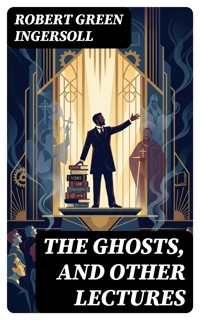
In "The Ghosts, and Other Lectures," Robert Green Ingersoll presents a series of compelling discourses that challenge prevailing notions of religion, superstition, and the afterlife. This collection of lectures, rich in rhetorical flair and intellectual rigor, reflects Ingersoll's belief in reason and the scientific method, showcasing his ability to articulate complex ideas in accessible language. Set against the backdrop of the 19th-century rationalist movement, Ingersoll's work embodies the spirit of enlightenment questioning that sought to dismantle dogmatic beliefs, featuring his famous critique of the concept of spiritual apparitions alongside examinations of morality without reliance on the divine. Robert Green Ingersoll, known as the "Great Agnostic," rose to prominence as one of America's most influential orators and social reformers during a time when skepticism about organized religion was emerging. Born in 1833 in New York, his experiences as a lawyer and a public figure fueled his advocacy for civil liberties, separation of church and state, and the rights of women. Ingersoll's upbringing in a religious household, accompanied by his eventual philosophical turn, catalyzed his desire to confront superstition and promote a more enlightened worldview. Readers seeking to explore the intersection of logic, passion, and advocacy for rational thought will find "The Ghosts, and Other Lectures" to be a provocative and enlightening journey. Ingersoll's eloquence not only entertains but also challenges readers to reconsider their beliefs about the supernatural and the moral implications of secularism, making it a timeless piece for anyone interested in the evolution of modern thought. In this enriched edition, we have carefully created added value for your reading experience: - A comprehensive Introduction outlines these selected works' unifying features, themes, or stylistic evolutions. - A Historical Context section situates the works in their broader era—social currents, cultural trends, and key events that underpin their creation. - A concise Synopsis (Selection) offers an accessible overview of the included texts, helping readers navigate plotlines and main ideas without revealing critical twists. - A unified Analysis examines recurring motifs and stylistic hallmarks across the collection, tying the stories together while spotlighting the different work's strengths. - Reflection questions inspire deeper contemplation of the author's overarching message, inviting readers to draw connections among different texts and relate them to modern contexts. - Lastly, our hand‐picked Memorable Quotes distill pivotal lines and turning points, serving as touchstones for the collection's central themes.
Das E-Book können Sie in Legimi-Apps oder einer beliebigen App lesen, die das folgende Format unterstützen:
Veröffentlichungsjahr: 2022
Ähnliche









The Ghosts, and Other Lectures
Table of Contents
Introduction
The Ghosts, and Other Lectures gathers a representative selection of Robert Green Ingersoll’s public writings, arranged to display the breadth of his career as an orator, reformer, and critic of received opinion. The volume presents lectures, political speeches, commemorative addresses, tributes, and essayistic pieces, rather than fiction or drama. Its scope is not exhaustive; instead it offers essential texts that defined his public voice and the issues to which he returned. From preface to conclusion, the collection follows Ingersoll in the forum and on the platform, where he tested arguments before audiences and refined a style that combined clarity, wit, and moral urgency.
As the title signals, a keynote is “The Ghosts,” Ingersoll’s celebrated lecture challenging the authority of superstition and the persistence of fear in law, education, and social life. Without resorting to invective, he appeals to evidence, experience, and humane values, arguing that progress follows from free inquiry and the courage to revise inherited beliefs. The piece exemplifies his method: define the question, examine tradition, and invite the audience to imagine alternatives grounded in reason and sympathy. It also sets the tone for the collection, where skepticism is allied not to cynicism but to a constructive vision of human dignity.
Questions of freedom shape the sequence that follows. “The Liberty of Man, Woman and Child,” together with the focused addresses “Liberty of Woman” and “The Liberty of Children,” advances a comprehensive argument for personal rights, education, and equality before the law. Ingersoll’s rhetoric favors lucid definitions, balanced contrasts, and a cadence suited to public hearing. He presses for emancipation of conscience, for women’s civil and political equality, and for the protection and development of children as ends in themselves. The essays belong to the tradition of civic persuasion, blending ethical appeal, historical reference, and common-sense illustration rather than technical philosophy.
The political and patriotic texts show allied facets of the same temperament. “1776. The Declaration of Independence” offers an orator’s meditation on the principles asserted at the nation’s founding and their unfinished demands. The nominating oration for James G. Blaine, the “Speech at Cincinnati,” and the remarks collected as “The Grant Banquet at the Palmer House, Chicago, Thursday, Nov. 18th, 1879” demonstrate Ingersoll’s facility with party rhetoric, civic celebration, and historical commemoration. He praises, criticizes, and exhorts in equal measure, using narrative, analogy, and pointed definition to link ideals with responsibility. Throughout, liberty remains the touchstone, not a partisan slogan.
Two tributes frame the personal dimension of his eloquence. “A Tribute to the Rev. Alexander Clark” portrays a life of public service and kindness, extending respect across theological difference. “A Tribute to Ebon C. Ingersoll, by his brother Robert” registers private grief in public cadences, honoring a beloved brother while reflecting on character, friendship, and duty. These memorial addresses show how Ingersoll’s humanism is inseparable from gratitude and sympathy. The rhetorical energy that elsewhere confronts dogma here steadies sorrow and remembers virtues. In them, argument yields to portraiture, yet the same devotion to honesty and compassion continues to guide.
Other pieces widen the horizon of subject and audience. “About Farming in Illinois” addresses the realities of work, exchange, and law as they affect rural life, a reminder that reform must speak to everyday conditions. “The Past Rises Before Me Like a Dream” revisits national memory and the sacrifices of soldiers, drawing civic lessons without sanctimony. Across such varied occasions, the same stylistic signatures recur: a preference for plain terms, illustrative anecdotes, and rhythmic emphasis that carries a room. Ingersoll links practical concerns with general principles, insisting that progress be measured not only by argument but by well-being.
Taken together, these lectures and speeches illuminate the coherence of Ingersoll’s outlook: the defense of free thought, the call for equal rights, the cultivation of civic courage, and the affirmation of secular ethics. The collection invites readers to hear nineteenth‑century American oratory as literature and public philosophy, composed for immediate effect yet durable in argument. It underscores his belief that a republic depends on candor, education, and the separation of civil authority from religious control. By gathering his most characteristic pieces, this volume offers both an introduction to his essential work and a resource for ongoing debates about liberty.
Historical Context
Ingersoll’s The Ghosts, and Other Lectures arose from the restless United States of the Reconstruction and early Gilded Age. Rapid industrialization, swelling immigration, and urban growth transformed public life, while the lyceum and commercial lecture circuits carried new ideas into packed halls from Boston to Chicago. A former Union colonel and Illinois attorney general (1867–69), Robert G. Ingersoll fused battlefield memory, courtroom cadence, and partisan experience into speeches on liberty, belief, and citizenship. Between the late 1860s and 1879 he toured relentlessly, publishing addresses that interrogated inherited authority and celebrated Enlightenment ideals amid fierce contests over religion, race, gender, and national identity.
Central to the collection is The Ghosts, a polemic against superstition that reflects a broader nineteenth‑century clash between science and theology. Darwin’s Origin of Species (1859), the spread of biblical “higher criticism,” and popular science lectures—such as John Tyndall’s widely reported Belfast Address (1874)—emboldened freethinkers while alarming clergy. In the United States, the 1873 Comstock Act censored “obscene” and heterodox materials, and publishers like D. M. Bennett faced prosecution by the late 1870s. Ingersoll’s arguments for reason, secular education, and freedom of conscience resonated with the National Liberal League’s campaigns, even as opponents mobilized revivalist energies to restrain blasphemy and irreligion.
His linked lectures on the liberty of man, woman, and child emerged amid contested reforms in family life and civic status. The women’s suffrage movement, energized since Seneca Falls (1848), suffered judicial setback in Minor v. Happersett (1875), while Susan B. Anthony’s 1873 trial dramatized voter exclusion under the new Fourteenth and Fifteenth Amendments. Married women’s property laws expanded unevenly, debates over divorce sharpened, and coeducation spread in the Midwest. Simultaneously, child labor and schooling were flashpoints: Massachusetts had pioneered compulsory education in 1852; other states followed in the 1870s, alongside nascent child-protection societies. Ingersoll’s rhetoric joined liberal currents demanding consent, autonomy, and secular instruction.
His celebration of 1776 and the Declaration of Independence drew power from the nation’s centennial reflections in 1876. The Philadelphia Centennial Exposition showcased industrial prowess while orators debated whether the founding promise encompassed newly emancipated citizens. That same year Frederick Douglass, at the unveiling of the Freedmen’s Memorial in Washington, D.C., insisted the Revolution’s ideals obliged equal rights in practice. After the disputed Hayes–Tilden election and the 1877 “Compromise,” federal retreat from Reconstruction intensified these arguments. Ingersoll invoked Enlightenment natural-rights language to criticize sectarian privilege and to defend universal liberty, linking revolutionary memory to contemporary struggles over race, suffrage, and citizenship.
His national political profile crystallized in Cincinnati during the Republican National Convention of June 1876. There Ingersoll delivered the electrifying nominating address for James G. Blaine, hailing him as a “plumed knight” while dismissing the damaging Mulligan letters controversy. The convention ultimately turned to Rutherford B. Hayes, yet newspapers from the Cincinnati Commercial to the New York Tribune celebrated Ingersoll’s oratory. That prominence fed demand for his lectures, where he recast partisan themes—civil service reform, separation of church and state, and wartime loyalty—into broader meditations on liberty and progress. The collection preserves that crossover between campaign rhetoric and civic philosophy.
Commemoration of the Civil War framed several addresses. The newly prominent Grand Army of the Republic fostered Decoration Day rituals after 1868, and public remembrances flourished in the late 1870s. Ingersoll’s “The past rises before me like a dream” drew on his service with the Eleventh Illinois Cavalry and on a culture that sacralized sacrifice while debating reunion’s meaning. When Ulysses S. Grant returned from his world tour in 1879, Chicago staged a lavish banquet at the Palmer House on November 18; Ingersoll’s toast welded gratitude to Union victory with a civic boosterism emblematic of the metropolis’s Gilded Age confidence.
Questions of economic justice thread through About Farming in Illinois. Postwar farmers faced volatile commodity prices, high interest, and discriminatory freight rates. The Granger movement, organized as the Patrons of Husbandry (founded 1867), helped secure state railroad regulations in the Upper Midwest, culminating in the Supreme Court’s Munn v. Illinois (1877) decision upholding rate controls. The Panic of 1873 and deflation further radicalized rural politics, feeding Greenback and anti-monopoly campaigns. Speaking from a Midwestern perspective, Ingersoll framed prosperity as dependent on science, infrastructure, and fair law, a vision that complemented his broader defense of secular schools and rational, democratic governance.
Finally, the volume’s elegiac tributes reveal how public mourning intersected with liberal theology’s unraveling. The Reverend Alexander Clark, a prominent Methodist minister and editor in Pennsylvania, died in 1871, prompting Ingersoll to honor a Christian adversary with civility while insisting truth need not fear debate. More personal still, his 1879 funeral oration for his brother, former Illinois congressman Ebon C. Ingersoll, delivered in Washington, D.C., offered secular consolation—“life is a narrow vale”—that newspapers widely reprinted. Such performances showed an orator capable of reconciling tenderness with skepticism, and they softened, for many contemporaries, the sharper critiques embedded elsewhere in the collection.
Synopsis (Selection)
Rationalism and Freethought: PREFACE.; THE GHOSTS.
The preface positions the collection as a forthright defense of reason, science, and secular morality against superstition and priestly power.
The Ghosts develops this stance through vivid, often satirical critiques of inherited fears and dogmas, showcasing Ingersoll’s ringing oratory, humor, and moral urgency.
Liberty Lectures: THE LIBERTY OF MAN, WOMAN AND CHILD; LIBERTY OF WOMAN.; THE LIBERTY OF CHILDREN.; CONCLUSION.
This suite advances a humanist program for personal and civic freedom, arguing that law, education, and conscience should secure the autonomy and dignity of every individual.
Focused sections on women and children press for equality, secular schooling, and domestic justice, ending in a summative peroration that blends practical reform with moral fervor.
ABOUT FARMING IN ILLINOIS.
A wry, plainspoken critique of agricultural life exposes the gap between political platitudes and the economic realities facing Midwestern farmers.
Local detail broadens into commentary on labor, fairness, and common-sense reform, revealing Ingersoll’s populist sympathies and comic edge.
Political Orations and National Memory: 1776. THE DECLARATION OF INDEPENDENCE.; SPEECH AT CINCINNATI; NOMINATING JAMES G. BLAINE FOR THE PRESIDENCY,; "THE PAST RISES BEFORE ME LIKE A DREAM."; THE GRANT BANQUET AT THE PALMER HOUSE, CHICAGO, THURSDAY, NOV. 18th, 1879.
These addresses fuse patriotic celebration with liberal principles, invoking revolutionary ideals, Union sacrifice, and civic duty to frame contemporary politics.
Whether endorsing a candidate or honoring soldiers and Grant, the tone is cadenced and emotive, using historical memory and rhetorical flourish to argue for national renewal and public virtue.
Tributes and Eulogies: A TRIBUTE TO THE Rev. ALEXANDER CLARK.; A TRIBUTE TO EBON C. INGERSOLL, BY HIS BROTHER ROBERT.
The memorial essays adopt an intimate, elegiac register to honor character, service, and humane influence beyond the grave.
They temper steadfast secularism with generosity toward the departed, highlighting themes of integrity, kindness, and the lasting moral example of a life well lived.




