


5,99 €
Mehr erfahren.
- Herausgeber: Tim Black
- Kategorie: Religion und Spiritualität
- Sprache: Englisch
The world is a broken place—we feel it, and long for things to change. This book contains a few encouragements that place the church and all followers of Jesus in the center of trying to figure out how to foster true change, both spiritual and physical. Does God care about the hopelessness felt by billions of people living in desperate poverty? Do followers of Jesus have a mandate to engage poverty that flows from a gospel-motivated center? If so, what does it look like?
The purpose of this book is to contribute to the discussion regarding the role that the fight against poverty should play in the mission of the church. It considers evangelical history because modern evangelicals often resist activities related to social transformation because they don’t seem related to the proclamation of the gospel. Historically, evangelicals have considered this differently. And there are reasons why modern evangelicals have treated social engagement as a space reserved for the government or other non-profit groups, thereby promoting a type of dualism that guts the gospel and leaves the world trapped in its evil and brokenness. That is not an option for followers of Jesus and will be explored in detail.
But history is only a guide. Scripture speaks loudly concerning God’s heart for the poor and how that should shape the behavior of his people. Chapter Three traces a journey through Scripture that gives structure and power to the overall discussion. Then Chapter 4 is a deep-dive into James Chapter 2 for a ‘no holds barred’ exploration of faith. The discussion uses socio-rhetorical principles that may be too academic for some, but is worth a skim nonetheless. James’ arguments are straight-forward and remain as impactful now as they were nearly two thousand years ago. Faith lacking corresponding works is not living faith.
Chapter 5 contains a theological discussion as a framework for church-based activity. How does a local church consider the work of the Spirit, already active and moving in local communities, and then join him? What does this even look like? The model that takes shape forms ongoing community engagement. After a short summary of the material covered thus far, the book finishes with an examination of the ways that good intentions fell short in a South African context and what proper engagement could look like in the future. A model is promoted by which local church leaders could formulate a congregational approach to mission, particularly as it relates to engaging the needs of the poor as a mandate of gospel advance. If one applies the principles of this book, what should transpire is a powerful advance of the gospel by the church as it meets the needs of the poor.
May it be so.
Das E-Book können Sie in Legimi-Apps oder einer beliebigen App lesen, die das folgende Format unterstützen:
Veröffentlichungsjahr: 2020
Ähnliche


















Tim Black
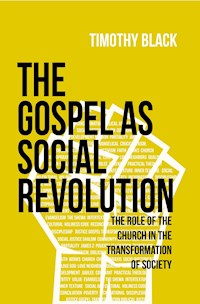
The Gospel as Social Revolution
The role of the church in the transformation of society
Copyright © 2020 by Tim Black
All rights reserved. No part of this publication may be reproduced, stored or transmitted in any form or by any means, electronic, mechanical, photocopying, recording, scanning, or otherwise without written permission from the publisher. It is illegal to copy this book, post it to a website, or distribute it by any other means without permission.
Tim Black has no responsibility for the persistence or accuracy of URLs for external or third-party Internet Websites referred to in this publication and does not guarantee that any content on such Websites is, or will remain, accurate or appropriate.
Designations used by companies to distinguish their products are often claimed as trademarks. All brand names and product names used in this book and on its cover are trade names, service marks, trademarks and registered trademarks of their respective owners. The publishers and the book are not associated with any product or vendor mentioned in this book. None of the companies referenced within the book have endorsed the book.
First edition
This book was professionally typeset on Reedsy Find out more at reedsy.com
Contents
ACKNOWLEDGEMENTS
CHAPTER ONE
1 Introduction
2 Setting the Stage
3 Outlining the Approach
4 Theological Framework
CHAPTER TWO
1 Introduction
2 Defining the Movement
3 Rise of the Movement
4 Shaping the Movement
5 Examining the Movement
6 Conclusion
CHAPTER THREE
1 Introduction
2 Biblical Definition of Poverty
3 God’s Intervention on Behalf of ‘the poor’
4 Poverty and Poverty Alleviation Defined
5 Conclusion
CHAPTER FOUR
1 Introduction
2 Inner Texture of James 2.1-13
3 Intertexture of James 2.1-13
4 The Social and Cultural Texture of James 2.1-13
5 Inner Texture of James 2:14-26
6 Intertexture of James 2.14-26
7 The Social and Cultural Texture of James 2.14-26
8 Conclusion
CHAPTER FIVE
1 Introduction
2 Developments in Practical Theology and Missiology
3 Practical theology as a discipline
4 Practical Theology as an Emerging Methodology
5 Conclusion
CHAPTER SIX
1 Introduction
2 The Historical Precedent for Activism
3 Socio-rhetorical Interpretive Results from James 2
4 Definition of Poverty and Need
5 Theological Model in Context
6 Conclusion
CHAPTER SEVEN
1 Introduction
2 The Continuing Crisis
3 Discipleship for Social Responsibility
4 Developing an Approach for Mission
5 Proposing a Model for Mission
6 Conclusion
REFERENCE LIST
ACKNOWLEDGEMENTS
The author wishes to express his appreciation to the following persons and organizations that have helped make this book possible.
The Zanokhanyo Network/Common Good teams—you are at the forefront of what it means to live the gospel for the glory of Christ on behalf of the poor. Your friendship and sacrifice have challenged me in ways that you will never know.
Dr. Godfrey Harold—our journey together began with an Honours degree many years ago. Your love for the Scriptures is infectious, and I appreciate your enthusiasm for theology. Thanks for reading many pages from my hand over the years and critiquing my work in a way that encourages me to keep going. You always have a book or article that is just the thing to move my research along.
Dr. Attie van Niekerk—Your insightful comments during this research have been incredibly helpful. If my writing has any merit, it is due to your careful analysis of my work. Thank you for taking the time to help bring structure to what often seems like chaos.
James and William Black—you became men and moved overseas during this project. May you find pleasure in God as you serve others. It is excellent to be your Dad and I am looking forward to spending more time with you and our new daughter Mackenzie.
Leslie—I am looking forward to catching up on all of the walks I have missed over the last 6 years. You are a great gift! Thanks for applying your significant editing skill to this work and for giving me the encouragement to finish. You remain the best researcher in the family, and I am a fortunate man to be your husband. ‘If the rests as good as the last has been, here’s hail to the rest of the road. . .’
Soli Deo Gloria
Tim Black
Cape Town 2016
CHAPTER ONE
THE GOSPEL AS SOCIAL REVOLUTION: THE ROLE OF THE CHURCH IN THE TRANSFORMATION OF SOCIETY
1 Introduction
This book has been born out of the sense of helplessness that I faced as a youth pastor at a local church in Cape Town. We were running a sewing course to teach women in a local township community how to provide for themselves and their families by learning a skill. For all of our efforts over the 6-week course, the women who successfully finished did not own sewing machines and could not turn their new skill into any sort of income stream. We were misguided when we thought that this course was even a partial answer to the scourge of unemployment. We meant well but were confronted by the reality of our good intentions being thwarted by the poverty machine. There were many reasons why these women were in poverty in the first place, and we naively assumed we could solve their problems with a crash course on the basics of sewing. We had a lot to learn.
But this desire to learn carried us on a journey that continues to find solutions to the entrenched poverty that still maintains a tight grip on the people of South Africa. We have learned a great deal through research, trial and error, and through careful listening. And we have seen God use these feeble efforts to move through a simple program that helps people—thousands of people—find hope and healing and meaningful employment during a time when the percentage of people out of work is reported by the government at over 30.1%1.
We did know a few things that remain true. First, God cares about people in poverty. We knew that we somehow needed to do something because it just didn’t seem right that people were living in shacks packed tightly together without running water or toilets. These people were our neighbors, living just a few kilometers away from our nice, leafy suburb. We had running water and toilets along with solid roofs that weren’t like to be in danger of blowing off during a severe rainy day in the middle of a Cape winter storm.
Secondly, we knew that since God cared about people in poverty, we should as well. The more we studied the Scriptures, the more evidence began to stack up that the powerless—those trapped in poverty for a myriad of reasons—had a champion in God and should have one in His people. And Jesus, the ‘in the flesh’ example of what God is like, was quite pointed in his reference to people, particularly religious people, who failed to care for those in need. ‘White-washed tombs’ and ‘hypocrites’ were just a few of the more common phrases Jesus used for the religious leaders who didn’t take him or his teachings seriously.
And finally, we knew that Christians had gotten confused about these first two things and had largely abandoned the proper care for those in need as part of their gospel mandate. Jesus is asked by a Pharisee what the greatest commandment is. Jesus’ response is simple, yet incredibly profound: ‘Love God, love your neighbor as you love yourself. Everything depends upon this’ (insert ftnt for Mt 22.34-40). At times it seems as if the Church, Jesus’ bride in waiting, has become pre-occupied with other things so that the thing that seems so closely connected to God’s heart—loving our neighbors—has become an activity on the fringe of what it means to be a Christ-follower.
So, in light of what we now know, what is the way forward? The purpose of this book is to encourage Christ-followers, Jesus’ bride, to rightly engage poverty as a gospel mandate. The call to love our neighbors has a modifier. We are to love ‘as we love ourselves.’ This calls us into relational living that is costly—it spends our privilege, it spends our resources, it spends our gifts and abilities—all for the glory of Jesus.
2 Setting the Stage
In Luke 16:19-31, Jesus tells a parable about a rich man and a poor man living in a nondescript community that could describe any other community in places around the globe where the rich and the poor are in close proximity, sharing nearby spaces. The poor man, Lazarus, is lying at the gate of the rich man. He is covered with sores. He is hungry, ‘longing to eat what fell from the rich man’s table.’ As he lays at the gate, dogs lick his flesh.
The rich man is described as being ‘dressed in purple and fine linen and liv(ing) in luxury every day.’ Although Lazarus is apparently known to the rich man, he is likely no more than a nuisance, similar to the beggars who stand on street corners at intersections around the world looking for small change or bits of food.
Both men die.
In a significant reversal, the rich man ends up tormented in hell, while angels carry Lazarus to Abraham’s side. The rich man calls out to Abraham for help in soothing his agony, but Abraham responds, ‘Son, remember that in your lifetime you received your good things while Lazarus received bad things, but now he is comforted here and you are in agony’ (Luke 16.27).
From a purely literary point of view, this seems like poetic justice; the calloused rich man gets what he deserves. But this parable leaves us with an uneasy feeling. Are the rich punished for being rich and the poor rewarded for simply being poor? What if the rich man worked hard for what he had? We don’t have enough information to know for sure as Jesus doesn’t really resolve the scene: Abraham refuses to be drawn into a rescue effort for the rich man’s family even with significant pleading. Although there might be a back story, we don’t know what that story is or what the rich man did to Lazarus that merited this radical reversal. We don’t know that he did anything. We only know what he didn’t do, which might be the point. It is not said that the rich man oppressed Lazarus, but that he callously failed to engage the poor man sitting at his gate.
Every day we move around the cities in our world, taking no notice of the Lazarus sitting at our gate. We become so used to the sights associated with poverty that we no longer really see them. They have faded into the scenery, part of a permanent backdrop in our international landscape.
If there is anything that the story helps us see, it is that we live as beings in community. As humans, we are on a journey together at some level: we inhabit similar spaces and share similar experiences. We have human solidarity and share common contexts. We all suffer the issues that are present in our communities, whether they be environmental issues, traffic problems, power cuts, natural disasters, inflation or political inaction, or instability. Whether we care to admit it or not, one person’s deprivation has consequences that impact us all. So it may not only be what we have done to others that is important to consider but of equal importance is what we fail to do in the face of someone else’s need when we have the ability to engage.
This book seeks to contribute to the discussion identifying the role that poverty alleviation should play as an expression of the mission of the evangelical movement in its presentation of the ‘gospel.’ It will consider historical changes in mission methodology, some reasons behind these changes, and the need for the restoration of a holistic, biblically-focused approach to ministry and evangelism. A socio-rhetorical interpretation of the New Testament book of James Chapter 2 will be used as a guide for the discussion. The results should be a theologically appropriate development model for the evangelical movement faithful to Scripture and centered on good development practices to engage the issues around poverty and poverty alleviation in local South African communities.
3 Outlining the Approach
The evangelical2 movement is firmly rooted in the Protestant tradition. The Reformation, especially in its Calvinistic expressions, displayed a fresh and vibrant demonstration of Christianity in its relationship to the world. The fundamental structures of that world were viewed through a new lens and ‘sentenced to be reformed’ (Smith 2009:248). Wherever Calvin’s teachings were embraced, the preaching of the gospel brought transformation to society. Those who inherited and espoused these traditions were instrumental in spreading a message that was intent upon bringing a thorough reformation of culture that impacted the structures of human society and the persons living within them. This was the soil from which the evangelical movement emerged in the 18th century, but slid into decline to be eclipsed by a form of dualism at some point late in the 19th century. It has not yet fully recovered.
Issues around dualism in its various forms are a major theme of this book. The division between faith and life, public and private, physical, and spiritual continues to prevent the evangelical movement and individual Christ-followers from a holistic understanding of mission and ministry.
To be faithful to Scripture, the modern evangelical movement—and the church—must return to a historical interpretation of the gospel and the church’s mission. James 2 helps to legitimize this statement, particularly when examined in a socio-rhetorical context to demonstrate appropriate Christian discipleship. J. Andrew Kirk succinctly defines this objective:
The battle is not so much for the biblical gospel. The struggle is to discover how personal evangelism, social involvement, personal integrity, growth in the knowledge of God, and in Christian fellowship can all be related together as indispensable parts of a total Christian witness (1985:16).
One must act out what one speaks: ‘Christian rhetoric without tangible acts of love is hypocrisy’ (Greer & Smith 2009:47).
4 Theological Framework
The epistemological basis for this book is located firmly within the evangelical tradition in an effort to thoroughly engage the evangelical movement in its theological praxis, particularly as it relates to activities around poverty alleviation. It still seems like this was an important undertaking. Although there are other empirical approaches available, this book aims to bring change to current evangelical praxis which, if it is to occur at all, is more likely through the influence exerted from within its own theological paradigm.
There will be two interdependent models used to provide structure for this research: a socio-rhetorical model devised by Vernon Robbins for interpreting the James 2 text and a compelling practical theology model offered by Don Browning and modified by Ray Anderson to guide evangelical praxis. These models will together serve to focus the evangelical community by defining contextual biblical responsibility and behavior.
Evangelicals have often used an interpretive framework based upon a historical-grammatical approach for determining meaning. This has been useful but can leave the interpretation short of reaching the author’s intended impact. The task of the interpreter is identified by A. Berkely Mickelson as ‘. . . find(ing) out the meaning of a statement (command, question) for the author and for the hearers and readers, and thereupon to transmit the meaning to modern readers’ (Mickelson in Padilla 2009:193). This action results in a static interpretation that, according to C. Rene Padilla, does not go far enough. He is rightly looking to take the biblical message from its original context and produce the same impact in modern hearers as was intended for the original audience. The text illuminates the contemporary situation and, at the same time, the contemporary situation illuminates the text. This is a
hermeneutical cycle which would make it possible for the contemporary readers or hearers to perceive present-day reality from a biblical perspective, even as the original readers and hearers could perceive their own reality from the perspective of a worldview rooted in revelation (Padilla 2009:194).
This hermeneutical cycle makes it possible for an interpreter to articulate a theology that is both faithful to biblical revelation and relevant to one’s context at the same time.
Socio-rhetorical interpretation is a useful tool to achieve the goals identified by Padilla. Vernon Robbin’s socio-rhetorical interpretive model invites a detailed examination of the text while moving interactively into the world of the people who wrote the texts and into one’s present world. Robbin’s model examines both the overt and covert elements of persuasive communication while integrating a sociological study of the underlying beliefs, values, and convictions found in the texts one reads and in the communities in which one lives. Language usage and lifestyle are assimilated in a way that brings ‘literary criticism, social-scientific criticism, rhetorical criticism, postmodern criticism, and theological criticism together into an integrated approach to interpretation’ (Robbins 1996:2). Socio-rhetorical interpretation will help one properly exegete the text of James 2 by bringing, ‘skills we use on a daily basis into an environment of interpretation that is both intricately sensitive to detail and perceptively attentive to large fields of meanings in the world in which we live’ (Robbins 1996:2). This interpretation provides one with a hermeneutical theology from which correct evangelical praxis can be determined.
Attention to a hermeneutical theology will guide one’s practical theology. Ray Anderson states that ‘(p)resent interpretation of Scripture must be as faithful to the eschatological reality and authority of Christ as to scriptural reality and authority’ (Anderson 2001:37). Anderson cites Don Browning’s model of practical theology to illustrate a process which Browning calls ‘practical reason,’ . . . ‘integrating theory and practice in an ongoing process of action and reflection’ (Anderson 2001:26). In Browning’s model, the theological task is placed at the center of the social context where the theologian and the church mediate the gospel of Christ. Critical to this mediation is action-reflection prompted by incidents that ask how the gospel of Christ answers the questions ‘What then shall we do?’ and ‘How then should we live?’ John Swinton calls this the crux of practical theology, serving as a ‘critical reflection on the actions of the church in light of the gospel and Christian tradition’ (Swinton in Anderson 2001:26).
While affirming Browning’s model as a framework for postmodern thought, Anderson reorients Browning’s theological model by changing its focus. Anderson suggests the model lacks a ‘. . . Christological concentration at the core and a trinitarian theology at the foundation’ (Anderson 2001:29). Anderson exchanges ‘experience’ at the center of Browning’s model with ‘Christopraxis’ which he defines as ‘the continuing ministry of Christ through the power and presence of the Holy Spirit’ (Anderson 2001:29). This is a useful revision which will be explored in detail in Chapter 5.
1 Statistics SA recorded this as the official unemployment rate 1st quarter 2020. With the Covid-19 pandemic, it is estimated that the official rate will sour to over 50%.
2 Although there are variations within evangelicalism that will be described in greater detail in Chapter 2 of this thesis, historians of evangelicalism often refer to David Bebbington’s classic definition which highlights four specific hallmarks of evangelical Christianity(1) ‘biblicism (a reliance on the Bible as the ultimate religious authority), (2) conversionism (a stress on the New Birth [conversion]), (3) activism (an energetic, individualistic approach to religious duties and social involvement), and (4) crucicentrism (a focus on Christ’s redeeming work as the heart of essential Christianity) (LeBruyns 2006:343 footnote).
CHAPTER TWO
The Rise and Fall of Social Engagement within the Evangelical Movement
‘The church is the church only when it exists for others. The church must share in the secular problems of ordinary human life, not dominating, but helping and serving’
(Bonhoeffer 1971:382).
1 Introduction
Christianity has been plagued for over a century by a dichotomy in its praxis. Liberals have reduced the mission of God to social action. Evangelicals, in response, have defined it as making individual converts through a proclamation of the ‘gospel.’ Grant and Hughes (2009: Intro) call this a ‘case, common in the history of theology, of a bad argument being countered by an equally bad one.’ Although there was never a complete polarization between evangelism and social action, there was enough suspicion generated between the two camps that social action was damned by many evangelicals for its ties to liberalism and proselytizing evangelism shunned by liberals for its association to fundamental evangelicalism.
The beginning stages and development of any movement will likely contain what may appear to be false starts and difficult to discern progress as things begin to take shape and stabilize. This chapter will define and describe the historical development of the evangelical movement from the Reformation to the present day, charting its progress and growth. It will also highlight the motives inherent within evangelicalism that have defined its character historically. These motives often resulted in behavior that clearly demonstrated a calling through conviction. As some of these motives changed, the movement lost much of its dynamism and transformative impact. Much of this change is still being felt today as the movement seeks to recover what was lost.
Key leaders had a tremendous impact throughout this process as the evangelical movement formed. Major developments along the way played a significant role in the modern evangelical movement’s current composition and emphases. Some of these major developments will be explored to establish the trends that resulted. Overall, the evangelical movement is complicated, meaning that volumes could be written, and have been written, to chart the characteristics of the movement and its global impact. This chapter merely scratches the surface to provide a background for a basic understanding of evangelicalism’s growth that contributes to its current shape and focus.
Finally, some significant issues plague modern evangelicalism. These matters will be explored in a way that highlights the differences that have emerged between the evangelicalism of the 16th century and what has arisen in the late 19th to early 21st centuries. Cultural narrow-mindedness and shallow social perspectives converged to produce what John Oliver of Malone College has termed ‘A Failure of Evangelical Conscience.’3 The result was that evangelical Christianity rather consistently opposed or simply ignored cultural currents that demanded social justice and civil rights. The full significance of this ‘failure’ has yet to be fully understood. Still, it would appear that the evangelical movement has missed a great opportunity for a powerful movement of the gospel. It may still have time to recover its mandate if it wishes to do so.
2 Defining the Movement
‘Evangelicalism’ is not and has never been, at least according to Mark Noll, an ‘ism’ like other Christian-isms—as in Catholicism, Presbyterianism, and Anglicanism. Rather, it comprises ‘shifting movements, temporary alliances, and the lengthened shadows of individuals’ (Noll 1994:8). Therefore, discussions around the evangelical movement tend to describe the way things are and personal attempts to provide some order to describe a multifaceted, complex set of urges and organizations.
The word evangelical has carried several different senses throughout church history, but almost all relate in some way to its etymological meaning of ‘good news.’ Euangelion (εὐαγγέλιον) is the Greek noun from which evangelical is transliterated. It is regularly employed by the New Testament writers to signify ‘glad tidings—the good news, the gospel—of Jesus who appeared on earth as the Son of God to accomplish God’s plan of salvation for needy humans’ (Noll 2003:16). ‘Evangelical’ religion has always been ‘gospel’ religion with a specific focus on salvation brought through Jesus Christ.
The term ‘evangelical’ was already in use during the English Middle Ages describing, for example, the message about salvation in Jesus or to refer to the four Gospels (Matthew, Mark, Luke, John) which describe the life, death, and resurrection of Jesus. Moreover, in addition to these uses, medieval students of Scripture often referred to the Old Testament book of Isaiah as ‘the evangelical prophet’ based upon its prophetic reference to the life and work of Christ (Noll 2003:16).
‘Evangelical’ began to take on meanings specifically associated with the Protestant Reformation during the sixteenth century. Martin Luther proclaimed an ‘evangelical’ account of salvation in Christ in contradiction to what he considered the Roman Church’s scandalous teachings. In this way, ‘evangelical’ rapidly assumed ‘a critical cast, since it was posing a contrast between faithful adherence to the gospel message of the New Testament and Catholic perversions of that message’ (Noll 2003:16). In the midst of conflict, the positive and negative connotations of ‘evangelical’ quickly multiplied. Noll (2003:17) highlights these uses:
It stood for justification by faith instead of trust in human works as the path to salvation;
It defended the sole sufficiency of Christ for salvation instead of the human (and often corrupted) mediations of the church;
It looked to the once-for-all triumph of Christ’s death on the cross instead of the repetition of Christ’s sacrifice in the Catholic mass;
It found final authority in the Bible as read by believers in general instead of what the Catholic Church said the Bible had to mean; and
It embraced the priesthood of all Christian believers instead of inappropriate reliance on a class of priests ordained by the church.
These differences were so marked that the term ‘evangelical’ became virtually synonymous with ‘Protestant.’
However, it is necessary to refine the definition further. Timothy George defines evangelicals in Christianity Today—often considered by many to be the authority on evangelicalism4—as the ‘worldwide family of Bible-believing Christians committed to sharing with everyone the transforming good news of new life in Jesus Christ, an utterly free gift that comes through faith alone in the crucified and risen Savior’ (George 1999:62)
Although this definition is a fundamental starting point, there has been little consensus among those who have tried to describe the evangelical movement. Part of the challenge that anyone faces in seeking to define the movement more specifically lies in the evangelical movement’s great diversity. Global Evangelicalism is immense, with men and women on every continent describing themselves as evangelical while comprising varied economic groupings, political philosophies, and denominational affiliations. The majority are Protestant, but even among Protestants, there is an incredibly diverse denominational mosaic.
However, the consensus in most academic quarters has emerged around the most oft-used general definition of the term ‘evangelical’ by British historian David Bebbington (1989:2). He has identified four qualities that have been special marks of Evangelical religion:
Conversionism, the belief that lives need to be changed; activism, the expression of the gospel in effort; Biblicism, a particular regard for the Bible; and what may be called crucicentrism, a stress on the sacrifice of Christ on the cross. Together they form a quadrilateral of priorities that is the basis of Evangelicalism.
According to Larsen (2008:28), these four pillars have ‘no rival anywhere near as influential or popular and are unlikely to be replaced by an alternative structure any time soon.’
However, these compulsions have never brought about a cohesive or easily definable movement. Shifts over time change the tenets that would identify the evangelical nature of a group or organization so that institutions considered ‘evangelical’ at one time may not be labeled the same later. However, there have continued to be denominations and local congregations that have served as organized manifestations of the evangelical movement since it was first recognized as a movement.
3 Rise of the Movement
3.1 Early beginnings
Evangelicalism, when seen in the wider perspective of church history, is best, as some insist, understood as a revival movement within orthodox Christianity. It has a theological center shaped by the,
‘trinitarian and Christological consensus of the early church, the formal and material principles of the Reformation, the missionary movement that grew out of the Great Awakening and the new movements of the Spirit that indicate “surprising works of God” are still happening in the world today’ (George 2008:15).
This view of evangelical history, often referred to as gospel successionism is clearly touted by evangelical theologian J.I. Packer as,
the Christianity, both convictional and behavioural, which we inherit from the New Testament via the Reformers, the Puritans, and the revival and missionary leaders of the eighteenth and nineteenth centuries….the heritage, I mean, which includes Athanasius and Augustine, Martin Luther and John Calvin, Richard Hooker (demonstrably an evangelical) and John Owen, Jonathan Edwards, George Whitefield and John Wesley, Charles Spurgeon and John Charles Ryle, Robert Aitken and William Booth, the great Presbyterian theologians of Scotland and North America, the spirituality of the English Puritans and the East African revival, and much, much more (Packer 1978:2).
One can also see traces of this successionist view evidenced early on through leaders in the Reformation era. Melanchthon eulogized Luther at his death by placing him in the line of gospel succession:
After the apostles comes a long line, inferior, indeed, but distinguished by the divine attestations: Polycarp, Irenaeus, Gregory of Neocaesaria, Basil, Augustin, Prosper, Maximus, Hugo, Bernard, Tauler, and others. And although these later times have been less fruitful, yet God has always preserved a remnant; and that a more splendid light of the gospel has been kindled by the voice of Luther cannot be denied5 (Stewart 2001:1).
Under this normative understanding, evangelical Christianity was defined as the ‘biblical, doctrinal and experiential Christianity, . . . the “faith once delivered to the saints” (Stewart 2001:2) in an ‘unbroken tradition of biblical, gospel-based Christianity, reaching back in time through the eighteenth-century revival, the Puritans, the Reformers, the Lollards and other dissenters, and then right back to New Testament Christianity’ (James [s.a]:1).
David Bebbington would disagree, and it is important to engage with his argument.6 He acknowledges elements of truth in the notion that there has been a constant witness to biblical truth through the two millennia since the time of Christ. However, he argues that the evidence points to a more subtle evangelical history around a movement that has ‘altered enormously over time in response to the changing assumptions of Western civilization’ (Bebbington 1989:19).
For Bebbington to demonstrate that modern evangelicalism appeared as a new phenomenon in the eighteenth century, he needs to establish certain features of the movement as distinctively different. The trademarks he settles upon are found within his definition and are characteristically evangelical preoccupations: conversion, the cross, the Bible, and activism. Bebbington acknowledges that three of these characteristics were not particularly new: ‘conversionism, Biblicism and crucicentrism had been as much a part of Puritanism as they were of Methodism’ (Bebbington 1989:35). The most distinguishing difference in the evangelical movement was ‘its new dynamism or expansive energy for mission and service: its activism’ (Hindmarsh 2008:328).
But it seems as if activism, claimed as missing by Bebbington, does exist, although maybe not with the same fervor and energy as witnessed during the Great Awakening. Bebbington (1989:10) defines ‘activism’ by referring to a remark by Jonathan Edwards: ‘Persons after their own conversion have commonly expressed an exceeding great desire for the conversion of others. Some have thought that they should be willing to die for the conversion of any soul . . . ’ (Edwards 1736:348). This passion for bringing the Gospel to others was certainly a hallmark of 18th- century evangelicalism and fits the definition of ‘activism.’
Bebbington further broadens ‘activism’ to describe high energy exerted in general religious activity. He points out the transformation exhibited in the role of a minister of religion, noting that ‘. . . the evangelical clergy as a body is indefatigable in ministerial duties’ instead of simply going about their daily activities like a member of the landed gentry (Bebbington 1989:11). He writes further that this ‘activism’ spilled over into, ‘efforts in such causes as public health, . . . Wilberforce’s campaign against the slave trade and Nonconformist political crusades around 1900 . . . ,’ all seen as representative of newfound evangelical fervor (Bebbington 1989:12).
According to this more general definition used by Bebbington, it seems that one could use ‘activism’ to describe not only evangelistic or mission activities but any passionate energy exerted in religious activity as a response to faith. This would mean that ‘activism’ is the ‘playing out of these doctrines (Bebbington’s Quadrilateral) practically, as evident in, but not limited to, evangelism and missions’ (Sweeney & Withrow 2008:284). Noll (2003:19) also weighs in, calling activism the ‘dedication of all believers, including laypeople, to lives of service for God . . . .’ Therefore, if there is sufficient evidence to trace the line of evangelicalism according to the definition espoused by Bebbington—all four elements of the definition—one would be able to assert that the evangelical movement predates the 1730s, contrary to Bebbington’s argument. The development and nature of the Reformation and its principal actors will be explored to guide this discussion.
3.2 The Reformation
3.2.1 Social and political influences
Luther and Calvin are normally touted as principal movers in the Reformation. However, the movement actually had its foundation in the work of ‘a wider network of theologians, professors, and students operating through associated universities and academies’ as well as the convergent aspects of the social, political and economic landscape that were relevant to the movement’s success (Hunter 2010:66).
This combination of influences merged to form a tapestry that set the stage for the leadership that appeared. The Holy Roman Empire was without political or administratively consolidated leadership while most of central Europe was comprised of hundreds of autonomous, self-governing principalities and organizations. Political rivalries and dynastic conflicts marked the entire region, pitting the landed nobility against one another in their constant efforts to expand their powers. Concurrently, there existed a growing discontent among the common people due to the inequities of power and wealth and the onerous duties that resulted. They yearned for new social freedoms that seemed unobtainable. Moreover, adding to these internal tensions were threats from the expanding Ottoman Empire in the East and tenuous relations with France and England. These preoccupations and other distractions kept the Imperial authority from ‘attending to the challenge of the new reformers’ when the Reformation presented itself (Hunter 2010:65).
Other factors were equally important. The late medieval economy was facing changes. International commerce expanded dramatically during the 16th-century. The primary beneficiaries of this growing wealth, particularly in central and northern Europe, were a class of merchants, entrepreneurs, financiers, and others scattered throughout an array of cities and towns located along its key trading routes. Concentrations of wealth and power were controlled by fewer members of the nobility and landed aristocracy. ‘The increasing prosperity and self-sufficiency of the towns and cities gave birth to a new and alternative commercial elite that were not only independent of the concentrated power of the church and its defenders, but who were eager to protect their growing political and, ipso facto, religious autonomy’ (Hunter 2010:65). The Reformation was significantly enabled by the political autonomy of these towns and cities and their increasing wealth.
3.2.2 Leadership and focus
This social and political context paved the way for the emergence and expansion of the movement and the early reformers’ growing influence. At its heart, the Reformation was an intellectual and moral revolution that originated within a German university’s theological faculty. Its biblio-centric focus challenged late medieval theology and religious practice. At the foundation of this revolution was the fact that the leading reformers were all exceptional scholars. ‘In addition to the Bible, they had mastery over the ideas, logic, language, and texts of classical thought and medieval scholasticism’ (Hunter 2010:66). And, as one will see, they could also be considered early evangelicals.
i Martin Luther
According to Cameron MacKenzie (2008:171), Martin Luther was an evangelical who believed that the Reformation was a ‘return to the teachings of Paul and the New Testament.’ Although he was certainly born from the Catholic tradition, what was new about his faith and the movement he initiated was his understanding of the gospel. ‘Evangelical’ (German evangelisch; Latin evangelicus), therefore, is a term Luther employed positively to describe true Christianity’ (MacKenzie 2008:171)7. Very early, it was associated with the Reformation as a whole. However, the label’s reference does not mean that ‘evangelical’ as defined since would necessarily have anything in common with Luther. However, there are significant continuities between the Reformers’ beliefs and later evangelicals that would place them within the evangelical movement. After all, George Whitefield and Jonathan Edwards found fundamental agreement with sixteenth-century Protestants (MacKenzie 2008:173)8.
However, even though there are significant differences between Luther and those who would come later, those differences should not obscure what were clearly evangelical characteristics of Luther’s faith. Foundational to his understanding of Christianity were the following:
(1) an exclusively biblical basis for the truths of Christianity (Biblicism); (2) the centrality of justification by grace through faith in the atoning work of Christ (crucicentrism, conversionism); (3) the need to oppose those errors in the church that militate against the truth of the gospel; (4) the agreement of this faith with the beliefs of the true church through the ages; and (5) the necessity of good works as the fruit of faith (activism) (MacKenzie 2008:173 (emphases added) ).
Although these characteristics are not precisely the same as the four qualities defined by David Bebbington, one can see enough overlap in this list to justify employing an ‘evangelical’ label to Martin Luther. In statements that he intended as general descriptions of what it means to be Christian, Luther expressed an evangelical faith-based upon Scripture as its foundation, Christ-centred and active in love. Luther’s faith had, at its heart, basic convictions about the grace of God, the sinfulness of humanity, the ransom for sin, and offer of salvation by Jesus Christ for all who believe. These are considered benchmarks of the evangelical movement.
Compared to later evangelicals, Luther’s activism was quite conservative. However, Luther clarifies that saving faith and good works are two separate but necessary things.
Good works follow such faith, renewal, and forgiveness of sins. What is still sinful or imperfect in them will not be counted as sin or defect, for Christ’s sake . . . . Therefore, we cannot boast of many merits and works, if they are viewed apart from grace and mercy. ( see Althaus in MacKenzie 2008:195 ftnt.).
‘Activism’ is the element of the evangelical quadrilateral that Bebbington believes is missing before the 18th century. However, Luther exhibits ‘activism’ by his conviction that correct theology includes care for those in poverty as an outworking of faith. The Reformation was concerned early on with the relationship of theology to poverty.9 Luther bases his theological position upon the conviction that salvation is not the process or goal of life, but rather its premise. The repentant sinner is freely accepted by the mercy of God without ethical or religious prerequisites. Luther defines his understanding of Christianity by the doctrine of justification by faith. This doctrine is the foundation for Christian activity globally and leads to charity towards one’s neighbor. ‘Such faith, through the working of the Holy Spirit, and by which we are reckoned and have become righteous and holy, performs good works through us, namely love toward the neighbour, prayer to God, and the suffering of persecution’ (MacKenzie 2008:195).
Luther’s emphasis on the Word also relativized all human constructions, freeing them from ideology by re-orienting them as service to one’s neighbor. This thinking fits squarely within the meaning of ‘activism.’ The gospel is thus proclaimed ‘with hand and mouth.’10 Therefore, it’s hard to rationalize the poor’s plight as a particular form of ‘blessedness’ as was taught by the medieval church since there is no salvific benefit in being poor or in giving alms. This concept alone gave the reformers a new theological foundation for poverty relief and reforming social policy. They had ‘de-ideologized the medieval approach to the poor, which had obscured the problem of poverty’ (Lindberg 1981:46).
The Reformation is traditionally dated from the posting of the Ninety-Five Theses of 1517. By 1519 Luther had raised the connection between theology and social concern in his writings against the brotherhoods. These associations had been originally intended for works of charity, but through the proliferation of masses and the accumulation of good works, they had degenerated into egocentric means of obtaining salvation. He states his guidelines as follows:
If men desire to obtain a brotherhood, they should gather provisions and feed and serve a tableful or two of poor people for the sake of God. . . Or they should gather money into a common treasury, each craft for itself. Then in cases of hardship, needy and fellow-workmen might be helped to get started and be lent money, or a young couple of the same craft might be fitted out respectably from this common treasury.11
These guidelines were the seed for the institutionalization of relief for the poor and the reform of social welfare expressed in the Wittenberg city ordinances of 1520, 1521, and 1522. The Wittenberg Order, issued by the City Council on 24 January 1522, established a Common Chest for ‘poor relief, low-interest loans provided for workers and artisans, and the subsidy of education and training for children of the poor’ (Lindberg 1981:47).
In summary, the Reformers’ new theology inaugurated a radical transformation in social policy and program and brought revolution to the Church. This transformation was ‘activism’ at its finest. These new forms of social welfare quickly spread throughout Germany, with the Wittenberg Order serving as the movement model. Luther was rightly convinced that the fundamental human rights of equality, freedom, and brotherly love found their basis in the Christian faith so that, despite many difficulties, the early Reformation development of poverty relief proceeded to implement this vision requiring care and concern for ‘personal dignity and (the) public alleviation of suffering’ (Lindberg 1981:48).
ii John Calvin
In a similar and somewhat more obvious fashion, John Calvin demonstrated attributes through his writing and ministry that offers clear evidence that would also define him as an ‘evangelical.’ This section shall review the four ‘isms’ of Bebbington’s definition through evidence seen in Calvin’s life and ministry. Although the elements are sometimes merged, they are nevertheless clearly visible. ‘Activism,’ perceived as care and concern for the poor, serves to place Calvin firmly alongside Luther within the evangelical movement.
The centrality of Scripture was at the forefront of Calvin’s thinking. ‘He is paramount among the Reformers in emphasizing the principle of sola scriptura in the faith of the church’ (Helm 2008:202). He focuses his efforts in a constant polemic against the practices of the Roman Catholic Church, accusing the Church of ‘obscuring the Word of God with her traditions and of nullifying its effect in practice’ (Helm 2008:202). Calvin’s commentaries bear witness to the focused way in which he displayed the tapestry of Scripture to those embracing the Reformed movement.
Scripture is critical for enabling one to understand God and oneself more clearly, manifesting intrinsic evidence of its God-breathed authenticity:
Let this then stand as a fixed point, that those whom the Spirit has inwardly taught rest firmly upon Scripture, and that Scripture is self-authenticated, and that it is not right for it to be made to depend upon demonstration of reasoning, for it is by the Spirit’s witness that it gains in our minds the certainty that it merits (Calvin 1997: vii, section v).
For Calvin, Scripture is not to be speculated over, but to be understood and applied, both necessary and sufficient for faith and life.
Like Luther, Calvin considered his conversion the pivotal event in his life. In his preface to his Commentary on the Psalms, he compares himself to the psalmist David when he writes:
And first, since I was too obstinately devoted to the superstitions of Popery to be easily extricated from so proud an abyss of mire, God by a sudden conversion subdued and brought my mind to a teachable frame, which was more hardened in such matters than might have been expected from one at my early period of life. Having thus received some taste and knowledge of true godliness, I was immediately inflamed with so intense a desire to make progress therein, that although I did not altogether leave off other studies, I yet pursued them with less ardour (Calvin & Anderson 2010: Preface p. xi).
Calvin seems quite clearly to endorse the possibility of instantaneous conversion, leading to the recognition of an important truth: sin has brought spiritual death. As no one can raise himself to life, supernatural regeneration is required. So it is important to stress for Calvin the ‘distinction between the inception of new life (regeneration in a narrow sense) and the conscious expression of the effects of this in repentance, faith, and love (a conversion experience)’ (Helm 2008:203).
Central to Calvin’s understanding of theology is the person and work of Christ.
It was his task to swallow up death. Who but the Life could do this? It was his task to conquer sin. Who but very Righteousness could do this? It was his task to rout the powers of world and air. Who but a power higher than world and air could do this? Now where does life or righteousness, or lordship and authority of heaven lie but with God alone? Therefore our most merciful God, when he willed that we be redeemed, made himself our Redeemer in the person of his only-begotten Son (Calvin 1997: II.xii.ii).
Calvin had a principal role in developing two fundamental areas of Christology: first, the threefold work of Christ as prophet, priest, and king, and secondly, the twofold grace of justification and sanctification that proceeds from our union with him. Our union with Christ is central to Calvin’s understanding of the link between justification, sanctification, and the sacraments.
‘By baptism, we are united with Christ in his death and resurrection. By faithful partaking of the Lord’s Supper, our union with Christ is confirmed with visible signs as Christ comes to us by his Spirit’ (Helm 2008:205). The heart of Calvin’s theology was Christ, and the cross was the center of his understanding of Christ’s work.
Calvin did not see himself in a narrow sense as a missionary or evangelist. However, his writings express the need for conversion and the need for the proclamation of . . . ‘the goodness of God to every nation’ (Commentary on Isa 12:5). He had compassion for the lost condition of people he claimed should also drive all Christians to witness. He declared in a sermon on Deuteronomy 33,
if we have any kindness in us, seeing that we see men go to destruction until God has got them under his obedience: ought we not to be moved with pity, to draw the silly souls out of hell, and to bring them into the way of salvation? (Calvin in Helm 2008:206 ftnt. 20).
Calvin remarked further that a Christian who is not involved in witness is actually denying faith:
[T]he godly will be filled with such an ardent desire to spread the doctrines of religion, that everyone not satisfied with his own calling and his personal knowledge will desire to draw others along with him. And indeed nothing could be more inconsistent with the nature of faith than that deadness which would lead a man to disregard his brethren, and to keep the light of knowledge choked up within his own breast (Calvin’s Commentary on Is. 2.3).12
Calvin’s concern for the church was not only focused on France, but he sought reformation of the church ‘in such places as Scotland, and England, Spain and Poland, Hungary and the Netherlands’ (Helm 2008:207). His ideas about the expansion and all-inclusive nature of God’s kingdom—especially in reference to the calling of the Gentiles—arise from his careful attention to the Scriptures. He desired to see Christ worshipped not only at home but around the world.
Calvin’s writings provide ample evidence that he exhibited the necessary elements required by Bebbington to qualify him as an ‘early evangelical.’ A section of a prayer that he prayed following a sermon he gave just before he died brings together the evidence that such a claim is so:
Since you desire all men to acknowledge you as Saviour of the world, through the redemption by our Lord Jesus Christ, may those who do not know him, being in darkness and captive to ignorance and error—may they by the light of your Holy Spirit and the preaching of your gospel, be led into the way of salvation, which is to know you, the only true God, and Jesus Christ whom you have sent (Calvin’s Sermons on the Beatitudes in Helm 2008:208 ftnt.).
It is also important to note the social vision of John Calvin, who has been described as a ‘constructive revolutionary’ (Smith 2009:247). A detailed study of his sermons in Geneva suggests that his focus was on the practical necessity of glorifying God now—not waiting for another world and happiness there. One can imagine the likely reaction of the merchants of Geneva wishing to separate their economic activities from biblical ethics upon hearing this message:
There would be those who would rather that the wheat spoil in the granary so that it will be eaten by vermin, so that it can be sold when there is want (for they only wish to starve the poor people) . . . See the wheat collected; how well our Lord has poured out his grace and his benediction so that the poor world would be nourished. But the speculator will gather it in granaries and lock it up securely, till finally the cry of famine is heard and that’s no longer possible. What will happen? It will be spoiled and rotten. How true it is that our Lord is mocked by those who want to have much profit . . . . These people entomb the grace of God, as if they warred against his bounty and against the paternal love which he displays toward everyone (Graham in Smith 2009:247 see ftnt.).
Calvin’s teaching is clearly prophetic. It emphasizes a concern for social justice, serving to illustrate that the Reformation introduced a fresh vision of Christianity related to society. The fundamental structures of that world were ‘held up to judgment’ and ‘sentenced to be reformed’ (Wolterstorff 1983:3). Wolterstorff continues by identifying this vision as ‘world-transformative Christianity’ in contrast to what he calls ‘avertive’ forms of religion. These ‘avertive’ forms motivate a desire to escape from what are seen to be the ‘inferior realms of the social and political worlds, in order to cultivate spiritual purity and “attain closer contact with a reality outside oneself which is higher, better, more real’” (Wolterstorff in Smith 2009:248).
4 Shaping the Movement
Wherever Calvin’s teaching was embraced, this world-transformative vision of the whole world renewed by the preaching of the gospel was experienced. This vision was clearly visible in Scotland, where the Reformation put down deeper roots among ordinary people than anywhere else in Europe save for Switzerland. John Knox and his colleagues took hold of Calvin’s utopian vision, demonstrating the transformation that the gospel could bring to a quickly changing world experiencing extensive social and cultural upheaval. They set about broad-scale transformation by designing a system of education that included placing a schoolmaster in every town, radically changing the universities, and introducing legislation which ‘curbed the power of oppressive landlords and proposed practical measures to relieve poverty’ (Smith 2009:248). One can argue that the Calvinist desire to reform human society was reinforced eschatologically through the hope that the gospel’s triumph would bring far-reaching social transformation. This desire can be traced to Calvin himself as he exhorted Christians to ‘hope boldly’ in the confidence that, despite opposition, Christ would one day ‘surpass our opinion and our hope’ (Murray in Smith 2009:251).
Luther, Calvin, and their allies redefined Western Christianity and ‘inaugurated a new theological tradition, evangelical Protestantism, founded on the supreme authority of Scripture and centered on an intense preoccupation with salvation through faith in Christ’s atoning sacrifice’ (Coffey 2008:272). The early Reformers’ basic theological convictions were defended and elaborated in what is recorded by Philip Schaff as ‘the Creeds of the Evangelical Churches’ (Schaff 1878: Chapter 5). Eighteenth-century evangelicals operated within this evangelical Protestant tradition, defending the core of its creeds. Essentially, evangelicalism was theologically derivative, which, to a remarkable degree, continues to be the case.
This was the framework from which the evangelical movement emerged in the eighteenth century. The nature and direction of Western Civilisation were challenged and transformed by the Reformation, ushering in a series of other movements that were not alternative directions but expansions with the same social vision as the Reformation.
4.1 Puritans
The English Puritan movement caught this same vision of socially transformative Christianity, continuing within the Reformers’ earlier framework. Brian Cosby ([s.a.]:307) proposes the following working definition of ‘Puritanism’:
A ‘Puritan’ was one who, politically, reacted against the via media of the Elizabethan Settlement in favour of a more thorough reformation in England; who, socially, promoted evangelism, catechism, and spiritual nourishment through the preaching and teaching of the Bible; who, theologically, held the views of Luther’s doctrine of faith (sola fide), Calvin’s doctrine of grace (solagratia), and the Reformers’ doctrine of Scripture (sola scriptura); and who, devotionally, strove for personal holiness, a practical faith, communion with God, and the glory of God in all things.
In A Quest for Godliness, James I. Packer (1990:329) defines the Puritans as:
Englishmen who embraced whole-heartedly a version of Christianity that paraded a particular blend of biblicist, pietist, churchly and worldly concerns. Puritanism, was essentially a movement for church reform, pastoral renewal and evangelism, and spiritual revival.
Others acknowledge this same view. Carl Trueman (in Coffey 2008: 266) insists that all four elements of Bebbington’s evangelical quadrilateral are ‘rooted in the Reformation,’ noticeably present within Puritanism. Puritans were seen at the vanguard of the movement to evangelize modern England and spread evangelical Protestantism. J.I. Packer (1990:46) contends that English Puritanism in both its Tudor and Stuart phases was primarily a movement set on national evangelization and personal revival. He writes that by the middle of the 17th century, ‘a work of grace was in progress in England every whit as potent and deep as its counterpart a century later.’ In fact, cultural markers indicated Puritan ‘activism’: A play titled Bartholomew Fair staged in 1614 contained a Puritan character named ‘Zeal-of-the-Land-Busy’ (Coffey 2008:266). There appears to be a strong connection between Puritanism and evangelicalism.
Historians acknowledge this continuity. David Bebbington emphasizes this relationship between Puritans like Richard Baxter and evangelicals like Philip Doddridge and George Whitefield, suggesting that ‘in many respects Evangelical religion prolonged existing lines of development.’ ‘Even Methodism,’ he continues, ‘had roots in the Puritan tradition . . . inherit(ing) a substantial legacy from the Puritans’ (Bebbington 1989:34-35).
Mark Noll affirms an even greater emphasis on the Puritan roots of evangelicalism:
The Puritan movement featured many themes that eighteenth-century evangelicals would later promote as well, especially intense preaching about the need for a saving Christ and calculated opposition to the merely formal religion that Puritans saw infecting the Church of England (Noll 2003:53).




