


0,49 €
Mehr erfahren.
- Herausgeber: Quickie Classics
- Kategorie: Krimi
- Sprache: Englisch
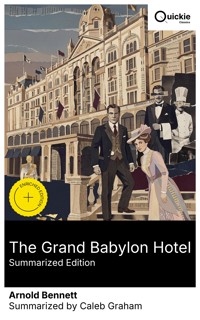
Arnold Bennett's The Grand Babylon Hotel is a sparkling fin‑de‑siècle entertainment that doubles as a sly anatomy of modern luxury. When American millionaire Theodore Racksole, affronted by a refusal to serve his daughter Nella a simple steak, impulsively purchases London's most opulent hotel, he inherits a labyrinth of secret suites, shadowed cellars, and imperial intrigues. The disappearance of Prince Eugen of Posen draws Racksole and Nella into a transnational conspiracy involving the inscrutable chef Rocco and the suave head waiter Jules. Bennett's brisk, serial pace fuses sensation novel, detective tale, and social comedy, measuring American improvisatory energy against the ritual of European high life and staging the hotel as a theater of surveillance, diplomacy, and desire. A Midlands realist with cosmopolitan range, Bennett (1867–1931) honed his craft in journalism and thrived within the constraints of serial publication. His eye for organization, money, and class—sharpened by years in London and Paris—makes the grand hotel a perfect microcosm of modernity. The book's precision, wit, and logistical verisimilitude anticipate his later masterpieces while revealing his pleasure in genre's agile machinery. Recommended to readers of classic mysteries, adventure romances, and cultural history alike, The Grand Babylon Hotel is at once an elegant caper and a study of luxury as power. It offers a superb entry to Bennett's oeuvre and remains startlingly fresh in its understanding of hospitality, spectacle, and the price of comfort. Quickie Classics summarizes timeless works with precision, preserving the author's voice and keeping the prose clear, fast, and readable—distilled, never diluted. Enriched Edition extras: Introduction · Synopsis · Historical Context · Brief Analysis · 4 Reflection Q&As · Editorial Footnotes.
Das E-Book können Sie in Legimi-Apps oder einer beliebigen App lesen, die das folgende Format unterstützen:
Veröffentlichungsjahr: 2026
Ähnliche



















The Grand Babylon Hotel (Summarized Edition)
Table of Contents
Introduction
In Arnold Bennett’s The Grand Babylon Hotel, the sheen of impeccable service and cosmopolitan luxury conceals a pressure chamber where personal desire, moneyed power, and continental politics collide, turning a palace of hospitality into a maze of thresholds—doors, corridors, lobbies, and private suites—through which identities are managed, secrets are ferried, and the fragile promise of safety is negotiated by those who own, those who serve, and those who arrive under assumed protections, revealing how, inside a place built to soothe anxiety and standardize experience, the unpredictable movements of individuals can unsettle entire systems designed to keep everything orderly and serene.
Often classed as a fast-paced thriller with a dash of mystery and social comedy, the novel unfolds in and around a fictional luxury hotel situated in London, imagined as a magnet for diplomats, royalty, financiers, and fashionable travelers. Bennett, a British novelist writing in the early twentieth century, uses this setting to test how a modern urban institution can become a stage for international intrigue. The early Edwardian milieu lends the book its blend of glamour and nervousness, as new technologies and transnational networks expand possibilities while intensifying anxieties about reputation, security, and the costs of belonging to an elite public.
The premise is enticingly simple: an American millionaire, affronted by a trivial slight in the dining room and eager to delight his independent-minded daughter, acquires the hotel with the ease of a man used to getting results, only to discover that ownership brings him behind the curtains of a perilous drama. A celebrated guest disappears without explanation, rumors ripple through the staff, and small irregularities point to larger designs. Bennett’s narrator moves with urbane confidence, alternating crisp dialogue with panoramic description, while the tone balances light irony and escalating suspense, inviting readers to enjoy both the sparkle and the shadows.
At its heart lies an exploration of how luxury operates as both refuge and instrument: money purchases calm, privacy, and discretion, but it also purchases influence, information, and the capacity to mask motives. The hotel becomes a working diagram of social hierarchy, where service corridors mirror diplomatic backchannels and where the etiquette of hospitality doubles as a language of control. Bennett considers the theater of class performance, the volatility of reputation, and the unstable boundaries between public and private life. He also tracks how cosmopolitan spaces circulate rumor and desire, turning personal choices into events with distinctly political consequences.
The novel’s pleasures are immediate: a kinetic sequence of scenes that move from gilded salons to back staircases, from formal banquets to hushed midnight vigils, each calibrated to heighten curiosity without exhausting it. Dialogue is clipped and pointed, descriptions are crisp yet economical, and the point of view maintains a knowing distance that lets irony accumulate. The relationship between the American proprietor and his daughter lends warmth and spark, as their initiative meets the hotel’s elaborate codes. Around them circulate seasoned professionals and enigmatic visitors, all observed with a shrewd eye for the rituals that keep grand places humming.
For contemporary readers, its concerns feel strikingly current. The global hotel remains a symbol of seamless experience built on complex, often invisible labor, while elites still rely on curated privacy and high-security spaces to transact business and pleasure. Bennett’s depiction of soft power—how information circulates through concierge desks, kitchens, and private dining rooms—anticipates debates about surveillance, data, and the trade-offs we accept for convenience. The novel’s attention to image management, cross-border rumor, and the theater of status speaks to today’s media-saturated culture, where reputations can turn in an instant and where luxurious settings are often pressure points for politics.
Reading The Grand Babylon Hotel is also a chance to see an early blueprint for the hotel thriller, a subgenre later taken up in cinema and fiction, rendered here with clarity, humor, and structural finesse. Bennett’s craft lies in the clean mechanics of setup and payoff, the choreography of entrances and exits, and the moral curiosity that animates his protagonists without sanctifying them. The result is a stylish entertainment with a thoughtful core. Approach it for atmosphere and pace; stay for its incisive view of how luxury systems work, and how human initiative can unsettle what appears perfectly managed.
Synopsis
First published in 1902, Arnold Bennett’s The Grand Babylon Hotel begins as a comedy of manners that quickly shades into intrigue. Theodore Racksole, an American millionaire touring Europe with his daughter Nella, is refused a simple meal in London’s most exclusive hotel. On a whim, and to assert his independence, he purchases the establishment from its urbane proprietor, Felix Babylon. The transaction gives Racksole control of a world-renowned house whose reputation rests on discretion, ceremony, and the smooth invisibility of service. Almost at once, the new owner discovers that the hotel’s polish masks tensions among staff and guests who expect predictable, polished rituals.
Under its new master, routines subtly shift. Celebrated functionaries, including Rocco, the hotel’s famed chef, and Jules, its unflappable head waiter, retain their posts, but the equilibrium of rank and habit is disturbed. Nella’s intelligent curiosity about how the place truly works mirrors her father’s impatience with mystique. The arrival of royal visitors from the small German state of Posen, notably Prince Aribert and his relative Prince Eugen, heightens the stakes. Diplomats, attendants, and onlookers hover at the threshold, while the hotel strives to appear serene. Early peculiar incidents—unexpected absences, changed orders, rooms watched too closely—hint that ceremony may conceal calculation.
A sudden death among the guests and the unexplained disappearance of a high-ranking lodger transform social comedy into a problem of crime and responsibility. Racksole realizes that ownership confers obligations beyond profit, especially when his premises could shelter wrongdoing. Prince Aribert, divided between dynastic caution and moral urgency, becomes both ally and check on the American’s forthright methods. At issue is whether discreet hospitality can coexist with transparency, and who, within such a machine, truly wields power. The police offer procedure; the press threatens exposure; but the hotel’s inner mechanisms—timetables and corridors—are where explanations must be found.
Nella Racksole refuses to be sidelined. Watching the front desk, she notices Miss Spencer, a newly installed clerk whose brisk competence arrives at an oddly opportune moment. Small irregularities multiply: signals exchanged between waiters, deliveries that never reach their destinations, messages intercepted or delayed. Suspicion falls upon the serene Rocco and the inscrutable Jules, whose authority over service routines allows movements to pass unseen. Father and daughter begin to map the building’s private arteries—service lifts, back stairways, and staff entrances—seeking where persons might be hidden or spirited away. The narrative prizes patient observation, misdirection, and disguise as much as force.
The search soon pushes beyond the hotel’s doors into the wider circuits that feed and protect it. From central London through popular routes to continental ports, the investigators encounter aliases, decoys, and an economy of favors. Aribert participates, bound by a sense of duty to his house and wary of scandal’s political costs. Racksole leverages wealth for access, yet he perceives limits to what money can compel without compounding harm. The chase raises questions about jurisdiction and the reach of a private proprietor: when a business promises sanctuary and neutrality, where does its responsibility to truth and safety end?
Clues point toward an organized design that exploits the hotel’s prestige and invisibility, using its back rooms and rhythms to manipulate the movement of persons under the guise of perfect service. The stakes implicate the succession and stability of a minor European realm; leverage over one figure could ripple into governments and financiers. Confrontations unfold in kitchens, corridors, and secluded houses, interspersed with comparatively light, ironic scenes that keep the tone spry. Bennett’s pacing favors quick reversals and tidy set pieces, and he withholds explanations just long enough to sustain doubt while guiding attentive readers through the machinery.
Without detailing final turns, the novel resolves its questions by weighing candor against discretion, and ingenuity against brute force. Its lasting appeal lies in how it anticipates twentieth-century thrillers while satirizing luxury’s theater: money talks loudly, but it must still learn the language of institutions. The partnership between an energetic American capitalist and a resourceful young woman models pragmatic virtue confronting inherited privilege and clandestine networks. The Grand Babylon Hotel endures as a brisk fable of cosmopolitan modernity, in which a public space designed to efface itself becomes the map of power, vulnerability, and the means by which both are negotiated.
Historical Context
Published in 1902, The Grand Babylon Hotel belongs to the late Victorian–early Edwardian moment often termed the Belle Époque. London, the seat of the British monarchy and Parliament and the world’s premier financial hub, set the scene for displays of wealth and power. International visitors, diplomats, and financiers converged on the West End, where elite clubs, theaters, and new luxury hotels concentrated. The transition after Queen Victoria’s death in 1901 to Edward VII’s reign cultivated a public appetite for ceremony and high society. Bennett situates his story within these institutions, using a premier hotel as a microcosm of imperial capital and cosmopolitan modernity.
The novel’s setting echoes the rapid rise of grand hotels in London during the 1890s. The Savoy opened in 1889 on the Strand with electric lighting, elevators, and telephones, setting a global standard. Claridge’s was refurbished in the 1890s; the Hotel Cecil opened in 1896, and the Carlton in 1899. Figures such as César Ritz and Auguste Escoffier professionalized luxury service, codifying discretion, cuisine, and the modern hotel’s hierarchy. In 1898 Ritz and Escoffier were dismissed from the Savoy after allegations of financial irregularities, a widely reported scandal. Bennett draws on this milieu, where opulence relied on rigorous management and tactful, almost invisible, control.
Late nineteenth-century transatlantic travel brought affluent American tourists and businessmen into London’s orbit. Regular express steamship services run by Cunard and the White Star Line connected New York with Liverpool and Southampton in under a week, feeding a steady elite clientele to West End hotels. The period also saw marriages between wealthy American heiresses and the British aristocracy, widely publicized as “Dollar Princess” alliances. American capital flowed into British finance and culture, and U.S. magnates maintained suites and offices in premier venues. Bennett’s hotel becomes a neutral ground where American wealth, European titles, and imperial administrators intersect under the watchful etiquette of luxury hospitality.
Before 1914, Europe’s dense web of monarchies and small courts made London a crossroads for titled visitors and diplomatic entourages. Elite hotels frequently hosted royal guests, envoys, and their security, operating alongside embassies and the Foreign Office’s protocols. The era carried acute anxieties about political violence: Empress Elisabeth of Austria was assassinated in 1898, King Umberto I of Italy in 1900, and U.S. President William McKinley in 1901. London’s Metropolitan Police and its Criminal Investigation Department, established in 1878, monitored threats while respecting elite privacy. Bennett’s milieu is shaped by this balance of ceremonial splendor, delicate protocol, and latent fears of disruption.




