


1,99 €
Mehr erfahren.
- Herausgeber: DigiCat
- Kategorie: Geisteswissenschaft
- Sprache: Englisch
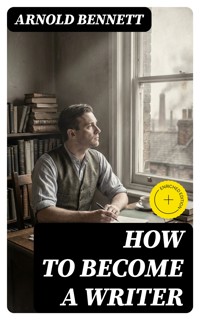
In "How to Become a Writer," Arnold Bennett encapsulates the essence of literary craftsmanship through a meticulous exploration of the art and intricacies of writing. Not merely a how-to guide, Bennett delves into the psychological motivations and discipline required for a writer's journey. His style is characterized by clarity and encouragement, blending pragmatic advice with philosophical insights that mirror the socio-cultural milieu of early 20th-century England. This period saw the rise of modernism, and Bennett's emphasis on personal experience and individuality resonates with the evolving literary landscape. Arnold Bennett, a prominent figure in the literary world, was not only a novelist but also a journalist and playwright. His diverse experiences informed his writing, encouraging him to challenge aspiring authors to harness their inner voice. Born in a working-class family, Bennett's life journey from the pottery town of Stoke-on-Trent to literary acclaim imbued him with a unique perspective on art and authenticity—elements he passionately shares in this work. This book is a vital companion for both novice and seasoned writers, offering profound insights into developing one's craft while navigating the complexities of self-expression. Bennett's blend of practicality and inspiration serves as a guiding beacon for those aspiring to leave a mark in the literary world. In this enriched edition, we have carefully created added value for your reading experience: - A comprehensive Introduction outlines these selected works' unifying features, themes, or stylistic evolutions. - A Historical Context section situates the works in their broader era—social currents, cultural trends, and key events that underpin their creation. - A concise Synopsis (Selection) offers an accessible overview of the included texts, helping readers navigate plotlines and main ideas without revealing critical twists. - A unified Analysis examines recurring motifs and stylistic hallmarks across the collection, tying the stories together while spotlighting the different work's strengths. - Reflection questions inspire deeper contemplation of the author's overarching message, inviting readers to draw connections among different texts and relate them to modern contexts. - Lastly, our hand‐picked Memorable Quotes distill pivotal lines and turning points, serving as touchstones for the collection's central themes.
Das E-Book können Sie in Legimi-Apps oder einer beliebigen App lesen, die das folgende Format unterstützen:
Veröffentlichungsjahr: 2023
Ähnliche









How to Become a Writer
Table of Contents
Introduction
This collection, titled "How to Become a Writer", assembles Arnold Bennett’s sustained, practical engagement with authorship as art and occupation. It is not a gathering of his novels or plays, but of the handbooks, essays, and reflective pieces in which he examined forms, methods, and the reading that nourishes them. From first intentions to mature assessment, the sequence maps a writer’s progress through choice of genre, technique, and professional practice. The purpose is twofold: to offer instruction that is concrete and usable, and to preserve a coherent portrait of Bennett’s understanding of what writing requires—application, experiment, and a continual conversation with literature itself.
In these pages, genres and text types are surveyed with unusual breadth. How to Become an Author and The Literary Career frame the vocation; The Formation of Style considers sentences and structure; Journalism, Short Stories, and Sensational and Other Serials examine press work, the tale, and the demands of serial publication. The Novel, Writing Novels, and Non-fictional Writing test long-form and informative prose, while Playwriting and Writing Plays address the stage. The Business Side of Books confronts contracts and circulation, The Occasional Author speaks to intermittent practice, The Artist and the Public weighs reception, and Seeing Life reminds the apprentice that observation is a writer’s durable instrument.
At the heart of the collection stands Literary Taste: How to Form It, accompanied here by its constituent chapters presented in sequence. The Aim, Your Particular Case, Why a Classic is a Classic, Where to Begin, How to Read a Classic, The Question of Style, Wrestling With an Author, System in Reading, Verse, and Broad Counsels form a sustained program for cultivating judgment and habit. The triptych An English Library: Period I, Period II, and Period III outlines suggested reading across English literature, and Mental Stocktaking concludes with assessment and renewal. Together they demonstrate Bennett’s conviction that writing power grows from disciplined, discriminating reading.
Across these works a unified ethic emerges. Bennett treats authorship as both imaginative enterprise and learned trade, requiring stamina, observation, and a conscious shaping of style. He traces the ecology of publishing—periodicals, serialisation, and books—showing how forms find readers and how writers locate their proper tasks. The Business Side of Books and The Artist and the Public anchor this social sense of literature, while Journalism and Short Stories ground it in everyday practice. The result is neither mere uplift nor narrow technique, but a balanced philosophy: write with purpose, understand the conditions of circulation, and let form answer frankly to audience and intention.
Stylistically, Bennett is notable for lucidity, economy, and a steady refusal to mystify craft. He writes as a working author addressing another worker, favouring plain statement, concrete tasks, and incremental progress. The Formation of Style and The Question of Style show his attention to rhythm, proportion, and clarity; System in Reading and Broad Counsels reveal the same methodical temper applied to the intake that sustains output. Even where he considers sensation, seriality, or the theatre’s immediate demands, his tone remains exact and unsentimental. The emphasis falls on repeatable method, the ethical value of accuracy, and the freedom that comes from competence.
The ongoing significance of these texts lies in their breadth and transferability. Because they address the whole circuit of writing—reading, choosing, drafting, revising, placing, and receiving—they remain useful whether one’s interest is in newsrooms, magazines, the book trade, or the stage. They value independent judgment over fashion, encourage patience over haste, and treat success as the by-product of sustained labour. Literary Taste, in particular, insists that a writer’s education is a lifetime enterprise, renewed by contact with demanding works. Taken together, the collection offers a durable vocabulary for thinking about practice, taste, and responsibility within the public life of letters.
This volume can be read straight through as an apprenticeship or consulted by need. One may begin with How to Become an Author, proceed through the genre-specific essays, and arrive at The Author’s Craft, Writing Novels, and Writing Plays for concentrated technique, before turning to The Business Side of Books and The Artist and the Public for context. Alternatively, start with Literary Taste and its chapters, then return to practice with renewed focus. In every path, the arc runs from aim to appraisal, with Mental Stocktaking closing the circuit, inviting writers to measure progress and re-enter the work with clearer purpose.
Historical Context
Arnold Bennett wrote his counsel during a period when British literacy and access to print expanded dramatically. The 1870 Education Act, later compulsory attendance (1880) and free elementary schooling (1891), enlarged the reading public that his practical guidance addresses. Public Libraries Acts and the spread of Carnegie-funded libraries from the 1880s created new routes into books. London’s late-Victorian press and publishing hub offered apprenticeships for ambitious provincials; Bennett himself moved from the Potteries to Fleet Street in 1893 to work in journalism. These conditions underlie the collection’s emphasis on method, discipline, and professionalism as the necessary virtues for navigating a crowded literary marketplace.
The rise of the halfpenny press and “New Journalism” reshaped opportunities for writers across genres Bennett surveys. Innovators such as W. T. Stead and Alfred Harmsworth (Lord Northcliffe) built mass-circulation papers—Daily Mail in 1896, Daily Express in 1900—whose appetite for crisp features, interviews, and human-interest stories rewarded clarity and speed. Linotype and photo-engraving lowered production costs, while magazines like Tit-Bits (1881) and The Strand (1891) created vigorous markets for short stories and serials. Bennett’s sections on journalism, short fiction, and sensational serials reflect this environment, balancing artistic aspiration with the realities of word-length, deadlines, readers’ tastes, and the editorial hierarchies of London periodicals.
Late-nineteenth-century publishing underwent structural changes that framed Bennett’s advice on careers and the business of books. The collapse of the three-volume novel in the mid-1890s and the dominance of the six-shilling single-volume format altered advances, print runs, and library orders. The Net Book Agreement of 1900 stabilized pricing and supported a nationwide retail network. Literary agents—A. P. Watt from 1875, followed by J. B. Pinker—professionalized negotiations over serial rights, overseas editions, and translations. International copyright norms shifted with the Berne Convention (1886), the U.S. International Copyright Act (1891), and Britain’s 1911 Act, shaping income streams that Bennett treats with lucid pragmatism in his business-oriented chapters.
Edwardian theatre offered both prestige and pitfalls for writers branching into drama. The Lord Chamberlain’s censorship under the Theatres Act of 1843 constrained subject matter, even as the Stage Society (founded 1899) and Royal Court experiments under Granville Barker (1904–1907) promoted Ibsenite realism and new forms. The actor‑manager system coexisted with commercial syndicates in the West End, creating complex production economics. Bennett’s success with Edward Knoblock on Milestones (1912) and his own The Great Adventure (1913) exemplified pathways available to adept craftsmen. His playwriting essays arise from this contested field, where structure, dialogue, and stage practicability had to meet box-office expectations.
Bennett’s craft principles grew from a realist tradition resisting fin‑de‑siècle aestheticism. Living in Paris for extended periods after 1903, he absorbed French models—Balzac’s social panoramas, Flaubert’s discipline, Maupassant’s concision—while retaining an English concern with provincial life and work. Alongside H. G. Wells and John Galsworthy, he helped define the Edwardian “novel of circumstance,” where exact observation and carefully marshalled detail govern narrative. Sections on the formation of style, “seeing life,” and the novel advocate a patient apprenticeship in looking outward: streets, offices, lodgings, theatres. Such advice was shaped by continental naturalism and by the expanding, class‑mixed urban Britain he chronicled.
The First World War disrupted British publishing through enlistments, paper shortages, and transport constraints, yet also widened audiences as soldiers and civilians turned to portable reading. Bennett’s The Author’s Craft appeared in 1914 at this hinge, urging practicality amid uncertainty. Postwar, inflation and new leisure patterns altered sales, while experimental modernism—Joyce’s Ulysses (1922), Eliot’s The Waste Land (1922)—reframed critical expectations. In 1923 Bennett queried “Is the Novel Decaying?,” and Virginia Woolf’s 1924 “Mr. Bennett and Mrs. Brown” challenged his methods, crystallizing a public debate about character, detail, and reality. Essays on the artist and the public register these tensions between tradition, commerce, and innovation.
Bennett’s program for literary self-education coincided with the democratization of “the classics” through cheap, durable series. Grant Richards’s World’s Classics began in 1901 and moved to Oxford University Press in 1906; J. M. Dent launched Everyman’s Library in 1906; Thomas Nelson produced shilling classics the same decade. Municipal libraries matured into civic institutions, and reading circles multiplied. Literary Taste: How to Form It (1909) and its companion essays thus serve a burgeoning middle-class readership seeking maps of English literature, methods for “wrestling” with authors, and systems for steady improvement. The guidance presumes abundant, affordable editions and a culture valorizing self-improvement.
Changing social currents also shaped Bennett’s tone of practical ambition. Urbanization and white-collar expansion opened clerical days and evening hours for aspiring writers; women entered journalism and fiction markets in growing numbers, amid New Woman debates and, later, partial suffrage in 1918. The rise of agents, contracts, and international rights made authorship a calculable profession as much as a calling. Hence chapters like The Occasional Author, Your Particular Case, and Mental Stocktaking emphasize planning, stamina, and negotiation. Contemporary reception favored Bennett’s worldly wisdom among middlebrow readers and practitioners, even as later modernist criticism questioned it—a tension that keeps the collection historically legible.
Synopsis (Selection)
Foundations of Authorship (How to Become an Author; The Literary Career; The Business Side of Books; The Occasional Author; The Artist and the Public)
These pieces map the path into professional writing, from first ambitions and career planning to managing the market, occasional work, and the writer’s relationship with readers.
With a brisk, demystifying tone, Bennett stresses routine, time management, and the balance of art and livelihood—recurring motifs delivered in plainspoken, reader-aware counsel.
Craft and Style Essentials (The Formation of Style; The Author's Craft; Seeing Life)
Bennett frames style and technique as trainable, advocating clarity, structure, and rhythm built through close study and steady practice.
Observation of ordinary life supplies material, and the tone is methodical and anti-mystical, favoring economy, exactness, and step-by-step guidance.
Journalism and Non-fiction (Journalism; Non-fictional Writing)
These essays emphasize accuracy, angle, brevity, and public utility, translating newsroom habits into durable non-fiction skills.
The tone is crisp and utilitarian, foregrounding credibility, organization, and a persistent reader-consciousness.
Prose Fiction Forms (Short Stories; Sensational and Other Serials; The Novel; Writing Novels)
Bennett covers hooks, pacing, characterization, and large-scale architecture, pairing principles with day-by-day methods for sustaining long projects.
He distinguishes episodic serial demands from unified novels while urging respect for genre conventions, purposeful scenes, and clear, unfussy prose.
Dramatic Writing (Playwriting; Writing Plays)
These guides attend to stage realities—dialogue economy, act structure, and performance constraints—so the page serves actors and audiences.
The hands-on, collaborative tone privileges clarity over flourish and keeps rehearsal and reception constantly in view.
Literary Taste: Orientation and Aims (Literary Taste: How to Form It; The Aim; Your Particular Case)
Bennett explains why forming literary taste matters and how to tailor a realistic reading plan to individual limits and goals.
Marking a shift from production to cultivation, he champions incremental habit-building and honest self-assessment.
Literary Taste: Why and How to Read (Why a Classic is a Classic; Where to Begin; How to Read a Classic; The Question of Style)
These sections define enduring value, propose sensible entry points, and model active, analytical reading of demanding works.
With an explanatory, reader-centered tone, they teach attention to style and form over mere storyline, favoring practical heuristics over abstractions.
Literary Taste: Practice and System (Wrestling With an Author; System in Reading; Verse; Broad Counsels)
Bennett counsels persistence with difficult authors, a sustainable reading system, and a confident approach to poetry.
Supportive yet procedural, he prizes notes, schedules, and measured progress—discipline coupled with curiosity.
Literary Taste: An English Library (An English Library: Period I; Period II; Period III)
A period-organized set of recommendations scaffolds historical perspective and breadth without pretending to be exhaustive.
The curatorial tone invites substitution to fit the reader’s case, reflecting Bennett’s signature mix of practicality and enthusiasm for classics.
Literary Taste: Mental Stocktaking (Mental Stocktaking)
This closing piece urges periodic audits of one’s reading to gauge growth, rebalance plans, and address gaps.
Reflective and unsentimental, it reinforces recurring themes of accountability, continuous improvement, and aligning taste with practice.
How to Become a Writer
How to Become an Author
Chapter I The Literary Career
Divisions of literature.
In the year 1902 there were published 1743 volumes of fiction, 504 educational works, 480 historical and biographical works, 567 volumes of theology and sermons, 463 political and economical works, and 227 books of criticism and belles-lettres. These were the principal divisions of the grand army of 5839 new books issued during the year, and it will be seen that fiction is handsomely entitled to the first place. And the position of fiction is even loftier than appears from the above figures; for, with the exception of a few school-books which enjoy a popularity far exceeding all other popularities, and a few theological works, no class of book can claim as high a circulation per volume as the novel. More writers are engaged in fiction than in any other branch of literature[1q], and their remuneration is better and perhaps surer than can be obtained in other literary markets. In esteem, influence, renown, and notoriety the novelists are also paramount.
Therefore in the present volume it will be proper for me to deal chiefly with the art and craft of fiction. For practical purposes I shall simply cut the whole of literature into two parts, fictional and non-fictional; and under the latter head I shall perforce crowd together the sublime and reverend muses of poetry, history, biography, theology, economy—everything, in short, that is not prose-fiction, save only plays; having regard to the extraordinary financial and artistic condition of the British stage and the British playwright at the dawn of the twentieth century, I propose to discuss the great “How” of the drama in a separate chapter unrelated to the general scheme of the book. As for journalism, though a journalist is not usually held to rank as an author, it is a. fact that very many, if not most, authors begin by being journalists. Accordingly I shall begin with the subject of journalism.
Two Branches of Journalism: The Mechanical.
There are two branches of journalism, and it is necessary to distinguish sharply between them. They may be called the literary branch and the mechanical branch. To take the latter first, it is mainly the concern of reporters, of all sorts, and of sub-editors. It is that part of the executive side of journalism which can be carried out with the least expenditure of original brain-power. It consists in reporting —parliament, fashionable weddings, cricket-matches, company meetings, fat-stock shows; and in work of a sub-editorial character—proof-correcting, marshalling and co-ordinating the various items of an issue, cutting or lengthening articles according to need, modifying the tone of articles to coincide with the policy of the paper, and generally seeing that the editor and his brilliant original contributors do not, in the carelessness of genius, make fools of themselves. The sub-editor and the reporter, by reason of highly-developed natural qualifications, sometimes reach a wonderful degree of capacity for their duties, and the sub-editorial chair is often occupied by an individual who obviously has not the slightest intention of remaining in it. But, as a rule, the sub-editor and the reporter are mild and minor personages. Any man of average intelligence can learn how to report verbatim, how to write correct English, how to make incorrect English correct, how to describe neatly and tersely. Sub-editors and reporters are not born; they become so because their fathers or uncles were sub-editors or reporters, or by some other accident, not because instinct irresistibly carries them into the career; they would probably have succeeded equally well in another calling. They enter an office early, by a chance influence or by heredity, and they reach a status similar to that of a solicitor’s managing-clerk. Fame is not for them, though occasionally they achieve a limited renown in professional circles. Their ultimate prospects are not glorious. Nor is their fiscal reward ever likely to be immense. In the provinces you may see the sub-editor or reporter of fifty who has reared a family on three pounds a week and will never earn three pounds ten. In London the very best mechanical posts yield as much as four hundred a year, and infrequently more; but the average salary of a thorough expert would decidedly not exceed two hundred and fifty, while the work performed is laborious, exacting, responsible, and often extremely inconvenient. Consider the case of the sub-editor of an evening paper, who must breakfast at 6 a.m. winter and summer, and of the sub-editor of a morning paper, who never gets to bed before three in the morning. Relatively, a clerk in a good house is better paid than a sub-editor or a reporter.
I shall have nothing more to say about this branch of journalism. Its duties are largely of an official kind and in the nature of routine, and are almost always studied practically in an office. A useful and trustworthy manual of them is Mr. John B. Mackie’s Modem Journalism: a Handbook of Instruction and Counsel for the Young Journalist, published by Crosby, Lockwood & Son, price half-a-crown.
The Literary Branch.
I come now to the higher branch of journalism, that which is connected, more or less remotely, with literature. This branch merges with the lower branch in the person of the “descriptive-reporter,” who may be a genius with the wages of an ambassador, like the late G. W. Steevens, or a mere hack who describes the Lord Mayor’s procession and writes “stalwart emissaries of the law” when he means policemen. It includes, besides the aristocracy of descriptive reporting, reviewers, dramatic and other critics, financial experts, fashion-writers, paragraphists, miscellaneous contributors regular and irregular, assorted leader-writers, assistant editors, and editors; I believe that newspaper proprietors also like to fancy themselves journalists. Very few ornaments of the creative branch of journalism become so by deliberate intention from the beginning. The average creative journalist enters his profession by “drifting” into it; the verb “to drift” is always used in this connection; the natural and proper assumption is that he was swept away on the flood of a powerful instinct. He makes a timid start by what is called “freelancing,” that is, sending an unsolicited contribution to a paper in the hope that it will be accepted and paid for. He continues to shoot out unsolicited contributions in all directions until one is at length taken; then he thinks his fortune is made. In due course he gradually establishes a connection with one or more papers; perhaps he writes a book. On a day he suddenly perceives that an editor actually respects and relies on him; he is asked to “come into the office” sometimes, to do “things,” and at last he gets the offer of an appointment. Lo! he is a full-fledged journalist; yet the intermediate stages leading from his first amateurish aspiring to his achieved position have been so slight, vague, and uncertain, that he can explain them neither to himself nor to others. He has "drifted into journalism.” And let me say here that he has done the right thing. It is always better to enter a newspaper office from towards the top than from towards the bottom. It is, in my opinion, an error of tactics for a youth with a marked bent towards journalism, to join a staff at an early age as a proof-reader, reporter, or assistant sub-editor; he is apt to sink into a groove, to be obsessed by the routine instead of the romance of journalism, and to lose intellectual elasticity.
The creative branch of journalism is proportionately no better paid than the mechanical branch. The highest journalistic post in the kingdom is reputed to be worth three thousand a year, an income at which scores of lawyers, grocers, bishops, music-hall artistes, and novelists would turn up their noses. A thousand a year is a handsome salary for the editor of a first-class organ; some editors of first-class organs receive much less, few receive more. (The London County Council employs eleven officers at a salary of over a thousand a year each, and five at a thousand each.) An assistant editor is worth something less than half an editor, while an advertisement manager is worth an editor and an assistant editor added together. A leader-writer may receive from four hundred to a thousand a year. No man can earn an adequate livelihood as a book-reviewer or a dramatic or musical critic, pure and simple; but a few women by much industry contrive to flourish by fashion - writing alone. The life of a man without a regular appointment who exists as a freelance may be adventurous, but it is scarcely worth living. The rate of pay for journalistic contributions varies from seven and sixpence to two guineas per thousand words; the average is probably under a pound; not a dozen men in London get more than two guineas a thousand for unsigned irregular contributions. A journalist at once brilliant, reliable, industrious, and enterprising, may be absolutely sure of a reasonably good income, provided he keeps clear of editorships and does not identify himself too prominently with any single paper. If he commits either of these indiscretions, his welfare largely depends on the unwillingness of his proprietor to sell his paper. A change of proprietorship usually means a change of editors and of prominent contributors, and there are few more pathetic sights in Fleet Street than the Famous Journalist dismissed through no fault of his own.
On the whole, it cannot be made too clear that journalism is never a gold-mine except for newspaper proprietors, and not always for them. The journalist sells his brains in a weak market Other things being equal, he receives decidedly less than he would receive in any pursuit save those of the graphic arts, sculpture, and music. He must console himself by meditating upon the romance, the publicity, and the influential character of his profession. Whether these intangible things are a sufficient consolation to the able, conscientious man who gives his best for, say, three or four hundred a year and the prospect of a precarious old age, is a question happily beyond the scope of my treatise.
Fiction.
I have made no mention of the natural gifts of universal curiosity, alertness, inextinguishable verve, and vivacious style which are necessary to success in creative journalism, because the aspirant will speedily discover by results whether or not he possesses them. If he fails in the earlier efforts of freelancing, he will learn thereby that he is not a born journalist, and the “drifting” process will automatically cease. For the same reason I need not enter upon an academic discussion of the qualifications proper to a novelist. In practice, nobody plunges blindly into the career of fiction. Long before the would-be novelist has reached the point at which to turn back means ignominious disaster, he will have ascertained with some exactness the exchange value of his qualifications, and will have set his course accordingly. There is the rare case of the beginner who achieves popularity by his first book. This apparently fortunate person will be courted by publishers and flattered by critics, and in the ecstasy of a facile triumph he may be tempted to abandon a sure livelihood “in order to devote himself entirely to fiction.” One sees the phrase occasionally in literary gossip. The temptation should be resisted at all costs. A slowly-built reputation as a, novelist is nearly indestructible; neither time nor decay of talent nor sheer carelessness will quite kill it; your Mudie subscriber, once well won, is the most faithful adherent in the world. But the reputation that springs up like a mushroom is apt to fade like a mushroom; modern instances might easily be cited, and will occur to the student of publishers’ lists. Moreover, it is unquestionable that many writers can produce one striking book and no more. Therefore the beginner in fiction should not allow himself to be dazzled by the success of a first book. The success of a seventh book is a sufficient assurance for the future, but the success of a first book should be followed by the success of two others before the author ventures, in Scott’s phrase, to use fiction as a crutch and not merely as a stick.
Speaking broadly, fiction is a lucrative profession; it cannot compare with stock-broking, or brewing, or practice at the parliamentary bar, but it is tolerably lucrative. Never before, despite the abolition of the three-volume novel, did so many average painstaking novelists earn such respectable incomes as at the present day. And the rewards of the really successful novelist seem to increase year by year. A common course is to begin with short stories for magazines and weeklies. These vary in length from two to six thousand words, and the payment, for unknown authors, varies from half a guinea to three guineas per thousand. The leading English magazines willingly pay fifteen guineas for a five-thousand-word story. But to make a living out of short stories alone is impossible in England. I believe it may be accomplished in America, where at least one magazine is prepared to pay forty dollars per thousand words irrespective of the author’s reputation.
The production of sensational serials is remunerative up to a certain point The halfpenny dailies and the popular penny weeklies will pay from ten shillings to thirty shillings per thousand words; and the newspaper syndicates, who buy to sell again to a number of clients simultaneously, sometimes go as far as two pounds per thousand for an author who has little reputation but who suits them. Thus a man may make a hundred pounds by working hard for a month, with the chance of an extra fifty pounds for book-rights afterwards. A writer who makes a name as a sensational serialist does not often get beyond three pounds per thousand, though the syndicates may be more generous, rising to five or six pounds per thousand. I should doubt whether even the most popular of sensational serialists can obtain more than six pounds per thousand. In this particular market a reputation is less valuable than elsewhere. And it must also be remembered that the sale of sensational serials in book form is seldom remarkable.
The mild domestic novelist who plods steadily along, and whose work is suitable for serial issue, is in a better position than the mere sensation-monger. She—it is often a “she”—may get from three to six pounds per thousand for serial rights as her reputation waxes, and her book-rights may be anything from two hundred to a thousand pounds. I can state with certainty that it is not unusual for a novelist who has never really had an undubitable success, but who has built up a sort of furtive half-reputation, to make a thousand pounds out of a novel, first and last. Such a person can write two novels a year with ease. I have more than once been astonished at the sums received by novelists whom, both in an artistic and a commercial sense, I had regarded as nobodies. I know an instance of a particularly mild and modest novelist who was selling the book-rights of her novels outright for three hundred pounds apiece. One day it occurred to her to demand double that sum, and to her immense surprise the publisher immediately accepted the suggestion. I should estimate that this author can comfortably write a book in three months.
The Really Successful Novelist.
The novelist who once really gets himself talked about, or, in other words, sells at least ten thousand copies of a book, and who is capable of living up to his reputation, soon finds that he is on a bed of roses. For serial rights in England and America he may get fifteen pounds per thousand, making twelve hundred pounds for an eighty-thousand-word novel. For book-rights he will be paid at the rate of about seventy-five pounds per thousand copies of the circulation; so that if his book sells ten thousand copies in England and five thousand copies in America, he receives eleven hundred and twenty-five pounds. Baron Tauchnitz will give from twenty-five to fifty pounds for the continental rights, and the colonial rights are worth something. The grand total for the book will thus be quite two thousand four hundred pounds. This novelist will probably produce three novels in two years. Magazines will pay sixty pounds apiece and upwards for his short stories, and from time to time the stories will be collected and issued in a volume which is good for a few hundred pounds. By writing a hundred and fifty thousand words a year he will make an annual income of three thousand five hundred pounds. His habit will be to write a thousand words a day three days a week, and on each working day he will earn about twenty-five pounds. All which is highly agreeable—but then the man is highly exceptional.
The case of the novelist who has a vogue of the most popular kind, that is to say, whose books reach a circulation of from fifty to a hundred thousand copies, is even more opulent, luxurious, and lofty. The sale of a hundred thousand copies of a six-shilling novel means that the author receives upwards of seven thousand five hundred pounds. The value of the serial rights of a book by such an author is extremely high in many cases, though sometimes it is nothing. There are ten authors in England who can count on receiving at least four thousand pounds for any long novel they choose to write, and there are several who have made, and may again make, twenty thousand pounds from a single book, which is at the rate of about four shillings a word. And seeing that any author who knows his craft can easily —despite statements to the contrary in illustrated interviews and other grandiose manifestations of bombast—compose three thousand words of his very best in a week, the pecuniary rewards of the first-class “boom” should satisfy the most avaricious and exacting.




