


9,99 €
Mehr erfahren.
- Herausgeber: Glagoslav Publications B.V. (N)
- Kategorie: Fremdsprachen
- Sprache: Englisch
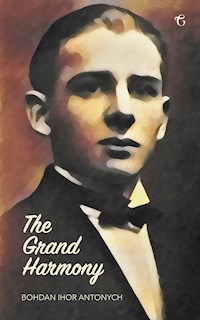
The extraordinarily inventive Ukrainian poet and literary critic Bohdan Ihor Antonych (1909-1937), the son of a Catholic priest, died prematurely at the early age of 28 of pneumonia. Originally from the mountainous Lemko region in Poland, where a variant of Ukrainian is spoken, he was home-schooled for the first eleven years of his life because of frequent illness. He began to write poetry in Ukrainian after he moved to the Western Ukrainian city of Lviv to continue his studies at the University of Lviv. He published just three collections of poetry in his lifetime: A Greeting to Life (1931), Three Rings (1934), and The Book of the Lion (1936), with the latter two firmly establishing his reputation as one of the best poets of his time in Ukraine. Three additional collections, The Green Gospel (1938), Rotations (1938), and The Grand Harmony (1967), were published posthumously.
A collection of poems on religious themes written in 1932 and 1933, The Grand Harmonyis a subtle and supple examination of Antonych’s intimately personal journey to faith, with all its revelatory verities as well as self-questioning and doubt. The collection marks the beginning of Antonych’s development into one of the greatest poets of his time. During Soviet times it was banned for its religious content. It was first published in its entirety in 1967 in New York.
The Grand Harmony first appeared in English translation in a bilingual edition with Litopys Publishers in 2007, which has long been sold out. The poems “Musica Noctis,” “De Morte I,” “Ars Poetica 1” and “Liber Peregrinorum 3” were reprinted in The Essential Poetry of Bohdan Ihor Antonych: Ecstasies and Elegies (Bucknell University Press, 2010). One can find additional poetic renderings of Antonych’s selected poetry in the translations of various well-known American poets under the title A Square of Angels (Ann Arbor: Ardis Publishers, 1977), which was edited by Bohdan Boychuk.
Das E-Book können Sie in Legimi-Apps oder einer beliebigen App lesen, die das folgende Format unterstützen:
Seitenzahl: 48
Veröffentlichungsjahr: 2018
Ähnliche







The Grand Harmony
Bohdan Ihor Antonych
THE GRAND HARMONY
by Bohdan Ihor Antonych
Translated by Michael M. Naydan
Publishers Maxim Hodak & Max Mendor
© 2017, Michael M. Naydan
© 2017, Glagoslav Publications, United Kingdom
Glagoslav Publications Ltd
88-90 Hatton Garden
EC1N 8PN London
United Kingdom
www.glagoslav.com
ISBN: 9781911414377 (Ebook)
This book is in copyright. No part of this publication may be reproduced, stored in a retrieval system or transmitted in any form or by any means without the prior permission in writing of the publisher, nor be otherwise circulated in any form of binding or cover other than that in which it is published without a similar condition, including this condition, being imposed on the subsequent purchaser.
This edition is dedicated to Lydia Stefanowska,
an expert on Antonych par excellence.
Contents
Biographical Note
Antonych Writing God: The Metaphysics of The Grand Harmony
I. THE GRAND HARMONY
UT IN OMNIBUS GLORIFICETUR DEUS
VENI SANCTE SPIRITUS
MUSICA NOCTIS
DE MORTE I
GLORIA IN EXCELSIS
DE MORTE IV
DE MORTE II
DUAE VIAE
ARS POETICA II, 1
AMEN
VINEA DIVINA
DEUS MAGNIFICUS
TE DEUM LAUDAMUS I
ADVOCATUS DIABOLI
RESURECTIO
MOMENTUM CUM DEO
LITANIA
A PRAYER
WEEKDAY
SACRED SIMPLICITY
NAÏVETÉ
ARS POETICA II, 4
VENI CREATOR
CONFITEOR
MATER DOLOROSA
LIBER PEREGRINORUM 3
AVE MARIA
GREEN HOLY DAY
ON DEATH III
ARS POETICA II, 2
ARS POETICA II, 3
TRIANGULUM
THE WOODSMAN, Part 2
THE FOURTH ANGLE
CREDO
SPES
AGNUS DEI
MATER GLORIOSA
ASCENSIO
APAGE SATANAS
TE DEUM LAUDAMUS, II
KYRIE ELEISON
MAGNIFICAT
ARS POETICA
SALVE REGINA
Biographical Note
The remarkable Ukrainian poet and literary critic Bohdan Ihor Antonych (1909-1937) lived for only a brief 28 years. Originally from the mountainous Lemko region in Poland, where a variant of Ukrainian is spoken, he was home-schooled for the first eleven years of his life until 1920 when he entered the Queen Sophia State Gymnasium in Syanok, which he completed eight years later. Antonych then matriculated at Lviv University. Lviv is the cultural center of Western Ukraine, which in Antonych’s lifetime was part of Poland. During his study of Ukrainian philology at the university, Antonych adopted Ukrainian as his literary language, and he also became extremely active in the literary and intellectual life of the multi-cultural city of Lviv, a city that he grew to love dearly. Antonych served as a kind of cultural bridge between Polish and Ukrainian literary circles, which at the time did not mix to any great degree. He died in 1937 of complications from pneumonia after a successful operation for appendicitis, just a few short months before his planned wedding to Olha Oliynyk. His premature death occurred at the height of his creative talent, when he already had emerged as a poet of extraordinary maturity and erudition.
In the brief span of his life, Antonych proved to have been an exceptionally innovative poet and an accomplished essayist. As Lydia Stefanowska observes in her critical writings on the poet, Antonych was greatly influenced by Polish avant-garde poetry of the 1920s and was one of the first literary critics to note the talent of the then young future Nobel Prize winner Czeslaw Milosz. Antonych’s poetry was a breath of fresh air for Ukrainian poetry in the 1930s, and like a number great poets, he was perceived in many different ways by his reading public. He has been described as an imagist, a mystic, a symbolist, and a pantheist. While these labels may fit certain moments in his poetry, they do not individually convey the totality of his oeuvre. His relatively small corpus of published works has been extraordinarily influential on a number of Ukrainian poets for generations to come, especially during the periods of the 1960s and 1980s, which were particularly trying times for Ukrainian society under Soviet repression. Antonych’s poetry covers a number of themes from the mundane, the joy of life in little things, to the profoundly metaphysical, to nature and man’s place in it, to urban themes, to an impending sense of apocalypse, which, regrettably, came true with the Nazi invasion. As opposed to the patriotic tendencies of a number of Western Ukrainian poets in his time, Antonych’s approach was an art for art’s sake one with high-minded aesthetic principles. His published collections include: A Greeting to Life (1931), Three Rings (1934), The Book of the Lion (1936), The Green Gospel (1938), and Rotations (1938). The latter two books were published posthumously. The Grand Harmony, a collection of poems on religious themes written in 1932, is a subtle and supple examination of the journey to personal faith, with all its revelatory verities and questioning. During Soviet times it was banned for its religious content. It was first published in its entirety in 1967 in New York.
The Grand Harmony first appeared in my English translation in a bilingual edition with Litopys Publishers in 2007, which has long been sold out. The poems “Musica Noctis,” “De Morte I,” “Ars Poetica 1” and “Liber Peregrinorum 3” were reprinted in my translation in The Essential Poetry of Bohdan Ihor Antonych: Ecstasies and Elegies (Bucknell University Press, 2010). One can find additional poetic renderings of Antonych’s selected poetry in the translations of various well-known American poets under the title A Square of Angels (Ann Arbor: Ardis Publishers, 1977), which was edited by Bohdan Boychuk.
I am grateful to Mykhailo Komarnytsky and Myroslava Prykhoda for all their support and assistance to make that original volume possible. I am especially thankful to Lydia Stefanowska for sharing her expertise on Antonych with me and for helping to make these translations better. My gratitude also to Mykola Polyuha for his expert suggestions for emendations. My translations for this new edition have been revised and fine-tuned from the original published versions.




