


1,99 €
Niedrigster Preis in 30 Tagen: 1,99 €
Niedrigster Preis in 30 Tagen: 1,99 €
Mehr erfahren.
- Herausgeber: Booksell-Verlag
- Kategorie: Poesie und Drama
- Sprache: Englisch
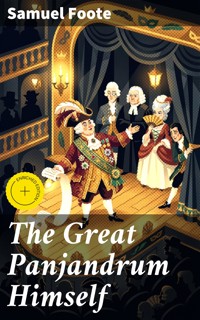
In "The Great Panjandrum Himself," Samuel Foote presents a masterful satire that explores themes of authority, absurdity, and the follies of human ambition. The work is characterized by its playful yet incisive wit, employing a whimsical style that blends poetry, drama, and social commentary. Set against the backdrop of 18th-century British society, Foote critiques the eccentricities of politics and the theater, providing readers with a vivid portrayal of the social hierarchies and pretentiousness of his time. The title itself, a nod to a grandiose but ultimately ridiculous figure, encapsulates the essence of Foote's sharp humor and keen observation of societal norms. Samuel Foote, a prominent figure in the world of 18th-century comedy, often drew from his own experiences as a playwright and actor. He faced personal challenges, such as the loss of his leg and his subsequent reliance on wit and humor as both a coping mechanism and a means of critique. His career in the theatrical world deeply informed his writing, allowing him to question the absurdities of life with an irreverent tone while simultaneously engaging with pressing social issues. Readers seeking a clever, entertaining dissection of human nature and social pretensions will find "The Great Panjandrum Himself" not only enlightening but also enjoyable. Foote's combination of humor and insight invites readers to reflect on the absurdities of their own world, making this work a timeless classic that resonates even today. In this enriched edition, we have carefully created added value for your reading experience: - A succinct Introduction situates the work's timeless appeal and themes. - The Synopsis outlines the central plot, highlighting key developments without spoiling critical twists. - A detailed Historical Context immerses you in the era's events and influences that shaped the writing. - A thorough Analysis dissects symbols, motifs, and character arcs to unearth underlying meanings. - Reflection questions prompt you to engage personally with the work's messages, connecting them to modern life.
Das E-Book können Sie in Legimi-Apps oder einer beliebigen App lesen, die das folgende Format unterstützen:
Veröffentlichungsjahr: 2020
Ähnliche










The Great Panjandrum Himself
Table of Contents
Introduction
The works gathered under the title The Great Panjandrum Himself by Samuel Foote and Randolph Caldecott’s Picture Books meet along a shared axis: the public life of invention. In each, language and image are treated not merely as carriers of meaning but as occasions for display, surprise, and quick shifts of attention. The unifying thread is an interest in how a figure, a scene, or even a phrase can become larger than itself through performance, amplification, and repetition. Together they foreground the pleasures and pressures of being seen, named, and remembered within culture.
paragraphs in this collection converse through motifs that can be inferred from their titles alone: grandeur, assertion, and the play of representation. The Great Panjandrum Himself announces a self-contained prominence, a title that performs authority while inviting scrutiny of how authority is staged. Randolph Caldecott’s Picture Books, by contrast, signal a plural field of scenes and characters, where meaning is likely distributed across multiple encounters rather than fixed in a single emblem. Read together, they establish a dialogue between singular eminence and manifold observation, between a concentrated claim to significance and the roaming curiosity of pictorial narrative.
Across both, the idea of “himself” sits productively beside the idea of “picture books.” The first suggests a centered persona, self-definition, and the rhetorical force of naming; the second suggests mediation, framing, and the outward presentation of subjects for communal viewing. That contrast sharpens a shared dilemma: how identity is formed when it is rendered, repeated, and circulated. Whether through the concentrated insistence of a title that elevates one figure or through the seriality implied by a set of books that accumulates many moments, the collection turns toward the mechanisms by which prominence and familiarity are made.
The tonal relationship is equally instructive. Samuel Foote’s titled work implies an edge of theatricality and social scrutiny, where an elevated label may carry a hint of exaggeration or testing. Randolph Caldecott’s Picture Books imply a different register, in which images and brief texts often invite swift comprehension and a lightness of touch. Placed together, these tonal tendencies do not cancel each other; they intensify the range of humor, poise, and perceptiveness available to the reader. The collection thus moves between concentrated satire-like emphasis and expansive, scene-based vitality, without requiring any single mode to dominate.
Genre and perspective also create a constructive tension. A single named work can function as a focal point, gathering attention around one emblematic title; a set of picture books suggests variety, recurrence, and the accumulation of episodes or tableaux. The result is a conversation between the emblem and the series, between the pronounced headline and the sustained gallery. That conversation is not a matter of hierarchy but of mutual illumination: the boldness of a singular assertion clarifies what is at stake in representation, while the breadth of pictorial storytelling shows how meaning can be built through juxtaposition, rhythm, and return.
The collection’s contemporary resonance lies in its shared sensitivity to how culture manufactures importance and how art makes that manufacture visible. In an environment saturated with titles, personas, and image-driven circulation, the pairing of The Great Panjandrum Himself with Randolph Caldecott’s Picture Books underscores enduring questions about scale and attention. It highlights the ease with which a designation can confer stature and the countervailing power of scenes, glimpses, and visual sequencing to complicate any simple claim. The works, in their different ways, reflect on the social life of representation as an ongoing practice.
Taken together, these works form a coherent study in the dynamics of prominence and portrayal. The Great Panjandrum Himself provides a concentrated emblem of named authority, while Randolph Caldecott’s Picture Books provide a widening field of observation in which figures and situations can be presented, varied, and re-encountered. Their conversation is sustained by a shared commitment to making the act of presentation legible, whether through the force of an assertive title or through the implied interplay of picture and text across multiple books. The collection thus offers a unified experience of wit, attention, and imaginative framing.
Historical Context
Socio-Political Landscape
Produced in late-Victorian Britain, “The Great Panjandrum Himself” and Randolph Caldecott’s Picture Books emerged within a confident constitutional monarchy whose stability was paired with anxious debate about authority and social order. The era’s reverence for hierarchy coexisted with periodic agitation for reform and a widening public sphere shaped by newspapers, clubs, and popular entertainment. These works mirror that atmosphere through playful ceremonies of power—figures who command attention, issue decrees, and stage public processions—yet whose pomp is gently punctured by accident, appetite, and childish noncompliance, aligning satire with reassurance rather than revolt.
Caldecott’s recurring scenes of village life, inns, streets, and domestic interiors reflect a society negotiating modernization while idealizing local custom. Railways, expanding cities, and commercial print networks were changing daily rhythms, yet his settings frequently return to customary pleasures: fairs, songs, food, and sociable disorder. The implicit politics are less parliamentary than communal, emphasizing informal governance by etiquette, rumor, and neighborly judgment. Authority appears as constables, parents, and self-important worthies, but it is continually tested by exuberant bodies, animals, and crowds, suggesting a culture both disciplined and delighted by managed misrule.
The anthology’s humor also registers Victorian anxieties about class and respectability. “The Great Panjandrum Himself” turns titles and status into inflated sound, hinting at how rank could be manufactured through performance and repetition. Caldecott similarly depicts servants, tradespeople, and rural laborers as visible participants in shared spectacles, not merely background. While the tone remains light, it presumes a social world stratified by dress, speech, and access to leisure. The frequent collisions of dignitaries with everyday chaos reflect a broader debate about whether social cohesion depended on deference or on mutual amusement and tolerance.
Intellectual & Aesthetic Currents
Both “The Great Panjandrum Himself” and Caldecott’s Picture Books exemplify a late-nineteenth-century confidence in nonsense as an artistic mode with rigorous internal logic. Their pleasures depend on rhythm, repetition, and escalation—devices that echo oral performance, nursery recitation, and music-hall patter while being refined for the page. Caldecott’s design integrates image and text so that meaning arises in the interval between them: a line of verse may be answered, contradicted, or amplified by pictorial action. This interplay reflects an aesthetic that valued wit, economy, and the child reader’s interpretive agility.
Caldecott’s pictorial language draws on traditions of caricature and comic observation while advancing a modern conception of the picture book as a unified sequence. His line is brisk and selective, using gesture and silhouette to suggest motion, temperament, and social type without heavy detail. The compositions privilege legibility and timing, resembling staged tableaux that invite rereading. In “The Great Panjandrum Himself,” verbal exuberance performs a similar function, building a spectacle from sound and cadence. Together, the works display an aesthetic of controlled spontaneity, where apparent improvisation rests on careful pacing and finely judged visual-verbal cues.
The anthology also reflects Victorian pedagogical tensions: instruction versus delight. Rather than moralizing directly, these pieces cultivate attentiveness, memory, and inference through play. Caldecott’s scenes reward noticing small consequences—who trips, who follows, who is startled—while maintaining an overall genial tone. “The Great Panjandrum Himself” trains the ear for linguistic pattern and the mind for absurd causal chains. This approach aligns with an emerging view of children’s literature as an artistic domain worthy of innovation, not merely a vehicle for admonition, and it anticipates later standards for picture-book craftsmanship and narrative economy.
Legacy & Reassessment Across Time
Caldecott’s Picture Books quickly became benchmarks for English illustration and helped define what a “classic” picture book could be: brief, rhythmically structured, and visually narrated. Their wide circulation in the late nineteenth and early twentieth centuries sustained an image of rural and domestic England that readers often treated as timeless, even as it was produced during rapid change. “The Great Panjandrum Himself” likewise persisted as a set piece of nonsense recitation, valued for its performability and mnemonic force. Across reprint culture, both works were repeatedly framed as nursery staples, reinforcing their association with early childhood and familial reading aloud.
Twentieth-century reassessment, however, increasingly treated these works as sophisticated artifacts of print culture rather than merely charming ephemera. Caldecott’s integration of typography, spacing, and sequential illustration has been read as foundational for later picture-book narrative techniques, with scholars emphasizing how the images do not simply decorate but argue with the text. “The Great Panjandrum Himself” has been revisited for how it parodies the inflation of titles and the mechanics of authority through sound. Such readings highlight the works’ formal intelligence and their subtle commentary on social performance, even when their surface remains buoyant and accessible.
Later audiences have also scrutinized what Caldecott’s genial world omits or smooths over. The emphasis on communal festivity and rustic order can be read as selective, offering reassurance rather than confrontation, and thus as participating in a broader Victorian tendency to aestheticize everyday life. At the same time, his crowds and minor characters complicate simple nostalgia, showing society as kinetic, mixed, and occasionally unruly. “The Great Panjandrum Himself,” in turn, invites debate about whether nonsense deflates power or ultimately domesticates it by making authority laughable yet still central. The anthology’s endurance rests on this productive ambiguity.
Synopsis (Selection)
THE GREAT PANJANDRUM HIMSELF
A brisk piece of literary nonsense that builds a grandiose figure through escalating wordplay, rhythmic repetition, and mock-ceremonial narration. Its comic tone turns authority and importance into a playful spectacle, emphasizing sound, momentum, and the joy of absurdity over literal sense.
Within the volume it acts as a concentrated burst of verbal farce that complements the more visually driven humor of the accompanying picture-book group. The contrast between pure linguistic escalation here and storytelling-through-images there highlights a shared theme: how easily meaning, status, and story can be inflated by style and performance.
Randolph Caldecott’s Picture Books
A set of short, illustrated tales that pair lively drawings with economical text to stage everyday mishaps, small adventures, and theatrical social encounters. The prevailing signature is bright, kinetic comedy with an undercurrent of gentle satire about manners, misread intentions, and the unpredictability of animals and people.
Across the collection, these pieces amplify the Panjandrum’s taste for exaggeration by translating it into visual motion, timing, and punchy scene changes rather than pure verbal escalation. Together they create a dialogue between nonsense and narrative, showing how humor can arise either from language’s self-propelling patterns or from pictures that choreograph behavior and consequence.




