


0,49 €
Niedrigster Preis in 30 Tagen: 1,99 €
Niedrigster Preis in 30 Tagen: 1,99 €
Mehr erfahren.
- Herausgeber: Booksell-Verlag
- Kategorie: Wissenschaft und neue Technologien
- Sprache: Englisch
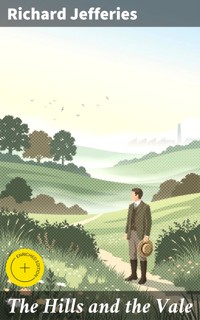
In "The Hills and the Vale," Richard Jefferies exquisitely captures the essence of rural life and the natural world, presenting a rich tapestry of pastoral landscapes and personal reflections. Jefferies' prose is characterized by its vivid imagery and lyrical quality, inviting readers to immerse themselves in the tranquil beauty of the English countryside. The book, written during the Victorian era, articulates a longing for the simplicity and harmony of nature, while also engaging with the rapid industrialization of that time. Jefferies' philosophical musings reveal a profound understanding of humanity's connection to the land, making this work an essential piece in the context of nature writing and ecological awareness. As a notable figure in the field of nature literature, Richard Jefferies was deeply influenced by his upbringing in rural Wiltshire and his keen observations of the natural world. His work often reflects a struggle between the encroaching modern age and the peacefulness of the countryside, stemming from Jefferies' own experiences with ill health and a yearning for solace amidst life's chaos. His writings bear the weight of nostalgia and a sincere appreciation for the fleeting moments of beauty found in nature. I wholeheartedly recommend "The Hills and the Vale" to readers seeking a deeper understanding of the symbiotic relationship between humans and nature. Jefferies'Äô evocative language will resonate with lovers of pastoral literature and those who cherish the restorative power of the countryside. This book serves not only as an exploration of landscapes but also as a meditation on existence, inviting readers to contemplate their own connections to the natural world. In this enriched edition, we have carefully created added value for your reading experience: - A succinct Introduction situates the work's timeless appeal and themes. - The Synopsis outlines the central plot, highlighting key developments without spoiling critical twists. - A detailed Historical Context immerses you in the era's events and influences that shaped the writing. - A thorough Analysis dissects symbols, motifs, and character arcs to unearth underlying meanings. - Reflection questions prompt you to engage personally with the work's messages, connecting them to modern life. - Hand‐picked Memorable Quotes shine a spotlight on moments of literary brilliance.
Das E-Book können Sie in Legimi-Apps oder einer beliebigen App lesen, die das folgende Format unterstützen:
Veröffentlichungsjahr: 2019
Ähnliche










The Hills and the Vale
Table of Contents
Introduction
The Hills and the Vale gathers a sequence of Richard Jefferies’ shorter pieces into a single, coherent volume, presenting his work as a continuous exploration rather than as isolated articles. The scope is selective rather than exhaustive: it is not a novel or a complete works, but a curated collection that moves across landscape, rural life, and the habits of attention by which those subjects become literature. Read together, the items show how Jefferies turns local scenes into sustained inquiry, balancing close observation with reflective argument and an evident commitment to clarity of description.
The texts here are primarily essays and sketches of place, custom, and natural history, shaped for a general readership and organized as distinct chapters. Some entries focus on practical experience and outdoor pursuits, others on seasonal change and wildlife, and others on village institutions and agricultural conditions. The variety of titles signals the range of forms: descriptive nature writing, topographical and social commentary, and short narrative or vignette-like pieces that work by accumulation of detail rather than by plot. The presence of a note on transcriber’s corrections in this edition underscores its archival, text-preserving purpose.
Across these pages Jefferies returns to the English countryside as a living system: hills and downs, brooks and fields, woods and villages, and the people whose labour and routines are bound to them. The unifying impulse is attentiveness—an insistence that ordinary ground can be looked at long enough to yield pattern, history, and feeling. Whether he is watching spring arrive, tracing the contours of a district, or describing a human practice in the open air, he treats the scene as an occasion for exact language and patient perspective. The landscape is never merely background; it is the medium through which experience is understood.
Jefferies’ characteristic style in these pieces joins sensory precision to measured contemplation. He writes with an eye trained on weather, light, and the small movements of birds and plants, yet he also keeps returning to the moral and social meanings that gather around land. The prose often proceeds by successive touches—one detail set beside another—until a full atmosphere is built, and the reader is drawn into a way of seeing rather than a single argument. That method lends the collection its unity: it is less a catalogue of topics than a sustained practice of perception and articulation.
Several selections turn explicitly toward rural society and agriculture, treating the countryside not only as scenery but as an economic and civic reality. Pieces concerned with labour, organization, and local institutions broaden the book’s register, placing natural description alongside observation of social conditions. This combination is central to the collection’s purpose: it preserves Jefferies’ ability to hold pastoral beauty and material difficulty in the same frame, without reducing either to sentiment or polemic. The result is a portrait of country life that recognizes both the enduring textures of place and the pressures that shape them.
The arrangement from practical subjects through seasonal studies and outward to more meditative chapters suggests an arc from immediate experience to larger reflection. Jefferies can begin with a particular activity or locality and then extend the view, letting the physical world prompt questions of time, continuity, and human belonging. Without turning these works into a single narrative, the collection invites a cumulative reading in which motifs recur: the coming of spring, the hush of woodland, the open expanse of downs, and the intimate scale of village spaces. Each return deepens the reader’s sense of a shared terrain.
The ongoing significance of Jefferies’ work lies in its fusion of literary craft with disciplined looking, a combination that continues to speak to readers concerned with nature, place, and the lived realities of rural communities. These essays and sketches model an ethics of attention that does not require rarity or spectacle; it asks instead for steadiness, patience, and a respect for what is near at hand. In bringing together pieces that range from local history to the textures of dawn and season, The Hills and the Vale presents Jefferies as a writer for whom environment, society, and inner life are inseparable parts of one enduring subject.
Historical Context
Richard Jefferies (1848–1887) wrote the pieces gathered in The Hills and the Vale from the standpoint of a Wiltshire native observing rapid change in the English countryside after mid-century. Born near Coate, outside Swindon, he grew up as railways, market towns, and commercial farming tightened their grip on a landscape long organized by parish, common, and custom. The collection’s frequent return to downs, brooks, woods, and village institutions reflects a late-Victorian tension between continuity and disruption: the persistence of seasonal rhythms and local speech alongside new forms of work, transport, and political expectations. These tensions underwrite both its natural description and its social critique.
Many essays in the volume emerged from Jefferies’s work as a journalist in the 1870s, when London periodicals sought rural correspondents to satisfy an expanding reading public. Rising literacy after the Elementary Education Act of 1870 and the growth of the cheap press created audiences for nature writing that also carried social information about agriculture and labour. Jefferies’s ability to connect field observation with topical issues suited this market, and his Wiltshire settings provided recognizable, reportable places rather than romantic abstractions. The collection’s blend of close natural history with commentary on farms, villages, and local politics reflects this journalistic context and the period’s hunger for “real England” amid urbanization.
The agricultural depression beginning in the mid-1870s shaped Jefferies’s attention to “unequal agriculture,” idle land, and the fragility of rural livelihoods. Cheap grain imports after the repeal of the Corn Laws (1846) intensified under late-century global trade and transport, while bad seasons in 1875–1879 compounded pressure on arable districts like parts of Wiltshire. Landowners and tenant farmers responded unevenly—some shifting to pasture, others cutting labour or rents—producing the disparities Jefferies records between prosperous acres and failing fields. These economic forces inform his interest in cultivation, tool use, and the landscape as a working system, not merely scenery, and they explain the somber undertone beneath pastoral passages.
Industrial and infrastructural growth around Swindon provides another anchor for the collection. The Great Western Railway established its Swindon works in 1843, and by Jefferies’s adulthood the town had become a major railway center, transforming employment patterns and local identity. “The Story of Swindon” resonates with a broader Victorian narrative of railway-driven modernization, in which new towns, timetables, and wage labor coexisted with nearby villages still structured by parish boundaries and seasonal hiring. Jefferies writes from the border between these worlds: he could walk from rail-built streets to open downland, and his sensitivity to noise, speed, and altered horizons reflects the lived proximity of industrial modernity to traditional rural space.
Political reform also frames Jefferies’s rural portraits, especially where the collection touches on the county franchise and village organization. The Second Reform Act (1867) and the Ballot Act (1872) altered electoral practice, while the Third Reform Act (1884) and Redistribution Act (1885) later extended the county vote and reshaped constituencies. Even before the final reforms, debate over representation, deference, and local influence was felt in counties like Wiltshire, where landowners had long dominated. Jefferies’s interest in how villages govern themselves and how labourers perceive power reflects the gradual politicization of rural life, as national legislation pressed into parish routines and old hierarchies faced scrutiny.
The condition of rural labour—wages, housing, bargaining power—became a prominent national issue in the years Jefferies was writing. Agricultural unionism surged with Joseph Arch’s formation of the National Agricultural Labourers’ Union in 1872, and strikes and meetings spread across southern England. Although membership later declined, the movement widened public attention to rural poverty, allotments, and the dependence of labourers on farmers and landlords. Jefferies’s sympathetic but unsentimental accounts of the Wiltshire labourer draw on this context, balancing personal observation with awareness that rural hardship had entered political discourse. Contemporary readers, especially in cities, often approached such writing as both revelation and indictment.
Intellectual currents in natural history and preservation shaped Jefferies’s method and reception. The Victorian era fostered popular science, field clubs, and collecting, while debates following Darwin’s On the Origin of Species (1859) encouraged close attention to adaptation, seasonality, and habitat. Jefferies’s sketches of birds, spring, and small phenomena share this observational ethos, yet he often turns from cataloguing toward reflective, almost metaphysical prose. At the same time, late-century concern for vanishing rural customs and landscapes—intensified by enclosure’s long aftermath and by suburban spread—made readers receptive to writing that seemed to rescue transient details. His work thus sits between naturalist practice and a growing cultural desire to conserve experience.
Finally, leisure and sport in the countryside underwent notable expansion, influencing essays on guns, skating, and outdoor pursuits. The 1870s and 1880s saw the wider availability of factory-made firearms and sporting goods, and the spread of rail travel enabled day trips and seasonal recreations. Field sports also carried social meanings—property rights, access to land, and the etiquette of class—so practical discussions of equipment and pastime can imply larger structures of privilege. Jefferies’s treatment of recreation is therefore historically situated: it reflects both increased middle-class participation in outdoor life and older rural boundaries. Across the collection, these shifts help explain his mixture of immediacy, critique, and elegiac calm.
Synopsis (Selection)
Introduction
Sets the scene for the collection by framing Jefferies’ purpose: to read the countryside closely, from daily labor to seasonal change, and to treat rural observation as a serious kind of knowledge.
Establishes a signature blend of plainspoken reportage and lyrical attentiveness, preparing the reader for essays that move between social critique and nature writing.
Rural skills & pastimes (Choosing a Gun; Skating)
These pieces use practical pursuits—selecting a firearm and taking to winter ice—to show how countryside life is shaped by tools, weather, and local custom as much as by scenery.
Jefferies’ tone is brisk and concrete yet quietly reflective, turning everyday techniques into meditations on self-reliance, risk, and the sensory immediacy of outdoor life.
Woods, churches, and local landscapes (Marlborough Forest; Village Churches; On the Downs; The Sun and the Brook)
A sequence of place-centered sketches that map the textures of forest, parish, chalk downland, and stream, treating each landscape as a living archive of work, worship, and habit.
The writing alternates between topographic clarity and painterly detail, with recurring motifs of light, wind, water, and time making the countryside feel both intimate and historically layered.
Seasonal natural history (Birds of Spring; The Spring of the Year; Vignettes from Nature)
Focuses on spring’s return through birds, plants, and small ecological dramas, offering close field observation that privileges patience and precision over grand narrative.
Across these vignettes Jefferies’ style becomes especially sensory and rhythmic, using recurring images of song, budding, and quick movement to express renewal without sentimentality.
Land, farming, and rural economy (A King of Acres; Unequal Agriculture; The Idle Earth)
Examines landownership and agricultural practice to show how wealth, productivity, and opportunity are unevenly distributed across the countryside.
The tone shifts toward argument and diagnosis, using concrete examples and contrasts to critique waste, inefficiency, and the social costs of mismanaged land.
Swindon and county politics (The Story of Swindon; Village Organization; After the County Franchise)
Traces local development and governance to reveal how towns, villages, and new political arrangements reshape everyday rural life and civic power.
Jefferies blends narrative local history with institutional observation, returning to motifs of change, representation, and the friction between tradition and modern administration.
Rural labor and class (The Wiltshire Labourer)
Centers on the conditions, outlook, and pressures of the agricultural worker, presenting rural poverty and resilience as structural realities rather than personal failings.
The essay’s restrained moral urgency complements the collection’s social critiques, tying landscape beauty to the human costs of sustaining it.
Nature, perception, and the metaphysical (Nature and Eternity; The Dawn)
These later, more contemplative pieces widen from natural description to questions of consciousness, time, and what the natural world suggests about permanence and meaning.
A notable tonal shift toward visionary inwardness appears here, yet the recurring stylistic signature remains: exact sensory noticing used as a bridge from the visible countryside to larger philosophical reach.
Transcriber's corrections
A brief note indicating textual emendations made in the process of transcription, without adding new argumentative or narrative content.
Serves as ancillary material rather than a thematic component of the collection.




