


0,49 €
Niedrigster Preis in 30 Tagen: 2,49 €
Niedrigster Preis in 30 Tagen: 2,49 €
Mehr erfahren.
- Herausgeber: Booksell-Verlag
- Kategorie: Lebensstil
- Sprache: Englisch
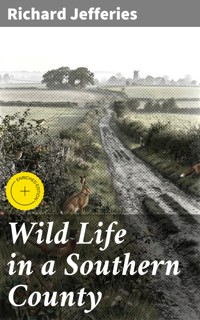
In "Wild Life in a Southern County," Richard Jefferies intricately weaves a tapestry of the English countryside, illuminating the flora and fauna that inhabit it. Written in the late 19th century, this work reflects the naturalistic observations characteristic of the Victorian era, revealing not only the beauty of nature but also its inherent struggles. Jefferies' lyrical prose is both descriptive and reflective, inviting readers to immerse themselves in the rhythms of rural life, making it a seminal text for those interested in natural history and ecological consciousness. Richard Jefferies, a self-educated naturalist and author from Wiltshire, England, draws deeply from his own experiences as a child raised in the countryside. His keen observations of wildlife and deep empathy for nature stem from a life intertwined with the landscapes he described. Jefferies' passion for the natural world shines through in this work, which is also layered with existential reflections, revealing his recognition of humanity's place within the larger ecosystem. "Wild Life in a Southern County" is highly recommended for readers seeking a profound connection to nature and a deeper understanding of rural England during the Victorian era. With its rich observational detail and lyrical elegance, this book stands as a timeless testament to the beauty and complexity of the natural world, sure to resonate with ecologists, historians, and lovers of literature alike. In this enriched edition, we have carefully created added value for your reading experience: - A succinct Introduction situates the work's timeless appeal and themes. - The Synopsis outlines the central plot, highlighting key developments without spoiling critical twists. - A detailed Historical Context immerses you in the era's events and influences that shaped the writing. - A thorough Analysis dissects symbols, motifs, and character arcs to unearth underlying meanings. - Reflection questions prompt you to engage personally with the work's messages, connecting them to modern life. - Hand‐picked Memorable Quotes shine a spotlight on moments of literary brilliance. - Interactive footnotes clarify unusual references, historical allusions, and archaic phrases for an effortless, more informed read.
Das E-Book können Sie in Legimi-Apps oder einer beliebigen App lesen, die das folgende Format unterstützen:
Veröffentlichungsjahr: 2019
Ähnliche















Wild Life in a Southern County
Table of Contents
Introduction
To watch the familiar countryside closely is to discover how much wildness persists beneath the routines of ordinary life.
Richard Jefferies’s Wild Life in a Southern County is a work of nature writing that observes the living world of rural England through an attentive, essay-like mode of description. Written in the nineteenth century, it belongs to a period when close field observation, country lore, and literary sketching often met on the same page, creating a form that is neither guidebook nor fiction but a patient record of what the author sees and hears. The “southern county” of the title signals a local focus rather than an abstract pastoral, grounding the book’s attention in particular fields, hedges, waters, and seasons.
The premise is simple and enduring: the author walks, watches, and returns, letting repeated encounters with birds, mammals, insects, and plants accumulate into a portrait of a place as it lives day by day. Readers are invited into a sustained attentiveness rather than a plot-driven journey, following the movement of weather, light, and habit as they shape what can be noticed. The experience is therefore cumulative and immersive, a kind of slow reading that rewards lingering. It is less about naming and more about seeing, and it encourages the reader to recalibrate perception toward the small, the fleeting, and the overlooked.
Jefferies’s voice is that of a careful observer who trusts the authority of direct experience, shaping detail into prose that often feels meditative without losing its groundedness. The tone tends toward quiet intensity: the countryside is not treated as mere backdrop but as a dynamic field of relations and surprises. The style favors concrete scenes and the rhythms of outdoor time, so that passages can feel like extended looking, listening, and waiting. Because the book proceeds by observation rather than argument, it can be entered at many points, and its pleasures are renewed by rereading, when earlier details begin to connect.
Among its central themes is attentiveness itself, presented as both a discipline and a form of enjoyment, with patience as the price of genuine encounter. The book repeatedly tests the boundary between the human world and the more-than-human one, suggesting how easily daily concerns can dull perception, and how quickly a landscape becomes alive when watched with care. It also explores seasonality and change, emphasizing cycles and variations that cannot be grasped in a single glance. Without reducing nature to a moral lesson, it implies that understanding comes through sustained contact and humility before complexity.
The work also matters for its implicit record of rural life as a lived environment rather than a picturesque idea. By dwelling on ordinary places and common creatures, it resists the tendency to value only the rare or spectacular, and it models a way of writing in which significance emerges from proximity. The county setting becomes a study in how locality shapes knowledge: what can be known depends on where one stands and how often one returns. This local realism, rooted in walking and waiting, offers a counterweight to generalized talk about “nature” that ignores place.
For contemporary readers, Wild Life in a Southern County remains relevant because it trains the mind toward careful observation at a time when attention is frequently fragmented and outdoor experience mediated. Its method anticipates modern concerns without requiring modern terminology: it shows that landscapes are not static, that small changes matter, and that the everyday environment can be read as a living text. The book also offers an alternative to speed and abstraction, inviting a slower pace that can deepen both knowledge and feeling. In doing so, it helps readers recover a sense of connection to nearby nature, wherever they live.
Synopsis
Wild Life in a Southern County by Richard Jefferies presents a closely observed account of animals and countryside life in an English southern county, written in Jefferies’s characteristic blend of natural history and reflective prose. The work proceeds through a series of connected sketches rather than a single plot, moving from general impressions of landscape and seasons to particular encounters with birds, mammals, insects, and plants. Jefferies frames his subject as both an external field of study and an intimate, everyday presence, establishing attention, patience, and accuracy as the guiding principles of his observations.
paragraphs: OOPS
The early portions emphasize how the appearance of the countryside shifts with weather and time, and how those shifts govern what can be seen and heard. Jefferies tracks signs and traces—calls, footprints, flight patterns, and subtle movement in hedgerows—to show that much of wild life is revealed indirectly. He frequently contrasts surface calm with constant activity beneath it, suggesting that human routines often overlook a parallel world operating at different hours and scales. This section sets up the book’s central tension between visibility and concealment in nature, and between knowledge and assumption in rural observation.
As the sequence continues, Jefferies turns to specific species and habitats, treating fields, woods, waterways, and village edges as distinct theatres of behavior. He attends to feeding, nesting, territorial habits, and seasonal migration where relevant, conveying how survival depends on both instinct and adaptability. Without presenting a rigid scientific treatise, he conveys a disciplined attentiveness and encourages the reader to test impressions against repeated viewing. The human presence remains largely in the background, but it shapes boundaries and pressures, showing how cultivation, paths, and customary practices intersect with animal movement and refuge.
Jefferies also explores the difficulty of truly knowing wild creatures, returning to the idea that closeness does not guarantee understanding. Many passages hinge on the observer’s limitations: distance, fleeting glimpses, changing light, and the animals’ wariness. He demonstrates how easily the mind fills gaps with convenient stories, and he repeatedly corrects such impulses by returning to what can be confirmed by experience. In this way, the book becomes an argument for a disciplined humility. Nature is portrayed not as a decorative backdrop but as a complex set of relations, risks, and opportunities.
The middle of the work expands the sense of countryside life by including smaller forms of wildness that are commonly ignored. Jefferies gives attention to insects and other minute lives as integral parts of the local ecology, not merely incidental details. He connects these presences to broader seasonal rhythms, showing how abundance and scarcity travel through food chains and habitats. The narrative flow remains observational, but the cumulative effect is to make the county feel densely inhabited, with each hedge, bank, or stream margin holding its own dramas. The emphasis stays on patterns, repetitions, and change over time.
Throughout, Jefferies balances admiration with unsentimental realism, acknowledging predation, loss, and the constant pressures that shape animal behavior. He treats the countryside as neither idyllic nor uniformly harsh, but as a place where beauty and struggle are intertwined. His reflections imply questions about the ethical and practical implications of human dominance, yet he avoids turning the book into a polemic. Instead, he uses concrete scenes to suggest how human actions alter what can thrive nearby. The writing remains grounded in locality, using the southern county as a lens for wider natural processes.
Historical Context
Richard Jefferies’ Wild Life in a Southern County (1879) was written in late-Victorian England, when rapid industrialization coexisted with long-established rural economies. Jefferies (1848–1887) was born near Swindon in Wiltshire, a largely agricultural county in the south of England. The book belongs to a period of expanding print culture: cheaper newspapers, magazines, and circulating libraries widened audiences for nonfiction prose about countryside life and natural history. It appeared as part of a broader Victorian interest in observing, cataloguing, and describing the natural world in accessible language for general readers.
The “southern county” Jefferies describes is grounded in the chalk downs, river valleys, and farmland typical of Wiltshire and adjacent counties. By the 1870s, railways had connected many market towns and villages to London and industrial centres, changing patterns of travel, trade, and leisure. Enclosure—largely completed earlier in the century—had consolidated open fields and commons into privately managed farms, reshaping habitats and access to land. Rural parishes, landed estates, tenant farms, and village institutions such as the church and the local market remained central to daily life even as national integration intensified.
Victorian natural history provided a key intellectual backdrop. Since the late eighteenth century, amateur and professional naturalists had produced county histories, field guides, and journals; by Jefferies’ time, societies and museums supported collecting and classification. Charles Darwin’s On the Origin of Species (1859) and later works intensified public discussion about evolution and adaptation, influencing how readers interpreted observations of animals, plants, and ecology. Jefferies wrote after these debates had entered mainstream culture, and his close attention to behaviour, seasonal change, and habitat reflects the era’s emphasis on empirical observation rather than purely romantic description.
The rural economy was under significant strain during the years immediately preceding and following the book’s publication. From the mid-1870s, Britain entered the “Great Depression” in agriculture: falling grain prices, competition from imported wheat facilitated by steamships and rail, and changing land values pressured farmers and labourers. These economic shifts contributed to social tension in many counties, including wage disputes and insecurity for hired workers. Jefferies’ focus on fields, hedgerows, and working landscapes is informed by this context in which countryside scenes were not merely picturesque, but tied to productivity, tenancy, and livelihoods.
Rural society was also shaped by political reform and the growth of organized labour. The Second Reform Act (1867) and the Ballot Act (1872) altered electoral politics and reduced open coercion at the polls, including in rural constituencies. In the early 1870s Joseph Arch helped found the National Agricultural Labourers’ Union (1872), bringing national attention to farm workers’ wages and conditions. Although Jefferies is primarily a nature writer, he wrote in a moment when the countryside was widely discussed as a site of inequality, modernization, and changing relations between landowners, farmers, and labourers.
Public health and infrastructure reforms affected rural and small-town environments that Jefferies knew. The Public Health Act (1875) consolidated sanitary regulation, while local government bodies increasingly addressed drainage, water supply, and housing conditions, matters relevant to villages and market towns. Education expanded after the Elementary Education Act (1870), increasing literacy and creating new readers for periodical literature and books about the natural world. Such changes did not erase traditional rural practices, but they reframed everyday life within a national agenda of improvement, measurement, and administrative oversight.
Environmental transformation was a visible feature of nineteenth-century Britain. Expansion of rail lines, quarrying for chalk and stone, improved field drainage, and intensified farming practices altered habitats for birds, insects, and wild plants. Game preservation on estates influenced species populations and land management, while shifting attitudes toward predators and “vermin” affected wildlife. Jefferies’ essays, attentive to seasonal rhythms and specific localities, were written against this backdrop of human-driven change. His method—patient field observation—mirrored contemporary scientific habits while recording landscapes undergoing measurable modification.
Within late-Victorian letters, Wild Life in a Southern County aligns with the era’s nonfiction tradition of countryside sketching and natural history, alongside writers who blended observation with social awareness. Jefferies’ work reflects a period when the countryside was increasingly idealized by urban readers yet materially pressured by economic depression and modernization. Without relying on fictional plot, the book uses real landscapes, ordinary rural institutions, and observable animal life to register those tensions. Its emphasis on what can be seen in fields and lanes serves both as documentation of a place and as an implicit critique of neglect, disruption, and complacent nostalgia in its time.




