


0,49 €
Niedrigster Preis in 30 Tagen: 1,99 €
Niedrigster Preis in 30 Tagen: 1,99 €
Mehr erfahren.
- Herausgeber: Booksell-Verlag
- Kategorie: Gesellschafts- und Liebesromane
- Sprache: Englisch
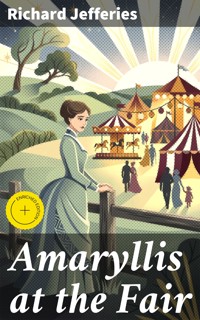
Set against the backdrop of a whimsical fair, Richard Jefferies' "Amaryllis at the Fair" intertwines elements of pastoral realism with a rich tapestry of human emotion and experience. The narrative employs a distinctive lyrical style, characterized by vivid descriptions and an acute awareness of the subtleties of nature and human interaction, showcasing Jefferies' skillful observations of life in Victorian England. Through the lens of young Amaryllis, who navigates the complexities of love and societal expectations, the novel invites readers to reflect on the transience of joy, evoked by the vibrant scenes of the fair and the poignant moments of connection and disconnection among the characters. Richard Jefferies (1848-1887), a pioneering English nature writer, drew inspiration from his rural upbringing and his profound connection to the English landscape. Motivated by his longing for authenticity in a rapidly industrializing world, Jefferies captured the essence of humanity'Äôs relationship with nature, thereby informing his narrative in "Amaryllis at the Fair." His expertise in embedding philosophical underpinnings within simple stories makes this work a significant addition to the literary canon of the time. "Amaryllis at the Fair" is a compelling read for enthusiasts of Victorian literature and those seeking to explore the delicate interplay of love, nature, and community. Jefferies' eloquent prose will resonate with readers, encouraging them to ponder the deeper meanings behind the joyous exuberance of the fair, making it a profound exploration of the human condition. In this enriched edition, we have carefully created added value for your reading experience: - A succinct Introduction situates the work's timeless appeal and themes. - The Synopsis outlines the central plot, highlighting key developments without spoiling critical twists. - A detailed Historical Context immerses you in the era's events and influences that shaped the writing. - A thorough Analysis dissects symbols, motifs, and character arcs to unearth underlying meanings. - Reflection questions prompt you to engage personally with the work's messages, connecting them to modern life. - Hand‐picked Memorable Quotes shine a spotlight on moments of literary brilliance. - Interactive footnotes clarify unusual references, historical allusions, and archaic phrases for an effortless, more informed read.
Das E-Book können Sie in Legimi-Apps oder einer beliebigen App lesen, die das folgende Format unterstützen:
Veröffentlichungsjahr: 2019
Ähnliche




















Amaryllis at the Fair
Table of Contents
Introduction
What happens to a life rooted in soil and seasons when it is pushed up against the glittering promises and subtle coercions of modern society?
Richard Jefferies’ Amaryllis at the Fair is a late-Victorian English novel, first published in 1887, that blends pastoral fiction with social observation and psychological attentiveness. Set chiefly in the countryside, it moves between the fields, lanes, and farmyards of rural life and the wider pressures that reach in from towns, markets, and public entertainments. Jefferies, best known for nature writing as well as fiction, brings to the novel an acute sensitivity to landscape and a keen ear for the moral and material language of everyday work.
The story centers on a farming household and the young woman known as Amaryllis, whose presence gathers the novel’s questions about desire, duty, independence, and the costs of survival. Rather than relying on melodramatic plot turns, the book unfolds through close attention to character, circumstance, and the steady accumulation of choices. The “fair” of the title signals a world of spectacle and exchange that stands in contrast to the rhythms of the farm, and the narrative draws energy from that contrast without turning it into a simple opposition of innocence and corruption.
Jefferies’ narrative voice often lingers, observing people and places with the patience of a naturalist and the tact of a social critic. Readers can expect richly textured description, a measured pace, and an atmosphere in which weather, work, and the look of a hedgerow carry emotional weight. The tone is serious and contemplative, yet not detached: the novel takes physical hardship, small pleasures, and private hopes with equal seriousness. Its style is attentive to the felt experience of rural life, presenting it neither as a quaint backdrop nor as a mere problem to be solved.
At its heart, the novel explores the tension between material necessity and the inward life. It considers how money, property, and social standing shape the possibilities available to individuals, especially within a farming economy vulnerable to change. Alongside these pressures, the book examines the persistence of personal aspiration and the difficulty of making a self within inherited roles. Jefferies treats nature not as a decorative setting but as a force that frames labor and mood, offering sustenance, indifference, and occasional consolation.
Amaryllis at the Fair also probes questions of gender and power through its attention to domestic spaces and social expectation. Without reducing its characters to symbols, it shows how reputation, marriageability, and household authority can operate as quiet forms of constraint. The fair, the market, and the public world beyond the farm represent not only entertainment but the circulation of judgments and desires, where people are seen, valued, and compared. In this way the novel connects private feeling to public structures, revealing how social systems reach into intimate decisions.
The book still matters because it registers a moment when rural life was being reimagined under the pressure of broader economic and cultural change, a situation that echoes in contemporary debates about community, labor, and the meaning of place. Jefferies’ careful depiction of how environments shape attention and conduct speaks to modern readers navigating their own forms of speed, spectacle, and uncertainty. The novel’s slow, sensuous observation can feel like a corrective to distraction, inviting reflection on what is lost when life is organized primarily around exchange rather than belonging. Its enduring value lies in its humane insistence that inner freedom is tested, and sometimes defended, in the most ordinary of days.
Synopsis
Richard Jefferies’ Amaryllis at the Fair is a late nineteenth-century novel that follows the life of Amaryllis Iden, a young woman growing up on a farm in rural England. The narrative establishes a household shaped by land, weather, and custom, while hinting at the pressures that bear on small proprietors and tenant farmers. Through close attention to daily routines and the textures of the countryside, Jefferies frames Amaryllis as both participant in and observer of her world, inviting the reader to consider how character is formed amid economic constraint, family expectation, and the pull of wider social life.
paragraphs
Amaryllis’s family circumstances are portrayed as precarious, with property, money, and reputation continually at stake. Jefferies traces the Iden family’s relationships and obligations, showing how decisions about work, debt, and status ripple through the home. Amaryllis’s position is complicated by generational authority and by assumptions about what a daughter should contribute and endure. Rather than treating rural life as purely idyllic, the novel emphasizes its negotiations: between affection and resentment, prudence and aspiration, and the desire for stability against the unpredictable forces that can upset a farm and a household.
As the story advances, Amaryllis’s inner life comes into sharper focus. She is shown weighing loyalty to her family against a growing sense of personal agency, and her perceptions of the people around her become more discriminating. Encounters within the village and among neighboring families reveal layers of social hierarchy and informal power, including how appearances are managed and how gossip can harden into judgment. Jefferies uses these interactions to explore how a community can sustain individuals while also constraining them, especially when economic hardship and pride make compromise difficult.
The “fair” of the title functions as a recurring social and symbolic point of reference, drawing together trade, entertainment, and observation. In the bustle of such public gatherings, the private dilemmas of the characters are placed against a broader canvas of rural commerce and public display. Amaryllis’s experience of this world contrasts with the routines of the farm, sharpening questions about what counts as freedom, what is merely distraction, and what possibilities exist beyond inherited roles. The fair scenes also illuminate the novel’s attention to class difference and to the ways money and status circulate in plain sight.
Alongside its social narrative, the novel sustains a careful depiction of landscape and season as active influences on mood and decision. Jefferies connects the material realities of soil, crops, and animals to the emotional weather of the household, so that changes in the countryside parallel shifts in human hope and fatigue. This environmental attentiveness is not presented as sentimental ornament; it reinforces the stakes of rural livelihood and the sense that human plans are continually tested by conditions outside individual control. Amaryllis’s sensibility is shaped by this intimacy with place and labor.
As relationships and financial pressures tighten, the story builds tensions around responsibility, endurance, and the cost of maintaining a family holding. Amaryllis’s judgments about those closest to her become more complex, and the narrative emphasizes how difficult it is to separate love from duty when security is uncertain. Jefferies keeps attention on practical matters—work, money, and social standing—while also tracing the quieter conflicts of self-respect and longing. The novel proceeds by accumulating moments of choice and consequence rather than by overt sensationalism, preparing the ground for later developments without disclosing their outcomes in advance.
Historical Context
Richard Jefferies published Amaryllis at the Fair in 1887, late in the Victorian period, when rural England was undergoing sustained economic and social change. The novel draws on a recognizable setting in the chalk-and-clay farming country of southern England, particularly Wiltshire, where Jefferies was born near Swindon in 1848. Its landscape and village life reflect a nation shaped by rapid industrial growth and expanding towns, yet still governed locally by landownership, parish structures, and customary rural hierarchies. Jefferies wrote after achieving prominence as a journalist and nature writer, bringing documentary habits to fiction.
The late nineteenth century saw the “Great Depression” in British agriculture (roughly 1873–1896), marked by falling grain prices and intensified foreign competition. Cheaper imported wheat and meat, enabled by steamships and railways, pressured arable farming and altered land use. Many estates and tenant farms shifted toward pasture, dairying, or cost-cutting; wages and employment for rural laborers were insecure. These conditions form the economic backdrop for a novel concerned with farm management, property, and the precariousness of rural livelihoods. Jefferies’ attention to material details of farming aligns with contemporary debates about rural decline and adaptation.
Rural society was also changing through law and politics. The Second Reform Act (1867) and the Representation of the People Act (1884) expanded the male electorate, increasing political attention to working people, including agricultural laborers. The secret ballot (1872) reduced landlord influence at elections, while the Agricultural Labourers’ Union (founded 1872) brought organized wage and condition demands into many counties. Although union strength fluctuated, these movements helped place class relations in the countryside under scrutiny. Jefferies’ portrayal of social distance, deference, and conflict is intelligible against this environment of expanding political participation and contested authority.
Institutionally, the Church of England remained prominent in parish life, but Victorian England experienced religious diversity and debate. The Oxford Movement earlier in the century had reshaped Anglican practice in some places, while Nonconformist chapels were influential in many rural districts. Education policy also mattered: the Elementary Education Act of 1870 established school boards and widened schooling, altering expectations for children and literacy in villages. Local governance still relied on magistrates and vestries, with later reforms on the horizon. Such institutions help contextualize the novel’s social settings and the moral language through which characters judge work, duty, and respectability.
Transport and markets connected countryside and town more tightly than earlier generations had known. By the 1870s and 1880s, railways had spread across England, moving livestock, milk, and produce quickly to urban consumers. Agricultural shows and fairs—longstanding institutions—remained important places for trading animals, hiring labor, and social display. They also highlighted new techniques, commercial competition, and the visibility of wealth. Jefferies uses the fair as a plausible focal point for observing rural society in motion, where status, cash, and reputation are publicly negotiated. This setting aligns with documented patterns of Victorian rural commerce and seasonal gatherings.
Intellectual movements of the period also shaped how nature and rural life were represented. Victorian natural history flourished in learned societies and popular periodicals, and debates over evolution after Charles Darwin’s On the Origin of Species (1859) influenced educated discussion of the natural world. Jefferies contributed to this culture through essays that combined close observation with reflective prose, published in magazines and later books. His approach differed from purely pastoral tradition by stressing physical detail and the pressures of modern life. The novel’s descriptive realism and attention to environment fit within a broader late-Victorian interest in empiricism, science, and the documentation of everyday experience.
Literary context is equally relevant. By the 1880s, English realism and regional writing had become prominent, with novelists depicting specific localities, dialects, and class relations. Rural fiction often engaged with questions of inheritance, marriage, labor, and the constraints imposed by property. At the same time, the “condition of England” tradition encouraged authors to examine how economic change affected ordinary lives. Jefferies, better known for nonfiction works such as The Gamekeeper at Home (1878) and Wild Life in a Southern County (1879), brought a comparable observational rigor to his rural novel. This helps explain its focus on the interplay of land, work, and social power.
Against this historical background, Amaryllis at the Fair reflects the tensions of late-Victorian rural England: economic uncertainty in farming, shifting class relations, and the persistence of traditional hierarchies amid modernization. Its fair and farm settings allow a grounded view of how money, reputation, and ownership influence personal prospects. Jefferies’ emphasis on exact landscape and labor conditions connects the story to contemporary concerns about agricultural depression and the lived reality of villagers rather than idealized pastoral scenes. Without relying on sensational events, the work can be read as a critique of complacent rural authority and a record of social change at the local level.




