


5,49 €
Mehr erfahren.
- Herausgeber: Tory Thorkelson
- Kategorie: Bildung
- Sprache: Englisch
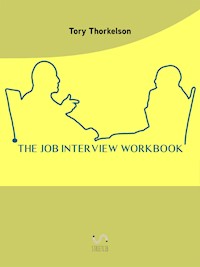
The Job Interview Workbook:
*Based on 10+ years of teaching job preparation and interview skills to undergraduate students, this workbook will:
*Build on basic skills like making small talk and asking open and closed questions.
*Review the basic theory including using registers and handling both assessment and information interviews.
*Allow students to practice both types of interviews above as an interviewer and interviewee.
*Show students how to create chronological and functional CVs.
*Help students write both application and inquiry styles of cover letters.
*Help students create professional looking CV’s and Cover letters.
*Introduce and practice the most common styles of interviews and interview questions.
*Help you effectively analyze the questions being asked for their purpose or intention as well as learn how to respond appropriately to each type of question.
*Show how to use both PAR and STAR techniques to answer behavioral and situational interview questions.
*Include plenty of real world based examples and activities to make the preparation process active and realistic.
*Offer a short list of useful resources and references for both student and teacher to explore selected topics in more detail as needed.
Das E-Book können Sie in Legimi-Apps oder einer beliebigen App lesen, die das folgende Format unterstützen:
Veröffentlichungsjahr: 2018
Ähnliche
















Tory S. Thorkelson, M.Ed.
The Job Interview Workbook
Table of contents
Part One: Interviews versus Conversations and a model
Part Two: Informal Interviews for practice
Part Three: Your CV and Cover Letter
Part Four: Types of Interviews/Interview Questions & Advice
Part Five: Worksheets and Practice activities
Sample Answers, Resources and References
Preface and About the Author
Part One: Interviews versus Conversations and a model
Common Conversation Sins:
An interview is sometimes referred to as a guided conversation. While this may be a bit misleading, it is a good, concise description of what a job interview that is done properly should feel like for the job applicant. Below is a list of some common mistakes that people make during a typical conversation that also relate to a good job interview.
i) Being rude: Playing with your phone, ignoring the people you are supposed to be talking with or otherwise showing that you’d rather be somewhere else than here talking to these people is bad behaviour. Period.
ii) Telling boring or depressing stories about yourself: This is not a session with your councillor, and these people are not your social workers or personal psychiatrist. They have no need or desire to make you feel good about yourself or keep you from committing social suicide. They are here for a friendly chat and that is all.
iii) Race, Religion, Politics, & WHY meat is killing us all: There are just some topics that you do not talk about with people you barely know. There are acceptable topics for small talk (see the lesson on this), but these are NOT them.
iv) Arguing for no reason: There are places and times to play devil’s advocate or have an enjoyable debate, but a typical social situation is not it.
v) Being boring: We all like to tell stories or make attempts to be interesting and the center of attention at times but telling stories or relating a long, boring anecdote about yourself is not a good way to make a good impression on people you just met.
vi) Failing to listen: Especially in a social situation with new people and in an unknown venue, it makes sense to listen carefully to what people are saying and how they are expressing themselves before you start trying to get into the conversation. Listening first, last and in between is a good way to avoid making mistakes in a conversation just as it is a good idea in almost any other aspect of life.
Vii) Complaining: Just as with people who argue about everything, those who complain about every aspect of a place, the people there, the food being offered or every other thing they dislike are unlikely to make a lot of new friends. There are times and places for this, but at a party or other meeting with relative strangers is NOT it.
Now, discuss these questions with your partner(s):
l Which of these do you agree or disagree with? Why?l Which of these also apply to a job interview situation as well? Why?What is a Register?:
In linguistics, a register is a set of words used with a particular group of people or in a specific situation. Registers can be professional, like the words or expressions used by doctors or teachers. They can also be personal, like the nicknames or slang used by close friends or the members of an online community or gamers who play a game like StarCraft together. Registers are also called tenor (Halliday, 1978) or even style (Trudgill, 1992)
Also, a register may be formal or intimate depending on the situation and group who uses it. The chart below shows one way to categorize registers by when and how they are used following Joos (1961) model:
Register type:Description:Example:FrozenPrinted; unchanging language such as bible quotations; often contains archaisms.Bible quotations.FormalOne-way participation; no interruptions. Technical vocabulary; Fuzzy semantics or exact definitions are important.Introductions between strangers.ConsultativeTwo-way participation. Background information provided; prior knowledge is not assumed. “Backchannel behaviour” (e.g. I see) is common. Interruptions allowed.Class discussion or Job interview.CasualIn group friends and acquaintances. No background information provided. Ellipsis and slang common. Interruptions are common.Conversation among close friends.IntimateNon-public. Intonation is more important than wording or grammar. Private vocabularyBed talk/conversation with your significant other. (e.g. boy/girlfriend/spouse)Registers & You:1) What is a “register”?
2) What are some terms used that are similar to register?
3) Look up definitions for the following terms:
Archaisms:Fuzzy semantics:Backchannel behavior:Ellipses:Slang:4) What are some terms that are similar to register?
5) Define and give examples of the following levels of formality.
Level:Definition:Example:Frozen:Formal:Consultative:Casual:Intimate:6) Now, think of words/phrases you ONLY use with the following people or in the following situations.A. Family:
Word/Phrase:Definition:English Equivalent:B. Friends:Word/Phrase:Definition:English Equivalent:C. Classmates/Teacher:Word/Phrase:Definition:English Equivalent:D. Club:Word/Phrase:Definition:English Equivalent:E. University Interview: ( Graduate School)Word/Phrase:Definition:English Equivalent:F. Job Interview:Word/Phrase:Definition:English Equivalent:Now, compare your answers with your partner(s).What words are the same/different? Why?
References:
Joos, M. (1961), The Five Clocks, New York: Harcourt, Brace and World
Small Talk:
Small talk is part of holding a polite conversation, often with a stranger or acquaintance, about unimportant or inoffensive topics. It is used most often on social occasions, like at a party, or with strangers at a bus stop for example.
Small talk requires that those involved:
l Research some common topics that may come up.l Stay away from potentially offensive topics (see below).l Be sensitive to each other’s cultures.l Find common interests to talk about.l Listen carefully to each other.l Be prepared to interrupt at times as turn-taking can be confusing a in English.l Use backchannel behaviours to show interest (“uhuh”, “I see”) or body language appropriately (nodding, smiling at appropriate times). l Be prepared to talk to a variety of people for short periods of time.l Be willing to talk for longer periods of time with some people without causing offence if you both share a passion for a particular topic.Acceptable/Unacceptable topics for small talk (America/Canada) include:
+:--:Sports (current games, favourite teams or players, etc.)Religion (be open-minded!)HobbiesPolitics (favorite party/politician)Weather (boring but can get a conversation started)DeathFamily (general questions, not private subjects!)Salary/Finance (pay is no one’s business, and neither is how much your new car/computer/dress cost!)Media (current or recent films, books, news, etc.)Relationships (keep that to your boy/girlfriend or spouse and maybe your closest friends)Holidays (When, where, etc. but not costs!)Sales (no one wants to hear your pitch for a product from someone they just met).Hometown (where they come from, how it compares to here)Job/Major/University (General, not too specific.)Latest fashions or trends.Celebrity (gossip may be OK here). Making small talk with ANYONE: My questionsBrainstorm some acceptable topics/questions you would use for a particular group of people (family, friends, classmates and so on) that could be considered to be like small talk for only that group.
Topic:_______________ Audience:___________________Question(s):
Topic:_______________ Audience:___________________Question(s):Topic:_______________ Audience:___________________Question(s):Topic:_______________ Audience:___________________Question(s):Topic:_______________ Audience:___________________Question(s):Topic:_______________ Audience:___________________Question(s):Topic:_______________ Audience:___________________Question(s):Topic:_______________ Audience:___________________Question(s):




