


0,49 €
Niedrigster Preis in 30 Tagen: 1,99 €
Niedrigster Preis in 30 Tagen: 1,99 €
Mehr erfahren.
- Herausgeber: Booksell-Verlag
- Kategorie: Gesellschafts- und Liebesromane
- Sprache: Englisch
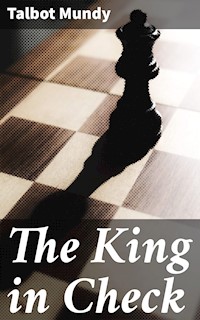
In "The King in Check," Talbot Mundy weaves an intricate narrative that embroils readers in the political machinations and cultural intricacies of early 20th-century India. With his trademark adventurous style, Mundy artfully blends elements of espionage, romance, and philosophical introspection, showcasing his affinity for melodrama while presenting a rich tapestry of characters whose allegiances are constantly tested. The novel is emblematic of Mundy's broader literary project, which often examines the tensions between East and West, tradition and modernization, set against a backdrop of colonial intrigue and mysticism. Talbot Mundy was a practitioner of adventure fiction, drawing from his own experiences as a soldier and traveller in India, which profoundly influenced his worldview and narrative style. Growing up in the late Victorian era, he was captivated by the exotic allure of the orient, and his writings often reflect a deep-seated curiosity about the complex interplay of diverse cultures. This background permeates "The King in Check," infusing the plot with authenticity and depth, as the characters navigate through moral dilemmas that mirror Mundy'Äôs own philosophical inquiries into loyalty, honor, and identity. For readers seeking an immersive journey that marries thrilling escapades with thoughtful reflections on cultural conflict, "The King in Check" stands as a compelling choice. Mundy'Äôs deft storytelling encourages readers to grapple with the intricate nuances of colonial dynamics and human relationships, making it a significant contribution to the adventure genre and a rewarding read for those interested in historical narratives that transcend simplistic portrayals of their times.
Das E-Book können Sie in Legimi-Apps oder einer beliebigen App lesen, die das folgende Format unterstützen:
Veröffentlichungsjahr: 2021
Ähnliche












The King in Check
Table of Contents
CHAPTER 1 "I'll make one to give this Faisal boy a hoist"
Whoever invented chess understood the world's works as some men know clocks and watches. He recognized a fact and based a game on it, with the result that his game endures. And what he clearly recognized was this: That no king matters much as long as your side is playing a winning game. You can leave your king in his corner then to amuse himself in dignified unimportance. But the minute you begin to lose, your king becomes a source of anxiety.
In what is called real life (which is only a great game, although a mighty good one) it makes no difference what you call your king. Call him Pope if you want to, or President, or Chairman. He grows in importance in proportion as the other side develops the attack. You've got to keep your symbol of authority protected or you lose.
Nevertheless, your game is not lost as long as your king can move. That's why the men who want to hurry up and start a new political era imprison kings and cut their heads off. With no head on his shoulders your king can only move in the direction of the cemetery, which is over the line and doesn't count.
I love a good fight, and have been told I ought to be ashamed of it. I've noticed, though, that the folk who propose to elevate my morals fight just as hard, and less cleanly, with their tongue than some of us do with our fists and sinews. I'm told, too, quite frequently that as an American I ought to be ashamed of fighting for a king. Dear old ladies of both sexes have assured me that it isn't moral to give aid and comfort to a gallant gentleman — a godless Mohammedan, too; which makes it much worse — who is striving gamely and without malice to keep his given word and save his country.
But if you've got all you want, do you know of any better fun than lending a hand while some man you happen to like gets his? I don't. Of course, some fellows want too much, and it's bad manners as well as waste of time to inflict your opinion on them. But given a reasonable purpose and a friend who needs your assistance, is there any better sport on earth than risking your own neck to help him put it over?
Walk wide of the man and particularly of the woman, who makes a noise about lining your pocket or improving your condition. An altruist is my friend James Schuyler Grim, but he makes less noise than a panther on a dark night; and I never knew a man less given to persuading you. He has one purpose, but almost never talks about it. It's a sure bet that if we hadn't struck up a close friendship, sounding each other out carefully as opportunity occurred, I would have been in the dark about it until this minute.
All the news of Asia from Alexandretta to the Persian Gulf and from Northern Turkestan to South Arabia reaches Grim's ears sooner or later. He earns his bread and butter knitting all that mess of cross-grained information into one intelligible pattern; after which he interprets it and acts suddenly without advance notices.
Time and again, lone-handed, he has done better than an army corps, by playing chief against chief in a land where the only law is individual interpretation of the Koran.
But it wasn't until our rescue of Jeremy Ross from near Abu Kem, that I ever heard Grim come out openly and admit that he was working to establish Faisal,* third son of the King of Mecca, as king of just as many Arabs as might care to have him over them. That was the cat he had been keeping in a bag for seven years.
[* Faisal — Faisal I, third son of Emir Hussein, the son of Sharif Husain of Mecca, was born in 1885. Faisal lived in Constantinople and later sat in the Ottoman parliament as deputy for Jidda. During the First World War Faisal served with the Turkish Army. In 1916 he changed sides and began working closely with T. E. Lawrence. He became the leading Arab military commander and led the troops into Damascus on 3rd October 1918. Feisal attended the Paris Peace Conference and on 10th March 1920 declared himself the King of Syria and Palestine. When he was deposed four months later by the French the British authorities agreed that he could become King of Iraq. He took office on 23rd August 1921 ... The British mandate for Iraq came to an end in October, 1932 and Iraq now entered the League of Nations as an independent state. However, Britain bound Iraq closely to the British Empire by a 25 year military alliance. Britain retained military bases in Iraq and exerted a strong political influence in the country. This included ensuring that the concession for oil exploration and exploitation to the Iraq Petroleum Company, a conglomerate of British, French and United States interests. During the 1930s there were seven military coups. These all failed but the king's rule came to an end when he was killed in a car accident in 1939. He was replaced by his son Faisal II. See the article on Faisal I at the website Spartacus Educational. ]
Right down to the minute when Grim, Jeremy and I sat down with Bin Saud the Avenger on a stricken field at Abu Kem, and Grim and Jeremy played their hands so cleverly that the Avenger was made, unwitting guardian of Jeremy's secret gold-mine, and Faisal's open and sworn supporter in the bargain, the heart of Grim's purpose continued to be a mystery even to me; and I have been as intimate with him as any man.
He doles out what he has in mind as grudgingly as any Scot spends the shillings in his purse. But the Scots are generous when they have to be, and so is Grim. There being nothing else for it on that occasion, he spilled the beans, the whole beans, and nothing but the beans. Having admitted us two to his secret, he dilated on it all the way back to Jerusalem, telling us all he knew of Faisal (which would fill a book), and growing almost lyrical at times as he related incidents in proof of his contention that Faisal, lineal descendant of the Prophet Mohammed, is the "whitest" Arab and most gallant leader of his race since Saladin.*
[* Saladin (1137-1193) — Sultan of Syria and Egypt; reconquered Jerusalem from the Christians in 1187 but was defeated by Richard Coeur de Lion in 1191. The Free Dictionary. For more information, see the Wikipedia article Saladin. ]
Knowing Grim and how carefully suppressed his enthusiasm usually is, I couldn't help being fired by all he said on that occasion.
And as for Jeremy, well — it was like meat and drink to him. You meet men more or less like Jeremy Ross in any of earth's wild places, although you rarely meet his equal for audacity, irreverence and riotous good-fellowship. He isn't the only Australian by a long shot who upholds Australia by fist and boast and astounding gallantry, yet stays away from home. You couldn't fix Jeremy with concrete; he'd find some means of bursting any mould.
He had been too long lost in the heart of Arabia for anything except the thought of Sydney Bluffs and the homesteads that lie beyond to tempt him for the first few days.
"You fellers come with me," he insisted. "You chuck the Army, Grim, and I'll show you a country where the cows have to bend their backs to let the sun go down. Ha-ha! Show you women too — red-lipped girls in sun-bonnets, that'll look good after the splay-footed crows you see out here. Tell you what: We'll pick up the Orient boat at Port Said — no P. and O. for me; I'm a passenger aboard ship, not a horrible example! — and make a wake for the Bull's Kid. Murder! Won't the scoff† taste good!
[* make a wake (Australian slang) — to set sail; to head for.]
[† scoff (British slang) — food. Probert Encyclopedia. ]
"We'll hit the Bull's Kid hard for about a week — mix it with the fellers in from way back — you know — dry-blowers,* pearlers,† spending it easy — handing their money to Bessie behind the bar and restless because she makes it last too long; watch them a while and get in touch with all that's happening; then flit out of Sydney like bats out of hell and hump blue‡ — eh?"
[* dry-blower— a miner who operates equipment used to separate particles of heavy mineral (e.g., gold) from sand or gravel when no water is available. Methods range from simple winnowing in the wind to the use of a dry-blower machine, which had a bellows which blew air through dirt loaded into the top of the machine, separating the lighter sand and gravel from the mineral. See the article A Guide to Common Mining Terminology in The Mining Heritage Places Assessment Manual.]
[† pearler — 1) a pearl-diver; 2) a boat engaged in seeking or trading pearls. The American Heritage Dictionary. ]
[‡ hump blue, hump the bluey — to carry a bedroll slung on the back, while travelling on foot: the swagman's (itinerant casual worker) standard mode of carrying his meager possessions. Australian English Dictionary at www.artistwd.com/joyzine.]
"Something'll turn up; it always does. I've got money in the bank — about, two thousand here in gold dust with me, — and if what you say's true, Grim, about me still being a trooper, then the Army owes me three years' back pay, and I'll have it or go to Buckingham Palace and tear off a piece of the King! We're capitalists, by Jupiter! Besides, you fellers agreed that if I shut down the mine at Abu Kem you'd join me and we'd be Grim, Ramsden and Ross."
"I'll keep the bargain if you hold me to it when the time comes," Grim answered.
"You bet I'll hold you to it! Rammy here, and you and I could trade the chosen people off the map between us. We're a combination. What's time got to do with it?"
"We've got to use your mine," Grim answered.
"I'm game. But let's see Australia first."
"Suppose we fix up your discharge, and you go home," Grim suggested. "Come back when you've had a vacation, and by that time Ramsden and I will have done what's possible for Faisal. He's in Damascus now, but the French have got him backed into a corner. No money — not much ammunition — French propaganda undermining the allegiance of his men — time working against him, and nothing to do but wait."
"What in hell have the French got to do with it?"
"They want Syria. They've got the coast towns now. They mean to have Damascus; and if they can catch Faisal and jail him to keep him out of mischief they will."
"But damn it! Didn't they promise the Arabs that Faisal should be King of Syria, Palestine, Mesopotamia, and all that?"
"They did. The Allies all promised, France included. But since the Armistice the British have made a present of Palestine to the Jews, and the French have demanded Syria for themselves. The British are pro-Faisal, but the French don't want him anywhere except dead or in jail. They know they've given him and the Arabs a raw deal; and they seem to think the simplest way out is to blacken Faisal's character and ditch him. If the French once catch him in Damascus he's done for and the Arab cause is lost."
"Why lost?" demanded Jeremy. "There are plenty more Arabs."
"But only one Faisal. He's the only man who can unite them all."
"I know a chance for him," said Jeremy. "Let him come with us three to Australia. There are thousands of fellers there who fought alongside him and don't care a damn for the French. They'll raise all the hell there is before they'll see him ditched."
"Uh-huh! London's the place for him," Grim answered. "The British like him, and they're ashamed of the way he's been treated. They'll give him Mesopotamia. Baghdad's the old Arab capital, and that'll do for a beginning; after that it's up to the Arabs themselves."
"Well? Where does my gold mine come in?" Jeremy asked.
"Faisal has no money. If it was made clear to him that he could serve the Arabs best by going to London, he'd consider it. The objection would be, though, that he'd have to make terms in advance with hog-financiers, who'd work through the Foreign Office to tie up all the oil and mine and irrigation concessions. If we tell him privately about your gold mine at Abu Kem he can laugh at financiers."
"All right," said Jeremy, "I'll give him the gold mine. Let him erect a modern plant and he'll have millions!"
"Uh-huh! Keep the mine secret. Let him go to London and arrange about Mespot. Just at present High Finance could find a hundred ways of disputing his title to the mine, but once he's king with the Arabs all rooting for him things'll be different. He'll treat you right when that time comes, don't worry."
"Worry? Me?" said Jeremy. "All that worries me is having to see this business through before we can make a wake for Sydney. I'm homesick. But never mind. All right, you fellers, I'll make one to give this Faisal boy a hoist!"
CHAPTER 2 "Atcha, Jimgrim sahib! Atcha!"
That conversation and Jeremy's conversion to the big idea took place on the way across the desert to Jerusalem — a journey that took us a week on camel-back — a rowdy, hot journey with the stifling simoon blowing grit into our followers' throats, who sang and argued alternately nevertheless. For, besides our old Ali Baba and his sixteen sons and grandsons, there were Jeremy's ten pickups from Arabia's byways, whom he couldn't leave behind because they knew the secret of his gold-mine.
Grim's authority is always at its height on the outbound trail, for then everybody knows that success, and even safety, depends on his swift thinking; on the way home afterward reaction sets in sometimes, because Arabs are made light-headed by success, and it isn't a simple matter to discipline free men when you have no obvious hold over them.
But that was where Jeremy came in. Jeremy could do tricks, and the Arabs were like children when he performed for them. They would be good if he would make one live chicken into two live ones by pulling it apart. They would pitch the tents without fighting if he would swallow a dozen eggs and produce them presently from under a camel's tail. If he would turn on his ventriloquism and make a camel say its prayers, they were willing to forgive — for the moment anyhow — even their nearest enemies.
So we became a sort of traveling sideshow, with Jeremy ballyhooing for himself in an amazing flow of colloquial Arabic, and hardly ever repeating the same trick.
All of which was very good for our crowd and convenient at the moment, but hardly so good for Jeremy's equilibrium. He is one of those handsome, perpetually youthful fellows, whose heads have been a wee mite turned by the sunshine of the world's warm smile. I don't mean by that that he isn't a top- hole man, or a thorough-going friend with guts and gumption, who would chance his neck for anyone he likes without a second's hesitation, for he's every bit of that. He has horse sense, too, and isn't fooled by the sort of flattery that women lavish on men who have laughing eyes and a little dark moustache.
But he hasn't been yet in a predicament that he couldn't laugh or fight his way out of; he has never yet found a job that he cared to stick at for more than a year or two, and seldom one that could hold him for six months.
He jumps from one thing to another, finding all the world so interesting and amusing, and most folk so ready to make friends with him, that he always feels sure of landing softly somewhere over the horizon.
So by the time we reached Jerusalem friend Jeremy was ripe for almost anything except the plan we had agreed on. Having talked that over pretty steadily most of the way from Abu Kem, it seemed already about as stale and unattractive to him as some of his oldest tricks. And Jerusalem provided plenty of distraction. We hadn't been in Grim's quarters half an hour when Jeremy was up to his ears in a dispute that looked like separating us.
Grim, who wears his Arab clothes from preference and never gets into uniform if he can help it, went straight to the telephone to report briefly to headquarters. I took Jeremy upstairs to discard my Indian disguise and hunt out clothes for Jeremy that would fit him, but found none, I being nearly as heavy as Grim and Jeremy together. He had finished clowning in the kit I offered him, and had got back into his Arab things while I was shaving off the black whiskers with which Nature adorns my face whenever I neglect the razor for a few days, when an auto came tooting and roaring down the narrow street, and a moment later three staff officers took the stairs at a run. So far, good; that was unofficial, good-natured, human and entirely decent. The three of them burst through the bed room door, all grins, and took turns pumping with Jeremy's right arm — glad to see him — proud to know him — pleased to see him looking fit and well, and all that kind of thing. Even men who had fought all through the war had forgotten some of its red tape by that time, and Jeremy not being in uniform they treated him like a fellow human being. And he reciprocated, Australian fashion, free and easy, throwing up his long legs on my bed and yelling for somebody to bring drinks for the crowd, while they showered questions on him.
It wasn't until Jeremy turned the tables and began to question them that the first cloud showed itself.
"Say, old top," he demanded of a man who wore the crossed swords of a brigadier. "Grim tells me I'm a trooper. When can I get my discharge?"
The effect was instantaneous. You would have thought they had touched a leper by the way they drew themselves up and changed face.
"Never thought of that. Oh, I say — this is a complication. You mean ... ?"
"I mean this," Jeremy answered dryly, because nobody could have helped notice their change of attitude: "I was made prisoner by Arabs and carried off. That's more than three years ago. The war's over. Grim tells me all Australians have been sent home and discharged. What about me?"
"Um-m-m! Ah! This will have to be considered. Let's see; to whom did you surrender?"
"Damn you, I didn't surrender! I met Grim in the desert, and reported to him for duty."
"Met Major Grim, eh?"
"Yes," said Grim, appearing in the door. "I came across him in the desert; he reported for duty; I gave him an order, and he obeyed it. Everything's regular."
"Um-m-m! How'd you make that out — regular? Have you any proof he wasn't a deserter? He'll have to be charged with desertion and tried by court martial, I'm afraid. Possibly a mere formality, but it'll have to be done, you know, before he can be given a clear discharge. If he can't be proved guilty of desertion he'll be cleared."
"How long will that take?" Jeremy demanded.
His voice rang sharp with the challenge note that means debate has ceased and quarrel started. It isn't the right note for dissolving difficulties.
"Couldn't tell you," said the brigadier. "My advice to you is to keep yourself as inconspicuous as possible until the administrator gets back."
It was good advice, but Grim, standing behind the brigadier, made signals to Jeremy in vain. Few Australians talk peace when there is no peace, and when there's a fight in prospect they like to get it over.
"I remember you," said Jeremy, speaking rather, slowly, and throwing in a little catchy laugh that was like a war-cry heard through a microphone. "You were the Fusilier major they lent to the Jordan Highlanders — fine force that — no advance without security — lost two men, if I remember — snakebite one; the other shot for looting. Am I right? So they've made you a brigadier! Aren't you the staff officer they sent to strafe a regiment of Anzacs* for going into action without orders? We chased you to cover! I can see you now running for fear we'd shoot you! Hah!"
[* Anzacs — soldiers from New Zealand or Australia. The American Heritage Dictionary. ]
Grim took the only course possible in the circumstances. The brigadier's neck was crimson, and Jeremy had to be saved somehow.
"Touch of sun, sir — that and hardship have unhinged him a bit. Suffers from delusions. Suppose I keep him here until the doctor sees him?"
"Um-m-m! Ah! Yes, you'd better. See he gets no whisky, will you? Too bad! Too bad! What a pity!"
Our three visitors left in a hurry, contriving to look devilish important. Grim followed them out.
"Rammy, old cock," said Jeremy, sprawling on the bed again and laughing, "don't look all that serious. Bring back your brigadier and I'll kiss him on both cheeks while you hold him! But say; suppose that doctor's one of these swabs who serve out number nine pills for shell-shock, broken leg, dyspepsia, housemaid's knee and the creeping itch? Suppose he swears I'm loony? What then?"
"Grim will find somebody to swear to anything once," I answered. "But you look altogether too dashed healthy — got to give the doctor-man a chance — here, get between the sheets and kid that something hurts you."
"Get out! The doc 'ud put a cast-iron splint on it, and order me into a hospital. How about tooth-ache? That do? Do they give you bread and water for it?"
So tooth-ache was selected as an alibi, and Jeremy wrapped his jaw in a towel, after jabbing his cheek with a pin so as to remember on which side the pain should be. But it was artifice wasted, for Grim had turned a better trick. He had found an Australian doctor in the hospital for Sikhs* — the only other Australian in Jerusalem just then — and brought him cooing upstairs in a way that proved he knew the whole story already.
[* Sikh (Hindi) — an adherent of Sikhism, a monotheistic religion founded in northern India in the 16th century and combining elements of Hinduism and Islam. The American Heritage Dictionary. For more information, see the Wikipedia article Sikhism. ]
The autopsy, as he called it, was a riot. We didn't talk of anything but fights at Gaza — the surprise at Nazareth, when the German General Staff fled up the road on foot in its pajamas — the three-day scrap at Nebi Samwil, when Australians and Turks took and retook the same hill half a dozen times, and parched enemies took turns drinking from one flask while the shells of both sides burst above them. It seems to have been almost like old-fashioned war in Palestine from their account of it, either side conceding that the other played the game.
When they had thrashed the whole campaign over from start to finish, making maps on my bed with hair brushes, razors and things, they got to talking of Australia; and that was all about fighting too: dog fights, fist fights between bullockies* on the long road from Northern Queensland, riots in Perth when the pearlers came in off the Barrier Reef to spend their pay, rows in the big shearing sheds when the Union men objected to unskilled labor — you'd have thought Australia was one big battlefield, with nothing else but fights worth talking of from dawn till dark.
[* bullocky (Australian slang) — a bullock- team driver. Infoplease Dictionary]
The doctor was one of those tightly-knit, dark-complexioned little men with large freckles and brown eyes, who surprise you with a mixture of intense domestic virtue and a capacity, that shouldn't mix with it at all, for turning up in all the unexpected places. You meet his sort everywhere, and they always have a wife along, who worships them and makes a home out of tin cans and packing-cases that would put the stay-at-home housekeepers to shame. They always have a picture on the wall of cows standing knee-deep in the water, and no matter what their circumstances are, there's always something in reserve, for guests, offered frankly without apology. Never hesitate with those folk, but don't let them go too far, for they'll beggar themselves to help you in a tight place, if you'll let them. Ticknor his name was. He's a good man.
"Say, Grim, there's a case in the Sikh hospital that ought to interest you," he said at last. "Fellow from Damascus — Arab — one of Faisal's crowd. He wouldn't let them take him to the Zionist hospital — swore a Jew knifed him and that the others would finish the job if they got half a chance. They'd have been arguing yet, and he dead and buried, if I hadn't gone shopping with Mabel. She saw the crowd first (I was in Noureddin's store) and jabbed her way in with her umbrella — she yelled to me and I bucked the line.
"The Jews wanted to tell me I had no right to take that chap to the Sikh hospital, and no more had I; so I plugged him up a bit, and put him in a cab, and let him take himself there, Mabel and me beside him. Seeing I was paying for the cab, I didn't see why Mabel should walk. Of course, once we had him in there he was too sick to be moved; but the Army won't pay for him, so I sent a bill to the Zionists, and they returned it with a rude remark on the margin. Maybe I can get the money out of Faisal some day; otherwise I'm stuck."
"I'll settle that," said Grim. "What's the tune he plays?"
"Utter mystery. Swears a Jew stabbed him, but that Damascus outfit blame the Jews for everything. He's only just down from Damascus. I think he's one of Faisal's officers, although he's not in uniform — prob'ly on a secret mission. Suppose you go and see him? But say, watch out for the doc on duty — he's a meddler. Tell him nothing!"
"Sure. How about Jeremy? What's the verdict?"
"What do you want done with him?"
"I want him out of reach of trouble here pending his discharge. No need to certify him mad, is there?"
"Mad? All Australians are mad. None of us need a certificate for that. Have you arrested him?"
"Not yet."
"Then you're too late! He's suffering from bad food and exposure. The air of Jerusalem's bad for him, and he's liable to get pugnacious if argued with. That runs in the blood. I order him off duty, and shall recommend him within twenty minutes to the P.M.O. for leave of absence at his own expense. If you know of any general who dares override the P.M.O. I'll show you a brass hat in the wind. Come on; d'you want to bet on it?"
"Will the P.M.O. fall?" asked Grim.
"Like a new chum* off a brumby.† Signs anything I shove under his nose. Comes round to our house to eat Mabel's damper and syrup three nights a week. You bet he'll sign it: Besides, he's white; pulled out of the firing-line by an Australian at Gaza, and hasn't forgotten it. He'd sign anything but checks to help an Anzac. I'll be going.
[* chum (Australian slang) — an Englishman. Australian English Dictionary at www.artistwd.com/joyzine.]
[† brumby (Australian English) — a wild horse, descended from escaped domestic horses imported for use during the settlement of Australia. Australian English Dictionary at www.artistwd.com/joyzine.]




