



1,99 €
Niedrigster Preis in 30 Tagen: 1,99 €
Niedrigster Preis in 30 Tagen: 1,99 €
Mehr erfahren.
- Herausgeber: Booksell-Verlag
- Kategorie: Fachliteratur
- Sprache: Englisch
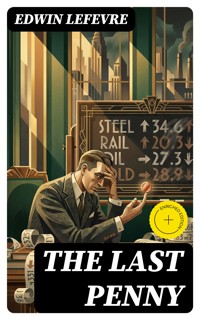
In "The Last Penny," Edwin Lefevre masterfully intertwines the intricacies of financial speculation with the emotional turmoil faced by his characters, painting a vivid portrait of the American stock market in the early 20th century. Lefevre's narrative employs a blend of realism and sharp dialogue, allowing readers to experience the exhilarating highs and the devastating lows of trading. The book serves as a critical commentary on human ambition and folly, echoing the sentiments of the burgeoning capitalist society while encapsulating the universal struggle for wealth and security amidst uncertainty. Edwin Lefevre, a journalist turned novelist, was deeply entrenched in the world of finance, which informed his expertise and insight in storytelling. His career as a reporter for the Wall Street Journal and his own experiences in trading provided a foundation that fueled "The Last Penny," illustrating both the excitement and the ethical dilemmas of the financial realm. Lefevre's background enriches his portrayal of characters who are inevitably intertwined with their ambitions, making them relatable yet cautionary figures in the realms of speculative trade. This compelling narrative is highly recommended for readers interested in financial literature, historical fiction, and the moral implications accompanying the pursuit of wealth. Lefevre's rich prose and insightful observations offer uncomfortable yet necessary reflections that resonate with contemporary social themes, ensuring that "The Last Penny" remains relevant and engaging for today's audiences. In this enriched edition, we have carefully created added value for your reading experience: - A succinct Introduction situates the work's timeless appeal and themes. - The Synopsis outlines the central plot, highlighting key developments without spoiling critical twists. - A detailed Historical Context immerses you in the era's events and influences that shaped the writing. - A thorough Analysis dissects symbols, motifs, and character arcs to unearth underlying meanings. - Reflection questions prompt you to engage personally with the work's messages, connecting them to modern life. - Hand‐picked Memorable Quotes shine a spotlight on moments of literary brilliance. - Interactive footnotes clarify unusual references, historical allusions, and archaic phrases for an effortless, more informed read.
Das E-Book können Sie in Legimi-Apps oder einer beliebigen App lesen, die das folgende Format unterstützen:
Veröffentlichungsjahr: 2019
Ähnliche











The Last Penny
Table of Contents
Introduction
At the charged intersection of money and conscience, this book asks what remains of a person when the arithmetic of gain is carried to its farthest place of reckoning.
The Last Penny is a work of fiction by Edwin Lefevre, an American author and financial journalist whose early twentieth-century writing made the dramas of enterprise and speculation intelligible to general readers. Without relying on didactic commentary, Lefevre crafts narratives that take shape where public markets touch private lives. This book belongs to that tradition of business-centered storytelling, yet it is driven less by technicalities than by character under pressure. Readers encounter an environment in which figures on a ledger carry emotional weight, and the external tempo of transactions mirrors the interior rhythm of doubt, resolve, and consequence.
The premise can be approached safely without divulging turns: a critical financial obligation looms, stakes mount beyond the numeric sum involved, and those nearest to the decision must choose what they are willing to surrender to meet the demand. Lefevre advances the situation with crisp economy, inviting readers to inhabit the mindset of people who calculate in both dollars and intangibles. Rather than sprawling across many plots, the book compresses action into a period where every delay intensifies risk. The experience is one of mounting tension, not from sensational twists, but from the steady tightening of practical choices that refuse to remain merely practical.
Lefevre’s abiding interest in the psychology of money animates the themes here: the seductive clarity of numbers versus the untidy realities they obscure; the ways reputation, trust, and timing become currencies of their own; and the moral discounts people grant themselves under pressure. Scarcity is not only a balance-sheet condition but a human atmosphere—of time, patience, and goodwill. The book asks what fairness means when contracts are binding and circumstances are cruel, and whether a clean settlement is ever truly clean. It considers how winning can turn hollow if the price of certainty is paid in relationships and self-respect.
Stylistically, the writing is observational and restrained, shaped by a reporter’s eye for telling detail and a storyteller’s feel for cadence. Dialogue and incident are used sparingly but effectively to expose character, with irony kept cool rather than caustic. The mood is taut yet sober, the prose precise without becoming technical, and the pacing measured enough to let implications accumulate. Readers encounter a voice that trusts inference: a glance across an office, a silence at a threshold, the weight of a signature on paper. Such choices cultivate a distinctive tension—the sense that the most decisive movements are interior.
Although rooted in the economic sensibilities of Lefevre’s era, the book’s questions resonate in the present. Many readers will recognize its portrait of obligations coming due amid volatile conditions, of households and firms navigating thin margins, and of the ethical gray zones that open when survival is at stake. It speaks to contemporary debates over debt, risk, and responsibility, while remaining intimate enough to avoid abstract sermonizing. By examining how systems shape choices without excusing them, the story pierces the illusion that financial decisions are purely rational. It offers, instead, a humane inquiry into how values are tested when options narrow.
Approached as either finance fiction or character study, The Last Penny rewards attention with a clear-sighted exploration of cost and worth. It will appeal to readers who value psychological acuity, compact construction, and a tone that refuses melodrama in favor of pressure that feels earned. Without resorting to spectacle, Lefevre stages a dilemma that exposes what money can settle and what it unsettles. The result is an introduction to his enduring preoccupations—how people reason under duress, what they tell themselves to proceed, and what remains when the ledger closes—that still invites reflection long after the last page is turned.
Synopsis
Edwin Lefevre’s The Last Penny follows the fortunes of a capable, self-reliant businessman whose comfortable success leads him into the complicated terrain of household economy, social expectations, and shifting markets. The story begins by establishing his practical temperament and modest origins, then moves quickly to his marriage into a world where appearances matter. Early chapters sketch an atmosphere of prosperity and routine, showing how small decisions accumulate into expensive commitments. The theme of economy emerges from the outset, not as an abstract doctrine but as a daily discipline tested by custom, pride, and convenience. The narrative balances domestic scenes with business realities, preparing for inevitable strain.
As the household expands—larger quarters, added help, and an increasingly busy social calendar—the fixed costs of maintaining status harden into obligations. The protagonist keeps faithful accounts and observes the creeping escalation of minor indulgences that become necessities. He is drawn between the efficiency he practices in business and the concessions he makes at home to avoid friction or embarrassment. Lefevre depicts the mechanics of spending with precision: service contracts, club dues, small luxuries, and deferred bills. The tension gathers quietly, expressed in debates over what constitutes a reasonable standard of living, and whether thrift is a virtue or a retreat from ambition.
A change in business conditions sharpens these questions. Income wavers just as expenses prove inflexible, and the protagonist recognizes that modest adjustments will no longer suffice. He proposes a systematic retrenchment, not as a confession of defeat but as a means to preserve independence. Family members, accustomed to comfort and mindful of reputation, greet this plan with objections rooted in custom and caution. Advice from friends, equally divided between prudent counsel and bravado, complicates the choice. The narrative emphasizes practical steps over melodrama, outlining a program of savings and a reordering of habits that must be lived day by day to show results.
The household economy becomes the crucible for larger principles. The family experiments with a strict budget, reconsiders service arrangements, and exchanges conspicuous expenses for simpler alternatives. These changes ripple beyond the ledger: friendships shift, invitations slow, and the social map redraws itself around new priorities. Lefevre details the mechanics of cutting costs without romanticizing denial. The protagonist studies each recurring item as if it were a contract, seeking value rather than mere cheapness. The human effects are plain, from the discomfort of parting with conveniences to the relief of clear rules. The experiment reveals both savings and unforeseen costs.
Parallel adjustments unfold at work. Contracts are renegotiated, wasteful practices identified, and speculative ventures deferred until the balance sheet can bear risk. A partner favors expansion, arguing that confidence itself produces opportunity, while the protagonist urges caution and order. External pressures intensify—a hesitant market, cautious lenders, and rivals alert to vulnerability. The book outlines a dilemma at the heart of enterprise: whether profits arise from relentless economy or from decisive risk at critical moments. A call for funds brings the question to a head. The protagonist weighs the hazard of overextension against the hidden expense of paralysis masquerading as prudence.
A domestic incident exposes the limits of strict austerity. An economy measure, sound on paper, proves shortsighted when measured against health, safety, or dignity. The episode broadens the protagonist’s understanding of value, shifting the discussion from price alone to fitness for purpose. His spouse, previously cast as defender of comfort and appearance, demonstrates practical insight, reframing certain expenditures as investments in stability rather than vanities. The narrative avoids moralizing, instead showing how thrift can harden into miserliness if divorced from judgment. The household’s rules are revised—not abandoned—reflecting a more flexible, experience-tested approach to living within means.
Circumstances then supply a decisive test. An opening appears that demands capital, resolve, and swift execution. The protagonist’s recent discipline has strengthened his position yet also made him wary of overreach. Colleagues urge boldness; caution presses for delay. Lefevre structures these chapters to mirror market tempo: quick appraisals, calculated commitments, and the knowledge that hesitation can be as costly as error. Prior lessons about needless waste, illusory economies, and the true cost of reliability inform the choice. The outcome is not described in sensational terms, but as the natural result of clear priorities applied under pressure, with relationships recalibrated accordingly.
In the aftermath, the story traces how households and businesses absorb the impact of large decisions. Some ties prove resilient, others ossify and fall away. The family adopts practices that feel sustainable rather than punitive, understanding that consistency, not hairshirt severity, preserves solvency and self-respect. Professionally, the protagonist organizes his affairs to prevent the slow drift back into unexamined expense or reflexive risk. Lefevre closes the narrative by returning to daily routines—accounts kept, agreements honored, comforts chosen consciously—suggesting that steadiness is achieved by small, repeated acts. The result is neither triumphalist nor bleak, but grounded in durable habits.
The Last Penny distills a broader message about money, character, and the culture of early twentieth-century prosperity. It shows how fortunes are shaped less by windfalls than by thousands of choices about standards, timing, and trust. Lefevre cautions against the waste of vanity and the equal danger of being penny-wise and pound-foolish. Economy, in this telling, is a tool, not a creed: it protects freedom when guided by judgment and erodes it when pursued to the exclusion of purpose. Without revealing final particulars, the book’s essence is clear: balance, clarity of aim, and disciplined flexibility outlast booms, slumps, and fashions.
Historical Context
Set principally in New York’s financial district in the 1900s–1910s, the narrative world of The Last Penny reflects the tempo of Wall Street before and during the Progressive Era. Ticker tape, telephones, and telegraph lines linked Broad and Wall Streets to Boston, Philadelphia, and Chicago, binding regional railroads, mines, and mills to Lower Manhattan’s call-money market. Trust companies on Fifth Avenue, private banking houses on Nassau Street, and the New York Stock Exchange’s trading floor formed the novel’s social geography. This was an era when operators gathered in back rooms, pools moved prices, and newsboys hawked extra editions—an environment of speed, rumor, and leverage that shaped the stakes, ethics, and risks dramatized in the book.
The consolidation wave of 1897–1904 created giant trusts—U.S. Steel (1901), Amalgamated Copper (1899), and the Northern Securities railroad combine challenged by Theodore Roosevelt in 1902–1904. The Supreme Court’s 1904 dissolution of Northern Securities and the 1911 breakups of Standard Oil and American Tobacco signaled a new federal willingness to discipline concentrated power. These contests unfolded in New York boardrooms and federal courts, amid public hostility to monopolies. The Last Penny mirrors this climate through its focus on pools, corners, and interlocking directorates. By portraying boardroom intrigue and control contests, it channels the era’s antitrust battles into the human calculations of insiders, minority shareholders, and the investing public.
The Panic of 1907 crystallized the fragility of pre-Fed finance. In October 1907, a failed attempt by F. Augustus Heinze and Charles W. Morse to corner United Copper triggered runs on associated banks and trusts. On October 22, the Knickerbocker Trust Company—then New York’s third largest—suspended, deepening the crisis. Call money rates spiked intraday to 100%, and clearing-house loan certificates substituted for cash. J. P. Morgan orchestrated emergency syndicates to stabilize the system, including a rescue of the Trust Company of America. The Last Penny draws on this anatomy of panic: sudden liquidity droughts, forced liquidations, and operator improvisation under duress are central to its depiction of risk, rumor, and survival.
Reform followed the 1907 shock. The Aldrich–Vreeland Act (1908) created emergency currency and a National Monetary Commission. A secret 1910 conference at Jekyll Island brought together Senator Nelson Aldrich, Paul Warburg, Frank Vanderlip, Henry P. Davison, and others to draft a central-banking blueprint. After extensive debate, the Federal Reserve Act (December 23, 1913) established 12 regional Reserve Banks and a Board in Washington, institutionalizing a lender of last resort and rediscounting machinery. The Last Penny reflects the transition from private rescues to public backstops: its market world grapples with changing call-money dynamics, the new discount window’s psychology, and the waning supremacy of a single private banker’s fiat in stabilizing crises.
World War I jolted American finance. The New York Stock Exchange closed on July 31, 1914, to stem gold outflows and reopened gradually—limited bond trading in December and full stock trading by April 1915. Wartime orders fueled surges in DuPont and Bethlehem Steel; British gold shipments and “dollar diplomacy” pivoted financial leadership toward New York. Treasury Secretary William G. McAdoo led Liberty Loan drives (1917–1919), while the War Revenue Act of 1917 raised rates to finance mobilization. Trading with the Enemy Act (1917) reshaped flows. The Last Penny channels wartime volatility and patriotic finance, staging how dealers, investors, and issuers navigated closures, capital controls, moral suasion, and the profits—and perils—of war-related booms.
Progressive Era law reconfigured markets’ legal scaffolding. The 16th Amendment (1913) authorized a federal income tax; the Underwood–Simmons Tariff (1913) lowered duties, shifting fiscal reliance toward income levies. The Clayton Antitrust Act (1914) and the creation of the Federal Trade Commission (1914) refined competition rules, targeting price discrimination and interlocking directorates. The Supreme Court’s 1911 decrees against Standard Oil and American Tobacco introduced the “rule of reason.” The Last Penny situates its operators within this tightening mesh of oversight, depicting how dealmaking, syndication, and access to inside information collided with evolving constraints on combinations, underwriting practices, and the reputational risks of regulatory scrutiny.
Speculative culture professionalized as authorities targeted bucket shops and off-exchange gambling. Chicago Board of Trade v. Christie Grain (1905) affirmed bona fide futures, bolstering organized exchanges. New York and other states intensified anti–bucket shop actions circa 1907–1909; police raids and legislative bans shuttered storefront rooms that mirrored tape action without delivering securities. The New York Curb Market organized in 1911, bringing order to outdoor trading later known as the American Stock Exchange. Call-loan rates, collateral standards, and margin practices tightened. The Last Penny maps this shift from illicit storefront speculation to regulated venues, tracing how tape readers, tipsters, and brokers adapted as informal edges narrowed and transparency, clearing, and margin discipline expanded.
The book functions as a critique of early twentieth-century capitalism’s asymmetries. By exposing insider pools, rumors as instruments of profit, and the ease with which liquidity crises punish the least protected, it indicts a system where private power sets public outcomes. The hierarchies of clubbable bankers versus small savers, and the impunity of operators relative to clerks and depositors, underscore class divides sharpened by panics and wartime finance. Its attention to regulatory half-measures and moral hazard challenges complacent narratives of progress, suggesting that new institutions altered the terms of speculation without erasing exploitation, information inequality, or the social costs of “success” extracted to the last penny.




