


Erhalten Sie Zugang zu diesem und mehr als 300000 Büchern ab EUR 5,99 monatlich.
- Herausgeber: IVP Academic
- Kategorie: Religion und Spiritualität
- Serie: New Explorations in Theology
- Sprache: Englisch
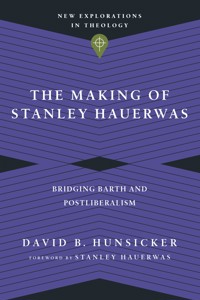
In the past half-century, few theologians have shaped the landscape of American belief and practice as much as Stanley Hauerwas. His work in social ethics, political theology, and ecclesiology has had a tremendous influence on the church and society. But have we understood Hauerwas's theology, his influences, and his place among the theologians correctly? Hauerwas is often associated—and rightly so—with the postliberal theological movement and its emphasis on a narrative interpretation of Scripture. Yet he also claims to stand within the theological tradition of Karl Barth, who strongly affirmed the priority of Jesus Christ in all matters and famously rejected Protestant liberalism. These are two rivers that seem to flow in different directions. In this New Explorations in Theology (NET) volume, theologian David Hunsicker offers a reevaluation of Hauerwas's theology, arguing that he is both a postliberal and a Barthian theologian. In so doing, Hunsicker helps us to understand better both the formation and the ongoing significance of one of America's great theologians. Featuring new monographs with cutting-edge research, New Explorations in Theology provides a platform for constructive, creative work in the areas of systematic, historical, philosophical, biblical, and practical theology.
Sie lesen das E-Book in den Legimi-Apps auf:
Seitenzahl: 451
Veröffentlichungsjahr: 2019
Das E-Book (TTS) können Sie hören im Abo „Legimi Premium” in Legimi-Apps auf:
Ähnliche









NEW EXPLORATIONS IN THEOLOGY
The Making of Stanley Hauerwas
Bridging Barth and Postliberalism
FOREWORD BY STANLEY HAUERWAS
To Barbara
whose love and commitment
made this work possible
and to Felicity
who has made me happy beyond belief
Contents
Foreword
Stanley Hauerwas
IT IS ENOUGH TO MAKE ME THINK there is a conspiracy afoot by intelligent young theologians to embarrass me. Robert Dean recently wrote a wonderful book, For the Life of the World: Jesus Christ and the Church in the Theologies of Dietrich Bonhoeffer and Stanley Hauerwas, in which he developed a very interesting comparison between Bonhoeffer’s and my theology. Dean’s treatment of my work was positive and constructive. In particular, he called attention to the christological commitments that are at the heart of everything I do but critics of my work usually ignore. But who wants to be compared with Bonhoeffer? Bonhoeffer was a great theologian. I am an American academic.
Being put up against Bonhoeffer is one thing, but now I have to face David Hunsicker’s investigation of my claim to be a Barthian. Barth, too, was a great theologian. I follow at a great distance. Barth was not only more learned than I could ever hope to be, but he had a theological imagination that was without compare. From my perspective, Barth is a miracle. He seems to have come from nowhere to help us recover the magic of the gospel. Hunsicker is, of course, right to hold my feet to the fire because I have claimed to be a “Barthian,” but as he also indicates I have never claimed to be a Barth scholar. Nonetheless, to be put up against Barth, if only to suggest there is something to be said for my claim to be a Barthian, is profoundly humbling.
What then am I to make of the fine books Dean and Hunsicker have written? Why should anyone care if I am a Barthian? Little seems to hang on an answer to that question. Yet the care with which Hunsicker pursues that question means that it might matter not because there is a definitive answer but because the pursuit of an answer can tell us something about how theology needs to be done. In short, theology is best done in conversation with other theologians. Barth’s Church Dogmatics is one long conversation with Scripture, the Christian tradition, contemporary theologians, and philosophers. What one learns from watching Barth carry on his conversations is how well he listens to his friends . . . and his foes.
I cannot claim to listen as well as Barth, but I hope even at this late time in my life that I can listen to the kind of critiques of what I have tried to do offered by Hunsicker (and Dean). Hunsicker develops criticisms that matter because he has done me the favor of reading me sympathetically but critically. That is a gift I cherish, and I can only hope that Hunsicker’s book will attract others to the conversation. For if he is right, as I take him to be, that in some ways I am a pragmatist, then we will know we are on to something by attending to the work done because someone listened.
Acknowledgments
ONLY AFTER THE TOIL of one’s labor is finished is it possible to look back and to acknowledge that the work was not done alone. Along the way, there have been many people who have helped to nurture and prune the ideas that became this book. Although it seems far too small a way to give thanks, it is nevertheless right that I should mention them here at the outset. To anyone I have overlooked, I apologize in advance.
The seeds of this book were planted in Durham, North Carolina, where I was simultaneously studying at Duke Divinity School and serving in ministry with my friend and mentor, Jeff McSwain. Jeff introduced me to the work of T. F. Torrance and, therefore, to Karl Barth. At the same time, I was taking classes with Douglas Campbell, a kindred theological spirit. In the following year, I began my first in-depth reading of Karl Barth’s theology with Willie Jennings at the same time I was taking Stanley Hauerwas’s Introduction to Christian Ethics course. I began to see connections that seemed natural to me. Only later would I discover that those connections were not widely acknowledged.
The seeds began to sprout at St. Mary’s College, University of St. Andrews. There, I began to develop the idea that if you take Barth’s rejection of natural theology seriously, then you must end up with something like Hauerwas’s theological ethics. At that point in time, comments from Alan Torrance and Stephen Holmes helped me to clarify my thought.
The tree reached maturation and began to bear fruit at Fuller Theological Seminary in Pasadena, California. My time at Fuller was marked by wonderful conversation and collaboration with a number of people. I can only mention a few here: Howard Loewen, Veli-Matti Kärkkäinen, Oliver Crisp, Nancey Murphy, Tommy Givens, and Daniel Lee. I am also grateful for the regular participants in the Karl Barth Reading Group and Eric Mulligan for facilitating that group. Among my peers, no one provided more feedback to early drafts of the work than Tom Bennett. Finally, I am thankful to my church family, First Presbyterian Church of Hollywood, and the Fraser Fund, without which I could not have afforded the time to pursue this inquiry.
The book was pruned and brought to harvest by Brian Brock and Stanley Hauerwas, who took interest in the project. But it is David McNutt who helped me to see how the development from dissertation to book should occur. IVP has been the perfect nursery for this little book, and I am grateful for the working relationship we have. Since St. Andrews, I have known David as a pastor, a theologian, a golfer, and a fantasy football commissioner. He was good at most of those things; he is an excellent editor.
Finally, the person who has the most sweat equity in the success of this book is my wife, Barbara, whose theological prowess and editorial acumen helped me to present the best possible manuscript to my editors. For Barbara, for our daughter, Felicity, and for our families, who gave us generous and unending support, I am thankful.
At this point, an author will often say something like, “If anything I have written here is wrong, the error is mine alone” in order to absolve one’s dialogue partners and friends. That is mostly true; however, you can blame Stanley Hauerwas for anything here you don’t much like. Stanley likes to say that it is his job to indoctrinate his students and that he wants them to think like him. I began as a dubious student in his intro to ethics course but grew over time to see the logic of his thinking. No doubt, that is at least partly Stanley’s fault.
David B. Hunsicker
Pasadena, CA
On the fiftieth anniversary of Karl Barth’s death, December 10, 2018.
Abbreviations
AC
Hauerwas, After Christendom
AE
Hauerwas, Approaching the End
AN
Hauerwas, Against the Nations
B
Brock and Hauerwas, Beginnings
BCCE
Hauerwas and Wells, The Blackwell Companion to Christian Ethics
BH
Hauerwas, A Better Hope
CC
Hauerwas, A Community of Character
CCL
Hauerwas, Character and the Christian Life
CD
Barth, Church Dogmatics
CDRO
Hauerwas and Coles, Christianity, Democracy, and the Radical Ordinary
CET
Hauerwas, Christian Existence Today
CSC
Hauerwas, Cross-Shattered Christ
CSH
Hauerwas, A Cross-Shattered Church
DF
Hauerwas, Dispatches from the Front
DT
Hauerwas, Disrupting Time
HC
Hauerwas, Hannah’s Child
HR
Hauerwas, The Hauerwas Reader
HS
Hauerwas and Willimon, The Holy Spirit
IGC
Hauerwas, In Good Company
M
Hauerwas, Matthew
MW
Hauerwas and Dean, Minding the Web
NT
Brunner and Barth, Natural Theology
PF
Hauerwas, Performing the Faith
PK
Hauerwas, The Peaceable Kingdom
RA
Hauerwas and Willimon, Resident Aliens
STT
Hauerwas, Sanctify Them in the Truth
SU
Hauerwas, The State of the University
TT
Hauerwas, Truthfulness and Tragedy
US
Hauerwas, Unleashing the Scripture
VV
Hauerwas, Vision and Virtue
WAD
Hauerwas, War and the American Difference
WGU
Hauerwas, With the Grain of the Universe
WRAL
Hauerwas and Willimon, Where Resident Aliens Live
WT
Hauerwas, The Work of Theology
WW
Hauerwas, Wilderness Wanderings
WWW
Hauerwas, Working with Words
Introduction
STANLEY HAUERWAS IS A BARTHIAN. At least, that is what he claims.1 He may very well be in some respects; nevertheless, a number of Barth’s contemporary interpreters bristle at the suggestion. For some interpreters, like Bruce McCormack, Hauerwas belongs to a group of scholars who misunderstand Barth. Barth influences these scholars indirectly, but they are not really Barthian. For McCormack, Hauerwas is a postliberal—an offshoot of neo-orthodoxy that caricatures Barth’s work in a manner that has been described by Francesca Murphy as “story Barthianism.”2 According to McCormack, the postliberal “narrative theology” interpretation of Barth neuters his realism. Others, like Nigel Biggar and Nicholas Healy, argue instead that Hauerwas’s theology is ecclesiocentric, replacing God-talk with church-talk. On these terms, Hauerwas is actually a Protestant liberal, the very thing against which Barth railed in his theology! Common to both of these perspectives is the assumption that Hauerwas is either disingenuous or deeply mistaken to locate his own work within a Barthian perspective.
This book critically investigates Hauerwas’s claim to be a Barthian over and against these alternative suggestions. Against these scholars, I will argue that Hauerwas is both Barthian and postliberal. Hauerwas’s theology is the continuation of a basic theological lesson he learned from Barth: to reject Protestant liberalism. Where it appears that Hauerwas breaks with Barth’s christocentrism, I argue that it is actually a chastened return to a theology of the third article after Barth—a possibility that Barth himself considered at the end of his life.3 Thus, while Hauerwas’s theological ethics bears strong resemblances to the ecclesiocentricity of Protestant liberalism, he presupposes some basic Barthian convictions that prevent him from simply resuming the liberal Protestant project without Barth’s insights. In this sense, Hauerwas is a Barthian postliberal.
THE IMPORTANCE OF KARL BARTH
Stanley Hauerwas (b. 1940) has been the subject of a number of dissertations and theological monographs. Best in class is surely Samuel Wells’s Transforming Fate into Destiny, a work that Hauerwas himself compliments.4 Published in 1994, Transforming Fate is a bit dated. Since that time, Hauerwas’s career has changed in a number of significant ways. To be precise: he delivered the prestigious Gifford Lectures at the University of St. Andrews in 2001; he reflected on and responded to the September 11 terrorist attacks and the subsequent wars in Iraq and Afghanistan; and he published over two dozen new books, and countless essays and sermons. Moreover, Transforming Fate—like most other works on Hauerwas—fails to explore the influence that Barth has on him. Scholars of Hauerwas’s work tend to skirt the topic, either taking Hauerwas at his word or ignoring the influence altogether. In my estimation, this is a significant mistake.
Michael Cartwright once described Hauerwas’s theology as a constellation.5 I think that image is especially helpful for thinking about the theologians and philosophers who influence Hauerwas. The intellectual stars in Hauerwas’s constellation include Alasdair MacIntyre, John Howard Yoder, and Ludwig Wittgenstein, among others. While scholars have trained their telescopes on the bright stars of each of these thinkers, no one has focused on Barth’s role in the constellation of Hauerwas’s thought. To my mind, this is like studying Orion yet ignoring Betelgeuse—one of the oldest and brightest stars in the constellation.
This is not to say, however, that no scholar has ever engaged Hauerwas and Barth in conversation. Indeed, a number of scholars have seen enough similarity to work constructively between both thinkers.6 Nor is it to say that no one has ever considered the matter of influence at all. Nicholas Healy’s recently published Hauerwas: A (Very) Critical Introduction is a critical treatment of Hauerwas that intends to lay bare Hauerwas’s liberal tendencies in a manner that undercuts his Barthian claims.7 Between these works, however, there is a lacuna in the literature regarding the exact nature and extent of influence that Barth has on Hauerwas. Can we take Hauerwas’s claim to be Barthian at face value? Or are his critics correct that his work moves in an opposing direction to Barth’s? To answer these questions is to understand Hauerwas on his own terms, that is, to understand him as a Barthian postliberal.
WHAT IS A BARTHIAN?
To claim that Hauerwas is a Barthian postliberal invites the more basic questions, What is a Barthian? and, What is a postliberal? Regarding the first question, there are some provisional typologies in the literature.8 For my purposes, McCormack’s basic distinction between two different types of Barthian scholarship is most helpful. For McCormack, the simple litmus test for determining a scholar’s Barthian bona fides is to ask whether a scholar has a “genuine understanding” of Barth’s thought. If the answer is yes, then that scholar falls into a type of Barthian that McCormack describes as “directly influenced” by Barth; in contrast, if the answer is no, then the scholar falls into a category that McCormack calls “indirect influence.” In McCormack’s thinking, “genuine understanding” requires one to conform to McCormack’s interpretation of Barth as a “critically realistic dialectical theologian.”9 McCormack himself coined this term. He means it to simultaneously communicate three things about Barth’s theology. First, in contrast to early English interpreters of Barth, McCormack insists that Barth’s theology remains dialectical from his early work through his mature work. Second, that Barth’s theology maintains that God is real, that is, that God exists beyond the bounds of human thought. Third, that Kant was right in his Critique of Pure Reason to suggest that humans cannot have knowledge of God’s very being because God exists beyond the bounds of human knowledge.10
Ever since the publication of McCormack’s magisterial Karl Barth’s Critically Realistic Dialectical Theology, Anglo-American Barth studies has turned to a reading of Barth that is closer to his German interpreters and, therefore, more attentive to Barth’s dialectical thinking, as well as the political and ethical dimensions of his work. This move undercuts a number of neo-orthodox assumptions about Barth’s theology, not least of which is the assumption expressed by H. Richard Niebuhr, James Gustafson, and others that Barth’s ethics have no room for human agency. Thus “critically realistic dialectical theology” positions itself over and against earlier Anglo-American interpretations of Barth as a “neo-orthodox” theologian.
McCormack is particularly hard on a group of theologians that operates under the label “postliberal.” According to him, postliberalism tends to read Barth in two mistaken directions. The first is exemplified by Hans Frei and the second by George Lindbeck. Although Frei was the best early English interpreter of Barth, he tended to read Barth as a nonfoundationalist. Nonfoundationalism is a postmodern rejection of an epistemological position called “foundationalism” usually attributed to modern philosophy after Descartes. According to Descartes, the acquisition of knowledge about anything is like building a house. You begin with a strong foundation, in this case basic propositions, and then you logically build the structure of knowledge from deducing further truths from the foundations up.11 As Nancey Murphy notes, for non- and postfoundationalists, an apt metaphor for epistemology is not a house but a web. No truth claim is obviously more basic than another. Depending on the distance between two particular truth claims in the web of knowledge, one might be perceived as more basic to the other. What makes them both true is that they both cohere within a web of knowledge that remains consistent.12 For McCormack, it is not that Barth is committed to philosophical foundationalism itself; indeed, nonfoundationalist or postfoundationalist theologians can still find much in Barth’s canon that is compatible with their agenda. Yet to suggest that Barth himself was engaged in a nonfoundationalist project is to read him anachronistically.13
Lindbeck’s misreading of Barth is far more severe, according to McCormack. Lindbeck argues that theology is “a highly contextual exercise in communal self-description.”14 He reads Barth as a theologian who is doing a type of intratextual theology that eschews metaphysics and focuses instead on the internal coherence of Scripture. By reading Barth in this way, McCormack argues, Lindbeck returns to the neo-orthodox interpretation of Barth that he learned from his teacher, H. Richard Niebuhr. Thus postliberalism is nothing more than a revival of the neo-orthodox reading of Barth, which “made sweeping use of the biblical language without committing itself to the ontology and cosmology which such language presupposed.”15
Hauerwas, a student of Niebuhr via Frei and Gustafson (the latter was his doctoral supervisor), inherits the neo-orthodox interpretation of Barth. As such, according to McCormack’s typology, Hauerwas slots into the group of postliberals “indirectly influenced” by Barth who tend to misread him in a manner that ignores his dialectical thinking and his critical realism. While Hauerwas has never pretended to be a Barth scholar—and therefore has never felt the need to conform to prevailing interpretations of Barth—he is deeply interested in the question of whether he “understands” Barth. For this reason, I will subject his claim to be a Barthian to McCormack’s criteria, rigorously investigating the suggestion that his work is plagued by its enduring relationship with Niebuhr and Lindbeck.
Although Hauerwas’s early work is heavily dependent on neo-orthodox interpretations of Barth, his understanding of Barth’s theology grows and adapts with the guild itself. This suggests that Hauerwas is at least interested in understanding Barth. Where Hauerwas chooses to “go beyond” Barth will be the place where we see most clearly the degree to which we can call Hauerwas a Barthian. Does his “going beyond” Barth demonstrate that he understands him enough to warrant a break with the Swiss theologian’s work? Or does he misunderstand Barth, and therefore fail to grasp the manner in which Barth’s own theology resolves the perceived problems that lead Hauerwas “beyond”?
I will argue that when I say Hauerwas is a Barthian, I mean that he at least understands the basic impulse that set Barth’s theology in motion: the rejection of Protestant liberalism. Such an understanding leads directly to a theological ethics that moves with the grain of Barth’s rejection. As such, Hauerwas ought to be considered “directly influenced” by Barth even though he will never fit the mold of a “critically realistic dialectical theologian.” At the very least, we must acknowledge that McCormack’s definition of “direct influence” is overly narrow, and that Barth’s influence on Hauerwas is certainly something more than “indirect.”
One difficulty noted by McCormack’s distinction between directly and indirectly influenced Barthians is his argument that postliberalism represents a misunderstanding of Barth’s theology insofar as it perpetuates some of the problems of the “neo-orthodox” Barth. Can one be—as I argue Hauerwas is—both Barthian, in a direct sense, and postliberal? In order to answer this question, we must attend to what it means to call someone a “postliberal.”
WHAT IS A POSTLIBERAL?
If the term Barthian is hard to nail down, the term postliberal is at least equally so. It first appeared in an essay by H. Richard Niebuhr, as a description for a type of theology that sought “to recover the Christian theological heritage and to renew modes of thought which the anti-traditional pathos of liberalism depreciated.”16 For a time, postliberal operated in a slippery fashion, referring to a number of generic postmodern theological projects. Eventually, its meaning became fixed to the school of theologians that emerged out of Niebuhr’s students. For this reason, postliberalism is also sometimes called “the Yale school” or “narrative theology.”
In the first case, “the Yale school” moniker is used to set postliberalism over and against the liberalism of “the Chicago school” at the University of Chicago. William Placher explains: at Yale, “students studied Christianity or Judaism or Buddhism, but not ‘religion’ ”; at Chicago, students studied religion “as a universal phenomenon whose themes and symbols manifest the experience of the sacred in different but related ways in different cultures.”17 Thus postliberalism is a counter to the modern liberal penchant for running roughshod over the particularities of religious traditions.
In the second case, postliberalism is sometimes called “narrative theology” because of its relationship to Yale theologians George Lindbeck and Hans Frei. The term postliberalism comes from Lindbeck, who is credited with coining the term in his famous book, The Nature of Doctrine.18 Whether or not he had his teacher H. Richard Niebuhr’s call for a “post-liberal” theology in his mind is hard to say. Regardless, the continuity between Niebuhr’s neo-orthodoxy and Lindbeck’s postliberalism is hard to deny. The name “narrative theology” comes from Lindbeck’s dependence on and association with Hans Frei’s landmark work The Eclipse of Biblical Narrative. Therein Frei argued that modern liberal Christianity distorted the biblical narrative by reading it with prior foundational commitments. Thus Scripture required an act of translation into a contemporary worldview that was prioritized over the worldview of Scripture itself. To the contrary, Frei argued that the theological task must allow the worldview of Scripture to encounter the reader on its own terms. In the first instance, then, theology must attend to the narrative dimensions of Scripture itself.
To this Lindbeck added a “cultural-linguistic” approach to the study of religion. Instead of grounding theology in commitments to foundational propositional truths or precognitive human experiences, postliberal theology begins with the language that is used to render the narrative and the thought-world of Scripture coherent. Christianity is a living tradition—a linguistic community that extends through time and space—with its own language that is coherent in its own cultural context. To translate it into a different idiom or to extrapolate foundational truths or experiences from it is to render it incoherent. Christian doctrines function as grammatical rules that teach us how the language of Scripture and the Christian community functions. In the second instance, then, theology must regulate the grammar of the Christian community in order to make sure it does not betray its own central narrative.
Postliberalism is grounded in these basic narrative and linguistic sensibilities. From there, however, it multiplies into an ever-growing number of theological agendas. Paul DeHart famously argues that postliberalism is like a river delta:
Like a powerful and clear stream which gradually disperses into smaller branches, the characteristic ideas associated with Frei and Lindbeck have spread in several directions, watering a greater area but also becoming more shallow and indistinct as they are simplified and abstracted from their original contexts and mingled with other intellectual sources.19
As a result, “there is no such position” as postliberalism.20
I think that DeHart is basically right. Consider the difference between essays on postliberalism published in different editions of David F. Ford’s volume The Modern Theologians. William Placher’s contribution to the 1997 edition claimed that postliberalism has four distinct characteristics: a nonfoundationalist epistemology, an unapologetic theology, an emphasis on the particularity of a religious tradition, and a narrative-communal approach to Scripture.21 By the publication of the 2005 edition, Jim Fodor felt it necessary to list nine characteristics: the retrieval and redeployment of premodern sources, a concern with the ecclesial nature of the theological task, the use of narrative, the grammar of Christian doctrine, the corrective role of theology, a distinct but ecumenical Protestantism, a nonessentialist approach to religion, a nonfoundationalist epistemology, and an unapologetic theology.22 Since then, the Jewish theologian Peter Ochs has argued that a further distinct characteristic of postliberalism should be its emphasis on a “nonsupersessionist” theology.23 DeHart’s river delta image is indeed apt!
Nevertheless, I still find the term postliberal useful as a description of Hauerwas’s theological sensibilities. To be sure, he obviously demonstrates affinity with a number of these theological commitments. Even more, however, I think his work is importantly characterized by one underappreciated aspect of postliberalism: pragmatism.
In his book Transforming Postliberal Theology, Chad Pecknold makes the compelling argument that the “complex relationship between scripture and pragmatism” is the “frequently neglected heart of postliberal thought.”24 Originally, the pragmatic nature of postliberalism was perceived as a weakness or a problem. Pecknold writes, “The early reception of The Nature of Doctrine either (1) ignored the pragmatic dimension of Lindbeck’s book; or (2) criticized its ‘pragmatism’; or (3) accused Lindbeck of not sufficiently thinking through his implicit pragmatism.”25 It is only recently, and largely on account of Hauerwas, that postliberalism’s pragmatic bent has reemerged as a distinguishing feature.26
When I say that Hauerwas’s theology is postliberal, I mean basically this: that Hauerwas’s theology is pragmatic. Yes, Hauerwas’s work is informed by his Yale school education; and yes, Hauerwas attends to the power of narrative to form disciples; but his work cannot be reduced to either of these labels. Instead, Hauerwas’s theology is an exemplification of what postliberal theology is to the extent that he wants to clarify the relationship between Christian convictions and Christian practices. This is more than a simple regression to the anthropocentrism of Protestant liberalism because it always seeks to describe human agency as it relates to the God who is presupposed in the basic narratives of the Christian faith. Hauerwas’s work connects philosophical impulses he learns from Wittgenstein with theological concepts of narrative and biography he gets from James McClendon and Lindbeck in order to generate a robust vision for how to speak about human agency after Barth. Or so I will argue.
BARTHIANISM OR ECCLESIOCENTRISM?
In 1986, at a conference in Oxford celebrating the centenary of Karl Barth’s birth, ethicist and Barth scholar Nigel Biggar suggested to Hauerwas that his work lacked a sufficient doctrine of God. To be more precise, Biggar suggested that “God was . . . curiously missing” from Hauerwas’s work. At least that is how Hauerwas remembers it.27 Biggar remembers suggesting that Hauerwas has “a suspect tendency to talk about the church where Barth would talk about God.”28 According to both accounts, then, Biggar’s main contention was that Hauerwas’s work to that point was insufficiently theocentric. From Biggar’s perspective, however, it is worth noting that not only did Hauerwas’s work lack “God-talk,” it actually refocused theological ethics on the locus of ecclesiology at the expense of the doctrine of God. Thus was born the charge that Hauerwas is “ecclesiocentric.”
Biggar would later go on to characterize his problems with Hauerwas’s theological ethics in tension with his interpretation of Barth’s:
With Stanley Hauerwas Barth agrees that the Bible contributes to Christian ethics through its basic “story.” But whereas for Barth the biblical story is significant in its reference to the reality of the living God, for Hauerwas its importance lies immediately in its sociological function in forming the identity of the Christian community and thereby providing the rationale of its morality.29
Biggar subsequently argues that the difference between Barth and Hauerwas is the difference between a theological and a sociological account of human agency. That is, for Barth, human action is always framed by God’s covenantal relationship with humanity. Therefore, to focus on human agency at the expense of divine agency is to allow the sociological to eclipse the theological.30 This is Biggar’s basic problem with Hauerwas’s theology: ecclesiocentrism focuses on the church’s agency at the expense of God’s. In this sense, Biggar worries that Hauerwas lacks “ecclesial humility.”31
Although Biggar was perhaps the first to express concerns of ecclesiocentrism, he is not alone. Indeed, it is open season on Hauerwas. In recent years, Hauerwas has been called an “onto-ecclesiologist,”32 an “ecclesiological fundamentalist,”33 and, most significantly, a liberal Protestant in the mold of Schleiermacher or Ritschl. As I’ve already indicated, I think the accusation that Hauerwas’s work is a continuation of the liberal Protestant project is the one that poses the greatest threat to his legitimacy as a Barthian. Any attempt to read Hauerwas in relationship to Barth will have to prove that these charges are false, or at least articulate how Hauerwas’s theology avoids any easy assimilation to Protestant liberalism. In my mind, two very specific charges must be addressed.
The first is what I am calling “the Schleiermacher thesis.” The Schleiermacher thesis is expressed by Healy, who argues in Hauerwas that Hauerwas’s “ecclesism” reduces theology to ecclesiology in a manner that is similar to Schleiermacher’s reduction of theology to the believing subject in The Christian Faith.34 Although Healy concedes that Hauerwas avoids some of Schleiermacher’s pietism and individualism, the basic problem is the same for both theologians. Both theologians emphasize a primarily “social-philosophical” account of the church; both suggest the church is the superior form of human community based on its special relationship with Jesus; both turn the church into an apologetic; and finally, both redirect doctrine from being about God to being about the church.35
At its heart, then, the Schleiermacher thesis is the claim that Hauerwas reproduces some of the very aspects of Protestant liberalism that he opposes. In turning to the church, his theology ends up talking about human agency—albeit in the form of church practices—instead of divine agency, and therefore collapses theology into anthropology. All of this obtains despite his strong insistence that he follows Barth in rejecting the anthropocentrism of Protestant liberalism. I think Halden Doerge explains it best when he argues that Hauerwas’s ecclesiocentrism “loops back behind Barth’s critique of liberal Protestantism”—meaning that Hauerwas recommences a liberal theological program after a Barthian interlude.36 An unasked question for Doerge is whether this “looping back” is of an anti-Barthian or a post-Barthian variety. I will argue that it is post-Barthian to the extent that it is Hauerwas’s postliberalism bringing him back to some of the key questions of liberal theology—not over and against Barth but with the grain of Barth’s thought.
The second charge that must be addressed is what I’m calling “the Ritschl thesis.” This charge takes its name from ethicist and Barthian theologian John Webster’s suggestion that Hauerwas’s work is not so much reminiscent of Schleiermacher but of Ritschl. In many ways, this charge is an intensification of the claim that Hauerwas is a Protestant liberal. Barth, after all, holds a great critical appreciation for Schleiermacher; the same cannot be said for Ritschl. When Barth turned from the theology of his teachers Harnack and Herrmann, he made a decisive break with the Ritschl school.
Ritschl famously described his own theology as an ellipsis with two focal points: personal salvation and the kingdom of God.37 The first has to do with Jesus himself and the freedom from sin that his life embodies, while the second has to do with the community he established where such freedom is experienced. Thus the two focal points of the ellipsis are christological and ecclesiological respectively. Historically, we come to the Christian faith from a perspective weighted toward the second focal point; the church is the precondition for understanding Christianity as a whole. On the one hand, the church historically and logically precedes the redemption of an individual believer.38 On the other hand, the church is a community of forgiveness founded by Jesus where people truly experience their Christian freedom in spite of the continued presence of sin in their lives.39
All of this means that Ritschl’s theology is ecclesiocentric in a twofold sense. First, the church is the historical and logical precondition for coming to a saving knowledge of our redemption by God through Christ. Second, the church is the place where we live out our freedom in God in such a manner that we further the transformation of the world around us into the kingdom of God. From the ecclesiological focal point, Christians look back toward the message of freedom proclaimed by Christ and look forward to the establishment of a perfect community of freedom in the world.
Webster reminds us that Ritschl is the great theologian of liberal Protestant ethics, with “his repudiation of metaphysics, his fear that preoccupation with fides quae is a speculative distraction from viewing the world in terms of moral value, and his conviction that Christian faith is principally a mode of active moral community.”40 In particular, Webster worries that (1) Ritschlian theologies abandon Nicaean Christology and attend to the moral example of Jesus’ earthly life,41 (2) collapses Christ into the moral community in the form of “the kingdom of God,”42 and (3) reduces Scripture to “the church’s book” giving undue “prominence to anthropological concepts such as ‘practice’ and ‘virtue.’”43 For Webster, these unmistakably Hauerwasian themes amount to “a highly sophisticated hermeneutical reworking of Ritschlian social moralism” that shifts theological accounts of Scripture away from God and toward the church. In this regard, Webster joins Biggar in locating Hauerwas’s Protestant liberalism in his treatment of Scripture. This is really the crux of what I am calling the Ritschl thesis. For these Barthians, Hauerwas vacates Scripture of its ability to witness to God’s activity, reducing it instead to a guidebook for the church’s activity and Jesus to little more than the guide whose life becomes paradigmatic for the church. He introduces a second, ecclesial, theological loci to his theology that distorts any possible christocentrism and weights the center of gravity toward ecclesiology.
THE ARGUMENT IN OVERVIEW
As we’ve just seen, the case against Hauerwas’s claim to be a Barthian unfolds in two parts. First, Hauerwas’s theology is obviously ecclesiocentric. Second, this ecclesiocentrism repeats the basic habits of Protestant liberalism. Therefore, Hauerwas’s work actually represents a retrieval of the type of theology that Barth rejected when he broke with Protestant liberalism. Ergo, Hauerwas is not a Barthian. I think the Ritschl thesis overstates its case when its advocates suggest that Hauerwas is not concerned with metaphysics, but I admit that there is something to the suggestion that Hauerwas resembles Ritschl to the extent that he attends to the social dimension of the Christian faith, particularly as it relates to Scripture and salvation.44 In general, I think the Schleiermacher thesis has more explanatory power, arguing that Hauerwas’s theology is “liberal” because it replaces divine agency with human agency and/or collapses the two in his ecclesiology.
I will argue, over and against Healy and others, that Hauerwas is Barthian exactly to the extent that he learns from Barth to reject Protestant liberalism. Indeed, his whole theological project is an attempt to mount a Barth-like rejection of Protestant liberalism in his own American context. This requires him to work “after Barth” in some ways that push beyond difficulties he finds in Barth’s work. This “after Barth” is best understood by Hauerwas’s commitment to postliberal theology as the means by which Barthian convictions actually inform Christian practice. This is what I mean when I argue that Hauerwas is a Barthian postliberal.
In part one I will develop my argument that Hauerwas is a Barthian postliberal. I will do this primarily by attending to Hauerwas’s biography, with special attention to Hauerwas’s intellectual influences. In chapter one I provide an overview of Barth’s influence on Hauerwas, from Hauerwas’s first encounters with Barth’s theology to his mature application of Barthian themes in his own theological ethics. In particular, I will pay attention to two narratives that shape Hauerwas’s theological ethics: the story of how ethics became divorced from doctrine and the story of how Christian ethics in America became about America instead of Christianity. These are the basic narratives of Protestant liberalism and how Hauerwas learns to reject it by attending to Barth’s claim that dogmatics and ethics are inseparable.
In chapter two I will sympathetically introduce Hauerwas’s claim to be a Barthian by attending to Hauerwas’s self-understanding of Barth’s influence on his work. I will argue that the basic theological lesson Hauerwas learns from Barth is to reject Protestant liberalism. For Hauerwas, learning this lesson means repeating this move in his own American Protestant context, a move that requires Hauerwas to go “beyond” Barth in some ways. Then in chapter three I will use abortion to demonstrate how Hauerwas’s theological ethics are both dependent on and go beyond Barth. Particularly, I will show how Hauerwas (1) leverages Barth’s rejection of natural theology into a rejection of ethical claims that are grounded in universal reason, and then (2) goes beyond Barth by asking the question from the third article of the creed, namely, ecclesiology.45
In chapter four I will pick the story back up at this point: that Hauerwas sees his own work as an attempt to “fix” deficiencies in Barth’s ecclesiology. Where Hauerwas appears to break with Barth’s own understanding of theological ethics by attending to the church’s centrality as a community of moral formation, Hauerwas understands himself to be improving on Barth by reading him in a postliberal trajectory. In order to make sense of this claim, I will go back into Hauerwas’s biography in order to understand how the postliberal impulses in his thought develop and what purpose they serve. In chapter five I will conclude part one with the argument that Hauerwas’s postliberal reading of Barth is a legitimate interpretation to the extent that he really understands the manner in which Barth thinks theology should work and the type of work it should accomplish. In this regard, I take Hauerwas to be more than “indirectly influenced” by Barth, warranting an expanded understanding of what it means to be a Barthian beyond McCormack’s narrow definition. Thus the story of how Hauerwas became a Barthian postliberal concludes.
Part two will be the first of two parts that raise important counterarguments to the story that I tell in part one. Specifically, in parts two and three I will continue the line of criticism developed by those who claim Hauerwas is a Protestant liberal. In part two I will develop the argument raised by the Schleiermacher thesis, interrogating Hauerwas’s claim that he learns to keep dogmatics and ethics together from Barth. In chapter six, I will argue that for Barth, keeping dogmatics and ethics together obtains in his reversal of the priority of the relationship between the law and the gospel and his rejection of casuistry, or the application of abstract ethical principles to concrete cases. Both moves require a deep theological commitment to the idea that dogmatics and ethics are grounded in the doctrine of God proper. In chapter seven I will then demonstrate that Hauerwas’s theology, to the contrary, holds the connection between dogmatics and ethics to obtain in ecclesiology, in particular through a revised use of casuistry. On the surface, then, Hauerwas’s theology seems anti-Barthian. Finally, in chapter eight, I will show how Hauerwas’s postliberalism allows him to sidestep this criticism in a way that both honors Barth’s theology and goes beyond it.
In part three I will attend to the argument made by advocates of the Ritschl thesis, namely, that Hauerwas’s use of Scripture is sociological in nature while Barth’s is theological. I will test this thesis by attending, in chapter nine, to the formal relationship between Scripture and the church in Barth and Hauerwas and, in chapter ten, to the manner in which each theologian actually reads Scripture. I will argue that the Ritschl thesis holds to the extent that where Barth talks about God, Hauerwas talks about the church. In chapter eleven, I will again show how Hauerwas’s postliberalism sidesteps the problem by moving in a manner that is not contrary to Barth. In this case, Hauerwas’s ecclesiocentrism is not contrary to Barth’s rejection of liberalism because Hauerwas’s turn to the church is a re-turn to the church from a Barthian perspective.
In the conclusion, I will suggest a few ways that Hauerwas could make his Barthian influence more transparent. First, I will use Kimlyn Bender’s work on Barth’s ecclesiology to show how it is possible to read Hauerwas’s ecclesiology as an extension of Barth’s basic christological commitments. This will put to bed the concerns of those who espouse the Ritschl thesis, that Hauerwas’s theology operates with a second ecclesiological focal point. Second, I will draw on the resources of the missional theology movement in order to show how a number of Hauerwas’s concerns are being addressed in similar ways from a more explicitly Barthian framework. The result will be an affirmation of Hauerwas’s diagnosis of the problems facing the church and an alternative construal of the solution that is more obviously Barthian.
Part One
The Making of aBarthian Postliberal
THE BASIC ARGUMENT I MAKE in this book is that in order to understand Hauerwas’s theological ethics, you have to understand how he is influenced by Karl Barth and postliberalism respectively. For therein lies the theological convictions that make his ethical arguments intelligible. Central to this point is the claim that one cannot simply reduce Hauerwas’s Barthianism to his postliberalism. Scholars who do so tend to assume that he is a bad interpreter of Barth, at the least, or part of a type of Protestant liberalism that is incommensurable with Barth’s theology.
In the first part of this book, I develop the argument that Hauerwas is a Barthian postliberal. I do this by first attending to the way Hauerwas understands modern Protestant theology in general and the development of Christian ethics in American theology specifically. First, Hauerwas argues, Protestant liberalism is plagued by a particular Christian response to Enlightenment rationalism: namely, that God was a subject that was beyond the possibility of empirical knowledge and, therefore, theology should be about morality. Second, it was subsequently determined that morality was a topic that could be established without respect to any particular religious convictions. With regard to how this plays out in the discipline of Christian ethics, Hauerwas notes that by the middle of the twentieth century, Christian ethicists were asking themselves if they really needed to be “Christian” to arrive at the conclusions they made.
I follow both of these suggestions as they work themselves out in Hauerwas’s thought. First, the story of Protestant liberalism is the story of how ethics, or morality, becomes divorced from theology. For Hauerwas, the problem of reducing theology to morality is resolved by Barth, who rejected any attempt to reason theologically from any starting point other than God. This includes Barth’s famous rejection of natural theology, which Hauerwas adopts and extends in his own rejection of rationalist appeals to universal law. We see this especially in the similarities between Barth’s and Hauerwas’s treatments of abortion.
Next, the story of Christian ethics in America is the story of how ethics ceased to be Christian, or how the church lost its distinctiveness in American culture. This problem is solved by a fusion of influences from John Howard Yoder and postliberalism. In the first instance, it is Yoder who—influenced by Barth—rejects the entire tradition of Christian ethics and grounds his own theological ethics in Scripture. This emboldens Hauerwas to break with the liberal Protestant Christian ethics of his Yale teachers. In the second instance, it is the development of a new type of postliberal theology that emphasizes practical reasoning that points a way forward for a theological ethics that at once speaks about God and human moral action in correspondence to what Christians have to say about God. For Hauerwas, this means learning from Barth how to ground his ethics christologically, from Yoder how to work out the ecclesiological implications of such a Christology, and from postliberalism how Christians “perform their faith” in light of these christological and ecclesiological convictions.
These two streams of theological influence come together in Hauerwas’s thought to produce Barthian postliberalism. For the vast majority of English-speaking interpreters of Barth, such a reading of Barth is problematic on its face. To the contrary, I argue, Hauerwas’s attention to performance, and particularly to how Barth’s theology performs its task, enables him to work with the grain of Barth’s theology in order to develop surprising but consistent theological impulses in his own American theological context.
1
The Stories That MadeStanley Hauerwas
STANLEY HAUERWAS ALTERNATIVELY calls himself a theologian and an ethicist. Early in his career, he was apt to identify himself as a Christian ethicist;1 however, over time, he came to describe himself predominantly as a theologian. There is some fluidity between these terms in Hauerwas’s thought to the extent that theology cannot be divorced from ethics.2 Nevertheless, the shift represents a subtle, albeit significant, development in Hauerwas’s work: over time he has learned to speak about God.3 Indeed, in Hauerwas’s later work he jokes that his colleagues do not consider him an ethicist and that he prefers to think of himself as a “theologian.”4
That Hauerwas prefers to think of himself as a theologian instead of an ethicist has everything to do with the critical stance he takes against Protestant liberalism. “Ethics” is what remains of Christianity after the retreat of theological convictions from the public square. For Hauerwas, this retreat is synonymous with the name Immanuel Kant.5 In this regard, “Christian ethics” is the means by which Christian theologians seek to legitimize their existence in modern research universities and hospitals. Quoting his doctoral advisor, James Gustafson, Hauerwas writes, “The term ‘ethicist’ is popular because it provides an identity for former theologians ‘who do not have the professional credentials of a moral philosopher.’”6
In order to understand why Hauerwas prefers to think of himself as a theologian and insists on keeping theology and ethics together, one must understand two important stories that Hauerwas tells about the history of theological ethics: The first is about the rise of Protestant liberalism as the end of theological ethics, while the second is about the continuation of the liberal Protestant project as “Christian ethics” in America. In this chapter, I will introduce each story—first, the divorce of ethics from theology, and second, the development of Christian ethics in America. Then I will tease out how Hauerwas conceives of his own theological ethics as parallel to Karl Barth’s insistence that dogmatics and ethics are inseparable. All of this will set the stage for chapters two and three, where I will attend specifically to the stories of how Hauerwas came to be influenced by Barth and postliberalism respectively.
ONCE THERE WAS NO CHRISTIAN ETHICS
The first story Hauerwas tells is a story about how ethics became divorced from theology. This story begins with the early church and ends with the Enlightenment. Its basic thesis is that current conceptions of Protestant social ethics are contingent, not necessary. In fact, earlier expressions of the Christian life better exemplify Christianity as the integration of belief and practice. The punch line to the first story is that theologians began by talking about God but, over time, ended up talking about humanity. This story is worth retelling briefly because it gives concrete expression to Hauerwas’s claim that he follows Barth in rejecting liberalism.
For Hauerwas, “Once there was no Christian ethics simply because Christians could not distinguish between their beliefs and their behavior.”7 Indeed, early Christianity was predominantly focused on how Christians should live. Theology simply was “pastoral direction” for how to live a morally substantial life.8 This changed somewhat with the rise of Christendom, or “Constantinianism,” as Hauerwas sometimes calls it.
Constantinianism is a term used by John Howard Yoder to describe the manner in which Christianity changes as it transitions from a persecuted minority to an established majority in the Roman Empire.9 Hauerwas and Wells explain, “Prior to Constantine, it took courage to be a Christian. After Constantine, it took courage to be a pagan. Before Constantine, no one doubted that Christians were different. After Constantine, it became increasingly unclear what difference being a Christian made.”10 In other words, before Christianity became established, what Christians believed made all the difference for how they lived; and how they lived, therefore, distinguished them from everyone else. With Constantinianism, everyone became Christian by being born in a “Christian” society. Meanwhile, moral behavior became secondary to theological belief. When this happened, ethics became about inward dispositions because outwardly everyone was already Christian.11
Even so, Christians developed a variety of theologically robust moral traditions. The most prominent is that of Augustine, who represents the mainstream of Western theological tradition. Two aspects of Augustine’s work are worth noting. First, Augustine argues that pagan conceptions of virtue (temperance, fortitude, justice, prudence) find their proper telos when they are understood as “forms of love whose object is God.”12 The priority of love for God has direct implications for how Christians imagine the social order.13
Secondly, as seen in City of God, Augustine distinguishes between the earthly city, which does not know God and is “characterized by order secured only through violence,” and the heavenly city, which is peacefully ordered by the worship of the one true God.14 While many see the Augustinian tradition as one that, for the most part, embraces Constantinianism—emphasizing the moral life as the pursuit of virtue while maintaining a sort of realpolitik with regard to the inherently sinful nature of worldly existence—Hauerwas maintains that Augustine’s argument in City of God is that true worship founds true politics. In this regard, Augustine refuses to compromise the essential link between Christian convictions and the moral life.
A second substantial response to Constantinianism comes from the monastic tradition. Monasticism maintained the distinctiveness of Christian convictions by recovering some of the effects of persecution and martyrdom with vows of poverty, chastity, and obedience. Such lives became exceptional witnesses to the radical demands of the gospel that more “worldly” Christians could aspire toward.15 Although it began as a countercultural movement within Christianity, monasticism came to have a lasting influence on mainstream Christianity through the development of penance.
Sometime around the fifth century, monks in Ireland began to hear confession from the laity. This practice became formalized with the development of penitentials (books that correlated particular sins with acts of penance meant to strengthen virtue as counteraction to sin).16 With the practice of penance, the church developed a rich and sophisticated casuistical approach to moral formation that simultaneously took seriously the call for Christians to pursue holiness and the importance of communal practices in such a pursuit. Casuistry, remember, is the case-by-case application of general ethical principles. In this case, it meant that the church developed a rich moral reasoning that prescribed certain acts of penance in correspondence with particular sins. The basic idea was that Christians could be trained to pursue virtuous action and avoid vicious action by practicing acts that refocused their desire away from sin and toward God. Thomas Aquinas’s Summa Theologica demonstrates the enduring influence of casuistry on Christian moral theology.
Aquinas’s moral theology is particularly exemplary for Hauerwas because Aquinas avoids the risk of reducing casuistry to legalism by underscoring the unity that exists between theology and ethics.17 Aquinas’s Summa has a three-part structure: part one explores God’s creative activity in divine freedom, part two describes creation’s return to God, and part three elaborates the means by which creation is able to return to God. A large part of the third section is devoted to casuistry. By considering questions regarding the moral life within the larger context of the story of creation and redemption, “the Summa, rather than being an argument for the independence of ethics, as it is sometimes characterized, is concerned to place the Christian’s journey to God squarely within the doctrine of God.”18 Aquinas is often misread in this regard as a natural law ethicist. To the contrary, his moral theology is best understood as a description of communal practices of discernment that have friendship with God as their ultimate aim.
To Hauerwas, it is not surprising that monasticism began with the intention of developing exemplary moral lives and ended up changing the confessional practices of the whole church. Theological convictions are best exemplified by the lives of saints who bear witness to their truthfulness through performance. Central to the development of such lives is the sort of casuistry that we see developed in both the Augustinian and the Thomist streams of Catholic moral theology.
According to Hauerwas, the Protestant Reformation marks the beginning of the modern fragmentation of theology from ethics. To be sure, the magisterial reformers were keen to keep theology and ethics together. After all, the Reformation vision was centered largely on the goal of church renewal. For Hauerwas, Luther’s treatment of the Decalogue in the Shorter Catechism, along with Calvinist and Wesleyan emphases on holiness, indicate that theology was inherently practical for the reformers.19 Even so, Hauerwas marks the Reformation as the beginning of the split of theology from ethics for two reasons: the Lutheran distinction between law and gospel and the fragmentation of Christendom. Both are worth exploring briefly.
First, Luther’s polemic against Roman Catholicism overdetermines the distinction between faith and works: “Faith, not works, determines the Christian’s relationship to God. Moreover works became associated with ‘ethics,’ . . . the way sinners attempt to secure their standing before God as a means of avoiding complete dependence on God.”20 In other words, faith becomes about salvation by God’s grace and works become about human obedience or disobedience to the law. Here, Hauerwas is concerned with two particular aspects of Lutheran theology: the law-gospel distinction and the two kingdoms doctrine.




