


1,99 €
Niedrigster Preis in 30 Tagen: 1,99 €
Niedrigster Preis in 30 Tagen: 1,99 €
Mehr erfahren.
- Herausgeber: DigiCat
- Kategorie: Lebensstil
- Sprache: Englisch
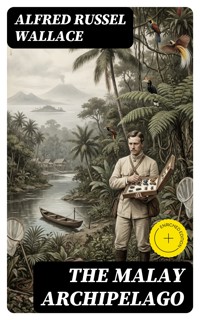
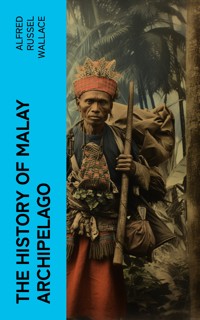
In "The Malay Archipelago," Alfred Russel Wallace presents an engaging and meticulously detailed account of his explorations through the diverse islands of Southeast Asia. Written in a vivid and accessible style, Wallace's narrative combines his observations of natural history with profound reflections on evolution, showcasing the rich biodiversity of the region. This work is not only a travelogue but also a crucial contribution to the scientific discourse of the 19th century, where he laid the groundwork for biogeography and underscored the importance of geographical isolation in species development. Alfred Russel Wallace, a contemporary of Charles Darwin, was a pioneering naturalist and explorer whose travels in the Malay Archipelago profoundly influenced his ideas about evolution and natural selection. His extensive fieldwork, marked by a keen eye for detail, allowed him to collect thousands of specimens and establish connections between species and their environments. Wallace's unique perspective on the interconnectedness of life and the impact of ecological factors undoubtedly shaped the insights presented in this seminal work. "The Malay Archipelago" is essential reading for both enthusiasts of natural history and those seeking to understand the foundations of evolutionary biology. Wallace's passion for discovery and his eloquent prose invite readers to explore the complexities of nature alongside him, making this book a timeless treasure that resonates with the spirit of inquiry and adventure. In this enriched edition, we have carefully created added value for your reading experience: - A succinct Introduction situates the work's timeless appeal and themes. - The Synopsis outlines the central plot, highlighting key developments without spoiling critical twists. - A detailed Historical Context immerses you in the era's events and influences that shaped the writing. - An Author Biography reveals milestones in the author's life, illuminating the personal insights behind the text. - A thorough Analysis dissects symbols, motifs, and character arcs to unearth underlying meanings. - Reflection questions prompt you to engage personally with the work's messages, connecting them to modern life. - Hand‐picked Memorable Quotes shine a spotlight on moments of literary brilliance. - Interactive footnotes clarify unusual references, historical allusions, and archaic phrases for an effortless, more informed read.
Das E-Book können Sie in Legimi-Apps oder einer beliebigen App lesen, die das folgende Format unterstützen:
Veröffentlichungsjahr: 2022
Ähnliche






The Malay Archipelago
Table of Contents
Introduction
A restless observer threads an immense necklace of islands where each narrow strait seems to redraw the map of life and unsettle every easy assumption about nature, place, and the human impulse to know.
Alfred Russel Wallace’s The Malay Archipelago (Vol. 1 & 2), first published in 1869 after his eight-year expedition from 1854 to 1862, stands at the confluence of travel narrative and scientific investigation. Written upon his return to Britain and distilled from journals, letters, and field notes, the work chronicles journeys through what was then called the Malay Archipelago. Wallace—already renowned for independently conceiving natural selection in 1858—uses the book to present a sustained, first-hand account of the region’s astonishing diversity. Without presuming foregone conclusions, he invites readers into the process of observing, comparing, and reasoning across islands, climates, and cultures, shaping a coherent vision from thousands of miles of movement.
Its classic status rests on a rare union of lucid prose, narrative momentum, and exacting observation. The story is personal yet disciplined, animated by storms, specimens, and encounters, but never losing the steadiness of a working naturalist’s mind. The book enlarged the possibilities of scientific writing in English by showing that fieldwork could be rendered with literary grace without sacrificing rigor. It has remained in print, widely read by scientists and general readers alike, because it gives a durable blueprint for how to look closely, record faithfully, and build ideas from evidence. Few works better exemplify the enduring appeal of curiosity organized into an artful, transparent method.
The archipelago Wallace explores stretches from the Malay Peninsula and Borneo across Sulawesi and the Moluccas to New Guinea and Timor, a vast, sea-bound realm of coral, rainforest, and volcanoes. He moves between bustling ports and remote villages, from lowland swamps to mountain ridges, tracing routes shaped by monsoon seasons and fickle currents. The setting is not mere backdrop; it is the principal actor, with its reefs, forests, and island chains arranging living forms in patterns that demand explanation. Wallace’s great gift is to make the geography intelligible, so that a reader senses how coastlines and channels become clues to deeper biological and historical connections.
At the heart of the work is a patient demonstration of how distribution—where species do and do not occur—can illuminate the forces that shape life. Wallace follows the evidence across short sea crossings that separate dramatically different faunas, articulating a striking boundary now known as the Wallace Line. He does not present abstractions from a study, but conclusions emerging from thousands of hours in the field, sorting, comparing, and revisiting. His immense collections, gathered with unflagging diligence, anchor the narrative in facts: wings, shells, skins, and beetle cases that together reveal order within seeming profusion.
The narrative succeeds equally as an account of travel under nineteenth-century conditions. Wallace records the hazards of sailing among shoals and reefs, the fatigue of long marches, and the relief of shelter after violent weather. He depicts erupting volcanoes and tremors, the pulse of monsoons, and the practicalities of provisioning in places far from metropolitan supply. The book acknowledges the indispensable skills of local pilots, hunters, and collectors who made progress possible, and it shows how scientific ambition depends on collaboration, negotiation, and patience as much as on solitary insight.
Alongside natural history, Wallace includes sustained observations on languages, trade networks, material culture, and social customs. He writes within the frameworks of his time, and modern readers can recognize both the curiosity that drives his attention and the limitations characteristic of a Victorian vantage point. Yet even where his interpretations reflect nineteenth-century assumptions, he strives to separate report from conjecture and to prefer evidence over stereotype. The result is a document that offers valuable ethnographic glimpses while inviting a reflective, historically informed reading of its author’s perspective.
The book’s influence reaches far beyond its immediate subject. It helped consolidate biogeography by grounding grand patterns in meticulous, place-based observation. Generations of naturalists, geographers, and travel writers have treated it as a touchstone for how to render landscapes, species, and human encounters together without blurring their distinctions. Its focus on islands as arenas for understanding origin, dispersal, and divergence anticipated avenues of inquiry later pursued across ecology and evolution. As a literary model, it encourages clarity, restraint, and narrative architecture that carry complex ideas without straining them into spectacle.
Part of its enduring power comes from structure and voice. Organized across two volumes, the book combines chronological journeys with thematic chapters that pause to consider particular creatures, terrains, or problems. Wallace’s tone is measured, his explanations cumulative rather than sensational, and his descriptions selected for use as evidence. He tests preliminary hunches against new facts, revising or refining as he moves. The reader experiences discovery as process—fallible, corrigible, and incremental—rather than as a single decisive revelation. That intellectual candor, grounded in firsthand work, gives the text an integrity that sustains trust across its many pages.
The period of composition also matters. Written in the decade after a major shift in scientific thought, the book shows how fieldwork could expand and corroborate emerging ideas about the history of life. It is not a treatise but a record of practice: budgeting time, hiring crews, packing specimens, coping with illness, and persuading officials. From such practicalities comes an ethic of method that is as instructive as any conclusion. By showing the scaffolding of inquiry, Wallace demonstrates how careful habits and persistence transform scattered observations into broader understanding.
Themes recur with cumulative force: that boundaries in nature can be both sharp and permeable; that geography shapes possibility; that careful comparison clarifies kinship; and that knowledge advances through collaboration across cultures. But equally present is the reminder that wonder—sustained, disciplined, revisited—remains an engine of insight. The Malay Archipelago captures the exhilaration of seeing order emerge from complexity without diminishing the strangeness that first drew the observer in. It lets readers feel both the nearness of data and the distance required for judgment.
Today the book speaks to urgent concerns: biodiversity under pressure, the necessity of long-term field observation, and the value of listening to local knowledge. It models an attention to place that resists haste and abstraction, and it honors a practice of science accountable to evidence and open to revision. As travel writing, it offers companionship to anyone who has felt discovery braided with uncertainty; as natural history, it remains a foundation for thinking about distribution and change. That is why these volumes endure: they teach us how to look, how to connect, and how to keep asking better questions.
Synopsis
Alfred Russel Wallace’s The Malay Archipelago (Vol. 1 & 2), first published in 1869, records eight years of travel and research across what are now Singapore, Indonesia, Timor-Leste, and parts of New Guinea. Combining expedition narrative with natural history, the work chronicles how he gathered, prepared, and shipped vast collections of animals and plants while observing geology, climate, and local societies. Wallace frames his purpose clearly: to document the region’s extraordinary diversity and to understand how species are distributed from island to island. The volumes interweave daily hardships, logistical ingenuity, and scientific reasoning to build a coherent picture of a complex, oceanic world.
Wallace opens with the western gateways of the archipelago, using coastal settlements and trade routes as staging points for inland collecting. Forest excursions in places such as Borneo showcase his methods—systematic trapping, careful note-taking, and reliance on local expertise. He details the formidable challenges of monsoons, disease, and transport, and he reflects on how such constraints shape what a naturalist can observe. Early chapters emphasize great mammalian forms, including the orangutan, as well as the profusion of insects, establishing a baseline for comparing communities across islands and hinting that geography and history might underlie sharp biological contrasts.
Moving through larger, more populous islands like Java and Sumatra, Wallace ties biodiversity patterns to topography and volcanism. He describes fertile plains, active cones, and belts of forest that shift with elevation and soil, observing how birds, butterflies, and mammals replace one another across altitudes and habitats. Colonial roads, plantations, and ports affect access and sampling, and Wallace weighs their influence while keeping his focus on natural distributions. The narrative blends travel difficulties and scientific inference, showing how repeated transects, seasonal revisits, and comparative collecting across neighboring islands reveal regularities that mere anecdote could miss.
The passage from Bali to Lombok becomes a turning point, where Wallace notes a striking change in fauna across a narrow strait. Despite geographic proximity, the animal life on either side differs in character, with western islands harboring typically Asian forms and eastern islands showing affinities with Australia and New Guinea. He links the divide to deep marine channels that would have limited past land connections, proposing that barriers in the sea can function like mountains or deserts on land. The idea matures into a central biogeographical insight, now widely recognized as a defining feature of the region’s natural history.
Further east in Celebes (Sulawesi), Wallace encounters assemblages that seem neither wholly western nor eastern. He documents distinctive birds and insects and a mosaic of habitats that complicate neat boundaries. The island’s unusual shape and suspected geological history prompt cautious speculation about intermittent connections and isolation. Field realities—steep coasts, scarce roads, and rapidly changing weather—shape his itineraries and datasets. Observations of local communities, trade patterns, and subsistence practices add context for how specimens are obtained and knowledge exchanged, while the fauna’s peculiarities reinforce his sense that long-term earth processes have sculpted modern distributions.
In the Moluccas, with bases such as Ternate and visits to neighboring islands, Wallace refines his comparative approach amid active volcanoes and seaways crowded with praus. He describes collecting strategies for birds and beetles, the preparation and packing of specimens, and the challenges of preserving them in tropical climates. Volcanic landscapes and frequent earthquakes spur reflections on uplift, subsidence, and island age. The Moluccas serve as both a logistical hub and a scientific crucible, where repeated crossings among close islands highlight how even small watery gaps can mark significant biological boundaries.
Expeditions to the Aru Islands and the fringes of New Guinea extend his investigations into Australasian realms. Wallace focuses on the abundance of birds of paradise and marsupials, the structure of lowland forests, and the seasonal rhythms governing access to interior regions. He relates cooperative work with local hunters and guides, alongside difficulties of provisioning and health. These chapters amplify his biogeographical theme: eastern islands host lineages absent in the west, suggesting separate histories and limited interchange. Accounts of Papuan communities, trade goods, and languages broaden the portrait of how cultural and natural geographies intersect.
As his travels conclude across additional islands, including reaches toward Timor, Wallace turns to synthesis. He proposes that the archipelago divides into two great zoological provinces, broadly aligned with Asia and Australia, separated by deep channels that curtailed past land bridges. He extends this reasoning to plants, insects, and birds, noting consistencies and exceptions that demand careful local study. The volumes also address human diversity in the region, contrasting Malay and Papuan populations while acknowledging zones of contact and exchange. Throughout, Wallace stresses method: cumulative evidence, repeated comparison, and the cautious use of geological inference.
The Malay Archipelago endures for its union of vivid field narrative with a disciplined account of species distributions, laying foundations for biogeography and informing evolutionary thought. Wallace’s careful documentation of island-by-island differences, and his argument that historical barriers shape present life, give the work lasting relevance to ecology, conservation, and the study of diversification. Without relying on sweeping generalities, he builds from firsthand observation to broader principles, inviting readers to see islands as natural laboratories. The book’s legacy lies in its measured demonstration that patient inquiry can reveal order within nature’s apparent complexity.
Historical Context
Alfred Russel Wallace’s The Malay Archipelago (1869) distills eight years of travel and collecting, roughly 1854–1862, across what are now Malaysia, Singapore, Indonesia, and Timor-Leste. Its setting is a maritime world governed by overlapping imperial and local powers: the Dutch East Indies, the British Straits Settlements, Portuguese Timor, and surviving sultanates. These polities were knit by trading routes that predated Europeans, yet were now regulated by colonial bureaucracies and naval patrols. The book emerges from mid-Victorian scientific culture, when learned societies, museums, and commercial specimen dealers shaped how nature was studied, described, and circulated to readers in Europe.
Nineteenth-century boundaries in the archipelago were largely set by earlier European rivalry. The Anglo-Dutch Treaty of 1824 confirmed British control over the Malay Peninsula and Singapore while recognizing Dutch primacy over most of the islands to the south and east. Dutch rule succeeded the bankrupt VOC after 1799, retaining strategic forts and alliances with sultanates such as Ternate and Tidore in the Moluccas. Singapore, founded in 1819, grew into a free port that attracted merchants from China, India, and the archipelago. This geopolitical map underlies Wallace’s routes, access, and sources of information, and frames the administrative actors appearing in his narrative.
Within the Netherlands Indies, the state strengthened control through residencies and a centralized bureaucracy. On Java, the Cultivation System (from 1830 to the late 1860s) compelled villages to raise export crops—coffee, sugar, indigo—under official supervision. Wallace spent comparatively little time on Java, but his movements elsewhere depended on the same administrative apparatus: passes, local officials, and Dutch naval transport. In the spice islands, the long history of clove and nutmeg regulation remained visible in plantations, forts, and the power of Dutch residents allied with local rulers. The book frequently situates collecting sites within that established colonial geography.
British power in the region was concentrated in the Straits Settlements—Penang, Malacca, and Singapore—formed in 1826 and administered by the East India Company, then by the British Crown from 1867. Singapore functioned as Wallace’s principal gateway, provisioning point, and postal node. Steamers of international lines carried mail to the Red Sea, where letters crossed Egypt overland, long before the Suez Canal opened in 1869. From Singapore, inter-island movement often reverted to local sail. The book repeatedly shows how British commercial infrastructure, especially the free port economy and mail networks, made long-distance scientific travel feasible.
Political diversity extended beyond Dutch and British spheres. In Borneo, part of the northwest coast formed the Raj of Sarawak under James Brooke from 1841, a personal regime recognized by Britain yet entrenched in regional politics. Portuguese authority persisted in parts of Timor, centered on Dili, while Dutch posts anchored the western end at Kupang. Sultanates mediated access and labor in the Moluccas and elsewhere. Wallace moved among these jurisdictions, comparing administration, taxation, and security. His published impressions—more favorable to certain Dutch posts, critical of Portuguese effectiveness in Timor—derive from these encounters and supply readers with a comparative colonial backdrop.
Travel across the archipelago depended on monsoon rhythms, seasonal winds, and hazardous straits. Wallace chartered or boarded indigenous craft—prahus and smaller boats—between islands where schedules were flexible and weather decisive. Steamships connected major ports, but inter-island traffic remained predominantly sail. Naval suppression of raiding reduced, but did not eliminate, risks on some routes. Local pilots, interpreters, and captains were indispensable. The book’s tempo—sudden departures, prolonged delays, unpredictable landfalls—reflects maritime realities rather than a planned scientific itinerary, and underscores the collaborative character of movement in a seascape defined by currents and reefs.
The everyday economy that Wallace observed centered on regional specializations. Traders moved copra, sago, rice, spices, timber, rattan, beeswax, tortoiseshell, trepang (sea cucumber), and birds-of-paradise plumes. Chinese and Bugis merchants were prominent in coastal markets, while Malay served as a lingua franca of exchange and negotiation. Many communities pursued mixed livelihoods—gardening, fishing, forest gathering, and seasonal voyaging. These circuits intersected with natural history work: carriers and hunters could be hired where trade already moved, and specimens could be packed onto cargo routes. The Malay Archipelago records how scientific collecting rode upon, and sometimes competed with, local commerce.
Wallace’s enterprise was embedded in Victorian institutions. Scientific authority was consolidated in societies such as the Linnean Society and in museums whose collections grew through purchase as well as donation. A commercial ecology of dealers and auction rooms in London and continental Europe created markets for insects, shells, skins, and ethnographic objects. Wallace’s London agent, Samuel Stevens, advanced funds and sold consignments, enabling a long field campaign financed by expected sales. Techniques of the time—shooting to obtain specimens, preserving with arsenic and camphor, meticulous labeling—connected remote forests to curators and taxonomists who would later describe and name new species.
The book also belongs to a wider tradition of scientific travel literature. Readers already knew Alexander von Humboldt’s narratives and Charles Darwin’s Beagle journal, and had encountered colonial ethnographies and natural histories by administrators and missionaries. Publications by Thomas Stamford Raffles on Java and by travelers to Borneo and the Moluccas had sketched political and cultural landscapes. In Britain, the Royal Geographical Society fostered exploration, while the Great Exhibition of 1851 showcased global nature and industry, cultivating a mass audience for wonders and statistics. Wallace wrote for these readers, uniting specimen lists with stories, climate tables with scenes of work and trade.
Between 1854 and 1862, Wallace ranged widely: the Malay Peninsula and Singapore; Borneo’s coasts and inland rivers; Celebes (Sulawesi) with its distinctive fauna; the Moluccan islands of Ternate, Halmahera (Gilolo), Bacan (Batchian), Ceram, and Ambon; the Aru Islands and the shores of New Guinea; and Timor. He assembled more than 125,000 specimens, with a formidable emphasis on insects, but also birds, mammals, and shells. Fieldwork depended on local expertise, including long service from a Malay assistant known as Ali, and many temporary crews and hunters. The book condenses these dispersed labors into an integrated portrait of place, people, and biodiversity.
Wallace’s travels overlapped with a crucial phase in evolutionary science. In 1855, while at Sarawak, he published a paper proposing that new species arise near allied forms in space and time. In 1858, ill with fever in Ternate, he drafted an essay on natural selection and sent it to Charles Darwin. Charles Lyell and Joseph Hooker arranged for a joint presentation of Darwin’s and Wallace’s papers at the Linnean Society in July 1858. Darwin’s On the Origin of Species followed in 1859. The Malay Archipelago, appearing a decade later, offers the empirical setting—geographic, ecological, ethnographic—against which these theoretical insights were formed.
One of the book’s most enduring contributions is biogeographical. Wallace noticed that certain deep channels—between Bali and Lombok, and between Borneo and Sulawesi—coincide with sharp turnovers in animal life. In 1860 he presented these observations to the Linnean Society, arguing that Asian and Australasian faunas interpenetrate but remain distinct. The boundary later called the Wallace Line is not a political frontier but a bathymetric and historical one, reflecting past sea levels and continental shelves. The book’s island-by-island narratives make these patterns vivid, linking birds and mammals to geology and explaining anomalies by reference to glaciations and land-bridge theory then in discussion.
Ethnographic description in the work reflects its time. Wallace distinguished broadly between “Malay” and “Papuan” populations as then categorized, attending to language, dress, navigation, house forms, and craft. He wrote about Dayak communities of Borneo, Christian villages in parts of the Moluccas and North Sulawesi, and seafaring Bugis traders. Mission schools and church networks, alongside Islamic sultanates and mosques, appear as institutions structuring daily life. His judgments combine praise for skills and social organization with assessments typical of Victorian racial science. As a travel-natural history, the book documents encounters while inevitably filtering them through contemporary European frameworks.
Health, hazard, and earth processes shaped the expedition. Malaria and other fevers repeatedly interrupted work; quinine and rest were practical remedies. Logistics depended on provisioning in small ports and on timely monsoons; delays could strand parties for weeks. Volcanic activity and earthquakes were part of the landscape, especially in the Moluccas—Ternate’s cone was a constant presence, and ash soils helped explain island fertility. Such conditions affected collecting—wet seasons spoiled specimens, storms wrecked boats—and they informed Wallace’s reflections on the dynamism of islands, from coral growth to uplift, themes that echo contemporary debates in geology and physical geography.
The communication systems of the 1850s and 1860s connected field and metropolis on long, irregular cycles. Letters and specimens traveled from Singapore and Batavia via the overland route across Egypt to Europe, taking months. Wallace’s papers appeared in venues such as the Annals and Magazine of Natural History and the Journal of the Proceedings of the Linnean Society, reaching a specialist audience before his book sought a broader public. Macmillan published The Malay Archipelago in two volumes in 1869, equipped with maps and engravings. Its style—alternating analysis and anecdote—was calibrated to satisfy both scientific peers and general readers curious about distant islands.
The book also registers global demand for natural resources. Gutta-percha, harvested from Southeast Asian trees, became essential for insulating submarine telegraph cables in the 1850s and 1860s, intensifying forest extraction. Fashion and trade sustained the collection of birds-of-paradise plumes from New Guinea and adjacent islands, while clove and nutmeg cultivation persisted in parts of the Moluccas after monopoly controls waned. Wallace records hunting methods, market prices, and the roles of intermediaries. He sometimes noted scarcity or local decline, without framing a general conservation policy, thereby providing evidence of early pressures on species and habitats as industrial communication spread.
Colonial governance appears in his pages as both infrastructure and subject of comparison. Dutch administrative order in some islands, British commercial openness in Singapore, Sarawak’s personalized rule, and Portuguese weakness in Timor furnished contrasting backdrops. Taxation, corvée obligations, and labor recruitment touched the people he hired and described. Missionaries, teachers, and soldiers were visible agents of cultural change. Wallace did not write a political tract, but his observations, favorable or critical, bear on debates of his day about the legitimacy and efficacy of imperial rule, and show how scientific work was entangled with the permissions, protections, and constraints of empire itself. Published just as the Suez Canal was opening, The Malay Archipelago stands at a hinge point in global mobility. It consolidates a decade of dispersed papers into a synthetic narrative that mirrors mid-Victorian faith in empirical accumulation while disclosing the colonial networks that enabled it. By dramatizing biogeographical boundaries and relaying the lived realities of ports, plantations, and forests, it supplies context to the emergence of evolutionary theory. At the same time, its comparisons of administrations, markets, and missions offer a quiet critique of governance and exploitation, making the book both a landmark of science and a document of its era.
Author Biography
Alfred Russel Wallace (1823–1913) was a British naturalist, explorer, and author whose investigations helped establish the theory of evolution by natural selection and the scientific field of biogeography. Working in the Victorian era, he pursued long expeditions in the tropics and turned field observations into influential books and essays. Independently of Charles Darwin, Wallace identified natural selection as a creative force shaping species, leading to a famous joint announcement in 1858. He is also closely associated with the biogeographic boundary now called the Wallace Line, which highlights deep faunal divisions across the Malay Archipelago. His prolific writings combined travel narrative, taxonomy, ecology, and philosophical reflection.
Wallace’s formal schooling ended in adolescence, after which he trained as a land surveyor and educated himself through voracious reading and practical work. The culture of mechanics’ institutes and local scientific societies exposed him to natural history and debate. In the 1840s he met Henry Walter Bates, whose enthusiasm for entomology reinforced Wallace’s interest in collecting and classification. Books such as Charles Lyell’s Principles of Geology and Thomas Malthus’s Essay on the Principle of Population shaped his thinking about gradual change and competition. This combination of field skills, self-directed study, and engagement with popular science created the intellectual foundation for his later theoretical insights.
In 1848 Wallace embarked for the Amazon basin with Bates to collect natural history specimens and document the region’s fauna and flora. He traveled for several years along major rivers, sending specimens to sponsors in Britain. Catastrophe struck on his homeward voyage in 1852 when his ship caught fire in the mid-Atlantic, destroying much of his collection and notes. He survived and soon published on what he had learned, including the volume Palm Trees of the Amazon and Their Uses. The Amazon experience honed his observational methods, deepened his interest in geographic patterns, and prepared him for a more ambitious expedition to Southeast Asia.
From the mid-1850s to early 1860s, Wallace explored the Malay Archipelago, visiting places from Borneo and Java to New Guinea and the Moluccas. He observed striking turnover of species between adjacent islands, laying the groundwork for the Wallace Line concept. In 1855 he published the Sarawak Law paper, arguing that new species arise near allied ones. In 1858, while on Ternate, he drafted an essay titled On the Tendency of Varieties to Depart Indefinitely from the Original Type and sent it to Charles Darwin. Charles Lyell and Joseph Dalton Hooker arranged a joint presentation at the Linnean Society, revealing natural selection to the scientific community.
Wallace consolidated his Asian travels in the widely read book The Malay Archipelago, a blend of adventure narrative and scientific analysis. He then produced major syntheses: The Geographical Distribution of Animals, which mapped global faunal regions; Tropical Nature and Other Essays; Island Life, analyzing evolution and extinction on islands; and Contributions to the Theory of Natural Selection. His later volume Darwinism offered a clear exposition and defense of natural selection. Together, these works established biogeography as a rigorous discipline, popularized evolutionary ideas for broad audiences, and provided extensive empirical evidence, from birds of paradise to beetles, that linked ecology, geology, and speciation.
Wallace’s intellectual interests extended beyond natural history into philosophy, social policy, and the study of extraordinary claims. He became a prominent advocate of spiritualism and argued that natural selection could not fully account for aspects of the human mind, a view he developed in essays and in Miracles and Modern Spiritualism. He also campaigned for land reform in Land Nationalisation and engaged in public debates about public health, including criticisms of compulsory vaccination policies. While many contemporaries disagreed with these positions, they reflected a consistent humanitarian and empiricist outlook, and they illustrate how he applied statistical reasoning and ethical concerns to contentious issues of his day.
In later decades Wallace remained an energetic public intellectual, publishing The Wonderful Century, surveying scientific and social change, and The World of Life, reflecting on evolution and ecology. He received honors from scientific societies and was appointed to the Order of Merit late in life. Wallace continued to correspond widely, mentor younger naturalists, and champion conservation before the term was common. He died in 1913 in England. His legacy is enduring: co-discoverer of natural selection, foundational figure in biogeography, and a model of field-based science joined to synthetic writing. The Wallace Line still frames research, and his books remain touchstones in evolutionary and island studies.
The Malay Archipelago (Vol. 1&2)
VOLUME 1
Table of Contents
PREFACE.
My readers will naturally ask why I have delayed writing this book for six years after my return; and I feel bound to give them full satisfaction on this point.
When I reached England in the spring of 1862, I found myself surrounded by a room full of packing cases containing the collections that I had, from time to time, sent home for my private use. These comprised nearly three thousand bird-skins of about one thousand species, at least twenty thousand beetles and butterflies of about seven thousand species, and some quadrupeds and land shells besides. A large proportion of these I had not seen for years, and in my then weakened state of health, the unpacking, sorting, and arranging of such a mass of specimens occupied a long time.
I very soon decided that until I had done something towards naming and describing the most important groups in my collection, and had worked out some of the more interesting problems of variation and geographical distribution (of which I had had glimpses while collecting them), I would not attempt to publish my travels. Indeed, I could have printed my notes and journals at once, leaving all reference to questions of natural history for a future work; but, I felt that this would be as unsatisfactory to myself as it would be disappointing to my friends, and uninstructive to the public.
Since my return, up to this date, I have published eighteen papers in the "Transactions" or "Proceedings of the Linnean Zoological and Entomological Societies", describing or cataloguing portions of my collections, along with twelve others in various scientific periodicals on more general subjects connected with them.
Nearly two thousand of my Coleoptera, and many hundreds of my butterflies, have been already described by various eminent naturalists, British and foreign; but a much larger number remains undescribed. Among those to whom science is most indebted for this laborious work, I must name Mr. F. P. Pascoe, late President of the Entomological Society of London[1], who had almost completed the classification and description of my large collection of Longicorn beetles (now in his possession), comprising more than a thousand species, of which at least nine hundred were previously undescribed and new to European cabinets.
The remaining orders of insects, comprising probably more than two thousand species, are in the collection of Mr. William Wilson Saunders, who has caused the larger portion of them to be described by good entomologists. The Hymenoptera alone amounted to more than nine hundred species, among which were two hundred and eighty different kinds of ants, of which two hundred were new.
The six years' delay in publishing my travels thus enables me to give what I hope may be an interesting and instructive sketch of the main results yet arrived at by the study of my collections; and as the countries I have to describe are not much visited or written about, and their social and physical conditions are not liable to rapid change, I believe and hope that my readers will gain much more than they will lose by not having read my book six years ago, and by this time perhaps forgotten all about it.
I must now say a few words on the plan of my work.
My journeys to the various islands were regulated by the seasons and the means of conveyance. I visited some islands two or three times at distant intervals, and in some cases had to make the same voyage four times over. A chronological arrangement would have puzzled my readers. They would never have known where they were, and my frequent references to the groups of islands, classed in accordance with the peculiarities of their animal productions and of their human inhabitants, would have been hardly intelligible. I have adopted, therefore, a geographical, zoological, and ethnological arrangement, passing from island to island in what seems the most natural succession, while I transgress the order in which I myself visited them, as little as possible.
I divide the Archipelago into five groups of islands, as follows:
I. THE INDO-MALAY ISLANDS: comprising the Malay Peninsula and Singapore, Borneo, Java, and Sumatra.
II. THE TIMOR GROUP: comprising the islands of Timor, Flores, Sumbawa, and Lombock, with several smaller ones.
III. CELEBES: comprising also the Sula Islands and Bouton.
IV. THE MOLUCCAN GROUP: comprising Bouru, Ceram, Batchian, Gilolo, and Morty; with the smaller islands of Ternate, Tidore, Makian, Kaióa, Amboyna, Banda, Goram, and Matabello.
V. THE PAPUAN GROUP: comprising the great island of New Guinea, with the Aru Islands, Mysol, Salwatty, Waigiou, and several others. The Ke Islands are described with this group on account of their ethnology, though zoologically and geographically they belong to the Moluccas.
The chapters relating to the separate islands of each of these groups are followed by one on the Natural History of that group; and the work may thus be divided into five parts, each treating one of the natural divisions of the Archipelago.
The first chapter is an introductory one, on the Physical Geography of the whole region; and the last is a general sketch of the races of man in the Archipelago and the surrounding countries. With this explanation, and a reference to the maps which illustrate the work, I trust that my readers will always know where they are, and in what direction they are going.
I am well aware that my book is far too small for the extent of the subjects it touches upon. It is a mere sketch; but so far as it goes, I have endeavoured to make it an accurate one. Almost the whole of the narrative and descriptive portions were written on the spot, and have had little more than verbal alterations. The chapters on Natural History, as well as many passages in other parts of the work, have been written in the hope of exciting an interest in the various questions connected with the origin of species and their geographical distribution. In some cases I have been able to explain my views in detail; while in others, owing to the greater complexity of the subject, I have thought it better to confine myself to a statement of the more interesting facts of the problem, whose solution is to be found in the principles developed by Mr. Darwin in his various works. The numerous illustrations will, it is believed, add much to the interest and value of the book. They have been made from my own sketches, from photographs, or from specimens—and such, only subjects that would really illustrate the narrative or the descriptions, have been chosen.
I have to thank Messrs. Walter and Henry Woodbury, whose acquaintance I had the pleasure of making in Java, for a number of photographs of scenery and of natives, which have been of the greatest assistance to me. Mr. William Wilson Saunders has kindly allowed me to figure the curious horned flies; and to Mr. Pascoe I am indebted for a loan of two of the very rare Longicorns which appear in the plate of Bornean beetles. All the other specimens figured are in my own collection.
As the main object of all my journeys was to obtain specimens of natural history, both for my private collection and to supply duplicates to museums and amateurs, I will give a general statement of the number of specimens I collected, and which reached home in good condition. I must premise that I generally employed one or two, and sometimes three Malay servants to assist me; and for nearly half the time had the services of an English lad, Charles Allen. I was just eight years away from England, but as I travelled about fourteen thousand miles within the Archipelago, and made sixty or seventy separate journeys, each involving some preparation and loss of time, I do not think that more than six years were really occupied in collecting.
I find that my Eastern collections amounted to:
310 specimens of Mammalia. 100 specimens of Reptiles. 8,050 specimens of Birds. 7,500 specimens of Shells. 13,100 specimens of Lepidoptera. 83,200 specimens of Coleoptera. 13,400 specimens of other Insects. 125,660 specimens of natural history in all.
It now only remains for me to thank all those friends to whom I am indebted for assistance or information. My thanks are more especially due to the Council of the Royal Geographical Society, through whose valuable recommendations I obtained important aid from our own Government and from that of Holland; and to Mr. William Wilson Saunders, whose kind and liberal encouragement in the early portion of my journey was of great service to me. I am also greatly indebted to Mr. Samuel Stevens (who acted as my agent), both for the care he took of my collections, and for the untiring assiduity with which he kept me supplied, both with useful information and with whatever necessaries I required.
I trust that these, and all other friends who have been in any way interested in my travels and collections, may derive from the perusal of my book, some faint reflexion of the pleasures I myself enjoyed amid the scenes and objects it describes.
CHAPTER I. PHYSICAL GEOGRAPHY.
From a look at a globe or a map of the Eastern hemisphere, we shall perceive between Asia and Australia a number of large and small islands forming a connected group distinct from those great masses of land, and having little connection with either of them. Situated upon the Equator, and bathed by the tepid water of the great tropical oceans, this region enjoys a climate more uniformly hot and moist than almost any other part of the globe, and teems with natural productions which are elsewhere unknown. The richest of fruits and the most precious of spices are Indigenous here. It produces the giant flowers of the Rafflesia[2], the great green-winged Ornithoptera[3] (princes among the butterfly tribes), the man-like Orangutan, and the gorgeous Birds of Paradise. It is inhabited by a peculiar and interesting race of mankind—the Malay, found nowhere beyond the limits of this insular tract, which has hence been named the Malay Archipelago.
To the ordinary Englishman this is perhaps the least known part of the globe. Our possessions in it are few and scanty; scarcely any of our travellers go to explore it; and in many collections of maps it is almost ignored, being divided between Asia and the Pacific Islands. It thus happens that few persons realize that, as a whole, it is comparable with the primary divisions of the globe, and that some of its separate islands are larger than France or the Austrian Empire. The traveller, however, soon acquires different ideas. He sails for days or even weeks along the shores of one of these great islands, often so great that its inhabitants believe it to be a vast continent. He finds that voyages among these islands are commonly reckoned by weeks and months, and that their several inhabitants are often as little known to each other as are the native races of the northern to those of the southern continent of America. He soon comes to look upon this region as one apart from the rest of the world, with its own races of men and its own aspects of nature; with its own ideas, feelings, customs, and modes of speech, and with a climate, vegetation, and animated life altogether peculiar to itself.
From many points of view these islands form one compact geographical whole, and as such they have always been treated by travellers and men of science; but, a more careful and detailed study of them under various aspects reveals the unexpected fact that they are divisible into two portions nearly equal in extent which differ widely in their natural products, and really form two parts of the primary divisions of the earth. I have been able to prove this in considerable detail by my observations on the natural history of the various parts of the Archipelago; and, as in the description of my travels and residence in the several islands I shall have to refer continually to this view, and adduce facts in support of it, I have thought it advisable to commence with a general sketch of the main features of the Malayan region as will render the facts hereafter brought forward more interesting, and their bearing upon the general question more easily understood. I proceed, therefore, to sketch the limits and extent of the Archipelago, and to point out the more striking features of its geology, physical geography, vegetation, and animal life.
Definition and Boundaries.—For reasons which depend mainly on the distribution of animal life, I consider the Malay Archipelago to include the Malay Peninsula as far as Tenasserim[4] and the Nicobar Islands on the west, the Philippines on the north, and the Solomon Islands, beyond New Guinea, on the east. All the great islands included within these limits are connected together by innumerable smaller ones, so that no one of them seems to be distinctly separated from the rest. With but few exceptions all enjoy an uniform and very similar climate, and are covered with a luxuriant forest vegetation. Whether we study their form and distribution on maps, or actually travel from island to island, our first impression will be that they form a connected whole, all the parts of which are intimately related to each other.
Extent of the Archipelago and Islands.—The Malay Archipelago extends for more than 4,000 miles in length from east to west, and is about 1,300 in breadth from north to south. It would stretch over an expanse equal to that of all Europe from the extreme west far into Central Asia, or would cover the widest parts of South America, and extend far beyond the land into the Pacific and Atlantic oceans. It includes three islands larger than Great Britain; and in one of them, Borneo, the whole of the British Isles might be set down, and would be surrounded by a sea of forests. New Guinea, though less compact in shape, is probably larger than Borneo. Sumatra is about equal in extent to Great Britain; Java, Luzon, and Celebes are each about the size of Ireland. Eighteen more islands are, on the average, as large as Jamaica; more than a hundred are as large as the Isle of Wight; while the isles and islets of smaller size are innumerable.
The absolute extent of land in the Archipelago is not greater than that contained by Western Europe from Hungary to Spain; but, owing to the manner in which the land is broken up and divided, the variety of its productions is rather in proportion to the immense surface over which the islands are spread, than to the quantity of land which they contain.
Geological Contrasts.—One of the chief volcanic belts upon the globe passes through the Archipelago, and produces a striking contrast in the scenery of the volcanic and non-volcanic islands. A curving line, marked out by scores of active, and hundreds of extinct, volcanoes may be traced through the whole length of Sumatra and Java, and thence by the islands of Bali, Lombock, Sumbawa, Flores, the Serwatty Islands, Banda, Amboyna, Batchian, Makian, Tidore, Ternate, and Gilolo, to Morty Island. Here there is a slight but well-marked break, or shift, of about 200 miles to the westward, where the volcanic belt begins again in North Celebes, and passes by Siau and Sanguir to the Philippine Islands along the eastern side of which it continues, in a curving line, to their northern extremity. From the extreme eastern bend of this belt at Banda, we pass onwards for 1,000 miles over a non-volcanic district to the volcanoes observed by Dampier, in 1699, on the north-eastern coast of New Guinea, and can there trace another volcanic belt through New Britain, New Ireland, and the Solomon Islands, to the eastern limits of the Archipelago.
In the whole region occupied by this vast line of volcanoes, and for a considerable breadth on each side of it, earthquakes are of continual recurrence, slight shocks being felt at intervals of every few weeks or months, while more severe ones, shaking down whole villages, and doing more or less injury to life and property, are sure to happen, in one part or another of this district, almost every year. On many of the islands the years of the great earthquakes form the chronological epochs of the native inhabitants, by the aid of which the ages of their children are remembered, and the dates of many important events are determined.
I can only briefly allude to the many fearful eruptions that have taken place in this region. In the amount of injury to life and property, and in the magnitude of their effects, they have not been surpassed by any upon record. Forty villages were destroyed by the eruption of Papandayang in Java, in 1772, when the whole mountain was blown up by repeated explosions, and a large lake left in its place. By the great eruption of Tomboro[5] in Sumbawa, in 1815, 12,000 people were destroyed, and the ashes darkened the air and fell thickly upon the earth and sea for 300 miles around. Even quite recently, since I left the country, a mountain which had been quiescent for more than 200 years suddenly burst into activity. The island of Makian, one of the Moluccas, was rent open in 1646 by a violent eruption which left a huge chasm on one side, extending into the heart of the mountain. It was, when I last visited it in 1860, clothed with vegetation to the summit, and contained twelve populous Malay villages. On the 29th of December, 1862, after 215 years of perfect inaction, it again suddenly burst forth, blowing up and completely altering the appearance of the mountain, destroying the greater part of the inhabitants, and sending forth such volumes of ashes as to darken the air at Ternate, forty miles off, and to almost entirely destroy the growing crops on that and the surrounding islands.
The island of Java contains more volcanoes, active and extinct, than any other known district of equal extent. They are about forty-five in number, and many of them exhibit most beautiful examples of the volcanic cone on a large scale, single or double, with entire or truncated summits, and averaging 10,000 feet high.
It is now well ascertained that almost all volcanoes have been slowly built up by the accumulation of matter—mud, ashes, and lava—ejected by themselves. The openings or craters, however, frequently shift their position, so that a country may be covered with a more or less irregular series of hills in chains and masses, only here and there rising into lofty cones, and yet the whole may be produced by true volcanic action. In this manner the greater part of Java has been formed. There has been some elevation, especially on the south coast, where extensive cliffs of coral limestone are found; and there may be a substratum of older stratified rocks; but still essentially Java is volcanic, and that noble and fertile island—the very garden of the East, and perhaps upon the whole the richest, the best cultivated, and the best governed tropical island in the world—owes its very existence to the same intense volcanic activity which still occasionally devastates its surface.
The great island of Sumatra exhibits, in proportion to its extent, a much smaller number of volcanoes, and a considerable portion of it has probably a non-volcanic origin.
To the eastward, the long string of islands from Java, passing by the north of Timor and away to Banda, are probably all due to volcanic action. Timor itself consists of ancient stratified rocks, but is said to have one volcano near its centre.
Going northward, Amboyna, a part of Bouru, and the west end of Ceram, the north part of Gilolo, and all the small islands around it, the northern extremity of Celebes, and the islands of Siau and Sanguir, are wholly volcanic. The Philippine Archipelago contains many active and extinct volcanoes, and has probably been reduced to its present fragmentary condition by subsidences attending on volcanic action.
All along this great line of volcanoes are to be found more or less palpable signs of upheaval and depression of land. The range of islands south of Sumatra, a part of the south coast of Java and of the islands east of it, the west and east end of Timor, portions of all the Moluccas, the Ke and Aru Islands, Waigiou, and the whole south and east of Gilolo, consist in a great measure of upraised coral-rock, exactly corresponding to that now forming in the adjacent seas. In many places I have observed the unaltered surfaces of the elevated reefs, with great masses of coral standing up in their natural position, and hundreds of shells so fresh-looking that it was hard to believe that they had been more than a few years out of the water; and, in fact, it is very probable that such changes have occurred within a few centuries.
The united lengths of these volcanic belts is about ninety degrees, or one-fourth of the entire circumference of the globe. Their width is about fifty miles; but, for a space of two hundred miles on each side of them, evidences of subterranean action are to be found in recently elevated coral-rock, or in barrier coral-reefs, indicating recent submergence. In the very centre or focus of the great curve of volcanoes is placed the large island of Borneo, in which no sign of recent volcanic action has yet been observed, and where earthquakes, so characteristic of the surrounding regions, are entirely unknown. The equally large island of New Guinea occupies another quiescent area, on which no sign of volcanic action has yet been discovered. With the exception of the eastern end of its northern peninsula, the large and curiously-shaped island of Celebes is also entirely free from volcanoes; and there is some reason to believe that the volcanic portion has once formed a separate island. The Malay Peninsula is also non-volcanic.
The first and most obvious division of the Archipelago would therefore be into quiescent and volcanic regions, and it might, perhaps, be expected that such a division would correspond to some differences in the character of the vegetation and the forms of life. This is the case, however, to a very limited extent; and we shall presently see that, although this development of subterranean fires is on so vast a scale—has piled up chains of mountains ten or twelve thousand feet high—has broken up continents and raised up islands from the ocean—yet it has all the character of a recent action which has not yet succeeded in obliterating the traces of a more ancient distribution of land and water.
Contrasts of Vegetation.—Placed immediately upon the Equator and surrounded by extensive oceans, it is not surprising that the various islands of the Archipelago should be almost always clothed with a forest vegetation from the level of the sea to the summits of the loftiest mountains. This is the general rule. Sumatra, New Guinea, Borneo, the Philippines and the Moluccas, and the uncultivated parts of Java and Celebes, are all forest countries, except a few small and unimportant tracts, due perhaps, in some cases, to ancient cultivation or accidental fires. To this, however, there is one important exception in the island of Timor and all the smaller islands around it, in which there is absolutely no forest such as exists in the other islands, and this character extends in a lesser degree to Flores, Sumbawa, Lombock, and Bali.
In Timor the most common trees are Eucalypti of several species, also characteristic of Australia, with sandalwood, acacia, and other sorts in less abundance. These are scattered over the country more or less thickly, but, never so as to deserve the name of a forest. Coarse and scanty grasses grow beneath them on the more barren hills, and a luxuriant herbage in the moister localities. In the islands between Timor and Java there is often a more thickly wooded country abounding in thorny and prickly trees. These seldom reach any great height, and during the force of the dry season they almost completely lose their leaves, allowing the ground beneath them to be parched up, and contrasting strongly with the damp, gloomy, ever-verdant forests of the other islands. This peculiar character, which extends in a less degree to the southern peninsula of Celebes and the east end of Java, is most probably owing to the proximity of Australia. The south-east monsoon, which lasts for about two-thirds of the year (from March to November), blowing over the northern parts of that country, produces a degree of heat and dryness which assimilates the vegetation and physical aspect of the adjacent islands to its own. A little further eastward in Timor and the Ke Islands, a moister climate prevails; the southeast winds blowing from the Pacific through Torres Straits and over the damp forests of New Guinea, and as a consequence, every rocky islet is clothed with verdure to its very summit. Further west again, as the same dry winds blow over a wider and wider extent of ocean, they have time to absorb fresh moisture, and we accordingly find the island of Java possessing a less and less arid climate, until in the extreme west near Batavia, rain occurs more or less all the year round, and the mountains are everywhere clothed with forests of unexampled luxuriance.
Contrasts in Depth of Sea.—It was first pointed out by Mr. George Windsor Earl, in a paper read before the Royal Geographical Society in 1845, and subsequently in a pamphlet "On the Physical Geography of South-Eastern Asia and Australia", dated 1855, that a shallow sea connected the great islands of Sumatra, Java, and Borneo with the Asiatic continent, with which their natural productions generally agreed; while a similar shallow sea connected New Guinea and some of the adjacent islands to Australia, all being characterised by the presence of marsupials.
We have here a clue to the most radical contrast in the Archipelago, and by following it out in detail I have arrived at the conclusion that we can draw a line among the islands, which shall so divide them that one-half shall truly belong to Asia, while the other shall no less certainly be allied to Australia. I term these respectively the Indo-Malayan and the Austro-Malayan divisions of the Archipelago[1q].
On referring to pages 12, 13, and 36 of Mr. Earl's pamphlet, it will be seen that he maintains the former connection of Asia and Australia as an important part of his view; whereas, I dwell mainly on their long continued separation. Notwithstanding this and other important differences between us, to him undoubtedly belongs the merit of first indicating the division of the Archipelago into an Australian and an Asiatic region, which it has been my good fortune to establish by more detailed observations.
Contrasts in Natural Productions.—To understand the importance of this class of facts, and its bearing upon the former distribution of land and sea, it is necessary to consider the results arrived at by geologists and naturalists in other parts of the world.
It is now generally admitted that the present distribution of living things on the surface of the earth is mainly the result of the last series of changes that it has undergone. Geology teaches us that the surface of the land, and the distribution of land and water, is everywhere slowly changing. It further teaches us that the forms of life which inhabit that surface have, during every period of which we possess any record, been also slowly changing.
It is not now necessary to say anything about how either of those changes took place; as to that, opinions may differ; but as to the fact that the changes themselves have occurred, from the earliest geological ages down to the present day, and are still going on, there is no difference of opinion. Every successive stratum of sedimentary rock, sand, or gravel, is a proof that changes of level have taken place; and the different species of animals and plants, whose remains are found in these deposits, prove that corresponding changes did occur in the organic world.
Taking, therefore, these two series of changes for granted, most of the present peculiarities and anomalies in the distribution of species may be directly traced to them. In our own islands, with a very few trifling exceptions, every quadruped, bird, reptile, insect, and plant, is found also on the adjacent continent. In the small islands of Sardinia and Corsica, there are some quadrupeds and insects, and many plants, quite peculiar. In Ceylon, more closely connected to India than Britain is to Europe, many animals and plants are different from those found in India, and peculiar to the island. In the Galapagos Islands, almost every indigenous living thing is peculiar to them, though closely resembling other kinds found in the nearest parts of the American continent.
Most naturalists now admit that these facts can only be explained by the greater or less lapse of time since the islands were upraised from beneath the ocean, or were separated from the nearest land; and this will be generally (though not always) indicated by the depth of the intervening sea. The enormous thickness of many marine deposits through wide areas shows that subsidence has often continued (with intermitting periods of repose) during epochs of immense duration. The depth of sea produced by such subsidence will therefore generally be a measure of time; and in like manner, the change which organic forms have undergone is a measure of time. When we make proper allowance for the continued introduction of new animals and plants from surrounding countries by those natural means of dispersal which have been so well explained by Sir Charles Lyell and Mr. Darwin, it is remarkable how closely these two measures correspond. Britain is separated from the continent by a very shallow sea, and only in a very few cases have our animals or plants begun to show a difference from the corresponding continental species. Corsica and Sardinia, divided from Italy by a much deeper sea, present a much greater difference in their organic forms. Cuba, separated from Yucatan by a wider and deeper strait, differs more markedly, so that most of its productions are of distinct and peculiar species; while Madagascar, divided from Africa by a deep channel three hundred miles wide, possesses so many peculiar features as to indicate separation at a very remote antiquity, or even to render it doubtful whether the two countries have ever been absolutely united.
Returning now to the Malay Archipelago, we find that all the wide expanse of sea which divides Java, Sumatra, and Borneo from each other, and from Malacca and Siam, is so shallow that ships can anchor in any part of it, since it rarely exceeds forty fathoms in depth; and if we go as far as the line of a hundred fathoms, we shall include the Philippine Islands and Bali, east of Java. If, therefore, these islands have been separated from each other and the continent by subsidence of the intervening tracts of land, we should conclude that the separation has been comparatively recent, since the depth to which the land has subsided is so small. It is also to be remarked that the great chain of active volcanoes in Sumatra and Java furnishes us with a sufficient cause for such subsidence, since the enormous masses of matter they have thrown out would take away the foundations of the surrounding district; and this may be the true explanation of the often-noticed fact that volcanoes and volcanic chains are always near the sea. The subsidence they produce around them will, in time, make a sea, if one does not already exist.




