


1,99 €
Mehr erfahren.
- Herausgeber: Quickie Classics
- Kategorie: Lebensstil
- Sprache: Englisch
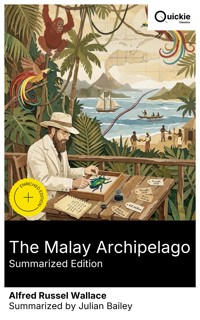
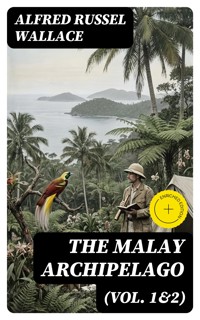
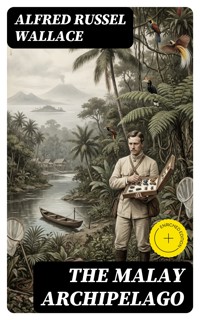
The Malay Archipelago (Vol. 1&2) fuses travel narrative, natural history, and ethnography, recounting Alfred Russel Wallace's eight-year journey (1854–1862) through Borneo, Celebes, the Moluccas, and New Guinea. In lucid Victorian prose he interleaves scenes of monsoons, volcanoes, and ports with exacting notes on orangutans, birds of paradise, beetles, and plants. Attention to routes, islands, and past sea levels underwrites a comparative method that culminates in the famous "Wallace Line," the faunal boundary between the Oriental and Australasian realms. Standing with Darwin's Voyage of the Beagle, it is a foundational work of biogeography and a classic of scientific travel writing. Wallace, a self-taught surveyor-turned-naturalist and professional collector, reached the archipelago after an Amazon venture, financing research by selling specimens. His malarial epiphany at Ternate crystallized a theory of natural selection, shared with Darwin in 1858; these volumes distill the observational discipline and logistical improvisation that made such insights possible. Readers of evolutionary biology, island biogeography, and environmental history will find these volumes indispensable, while admirers of travel literature will relish their narrative vigor and ethnographic attentiveness. As a primary document, it rewards scholars and curious generalists seeking the origins of ecological thought. Quickie Classics summarizes timeless works with precision, preserving the author's voice and keeping the prose clear, fast, and readable—distilled, never diluted. Enriched Edition extras: Introduction · Synopsis · Historical Context · Author Biography · Brief Analysis · 4 Reflection Q&As · Editorial Footnotes.
Das E-Book können Sie in Legimi-Apps oder einer beliebigen App lesen, die das folgende Format unterstützen:
Veröffentlichungsjahr: 2026
Ähnliche





The Malay Archipelago (Summarized Edition)
Table of Contents
Introduction
Threading his way through thousands of tropical islands, a lone naturalist turns travel into experiment, showing how patient collecting, comparison, and note-taking can reveal why life clusters, diverges, and sometimes abruptly changes from shore to shore, and how a journey undertaken to see the world can become a disciplined search for the principles that shape it, as rainforests, reefs, volcanoes, and bustling ports draw him into a continual negotiation between chance encounter and careful explanation, immediate sensation and long inference, the glitter of specimen trade and the sober logic of science.
First published in 1869 in two volumes, The Malay Archipelago is a landmark of nineteenth-century travel writing and natural history, drawn from Alfred Russel Wallace’s fieldwork between 1854 and 1862. Moving by sailboat, canoe, and coastal steamer, Wallace explores the great island realm stretching between the Indian and Pacific Oceans, encompassing parts of what are now Indonesia, Malaysia, Singapore, and New Guinea. The book belongs equally to the genres of travel narrative, scientific reportage, and ethnographic observation, shaped by the practical demands of collecting in a tropical climate and by the intellectual ferment of Victorian science.
Readers encounter a first-person narrative that is simultaneously vivid and methodical, attentive to the colours of birds and beetles, the lay of coastlines, and the practicalities of boats, huts, and notebooks. Episodes of river travel, forest marches, and market negotiations alternate with clear, reflective passages that pause to examine patterns in geography and life. Wallace’s cadence is patient, empirical, and quietly lyrical, inviting an experience closer to a field journal polished into literature than to a heroic yarn. The result is a sustained, spoiler-safe chronicle of movement and attention, where discovery lies as much in comparison and record as in any single moment.
At its intellectual core, The Malay Archipelago investigates how species arise and arrange themselves across space, using the islands as a natural laboratory for comparison. Patterns noticed from island to island crystallize into big ideas: certain groups of animals recur together, others vanish as if cut off, and a striking faunal boundary later known as the Wallace Line separates Asian and Australasian forms. Without rushing to grand claims, Wallace builds his case by accumulating distributions, contrasts, and careful local histories, sketching an early, influential picture of biogeography that still frames how scientists think about evolution, isolation, and the shaping force of place.
The narrative also engages the human dimensions of exploration: coastal traders, boatmen, hunters, and local experts whose skills structure the work of collecting and travel. Wallace records food, houses, craft, and exchange, alongside notes on languages and social life, producing an ethnographic portrait filtered through a nineteenth-century lens. Contemporary readers will notice both curiosity and constraint here, as moments of respect for local knowledge coexist with assumptions typical of the era’s hierarchies. Read with care, these passages illuminate how science, commerce, and empire intersected in everyday practice, and they open space to consider collaboration, credit, and the ethics of representation.
Equally compelling is the portrait of scientific work as a craft learned in motion. The pages are filled with the material reality of inquiry: routes and seasons to catch certain migrations, shelters improvised against rain, methods for storing and cataloguing finds, and the steady rhythm of writing, labeling, and comparison. Even when the scenery is spectacular, the book returns to procedure and patience, showing how knowledge grows from repeated trials rather than isolated triumphs. For modern readers fascinated by field methods, sustainability, or the discipline of note-taking, these chapters model a transparent, teachable practice of observation under real-world constraints.
Today, The Malay Archipelago endures because it joins foundational science with narrative clarity, offering both a key chapter in the history of evolutionary thought and a textured account of one of the planet’s richest bioregions. In an era of habitat loss and climate stress, its island-by-island attention shows how local detail matters to global understanding, and why baselines recorded long ago remain invaluable. It also invites readers to examine how knowledge is made across cultures and disciplines. Approached as literature, it rewards with steady wonder; approached as science, it teaches how to see, compare, and ask disciplined, generative questions.
Synopsis
The Malay Archipelago (Vol. 1 & 2), published in 1869, is Alfred Russel Wallace’s account of eight years of travel and research, from 1854 to 1862, across the islands between continental Asia and Australia. Structured as a sequence of journeys and reflections, the work combines travel narrative, natural history, and ethnography. Wallace describes routes, seasons, and practical methods of collecting, while situating observations within the broader geography of the region. The two volumes trace his movements from major colonial ports into remote islands and forests, using each locality to build a comparative picture of landscapes, fauna and flora, and the diverse communities who inhabit them.
The opening chapters orient readers to monsoons, volcano-lined seas, and the archipelago’s role in global trade. Wallace explains how ships, local praus, and river canoes made science possible, and how partnerships with guides, hunters, and village headmen underpinned specimen collecting. He uses bustling entrepôts such as Singapore and Batavia to introduce a mosaic of languages, belief systems, and colonial administrations. Amid this setting, he sets out the scientific aims that frame the narrative: to document species with precision, compare island biotas, and test how barriers of water and depth shape the distribution and variation of animals and plants.
In Borneo’s forests he develops themes that recur throughout both volumes: the rigors of fieldwork, the economics of natural history, and the interpretive value of careful comparison. River expeditions bring encounters with orangutans, hornbills, and a teeming insect fauna, while long stays among Dayak and Malay settlements provide observations on agriculture, trade, and material culture. Wallace situates these notes within a wider account of forest structure, soils, and climate, considering how human practices interact with ecology. Illness, scarcity, and logistical setbacks punctuate progress, but also sharpen his focus on what can be inferred from small samples collected across contrasting habitats.
Further travel through Java and eastward to Bali and Lombok adds a decisive biogeographic puzzle. Cultivated plains and volcanic highlands offer rich assemblages of birds and insects, yet across a narrow strait Wallace perceives an abrupt shift in characteristic species. He relates this contrast to evidence from nautical charts and the lay of the land, entertaining the idea that deep-water barriers can sustain long-term separation between neighboring faunas. The route becomes a controlled experiment in nature: similar climates and distances, distinct animal communities. This recurring pattern guides subsequent island visits and sets the stage for more formal regional comparisons.
Celebes (Sulawesi) intensifies the inquiry. Its radiating peninsulas and complex history seem mirrored in singular animals and striking insect forms. Wallace documents creatures unlike those of either continent, noting, for instance, peculiar wild pigs and mound-building birds, alongside intricate butterfly series that reveal local variation. He weighs whether such assemblages are mixtures, relics, or products of unique evolution, and he tests ideas about dispersal against observations of winds, currents, and seasonal abundance. Human geography also enters the analysis, as trade routes and settlement patterns provide indirect clues to past connections without substituting for the evidence yielded by fauna.
In the Moluccas he makes Ternate a working base for extended excursions to neighboring islands such as Batchian and Gilolo, with Amboyna as another point of reference. Here eruptions, earthquakes, and steep forested slopes frame daily life and collecting. Expeditions to the Aru Islands anchor memorable chapters on birds of paradise, whose habits, displays, and habitats are described through painstaking fieldwork and collaboration with local hunters. Health crises and shortages recur, but they underline the practical limits of exploration and the need to read patterns across many partial inventories. Ethnographic sketches accompany natural histories without attempting exhaustive cultural study.
Voyages toward New Guinea’s coasts and neighboring islands add further contrasts in people, landscapes, and species. Coral reefs, mangrove-lined bays, and mountainous interiors provide a backdrop for marsupials, cassowaries, and diverse parrots, reinforcing a division between western and eastern faunas. Wallace records how collecting in rain-drenched, inaccessible terrain depends on seasonal timing and indigenous expertise, and he conveys the uncertainty of working where maps and supplies are always provisional. The chapters balance caution with inference, showing how repeated encounters—successful and otherwise—can outline broader patterns even when interior regions remain largely unknown to visiting naturalists of the period.
The concluding sections synthesize observations into a geographic explanation for the archipelago’s living map. Wallace compares island lists, seabed depths, and geological hints to propose provinces aligned with past land connections to Asia and to Australia–New Guinea, separated by persistently deep channels. He argues that climate alone cannot account for the sharp boundaries he observed, and he links dispersal ability to the filtering role of straits. The result is a framework—exemplified by a boundary later known as Wallace’s Line—that organizes a multitude of local facts, while leaving room for future corrections as charts improve and collections grow.
Across both volumes, The Malay Archipelago blends empiricism, narrative craft, and comparative reasoning to illuminate one of the world’s most intricate island systems. Its enduring significance lies in demonstrating how meticulous field observations, made under ordinary constraints of travel and trade, can yield large insights about biodiversity and place. The work helped define biogeography as a discipline and offered a model of scientific travel attentive to local knowledge. Read today, it invites reflection on how natural history is built—incrementally, collaboratively, and cautiously—while encouraging ongoing inquiry into how barriers, history, and ecology shape the distribution of life.
Historical Context
The Malay Archipelago was written after Alfred Russel Wallace’s eight-year expedition (1854–1862) across what are now Indonesia, Malaysia, Singapore, and Timor, with excursions to New Guinea’s western shores. Operating from ports such as Singapore, Makassar, Ambon, and Ternate, he traveled among islands long tied to the global spice trade. The book appeared in 1869, when Victorian Britain prized travel narratives that combined adventure with natural history. Wallace situates his observations within the frameworks of the Royal Geographical Society and British Museum–centered science, presenting a regionally organized account of landscapes, peoples, and fauna that many readers knew chiefly through earlier commercial and missionary reports.
Mid-nineteenth-century natural history thrived on specimen collecting, classification, and exchange. Wallace financed his travels by selling birds, insects, and mammals to private collectors and to European museums, aligning his work with a widespread market for exotic biodiversity. Steam-era communications shortened letters’ transit times, enabling steady correspondence with London-based naturalists and dealers, though long sea passages still shaped logistics. The Straits Settlements served as a key relay for supplies and shipments. Field observations linked to metropolitan institutions allowed Wallace to test ideas about variation and distribution, while the expanding print culture of scientific journals and periodicals created audiences receptive to data-rich travel narratives.
Wallace’s fieldwork unfolded amid intense debate over species origins. In 1855, while in Sarawak, he published an essay proposing a lawlike pattern in the appearance of species, foreshadowing evolutionary thinking. In 1858, while based in Ternate, he formulated natural selection and sent an essay to Charles Darwin. With the mediation of Charles Lyell and Joseph Dalton Hooker, Wallace’s paper and Darwin’s extracts were read jointly at the Linnean Society of London. Darwin’s On the Origin of Species (1859) immediately reframed biological discourse. The Malay Archipelago, written afterward, provides case studies—especially from island faunas—that illustrate mechanisms and consequences of evolution.
Wallace moved through overlapping colonial jurisdictions that structured travel and labor. The Dutch governed most of the region as the Netherlands Indies, administering territories such as Java, Sumatra, Borneo’s south and east, Sulawesi, and the Moluccas. Singapore, Penang, and Malacca formed the British Straits Settlements, key entrepôts for shipping and supplies. In northwest Borneo, Sarawak was ruled by James Brooke as an independent rajah under British protection. Local polities, notably the Sultanate of Ternate, also influenced permits and security. These authorities supplied ships, guides, and safe-conducts, while also shaping the trade networks through which Wallace acquired provisions and sent specimens.
Victorian anthropology and ethnology were coalescing into formal disciplines, with London societies debating human variation, language families, and migration. Wallace’s narrative records detailed observations of Malay-speaking communities and Papuan groups in eastern islands, noting technologies, trade, housing, and navigation. Malay functioned widely as a lingua franca, facilitating his hiring of porters and interpreters. He read and contributed to metropolitan discussions but relied primarily on firsthand encounters to assess claims about cultural difference. While employing terms and categories current in his era, he often foregrounds practical knowledge—such as boat-building and forest craft—that shaped travel outcomes and informed his comparative judgments.
The archipelago’s geography—deep marine trenches between continental shelves—created stark biological divisions. Wallace compared assemblages on islands like Bali and Lombok, or Borneo and Sulawesi, noting abrupt shifts in mammals and birds inconsistent with simple dispersal. From these patterns he inferred a faunal boundary now known as Wallace’s Line, separating Asian from Australasian biotas. His synthesis integrated earlier navigational and geological reports with extensive specimen lists and routes. These observations anticipated later plate-tectonic explanations and helped establish biogeography as a rigorous field. In the book, the boundary serves less as a curiosity than as a framework for interpreting distribution, diversification, and endemism.
Practical challenges pervaded the expedition. Monsoon rhythms dictated sailing schedules; coral reefs and volcanic coasts demanded local seamanship. Disease, especially malaria, repeatedly interrupted collecting, and food shortages occasionally forced relocations. Wallace adapted European methods to tropical conditions, refining nets, bait, and preservation techniques suitable for humidity and heat. He built temporary field stations and relied on numerous local assistants, notably his long-serving aide Ali, whose hunting and tracking materially increased specimen yields. Shipping thousands of skins, beetles, and butterflies required meticulous packing to survive months at sea. These constraints and collaborations directly shaped the data and perspectives reported in the volumes.
Published in 1869 to strong interest, The Malay Archipelago consolidated Wallace’s reputation and supplied vivid evidence for evolution, island biogeography, and zoogeographical regions. Reviewers praised its empirical richness and clear exposition, and it quickly became a standard of scientific travel writing. The work reflects its era’s reliance on imperial routes, museums, and correspondence networks, yet also tests the period’s assumptions by grounding large theories in field observation. Its portraits of commerce, governance, and daily craft reveal how colonial infrastructures both enabled and delimited research. In uniting narrative, data, and analysis, the book exemplifies Victorian science while critically advancing its methods and claims.
Author Biography
Alfred Russel Wallace (1823–1913) was a British naturalist, explorer, and author whose independent discovery of natural selection placed him alongside Charles Darwin as a founder of evolutionary biology. Working in the Victorian era, he combined field exploration with rigorous observation to reshape understandings of biodiversity, species formation, and geographic distribution. Wallace’s writings, notably The Malay Archipelago, reached wide audiences and helped define natural history as both a scientific and literary pursuit. His synthesis of meticulous collecting, bold theorizing, and accessible prose established him as a central figure in modern biology and a pioneer of biogeography, the study of how species are distributed across space and time.
Wallace’s formal schooling ended early, and he trained as a surveyor, a practical education that sharpened his observational skills and interest in the natural world. He continued his education through self-directed reading and lectures at mechanics’ institutes, engaging with debates that animated mid-nineteenth-century science. Influential works included Charles Lyell’s Principles of Geology and Thomas Malthus’s Essay on the Principle of Population, as well as the anonymous Vestiges of the Natural History of Creation. He cultivated a working naturalist’s craft—collecting, classifying, and selling specimens—while discussing species origins with like-minded contemporaries, a milieu that shaped his questions about variation and the emergence of new forms.
In 1848 Wallace embarked for the Amazon with Henry Walter Bates to collect and study tropical biodiversity. Over several years he traced the Rio Negro and other waterways, amassing extensive notes and specimens intended for scientific study and commercial sale. Catastrophe struck in 1852 when a homeward voyage ended in shipboard fire, destroying much of his collection. Wallace survived and later published A Narrative of Travels on the Amazon and Rio Negro, distilling field observations into a clear account of rainforest natural history. The experience strengthened his fascination with species distribution and variation, themes that would guide his next and most influential expedition.
From 1854 to 1862 Wallace conducted fieldwork across the Malay Archipelago, traveling among Borneo, Sulawesi, the Moluccas, and New Guinea. There he documented striking faunal contrasts and articulated what became known as the Wallace Line, a boundary separating Asian and Australasian biotas. During this period he conceived natural selection to explain the origin of species, composing an essay in 1858 that he sent to Charles Darwin. Their ideas were presented together at the Linnean Society that year, a watershed moment for evolutionary theory. Wallace continued collecting and analyzing patterns of distribution, linking geography and evolution in ways that transformed natural history.
After returning to Britain, Wallace wrote The Malay Archipelago (1869), a travel and science classic admired for its vivid narrative and empirical insight. His Contributions to the Theory of Natural Selection (1870) gathered key essays, while The Geographical Distribution of Animals (1876) and Island Life (1880) founded biogeography as a systematic discipline. In Darwinism (1889), he defended natural selection yet differed from Darwin on points such as sexual selection and the evolution of human cognition. Wallace argued that some human mental capacities might exceed the explanatory reach of natural selection alone, a stance that stirred debate while underscoring his independence of mind.
Wallace’s scientific work intersected with wide-ranging social and philosophical commitments. He advocated land reform and wrote Land Nationalisation (1882), linking social equity to environmental stewardship. He opposed compulsory vaccination policies and engaged in public controversy on that question. He also embraced spiritualism, arguing in Miracles and Modern Spiritualism (1875) that certain phenomena warranted serious inquiry, a position that many contemporaries rejected. Wallace entered public disputes beyond biology, including well-publicized tests of Earth’s curvature that led to litigation. Throughout, he wrote clearly for general readers, using evidence-centered argument even when his conclusions departed from scientific mainstreams.
In later years Wallace remained an active commentator on science and society, publishing essays and books, including The Wonderful Century (1898), which balanced praise for scientific progress with criticism of its social costs. He received public recognition late in life, notably the Order of Merit and the Linnean Society’s Darwin–Wallace Medal in 1908. Though never a university academic, he influenced generations of naturalists, geographers, and evolutionary biologists. Wallace died in 1913 in England. His legacy endures in evolutionary theory, conservation thinking, and the field of biogeography—especially the concept of faunal regions and the “Wallace Line”—which continues to inform contemporary research and biodiversity policy.




