


1,99 €
Mehr erfahren.
- Herausgeber: DigiCat
- Kategorie: Sachliteratur, Reportagen, Biografien
- Sprache: Englisch
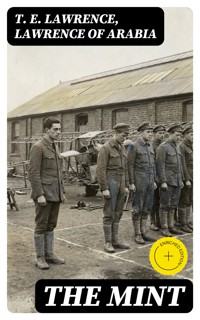
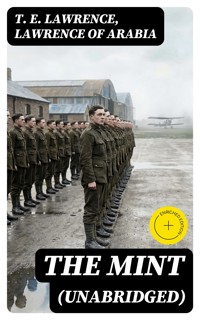
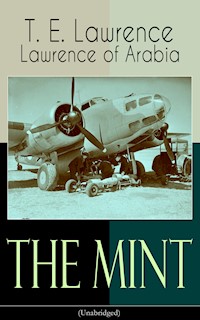
THE MINT is an anthology that captures the myriad facets of early 20th-century military life through the lens of vivid prose and reflective narratives. Encompassing a range of literary styles from sharp realism to introspective memoir, the collection offers an intimate portrayal of the personal and collective experiences within the Royal Air Force during a transformative period. This volume is rich with diversity, presenting pieces that oscillate between the exhilaration of duty and the sobering realities of wartime, providing a nuanced tapestry of thoughts and memories that convey the complexity of military existence. Curated with contributions from figures deeply embedded in the historical and cultural fabric of their time, this anthology benefits immensely from the insight of T. E. Lawrence and his contemporaries. Together, these voices not only chronicle the day-to-day experiences of men in uniform but also reflect broader themes pertinent to the human condition during times of conflict. They skillfully interweave personal vignettes with broader cultural and literary movements of the era, demonstrating how individual stories can illuminate larger truths about national identity and personal growth. Readers of THE MINT are invited to explore the profound mosaic of perspectives on offer, each work serving as a unique entry point into the arena of early 20th-century military life. This collection is an invaluable resource for those seeking to immerse themselves in the period's cultural and historical currents, as well as for anyone interested in the power of narrative to bridge disparate experiences. Delving into this anthology promises not only educational enrichment but also a vibrant dialogue with the multifaceted voices that comprise our shared past. In this enriched edition, we have carefully created added value for your reading experience: - A succinct Introduction situates the work's timeless appeal and themes. - The Synopsis outlines the central plot, highlighting key developments without spoiling critical twists. - A detailed Historical Context immerses you in the era's events and influences that shaped the writing. - An Author Biography reveals milestones in the author's life, illuminating the personal insights behind the text. - A thorough Analysis dissects symbols, motifs, and character arcs to unearth underlying meanings. - Reflection questions prompt you to engage personally with the work's messages, connecting them to modern life. - Hand‐picked Memorable Quotes shine a spotlight on moments of literary brilliance. - Interactive footnotes clarify unusual references, historical allusions, and archaic phrases for an effortless, more informed read.
Das E-Book können Sie in Legimi-Apps oder einer beliebigen App lesen, die das folgende Format unterstützen:
Veröffentlichungsjahr: 2023
Ähnliche










THE MINT
Table of Contents
Introduction
A celebrated man seeks to vanish into the ranks, testing whether a modern institution can stamp a new identity onto a self that refuses to disappear.
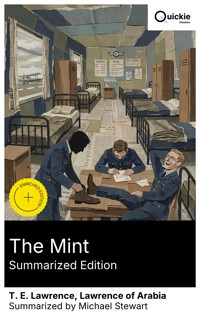
The Mint is T. E. Lawrence’s stark book about life in uniform after the First World War, written by the figure remembered as Lawrence of Arabia. Composed in the years following his wartime fame, it recounts his experience as an enlisted man, first under an assumed name and later as T. E. Shaw, within the Royal Air Force and the Army. Published posthumously in 1955, it presents the routines, pressures, and camaraderie of barracks life, examining what service does to individuals and how individuals shape, resist, or absorb its demands.
Neither conventional memoir nor novel, the work unfolds as a sequence of concentrated episodes, each built from close observation and economical prose. The scenes are specific and tactile—locker rooms, drill grounds, mess halls—yet the arrangement is artful, moving from the rawness of initiation toward a tempered, reflective understanding. Instead of recalling campaigns, Lawrence turns to the textures of ordinary service: fatigue duties, inspections, and the uneasy intimacy of communal living. In doing so, he constructs a disciplined literary form that suits his subject, achieving sharp focus without ornament and refusing to elevate the mundane into melodrama.
The book’s context is crucial. Britain in the early 1920s was adjusting to peace, mass demobilization, and shifting class boundaries, while the Royal Air Force—newly established after 1918—was defining its culture and methods. Against this backdrop, Lawrence, who had been thrust into celebrity by wartime exploits, sought obscurity in the ranks. The Mint records that decision’s consequences from the inside, without relying on his renown. The perspective is that of a recruit and airman among recruits and airmen, attentive to institutional rhythms, the hierarchies of the barrack room, and the unspoken codes that govern belonging and exclusion.
Its classic status rests on several intertwined achievements. First, Lawrence brings literary precision to experiences often dismissed as banal, revealing how routine can be both grinding and formative. Second, he interrogates authority without caricature, acknowledging its necessity while exposing its excesses. Third, he writes about class and language with an ear attuned to nuance, rendering speech patterns and silences as evidence of who is permitted to speak and who must endure. The result is a work that has endured not for spectacle, but for its ethical seriousness and exacting attention to the ordinary.
The Mint also broadened the field of military literature by centering the ranks rather than command. Though issued after Lawrence’s death, it has influenced how later readers, writers, and scholars imagine barracks life, the dynamics of discipline, and the psychology of anonymity. Its frankness, at times uncomfortable, helped legitimize depictions of service that are unsentimental yet humane. The book’s focus on institutional machinery and personal resilience resonates with social histories of the twentieth century, and it stands as a reference point in discussions of how modern organizations shape, and sometimes reduce, the selves that serve within them.
The publication history underscores its force. Because Lawrence recorded the language and mores of the barrack room with uncompromising fidelity, early public editions moderated certain passages to meet the standards of the day. Subsequent printings restored material that had been softened, enabling readers to encounter the full grain of the original. This trajectory—from restraint to restoration—mirrors the book’s larger project: confronting the reader with an unpolished reality and trusting that candor, rather than euphemism, is the proper measure of respect for the lives it portrays.
At the core lies a sustained exploration of transformation. The title’s metaphor suggests a coining process: raw material pressed into uniform shape. Lawrence observes how the body learns drill, how habits overwrite hesitation, and how comradeship grows in the pressure of repeated tasks. Yet the text also notes what resists formation: private memory, stubborn pride, and the quiet integrity that refuses to be melted down. The interplay of shaping and refusal gives the book its tension, inviting reflection on what is gained in service and what must be guarded if one is to remain fully human.
Lawrence’s authorship matters here, but not for self-display. His battlefield fame is the backdrop he deliberately sets aside to test whether self-effacement is possible in a world hungry for celebrity. The Mint becomes a counterpart to his earlier masterpiece, Seven Pillars of Wisdom, by inverting its scale and glamour. Instead of desert campaigns, it studies a training room; instead of strategy, it watches maintenance; instead of the rhetoric of command, it listens to the talk of ordinary men. The juxtaposition enriches both works, showing Lawrence’s range and his sustained inquiry into duty and identity.
Attentive readers will notice the craft by which scenes accumulate meaning. Character emerges through gesture and routine rather than exposition. Settings are rendered with tactile economy, allowing objects—bunks, kit, tools—to bear thematic weight. The narrative trusts implication, using ellipsis to honor the privacy of individuals even while drawing a collective portrait. This restraint creates a moral atmosphere in which judgment is measured, sympathy hard-won, and insight grounded in labor rather than abstraction. The result is prose that feels lived-in, as exacting as drill yet open to sudden, humane recognition.
While The Mint provides no conventional plot, its arc is unmistakable: initiation, endurance, and the gradual calibration of self to institution. The book invites readers to inhabit duration—the repetitive time of duty—in order to see what repetition reveals. Such a structure foregrounds questions that remain pressing: Who benefits from obedience? How is dignity maintained in close quarters? Where does solidarity end and conformity begin? The answers are never simple, and Lawrence refuses to supply consolations. Instead, he offers clarity, trusting the reader to reckon with what the pages disclose.
The Mint endures because it speaks to the present as much as to its own moment. In an age preoccupied with systems—from corporations to bureaucracies to digital platforms—it shows how institutions imprint themselves on bodies and language, and how individuals negotiate space for autonomy within them. Its themes of class, anonymity, and the ethics of work remain current, while its disciplined prose models a way of looking that resists distraction. For readers seeking a classic that illuminates the ordinary with uncommon intelligence, Lawrence’s book offers a lasting, bracing, and deeply humane companion.
Synopsis
The Mint is T. E. Lawrence’s prose portrait of life as a rank‑and‑file airman in the Royal Air Force, written as a sequence of terse sketches and published posthumously in 1955. Setting aside his wartime fame, Lawrence records the routines, pressures, and textures of barrack life with documentary precision. The title invokes a factory that stamps coins, a figure for how institutions mold individuals. Rather than a continuous narrative, the book assembles moments—arrival, drill, mess, fatigue duties—that together convey a system’s rhythm. Its vantage is deliberately narrow: the view from the barrack room, the square, the workshop, and the corridors of authority that shape them.
The opening pages follow Lawrence’s entrance into recruit life under an assumed name, foregrounding the shock of induction. He observes the stripping away of civilian habits and the imposition of uniform, timetable, and rulebook. The barrack room becomes the crucible in which order is established through inspections and chore charts; identity is reduced to a kit laid out on a bed and a number stenciled on clothing. Anxieties about meeting standards run alongside practical learning—how to fold blankets, polish brass, respond on parade—as men are sorted by aptitude and temperament into workable parts of a larger machine.
Training routines dominate the early vignettes: early reveille, physical drill, foot slogging, and the meticulous maintenance of clothing and equipment. Non‑commissioned officers emerge as the system’s voice and will, enforcing correctness with a mix of professionalism, impatience, and rough humor. Lawrence’s eye lingers on details—a knot in a bootlace, the smell of wet wool—that register the closeness and constraint of communal life. He treats the spoken language of the ranks as a social fact, noting how idiom, profanity, and banter maintain group cohesion while enforcing unwritten codes about effort, loyalty, and bearing under pressure.
Camaraderie grows within those constraints. The book records small economies and small graces: shared tobacco, a loaned tool, a spot swapped on the cleaning roster. Frictions arise—swagger, bullying, or sly defiance—yet Lawrence emphasizes how the group disciplines itself through example and ridicule more often than through formal punishment. Meals and the mess are recurring stages where status and solidarity are negotiated, from jostling in queues to the private etiquette of plate and mug. Through these sketches, he shows how the barrack room becomes a social organism that can absorb individual quirks while prioritizing collective punctuality and performance.
The institutional rituals—parades, medicals, inspections—provide the book’s regular pulse. On the square, precision movement translates obedience into muscle memory; in the medical line, bodies are cataloged and made serviceable. Observing these circuits, Lawrence draws a quiet linkage between efficiency and impersonality. He notes the paradox that the same practices that standardize men also elicit pride in craft: boots that gleam, bedding that passes the measuring stick, formations that move as one. Glimpses of workshops and flight lines surface as reminders of the RAF’s technical purpose, yet the narrative remains with the people who keep that purpose possible.
As training recedes, the sketches follow into routine station life, where tasks diversify—guard, fatigue parties, maintenance, and, at times, kitchen or mess duties. The tempo changes from abrupt drill to long stretches of work punctuated by inspections and brief leisure. Lawrence attends to the arithmetic of pay, the value of a pass, and the solace of reading or a brief ride beyond the gate. Class and education flicker in the background as quiet structural facts, visible in who explains a task, who is promoted, or who remains silent. The emphasis stays on the texture of days rather than on singular dramatic events.
Throughout, the book tracks Lawrence’s internal project: to vanish into the ranks and measure himself against ordinary standards. He treats anonymity as discipline, a corrective to celebrity and command. The tension between self‑effacement and self‑respect informs his approach to small tasks—peeling potatoes well, cleaning a room to regulation—as if excellence must be found in what is assigned, not chosen. He reflects on authority as a practical art learned from below, in the way an NCO handles a late recruit or a sloppy locker. These reflections remain grounded in observation, not theory, and avoid explicit self‑justification.
Pressures from outside the barrack walls intrude gradually. Rumors, curious glances, and administrative hesitations hint that the fragile anonymity may not hold. Lawrence notes how publicity, even as rumor, disrupts the economy of trust among men who prefer to be left to their work. The sketches capture brief interviews with superiors and the bureaucratic awkwardness created when a famous past collides with ordinary service. Without making a melodrama of it, he records the uncertainty that follows and the narrowing of options, while continuing to insist that the book’s true subject is the institution’s daily life rather than his personal circumstances.
In closing passages and in its publication history, The Mint frames itself as a document of rank‑and‑file experience in a modern, technical force. Lawrence withheld it in his lifetime due to its frank language and to spare identifiable individuals, and it appeared after his death in 1955. The book’s enduring interest lies in its cool attention to how systems shape conduct and character, and how dignity can be maintained within impersonal structures. Read as a companion to his better‑known wartime narrative, it offers a counterpoint: a study of obedience rather than leadership, and a meditation on the costs and consolations of belonging.
Historical Context
The Mint is set in the early to mid-1920s, chiefly in England, within the Royal Air Force’s recruit depots and stations that govern the daily life of raw airmen. The institutions that frame the narrative are a newly independent RAF, the wider British military establishment, and the imperial state they serve, alongside an increasingly intrusive popular press. The book’s scenes unfold amid parade grounds, barrack rooms, ablutions, and workshops, where routine is law. It records the disciplined life of a mass-service institution that molds individuals into regulars under standardized rules, and it does so at a moment when Britain is recalibrating after the First World War.
The RAF itself was an innovation of 1918, created by merging the Royal Flying Corps and the Royal Naval Air Service into an independent service. After the Armistice, its survival as an autonomous arm was debated, but Air Marshal Sir Hugh Trenchard secured its future, emphasizing training, discipline, and a distinct “air force spirit.” Central depots such as RAF Uxbridge became the entry point for recruits. The Mint captures this formative stage: a service defining its ethos while adapting Army-derived drill and hierarchy to a technical branch whose identity and legitimacy were still being consolidated in the interwar years.
The broader national context was postwar demobilization and austerity. From 1919, Britain reduced its forces while managing economic volatility, including the sharp recession of 1920–21. The “Geddes Axe” (1921–22) cut public spending, and an informal “Ten Year Rule” (adopted in 1919) assumed no major war, constraining defense budgets. Such pressures shaped conditions on stations: economies in kit, buildings, and rations; a premium on routine and efficiency; and a culture of exacting inspections. The Mint’s meticulous attention to cleaning, drill, and timekeeping echoes a service coping with constraint through regulation and relentless order.
T. E. Lawrence reached this world by a singular route. Famous for his role in the Arab Revolt of 1916–18 and his postwar advocacy at the Paris Peace Conference, he later served in the Colonial Office, advising on Middle Eastern policy around the 1921 Cairo Conference. Burdened by public fame and wary of political entanglements, he sought anonymity and ordinary service. With senior help, he enlisted in August 1922 under an assumed name in the RAF. The Mint derives from this plunge into the ranks, rendering a ground-level portrait from a man previously at the center of imperial decision-making.
Recruit training was an initiation into a system designed to standardize bodies, speech, and habits. At depots like RAF Uxbridge, volunteers underwent medicals, drill, fatigues, and instruction in basic skills before trade training. The book’s title conveys the sense of men being coined—struck into uniform value—by a relentless process of parade, cleaning, and inspection. The Mint’s first section, often associated with the recruit stage, records how institutional time, the shouted cadence of NCOs, and the polish of boots and brass created a rhythm that both absorbed and resisted individual identity.
Class and rank, long-standing features of British military life, also inform the book. The RAF, though new, inherited the officer/other rank divide, now overlaid on a service that depended on skilled artisans, mechanics, and clerks. Airmen came from diverse regions and trades, forming a barrack-room culture of solidarity, rivalry, and blunt speech. Lawrence’s perspective foregrounds this world of the ranks, largely unseen by public narratives that celebrated flyers and commanders. The Mint listens to the talk of workshops and huts, exposing how class markers—accent, schooling, bearing—intersected with the RAF’s promise of technical advancement and steady employment.
The culture of popular newspapers in the 1920s made anonymity difficult. Lawrence’s presence in the ranks was exposed within months, and he was discharged from the RAF in early 1923 amid a flurry of publicity. He entered the Royal Tank Corps under another name, then, with official assistance, returned to the RAF in 1925. The Mint reflects these phases obliquely through its sections, moving from the rawness of initial training to a later, steadier rhythm at an established station. The ordeal of being “found out” and the persistent press interest underscore the book’s concern with privacy in an age of celebrity.
Imperial policy forms an understated but crucial backdrop. After the 1920 Iraqi revolt, Britain leaned on “air control”—using the RAF for reconnaissance, deterrence, and punitive strikes—to reduce costs of garrisoning vast territories. The 1921 Cairo Conference endorsed arrangements that relied heavily on air power to manage mandates such as Iraq and Transjordan. While The Mint rarely addresses operations overseas, it portrays the home-front machinery—training, discipline, trades—that made such policies possible. The quiet regularity of depot life is part of a wider apparatus projecting imperial authority with fewer soldiers and tighter budgets.
Technological modernity is integral. The RAF was a service of engines, gauges, and workshops, where maintenance could be as decisive as flying. Interwar Britain saw expanding electrification, mechanized transport, and factory-style organization; the depot mirrors this world. The Mint’s attention to tools, cleaning compounds, lockers, and benches situates the airman’s routine within a broader culture of industrial discipline. The promise of skilled trades and advancement through technical proficiency offered a different military future from the infantry trenches of 1914–18, yet one equally governed by schedules, checklists, and the perfectionism of inspection.
Economic insecurity shaped enlistment. High unemployment persisted in parts of Britain across the 1920s, and the 1926 General Strike dramatized tensions between labor and capital. For many, the forces provided regular meals, lodging, and a wage in an unstable job market. The Mint records the value of predictable rations and pay, while showing the costs: regimentation, loss of privacy, and subjection to military law. It captures the sensibility of men who measured time by parades and paydays, living in close quarters during a decade when civilian prospects could be uncertain and local industries struggled to recover or modernize.
Military law and routine frame daily life in the book. The Air Force’s regulations—descended from Army practice but tailored to a new service—governed everything from kit layout to lights-out. Summary punishments, inspections, and periodic medicals regulated the body and behavior. The Mint’s vignettes show how such rules formed habits: boots whitened with blanco, brass burnished, beds made to pattern, language policed at roll call yet exuberant in barracks. The emphasis on punctuality and exact dress reflects a system that, in the absence of war, justified itself through perfect form and internal order.
Place matters. RAF Uxbridge, near London, was a busy depot linked to the rail network and the capital’s temptations; a recruit could glimpse civilian life just beyond the gates. Later, stations such as RAF Cranwell in Lincolnshire were more isolated, tying the rhythm of service to the self-contained world of the camp and nearby village. The Mint traces this shift from metropolitan proximity to provincial seclusion, showing how geography influenced morale, leisure, and the texture of off-duty hours—cinemas, canteens, pubs, and the short walks that defined the reachable world of an airman.
Education and language are part of the era’s story. Compulsory schooling had raised literacy, and technical services drew on recruits’ capacity to learn trades. At the same time, the barrack room preserved dialects, slang, and workplace idioms. The Mint carefully records the vernacular of the ranks, preserving a linguistic snapshot of 1920s Britain—its jokes, insults, and rhythms of speech. In doing so, it aligns with a broader interwar interest in social documentation, even as it challenges genteel literary conventions by treating the airman’s talk as worthy of the same attention as the policies debated in Whitehall.
Health and hygiene, sharpened by wartime experience and the recent memory of the 1918–19 influenza pandemic, were central to service life. Military medicine emphasized vaccination, cleanliness, and physical training. Ablutions, sick parades, and medical inspections punctuate The Mint’s portrait of routine. The emphasis on bathing, kit drying, and orderly sleeping quarters reflects interwar public health ideals translated into barrack practice. Physical culture—runs, drills, gym work—sought to produce resilient bodies for a peacetime force that still had to be ready for distant duties, policing, or emergency deployments within the empire.
The history of the text itself illuminates interwar and mid-century publishing norms. Lawrence drafted The Mint in the 1920s and kept it private, wary of libel and the impact of its explicit language on real individuals. Britain’s obscenity laws and prevailing moral codes made publication sensitive. After his death in 1935, the book appeared in 1955, with a trade edition toned down and a limited unexpurgated issue for collectors. The controversy over its language and candor reveals the distance between barrack-room speech and postwar literary respectability, and it shows how mid-century Britain negotiated authenticity and decorum.
Identity and naming are part of the context. Seeking separation from the “Lawrence of Arabia” image, he served under assumed names and later changed his surname by deed poll to Shaw (in 1927), a step that acknowledged his wish to live and be judged outside celebrity. The Mint embodies that project: an attempt to write not as a public figure or officer but as one of the ranks, observing without deference. His friendships, including with the Shaws, supported this reorientation. The book’s insistence on the ordinary—boots, bunks, billets—counteracts the heroic narratives that had fixed his earlier reputation.
As a whole, The Mint mirrors and critiques its era. It makes legible the institutions that sustained Britain’s interwar posture—an independent air force, a frugal empire managed by technology and routine—while pointing to the human costs of efficiency, anonymity, and hierarchy. By turning from strategy to the square, from diplomacy to the drill shed, it rebalances the historical record. The result is both a social document of 1920s service life and a skeptical commentary on the processes that “minted” modern subjects. In its exactness and restraint, the book holds a glass to the age that produced it.
Author Biography
Thomas Edward Lawrence (1888–1935), widely known as Lawrence of Arabia, was a British archaeologist, soldier, and writer whose life bridged scholarship and the upheavals of the First World War. His liaison role with the Arab Revolt against Ottoman rule made him an enduring figure in twentieth-century history, while his book Seven Pillars of Wisdom secured his reputation as a prose stylist and memoirist. Moving between deserts, diplomatic corridors, and literary circles, he grappled with questions of nationalism, empire, and personal responsibility. Public fascination, amplified soon after the war, produced both admiration and skepticism, ensuring that Lawrence’s achievements and self-representation have remained subjects of debate.
Lawrence studied history at Oxford, producing an undergraduate thesis on crusader castles that required long walking journeys through France and the Levant. The research honed his eye for landscape, fortification, and medieval sources, shaping habits that later informed his war writing. Mentored by the archaeologist D. G. Hogarth, he worked with British Museum expeditions, acquiring languages, notably Arabic, and a close familiarity with Syrian and Mesopotamian sites. Classical literature and medieval chronicles influenced his literary sensibility, alongside the austere clarity of travelers’ narratives. These academic and field experiences, grounded in careful observation, prepared him for intelligence work and for the ethnographic detail of his later prose.
From 1911 to 1914 Lawrence served on the British Museum’s excavations at Carchemish, on the Euphrates, collaborating with colleagues such as Leonard Woolley. The outbreak of war redirected his skills. Posted to Cairo, he joined the intelligence staff that gathered information on Ottoman forces and Arab politics. His regional knowledge and rapport with local leaders led to field assignments as the Arab Revolt gained momentum after 1916. As a liaison officer, he advised on strategy, coordinated supplies, and relayed information between British command and Arab commanders, balancing military objectives with commitments to Arab aspirations that he had come to view as politically and morally significant.
During the revolt he supported operations that favored mobility, sabotage, and tribal coalition-building over set-piece battles. The systematic disruption of the Hejaz Railway and the overland campaign culminating in the fall of Aqaba in 1917 became emblematic of this approach. Lawrence’s work with Emir Faisal’s forces helped extend the revolt northward toward Damascus in 1918. His adoption of local dress, fluency, and willingness to share risk contributed to his authority among Arab allies and to his later celebrity. That celebrity expanded rapidly after the war, aided by reportage and popular lectures, notably by Lowell Thomas, which magnified his exploits for international audiences.
After the armistice, Lawrence engaged with the unsettled politics of the region, supporting Arab claims at the Paris Peace Conference and later advising at the Colonial Office in the early 1920s. The tensions between promises made during wartime and imperial arrangements informed Seven Pillars of Wisdom, drafted and redrafted over several years and circulated in limited editions by the mid-1920s. An abridgment, Revolt in the Desert (1927), brought his narrative to a wider public. Critics praised the vivid, experimental prose and strategic insight, while disputing aspects of his self-portrait. Lawrence also translated The Forest Giant (1921) and produced a notable English version of Homer’s Odyssey (1932).
Seeking privacy and ordinary service, Lawrence enlisted under assumed names, first in the Royal Air Force and briefly in the Tank Corps, later changing his legal surname to Shaw. Stationed largely away from public view, he worked on small-craft design and high-speed boats and drafted The Mint, a stark account of life in the ranks that he withheld from publication during his lifetime. Friendships with writers, including George Bernard Shaw, sustained his literary efforts and sharpened his sense of audience and style. Throughout these years he continued to reflect on the ethics of command, the limits of power, and the costs of fame.
Lawrence died in 1935 after a motorcycle accident near Clouds Hill, his isolated cottage in Dorset. The circumstances of the crash prompted medical research that later influenced the adoption of crash helmets for motorcyclists. Posthumous publications, including collections of his correspondence, further complicated his image by revealing an austere, disciplined, and often self-critical voice. His role in irregular warfare remains a touchstone in military studies, and his prose continues to attract readers for its landscape writing and moral intensity. The 1962 film Lawrence of Arabia fixed a powerful public myth, while scholarship has emphasized the collaborative nature of the revolt and the ambiguities of empire.
THE MINT
Part I. The raw material
1. Recruiting Office
God, this is awful. Hesitating for two hours up and down a filthy street, lips and hands and knees tremulously out of control, my heart pounding in fear of that little door through which I must go to join up. Try sitting a moment in the churchyard? That's caused it. The nearest lavatory, now. Oh yes, of course, under the church. What was Baker's story about the cornice?
A penny; which leaves me fifteen. Buck up, old seat-wiper: I can't tip you and I'm urgent. Won by a short head. My right shoe is burst along the welt and my trousers are growing fringes. One reason that taught me I wasn't a man of action was this routine melting of the bowels before a crisis. However, now we end it. I'm going straight up and in.
All smooth so far. They are gentle-spoken to us, almost sorry. Won't you walk into my parlour? Wait upstairs for medical exam? 'Righto!' This sodden pyramid of clothes upon the floor is sign of a dirtier man than me in front. My go next? Everything off? (Naked we come into the R.A.F.). Ross? 'Yes, that's me.'
Officers, two of them...
'D'you smoke?'
Not much, Sir.
'Well, cut it out. See?'
Six months back, it was, my last cigarette. However, no use giving myself away.
'Nerves like a rabbit.' The scotch-voiced doctor's hard fingers go hammer, hammer, hammer over the loud box of my ribs. I must be pretty hollow.
'Turn over: get up: stand under here: make yourself as tall as you can: he'll just do five foot six, Mac: chest - say 34. Expansion - by Jove, 38. That'll do. Now jump: higher: lift your right leg: hold it there: cough: all right: on your toes: arms straight in front of you: open your fingers wide: hold them so: turn round: bend over. Hullo, what the hell's those marks? Punishment?' 'No Sir, more like persuasion Sir, I think.' Face, neck, chest, getting hot.
'H... m... m..., that would account for the nerves.' His voice sounds softer. 'Don't put them down, Mac. Say Two parallel scars on ribs. What were they, boy?'
Superficial wounds, Sir.
'Answer my question.'
A barbed-wire tear, over a fence.
'H... m... m... and how long have you been short of food?'
(O Lord, I never thought he'd spot that. Since April I've been taking off my friends what meals I dared, all that my shame would let me take. I'd haunt the Duke of York steps at lunch-time, so as to turn back with someone to his club for the food whose necessity nearly choked me. Put a good face on it; better.)
Gone a bit short the last three months, Sir. How my throat burns!
'More like six'... came back in a growl. The worst of telling lies naked is that the red shows all the way down. A long pause, me shivering in disgrace. He stares so gravely, and my eyes are watering. (Oh, it hurts: I wish I hadn't taken this job on.)
At last, 'All right: get back into your clothes. You aren't as good as we want but after a few weeks at the Depot you'll pull up all right.' Thank you very much, Sir. 'Best of luck, boy,' from Mac. Grunt from the kinder-spoken one. Here's the vegetable market again, not changed. I'm still shaking everyway, but anyhow I've done it. Isn't there a Fuller's down that street? I've half a mind to blow my shilling on a coffee. Seven years now before I need think of winning a meal.




