



0,00 €
Niedrigster Preis in 30 Tagen: 0,00 €
Niedrigster Preis in 30 Tagen: 0,00 €
Mehr erfahren.
- Herausgeber: DigiCat
- Kategorie: Geisteswissenschaft
- Sprache: Englisch
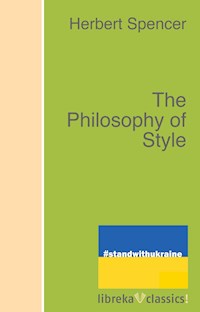
In "The Philosophy of Style," Herbert Spencer delves into the intricate relationship between style and thought, positing that style is not merely a superficial layer of writing but an essential expression of the writer's philosophy. Spencer employs a systematic and analytical literary approach, drawing on evolutionary principles to argue that clarity and coherence in writing are paramount for effective communication. The work is informed by the Victorian context of Spencer's time, where the convergence of science and philosophy had a profound influence on literary theory, leading to a demand for more structured and purposeful writing. His emphasis on economy of expression and adaptability reflects an ongoing dialogue in the literature about the roles of form and function in language usage. Herbert Spencer, a prominent Victorian philosopher and social theorist, was a pivotal figure in the development of sociology and ethics. His background in natural sciences, combined with his interest in human progress and culture, motivated him to explore how language could mirror intellectual efficiency. Spencer's broader philosophical views, notably his advocacy for the survival of the fittest, permeate his analysis of style, revealing his belief in the evolution of literary forms alongside human thought. "The Philosophy of Style" is a must-read for scholars, writers, and students alike seeking to refine their understanding of stylistic choices in literature. Spencer's insights into effective communication and his prescient theories on the interplay between style and substance elevate this work beyond its era, making it relevant for contemporary discussions about writing. Its concise, yet profound examination invites readers to critically engage with their own writing practices, ultimately influencing how they convey ideas. In this enriched edition, we have carefully created added value for your reading experience: - A succinct Introduction situates the work's timeless appeal and themes. - The Synopsis outlines the central plot, highlighting key developments without spoiling critical twists. - A detailed Historical Context immerses you in the era's events and influences that shaped the writing. - An Author Biography reveals milestones in the author's life, illuminating the personal insights behind the text. - A thorough Analysis dissects symbols, motifs, and character arcs to unearth underlying meanings. - Reflection questions prompt you to engage personally with the work's messages, connecting them to modern life. - Hand‐picked Memorable Quotes shine a spotlight on moments of literary brilliance. - Interactive footnotes clarify unusual references, historical allusions, and archaic phrases for an effortless, more informed read.
Das E-Book können Sie in Legimi-Apps oder einer beliebigen App lesen, die das folgende Format unterstützen:
Veröffentlichungsjahr: 2022
Ähnliche







The Philosophy of Style
Table of Contents
Introduction
At its core, this work claims that the finest prose steers a reader’s attention with the least possible waste. That claim furnishes both a standard and a challenge: if writing is an instrument for delivering thought, how can it be tuned so that meaning arrives with maximum clarity and minimum friction? The Philosophy of Style turns this problem into a program, inviting us to examine the forces—mental, sensory, and linguistic—that make sentences either direct pathways or needless detours.
The Philosophy of Style holds classic status because it treats writing not as ornament, but as disciplined efficiency. Its enduring appeal lies in the way it unites clarity with force, demonstrating that elegance is not a luxury added after sense, but a result of sense well delivered. The essay’s compact argument, its lucid examples, and its insistence on measurable effects have kept it in circulation, taught in classrooms, and consulted by readers who seek a rationale for why some prose compels while other prose resists.
Herbert Spencer (1820–1903), a prominent Victorian philosopher and sociologist, first published this essay in 1852 in the Westminster Review, later reprinting it in collections of his essays. Written amid nineteenth-century enthusiasm for scientific explanation, it presents a striking premise: principles of effective style can be grounded in how minds process information. Rather than compiling maxims, Spencer proposes causes. He asks how choice of words, arrangement of clauses, and the sequence of ideas either ease or burden the reader’s attention, and he draws conclusions meant to guide practice without reducing art to rigid rule.
This methodological stance—explaining style through psychology—accounts for much of the work’s originality. Spencer argues that readers possess finite mental resources and that prose should respect those limits. He examines economy in expression, the order of subject and predicate, the placement of modifiers, and the interplay between sound and meaning. His approach treats clarity, vigor, and beauty as different faces of the same phenomenon: successful writing arranges language so that thought flows forward, each element helping rather than hindering comprehension.
Although compact, the essay proceeds with a patience that models the care it recommends. Spencer dismantles common pitfalls—ambiguous references, tangled syntax, decorative excess—and shows how small adjustments produce large gains in intelligibility. He does not merely urge brevity; he insists on the right brevity, where deletion strengthens the line of thought rather than amputating it. Nor does he dismiss ornament; he asks whether it aids the march of meaning. The reader is shown how effect results from structure, not from afterthought.
The literary impact of this analysis is twofold. First, it offered Victorians a persuasive argument for plain, functional prose amid a culture that valued elaborate expression. Second, by situating rhetoric within observable mental processes, it gave teachers and critics a shared vocabulary for discussing style beyond taste. As a result, the essay has been frequently anthologized, cited in histories of rhetoric, and recognized as a landmark in the movement to connect literary craft with principles verifiable beyond personal preference.
Its influence on later writers and theorists has been durable rather than sensational. Many advocates of the modern plain style echo its core contention that clarity and energy grow together when sentences are built to reduce needless effort. Composition handbooks, editorial practices, and discussions of readability reflect the essay’s emphasis on order, concision, and audience awareness. Even where authors diverge in taste, they often engage this framework, accepting that effective style must answer to the reader’s experience moment by moment.
The themes that recur throughout the work have proved strangely contemporary. It weighs the tension between richness and overload, showing how attention can be captured without being squandered. It favors specificity over vagueness, sequence over scatter, and purpose over display. It links sound to sense, reminding us that rhythm is not mere music but a means of carrying thought. And it treats stylistic choices as ethical in a modest, practical way: to write clearly is to respect another mind.
Spencer’s discussion of syntax is particularly memorable for its practicality. He explains how the order of information shapes the reader’s expectations and how misplacement forces costly backtracking. He examines the weight of long sentences, the relief of short ones, and the way transitions prepare the next step. He considers word choice not as adornment, but as the careful trade of precision for accessibility. In each case, the test is concrete: does this arrangement make the idea easier to grasp at the pace of reading?
The essay’s Victorian context also matters. It participates in the century’s broader ambition to derive general laws from observed phenomena, whether in biology, psychology, or society. While some illustrative passages bear the flavor of their time, the central insight—that style succeeds when it harmonizes with the reader’s cognitive processes—has traveled well. The work thus stands as a bridge: a nineteenth-century document that anticipated later inquiries into cognition, communication, and design.
Readers encountering The Philosophy of Style today will find not a manual of tricks but a steady invitation to think. It encourages slow attention to fast effects, asking us to treat each sentence as a device with measurable consequences for a real reader. In doing so, it fosters habits of revision that are generous rather than austere, guided by the question of how best to carry meaning forward. The reward is a kind of transparency through which ideas appear with their edges intact.
In an era saturated with messages, the essay’s argument feels freshly relevant. Digital communication magnifies the costs of confusion and the value of immediacy; audiences reward writing that moves cleanly from premise to payoff. Spencer’s analysis offers a durable compass for that terrain. By linking style to the management of attention, it clarifies why certain patterns endure across media and why clarity remains a democratic virtue. This enduring alignment between theory and practice explains the work’s lasting appeal.
Synopsis
Herbert Spencer’s The Philosophy of Style is a nineteenth-century essay, later issued in book form, that seeks to derive principles of effective writing from psychological laws. Rather than prescribing taste by authority, Spencer argues that style has measurable purposes rooted in how readers process language. He frames his inquiry as an attempt to explain why certain constructions communicate more readily than others, and how beauty in expression often accompanies ease of apprehension. Setting aside personal preference, he treats composition as a practical art oriented to the reader’s mind. This opening establishes a method: reason from general cognitive tendencies to specific recommendations for sentences and paragraphs.
Spencer begins by proposing a single governing aim: the efficient transfer of thought with minimum expenditure of the reader’s attention. From this, he derives a principle of economy. Every needless diversion, pause, or ambiguity wastes mental energy, while smooth progression strengthens impression. Clearness therefore becomes foundational, and force or grace succeed best when they do not obstruct it. The essay contends that many admired effects are by-products of facility, not additions layered upon it. Spencer’s argument positions rhetoric within a quasi-scientific framework, suggesting that effective writing follows the line of least resistance in perception and memory, and that rules serve only insofar as they embody this tendency.
He next examines sentence structure as the primary site where economy can be gained or lost. Spencer analyzes the order of words and clauses, emphasizing that related elements should stand near one another to prevent premature or retroactive interpretation. Interruptions that separate a governing word from its dependents impose costs on the reader’s attention. He discusses the effects of inversion, compound versus complex forms, and the placement of qualifying phrases. Sentences should deliver their central relation without detours, yet may employ suspense or climax when such arrangement reduces rereading. Punctuation is treated as a tool for signaling structure, not as a substitute for structural coherence.




