



2,49 €
Niedrigster Preis in 30 Tagen: 0,99 €
Niedrigster Preis in 30 Tagen: 0,99 €
Mehr erfahren.
- Herausgeber: Musaicum Books
- Kategorie: Geisteswissenschaft
- Sprache: Englisch
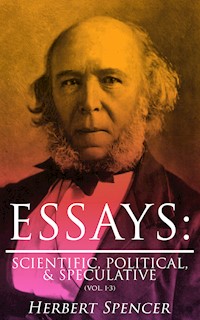
Herbert Spencer's seminal work, 'The Complete Essays by Herbert Spencer (Vol. 1-3)', is a collection of some of his most significant essays that delve into the fields of sociology, philosophy, and ethics. Known for his evolutionary perspective and social Darwinism, Spencer's writing style is characterized by a blend of scientific rigor and philosophical insight. The essays in this collection offer a unique perspective on societal development, individual liberty, and the role of government in shaping human progress. Spencer's analytical approach and keen observations make this collection a must-read for anyone interested in the intersection of science and society in the 19th century context. His influence on the fields of sociology and politics is undeniable, and this collection serves as a comprehensive introduction to his ideas and theories. Herbert Spencer's body of work reflects his belief in the power of individual agency and the importance of social cohesion for societal advancement. Readers interested in exploring the intellectual foundations of modern social science will find this collection both enlightening and thought-provoking. In this enriched edition, we have carefully created added value for your reading experience: - A comprehensive Introduction outlines these selected works' unifying features, themes, or stylistic evolutions. - The Author Biography highlights personal milestones and literary influences that shape the entire body of writing. - A Historical Context section situates the works in their broader era—social currents, cultural trends, and key events that underpin their creation. - A concise Synopsis (Selection) offers an accessible overview of the included texts, helping readers navigate plotlines and main ideas without revealing critical twists. - A unified Analysis examines recurring motifs and stylistic hallmarks across the collection, tying the stories together while spotlighting the different work's strengths. - Reflection questions inspire deeper contemplation of the author's overarching message, inviting readers to draw connections among different texts and relate them to modern contexts. - Lastly, our hand‐picked Memorable Quotes distill pivotal lines and turning points, serving as touchstones for the collection's central themes.
Das E-Book können Sie in Legimi-Apps oder einer beliebigen App lesen, die das folgende Format unterstützen:
Veröffentlichungsjahr: 2021
Ähnliche














The Complete Essays by Herbert Spencer
(Vol. 1-3)
Published by
Books
Table of Contents
Introduction
This three-volume set, The Complete Essays by Herbert Spencer, gathers the author’s short-form writings into a single, coherent collection. The purpose is to make accessible, in one place, the essays through which Spencer elaborated, refined, and tested ideas that also animate his larger treatises. Spanning his career, these pieces reveal the breadth of his interests and the evolution of his arguments across changing intellectual climates. The collection focuses on essays as a distinct mode: compact, argumentative, and often occasioned by public debates. By presenting them together, the volumes allow readers to trace Spencer’s reasoning as it develops within and beyond his major books.
Herbert Spencer was among the most widely read philosophers of the Victorian era, known for an ambitious program that sought to relate phenomena across nature, mind, society, and ethics. While works like First Principles and the Principles series provide a comprehensive architecture, his essays often supplied the first formulations and public tests of central claims. Many originally appeared in nineteenth-century periodicals and were later revised for collected editions under the heading Essays: Scientific, Political, and Speculative. Brought together here, they illuminate both the intellectual environment that prompted them and the systematic aspirations that give them lasting coherence.
The scope of these essays is capacious. Spencer addresses the organization of knowledge, the methods of science, and the idea of evolution as a general tendency observable across domains. He considers the conditions of social order, the limits of authority, and the grounds of moral judgment. He explores education, culture, and the arts as expressions of human development. What unifies this range is a consistent effort to explain complex patterns through naturalistic principles and to show how small changes accumulate into large-scale transformations. The essays repeatedly return to questions about progress, adaptation, and the interdependence of parts within a whole.
The text type represented here is the essay in its varied forms: sustained expositions, short polemics, programmatic statements, and responses to contemporary positions. Some pieces read as interventions in live controversies; others present broad syntheses meant to guide future inquiry. In each case, the essay form enables Spencer’s characteristic movement from general propositions to illustrative instances. Readers will also find occasional review-like discussions in which a current publication or trend serves as a springboard for a more general argument. The result is a record of how Spencer worked ideas out in public, before and alongside his longer books.
Several recurring themes lend the collection a strong internal unity. A central thread is the attempt to understand social life through principles continuous with those observed in nature, without reducing human affairs to mere biology. Another is Spencer’s liberal emphasis on voluntary cooperation and the risks he associated with expansive coercive authority. His educational essays, including the widely read piece that asks what kinds of knowledge deserve priority, apply his broader commitments to practical curricula. Across topics, he seeks to balance abstract first principles with detailed observation of institutions, customs, and everyday practices.
Readers interested in the sciences will encounter essays that argue for methodological rigor, the tracing of regularities, and the cautious extension of explanatory frameworks. Spencer frequently examines how complex systems arise from simpler antecedents, offering proposals about orderly change that he claims recur at many levels. He is attentive to the provisional status of scientific generalizations while defending their cumulative force. The scientific essays are notable for relating empirical findings to philosophical questions—how we know, how we classify, and how we connect disparate facts into intelligible patterns that invite further test and refinement.
Stylistically, Spencer’s essays display a preference for clear definitions, stepwise inference, and extensive use of analogy. He often begins with a principle stated in abstract terms and proceeds to show its application across multiple cases, building momentum through serial exemplification. The tone is deliberative, aiming to persuade by accumulation rather than by rhetorical flourish. His prose reflects Victorian habits of exposition—measured, systematic, and confident in the power of general reasoning—while remaining attentive to counterarguments and practical consequences. This combination of breadth and method gives the essays both accessibility and intellectual reach.
In social and political topics, Spencer articulates a view that privileges individual rights, contractual relations, and emergent social coordination. He questions policies that, in his view, displace voluntary arrangements with centralized control. At the same time, he treats society as an organismic system whose parts cohere through functional differentiation. Later debates have scrutinized aspects of these positions, especially in light of the phrase he introduced into evolutionary discourse. Regardless of agreement, the essays remain central documents for understanding nineteenth-century liberal thought and its complex intersections with emerging social science.
Ethical and aesthetic reflections form another significant strand. Spencer proposes that moral sentiments and standards have histories, molded by human needs and the conditions of social life. He explores the bearing of sympathy, habit, and long-term consequences on moral evaluation. On the arts, he considers how expressive forms may arise from and contribute to human adaptation, treating music, literature, and ritual as vehicles of social meaning. These essays do not present isolated judgments; rather, they situate values within the same evolutionary narrative that informs his scientific and political work, thereby linking feeling, conduct, and culture.
The three volumes collectively showcase Spencer’s range without severing the threads that bind his writings together. Across them, readers will find essays that might be called scientific in emphasis, others that are political, and still others that address speculative or philosophical questions—categories he himself employed in earlier collected editions. The present gathering preserves that breadth while allowing readers to move among topics according to interest. Whether approached systematically or selectively, the set affords multiple entry points into Spencer’s overarching project and the discussions that shaped his era.
Because many essays originated in specific debates of the nineteenth century, this collection also provides a map of the conversations to which Spencer contributed. He often revisits an idea in different contexts, clarifying distinctions or extending implications as new objections or data emerge. Reading across the volumes reveals how positions cohere, where they shift, and how local arguments fit into a larger scheme. The essays thus function as both standalone interventions and connective tissue, linking the conceptual architecture of his major works with the practical questions that kept his thought engaged with public life.
The lasting significance of Spencer’s essays lies in their ambition to relate diverse fields within a unified explanatory vision and in their historical role within the development of modern social and scientific thought. They invite readers to weigh claims about order, progress, and freedom that continue to animate inquiry and policy. By assembling them in a comprehensive three-volume collection, this edition offers a durable resource for study and debate. It allows contemporary readers to judge the arguments on their merits, appreciate their influence, and situate them within the wider intellectual landscape from which they emerged.
Author Biography
Herbert Spencer (1820–1903) was a prominent English philosopher and social theorist whose sweeping system of “evolutionary” explanation shaped debates across the late nineteenth century. Writing for a broad public, he sought to unify knowledge about nature, mind, society, and morals under a single, law-like account of development. He popularized the phrase “survival of the fittest,” and his work influenced discussions in philosophy, early sociology, and political theory. The three-volume collection presented here offers a compact path into his thought, allowing readers to see how his ideas about progress, organization, and individual liberty were articulated across different stages of his career.
Spencer’s education was largely informal and self-directed. Raised in an environment attentive to science and dissenting intellectual traditions, he developed strong interests in mathematics, natural history, and mechanics. In his youth he worked as a railway engineer, an experience that reinforced his preference for systematic explanation and incremental problem-solving. He read widely and engaged contemporary currents—classical liberalism, utilitarian ethics, and emerging theories of biological change—before and after the publication of Darwin’s work. Auguste Comte’s positivism provided both a stimulus and a foil: Spencer admired efforts to ground social knowledge in observation while rejecting any program that subordinated individual judgment to centralized authority.
By the 1840s Spencer had shifted from engineering to journalism and authorship, contributing essays and reviews to periodicals before taking on editorial duties at The Economist. He developed a distinctive voice that combined empirical illustration with sweeping generalization, arguing that many social arrangements arise from spontaneous coordination rather than legislative design. Early political writings emphasized individual liberties and cautioned against expansive state action. He wrote with the confidence of a public intellectual, addressing readers well beyond academic circles. The three volumes in this collection reflect that breadth, gathering pieces that show him moving from topical analysis toward a more architectonic statement of principles.
Spencer’s most ambitious undertaking was a long, interconnected project he called a synthetic philosophy, aiming to integrate the sciences and the study of society under a common schema. He treated evolution as a universal tendency from the simple to the complex, marked by increasing differentiation and integration. A foundational statement set out “first principles,” followed by applications to biology, psychology, sociology, and ethics across several decades. In this context he introduced “survival of the fittest” as a biological shorthand, later echoed in social debates. The collection’s volumes give readers a vantage on this system-building impulse, from methodological groundwork to wide-ranging applications.
Spencer’s sociological writings helped normalize comparative analysis and long-run developmental narratives. He described societies as systems whose parts cohere through functional interdependence, drawing analogies to organisms while insisting that social order emerges from individual actions. His typology contrasting coercive, war-oriented (“militant”) arrangements with voluntary, exchange-centered (“industrial”) ones framed enduring discussions about institutional change. He mined travel reports, legislative records, and historical chronicles to support generalizations, while warning that abstract laws must be checked against varied cases. The present three-volume set lets readers follow these recurring moves—comparison, typology, functional explanation—across themes of kinship, governance, markets, and moral norms.
Reception of Spencer’s work was dramatic and mixed. He was widely read in the late nineteenth century, admired for synthesizing vast domains and criticized for overreach. Supporters found in his writings a defense of voluntary association and incremental reform; detractors objected to what they saw as deterministic or reductive tendencies, especially when evolutionary language migrated into social and political argument. Later commentators attached the label “Social Darwinism” to some interpretations of his views, a characterization that remains debated. The essays and treatises represented across Volume 1, Volume 2, and Volume 3 help clarify both the appeal and the limits of his approach by foregrounding his own formulations.
Spencer’s later years were marked by recurring health difficulties, but he continued to revise and extend his publications, maintaining the independence that had shaped his career. He died in the early twentieth century in England, leaving a legacy that still provokes consideration and critique. His influence endures in the history of sociology, in liberal political philosophy’s arguments about state and market, and in contemporary systems thinking that treats complex wholes as composed of interacting parts. This collection’s three volumes remain a valuable gateway, presenting the sweep of his ambition alongside the tensions that make his work a continuing object of study.
Historical Context
Herbert Spencer’s career unfolded across the Victorian century, from his birth in 1820 to his death in 1903, a span that witnessed industrial acceleration, imperial expansion, and a restructuring of British political life. The essays gathered across three volumes reflect decades of writing first in newspapers and leading reviews, then as parts of his broader Synthetic Philosophy. Written largely between the early 1850s and the 1890s, they register the pressures of mechanized production, urban growth, and new scientific programs. The collection thus frames a continuous commentary on how Britain’s economic and intellectual revolutions reshaped institutions, beliefs, and the scope of government action.
Spencer’s formative years as a civil engineer coincided with Britain’s railway boom of the 1830s–1840s, when speculative investment and novel corporate structures transformed transport and finance. His essay “Railway Morals and Railway Policy” (1854) drew on that world to criticize managerial abuses, conflicts of interest, and weak shareholder protections in joint-stock enterprises. The Joint Stock Companies Act (1844) and the Limited Liability Act (1855) had begun to formalize regulation, yet scandals and overcapitalization persisted. Spencer’s treatment of railways became a template for his broader concern with moral agency in economic organizations—arguing that market freedom required clearly enforced responsibilities rather than politically favored monopolies.
British liberalism’s mid-century ascendancy, strengthened by free-trade victories such as the repeal of the Corn Laws (1846), provided the immediate political context for Spencer’s early writings. The New Poor Law (1834) and successive Factory Acts fueled debate over how far the state should intervene in labor, welfare, and morals. Spencer’s “The Proper Sphere of Government” (1843) and “Over-Legislation” (1853) reflect this climate of argument, advocating minimal coercion and warning against ad hoc remedies to complex social problems. He positioned himself near the Manchester School in suspicion of paternalism, yet pressed a distinctively systematic case grounded in general social principles rather than purely fiscal concerns.
The upheavals of 1848 in Europe and the waning of Chartism in Britain sharpened anxieties about democracy, socialism, and authority. As the franchise widened through the Second Reform Act (1867) and the Third Reform Act (1884), questions about majority rule and minority rights grew more acute. Spencer’s political essays from the 1880s, notably “The Coming Slavery” (1884), expressed fear that proliferating regulations, compulsory schemes, and state-administered relief could invert liberal gains. He traced such trends to well-meaning legislative activism coupled with electoral incentives—arguing that collectivist measures, even when popular, might erode voluntary cooperation and personal responsibility.
Spencer’s scientific essays emerged from a pre-Darwinian environment shaped by geologists like Charles Lyell and astronomers who debated the nebular hypothesis. In “The Development Hypothesis” (1852) and “Progress: Its Law and Cause” (1857), he proposed that change from the simple to the complex characterized phenomena from biology to society. “The Genesis of Science” (1854) mapped the historical differentiation of knowledge, portraying science as an organic, cumulative enterprise. These essays situated Spencer among British evolutionists who anticipated or paralleled themes later associated with Charles Darwin, while grounding social analysis in methodological continuities with natural history.
Publication of Darwin’s On the Origin of Species (1859) altered the intellectual landscape. Spencer accepted evolutionary explanations and in 1864 coined “survival of the fittest” in his Principles of Biology to describe natural selection’s outcomes. The essays in these volumes apply evolutionary ideas to psychology, culture, and institutions. “The Social Organism” (1860) articulated analogies between biological and social integration, encouraging a comparative approach to social structure. While he differed from Darwin on mechanism and scope, Spencer used evolutionary universals to critique hasty state remedies—arguing that complex orders emerge through gradual adaptation rather than by decree.
Mid-century advances in physics and astronomy reinforced Spencer’s drive toward synthesis. Conservation of energy research (Joule, Helmholtz, 1840s) and discussions of cosmic formation encouraged unified explanations. Essays such as “The Nebular Hypothesis” (1858) and “Progress: Its Law and Cause” located society within a continuum from cosmic to cultural evolution. The Great Exhibition of 1851 symbolized technological confidence and industrial interdependence that his writing both celebrated and interrogated. By treating social life as a system of interrelated functions, Spencer positioned political and ethical questions within a broader natural order that combined constraint with open-ended development.
Religious controversy shaped Victorian inquiry, from debates over biblical criticism to disputes about miracles and ecclesiastical authority. Although the word “agnostic” was popularized slightly later by T. H. Huxley (1869), Spencer’s First Principles (1862) had already argued for the “Unknowable”—a sphere where ultimate reality exceeded human comprehension. The essays echo this stance by urging a truce between science and religion based on limits of knowledge. Rather than attacking faith directly, he outlined how stable social cooperation flourishes when beliefs are tested against experience and freed from coercive establishment, consistent with contemporaneous Nonconformist critiques of state churches.
Education became a central reform arena after the Elementary Education Act (1870) created publicly supported elementary schools. Earlier, “What Knowledge Is of Most Worth?” (1859) pressed for curricula grounded in science, physiology, and practical reasoning—contending that literacy and numeracy must be joined to knowledge indispensable for life. Mechanics’ institutes, examining bodies, and proliferating technical schools provided the institutional scaffolding for such priorities. In the political essays, Spencer warned that centralized control of schooling risked stifling plurality and experimentation. Collectively, these writings track the Victorian transition from ad hoc instruction toward mass education and credentialed expertise.
Rapid urbanization produced sanitation crises and administrative innovations. Edwin Chadwick’s 1842 report and the Public Health Acts (1848, 1875) expanded municipal responsibilities for water, sewage, and housing. Spencer’s political essays assessed these interventions through a liberal lens that acknowledged public hazards while resisting expansive coercion and permanent bureaucracies. Debates over compulsory measures in health and safety legislation illustrate a recurring theme: remedies should respect voluntary association and dispersed initiative wherever feasible. In Spencer’s view, cumulative civic capabilities—friendly societies, local charities, and mutual-aid networks—were vital counterweights to centralized, one-size-fits-all policy.
British imperial commitments and warfare punctuated the period—the Crimean War (1853–1856), the Indian Rebellion (1857), and later colonial campaigns. Spencer treated militarism as a formative social type whose command-and-control logic spilled into civil life. Essays that compare “militant” and “industrial” arrangements emphasized how military organization, if dominant, encourages hierarchy and compulsion over contract and consent. Even where he endorsed national defense, he warned that glorifying war biases legislation toward barracks-like uniformity. The collection’s analyses thus tie questions of peace and commerce to civil liberties, arguing that freer exchange promotes a less coercive political temper.
The expanding print sphere—cheap newspapers after the 1855 stamp-duty repeal, serialized reviews, and transatlantic reprints—provided Spencer’s essays with wide circulation. In “The Philosophy of Style” (1852), he advanced a psychological account of clarity and brevity that matched the needs of mass readership and professional communication. “Manners and Fashion” (1854) examined the social enforcement of taste and dress, situating etiquette within evolutionary accounts of prestige and imitation. These cultural pieces register the democratization of reading and consumption, where standards once anchored in courtly life diffused through cities, workplaces, and voluntary associations shaped by industrial time-discipline.
Victorian political economy remained haunted by Malthus’s population theory and by disputes over poor relief, wages, and emigration. Spencer’s early population essays, written around 1852, engaged these questions within a larger evolutionary ethics: long-term improvement, he argued, depended on foresight, voluntary restraint, and the gradual alignment of conduct with consequences. As Britain moved toward freer trade and a global industrial role, his writings insisted that prosperity required institutional environments rewarding prudence and cooperation. The essays thus connect demographic pressure, family formation, and labor mobility to legal frameworks that either amplify or blunt incentives for self-directed betterment.
Comtean positivism and the classification of the sciences provided another nineteenth-century backdrop. Spencer adopted the comparative ambition but rejected Auguste Comte’s quasi-religious prescriptions, arguing instead for a science anchored in empirical generalizations and provisional syntheses. “The Genesis of Science” traced disciplinary specialization from myth and craft to modern method, while other essays drew evidence from ethnography, travel literature, and statistics. This methodological eclecticism paralleled the era’s knowledge institutions—learned societies, museums, and statistical bureaus—that supplied data for cross-cultural generalization, and it helped normalize the idea that sociology could be a law-seeking inquiry continuous with natural science.
Late-century politics witnessed the rise of New Liberalism, organized labor, and socialism’s parliamentary strategies. The Fabian Society formed in 1884; employer liability and factory codes expanded in the 1870s–1890s. Spencer’s “The Man versus the State” sequence (1884) and “From Freedom to Bondage” (1891) crystallized his response, portraying accumulating interventions as a drift from voluntary contract to pervasive regulation. He linked licensing regimes, rate-funded services, and inspection powers to unintended consequences that burdened enterprise and civic initiative. Irish Home Rule controversies and debates over municipal trading further fed anxieties that political centralization would displace associative, local solutions.
The periodical economy shaped Spencer’s transnational reach. He wrote for prominent British reviews and was widely published in the United States by D. Appleton & Company, gaining a substantial Gilded Age readership. His 1882 visit to America underscored the appeal of evolutionary liberalism among industrialists and reformers alike, even as he criticized certain activist currents. Critics later grouped him with so-called “social Darwinism,” a retrospective label that historians dispute. The essays themselves reveal a more intricate position: opposition to coercive state aid combined with endorsement of voluntary charity, contract enforcement, and legal neutrality as preconditions for social improvement.
Across the three volumes, specific controversies—railway governance, public health administration, state education, poor relief, and colonial conflict—become indices of structural change in Victorian society. Spencer’s recurring devices, such as analogies to biological organization and appeals to unintended effects, reflect a century wrestling with complexity before the specialized social sciences fully consolidated. The essays complement his larger Synthetic Philosophy but stand independently as interventions in ongoing policy debates. They portray modernization not as a simple gain but as a rebalancing of authority, responsibility, and knowledge amid expanding populations, technologies, and markets that defied traditional administrative habits of command. The collection functions today as both historical artifact and living polemic. Its Victorian readers recognized arguments for free exchange, local initiative, and incremental reform in the face of fashionable centralization. Later audiences—Progressive Era reformers, welfare-state architects, and late twentieth-century libertarians—have each recast Spencer: either as obstacle, interlocutor, or ally. Contemporary scholarship reads the essays to understand how evolutionary frameworks, media ecosystems, and institutional experiments jointly shaped modern liberal societies, and how those legacies still structure policy imagination.
Synopsis (Selection)
Volume 1
This opening volume gathers essays that sketch an overarching system, linking gradual development in nature to the formation of social institutions and moral norms. The pieces balance wide-ranging theory with illustrative cases, arguing for individual self-direction and spontaneous social order while laying out a method grounded in observable regularities.
Volume 2
The second volume extends these arguments into debates about politics, education, and social organization, testing first principles against practical questions. Its tone is assertive and reform-minded, emphasizing voluntary cooperation, limits on coercive authority, and the adaptive evolution of institutions.
Volume 3
The final volume turns toward synthesis and scope, tracing implications for knowledge, psychology, and culture while attending to the complexity and limits of generalization. More reflective and integrative, it consolidates earlier claims about evolution and society into a cohesive outlook that prizes consistency, utility, and incremental change.
The Complete Essays by Herbert Spencer (Vol. 1-3)
Volume 1
Table of Contents
PREFACE
Excepting those which have appeared as articles in periodicals during the last eight years, the essays here gathered together were originally re-published in separate volumes at long intervals. The first volume appeared in December 1857; the second in November 1863; and the third in February 1874. By the time the original editions of the first two had been sold, American reprints, differently entitled and having the essays differently arranged, had been produced; and, for economy's sake, I have since contented myself with importing successive supplies printed from the American stereotype plates. Of the third volume, however, supplies have, as they were required, been printed over here, from plates partly American and partly English. The completion of this final edition of course puts an end to this make-shift arrangement.
The essays above referred to as having been written since 1882, are now incorporated with those previously re-published. There are seven of them; namely—"Morals and Moral Sentiments," "The Factors of Organic Evolution," "Professor Green's Explanations," "The Ethics of Kant," "Absolute Political Ethics," "From Freedom to Bondage," and "The Americans." As well as these large additions there are small additions, in the shape of postscripts to various essays—one to "The Constitution of the Sun," one to "The Philosophy of Style," one to "Railway Morals," one to "Prison Ethics," and one to "The Origin and Function of Music:" which last is about equal in length to the original essay. Changes have been made in many of the essays: in some cases by omitting passages and in other cases by including new ones. Especially the essay on "The Nebular Hypothesis" may be named as one which, though unchanged in essentials, has been much altered by additions and subtractions, and by bringing its statements up to date; so that it has been in large measure re-cast. Beyond these respects in which this final edition differs from preceding editions, it differs in having undergone a verification of its references and quotations, as well as a second verbal revision.
Naturally the fusion of three separate series of essays into one series, has made needful a general re-arrangement. Whether to follow the order of time or the order of subjects was a question which presented itself; and, as neither alternative promised satisfactory results, I eventually decided to compromise—to follow partly the one order and partly the other. The first volume is made up of essays in which the idea of evolution, general or special, is dominant. In the second volume essays dealing with philosophical questions, with abstract and concrete science, and with aesthetics, are brought together; but though all of them are tacitly evolutionary, their evolutionism is an incidental rather than a necessary trait. The ethical, political, and social essays composing the third volume, though mostly written from the evolution point of view, have for their more immediate purposes the enunciation of doctrines which are directly practical in their bearings. Meanwhile, within each volume the essays are arranged in order of time: not indeed strictly, but so far as consists with the requirements of sub-classing.
Beyond the essays included in these three volumes, there remain several which I have not thought it well to include—in some cases because of their personal character, in other cases because of their relative unimportance, and in yet other cases because they would scarcely be understood in the absence of the arguments to which they are replies. But for the convenience of any who may wish to find them, I append their titles and places of publication. These are as follows:—"Retrogressive Religion," in The Nineteenth Century for July 1884; "Last Words about Agnosticism and the Religion of Humanity," in The Nineteenth Century for November 1884; a note to Prof. Cairns' Critique on the Study of Sociology, in The Fortnightly Review, for February 1875; "A Short Rejoinder" [to Mr. J. F. McLennan], Fortnightly Review, June 1877; "Prof. Goldwin Smith as a Critic," Contemporary Review, March 1882; "A Rejoinder to M. de Laveleye," Contemporary Review, April 1885.
London, December, 1890.
THE DEVELOPMENT HYPOTHESIS.
[Originally published in The Leader, for March 20, 1852. Brief though it is, I place this essay before the rest, partly because with the exception of a similarly-brief essay on "Use and Beauty", it came first in order of time, but chiefly because it came first in order of thought, and struck the keynote of all that was to follow.]
In a debate upon the development hypothesis, lately narrated to me by a friend, one of the disputants was described as arguing that as, in all our experience, we know no such phenomenon as transmutation of species, it is unphilosophical to assume that transmutation of species ever takes place. Had I been present I think that, passing over his assertion, which is open to criticism, I should have replied that, as in all our experience we have never known a species created, it was, by his own showing, unphilosophical to assume that any species ever had been created.
Those who cavalierly reject the Theory of Evolution as not being adequately supported by facts, seem to forget that their own theory is supported by no facts at all. Like the majority of men who are born to a given belief, they demand the most rigorous proof of any adverse belief, but assume that their own needs none. Here we find, scattered over the globe, vegetable and animal organisms numbering, of the one kind (according to Humboldt), some 320,000 species, and of the other, some 2,000,000 species (see Carpenter); and if to these we add the numbers of animal and vegetable species which have become extinct, we may safely estimate the number of species that have existed, and are existing, on the Earth, at not less than ten millions. Well, which is the most rational theory about these ten millions of species? Is it most likely that there have been ten millions of special creations? or is it most likely that, by continual modifications due to change of circumstances, ten millions of varieties have been produced, as varieties are being produced still?
Doubtless many will reply that they can more easily conceive ten millions of special creations to have taken place, than they can conceive that ten millions of varieties have arisen by successive modifications. All such, however, will find, on inquiry, that they are under an illusion. This is one of the many cases in which men do not really believe, but rather believe they believe. It is not that they can truly conceive ten millions of special creations to have taken place, but that they think they can do so. Careful introspection will show them that they have never yet realized to themselves the creation of even one species. If they have formed a definite conception of the process, let them tell us how a new species is constructed, and how it makes its appearance. Is it thrown down from the clouds? or must we hold to the notion that it struggles up out of the ground? Do its limbs and viscera rush together from all the points of the compass? or must we receive the old Hebrew idea, that God takes clay and moulds a new creature? If they say that a new creature is produced in none of these modes, which are too absurd to be believed, then they are required to describe the mode in which a new creature may be produced—a mode which does not seem absurd; and such a mode they will find that they neither have conceived nor can conceive.
Should the believers in special creations consider it unfair thus to call upon them to describe how special creations take place, I reply that this is far less than they demand from the supporters of the Development Hypothesis. They are merely asked to point out a conceivable mode. On the other hand, they ask, not simply for a conceivable mode, but for the actual mode. They do not say—Show us how this may take place; but they say—Show us how this does take place. So far from its being unreasonable to put the above question, it would be reasonable to ask not only for a possible mode of special creation, but for an ascertained mode; seeing that this is no greater a demand than they make upon their opponents.
And here we may perceive how much more defensible the new doctrine is than the old one. Even could the supporters of the Development Hypothesis merely show that the origination of species by the process of modification is conceivable, they would be in a better position than their opponents. But they can do much more than this. They can show that the process of modification has effected, and is effecting, decided changes in all organisms subject to modifying influences. Though, from the impossibility of getting at a sufficiency of facts, they are unable to trace the many phases through which any existing species has passed in arriving at its present form, or to identify the influences which caused the successive modifications; yet, they can show that any existing species—animal or vegetable—when placed under conditions different from its previous ones, immediately begins to undergo certain changes fitting it for the new conditions. They can show that in successive generations these changes continue; until, ultimately, the new conditions become the natural ones. They can show that in cultivated plants, in domesticated animals, and in the several races of men, such alterations have taken place. They can show that the degrees of difference so produced are often, as in dogs, greater than those on which distinctions of species are in other cases founded. They can show that it is a matter of dispute whether some of these modified forms are varieties or separate species. They can show, too, that the changes daily taking place in ourselves—the facility that attends long practice, and the loss of aptitude that begins when practice ceases—the strengthening of passions habitually gratified, and the weakening of those habitually curbed—the development of every faculty, bodily, moral, or intellectual, according to the use made of it—are all explicable on this same principle. And thus they can show that throughout all organic nature there is at work a modifying influence of the kind they assign as the cause of these specific differences: an influence which, though slow in its action, does, in time, if the circumstances demand it, produce marked changes—an influence which, to all appearance, would produce in the millions of years, and under the great varieties of condition which geological records imply, any amount of change.
Which, then, is the most rational hypothesis?—that of special creations which has neither a fact to support it nor is even definitely conceivable; or that of modification, which is not only definitely conceivable, but is countenanced by the habitudes of every existing organism?
That by any series of changes a protozoon should ever become a mammal, seems to those who are not familiar with zoology, and who have not seen how clear becomes the relationship between the simplest and the most complex forms when intermediate forms are examined, a very grotesque notion. Habitually looking at things rather in their statical aspect than in their dynamical aspect, they never realize the fact that, by small increments of modification, any amount of modification may in time be generated. That surprise which they feel on finding one whom they last saw as a boy, grown into a man, becomes incredulity when the degree of change is greater. Nevertheless, abundant instances are at hand of the mode in which we may pass to the most diverse forms by insensible gradations. Arguing the matter some time since with a learned professor, I illustrated my position thus:—You admit that there is no apparent relationship between a circle and an hyperbola. The one is a finite curve; the other is an infinite one. All parts of the one are alike; of the other no parts are alike [save parts on its opposite sides]. The one incloses a space; the other will not inclose a space though produced for ever. Yet opposite as are these curves in all their properties, they may be connected together by a series of intermediate curves, no one of which differs from the adjacent ones in any appreciable degree. Thus, if a cone be cut by a plane at right angles to its axis we get a circle. If, instead of being perfectly at right angles, the plane subtends with the axis an angle of 89° 59´, we have an ellipse which no human eye, even when aided by an accurate pair of compasses, can distinguish from a circle. Decreasing the angle minute by minute, the ellipse becomes first perceptibly eccentric, then manifestly so, and by and by acquires so immensely elongated a form, as to bear no recognizable resemblance to a circle. By continuing this process, the ellipse passes insensibly into a parabola; and, ultimately, by still further diminishing the angle, into an hyperbola. Now here we have four different species of curve—circle, ellipse, parabola, and hyperbola—each having its peculiar properties and its separate equation, and the first and last of which are quite opposite in nature, connected together as members of one series, all producible by a single process of insensible modification.
But the blindness of those who think it absurd to suppose that complex organic forms may have arisen by successive modifications out of simple ones, becomes astonishing when we remember that complex organic forms are daily being thus produced. A tree differs from a seed immeasurably in every respect—in bulk, in structure, in colour, in form, in chemical composition: differs so greatly that no visible resemblance of any kind can be pointed out between them. Yet is the one changed in the course of a few years into the other: changed so gradually, that at no moment can it be said—Now the seed ceases to be, and the tree exists. What can be more widely contrasted than a newly-born child and the small, semi-transparent spherule constituting the human ovum? The infant is so complex in structure that a cyclopædia is needed to describe its constituent parts. The germinal vesicle is so simple that it may be defined in a line. Nevertheless a few months suffice to develop the one out of the other; and that, too, by a series of modifications so small, that were the embryo examined at successive minutes, even a microscope would with difficulty disclose any sensible changes. That the uneducated and the ill-educated should think the hypothesis that all races of beings, man inclusive, may in process of time have been evolved from the simplest monad, a ludicrous one, is not to be wondered at. But for the physiologist, who knows that every individual being is so evolved—who knows, further, that in their earliest condition the germs of all plants and animals whatever are so similar, "that there is no appreciable distinction amongst them, which would enable it to be determined whether a particular molecule is the germ of a Conferva or of an Oak, of a Zoophyte or of a Man;"[1]—for him to make a difficulty of the matter is inexcusable. Surely if a single cell may, when subjected to certain influences, become a man in the space of twenty years; there is nothing absurd in the hypothesis that under certain other influences, a cell may, in the course of millions of years, give origin to the human race.
We have, indeed, in the part taken by many scientific men in this controversy of "Law versus Miracle," a good illustration of the tenacious vitality of superstitions. Ask one of our leading geologists or physiologists whether he believes in the Mosaic account of the creation, and he will take the question as next to an insult. Either he rejects the narrative entirely, or understands it in some vague nonnatural sense. Yet one part of it he unconsciously adopts; and that, too, literally. For whence has he got this notion of "special creations," which he thinks so reasonable, and fights for so vigorously? Evidently he can trace it back to no other source than this myth which he repudiates. He has not a single fact in nature to cite in proof of it; nor is he prepared with any chain of reasoning by which it may be established. Catechize him, and he will be forced to confess that the notion was put into his mind in childhood as part of a story which he now thinks absurd. And why, after rejecting all the rest of the story, he should strenuously defend this last remnant of it, as though he had received it on valid authority, he would be puzzled to say.
FOOTNOTE:
[1] Carpenter, Principles of Comparative Physiology, p. 474.
PROGRESS: ITS LAW AND CAUSE.
[First published in The Westminster Review for April, 1857. Though the ideas and illustrations contained in this essay were eventually incorporated in First Principles, yet I think it well here to reproduce it as exhibiting the form under which the General Doctrine of Evolution made its first appearance.]
The current conception of progress is shifting and indefinite. Sometimes it comprehends little more than simple growth—as of a nation in the number of its members and the extent of territory over which it spreads. Sometimes it has reference to quantity of material products—as when the advance of agriculture and manufactures is the topic. Sometimes the superior quality of these products is contemplated; and sometimes the new or improved appliances by which they are produced. When, again, we speak of moral or intellectual progress, we refer to states of the individual or people exhibiting it; while, when the progress of Science, or Art, is commented upon, we have in view certain abstract results of human thought and action. Not only, however, is the current conception of progress more or less vague, but it is in great measure erroneous. It takes in not so much the reality of progress as its accompaniments—not so much the substance as the shadow. That progress in intelligence seen during the growth of the child into the man, or the savage into the philosopher, is commonly regarded as consisting in the greater number of facts known and laws understood; whereas the actual progress consists in those internal modifications of which this larger knowledge is the expression. Social progress is supposed to consist in the making of a greater quantity and variety of the articles required for satisfying men's wants; in the increasing security of person and property; in widening freedom of action; whereas, rightly understood, social progress consists in those changes of structure in the social organism which have entailed these consequences. The current conception is a teleological one. The phenomena are contemplated solely as bearing on human happiness. Only those changes are held to constitute progress which directly or indirectly tend to heighten human happiness; and they are thought to constitute progress simply because they tend to heighten human happiness. But rightly to understand progress, we must learn the nature of these changes, considered apart from our interests. Ceasing, for example, to regard the successive geological modifications that have taken place in the Earth, as modifications that have gradually fitted it for the habitation of Man, and as therefore constituting geological progress, we must ascertain the character common to these modifications—the law to which they all conform. And similarly in every other case. Leaving out of sight concomitants and beneficial consequences, let us ask what progress is in itself.
In respect to that progress which individual organisms display in the course of their evolution, this question has been answered by the Germans. The investigations of Wolff, Goethe, and von Baer, have established the truth that the series of changes gone through during the development of a seed into a tree, or an ovum into an animal, constitute an advance from homogeneity of structure to heterogeneity of structure. In its primary stage, every germ consists of a substance that is uniform throughout, both in texture and chemical composition. The first step is the appearance of a difference between two parts of this substance; or, as the phenomenon is called in physiological language, a differentiation. Each of these differentiated divisions presently begins itself to exhibit some contrast of parts: and by and by these secondary differentiations become as definite as the original one. This process is continuously repeated—is simultaneously going on in all parts of the growing embryo; and by endless such differentiations there is finally produced that complex combination of tissues and organs constituting the adult animal or plant. This is the history of all organisms whatever. It is settled beyond dispute that organic progress consists in a change from the homogeneous to the heterogeneous[1q].
Now, we propose in the first place to show, that this law of organic progress is the law of all progress. Whether it be in the development of the Earth, in the development of Life upon its surface, in the development of Society, of Government, of Manufactures, of Commerce, of Language, Literature, Science, Art, this same evolution of the simple into the complex, through successive differentiations, holds throughout. From the earliest traceable cosmical changes down to the latest results of civilization, we shall find that the transformation of the homogeneous into the heterogeneous, is that in which progress essentially consists.
With the view of showing that if the Nebular Hypothesis be true, the genesis of the solar system supplies one illustration of this law, let us assume that the matter of which the sun and planets consist was once in a diffused form; and that from the gravitation of its atoms there resulted a gradual concentration. By the hypothesis, the solar system in its nascent state existed as an indefinitely extended and nearly homogeneous medium—a medium almost homogeneous in density, in temperature, and in other physical attributes. The first change in the direction of increased aggregation, brought a contrast in density and a contrast in temperature, between the interior and the exterior of this mass. Simultaneously the drawing in of outer parts caused motions ending in rotation round a centre with various angular velocities. These differentiations increased in number and degree until there was evolved the organized group of sun, planets, and satellites, which we now know—a group which presents numerous contrasts of structure and action among its members. There are the immense contrasts between the sun and the planets, in bulk and in weight; as well as the subordinate contrasts between one planet and another, and between the planets and their satellites. There is the similarly-marked contrast between the sun as almost stationary (relatively to the other members of the Solar System), and the planets as moving round him with great velocity: while there are the secondary contrasts between the velocities and periods of the several planets, and between their simple revolutions and the double ones of their satellites, which have to move round their primaries while moving round the sun. There is the yet further strong contrast between the sun and the planets in respect of temperature; and there is good reason to suppose that the planets and satellites differ from each other in their proper heats, as well as in the amounts of heat they receive from the sun. When we bear in mind that, in addition to these various contrasts, the planets and satellites also differ in respect to their distances from each other and their primary; in respect to the inclinations of their orbits, the inclinations of their axes, their times of rotation on their axes, their specific gravities, and their physical constitutions; we see what a high degree of heterogeneity the solar system exhibits, when compared with the almost complete homogeneity of the nebulous mass out of which it is supposed to have originated.
Passing from this hypothetical illustration, which must be taken for what it is worth, without prejudice to the general argument, let us descend to a more certain order of evidence. It is now generally agreed among geologists and physicists that the Earth was at one time a mass of molten matter. If so, it was at that time relatively homogeneous in consistence, and, in virtue of the circulation which takes place in heated fluids, must have been comparatively homogeneous in temperature; and it must have been surrounded by an atmosphere consisting partly of the elements of air and water, and partly of those various other elements which are among the more ready to assume gaseous forms at high temperatures. That slow cooling by radiation which is still going on at an inappreciable rate, and which, though originally far more rapid than now, necessarily required an immense time to produce any decided change, must ultimately have resulted in the solidification of the portion most able to part with its heat—namely, the surface. In the thin crust thus formed we have the first marked differentiation. A still further cooling, a consequent thickening of this crust, and an accompanying deposition of all solidifiable elements contained in the atmosphere, must finally have been followed by the condensation of the water previously existing as vapour. A second marked differentiation must thus have arisen; and as the condensation must have taken place on the coolest parts of the surface—namely, about the poles—there must thus have resulted the first geographical distinction of parts. To these illustrations of growing heterogeneity, which, though deduced from known physical laws, may be regarded as more or less hypothetical, Geology adds an extensive series that have been inductively established. Investigations show that the Earth has been continually becoming more heterogeneous in virtue of the multiplication of sedimentary strata which form its crust; also, that it has been becoming more heterogeneous in respect of the composition of these strata, the later of which, being made from the detritus of the earlier, are many of them rendered highly complex by the mixture of materials they contain; and further, that this heterogeneity has been vastly increased by the actions of the Earth's still molten nucleus upon its envelope, whence have resulted not only many kinds of igneous rocks, but the tilting up of sedimentary strata at all angles, the formation of faults and metallic veins, the production of endless dislocations and irregularities. Yet again, geologists teach us that the Earth's surface has been growing more varied in elevation—that the most ancient mountain systems are the smallest, and the Andes and Himalayas the most modern; while in all probability there have been corresponding changes in the bed of the ocean. As a consequence of these ceaseless differentiations, we now find that no considerable portion of the Earth's exposed surface is like any other portion, either in contour, in geologic structure, or in chemical composition; and that in most parts it changes from mile to mile in all these characters. Moreover, there has been simultaneously going on a differentiation of climates. As fast as the Earth cooled and its crust solidified, there arose appreciable differences in temperature between those parts of its surface more exposed to the sun and those less exposed. As the cooling progressed, these differences became more pronounced; until there finally resulted those marked contrasts between regions of perpetual ice and snow, regions where winter and summer alternately reign for periods varying according to the latitude, and regions where summer follows summer with scarcely an appreciable variation. At the same time the many and varied elevations and subsidences of portions of the Earth's crust, bringing about the present irregular distribution of land and sea, have entailed modifications of climate beyond those dependent on latitude; while a yet further series of such modifications have been produced by increasing differences of elevation in the land, which have in sundry places brought arctic, temperate, and tropical climates to within a few miles of one another. And the general outcome of these changes is, that not only has every extensive region its own meteorologic conditions, but that every locality in each region differs more or less from others in those conditions; as in its structure, its contour, its soil. Thus, between our existing Earth, the phenomena of whose crust neither geographers, geologists, mineralogists, nor meteorologists have yet enumerated, and the molten globe out of which it was evolved, the contrast in heterogeneity is extreme.
When from the Earth itself we turn to the plants and animals which have lived, or still live, upon its surface, we find ourselves in some difficulty from lack of facts. That every existing organism has been developed out of the simple into the complex, is indeed the first established truth of all; and that every organism which existed in past times was similarly developed, is an inference no physiologist will hesitate to draw. But when we pass from individual forms of life to Life in general, and inquire whether the same law is seen in the ensemble of its manifestations—whether modern plants and animals are of more heterogeneous structure than ancient ones, and whether the Earth's present Flora and Fauna are more heterogeneous than the Flora and Fauna of the past—we find the evidence so fragmentary, that every conclusion is open to dispute. Three-fifths of the Earth's surface being covered by water; a great part of the exposed land being inaccessible to, or untravelled by, the geologist; the greater part of the remainder having been scarcely more than glanced at; and even the most familiar portions, as England, having been so imperfectly explored that a new series of strata has been added within these four years—it is impossible for us to say with certainty what creatures have, and what have not, existed at any particular period. Considering the perishable nature of many of the lower organic forms, the metamorphosis of numerous sedimentary strata, and the great gaps occurring among the rest, we shall see further reason for distrusting our deductions. On the one hand, the repeated discovery of vertebrate remains in strata previously supposed to contain none—of reptiles where only fish were thought to exist—of mammals where it was believed there were no creatures higher than reptiles—renders it daily more manifest how small is the value of negative evidence. On the other hand, the worthlessness of the assumption that we have discovered the earliest, or anything like the earliest, organic remains, is becoming equally clear. That the oldest known sedimentary rocks have been greatly changed by igneous action, and that still older ones have been totally transformed by it, is becoming undeniable. And the fact that sedimentary strata earlier than any we know, have been melted up, being admitted, it must also be admitted that we cannot say how far back in time this destruction of sedimentary strata has been going on. Thus the title Palæozoic, as applied to the earliest known fossiliferous strata, involves a petitio principii; and, for aught we know to the contrary, only the last few chapters of the Earth's biological history may have come down to us. On neither side, therefore, is the evidence conclusive. Nevertheless we cannot but think that, scanty as they are, the facts, taken altogether, tend to show both that the more heterogeneous organisms have been evolved in the later geologic periods, and that Life in general has been more heterogeneously manifested as time has advanced. Let us cite, in illustration, the one case of the Vertebrata. The earliest known vertebrate remains are those of Fishes; and Fishes are the most homogeneous of the vertebrata. Later and more heterogeneous are Reptiles. Later still, and more heterogeneous still, are Birds and Mammals. If it be said that the Palæozoic deposits, not being estuary deposits, are not likely to contain the remains of terrestrial vertebrata, which may nevertheless have existed at that era, we reply that we are merely pointing to the leading facts, such as they are. But to avoid any such criticism, let us take the mammalian subdivision only. The earliest known remains of mammals are those of small marsupials, which are the lowest of the mammalian type; while, conversely, the highest of the mammalian type—Man—is the most recent. The evidence that the vertebrate fauna, as a whole, has become more heterogeneous, is considerably stronger. To the argument that the vertebrate fauna of the Palæozoic period, consisting, so far as we know, entirely of Fishes, was less heterogeneous than the modern vertebrate fauna, which includes Reptiles, Birds, and Mammals, of multitudinous genera, it may be replied, as before, that estuary deposits of the Palæozoic period, could we find them, might contain other orders of vertebrata. But no such reply can be made to the argument that whereas the marine vertebrata of the Palæozoic period consisted entirely of cartilaginous fishes, the marine vertebrata of later periods include numerous genera of osseous fishes; and that, therefore, the later marine vertebrate faunas are more heterogeneous than the oldest known one. Nor, again, can any such reply be made to the fact that there are far more numerous orders and genera of mammalian remains in the tertiary formations than in the secondary formations. Did we wish merely to make out the best case, we might dwell upon the opinion of Dr. Carpenter, who says that "the general facts of Palæontology appear to sanction the belief, that the same plan may be traced out in what may be called the general life of the globe, as in the individual life of every one of the forms of organized being which now people it." Or we might quote, as decisive, the judgment of Professor Owen, who holds that the earlier examples of each group of creatures severally departed less widely from archetypal generality than the later examples—were severally less unlike the fundamental form common to the group as a whole; and thus constituted a less heterogeneous group of creatures. But in deference to an authority for whom we have the highest respect, who considers that the evidence at present obtained does not justify a verdict either way, we are content to leave the question open.[2]
Whether an advance from the homogeneous to the heterogeneous is or is not displayed in the biological history of the globe, it is clearly enough displayed in the progress of the latest and most heterogeneous creature—Man. It is true alike that, during the period in which the Earth has been peopled, the human organism has grown more heterogeneous among the civilized divisions of the species; and that the species, as a whole, has been growing more heterogeneous in virtue of the multiplication of races and the differentiation of these races from each other. In proof of the first of these positions, we may cite the fact that, in the relative development of the limbs, the civilized man departs more widely from the general type of the placental mammalia than do the lower human races. While often possessing well-developed body and arms, the Australian has very small legs: thus reminding us of the chimpanzee and the gorilla, which present no great contrasts in size between the hind and fore limbs. But in the European, the greater length and massiveness of the legs have become marked—the fore and hind limbs are more heterogeneous. Again, the greater ratio which the cranial bones bear to the facial bones illustrates the same truth. Among the vertebrata in general, progress is marked by an increasing heterogeneity in the vertebral column, and more especially in the segments constituting the skull: the higher forms being distinguished by the relatively larger size of the bones which cover the brain, and the relatively




