


0,49 €
Niedrigster Preis in 30 Tagen: 1,99 €
Niedrigster Preis in 30 Tagen: 1,99 €
Mehr erfahren.
- Herausgeber: Booksell-Verlag
- Kategorie: Poesie und Drama
- Sprache: Englisch
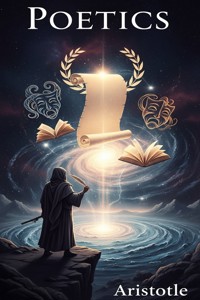
Aristotle's "The Poetics" stands as a foundational text in the study of literary theory and dramatic criticism. Through a meticulous analysis of tragedy, epic poetry, and the principles underlying successful storytelling, Aristotle elucidates concepts such as catharsis, mimesis, and the unities of time, place, and action. His systematic approach not only highlights the mechanics of these literary forms but also engages with broader philosophical inquiries, positioning literature as a mirror to human experience. Written in a clear and methodical style, the work reflects the intellectual milieu of ancient Greece, emphasizing empirical observation and rational thought, marking it as a precursor to both aesthetic and narrative theory in Western literature. Aristotle (384-322 BCE), a towering figure in Western philosophy, made significant contributions across disciplines including ethics, politics, metaphysics, and, of course, literary criticism. His engagement with the works of his predecessors, especially that of Plato, and his interactions with the performing arts in Athens, informed his insights into the nature of art and its impact on society. This background in empirical observation and discourse shaped Aristotle's belief in art as an essential reflection of human nature, compelling him to analyze its form and structure systematically in "The Poetics." I highly recommend "The Poetics" to anyone interested in a deeper understanding of literature, drama, and the intricate relationship between narrative and truth. Aristotle'Äôs arguments remain relevant, challenging readers to consider not only the mechanics of storytelling but also its moral and philosophical implications. This text is essential for aspiring writers, scholars, and anyone fascinated by the enduring power of the written word. In this enriched edition, we have carefully created added value for your reading experience: - A succinct Introduction situates the work's timeless appeal and themes. - The Synopsis outlines the central plot, highlighting key developments without spoiling critical twists. - A detailed Historical Context immerses you in the era's events and influences that shaped the writing. - An Author Biography reveals milestones in the author's life, illuminating the personal insights behind the text. - A thorough Analysis dissects symbols, motifs, and character arcs to unearth underlying meanings. - Reflection questions prompt you to engage personally with the work's messages, connecting them to modern life. - Hand‐picked Memorable Quotes shine a spotlight on moments of literary brilliance. - Interactive footnotes clarify unusual references, historical allusions, and archaic phrases for an effortless, more informed read.
Das E-Book können Sie in Legimi-Apps oder einer beliebigen App lesen, die das folgende Format unterstützen:
Veröffentlichungsjahr: 2019
Ähnliche


The Poetics of Aristotle
Table of Contents
Introduction
A single performance can make an audience feel fear and pity at once, as if order and chaos were being argued on the same stage.
The Poetics of Aristotle has long been regarded as a classic because it offers one of the earliest systematic accounts of how literature—especially dramatic literature—works. Its compact arguments helped later generations speak about plots, characters, and emotional effect with a shared vocabulary. Readers return to it not for a story but for a framework: a way to understand why some works feel inevitable and moving while others feel shapeless. The treatise has shaped critical habits in the West for centuries, influencing how writers plan narratives and how critics judge them.
Aristotle, a Greek philosopher of the fourth century BCE, composed the work as a study of poetic art in his own cultural setting, where tragedy and epic were major public forms. The text survives as a treatise rather than as a polished literary performance, and it addresses poetry in the broad sense of artistic making. In S. H. Butcher’s English version, the book is presented for modern readers in a form that aims to make Aristotle’s technical discussion readable without turning it into a paraphrase. The result is both historical document and living critical tool.
At the center of the treatise is an inquiry into what makes certain kinds of poetry effective, with tragedy receiving the most sustained attention. Aristotle considers the elements that compose a work and the way those elements must be organized to produce a coherent whole. Instead of approaching poetry only as ornament or moral lesson, he examines it as an art with its own principles and standards. The premise is analytical: if poetry is an art, its effects can be described, its parts distinguished, and its successes explained by reasons rather than by taste alone.
One reason the work holds classic status is its insistence on structure as the backbone of artistic power. It makes readers attend to how incidents are connected, how reversals and recognitions function within a design, and how a work can be unified rather than merely episodic. This structural outlook became foundational for later criticism and for narrative craft, because it suggests that emotional force is not accidental but engineered through arrangement. When later writers and teachers discuss what holds a story together, they often draw—directly or indirectly—on the categories Aristotle set out.
Equally enduring is Aristotle’s attention to the audience’s experience. He treats poetry as something that does work on the mind, shaping feeling and understanding through imitation and pattern. The famous emphasis on tragic emotion has encouraged centuries of debate about what art is for and how it affects those who witness it. By connecting form to response, the treatise bridges craft and psychology: it invites readers to see that artistic choices are not merely decorative decisions but the means by which a work reaches its audience and leaves a residue of insight or disturbance.
The Poetics also became influential because it offers a method. Aristotle classifies, distinguishes, and tests claims against examples, seeking definitions that can guide judgment. This approach helped establish literary criticism as a disciplined inquiry rather than a collection of preferences. Later critics and theorists have revised, resisted, or expanded his model, yet the conversation is often framed by his questions: what counts as excellence in a genre, what parts are essential, and how should a work be evaluated on its own terms? A classic endures when it continues to organize disputes.
Butcher’s role matters in the book’s reception in English. His translation and editorial work made a difficult Greek treatise widely accessible to students and general readers, and it helped place Aristotle’s ideas within the tradition of modern literary study. The translation is associated with a period when classical scholarship strongly influenced education and criticism, and Butcher’s rendering has been widely read and reprinted. In approaching this version, readers encounter both Aristotle’s argument and a landmark of English-language classical interpretation, shaped by the translator’s effort to balance precision with clarity.
Because the treatise is concise, it invites careful reading. Its key terms—such as the components of tragedy and the principles of poetic composition—are presented as working tools, not as abstract ornaments. The book offers a way to see how genre expectations guide both writer and audience, and how a work can fulfill those expectations with originality. Even when one disagrees with a particular claim, the discipline of the argument models a way of thinking: identify the goal of an art, then evaluate the means by which it achieves that goal.
The influence of The Poetics on later writers and critics is visible in the long history of discussions about dramatic unity, narrative causation, and the shaping of character through action. Across many periods, playwrights and theorists have either taken Aristotle as a guide or defined themselves by departing from him. The treatise also helped elevate tragedy and epic as central objects of study, setting a pattern for curricula and criticism. Its concepts entered the common language of literary analysis, making it possible to talk about craft with a shared set of reference points.
Yet the book’s endurance is not merely academic. It addresses themes that remain central to artistic creation: the relation between representation and truth, the balance between surprise and necessity, and the way art can convert disorderly experience into intelligible form. These are not topics confined to ancient theater; they arise whenever people tell stories to make sense of conflict, choice, and consequence. Aristotle’s focus on how meaning emerges from arrangement speaks to a constant problem of art: how to shape events so they feel both plausible and significant.
Read today, The Poetics remains compelling because it treats storytelling as a serious human activity with knowable principles, while leaving room for ingenuity within those principles. In an age of film, television, games, and digital narrative, questions of plot construction, pacing, and emotional impact are discussed daily, often in terms that echo Aristotle’s concerns. The treatise’s lasting appeal lies in its combination of brevity and depth: it is short enough to revisit and dense enough to reward rereading, continuing to connect ancient reflection with modern creative practice.
Synopsis
S. H. Butcher’s The Poetics of Aristotle presents, in English, Aristotle’s compact treatise on poetry and dramatic art, aiming to clarify both the text and its critical vocabulary for modern readers. The work proceeds as a systematic inquiry into what poetry is, how it differs from other forms of discourse, and why it matters. Aristotle approaches the subject analytically, treating poetry as an art with discernible principles rather than a matter of inspiration alone. The treatise sets out to examine kinds of poetic composition, their constituent parts, and the standards by which they succeed or fail, grounding criticism in structure, effect, and purpose.
paragraphs=[
Aristotle begins by classifying poetic arts by their means, objects, and manner of imitation. He frames poetry as mimesis, an act of representation that can use different media such as rhythm, language, and harmony, and can depict characters of varying moral stature. This opening lays the conceptual foundation for later, more detailed analysis, distinguishing poetry from history and other forms of writing without reducing it to mere copying. The discussion introduces the idea that artistic representation follows patterns that can be studied, that genres have specific aims, and that the audience’s experience is a legitimate component of critical evaluation. The emphasis remains on observable features and their effects.
paragraphs=[
From this taxonomy, Aristotle turns toward the major forms of drama, with tragedy receiving sustained attention. He treats tragedy as a structured composition that produces a distinctive kind of pleasure through the arrangement of events. The inquiry is not primarily about performance practice but about the internal logic of the work, including how incidents are organized and how character and thought are expressed. As the argument moves forward, Aristotle identifies the principal parts of tragedy and differentiates among them, stressing that some elements are more central to the art’s purpose than others. This sets up the treatise’s most influential claim that plot, properly understood, governs the success of tragic drama.
paragraphs=[
Aristotle’s analysis of plot develops step by step, focusing on unity, completeness, and magnitude. A good plot, he argues, is not merely a sequence of episodes but an ordered whole with a beginning, middle, and end, in which events arise from probability or necessity. He contrasts unified action with episodic composition, and he connects coherence to the audience’s capacity to grasp the action as one intelligible movement. The discussion emphasizes causal linkage and intelligibility, suggesting that emotional impact depends on the rational arrangement of incidents. In treating plot as a formal principle, Aristotle frames dramatic art as an engineered experience, where design determines effect.
paragraphs=[
The treatise then examines the kinds of plots that are especially effective in tragedy, alongside the emotions tragedy is associated with. Aristotle considers how certain patterns of action intensify pity and fear and how recognition and reversal function within a well-made structure. These mechanisms are discussed as components of craft, not as accidental surprises, and they are tied to the audience’s evolving understanding of the situation on stage. Aristotle also differentiates among types of tragic plots and indicates why some constructions better serve the genre’s end. Throughout, the focus remains on how an arrangement of events can guide perception and feeling in a controlled, intelligible way, rather than on sensational incident alone.




