


0,00 €
Niedrigster Preis in 30 Tagen: 0,00 €
Niedrigster Preis in 30 Tagen: 0,00 €
Mehr erfahren.
- Herausgeber: DigiCat
- Kategorie: Gesellschafts- und Liebesromane
- Sprache: Englisch
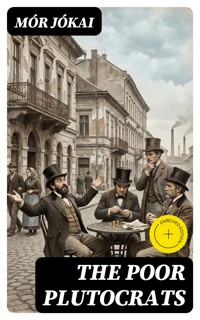
Mór Jókai's "The Poor Plutocrats" is a masterful exploration of the juxtaposition between wealth and social standing, intricately woven into the fabric of 19th-century Hungarian society. Jókai employs a rich, descriptive literary style that combines humor and satire, reflecting the absurdities of both the upper echelons of society and the struggles of the lower classes. The narrative, filled with engaging characters and sharp dialogues, critiques societal norms and the fleeting nature of wealth, challenging readers to reconsider concepts of prosperity and virtue in an era marked by rapid industrialization and social change. Born in 1825, Mór Jókai was a prominent Hungarian novelist whose works often reflect his insatiable curiosity about human nature and the socio-political landscape of his time. As a politician and a passionate advocate for Hungarian independence, Jókai's societal observations and personal experiences indelibly influenced his writing. "The Poor Plutocrats" stands as a testament to his belief in the intersection of literature and social reform, conveying profound insights on economic disparity and human resilience. This novel is highly recommended for readers interested in social critique, historical fiction, and those who appreciate the intricacies of human relationships amid societal pressure. Jókai's compelling narrative invites readers to reflect on their own values and the societal structures they inhabit, making it an enduring classic that resonates with contemporary audiences. In this enriched edition, we have carefully created added value for your reading experience: - A succinct Introduction situates the work's timeless appeal and themes. - The Synopsis outlines the central plot, highlighting key developments without spoiling critical twists. - A detailed Historical Context immerses you in the era's events and influences that shaped the writing. - A thorough Analysis dissects symbols, motifs, and character arcs to unearth underlying meanings. - Reflection questions prompt you to engage personally with the work's messages, connecting them to modern life. - Hand‐picked Memorable Quotes shine a spotlight on moments of literary brilliance. - Interactive footnotes clarify unusual references, historical allusions, and archaic phrases for an effortless, more informed read.
Das E-Book können Sie in Legimi-Apps oder einer beliebigen App lesen, die das folgende Format unterstützen:
Veröffentlichungsjahr: 2022
Ähnliche














The Poor Plutocrats
Table of Contents
Introduction
Threaded through bustling parlors and shadowed counting rooms, The Poor Plutocrats explores how riches promise command yet ransom conscience, how generosity can masquerade as vanity, and how, in the friction between public glitter and private need, a society tests whether it truly understands the cost of dignity, the price of loyalty, and the elusive arithmetic by which love, labor, and honor outweigh coin, so that every favor, ledger, and whispered reputation becomes an anxious wager about what it means to be wealthy in name but impoverished in spirit, or humble in means yet rich in purpose and ties.
Mór Jókai’s novel is a nineteenth-century Hungarian social narrative often translated as The Poor Plutocrats, a work that blends romantic verve with satiric observation in a recognizably Central European setting. Written by one of Hungary’s most widely read novelists of the era, it depicts the textures of civic life, commerce, and domestic propriety as the country modernizes. The scenes unfold among households and offices, civic gatherings and festive occasions, with the atmosphere of an evolving bourgeois society. Readers should expect a historically inflected canvas rather than documentary reportage, a literary portrait attentive to manners, aspiration, and the moral theater of wealth.
At the story’s outset, a circle of prosperous citizens becomes entangled with people whose resources are slender but whose commitments run deep, and the resulting exchanges—of favors, obligations, and expectations—set a chain of consequences into motion. A public-spirited gesture offers an occasion for display and for genuine aid, yet it also reveals fault lines between reputation and responsibility. Jókai builds the situation through chance encounters, bureaucratic puzzles, and social rites, letting misunderstandings accumulate without malice. The plot turns not on a single mastermind or villain but on the pressure of appearances, the fragility of trust, and the resilience of ordinary decency.
The narrative voice is expansive and companionable, with an omniscient vantage that glides from drawing-room wit to earnest moral inquiry, from picturesque description to brisk comedic set pieces. Jókai favors lively contrasts: solemn meetings punctured by small absurdities, private doubts leavened by flashes of tenderness, and minor characters who unexpectedly shape the current of events. The tone is urbane rather than cynical, valuing sympathy without abandoning irony. Episodes tend to gather in crescendos—banquets, errands, letters—that leave a trace of consequence after the laughter subsides. The result is a readable blend of entertainment and instruction, warmth and sharp-eyed scrutiny.
Central themes revolve around the ethics of prosperity: when does help dignify and when does it patronize; how does public honor relate to private duty; and what forms of work, care, and allegiance hold communities together when money falters. The novel investigates social capital—the quiet networks of obligation and trust—alongside the more obvious currencies of contracts and donations. It probes the temptations of image-making in civic life and the comfort of rituals that can either bind or blind. Without preaching, the narrative steadily asks what a person owes to neighbors and to self, and how generosity can be both prudent and brave.
For contemporary readers, the novel’s questions feel freshly relevant amid debates about inequality, philanthropy, reputation, and the performance of virtue in public life. Jókai’s portrait of public ceremonies, benefactions, and well-advertised kindness anticipates modern anxieties about optics and accountability. His emphasis on ordinary stability—secure housing, steady work, mutual aid—grounds the drama in needs that remain recognizable. The story suggests that institutions are only as trustworthy as the people who steward them, and that fairness depends on habits of attention as much as grand gestures. In this sense, its portrait of status and solidarity reads less as period detail than as diagnosis.
Approached as a character-driven social tale rather than a puzzle to be solved, The Poor Plutocrats rewards patient attention to its turns of feeling, its quiet reckonings, and the comic relief that keeps earnest questions buoyant. New readers will find a humane sensibility that resists easy cynicism while acknowledging human vanity. The book’s enduring appeal lies in its confidence that decency can survive transaction, that care can be organized without being commodified, and that status is a brittle shelter. It is a classic not because it flatters the rich or scolds the poor, but because it cherishes responsibility.
Synopsis
The Poor Plutocrats, a nineteenth-century novel by Hungarian author Mór Jókai, builds a comic-satiric study of people who have everything and live as if they have nothing. Its plot centers on a wealthy clan whose reputation for parsimony and secrecy dominates a provincial town, where money quietly directs favors, marriages, and municipal decisions. Jókai frames the theme as a paradox: riches meant to ensure security instead invite fear, suspicion, and self-imposed deprivation. By moving between parlors, counting rooms, and public spaces, the narrative establishes an environment where prosperity is measured by hoarded ledgers rather than human fellowship, and characters learn to speak in the currency of caution.
Within this household the discipline of thrift hardens into ritual. Meals are austere, rooms are kept dim, and small economies are treated as moral victories. Investments and collateral are guarded like family heirlooms, while visits from tradesmen and petitioners are weighed with theatrical seriousness. The town views the family with a mix of dependence and resentment: their hidden capital sustains enterprises yet rarely appears as open generosity. Through brisk scenes and gently caricatured figures, the novel traces how this ethos shapes each decision, from arranging apprenticeships to negotiating dowries, and how pride in frugality can slide into a fearful refusal to engage with ordinary joys.
A countercurrent enters through younger members and outsiders drawn into the family’s orbit. Educated but modestly placed professionals, wards with uncertain prospects, and neighbors with practical kindness challenge the prevailing logic that every affection must be budgeted. Social calls become strategic conferences; courtship doubles as an audit of character and solvency. Misunderstandings turn comic as characters speak past one another, imagining schemes where none are intended, or missing gestures of goodwill. Contracts, sureties, and guardianships multiply, and with them the stakes of trust. The question emerges whether wealth can protect what it cannot perceive: loyalty, candor, and the quiet freedoms of friendship.
Financial tremors from beyond the town unsettle the carefully balanced arrangements. Rumors of failed ventures or a contested note send clerks and relatives scurrying, while the patriarchal custodians tighten rules and inventories. Debts owed to the household grant leverage but also invite retaliation; the powerful find themselves isolated when they most need allies. In this stretch Jókai stages lively set pieces in offices, council halls, and kitchens, showing how anxiety trickles through all classes. Acts of discreet charity by those with little stand in contrast to calculated favors from those with much, and the difference begins to alter how people listen and respond.
As tensions mount, the narrative brings hidden obligations to light. Some fortunes prove entangled with promises to protect dependents or finance communal improvements; other hoards sit untouched while needs press at the gate. Romantic feeling deepens along with ethical demands, forcing characters to weigh reputation against generosity and legal strictness against humane flexibility. The comedy sharpens when symbols of prosperity—keys, seals, and account books—become props in scenes of misunderstanding. Yet beneath the bustle lies a sober inquiry: whether wealth fulfills its purpose when it circulates, or when it is kept intact, waiting for imagined catastrophes that may never arrive.
Approaching its culmination, the book gathers its strands into decisions rather than pronouncements. Plans to consolidate assets or engineer advantageous alliances collide with appeals for fairness and care. Public opinion, fickle and theatrical, threatens to punish either failure or success, while private conscience urges a quieter standard. The outcome of contested papers and precarious engagements is handled with restraint, favoring personal growth over courtroom spectacle. Without announcing a final moral, the plot moves toward reconciliations that depend on trust more than capital, and on the willingness to risk comfort in order to do right by those made vulnerable by previous caution.
Read today, The Poor Plutocrats endures as both lively entertainment and a clear-sighted reflection on wealth’s anxieties. Jókai’s blend of humor, sentiment, and social observation gives the story a buoyant surface that carries pointed questions about responsibility, community, and the uses of prosperity. Its portrait of people who mistake hoarding for safety, and accounting for wisdom, remains recognizable in any age anxious about security. Without relying on grand revelations, the novel leaves readers considering how resources acquire meaning only in relation to others, and how generosity—measured in attention as much as money—can restore ties that calculation alone steadily wears thin.
Historical Context
The Poor Plutocrats (A szegény gazdagok), first published in 1860, belongs to Mór Jókai’s cycle of mid‑nineteenth‑century social novels. It is set in the Kingdom of Hungary under Habsburg rule, primarily in and around the rapidly changing towns of Pest and provincial county seats. Jókai writes against a backdrop of legal and economic transition following the 1848 reforms and their contested aftermath. The work’s title already signals a paradox central to the age: material wealth without security or dignity. Its scenes draw on recognizable institutions—counties, courts, banks, clubs, and theaters—whose evolving roles mirrored Hungary’s passage from a feudal order toward modern civil society.
The political setting was reshaped by the Hungarian Revolution and War of Independence of 1848–1849. Revolutionary laws—often called the April Laws—abolished serfdom, introduced equality before the law, and sought a responsible Hungarian ministry. The uprising, led by figures such as Lajos Kossuth, was defeated after Russian intervention. In its wake, Emperor Franz Joseph imposed centralized “Bach” neo‑absolutism (1849–1859), marked by administrative reorganization, police surveillance, press censorship, and increased use of German in official life. Hungarian public debate survived in constrained forms. Writers, including Jókai, adapted through allegory, humor, and historical fiction to explore themes that could not be addressed openly.
After Austria’s military setback in Italy in 1859, Vienna experimented with constitutional concessions. The October Diploma (1860) and February Patent (1861) partially restored representation, and the Hungarian Diet met in 1861, though disputes over sovereignty persisted. The broader settlement followed later, with the Austro‑Hungarian Compromise of 1867 creating the Dual Monarchy and reestablishing a separate Hungarian government responsible to the Diet. The Poor Plutocrats, appearing before the Compromise, reflects the uncertainties of the interim: fluctuating laws, contested loyalties, and a society negotiating regional autonomy within imperial frameworks. Jókai’s characters operate within this unsettled constitutional climate, where status and privilege are visibly in motion.
Economic transformation underpins the novel’s milieu. The 1848 emancipation of serfs and the end of feudal dues accelerated commercialization, credit, and land transfers. Pest became a financial center, home to institutions such as the First Hungarian Savings Bank (1840) and the Hungarian Commercial Bank of Pest (1841). Hungary’s first railway, the Pest–Vác line, opened in 1846, with rapid network growth in the 1850s and 1860s. These changes created fortunes and failures; the global Panic of 1857 strained credit across the Habsburg lands. Many indebted country nobles faced liquidation, while merchants, contractors, and bankers ascended, reshaping local hierarchies and expectations of success.
Urban life in Pest and Buda offered new arenas for ambition. Theaters, coffeehouses, and clubs fostered sociability and public opinion, with the National Theatre in Pest (opened 1837) central to Hungarian cultural life. Jókai, who had married the celebrated actress Róza Laborfalvi in 1848, moved among artistic and journalistic circles while publishing prolifically. Expanding literacy and a dynamic press created appetite for serialized fiction and topical satire. Although censorship persisted during the 1850s, the early 1860s saw a cautious loosening, allowing writers to examine recent history indirectly. The novel’s social landscape thus mirrors the metropolis’s mix of spectacle, philanthropy, and calculated self-promotion.
Legal and social reforms reorganized status. The April Laws established equality before the courts, and later measures standardized administration and finance, even under neo‑absolutist oversight. County institutions retained symbolic weight, but urban municipalities gained practical influence, especially in commerce and credit. Guild restrictions weakened mid‑century, and savings banks, insurance firms, and joint‑stock companies multiplied. Debates over citizenship and religion intensified; Jewish communities, prominent in trade and finance, gained full civil equality in Hungary with the 1867–1868 legislation. Such shifts complicated inherited hierarchies. Jókai’s portrayal of negotiable rank, reputational risk, and charitable display reflects these evolving norms without requiring explicit political argument.
The Habsburg Empire’s fiscal and military pressures also frame the narrative world. Austria’s defeats in 1859 and 1866 produced heavy financial strains, administrative retrenchment, and bargaining with regional elites. Taxation, conscription, and state borrowing affected Hungarian towns and estates alike. Railways tied Budapest and Vienna more closely, integrating markets while exposing investors to cycles of boom and contraction. Liberal economic ideas and constitutional debates circulated through transnational networks, from parliamentary speeches to the press. Within this climate, social ascent depended as much on credit and connections as on land, and the fear of sudden reversal shadowed both old families and newcomers.
Viewed in this context, The Poor Plutocrats reads as a social diagnosis of Hungary’s passage to modernity. It juxtaposes inherited privilege with acquisitive energy, questioning what constitutes true prosperity in a time of precarious credit and public display. Jókai employs comic types, sentiment, and civic ideals to probe the responsibilities attached to wealth, including philanthropy, honesty in business, and service to community. The novel’s measured optimism aligns with contemporary liberal hopes for constitutional order after upheaval, while its satire cautions against speculation and vanity. In doing so, it records and critiques the values shaping Hungarian society on the eve of the Dual Monarchy.




