


Erhalten Sie Zugang zu diesem und mehr als 300000 Büchern ab EUR 5,99 monatlich.
- Herausgeber: IVP
- Kategorie: Religion und Spiritualität
- Sprache: Englisch
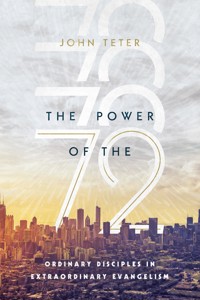
They were not professionals. They were not celebrities. We don't even know their names.We know very little about them, except that they were everyday people who were drawn to Jesus. When Jesus asked them to join him in his mission, they stepped up, answered the call, and went out in his name. And amazing things happened as a result.They were the 72.Pastor and evangelist John Teter explains how Jesus trains ordinary people to accomplish an extraordinary mission. He unpacks the story of the sending of the 72 to reveal how they were equipped in evangelism and discovered opportunities to herald God's kingdom in concrete and tangible ways. Filled with vivid stories of Teter's remarkable experiences in ministry and church planting, this book shows how we can live out God's call and witness the transformation of those around us.You too have been called by Jesus. Discover how God empowers you to play your part. Welcome to the 72.
Sie lesen das E-Book in den Legimi-Apps auf:
Seitenzahl: 236
Veröffentlichungsjahr: 2017
Das E-Book (TTS) können Sie hören im Abo „Legimi Premium” in Legimi-Apps auf:
Ähnliche
















ORDINARY DISCIPLES IN EXTRAORDINARY EVANGELISM
For Joy, Kara, and Luke
May you follow Jesus closelyand with your very own eyessee Satan fall like lightning from heaven
After this the Lord appointed seventy-two others and sent them on ahead of him, two by two, into every town and place where he himself was about to go. And he said to them, “The harvest is plentiful, but the laborers are few. Therefore pray earnestly to the Lord of the harvest to send out laborers into his harvest. Go your way; behold, I am sending you out as lambs in the midst of wolves. Carry no moneybag, no knapsack, no sandals, and greet no one on the road. Whatever house you enter, first say, ‘Peace be to this house!’ And if a son of peace is there, your peace will rest upon him. But if not, it will return to you. And remain in the same house, eating and drinking what they provide, for the laborer deserves his wages. Do not go from house to house. Whenever you enter a town and they receive you, eat what is set before you. Heal the sick in it and say to them, ‘The kingdom of God has come near to you.’ But whenever you enter a town and they do not receive you, go into its streets and say, ‘Even the dust of your town that clings to our feet we wipe off against you. Nevertheless know this, that the kingdom of God has come near.’ I tell you, it will be more bearable on that day for Sodom than for that town.
“Woe to you, Chorazin! Woe to you, Bethsaida! For if the mighty works done in you had been done in Tyre and Sidon, they would have repented long ago, sitting in sackcloth and ashes. But it will be more bearable in the judgment for Tyre and Sidon than for you. And you, Capernaum, will you be exalted to heaven? You shall be brought down to Hades.
“The one who hears you hears me, and the one who rejects you rejects me, and the one who rejects me rejects him who sent me.”
The seventy-two returned with joy, saying, “Lord, even the demons are subject to us in your name!” And he said to them, “I saw Satan fall like lightning from heaven. Behold, I have given you authority to tread on serpents and scorpions, and over all the power of the enemy, and nothing shall hurt you. Nevertheless, do not rejoice in this, that the spirits are subject to you, but rejoice that your names are written in heaven.”
LUKE 10:1-20
Contents
FOREWORD
Darrell Johnson
John Teter is exactly the right person to write a book on ordinary disciples engaged in extraordinary evangelism. John is an extraordinary ordinary disciple of Jesus, the extraordinary Evangelist. From the day he surrendered to Jesus’ call upon his life, John has manifested—and lived—the spiritual gift of evangelism. He “oozes” the winsome joy, contagious enthusiasm, compassionate courage, and unquenchable energy of one captured by he who is life itself. I have known John for decades now, and I walk away from every encounter with him saying, “Lord, I wish I could be more like him.”
In his now-classic work The Master Plan of Evangelism, Robert E. Coleman identifies the qualities Jesus seeks in those he calls to join him in winning the world into his kingdom. “None of them occupied prominent places in the Synagogue, nor did any of them belong to the Levitical priesthood. For the most part they were common laboring men [and women], probably having no professional training beyond the rudiments of knowledge necessary for their vocations.”1 They were not wealthy, except perhaps the sons of Zebedee, who ran a thriving fishing business. None had degrees from academic institutions. “One might wonder how Jesus could ever use them.” Yet Jesus chose them because, argues Coleman, “they were teachable.” They had big hearts, and they yearned for God and the reality of his life and kingdom. They were “pliable in the hands of the Master.”
Coleman is describing John Teter! Teachable, pliable, yearning for all that Jesus has and wants to give us. I stand amazed at just how much Jesus has taught my brother.
So read the journey of how Jesus has used his teachable disciple to build a thriving ministry among ordinary disciples in the heart of the city. Follow John into the world of Luke 10, where Jesus sends seventy-two “wonder how Jesus could ever use them” ordinary people into the world with his good news. And you will, like me, find yourself invigorated by the life-giving dynamism of extraordinary evangelism.
Thank you, John, for being so teachable, and for teaching me what an authentic disciple looks like in our world.
1. Robert E. Coleman, The Master Plan of Evangelism (Los Angeles: Rusthoi, 1963).
Introduction
WELCOME TO THE POWER OF THE 72
You know what to do. We have trained you.
Let’s play Orioles baseball.
COACH EDGAR ORTIZ
THE WEST LONG BEACH ORIOLES
Little League baseball has been one of our family’s great joys in recent years. My wife, Becky, and I have a seven-year-old daughter, Kara, who from birth has lived her life with great energy, passion, and focus. And she has always loved sports. When she was in tee-ball, we played against the Tigers, coached by Edgar Ortiz. At age five, Kara pointed out how good the Tigers were, and she even prayed at bedtime that Edgar would someday be her coach. Through a series of circumstances, her prayers were answered, and I became Edgar’s assistant coach on the Farm Ball Orioles.
Edgar grew up in West Long Beach, played baseball for Compton College, was drafted by the Detroit Tigers, and made it all the way to minor league AA before an injury ended his playing career. A giant man with an even bigger heart for children, his unique blend of stature, experience, and communication style make him one of the best coaches around. He is passionate about teaching kids the technical aspects of the game of baseball, while making sure he can see their teeth—because they’re smiling.
At the early practices, Edgar taught the Orioles to hold the ball correctly and then taught them how to step and turn their shoulders. Next he focused on release points and aiming the throw at a teammate’s chest. They learned how to throw, catch, and field ground balls. They learned how to hit and run the bases. Soon the concentration on details paid great dividends, and each of the kids improved. Our team came together in a way we never hoped or imagined.
The 2016 Orioles season was magical. We went 24-1, won our Silverado Park league, and then went on to defeat six other leagues to win the Southern California District 38 Tournament of Champions. The Orioles were neither the biggest kids nor the most talented, but they played with great heart and sound fundamentals. When the pressure was on, our children were able to execute the technical skills of the game.
Kara played first base for the Orioles, and the coaches recognized her contributions by voting her onto the all-star team. Coach Edgar left the meeting after the vote and came directly to our house to tell her the good news. She was asleep, but we woke her up so Edgar could tell her in person. I will never forget the joy on her face; she immediately wrapped her arms around Edgar’s neck, covering his Dallas Cowboys tattoo with her little arms. He hugged her and said, “I’m proud of you, mama.”
I learned an important lesson serving on Edgar’s coaching staff. To execute, players needed technical training, not just head knowledge. Very few players could explain the strategy or nuances of the game. While six- and seven-year-old minds sometimes focused on the dirt or picking the daisy in front of them, their bodies still knew how to throw, catch, and hit when the pressure was on. Every year on opening day, Silverado Park will raise the 2016 Farm Ball Orioles championship banner because Edgar and our coaching staff taught the kids to play Orioles baseball.
Just as young players must learn fundamentals to help them execute during games, so disciples must learn practical skills to become effective evangelists. Luke’s Gospel provides a remarkable account of how Jesus called seventy-two disciples, taught them how to be evangelists, and watched them accomplish great things for God’s kingdom. If six- and seven-year-olds can listen to their coach to win a baseball championship, how much more can we learn from our Master when eternal joy or punishment hang in the balance for every human soul.
I’M ONE OF THE 72
To provide some perspective and context, allow me to introduce myself. I’m the son of a Dutch-American father and a Korean mother. My parents met on a steamship on a journey from Seattle to Seoul in 1958. My mother was returning to Korea to tell her family that she had secured her dream job in Los Angeles. My father was a mariner on the ship. They fell in love during the three-week trip across the Pacific Ocean. Their long voyage certainly puts international travel today in perspective.
I was born and raised in Los Angeles and currently live in Long Beach with my amazing wife and our three wonderful children, Joy, Kara, and Luke. I didn’t grow up in a Christian home; I came to faith through InterVarsity Christian Fellowship at the University of California, Los Angeles, when I was twenty-two.
After I had served for twelve years with InterVarsity, the Holy Spirit called us to plant a church in our inner-city neighborhood of West Long Beach. Becky and I like to joke that Fountain of Life Covenant Church (FOL) is our fourth child. Since our home base is the local church, many of the illustrations and stories in this book come from FOL. It’s our testimony that as we have gone out as a pair, we have seen “Satan fall like lightning from heaven” (Luke 10:18). God has given power to our feeble attempts to heal the city and declare the kingdom of God to bring many to faith. We hope to pass along the lessons, both good and bad, to inspire you to experience God’s power in evangelism for yourself.
Pastor Charles Simeon is one of my Christian heroes. He ministered at the same church in Cambridge, England, for fifty-four years. For much of that time, he served as a working pastor, leading his church and participating in national and international missions. Following the Simeon model, I have served as a pastor and simultaneously served with the Evangelical Covenant Church and Fountain of Life Antioch, our local effort to help plant new churches from Jackson, Mississippi, and Marion, Indiana, to Hong Kong. I’m grateful for what God is teaching me as I serve and learn in local, national, and international ministry circles and as I seek to be a faithful witness for Jesus “in Jerusalem and in all Judea and Samaria, and to the end of the earth” (Acts 1:8).
I love to share my faith. It brings me so much joy to be a small part of another person coming to faith. I believe God has given me the spiritual gift of evangelism, so I try to use that gift in my personal friendships and public preaching. The call for evangelism draws me deeply into texts like Luke 10, and I’m proud to call myself “one of the 72.”
CORE BOOK STUDY AND LUKE’S GOSPEL
Christian leadership is hard, but frontline evangelism with people who reject you is even harder. As God calls us to challenging ministry, he equips us to meet the tests and trials we’ll experience. In my experience, mastering core books of the Bible has given me strength and ministry insights. Core-book Bible study involves in-depth study of contexts and historical backgrounds, including the analysis of verses, chapters, and sections. The author of the book becomes a mentor and, in some mystical manner, a friend. Because of the large amount of time I have spent in Luke through Acts, I like to say that Luke has become my homie.
Living in Luke’s Gospel has framed my church-planting experience. We chose our home and our context for ministry because of Jesus’ mission statement in Luke 4. Our church has a one-verse vision that comes from Luke 10:2: we are kingdom workers. Our evangelism model is based on the sending of the 72. It is my testimony that as I attempted to master Luke’s Gospel, Luke’s Gospel mastered me. It took me almost two years to complete the twenty-four chapters, and I’ve learned many concepts from studying and applying Luke’s Gospel to my life and ministry.
For the reader’s convenience, each chapter in The Power of 72 contains an insert stating the chapter theme and core text.
CHAPTER THEME: Live today as one of the 72.
CORE TEXT: Overview of Luke 10:1-2
After this the Lord appointed seventy-two others and sent them on ahead of him, two by two, into every town and place where he himself was about to go. And he said to them, “The harvest is plentiful, but the laborers are few. Therefore pray earnestly to the Lord of the harvest to send out laborers into his harvest.”
ANONYMOUS EVANGELISTS
This chapter is an invitation to become part of God’s good work of reaching the world.
A wise preaching mentor once told me, “Live in the text until the text lives in you.” I pray that these same words will be your experience as we journey together in the good news of Luke 10. It begins with a detailed account of the training and ministry experience of seventy-two anonymous evangelists and ends with one of Jesus’ most famous stories, the parable of the good Samaritan.
When I became the director of church planting for the Evangelical Covenant Church, I asked God to give our team a vision that was grounded in his Word, which is timeless and inspirational. I remember where I was standing when God’s Spirit led us to Luke 10:1-24. It felt as though the Lord had indeed spoken to our hearts and minds. I love the biblical model of anonymous but faithful disciples who engage their world with the news—not the advice—of the gospel. Not only does the world need this vision, but as disciples of Jesus, we need it.
We know very little about the 72, and I think this was Luke’s intention. Because we have a number, some believe that this number is symbolic. For example, scholars have argued that seventy-two refers to the number of apostles (twelve) times the number that symbolizes man (six). The number twelve highlights the strength, power, and vision of God. The six shines light on man: created on the sixth day, sinner, unable to change the human heart.
Another reading is that seventy-two was the number of known countries in the world during Jesus’ time. The Lord of the harvest was symbolically sending out an evangelist for each country. This theory highlights God’s heart for all countries, especially the Gentile ones.
I believe Luke introduces the evangelists this way so we see ourselves in the story. It’s no accident that we don’t know their names, genders, ages, or spiritual gifts. We also don’t know their personality profiles. Their anonymity allows us to pause and wonder if we could be among the seventy-two disciples. It might be hard to picture ourselves planting churches all over the ancient world like Paul, preaching a fiery first sermon before a hostile crowd of three thousand people, or like Priscilla mentoring Apollos (Acts 18:26). We know their names because they are the all-stars. But the 72 were unknown rookies just like you and me.
We have very little data about them. One could argue that the only certainty we have is that Jesus hand-selected them to deliver the message of salvation. The living God personally called them, trained them, and sent them to be a part of his evangelism team.
There are so many great moments in the first four Gospels. I often wish I could have been a fly on the wall, watching Jesus and his leadership team in action. If it were possible to travel back in time, the evangelism training seminar from Luke 10 would be at the top of my list. What led up to the 72 arriving for their briefing? Imagine receiving an email, phone call, or text from Jesus of Nazareth, inviting you to be a part of his new ministry team. What grace would have been conveyed if you were under the personal training of the Lord Jesus himself!
Jesus called, trained, and sent these followers into an unknown and strategic mission field. The 72 were the answer to his earnest prayers to the Lord of the harvest. And they were found faithful in accomplishing the mission God had set before them. Although they were like lambs among wolves, joy awaited them at the finish line.
But let’s be honest. They must have been terrified.
Have you ever jumped off a high dive into a swimming pool? The clear blue water seems a hundred miles beneath your feet, and fear arises as you look behind you and see others urging you to jump. I remember that terrifying moment vividly. In high school, I worked at a tennis center that had an Olympic-size pool with a ten-meter diving board. My lifeguard friends always warned us, “Don’t look down, or your face will suffer the consequences.” When it was your turn to jump from the high dive, there was no turning back.
I imagine that the seventy-two disciples felt a similar fear on the morning when Jesus sent them out. He sent seventy-two people into a hostile environment. And he addressed the inner workings of their hearts and their fears when he said his missionaries would be like sheep among wolves.
Yet, despite this fearsome image, they returned with joy. All of them.
It would have been enough for thirty-six to return with joy and incredible if sixty-four returned with joy, but the text clearly states that all seventy-two returned with joy (Luke 24:52). This teaches us that we can actually accomplish the mission. In some mysterious way, the work of God through these seventy-two caused movement in the spiritual realm.
The lives of the 72 teach us that evangelism is not just for the spiritually gifted. The good and hard work of evangelism is a call for all disciples at all times.
THE POWER OF THE 72
The title of this book includes the word power. The 72, our rookie evangelists, wouldn’t have considered themselves to be in positions of power. A lamb does not have the place of power when wolves are present. The Lord had to train them how to deal with their emotions, their fears, and the rejection they would face. Yet their ministry had a massive impact in the spiritual realm.
The Lord “saw Satan fall like lightning from heaven” (Luke 10:18). I think this means that in the next dimension, which only God, angels, and the spiritual beings can see, the devil lost significant positional authority. The work of the 72 didn’t cause Satan to fall physically from another dimension into the South China Sea. No, their work caused a shift in the eternal realm that brought the devil and his dark kingdom crashing down. These are the kind of results one might expect from disciples named Paul, John, and Peter.
Three Greek words used in the New Testament are translated as power in English. The first is dynamis, the explosive nature of power, from which we get the word dynamite. The second word for power is energeia, from which energy is derived. The third word is kratos (the root for “-cracy”), which denotes authority. I believe that as Jesus called, trained, and sent the 72, all three words were in play.
The 72 were sent to demonstrate the same explosive power of God that raised Jesus from the dead. Prayers, healing, and miraculous signs validated their message. They were sent with great energy and zeal to love, serve, and bring new life to the city. They were sent with the authority of the emperor of the universe and were so aligned with his authority and the knowledge that if they were rejected, it was God himself who was rejected. That’s a massive amount of power that can’t be seen by the human eye.
Pastor and author Darrell Johnson reminds us that our mission always flows from our relationship with Jesus. The transference of his authority onto the 72 only strengthens this idea. Johnson wrote, “You can see that the three great disciplines of discipleship—worship, community, mission—cannot be separated because they are grounded in the Trinity. Co-lovers with God is worship. Co-lovers with God of one another is community. Co-lovers with God of the world is mission.”1
A last dimension of power is the 72 operating as a team. Standing alone, the newly appointed evangelists would have had a difficult time embracing and overcoming the challenges. But there was a power to draw from as they were together. Each evangelist was given an immediate partner. Each two-person ministry team was part of a much bigger thirty-six-person evangelism battalion. Together, there were seventy-two personalities, seventy-two diverse perspectives, seventy-two prayers, and seventy-two voices.
These anonymous evangelists were sent in God’s explosive, forceful, and ruling power. This was power beyond measure. This was power that never burns out. This was power that is never thwarted. Alone there would have been little power. But in Jesus and on mission together, the 72 were powerful enough to unseat Satan himself and throw him down to earth.
ONE
In Zero to One, Peter Thiel, the creator of PayPal, argued that the most significant development in the life of a company is not moving from a hundred to a thousand to one hundred thousand to one million. The most important step of growth is creating something new and moving the needle from zero to one. He wrote, “Indeed, the single most powerful pattern I have noticed is that successful people find value in unexpected places, and they do this by thinking about people first instead of formulas.”2
When we move from zero to one, we create a template of sorts and a baseline for learning. I wonder if when Jesus trained the 72 for evangelism, he had the number one in mind. Luke 15, often called “the gospel within the third gospel,” is full of that number. There is one lost sheep, one lost coin, one immoral son, and one lost religious son. And the shepherd, the woman, and the father all do everything they can to find that lost one.
I believe in goals. Pushing yourself beyond your comfort zone to complete a project at work, achieve a higher score on an exam, or win a tough tennis match takes a goal as well as a commitment to reach that goal. As you work through the chapters ahead, consider setting the number one as your goal. If you’re able to move your evangelism ministry from zero to one, you will have learned to live as one of the 72.
Let me provide an example of getting from zero to one. I met Robert during the first year of our church plant. When planting a new church, a pastor must be open, available, and aware of how God might be leading. Following Paul’s model in Acts 16, I wanted to make sure I was a part of the daily rhythms of public life. It’s nearly impossible to plant a church from behind a desk, so I regularly prayed, studied, sent emails, and met with people at our local Starbucks.
Rob was doing some class work at a table next to me. He was a biracial twenty-three-year-old student at Cal State Long Beach, majoring in accounting. We quickly bonded over being biracial and our mutual love of sports: lots and lots of sports. Since FOL was hosting an outreach basketball tournament, I invited Rob.
A few days later, I saw him again, this time at another Starbucks. I told him I was a pastor and that I wanted to show how much God cared about him by buying him a specialty drink. He shared a bit about his faith background and how he hadn’t been to church in years, but that he was very open. We exchanged numbers, and he shared again how excited he was for the big hoops tournament.
The tournament came, and Rob didn’t show up. I was surprised that he missed it, so I called him to check up and let him know I was thinking about him. He picked up the phone and apologized for not being able to play, especially because he always tried to keep his word. I told him it wasn’t that big a deal. I then heard what sounded like machines beeping in the background again and again. I began to put the pieces together, and I asked, “Are you in the hospital?”
“Yeah, man. I’m in the hospital.”
“Are you okay, bro?” I asked.
“I’m not doing too hot,” he answered.
“What happened, Rob?”
“I was down at the shoreline last night with my buddies. We ran into some rough dudes, and a fight broke out. I jumped in to try and help my homie a little bit. And I got shot three times.”
So I visited Rob at the hospital. When I asked about his family, he told me his mother died when he was five, and his father was never around after the death. Having lost my own father to a plane accident when I was a boy, I understood something about his loss, pain, and the challenges of growing up without a parent. I prayed for Rob, lifting him up to Jesus, who works all things for good.
Rob’s Christian conversion became one of my first templates for how young people in the city come to faith. Ten years later, Rob and I are thankful for how God brought us into friendship. Today he is a committed disciple of Jesus, deepening and growing as one of the 72. We laugh together about the best excuse ever for not coming to a basketball tournament.
The woman pursued and found one lost coin. The church planter pursued and found one lost college student.
My hope and prayer is that this book will (1) provide a clear theological foundation for evangelism and the call to first preach the gospel to the poor; (2) present my theory of process conversion, which has been field-tested in America and Asia for close to five years, so that you know how non-Christians come to faith; (3) call you to master four ministry tasks that are central to personal evangelism; and (4) prepare you for daily rejection by providing the perspective of eternal joy.
STRUCTURE AND FEATURES
The Power of the 72 has two parts. Following a very loose model based on Paul’s letters, the first half of the book is theology. The second half is application. I’m a firm believer that Christian ministry needs a strong balance of orthodoxy (what we believe) and orthopraxy (what we do).
Part one explains the theology of ministry flowing out of being, evangelism that prioritizes the poor, and a fresh understanding of persecution and suffering. It’s my desire to teach the Scripture with hermeneutic integrity and appropriate intensity.
Part two provides practical input on how to “do” evangelism with real people. Chapter four, “How People Become Christians,” defines process conversion and introduces a timeline that has three features: four benchmark events; three conversion conversations we must initiate with our friends; and two ministry tools. My research has identified the benchmark events present in process conversion: (1) trusting a non-Christian; (2) experiencing God and the good news of the gospel; (3) hearing and understanding the good news; and (4) receiving a clear call to follow Jesus.




