


8,00 €
Mehr erfahren.
- Herausgeber: Sachin Naha
- Kategorie: Für Kinder und Jugendliche
- Sprache: Englisch
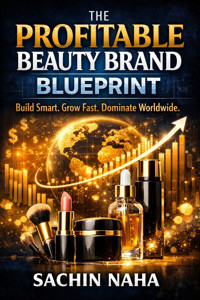
The Profitable Beauty Brand Blueprint: Build Smart. Grow Fast. Dominate Worldwide. is a practical step-by-step guide for entrepreneurs who want to start a beauty brand, grow a skincare or cosmetics business, and build a profitable global beauty company with strong margins and long-term wealth creation. This book focuses on revenue growth, high-margin product development, cost control, premium pricing strategy, digital marketing, direct-to-consumer (DTC) sales, and smart financial planning. Readers learn how to identify high-demand beauty market trends such as clean beauty and multi-use products, create a powerful brand identity, manage cash flow, calculate customer acquisition cost (CAC), increase repeat purchases, and scale operations without losing ownership or equity. Covering manufacturing, inventory management, global expansion, brand valuation, and exit strategy planning, this commercial beauty business blueprint delivers clear, actionable strategies to launch, scale, and dominate in the competitive worldwide beauty industry.
Das E-Book können Sie in Legimi-Apps oder einer beliebigen App lesen, die das folgende Format unterstützen:
Veröffentlichungsjahr: 2026
Ähnliche
















Table of Contents
Chapter 1: Think Like an Owner, Not an Artist
Chapter 2: Study the Global Beauty Economy
Chapter 3: Find a Profitable Gap, Not a Passion Project
Chapter 4: Build a Commercial Brand Identity
Chapter 5: Develop Products That Sell, Not Just Impress
Chapter 6: Control Cost From Day One
Chapter 7: Build a Lean Financial Model
Chapter 8: Smart Pricing for Premium Perception
Chapter 9: Digital-First Distribution Strategy
Chapter 10: Marketing That Converts to Revenue
Chapter 11: Build Community, Not Just Customers
Chapter 12: Inventory, Operations and Risk Control
Chapter 13: Contracts, Equity & Corporate Lessons
Chapter 14: Reinvention and Market Evolution
Chapter 15: Build an Asset That Outlives You
The Profitable Beauty Brand Blueprint
Build Smart. Grow Fast. Dominate Worldwide.
About the book
The Profitable Beauty Brand Blueprint: Build Smart. Grow Fast. Dominate Worldwide. is a practical, results-driven guide for aspiring entrepreneurs who want to launch, scale, and dominate a profitable global beauty business with full focus on revenue growth, high margins, cost control, and long-term wealth creation. This step-by-step commercial roadmap covers everything from developing a profit-first business mindset and identifying high-growth beauty market opportunities to creating high-margin products, building a strong brand identity, controlling manufacturing costs, setting premium pricing, and designing a digital-first sales strategy. Readers learn how to manage cash flow, track customer acquisition costs, increase repeat purchases, optimize inventory, build loyal communities, and scale operations efficiently while protecting ownership, equity, and brand valuation. With clear guidance on global expansion, market trends, clean beauty demand, operational risk management, and strategic exit planning, this book delivers a complete blueprint for building a scalable, competitive, and financially successful beauty brand designed for sustained profitability and long-term business value.
Author
Chapter 1: Think Like an Owner, Not an Artist
Introduction: The Night the Numbers Didn’t Lie
At 2:17 a.m., the Shopify dashboard refreshed. Revenue: $0. The launch had failed. Forty-eight hours earlier, the founder had been posting glossy visuals, flooded with heart emojis and comments saying “Obsessed.” But applause does not pay suppliers. Compliments do not fund inventory. That night, staring at a blank revenue graph, she faced a brutal truth: she had built for admiration, not for margin.
Meanwhile, in a warehouse thousands of miles away, a different founder was reviewing unit economics before approving a shade extension. That company would later scale into a multi-hundred-million-dollar enterprise, like Fenty Beauty, which surpassed $500 million in its first year and later crossed the billion-dollar valuation mark. The difference was not talent. It was thinking. One thought like an artist. The other thought like an owner.
This chapter is not about lipsticks or skincare rituals. It is about ownership psychology, commercial discipline, and building a beauty brand as an asset that compounds wealth.
This is where your transformation begins.
The Central Idea: Beauty Is an Asset Class
The fresh, often uncomfortable truth: beauty is not self-expression first. It is an asset class.
The global beauty industry generates more than $500 billion annually. Brands like L'Oréal generate over $40 billion in yearly revenue. Estée Lauder Companies operates as a multi-brand portfolio machine. Rare Beauty crossed $400 million in revenue in just a few years by pairing identity with operational clarity.
These are not makeup stories. They are capital allocation stories.
The owner mindset reframes everything:
• Products are vehicles for cash flow.• Brand equity is an appreciating intangible asset.• Margin is oxygen.• Control equals wealth.
Call this framework Asset-First Beauty™ — build every decision around long-term asset value, not short-term validation.
Step 1: Define Income Before Identity
Most founders begin with packaging, shade names, and Instagram aesthetics. Owners begin with numbers.
Zoom into a small turning point: a founder deciding between a glass bottle costing $3.20 per unit and a high-quality plastic bottle costing $1.10. The glass looks premium. Influencers will love it. But at scale, that $2.10 difference destroys margin. At 100,000 units, that is $210,000 lost.
Owners ask:
• What is my 3-year revenue target?• What net profit margin will I protect? 20%? 30%?• What EBITDA multiple do I want at exit?
If your goal is $5 million annual revenue with 25% net margin, you are targeting $1.25 million profit annually. That profit, valued at a conservative 5x multiple, creates a $6.25 million asset.
Define the income first. Identity follows.
Call this discipline Revenue Reverse Engineering™ — design products backward from your wealth target.
Step 2: Build for Margin, Not for Applause
In the age of TikTok virality, applause is addictive. But virality without profitability is a trap.
Consider Glossier. It built a cult following and achieved a valuation exceeding $1 billion at its peak. Yet growth without operational discipline led to restructuring and valuation corrections. Contrast this with e.l.f. Beauty, which focused on cost efficiency and mass pricing strategy, generating over $700 million in annual revenue with disciplined margins and strong stock market performance.
The turning point is subtle. It happens when a founder decides whether to:
• Discount heavily to boost launch numbers• Or protect pricing integrity
Heavy discounting trains customers to wait. Strong pricing trains customers to respect value.
Mistake consequence: once margin collapses, recovery is painful. Ad spend increases. Inventory sits. Cash flow tightens. Investors demand control.
This is where many founders lose equity.
Call this Margin Discipline Loop™ — Protect price → Protect margin → Protect control → Protect equity.
Step 3: Separate Personal Identity from Business Identity
In modern beauty, the founder often is the brand. But this creates fragility.
When controversy hits a personality-driven brand, valuation drops instantly. Investors price risk aggressively. Retailers become cautious.
Look at how Huda Beauty structured operations beyond influencer visibility, building distribution scale and product systems independent of social noise. Or how Charlotte Tilbury Beauty built a sellable enterprise that attracted majority acquisition by Puig, transforming a personal brand into a global corporate asset.
The key shift:
You are the founder.You are not the SKU.
This separation allows:
• Clean governance• Professional management• Sellable equity• Emotional stability
Call this Founder Firewall™ — protect the brand from personal volatility.
Step 4: Plan the Exit on Day One
Most founders avoid thinking about exit. Owners start there.
Do you want:
• 100% ownership of a $2 million lifestyle brand?• Or 40% ownership of a $50 million company?
Equity structure determines freedom.
Zoom into a precise moment: a founder signs an investor agreement at a $5 million valuation, raising $1 million for 20% equity. It feels like validation. But future dilution reduces ownership to 35%. When the company sells for $40 million, the founder receives $14 million before taxes instead of the $40 million they once imagined.
Not wrong. Just unplanned.
Brands like Anastasia Beverly Hills scaled with strategic capital while maintaining strong control structures. Ownership decisions shaped long-term wealth outcomes.
Call this Exit-Backwards Strategy™ — build today with your liquidity event in mind.
Step 5: Master Core Commercial Skills
Creative brilliance without commercial skill is expensive.
To build globally competitive beauty businesses, founders must master:
Unit economics modeling
Supply chain negotiation
Regulatory compliance across regions
Digital performance marketing
Cash flow forecasting
Valuation literacy
For example, expansion into markets like India, Southeast Asia, or the Middle East requires understanding import duties, localization costs, and distribution margins. Ignoring this destroys profitability.
Modern beauty is not local. It is borderless. E-commerce enables a brand launched in Mumbai to ship to New York within weeks. But global scale demands operational intelligence.
This is Commercial Competence Stack™ — the layered skills that convert creativity into capital.
The Emotional Shift: From Creator to Capital Builder
The real transformation is internal.
The moment you stop asking, “Will people love this?”And start asking, “Will this compound?”
That shift feels uncomfortable. It feels less glamorous. It demands spreadsheets instead of mood boards.
But it builds freedom.
When monthly revenue crosses $500,000 with controlled margins, something changes psychologically. The business stops being fragile. It becomes predictable. Predictability creates leverage. Leverage creates optionality.
Optionality creates power.
Conclusion: Treat It Like an Asset
A beauty brand is not a hobby. Not a personal validation project. Not a social media identity.
It is a structured, revenue-generating, equity-building commercial machine.
Start with income targets.Protect margin.Separate identity from enterprise.Design your exit early.Master commercial fundamentals.
The world does not need another pretty product. It needs disciplined builders who understand that beauty, at scale, is economics wearing elegance.
Think like an owner.Build like an investor.Operate like a strategist.
When you do, your beauty brand stops being a passion project.
It becomes an asset.
Chapter 2: Study the Global Beauty Economy
Introduction: The Day the Shelf Went Silent
In 2020, as stores across the world shut down, something strange happened. Beauty counters in airports went dark. Malls in cities like New York City and Dubai stood silent. Traditional beauty giants that relied on physical retail watched revenues tremble. Yet at the same moment, direct-to-consumer brands were quietly rewriting the rules.
One founder in Los Angeles watched her Shopify dashboard light up at 2:13 a.m. Orders from India. Repeat customers from United States. First-time buyers from United Arab Emirates. Her tiny digital-native skincare brand, unknown to department stores, had crossed $10 million in revenue without a single physical shelf.
The shelf had gone silent. The algorithm had started speaking.
That was the turning point.
If you want to build a globally competitive beauty business today, you must understand one core truth: money does not flow where tradition lives. It flows where demand compounds.
This chapter is about reading the global money map. Because before you create product, before you design packaging, before you dream of valuation, you must answer one brutal commercial question: Where is the revenue gravity?
The Revenue Gravity Principle
Beauty is no longer about glamour. It is about global capital allocation. The global beauty market now exceeds $500 billion in annual revenue and continues expanding across emerging economies and premium urban markets. But growth is uneven. Certain geographies and categories behave like magnets.
The United States remains the largest profit engine. Premium pricing tolerance is high. Customer lifetime value is strong. Subscription models thrive. Beauty brands like Eyes, Lips, Face a U.S. based cosmetics company proved that even mass-positioned products can scale into multi-billion-dollar valuations by blending affordability with digital fluency, generating over $1 billion in annual revenue.
India is the growth accelerator. A young demographic. Rapid smartphone penetration. Rising disposable income. Local brands such as Nykaa crossed $700 million in annual revenue by combining marketplace infrastructure with private labels. The Indian consumer is price-aware yet aspiration-driven. That tension creates opportunity.




