


Erhalten Sie Zugang zu diesem und mehr als 300000 Büchern ab EUR 5,99 monatlich.
- Herausgeber: Atlantic Books
- Kategorie: Religion und Spiritualität
- Serie: BOOKS THAT SHOOK THE WORLD
- Sprache: Englisch
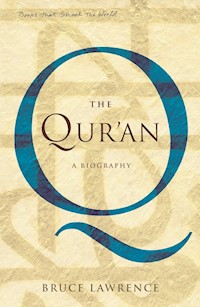
The Qur'an: A Biography is a beautifully written and authoritative account of one of the world's most famous, and most misunderstood books. Few books in history are as poorly read or understood as the Qur'an. Sent down in a series of revelations to the Prophet Muhammad, it is regarded by the faithful as the unmediated word of Allah. It is revered by Muslims throughout the world, it inspires unparalleled levels of devotion, passion, fear and, sometimes, incomprehension. In this book, the distinguished scholar Bruce Lawrence shows precisely why the Qur'an is Islam. He describes the origins of the faith in seventh-century Arabia and looks at why the Qur'an needs to be both memorized and recited by its followers. Lawrence also discusses the book's many doubters and commentators and assesses its important influence in societies and politics today. Above all, Lawrence emphasizes that the Qur'an demands interpretation, and can only be properly understood through its history.
Sie lesen das E-Book in den Legimi-Apps auf:
Seitenzahl: 254
Veröffentlichungsjahr: 2014
Das E-Book (TTS) können Sie hören im Abo „Legimi Premium” in Legimi-Apps auf:
Ähnliche












The Qur’an
A Biography
Other titles in the Books That Shook the World series:
Available now:
Plato’s Republic by Simon Blackburn
Darwin’s Origin of Species by Janet Browne
Thomas Paine’s Rights of Man by Christopher Hitchens
Marx’s Das Kapital by Francis Wheen
Forthcoming:
The Bible by Karen Armstrong
Homer’s The Iliad and the Odyssey by Alberto Manguel
Adam Smith’s Wealth of Nations by P. J. O’Rourke
Clausewitz’s On War by Hew Strachan
Published in Great Britain in hardback in 2006 by Atlantic Books.
Atlantic Books is an imprint of Grove Atlantic Ltd.
Copyright © Bruce Lawrence 2006
The moral right of Bruce Lawrence to be identified as the author of this work has been asserted in accordance with the Copyright, Designs and Patents Act of 1988.
All rights reserved. No part of this publication may be reproduced, stored in a retrieval system, or transmitted in any form or by any means, electronic, mechanical, photocopying, recording, or otherwise, without the prior permission of both the copyright owner and the above publisher of this book.
Every effort has been made to contact copyright holders. The publishers will be pleased to make good any omissions or rectify any mistakes brought to their attention at the earliest opportunity.
9 8 7 6 5 4 3 2 1
A CIP catalogue record for this book is available from the British Library
ISBN 1 84354 398 2 eISBN 978 1 78239 218 7
Designed by Richard Marston
Printed in Great Britain by [ ]
Atlantic Books An imprint of Grove Atlantic Ltd Ormond House 26–27 Boswell Street London WC1N 3JZ
www.groveatlantic.co.uk
For Dr Ibrahim Abu Nab, who lived the truth of ‘seeking God’s purpose every day’. (Qur’an, Chapter 55:29)
CONTENTS
Acknowledgements
A Note on Translations
A Note on Romanization
Introduction
ARAB CORE
1 The Prophet Muhammad:
Merchant and Messenger
2 The Prophet Muhammad:
Organizer and Strategist
3 ’A’ishah:
Muhammad’s Wife and Custodian of His Memory
4 The Dome of the Rock:
Jerusalem Landmark, Qur’anic Icon
EARLY COMMENTARIES
5 Ja’far as-Sadiq:
Shi’ite Imam and Qur’anic Exegete
6 Abu Ja’far at-Tabari:
Sunni Historian and Qur’anic Exegete
LATER INTERPRETATIONS
7 Robert of Ketton:
Polymath Translator of the Qur’an
8 Muhyiddin Ibn ‘Arabi:
Visionary Interpreter of Divine Names
9 Jalal ad-din Rumi:
Author of the Persian Qur’an
ASIAN ECHOES
10 Taj Mahal:
Gateway to the Qur’anic Vision of Paradise
11 Ahmad Khan:
Indian Educator and Qur’an Commentator
12 Muhammad Iqbal:
Pakistani Poet Inspired by Qur’anic Motifs
GLOBAL ACCENTS
13 W. D. Mohammed:
Qur’an as Guide to Racial Equality
14 Osama bin Laden:
Qur’an as Mandate for Jihad
15 AIDS Victims and Sick Women:
Qur’an as Prescription for Mercy
Epilogue
Glossary of Key Terms
Further Reading
Index
ACKNOWLEDGEMENTS
My debts are too many to permit more than brief acknowledgement here. My first and enduring debt is to Ibrahim Abu Nab of Amman. A gifted translator, journalist and filmmaker, Ibrahim opened his heart as well as his home to me when I visited him back in the 1980s. We spent long evening hours reading, discussing and translating the Noble Qur’an. I have benefited from his insight into A Book of Signs (the Qur’an is at once the Noble Qur’an and A Book of Signs. See below pp. 8 & 15) and his reverence for its divine origins. I honour his memory by dedicating this book to him.
In several chapters I have used some of the privately circulated translations of Shawkat Toorawa. I am indebted to him for permission both to cite his lyrical renditions and to modify them slightly in this biography of A Book of Signs. Equally am I beholden to five of my former students, Rick Colby, Jamillah Karim, Scott Kugle, Rob Rozehnal and Omid Safi, for their extraordinary insight into the shaping and reshaping of this text. To my colleague, Ebrahim Moosa, who read the whole of the manuscript with the heart of a believer and the eye of a critic, I give special thanks. My life’s partner, Miriam Cooke, did so much that no words of mine are adequate. I invoke Rumi. Quoting the Prophet’s dictum, Mawlana once observed that ‘women totally dominate men of intellect and possessors of hearts’. May this book be its beneficiary!
A NOTE ON TRANSLATIONS
Notes on translation are as necessary with respect to the Qur’an as they are futile. No single translation in English satisfies. The closest is Thomas Cleary, The Qur’an: A New Translation (Starlatch Press, 2004), often cited, or paraphrased, in the chapters above. It completes his earlier, condensed effort, The Essential Koran (HarperSanFrancisco, 1994), which some may still prefer, if only because it, unlike the 2004 rendition, offers an introduction and partial commentary. The most satisfying English translations with commentary and/or textual apparatus are A. J. Arberry, The Koran Interpreted (Macmillan, 1955) and M. A. S. Abdel Haleem, The Qur’an: A New Translation (Oxford University Press, 2004). For those who want both an English translation and the Arabic original with which to compare it, Ahmed Ali has provided Al-Qur’an: A Contemporary Translation (Princeton University Press, 1988).
The Qur’an exceeds the efforts of the most skilled and dedicated translators. It must be heard to be appreciated in its Arabic cadences, its inexpressible rhythms, its calibrated scales. The most available partial recitations can be found in the audio CD that accompanies Michael Sells’ original, evocative study, Approaching the Qur’an: the Early Revelations (White Cloud Press, 1999).
For an insider’s introduction to the elements of traditional and progressive interpretation of the Qur’an, consult Farid Esack, The Qur’an: A Short Introduction (Oneworld Publications, 2002), and for the delights and dilemmas of teaching the Qur’an in the modern European or American university, see Jane D. McAuliffe, ‘Disparity and Context: Teaching Quranic Studies in North America’ in Brannon M. Wheeler (ed.), Teaching Islam (Oxford University Press, 2003), pp. 94–107.
Jane D. McAuliffe is also the General Editor for what will be the major reference work in English on the Qur’an for at least the next fifty years: Encyclopaedia of the Qur’an (E. J. Brill, 2001–2005). Its five volumes total slightly less than 2,700 pages, and include extensive cross-referencing as well as some illustrations in volume 2.
A NOTE ON ROMANIZATION
There are several styles for rendering Arabic words into English, and throughout I have followed the most popular usage, so that the Prophet Muhammad is spelt differently from Imam W. D. Mohammed, though both are the same word in Arabic, and most feminine names end with –ah, though they can also end with just –a. For those who know Arabic these choices are arbitrary, while for others they are minor details worth noting but without lingering on their importance.
INTRODUCTION
The Qur’an discloses key elements about itself. Specific verses clarify the meaning of its name, the affirmation of Islam as true religion, and the priority of peace.
1. The name Qur’an means recitation:
We have sent it down with truth,
and with truth has it come down,
and We have not sent you (Muhammad)
except as a herald and a warner.
And We have divided the Recitation (Qur’an)
that you may recite it to humankind at intervals,
and We have sent it down by (successive) revelations. (17:105–6)1
2. Islam is true religion:
The true religion with God is Islam. (3:19)
If anyone seeks a religion other than Islam,
it will not be accepted from him. (3:85)
Today I have perfected your religion for you,
and I have completed my blessing upon you,
and I have approved Islam for your religion. (5:5)
Whomever God desires to guide,
He expands his breast to Islam. (6:125)
And finally, in a rhetorical question:
Will not he whose breast God has expanded to Islam,
walk upright in a light from his Lord? (39:24)
Since the word ‘Islam’ means complete devotion or surrender (to God), the rhetorical question of the last verse lays down the fundamental duty incumbent on each Muslim: to ‘walk upright in a light from his Lord’.
3. Peace is the priority:
God summons humankind to the abode of peace (dar as-salam), both in this life and in the next. (10:25)
So closely is the concept of peace (salam) related to surrender (islam) that the two become interchangeable, from the first revelation till the final Day of Judgement.
It is angelic intermediaries who mark the first revelation of the Qur’an, and they mark it with greetings of peace. During the Night of Power, when the Qur’an is said to have been revealed in its entirety to the Prophet Muhammad,
Angels and the spirit alight,
On every errand by God made right
Peace reigns until dawn’s early light. (97:4–5)
Similarly, when the faithful enter Paradise, they will be greeted by angels uttering the phrase, ‘As-salamu ‘alaykum,’ (‘Peace be upon you’) (7:46; 13:23–4; 16:32). Everywhere in the Muslim world, as also among Muslims living outside the majority Muslim regions of Africa and Asia, one uses the greeting ‘As-salamu ‘alaykum’, to which the response is ‘Wa-‘alaykum as-salam’ (‘And upon you, too, be peace’).
But the return greeting can also be lengthened. This habit derives from, even as it reinforces, the Qur’anic command:
And when you are greeted with a greeting,
greet with one fairer than it, or return it. (4:86)
The ‘fairer than it’ is often spoken if people have not seen each other for a long time. To make the response ‘fairer than it [the original greeting]’, a Muslim may outdo the greeter with a cadenza of good wishes: ‘wa-‘alaykum as-salam wa-rahmatullahi wa-barakatuhu’ (‘And on you be peace, and (also) God’s mercy and (also) His blessing’).
In every instance, peace here in this world relates to peace in the next world. Chapter 36, Ya Sin, attests the clear and ever-present link. When the Day of Judgement arrives, it will come as
But a single cry, when lo!
They are all brought before Us. (36:53)
And then from the Sovereign of the Day of Judgement (‘malik yawm ad-din’, 1:3) will come:
Peace ! A word from a Merciful Lord! (36:58)
Hence the everyday greeting of peace that unites believer to believer in this world anticipates the peace pronounced by God on the Final Day, the Day of Judgement.
*
Beyond disclosing its name, affirming Islam and stressing peace, the Qur’an has other key characteristics that deserve mention.
Revelations are sorted out into Chapters and verses, and the causes of each revelation provide context for its content. The number of revelations exceeds 200. They came to the Prophet Muhammad via a divine mediary (the Archangel Gabriel) between 610–632 CE. They are now arranged in 114 Surahs or Chapters. All but one (Chapter 9) begins by invoking God’s Name, then qualifies the Name as at once Compassion and Compassionate: ‘In the Name of God, Full of Compassion, Ever Compassionate’. Different people close to the Prophet Muhammad heard these revelations as he uttered them. They remembered the words and repeated them orally. A few wrote them down. In all they total at least 6,219 verses.
The contents of Surahs (Chapters) and ayat (verses) are informed by the causes of revelation, that is, by events and circumstances that marked the Prophet’s life and the early Muslim community. They have two major emphases. The first and shortest revelations came in the Meccan period (610–622). Invoking heaven and hell in anticipation of the Day of Judgement, they call polytheists to worship God as One. They also call Jews and Christians to recognize Muhammad as the seal of prophecy fulfilling for the Arabs and humankind the mission set forth for earlier prophets. Abraham and Moses are the principal prophets from the Torah, John the Baptist and Jesus the principal prophets from the Gospel. The later revelations, because they came after the hijrah, or flight from Mecca to Medina, are known as Chapters from the Medinan period (622–632). They share images and persons, themes and categories from the early, Meccan period but they are at once longer and more directed to social, political and military issues.
Naming of the Chapters became crucial for their recall and recitation. Sometimes the name came from a word or theme mentioned in the Chapter. Certain Chapters have several names because they are important for multiple reasons. ‘Surat al-Fatihah’ is the first and the most often recited. Though it is called ‘The Opening’, it is also known as the ‘Mother of the Book’ or the ‘Seven Oft-Repeated Verses’. Chapter 17 is known as ‘The Children of Israel’ but also as ‘The Night Journey’, since its initial verse alludes to the most unusual journey of the Prophet Muhammad: he flew on a winged steed from Mecca to Jerusalem, from Jerusalem to the Highest Heaven, then back to Jerusalem and Mecca, all in a single night. (The journey may have been a dream sequence or an out-of-body experience but was nonetheless real; see Chapter 1 below.) Chapter 112, one of the shortest Chapters, is so pivotal that it has been labelled by its dense but complementary themes ‘The Unity’ or ‘The Sincerity’ or ‘The Nature of Lordship’. Still other Chapters are known by mysterious letters that occur in the first verse, like ‘Ta Ha’ (20), ‘Ya Sin’ (36) and ‘Qaf’ (50).
Through a complex process, the recitations that had been revealed in verses and chapters became over time a book. After the death of the Prophet Muhammad, ‘Ali, his close relative and supporter, worked with others to compile them into a written text. Then twenty years later, during the rule of ‘Uthman, the third Caliph or Successor to Muhammad (after Abu Bakr and ‘Umar but before ‘Ali), all extant versions were arranged into one ‘standard’ version. This version persists substantially unchanged to the present day.
The earliest copies of the Qur’an were written in a script called Kufic Arabic, which had no vowel signs. It was for a further forty years, during the rule of the Umayyad Caliph ‘Abd al-Malik (685–705), that the first written version of the Qur’an with diacritics was produced. Seven different ways of reciting the Qur’an were also fixed, but that occurred still later, c. 934 CE. The same seven forms of Qur’an recitation have remained a canonical standard ever since.
*
The emphasis on recitation is not accidental. It is central to understanding the formation and the force of the Qur’an. The Qur’an is a book unlike any other: it is an oral book that sounds better spoken than read silently, but it is an oral book that is also a scripture. More evocative in recitation than in writing, the Qur’an is only fully the Qur’an when it is recited. To hear the Qur’an recited is for Muslims unlike anything else. It is to experience the power of divine revelation as a shattering voice from the Unseen. It moves, it glides, it soars, it sings. It is in this world yet not of it.
The Qur’an was first enunciated by the Archangel Gabriel to the Prophet Muhammad in early seventh-century Arabia. What Muhammad heard then must be heard again and again, from now until the end of time. Hearing the Qur’an recited is the compass of spiritual insight and moral guidance for Muslims. It is the message in its pure form, a form at once starkly pure and vivid.
The Qur’an is a multilayered Arabic text. Even those who hear it understand it in numerous, sometimes divergent ways, and those who cannot hear it in Arabic grasp no more than a fraction of its intended message.
The limits of human experience affect the way we approach the text. The Qur’an as written in Arabic is less than the revelation given to Muhammad; it is a second-order revelation. The Qur’an written, then translated from Arabic to English, becomes a third-order revelation. Distance from the source handicaps us, yet we can still learn about Islam by engaging with the Qur’an, even as a written text, translated from Arabic to English.
The Qur’an rendered into English projects an echo, at times a loud echo, of the vibrant spiritual core of Islam. Whether one hears or reads it, in Arabic or some other language, it is A Book of Signs because each of its many verses, like delicate filigree, is more than words: the Arabic word for the smallest unit of Qur’anic text means ‘verse’, but ‘verse’ also means ‘sign’ or ‘miracle’. As tangible signs, Qur’anic verses are expressive of an inexhaustible truth. They signify meaning layered within meaning, light upon light, miracle after miracle.
To make the Qur’an accessible to a broad and varied readership, I have arranged this book as a series of vignettes which can be read consecutively or selectively. To offer a thematic thread, the fifteen vignettes are divided into five sections of three, entitled ‘Arab Core’, ‘Early Commentaries’, ‘Later Interpretations’, ‘Asian Echoes’ and ‘Global Accents’. Each vignette has a distinct geo-historical context and is marked by a specific date in the span of Muslim and world history. The exception is the last vignette. Just as the Qur’an speaks across epochs, so the use of Qur’anic passages and invocation of God’s names have no temporal or spatial limit. The last vignette could also be the first: its attention to the sick is unbounded by either time or space, even though AIDS, one of its topics, is a virulent, contemporary disease.
Still, there is a storyline, and it cannot be ignored. It is framed in Arabia with an Arab core. In 610 a Meccan merchant, while meditating in a mountain-top cave, heard a voice summoning him from beyond to be a messenger. He was given messages, which were disclosures, or revelations, from on high. What became the Qur’an transformed the way Muhammad thought about himself, his society and the world. These revelations prompted him to challenge kin and clans, to motivate others to follow him, to form a new community and to make that community the centre of a new movement. There followed skirmishes and warfare, alliances and treachery which changed his life but did not alter his purpose. He was confirmed as the Prophet, the final Prophet, of God. His name was Muhammad ibn Abdallah, the religion revealed to him was Islam, the centre of Islam was Mecca (and then, after the hijrah or flight, Medina as well as Mecca).
During Muhammad’s lifetime, but even more after his death in 632, Muslim armies fanned out in all directions from Mecca. They confronted long-established empires adjacent to Arabia. To the east they attacked Hindu coastal cities in Gujarat and Sind. To the north they swept through the Persian Sassanian Empire. They swiftly toppled it, claiming Iraq and Iran as part of a new Islamic polity by the mid-650s. To the west, Muslim armies quickly conquered Egypt but then moved less rapidly across North Africa, fighting both Berbers and Byzantines until they reached the Atlantic Ocean in the 680s. It was a military conquest that occurred faster, and with more consequence, than the spread of the Roman Empire seven hundred years earlier. It made Arab armies, and navies, the major controlling force of both the Mediterranean and the Indian Ocean. It also expanded the audience for the Qur’an beyond what could have been imagined in the lifetime of the Prophet.
This book traces specific ways in which the Qur’an was experienced within the growing Muslim community. The Prophet’s young wife ‘A’ishah became a major figure in its transmission, as did a descendant of ‘Ali, the Shi‘ite Imam Ja‘far as-Sadiq. Monuments as well as persons transmitted the text and projected the authority of the Qur’an, none more so than the Dome of the Rock. Built in Jerusalem within a century of the Prophet’s death and on the Temple Mount, hallowed for both Jews and Christians, the Dome of the Rock memorialized the Night Journey of Muhammad, the journey that took him from Mecca to Jerusalem to Heaven to Jerusalem then back to Mecca. The Dome of the Rock etched the Night Journey with words of the Qur’an. They are words that have preserved until today the earliest written verses of the Qur’an.
However, not all Christians or Jews accepted the Qur’an as true or Muhammad as God’s Prophet. Among the doubters was Robert of Ketton, a Christian monk, who first translated the Qur’an into Latin. His role as a hostile but engaged student of A Book of Signs deserves mention along with the parallel role of major Muslim interpreters who elaborated Qur’anic themes in new and imaginative directions. Two of them were Persian: the ninth-century scholar at-Tabari and the thirteenth-century poet Jalal ad-din Rumi. Another was an Andalusian Arab, the twelfth-century mystic, Muhyi ad-din Ibn ‘Arabi.
The commentary of at-Tabari, together with the interpretive approaches of Rumi and Ibn ‘Arabi, had an impact on the large and varied Muslim community of India. From the seventh century India had been linked to the global Muslim community. Known as Hindustan, the Asian subcontinent or South Asia today encompasses the current nation-state of India as well as India’s biggest neighbours, Pakistan, Bangladesh and Afghanistan. Hindustan has been a major platform for the growth of Muslim communities, and remains today a vast arena for the expression of Islamic loyalty.
South Asian Muslims approach the Qur’an from a cultural domain shaped by language and outlook that are Islamic but not Arab. Open to outside influences, they filter what they receive through their own distinctive aesthetic imagination. Of fifteen vignettes, three come from South Asia. The first focuses on a royal woman who was memorialized in her burial space: the Taj Mahal. The Taj Mahal is a seventeenth-century tomb that is at once simple and complex. Its marble surfaces project a unity that forever changes, from morning to evening light. It is fronted by a water pavilion, surrounded by mosques and geometrical gardens, and banked against the Jumna River. The Qur’anic inscriptions on the marble surfaces of the Taj Mahal tell the story of its intent. The Taj Mahal proclaims a view of the next world etched by the Qur’an and echoing Ibn ‘Arabi in its visionary breadth.
India has also produced several notable male interpreters of the Qur’an, two of whom are included here. One was the nineteenth-century rationalist Sir Sayyid Ahmad Khan. Sir Sayyid welcomed the pragmatic values of the British, especially in governance and education. To the extent that modern science embodied the metaphysical values of modern Europe, however, he challenged its superiority and countered with an alternative modernity based on the rigorous retrieval of Qur’anic values. In this sense, he was the precursor to Muhammad Iqbal, the most famous Indian, then Pakistani, interpreter of Islam in the twentieth century. A poet-philosopher, Muhammad Iqbal was not a Qur’an interpreter, either by intention or by reputation. He engaged European philosophy and modern science as twins, each reinforcing the authority of the other, yet he saw both as inseparable from the larger message of Islam over time that was presented in the Qur’an. Iqbal was a citizen of the modern world, intent on reconciling reason with revelation. Resolutely Muslim, he projected in verse a perception of Qur’anic truth that was pervasive and superior to all other truths, including modern philosophy.
All the vignettes in this book illustrate a recurrent, essential point: while the Qur’an itself is a unitary, coherent source of knowledge, there is not a single Qur’anic message. The Qur’an – like all sacred literature – requires study. The act of studying its form, content and transmission over time is called interpretation. For the Qur’an, as for the Torah or the Bible, interpretation requires a form of human labour inseparable from the conscious or unconscious decisions of the labourer. Each interpreter must choose. Each must follow a principle of interpretation. No matter who the interpreter, no matter the time or place from which she or he looks at the Qur’an, certain themes, issues and accents will be selected and emphasized over others. The major difference is between narrow and broad selection of Qur’anic texts, or more precisely, between taking certain verses and passages out of context rather than viewing them in their full context when making claims about a normative Islamic world-view.
But selection is not the same as invocation. Nearly all Muslims invoke the Qur’an – as ritual authority, as everyday guide, as artistic motif, or even as ‘magic’. Some memorize the Noble Book from youth, honouring the tradition that prizes its orality or spoken quality as the bedrock of truth. Even for those who do not memorize all of its 6,000-plus verses, its words acquire an everyday rhythm. They can be put around the neck in an amulet; they can sit on taxi drivers’ dashboards, in rear windows or on bumper stickers; they can be carved into stone or scratched into metal or used to grace a letterhead. Written on an alphabet or prayer board, they can also be washed off and drunk for curative purposes. Even a Muslim who doesn’t know Arabic or has never learned the Arabic of the Qur’an, respects the book, can recognize when others use it, and may draw on its syllables and sounds in everyday life. Consider the sick woman mentioned below. She uses the Qur’an as a magical force, invoking its words whether through whispering them, smelling them or drinking them. Such are the popular means of making the Qur’an one’s own touchstone for healing and for hope. Even though many have contested this as a blasphemous use of the Qur’an, such use, as well as the controversy surrounding its use, will continue for the rest of this century and beyond.
No one can exhaust the Qur’an, as the book itself attests:
Say, even if the ocean were ink
For (writing) the words of my Lord,
The ocean would be exhausted
Before the words of my Lord were exhausted,
Even if We were to add another ocean to it. (18:109)
The fifteen vignettes only hint at the surfeit of meanings that make the Qur’an unique. What they are intended to do for the reader, whether Arab or non-Arab, Muslim or non-Muslim, is to engage both the text and the context of the Qur’an. Contexts are crucial. Although the Qur’an as a whole is authoritative, its content must be applied to particular contexts. Which aspect of the Qur’an applies and where? When does it apply and for whom? These are questions that probe coherence and selectivity at two levels: first, why are some but not all passages of the Qur’an of special value at different times and places?; and secondly, how do changes in context impart special value to particular verses or Chapters?
The crucial criterion for interpreting the Qur’an is history. In a historical context the Qur’an becomes A Book of Signs, multilayered in its meanings, continuously reinterpreted by successive generations and diverse audiences. Detached from history the Qur’an becomes the Book of Signs, singular in its meaning, applicable across time and place, unchanging, univocal.
Is the Qur’an plurivocal or univocal? Devout Muslims are divided. Those who assert that it is univocal occupy one perspective within the interpretive community of Qur’an users. They have been called fundamentalists but they are better understood as absolutists, since they see the Qur’an, and by extension Islam, as primordial. It has a heavenly prototype, ‘umm al-kitab’, literally, the Meta-Book, which is the full record of God’s Word. The Qur’an as a perfect reflection of the heavenly prototype is not like other words or books. It is above time and beyond history; it remains untouched by human temperament or by temporal change. Absolutists can exist in different eras. Osama bin Laden had his precursors in the seventh-century Khawarij, early Muslims who rejected any human mediation of God’s Word. In common with the Khawarij, bin Laden decries the departure of Muslims from a single, ‘true’ interpretation of Qur’anic revelation and social action. When he invokes the Qur’an, he projects it as a single, unchanging message.
For the militant Muslim minority, the necessary sequel to professing the faith is defending the faith. Instead of daily prayer, alms-giving, fasting and pilgrimage – all deemed to be essential practices, or pillars of piety, for most Muslims – the very next step required of all believers, in the view of militants, is to wage jihad. They justify jihad not as moral struggle but as all-out war. Citing certain passages from the Qur’an, they uphold them as singular in meaning and valid for all time. The duty of every believer is to sacrifice himself or herself in defence of the faith through armed combat.
Yet neither bin Laden nor other absolutists speak for all Muslims. Militant Muslims remain a fractious minority who stress the confrontational aspect of monotheistic faith. Other Muslims demur. Notable amongst them is the voice of Imam W. D. Mohammed (see chapter 13). An African-American Muslim leader, he has provided guidance to millions of his co-religionists who had previously defined Islam by race as much as by creed. Since the 1960s he has led them into mainstream Islam and also into mainstream America. Imam Mohammed contests that the Qur’an provides a staging ground for apocalyptic warfare. For him the Qur’an does require jihad, but it is not jihad as all-out war. It is jihad as an eternal battle between good and evil. The highest temporal pursuit for Muslims, in his view, is to be pragmatic citizens of a twenty-first-century global community. Deeply grounded in a Qur’anic world-view, Imam Mohammed remains open to engagement with non-Muslims. He seeks allies in a larger war against poverty, racism and environmental degradation. He values a world at peace where the true jihad is for justice, not armed conflict motivated by hatred or displayed as terror. Though absent from mainstream media, his voice is as important as Osama bin Laden’s. Like the sick woman who derives her hope from Qur’anic traces, Imam Mohammed provides a vital, contemporary invocation of A Book of Signs in the twenty-first century.
Arab Core
CHAPTER 1
The Prophet Muhammad: Merchant and Messenger
619 CE
Muhammad was a merchant with a message. The message was not his own nor did he seek it. The message sought him, filled him and transformed him, making his life a journey that none, including he, could have imagined.




