


1,99 €
Mehr erfahren.
- Herausgeber: Quickie Classics
- Kategorie: Gesellschafts- und Liebesromane
- Sprache: Englisch
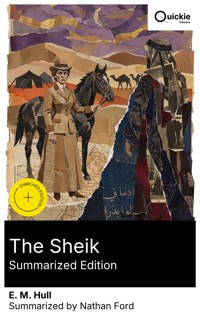
The Sheik (1919) braids a captivity romance with an imperial adventure as the fiercely independent English heiress Diana Mayo is abducted in the Algerian Sahara by the enigmatic chieftain Ahmed Ben Hassan. Hull's prose is unabashedly lush—sand-dune panoramas, perfumed tents, and high-strung interior monologues—propelling a melodrama whose erotic charge scandalized and enthralled postwar readers. Situated within the Orientalist "desert romance," the novel refracts anxieties about gender, race, and empire through fevered fantasies of domination and surrender, and it became a defining popular text, spawning imitators and a star-making 1921 film adaptation starring Rudolph Valentino. E. M. Hull, a reserved British novelist, wrote the book amid World War I disruptions, transmuting contemporary tensions over female independence and marital power into sensational form. Drawing more on travelogues and imperial adventure fiction than firsthand experience, she fashioned a vividly imagined Sahara and, with The Sheik's runaway success, set the template she refined in later desert tales. Read today, The Sheik rewards scholars and general readers alike: a cornerstone of popular romance and a revealing artifact of Orientalist fantasy and postwar desire. Approach it critically yet empathetically, and you will find a text that unsettles, captivates, and sustains vigorous debate. Quickie Classics summarizes timeless works with precision, preserving the author's voice and keeping the prose clear, fast, and readable—distilled, never diluted. Enriched Edition extras: Introduction · Synopsis · Historical Context · Brief Analysis · 4 Reflection Q&As · Editorial Footnotes.
Das E-Book können Sie in Legimi-Apps oder einer beliebigen App lesen, die das folgende Format unterstützen:
Veröffentlichungsjahr: 2026
Ähnliche














The Sheik (Summarized Edition)
Table of Contents
Introduction
At the heart of The Sheik lies a combustible negotiation between individual freedom and engulfing desire, where the will to remain sovereign collides with the magnetism of domination, the fantasy of boundless horizons masks constricting power, and the desert’s shimmering promise of escape becomes the stage on which autonomy, cultural difference, and romantic obsession test—and expose—the limits of control; set amid caravan routes and oasis towns, the narrative’s heat distills fear and fascination into a single pulse that challenges readers to consider how stories transform peril into passion and distance into intimacy without dissolving the ethical questions that burn beneath the sand.
First published in 1919, E. M. Hull’s novel belongs to the romantic adventure tradition often labeled the desert romance, unfolding largely in the North African Sahara with its dunes, oases, and colonial waypoints. Written in the period immediately following the First World War, it captured an appetite for escapist spectacle and became a major popular success, further amplified by a 1921 screen adaptation starring Rudolph Valentino. Readers encounter a hybrid of melodrama, travel fantasy, and captivity narrative that dramatizes the meeting of a headstrong European traveler and a commanding desert leader, while directing attention to the era’s imagination of exotic space and absolute authority.
At the novel’s outset, Diana Mayo, an independently minded Englishwoman traveling with minimal chaperonage, ventures into the Sahara and is seized by Ahmed Ben Hassan, a formidable sheik whose motives remain deliberately obscured by ritual, secrecy, and ruthless self-possession. From this precipitating act, the story moves through desert camps, guarded tents, and night journeys where silence carries as much weight as speech. Hull’s prose favors high color and emphatic rhythm, alternating breathless action with languorous description of landscapes and interiors. The tone is heightened, sometimes fevered, and the narration keeps readers close to emotional oscillations while withholding certain truths that complicate first impressions.
In its central relationship, the book interrogates power: who holds it, how it is exercised, and whether desire can coexist with autonomy without erasing consent. It also stages a clash between European modernity and a fantasized East, drawing on Orientalist conventions that encode racial and cultural hierarchies even as they glamorize desert cultural forms. The heroine’s self-definition and the sheik’s command test prevailing ideas of gender, class, and civilization, exposing the pressures that shape identity under spectacle and coercion. The novel’s allure and its ethical provocations are inseparable, compelling readers to assess how fantasy intensifies rather than resolves contradictions of dominance and submission.
As a watershed of popular fiction, The Sheik helped crystallize enduring romance templates: the imperious lover, the remote setting that suspends ordinary rules, the transformation arc sparked by peril, and the pull between resistance and surrender. Its visibility—cemented by massive sales and a widely seen film—means later genres converse with it, whether by imitation, revision, or critique. Contemporary readers encounter not only a period page-turner but a source text for debates about consent, fantasy, and the politics of representation in romantic storytelling. Studying it clarifies how mass culture manufactures desire, and how readers negotiate pleasure alongside unease in charged narratives.
Approaching the novel today benefits from a double lens: as a historical artifact shaped by British imperial culture and as a narrative engine whose rhythms still work on the pulse. Its depictions of Arab identity and desert life draw on stereotypes and fantasies that invite postcolonial scrutiny, and its coercive framework demands clear-eyed attention to boundaries, agency, and harm. Yet Hull’s scene-setting, momentum, and acute tracking of emotional weather explain the book’s grip on successive audiences. Reading with curiosity and skepticism together allows one to register both the seduction of the form and the structures that make that seduction possible.
To enter The Sheik is to cross into a carefully staged mirage where narrative speed, atmospheric detail, and moral friction build a lasting, unsettling glow. The book’s central tension—self-rule contending with overpowering attraction—echoes beyond its moment of origin, raising questions that continue to animate conversations about romance, power, and cultural desire. As a product of 1919 and an influencer of countless later stories, it rewards a critical reading that separates surface glamour from substrata of ideology while recognizing the craft that sustains its spell. The desert here is both backdrop and pressure chamber, and the test it sets remains unmistakably modern.
Synopsis
The Sheik (1919) by British author E. M. Hull is a desert romance set largely in the North African Sahara. It introduces Diana Mayo, a wealthy, headstrong Englishwoman determined to travel without chaperonage, testing social boundaries and her own nerve. On the eve of a solitary expedition, she encounters the enigmatic Sheik Ahmed Ben Hassan, a powerful desert leader whose self-possession unsettles her independence. Despite warnings about danger beyond colonial outposts, Diana pushes into the dunes with minimal escort. Her quest for absolute autonomy and adventure collides with a world ruled by other codes, setting in motion an encounter that will dominate the narrative.
Early in her trek, Diana is seized by Ahmed Ben Hassan’s riders and taken to his desert encampment. The abduction removes her from the safety of colonial settlements into a closed world where his authority is absolute. Isolated among armed retainers and elaborate tents, she confronts the stark limits of her freedom. The Sheik enforces strict rules, denying her contact with outsiders and rebuffing defiance with implacable control. The novel emphasizes the shock of dispossession as Diana’s modern self-reliance meets a hierarchical culture of command, presenting captivity not only as physical constraint but as a psychological challenge to identity and will.
Life in the encampment unfolds through routines that reveal both luxury and menace: carefully managed travel, trained horses, attentive servants, and the constant presence of guards. Ahmed’s magnetism and volatility dominate the scene, while his rare absences throw Diana into calculations about escape. A cosmopolitan visitor, Raoul de Saint Hubert, brings a second perspective, recognizing refinement and education behind the Sheik’s severity and detecting Diana’s courage beneath her peril. Their guarded conversations situate the captor as more than a stereotype and the captive as more than a victim, creating a triangle of observation in which motives, boundaries, and possible futures are tested.
As days stretch into weeks, the book tracks an intimate war of attrition between command and resistance. Diana’s pride and ingenuity repeatedly collide with the Sheik’s possessiveness and self-discipline, producing friction that oscillates between confrontation and uneasy détente. Glimpses of vulnerability—an offered comfort, a restrained anger, a word withheld—complicate straightforward judgments of cruelty or consent. Hull frames the desert as both prison and catalyst, a vast arena in which self-conceptions erode under heat and isolation. Internal monologues chart Diana’s evolving responses, from defiance to disorienting ambivalence, while Ahmed’s guarded actions suggest a private code that remains opaque yet compelling.
Beyond the tented world, danger multiplies. Rival leaders contest territory, caravan routes invite ambush, and rumor magnifies every absence from camp. A journey across dunes becomes a gauntlet where stamina, horsemanship, and command decide survival. The novel pivots to movement and pursuit, using skirmishes and raids to test loyalty and control under pressure. In crisis, Ahmed’s strategic ruthlessness and legendary reputation come to the fore, exposing the brittle edges of power. For Diana, external threats sharpen existing dilemmas, forcing choices about trust and cooperation without resolving the deeper imbalance that governs her captivity and complicates any sense of safety.
Interludes of relative calm introduce confidences that hint at veiled origins, continental education, and long-standing enmities, intimations that recast assumptions about culture and belonging. Saint Hubert’s return raises ethical questions about complicity and rescue, while private revelations suggest that identity in this world is a matter of performance as much as descent. The narrative edges toward decisive turning points without foreclosing them, layering backstory with present risk. As expectations of civilized conduct clash with desert codes, prospects for negotiation—whether personal or political—come into view. Choices about departure, allegiance, and self-definition gather force, promising change while keeping outcomes unresolved.
Without disclosing final turns, The Sheik endures as a touchstone of early twentieth-century popular romance, notable for its volatile mix of domination, desire, and exotic spectacle. Its portrayal of gender roles and colonial settings has drawn sustained scrutiny, prompting debates about coercion, consent, and orientalist fantasy that continue to shape readings today. At the same time, the novel’s taut pacing, memorable central figures, and stark landscape helped establish formulas that influenced later genre fiction and screen adaptations. As a cultural artifact, it crystallizes postwar anxieties about freedom and authority, while inviting readers to weigh perilous attraction against the costs of power.
Historical Context
First published in Britain in 1919, The Sheik emerged in the immediate aftermath of the First World War, when readers sought diversion and new forms of popular fiction. Its author, Edith Maude Hull, a British writer living in Derbyshire, began the novel while her husband served during the war. The book quickly became a transatlantic bestseller, circulating through lending libraries and bookshops and reaching a broad middle-class audience. Appearing as the interwar era opened, it spoke to shifting tastes shaped by wartime disruption, mass-market publishing, and a hunger for exotic settings. The novel’s sensational reputation positioned it squarely within debates about modern leisure and morality.
Set largely in the Sahara, the novel draws on a North African geography already mediated by European empire. Algeria, conquered by France beginning in 1830, was divided between coastal departments and the militarily administered Territoires du Sud. Oases such as Biskra developed tourist infrastructures—hotels, guides, and postcard industries—catering to winter visitors arriving by rail and steamer. French colonial forces and administrators regulated caravan routes and tribal leadership under colonial policy. For British readers, the desert functioned as a stage both accessible and distant: a playground promised by guidebooks yet framed by imperial control. The book’s setting channels those contradictions of allure and domination.
The Sheik inherits a long Orientalist tradition in European letters that cast the “East” as sensual, dangerous, and picturesque. English readers knew desert romance through earlier works like Ouida’s Under Two Flags (1867), set among French spahis in Algeria, and travel writing by figures such as Pierre Loti that popularized Sahara landscapes. Romantic precedents extended back to Byron’s Oriental tales and nineteenth‑century adventure fiction by H. Rider Haggard and others. These texts supplied stock figures—the noble tribesman, the tyrant, the captivated European—and a rhetoric of heat and vastness. Hull’s novel deploys and intensifies those conventions, shaping characters and atmosphere to meet modern mass‑market expectations.




