


Erhalten Sie Zugang zu diesem und mehr als 300000 Büchern ab EUR 5,99 monatlich.
- Herausgeber: Phoenix Classics
- Kategorie: Fantasy und Science-Fiction
- Sprache: Englisch
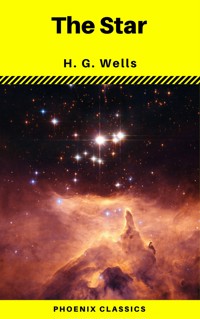
This book contains several tables of HTML content to make reading easier. in January (about 1900, presumably), the people of Earth awaken to the notion that a strange luminous object has erupted, into the Solar System, after disturbing the normal orbit of the planet Neptune. Indeed, such object is a luminous celestial body, whose luminosity is distinguishable on the sky about the constellation of Leo. Although initially it is a matter of concern only for astronomers, eventually the world media announces that it is a whole star, heading in a collision course toward the center of our star system. In its way, the star had enwrapped Neptune indeed, bringing it inside. Although many people are concerned by this, the issue amounts to little more than a temporary fad. The loose star continues its path, now affecting the planet Jupiter and all its moons. At this point, the studies of a mathematician are published throughout the world. He explains that both the intruding star and our Sun are exerting reciprocal gravitational attraction, and as a result it is being pulled deeper into the solar system. With the orientation of the star being what it is, it is determined that the star would either hit Earth or pass by at close proximity, which would lead to apocalyptic ecological consequences. While the Earth is losing its nights owing to its luminosity, many people begin to worry. Some cynics continue to refute this, remembering the year 1000, in which humanity also anticipated the world's end. The English winter softens progressively into a thaw, as the intruding star grows fast on the sky. Its high speed is evident during the worst hours of the event. On that day, in the sky above England the relative size of the star was equivalent to a third of the size of the Moon. Upon reaching the skies of the United States the relative size had already increased to the size of the Moon.
Sie lesen das E-Book in den Legimi-Apps auf:
Seitenzahl: 20
Veröffentlichungsjahr: 2017
Das E-Book (TTS) können Sie hören im Abo „Legimi Premium” in Legimi-Apps auf:
Ähnliche


















The Star
H. G. Wells
The Star
It was on the first day of the new year that the announcement was made, almost simultaneously from three observatories, that the motion of the planet Neptune, the outermost of all the planets that wheel about the sun, had become very erratic. Ogilvy had already called attention to a suspected retardation in its velocity in December. Such a piece of news was scarcely calculated to interest a world the greater portion of whose inhabitants were unaware of the existence of the planet Neptune, nor outside the astronomical profession did the subsequent discovery of a faint remote speck of light in the region of the perturbed planet cause any very great excitement. Scientific people, however, found the intelligence remarkable enough, even before it became known that the new body was rapidly growing larger and brighter, that its motion was quite different from the orderly progress of the planets, and that the deflection of Neptune and its satellite was becoming now of an unprecedented kind.
Few people without a training in science can realise the huge isolation of the solar system. The sun with its specks of planets, its dust of planetoids, and its impalpable comets, swims in a vacant immensity that almost defeats the imagination. Beyond the orbit of Neptune there is space, vacant so far as human observation has penetrated, without warmth or light or sound, blank emptiness, for twenty million times a million miles. That is the smallest estimate of the distance to be traversed before the very nearest of the stars is attained. And, saving a few comets more unsubstantial than the thinnest flame, no matter had ever to human knowledge crossed this gulf of space until early in the twentieth century this strange wanderer appeared. A vast mass of matter it was, bulky, heavy, rushing without warning out of the black mystery of the sky into the radiance of the sun. By the second day it was clearly visible to any decent instrument, as a speck with a barely sensible diameter, in the constellation Leo near Regulus. In a little while an opera glass could attain it.




