


Erhalten Sie Zugang zu diesem und mehr als 300000 Büchern ab EUR 5,99 monatlich.
- Herausgeber: Nick Hern Books
- Kategorie: Poesie und Drama
- Serie: NHB Modern Plays
- Sprache: Englisch
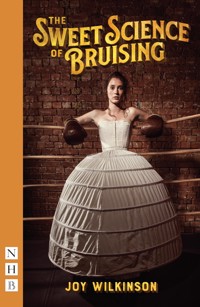
'When that bell rings, your life is entirely in your hands.' London, 1869. Four very different Victorian women are drawn into the dark underground world of female boxing by the eccentric Professor Sharp. Controlled by men and constrained by corsets, each finds an unexpected freedom in the boxing ring. As their lives begin to intertwine, their journey takes us through grand drawing rooms, bustling theatres and rowdy Southwark pubs, where the women fight inequality as well as each other. But with the final showdown approaching, only one can become the Lady Boxing Champion of the World… Joy Wilkinson's play The Sweet Science of Bruising is an epic tale of passion, politics and pugilism. It premiered at Southwark Playhouse, London, in October 2018, in a production by Troupe.
Sie lesen das E-Book in den Legimi-Apps auf:
Seitenzahl: 112
Veröffentlichungsjahr: 2018
Das E-Book (TTS) können Sie hören im Abo „Legimi Premium” in Legimi-Apps auf:
Ähnliche








Joy Wilkinson
THE SWEETSCIENCEOF BRUISING
NICK HERN BOOKS
London
www.nickhernbooks.co.uk
Contents
Original Production
Foreword
Acknowledgements
Characters
The Sweet Science of Bruising
About the Author
Copyright and Performing Rights Information
The Sweet Science of Bruising was produced by Troupe and first performed at Southwark Playhouse on 3 October 2018 with the following cast:
PROFESSOR CHARLIE SHARP
Bruce Alexander
VIOLET HUNTER
Sophie Bleasdale
MATILDA ‘MATTY’ BLACKWELL
Jessica Regan
ANNA LAMB
Kemi-Bo Jacobs
POLLY STOKES
Fiona Skinner
AUNT GEORGE
Caroline Harker
EMILY
Alice Kerrigan
LORD CAVENDISH
Joe Coen
CAPTAIN DANBY
James Baxter
DR FORSTER
Ashley Cook
GABRIEL LAMB
Joe Coen
NANCY
Alice Kerrigan
PAUL STOKES
James Baxter
DR JAMES BELL
Ashley Cook
REFEREE
Ashley Cook
Director
Kirsty Patrick Ward
Fight and Movement Director
Alison de Burgh
Designer
Anna Reid
Lighting Designer
Tim Deiling
Sound Designer and Composer
Max Perryment
Dialect Coach
Katherine Heath
Costume Supervisor
Flora Moyes
Stage Manager
Grace Lewis
Assistant Stage Manager
Rhiannon Bridgland-Bishop
Assistant Director
Jackie Fisher
Production Manager
Ian Taylor
Producer
Troupe
Foreword
‘Whose story is it?’
That’s the first question we must ask ourselves when setting out to write a story – according to the list I was given by John Yorke on the BBC Writers’ Academy in 2006. What I learned at the Academy was invaluable and I still use the list, but back then I was younger and arsier and this rule really bugged me – that a well-told story should only have one protagonist, or perhaps a group protagonist, as long as they acted as a team with a shared goal. Even though there were exceptions, this monolithic approach bothered me. I understood the point was we empathise with the protagonist and there is only one of us, but isn’t the beauty of drama being able to put ourselves in many roles – any roles – so as to experience the world through a whole range of perspectives? And even though the thousands of different stories out there could give us that range, the range of heroes wasn’t really that wide. The range of heroines was even narrower. Surely there was room for some more diverse protagonists?As many as we can handle!
So when, a year or so later, Purni Morell offered me the chance to develop a new play at the National Theatre Studio and encouraged me not to worry about any parameters, I thought sod it! I’m going to write a play with four female protagonists and give them all their own stories, so that even if you identify more with one, you understand them all.
My first play, Fair, was set on a fairground and it was while researching the history of that world that I came across a book by Professor Vanessa Toulmin that covered female boxing – A Fair Fight. The subject was perfect for my four heroines, and tantalising snippets about women challenging each other for the title of Lady Boxing Champion gave me my springboard. I researched in depth about boxing and nineteenth-century women, and although there wasn’t much about the nineteenth-century female boxers themselves, that was a dramatist’s gift, giving me just enough fuel to take the leap and make it my own.
I did an initial two-week workshop with Fair director Helen Eastman, ace fight director Alison de Burgh, period costume guru Natasha Jenkins, and some brilliant actors. We spent most of it on the physical side, trying out ways to mix fighting with dialogue, but also talking about all types of fighting and violence and what they mean to us today. Despite the historical research, I’m not interested in museum pieces, and (to paraphrase Ken Loach) whether it’s a true story matters less to me than if there is truth in the story. If history is written by the victors, we have to be more imaginative to tell the stories of the losers. Female boxers embody winners and losers, from the early backstreet catfighters to our twenty-first-century Olympic champion Nicola Adams, they battle their way from unlikely origins to beat out their own heroic arc, encapsulating conflict at every level – yet another gift for a dramatist!
After the workshop, I went away and wrote the play, finishing it a few days before giving birth to my first son. When I came back to work, we did another two weeks workshopping the script with different but equally brilliant actors, which led to a staged reading at Soho Theatre. I remember thinking – we have to get this on before the 2012 Olympics (when women’s boxing was allowed for the first time) or it’ll be dead in the water. As the invited industry folk took their seats, I overheard one bastard take in the cast and scoff: ‘Ten actors?! They’ll never get that produced!’ Helen and the cast knocked it out of the park, but the bastard was sadly correct. We never got it produced. So much for multiple protagonists and not worrying about parameters! The 2012 Olympics came and went, the script got passed around and good people would get in touch to tell me how much they loved it, but no one could put it on. So I learned my lesson and I wrote a one-man show, and film, TV and radio drama, and had another son. However much I still loved my lady boxing play, I had to accept defeat.
And then in 2017, a good and thankfully dauntless person got in touch. Troupe producer Ashley Cook had read the script a couple of years earlier and couldn’t put it on right then, but he kept it in mind and sent it to Kirsty Patrick Ward, a director who had impressed him. They both loved it, so when they were both ready, we all met up and suddenly – in the final round – the play was back on its feet with a new burst of energy.
We’ve put the script through its paces with a workshop at LIPA and two closed readings, thanks to the generosity and talent of more fantastic actors and RADA dramaturg Lloyd Trott. The play has evolved a lot since its first incarnation over a decade ago, and strangely, despite my post-Olympics despair (didn’t we all have that?), I can now see that this is precisely the right time for this play to come to life.
Lloyd Trott spoke of it as ‘one of the first post-Octoroon period dramas’, referring to the revelatory Branden Jacobs-Jenkins’ play at the Orange Tree/ National Theatre, itself following the phenomenon that is Hamilton. The Globe’s production of Emilia has brought a new all-female take on the Shakespearean era, and now here we are, bringing you our four Victorian boxing heroines, playing with the form of the period drama to put different stories on stage and ask questions about how we live now. How do we balance our drive to win as individuals with our need to connect and work together? Can we compete to be the best and still care for others? Can women create different power structures? Do we want to? Or are we all the same, men and women, winners and losers – single protagonists in our own stories? In other words –
Whose story is it?
I wrote the play, but as you can see even from this scant summary, it wouldn’t have happened without the input of dozens of brilliant people. A play is monolithic and collaborative, from the first conversations that kindle the spark, through the long hours holed up alone, to the conversations that you’ll have afterwards in the bar. Because, of course, it’s your story now – the audience, individuals and as a group, alone in the dark yet unified in the moment, no matter what side of the fight you might be on.
Joy Wilkinson, September 2018
Acknowledgements
Joy Wilkinson would like to thank Helen Eastman, Purni Morell, Alison de Burgh, Natasha Jenkins, Alex Silverman, Chris Campbell, Lloyd Trott and all the incredible actors who participated in development workshops/ readings at the National Theatre Studio, Soho Theatre, LIPA, Theatre Delicatessen, and RADA. Thanks also to Matt Connell, Alexandra Cory, Sarah Wooley, Neil Williams and my family for their endless support.
Characters
PROFESSOR CHARLIE SHARP
VIOLET HUNTER
MATILDA ‘MATTY’ BLACKWELL
ANNA LAMB
POLLY STOKES
AUNT GEORGE
EMILY (also plays NANCY)
GABRIEL LAMB (also plays LORD CAVENDISH)
PAUL STOKES (also plays CAPTAIN DANBY)
DR JAMES BELL (also plays DR FORSTER and REFEREE)
This ebook was created before the end of rehearsals and so may differ slightly from the play as performed.
ACT ONE
Scene One
1869. An amphitheatre in Islington, London, moments before show time.
In the middle of a boxing ring sits PROFESSOR CHARLIE SHARP. He seems old and sickly, huddled beneath a blanket. When he walks, he needs a cane. When he speaks, he needs to cough. When he wishes it, he needs neither.
When the audience is almost settled, the PROFESSOR clears his throat and speaks, weakly.
PROFESSOR. Ladies and gentlemen. I am very sorry to have to tell you… that I shall not be fighting tonight. (Smiles. A little louder.) A delicate child, I. Never felt a blow from my fretful parents, except to get the air into my lungs. I was schooled in my sickbed, an early observer of the fisticuffs below my window. How I longed to be down in the streets with them. The sweaty stuff of life right outside whilst I tried to memorise my declensions. The only sweat I shed was in fevered dreams. The only muscle I trained to bulging was my brain – (Louder, rising to his feet.) but I have used it since to bring my dreams to life, to put the gutter up onstage and elevate it to an art, a science: The Sweet Science of Bruising! (Moving around now, surprisingly light on his feet.) The theory of evolution wrenched into sweat-drenched reality, with each contender fighting to be the best. The personification of progress! And where could be more progressive than Islington? (Beat.) Tonight at the Angel Amphitheatre, I, Professor Charlie Sharp, bring you, ladies and gentlemen… ladies. Please welcome them, as they do battle to be named the greatest of them all – the very first, the one and only, Lady Boxing Champion of the World – Four women announce themselves.
VIOLET. Violet Hunter.
MATTY. Matilda Blackwell.
ANNA. Anna Lamb.
POLLY. Polly Stokes.
A beat – they look at each other. The PROFESSOR takes VIOLET HUNTER’s hand and brings her to the fore. The others stand down, for now.
PROFESSOR. Violet Hunter, the one and only Lady Boxing Champion of the World.
Or rather, she will be. She’s still only a lady and she’s barely heard of boxing. She’s in a West End theatre at a matinee. A world away…
VIOLET takes a seat beside EMILY and AUNT GEORGE, sisters in suffrage. They are watching a play. The boxing ring has become a stage where a ‘cup-and-saucer drama’ nears its end. At a table laid for tea, two gentlemen, LORD CAVENDISH and CAPTAIN DANBY, tensely eat crumpets. They stand as DR FORSTER enters, grave.
CAVENDISH. What news, doctor?
DANBY. Will she live?
FORSTER. Her heart is weak and cannot stand the strain of choosing between two such worthy suitors. To save her life, it is left to me to diagnose who is truly deserving of her love.
CAVENDISH. Then, good doctor, I submit everything I own for your examination. My name, my estate, my body and soul, every atom of which is devoted to Miss Laura. Upon thorough assessment, there is no doubt about whom you must choose.
FORSTER. Most convincing, Lord Cavendish. And Captain Danby?
DANBY. I, too, love Miss Laura, but I cannot allow her agony to last a moment longer. Certainly not long enough for a thorough assessment of our suitability. All that matters now is that she lives. For that gift alone, would I willingly give her up.
CAVENDISH. Good man!
A triumphant CAVENDISH passes DANBY the plate of crumpets. FORSTER stays his hand.
FORSTER. I have made my diagnosis. The right man is… Captain Danby! For only true love recognises the demand for sacrifice over the compulsion to possess.
DANBY. Then I shall marry Miss Laura!
CAVENDISH. And I shall make my way in the world alone, but with a new understanding of the true nature of love, and a readiness to embrace it afresh!
FORSTER. That’s progress!
Beaming, he takes a hearty bite of a crumpet. Curtain.
As they take their bows and retreat, AUNT GEORGE claps politely. EMILY claps with fervour. VIOLET is oblivious, lost in her thoughts.
AUNT GEORGE. Dear Emily, I sometimes suspect that you come to the theatre to see the plays.
EMILY. How funny! (Dabs eyes.) It’s hard not to get caught up in it all though, isn’t it?
AUNT GEORGE. On the contrary, I find it the perfect opportunity to think of other things. A place for us to gather, safely in public, seditiously alone, and while everyone’s attention is directed elsewhere, we are free to contemplate what really matters and imagine – if it were all swept away, what might we put in its place?
EMILY (enthused). What about a death scene for the heroine? Why should Miss Laura remain offstage during the most dramatic moments?
AUNT GEORGE. I said what really matters, in the real world – the enfranchisement of women!




