


4,49 €
Mehr erfahren.
- Herausgeber: neobooks
- Kategorie: Religion und Spiritualität
- Sprache: Deutsch
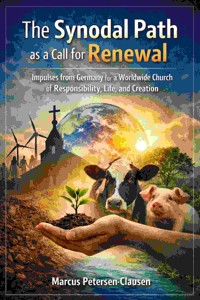
This book offers a compelling analysis and ethical reflection on the Synodal Path in Germany. It takes up the causes, debates, and resolutions of this reform process and consistently develops them further. The starting point is the Church's profound crisis of trust caused by abuse of power, sexual violence, and structural failure. Written in clear language, the book connects internal Church issues with global responsibility. It addresses power and accountability, the role of women, sexuality and contraception, the protection of creation, the treatment of animals, hunger and global injustice, and child marriage. It is not aimed solely at the grassroots level, but explicitly at decision-makers in the Vatican and within the global Church. The Synodal Path is not presented here as a completed project, but as an ethical point of departure. The book does not call for quick solutions, but for consistency, courage, and a willingness to measure faith against lived reality. Attention: The author uses artificial intelligence for creating most of his texts (and is required to disclose this use).
Das E-Book können Sie in Legimi-Apps oder einer beliebigen App lesen, die das folgende Format unterstützen:
Seitenzahl: 35
Veröffentlichungsjahr: 2026
Ähnliche












The Synodal Path as a Call for Renewal
Subtitle:
Impulses from Germany for a Worldwide Church of Responsibility, Life, and Creation
The Synodal Path as a Call for Renewal
Subtitle
Impulses from Germany for a Worldwide Church of Responsibility, Life, and Creation
Foreword
This book is an invitation to take a closer look. It is addressed to people in the Vatican and to all those who bear responsibility for the Catholic Church. This is not about accusation. It is about reality.
The Synodal Path was an attempt to be honest. Honest about power. Honest about guilt. Honest about structures that made suffering possible. For six years, people in Germany talked, argued, listened, and passed resolutions. Not because they wanted to destroy the Church, but because they wanted to preserve it.
This book takes up the goals and resolutions of this path and carries them forward. It asks what they mean for a world in which nearly nine billion people live. A world in which unborn life is meant to be protected while, at the same time, millions of children starve. A world in which the Church calls contraception a sin even as overpopulation, poverty, and suffering continue to grow. A world in which animals suffer and creation is being destroyed.
The Synodal Path was not an end. It was a beginning. This book understands itself as an impulse to take this beginning seriously and to move forward with courage.
Disclaimer
This book is a work of opinion and reflection. It makes no claim to canonical authority and does not replace any official documents or decisions of the Catholic Church or the Holy See.
The positions, evaluations, and suggestions presented are based on the goals and resolutions of the Synodal Path as well as on ethical, social, and global considerations. They are proposals, not demands with legal force.
This book was created with the support of artificial intelligence. The content was formulated and editorially compiled using artificial intelligence. Responsibility for publication, topic selection, and overall orientation lies entirely with the publisher.
This book is intended as a contribution to dialogue, not as a judgment.
Imprint
Person responsible for content:
Marcus Petersen-Clausen
Ginsterweg 7
30900 Mellendorf / Wedemark, Germany
Telephone: +49 179 6162178
This document is protected by copyright.
© 2025 Marcus Petersen-Clausen
© 2025 Köche-Nord.de
Table of Contents
Chapter 1: The Synodal Path
Chapter 2: Power, Control, and Responsibility
Chapter 3: Women, Dignity, and Participation
Chapter 4: Sexuality, Contraception, and Responsibility
Chapter 5: Creation, Animals, and Nutrition
Chapter 6: Church, Hunger, and Global Justice
Chapter 7: From Resolution to Impact
Chapter 8: The Synodal Path as a Global Opportunity
Chapter 9: Child Marriage
Chapter 10: Afterword
References and Further Reading
Chapter 1: The Synodal Path – Why It Was Necessary
The Synodal Path emerged from a crisis. Not a minor one. A deep, shattering one. From reports of sexual abuse that could no longer be ignored. From files spanning decades. From names, places, and numbers that proved these were not isolated cases. From the knowledge that perpetrators were transferred while victims were silenced. From the experience of many survivors who had trusted the Church and saw that trust betrayed.
With every new study and every new report, it became clearer that this was not merely about individual failure, but about systemic problems. About structures that protected power and harmed people. About a culture in which loyalty was valued more highly than truth. About communities that preferred not to know rather than to face consequences. Many believers experienced this period as a rupture. They did not leave because they lost their faith, but because they no longer felt represented by the institution.
For decades, the Church had concentrated power. Decisions were made by a few, often without involving those who bore the consequences. Oversight was lacking. Transparency was lacking. Responsibilities were unclear. Trust was lost not suddenly, but gradually. The Synodal Path confronted this reality not out of enthusiasm for reform, but out of necessity.




