


33,99 €
Mehr erfahren.
- Herausgeber: RAR Medical Services
- Kategorie: Bildung
- Sprache: Englisch
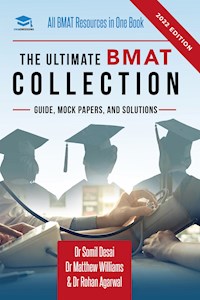
Your complete learning resource for the BMAT This BMAT collection gives you all the resources for the BMAT in one fully comprehensive guidebook. This collections book consists of 5 full books - you get all guides and practice papers in one single volume. This allows you to plan your preparation more thoroughly, whilst benefiting from the convenience and savings of a single preparation book. Start by reading The Ultimate BMAT Guide which gives you all the information about the test, the question styles, question answering strategy and 600 practice questions to hone your skills. Each practice question comes with fully worked solutions, so you can build on your mistakes and improve your scores over time. Then work you way through our comprehensive worked solutions for all current BMAT past papers, including model essays! Finally put all your skills into practice with 8 authentic mock tests. With contributions from specialist BMAT tutors and Published by the UK’s leading University Admissions Company, The Ultimate BMAT Collection is the world’s most comprehensive preparation guide. This book will allow you to approach the test with confidence and gain the best possible score.
Das E-Book können Sie in Legimi-Apps oder einer beliebigen App lesen, die das folgende Format unterstützen:
Veröffentlichungsjahr: 2018
Ähnliche





Copyright © 2018 UniAdmissions. All rights reserved.
ISBN 978-1-912557-25-7
No part of this publication may be reproduced or transmitted in any form or by any means, electronic or mechanical, including photocopying, recording, or by any information retrieval system without prior written permission of the publisher. This publication may not be used in conjunction with or to support any commercial undertaking without the prior written permission of the publisher.
Published by RAR Medical Services [email protected]: 0208 068 0438
This book is neither created nor endorsed by BMAT. The authors and publisher are not affiliated with BMAT. The information offered in this book is purely advisory and any advice given should be taken within this context. As such, the publishers and authors accept no liability whatsoever for the outcome of any applicant’s BMAT performance, the outcome of any university applications or for any other loss. Although every precaution has been taken in the preparation of this book, the publisher and author assume no responsibility for errors or omissions of any kind. Neither is any liability assumed for damages resulting from the use of information contained herein. This does not affect your statutory rights.
About the Authors
Rohan is the Director of Operations at UniAdmissions and is responsible for its technical and commercial arms. He graduated from Gonville and Caius College, Cambridge and is a fully qualified doctor. Over the last five years, he has tutored hundreds of successful Oxbridge and Medical applicants. He has also authored ten books on admissions tests and interviews.
Rohan has taught physiology to undergraduates and interviewed medical school applicants for Cambridge. He has published research on bone physiology and writes education articles for the Independent and Huffington Post. In his spare time, Rohan enjoys playing the piano and table tennis.
Matthew is Medical Resources Editor at UniAdmissions and a 4th year medical student at St Catherine’s College, Oxford. As the first student from Barry Comprehensive School in South Wales to receive a place on the Oxford medicine course he embraced all aspects of university life, both social and academic. Matt Scored in the top 5% for his UKCAT and BMAT to secure his offer at the University of Oxford.
Matthew has worked with UniAdmissions since 2014 – tutoring several applicants successfully into Oxbridge and Russell group universities. His work has been published in international scientific journals and he has presented his research at conferences across the globe. In his spare time, Matt enjoys playing rugby and golf.
How to use this Book
The Ultimate BMAT Guide
General Advice
SECTION 1
SECTION 1: Critical Thinking
Critical Thinking Questions
SECTION 1: Problem Solving Questions
Problem Solving Questions
SECTION 1: Data Analysis
Data Analysis Questions
SECTION 2
SECTION 2: Biology
Biology Questions
SECTION 2: Chemistry
Chemistry Questions
SECTION 2: Physics
Physics Questions
SECTION 2: Maths
Maths Questions
SECTION 3
Annotated Essays
Answer Key
Worked Answers
BMAT Worked Solutions
2003
2004
2005
2006
2007
2008
2009
2010
2011
2012
2013
2014
2015
2016
2017
BMAT Practice Papers
General Advice
Revision Timetable
Getting the most out of Mock Papers
Section 1: An Overview
Section 2: An Overview
Section 2: Revision Checklist
Section 3: An Overview
Scoring Tables
Mock Paper A
Mock Paper B
Mock Paper C
Mock Paper D
Mock Paper E
Mock Paper F
Mock Paper G
Mock Paper H
Answer Key
Mock Paper A Answers
Mock Paper B Answers
Mock Paper C Answers
Mock Paper D Answers
Mock Paper E Answers
Mock Paper F Answers
Mock Paper G Answers
Mock Paper H Answers
Final Advice
Your Free Book
UKCAT Intensive Course
BMAT Intensive Course
Medicine Interview Course
How to use this Book
Congratulations on taking the first step to your BMAT preparation! First used in 2008, the BMAT is a difficult exam and you’ll need to prepare thoroughly in order to make sure you get that dream university place.
The Ultimate BMAT Collection is the most comprehensive BMAT book available – it’s the culmination of five top-selling BMAT books:
The Ultimate BMAT GuideBMAT Past Paper Solutions: Volume 1BMAT Past Paper Solutions: Volume 2BMAT Practice Papers: Volume 1BMAT Practice Papers: Volume 2Whilst it might be tempting to dive straight in with mock papers, this is not a sound strategy. Instead, you should approach the BMAT in the three steps shown below. Firstly, start off by understanding the structure, syllabus and theory behind the test. Once you’re satisfied with this, move onto doing the 600 practice questions found in The Ultimate BMAT Guide (not timed!).
Then, once you feel ready for a challenge, do each past paper under timed conditions. Start with the 2003 paper and work chronologically; check your solutions against the model answers given in BMAT Past Paper Worked Solutions. Finally, once you’ve exhausted these, go through the 8 BMAT Mock Papers found in BMAT Practice Papers – these are a final boost to your preparation.
As you’ve probably realised by now, there are well over 3,000 questions to tackle meaning that this isn’t a test that you can prepare for in a single week. From our experience, the best students will prepare anywhere between four to eight weeks (although there are some notable exceptions!).
Remember that the route to a high score is your approach and practice. Don’t fall into the trap that “you can’t prepare for the BMAT”– this could not be further from the truth. With knowledge of the test, some useful time-saving techniques and plenty of practice you can dramatically boost your score.
Work hard, never give up and do yourself justice. Good luck!
The Ultimate BMAT Guide
The Basics
What is the BMAT?
The BioMedical Admissions Test (BMAT) is a 2-hour written exam for medical and veterinary students who are applying for competitive universities.
What does the BMAT consist of?
Why is the BMAT used?
Medical and veterinary applicants tend to be a bright bunch and therefore usually have excellent grades. For example, in 2013 over 65% of students who applied to Cambridge for Medicine had UMS greater than 90% in all of their A level subjects. This means that competition is fierce – meaning that the universities must use the BMAT to help differentiate between applicants.
When do I sit BMAT?
There are two sittings for the BMAT – the second week of September and first week of November (normally Wednesday morning). You can generally sit the BMAT on either date however, some universities will ask that you sit the test on a specific date e.g. Oxford, Lee Kong Chian and Chulalongkorn University will only accept results from the November BMAT sitting. You’re highly advised to check which date you should sit the BMAT depending on your university choices.
When should I sit the BMAT?
Who has to sit the BMAT?
Applicants to the following universities must sit the BMAT:
Do I have to resit the BMAT if I reapply?
You only need to resit the BMAT if you are applying to a university that requires it. You cannot use your score from any previous attempts.
How is the BMAT Scored?
Section 1 and Section 2 are marked on a scale of 0 to 9. Generally, 5 is an average score, 6 is good, and 7 is excellent. Very few people (<5%) get more than 8.
The marks for sections 1 + 2 show a normal distribution with a large range. The important thing to note is that the difference between a score of 5.0 and 6.5+ is often only 3-4 questions. Thus, you can see that even small improvements in your raw score will lead to massive improvements when they are scaled.
Section 3 is marked on 2 scales: A-E for Quality of English and 0-5 for Strength of Argument
The marks for sections 3 show a normal distribution for the strength of argument; the average mark for the strength of argument is between 3 – 3.5. The quality of English marks are negatively skewed distribution. I.e. the vast majority of students will score A or B for quality of English. The ones that don’t tend to be students who are not fluent in English.
This effectively means that the letter score is used to flag students who have a comparatively weaker grasp of English- i.e. it is a test of competence rather than excellence like the rest of the BMAT. This effectively means that if you get a C or below, admissions tutors are more likely to scrutinise your essay than otherwise.
Finally, section 3 is marked by two different examiners. If there is a large discrepancy between their marks, it is marked by a third examiner.
Can I resit the BMAT?
No, you can only sit the BMAT once per admissions cycle. You can resit the BMAT if you apply for medicine again in the future.
Where do I sit the BMAT?
For the September sitting, you will need to register yourself and sit the test at one of 20 authorised centres. In November, your school will normally register you and you can usually sit the BMAT at your school or college (ask your exams officer for more information). Alternatively, if your school isn’t a registered test centre or you’re not attending a school or college, you can sit the BMAT at an authorised test centre.
When do I get my results?
For the September sitting, you will get your results by the end of September online. You are then responsible for informing the University of your Score. For the November sitting, The BMAT results are usually released to universities in mid-late November and then to students in late November.
How is the BMAT used?
Cambridge: Cambridge interviews more than 90% of students who apply so the BMAT score isn’t vital for making the interview shortlist. However, it can play a huge role in the final decision – for example, 50% of overall marks for your application may be allocated to the BMAT. Thus, it’s essential you find out as much information about the college you’re applying to.
Oxford: Oxford typically receives thousands of applications each year and they use the BMAT to shortlist students for interview. Typically, 450 students are invited for interview for 150 places. Thus, if you get offered an interview- you are doing very well! Oxford centralise their short listing process and use an algorithm that uses your % A*s at GCSE along with your BMAT score to rank all their applicants of which the top are invited to interview. BMAT sections 1 + 2 count for 40% each of your BMAT score whilst section 3 counts for 20% [the strength of argument (number) contributes to 13.3% and the quality of English (letter) makes up the remaining 6.7%].
UCL: UCL make offers based on all components of the application and whilst the BMAT is important there is no magic threshold that you need to meet in order to guarantee an interview. Applicants with higher BMAT scores tend to be interviewed earlier in the year.
Imperial: Imperial employs a BMAT threshold to shortlist for interview. This exact threshold changes every year but in the past has been approximately 4.5-5.0 for sections 1 + 2 and 2.5 B for section 3.
Leeds: The BMAT contributes to 15% of your academic score at Leeds. You will be allocated marks based on your rank in the BMAT. Thus, applicants in the top 20% of the BMAT will get the full quota of marks for their application and the bottom 20% will get the lowest possible mark for their application. Thus, you can still get an interview if you perform poorly in the BMAT (it’ just much harder!). Leeds will calculate your BMAT score by attributing 40% to section 1, 40% to section 2 and 20% to section 3 (lower weighting as it can come up during the interview).
Brighton: Brighton started using the BMAT in 2014 so little is known about how they use it in their decision making process. They state on their website that it “may also be used as a final discriminator if needed after interview.”
Royal Veterinary College: It is unclear how the RVC use the BMAT- it has influenced applications both before and after interview and it’s likely that they use it on a case-by-case basis rather than as an arbitrary cut-off.
SECTION 1
This is the first section of the BMAT and as you walk in, it is inevitable that you will feel nervous. Make sure that you have been to the toilet because once it starts you cannot simply pause and go. Take a few deep breaths and calm yourself down. Remember that panicking will not help and may negatively affect your marks- so try and avoid this as much as possible.
You have one hour to answer 35 questions in section 1. The questions fall into three categories:
Problem solvingData handlingCritical thinkingWhilst this section of the BMAT is renowned for being difficult to prepare for, there are powerful shortcuts and techniques that you can use to save valuable time on these types of questions.
You have approximately 100 seconds per question; this may sound like a lot but given that you’re often required to read and analyse passages or graphs- it can often not be enough. Nevertheless, this section is not as time pressured as section 2 so most students usually finish the majority of questions in time. However, some questions in this section are very tricky and can be a big drain on your limited time. Thepeople who fail to complete section 1 are those who get bogged down on a particular question.
Therefore, it is vital that you start to get a feel for which questions are going to be easy and quick to do and which ones should be left till the end. The best way to do this is through practice and the questions in this book will offer extensive opportunities for you to do so.
Critical Thinking Questions
Question 1-6 are based on the passage below:
People have tried to elucidate the differences between the different genders for many years. Are they societal pressures or genetic differences? In the past it has always been assumed that it was programmed into our DNA to act in a certain more masculine or feminine way but now evidence has emerged that may show it is not our genetics that determines the way we act, but that society pre-programmes us into gender identification. Whilst it is generally acknowledged that not all boys and girls are the same, why is it that most young boys like to play with trucks and diggers whilst young girls prefer dollies and pink?
The society we live in has always been an important factor in our identity, take cultural differences; the language we speak the food we eat, the clothes we wear. All of these factors influence our identity. New research finds that the people around us may prove to be the biggest influence on our gender behaviour. It shows our parents buying gendered toys may have a much bigger influence than the genes they gave us. Girls are being programmed to like the same things as their mothers and this has lasting effects on their personality. Young girls and boys are forced into their gender stereotypes through the clothes they are bought, the hairstyle they wear and the toys they play with.
The power of society to influence gender behaviour explains the cases where children have been born with different external sex organs to those that would match their sex determining chromosomes. Despite the influence of their DNA they identify to the gender they have always been told they are. Once the difference has been detected, how then are they ever to feel comfortable in their own skin? The only way to prevent society having such a large influence on gender identity is to allow children to express themselves, wear what they want and play with what they want without fear of not fitting in.
Question 1:
What is the main conclusion from the first paragraph?
Society controls gender behaviour.People are different based on their gender.DNA programmes how we act.Boys do not like the same things as girls because of their genes.Question 2:
Which of the following, if true, points out the flaw in the first paragraph’s argument?
Not all boys like trucks.Genes control the production of hormones.Differences in gender may be due to an equal combination of society and genes.Some girls like trucks.Question 3:
According to the statement, how can culture affect identity?
Culture can influence what we wear and how we speak.Our parents act the way they do because of culture.Culture affects our genetics.Culture usually relates to where we live.Question 4:
Which of these is most implied by the statement?
Children usually identify with the gender they appear to be.Children are programmed to like the things they do by their DNA.Girls like dollies and pink because their mothers do.It is wrong for boys to have long hair like girls.Question 5:
What does the statement say is the best way to prevent gender stereotyping?
Mothers spending more time with their sons.Parents buying gender-neutral clothes for their children.Allowing children to act how they want.Not telling children if they have different sex organs.Question 6:
What, according to the statement is the biggest problem for children born with different external sex organs to those which match their sex chromosomes?
They may have other problems with their DNA.Society may not accept them for who they are.They may wish to be another gender.They are not the gender they are treated as which can be distressing.Questions 7-11 are based on the passage below:
New evidence has emerged that the most important factor in a child’s development could be their napping routine. It has come to light that regular napping could well be the deciding factor for determining toddlers’ memory and learning abilities. The new countrywide survey of 1000 toddlers, all born in the same year showed around 75% had regular 30-minute naps. Parents cited the benefits of their child having a regular routine (including meal times) such as decreased irritability, and stated the only downfall of occasional problems with sleeping at night. Research indicating that toddlers were 10% more likely to suffer regular night-time sleeping disturbances when they regularly napped supported the parent’s view.
Those who regularly took 30-minute naps were more than twice as likely to remember simple words such as those of new toys than their non-napping counterparts, who also had higher incidences of memory impairment, behavioural problems and learning difficulties. Toddlers who regularly had 30 minute naps were tested on whether they were able recall the names of new objects the following day, compared to a control group who did not regularly nap. These potential links between napping and memory, behaviour and learning ability provides exciting new evidence in the field of child development.
Question 7:
If in 100 toddlers 5% who did not nap were able to remember a new teddy’s name, how many who had napped would be expected to remember?
891012Question 8:
Assuming that the incidence of night-time sleeping disturbances is the same in for all toddlers independent of all characteristics other than napping, what is the percentage of toddlers who suffer regular night-time sleeping disturbances as a result of napping?
7.5%10%14%20%50%Question 9:
Using the information from the passage above, which of the following is the most plausible alternative reason for the link between memory and napping?
Children who have bad memory abilities are also likely to have trouble sleeping.Children who regularly nap, are born with better memories.Children who do not nap were unable to concentrate on the memory testing exercises for the study.Parents who enforce a routine of napping are more likely to conduct memory exercises with their children.Question 10:
Which of the following is most strongly indicated?
B. Families have more enjoyable meal times when their toddlers regularly nap.Toddlers have better routines when they nap.Parents enforce napping to improve their toddlers’ memory ability.Napping is important for parents’ routines.Question 11:
Which of the following, if true, would strengthen the conclusion that there is a causal link between regular napping and improved memory in toddlers?
Improved memory is also associated with regular mealtimes.Parents who enforce regular napping are more inclined to include their children in studies.Toddlers’ memory development is so rapid that even a few weeks can make a difference to performance.Among toddler playgroups where napping incidence is higher and more consistent memory performance is significantly improved compared to those that do not.Question 12:
Tom’s father says to him: ‘You must work for your A-levels. That is the best way to do well in your A-level exams. If you work especially hard for Geography, you will definitely succeed in your Geography A-level exam’.
Which of the following is the best statement Tom could say to prove a flaw in his father’s argument?
‘It takes me longer to study for my History exam, so I should prioritise that.’‘I do not have to work hard to do well in my Geography A-level.’‘Just because I work hard, does not mean I will do well in my A-levels.’‘You are putting too much importance on studying for A-levels.’‘You haven’t accounted for the fact that Geography is harder than my other subjects.’Question 13:
Today the NHS is increasingly struggling to be financially viable. In the future, the NHS may have to reduce the services it cannot afford. The NHS is supported by government funds, which come from those who pay tax in the UK. Recently the NHS has been criticised for allowing fertility treatments to be free, as many people believe these are not important and should not be paid for when there is not enough money to pay the doctors and nurses.
Which of the following is the most accurate conclusion of the statement above?
Only taxpayers should decide where the NHS spends its money.Doctors and nurses should be better paid.The NHS should stop free fertility treatments.Fertility treatments may have to be cut if finances do not improve.Question 14:
‘We should allow people to drive as fast as they want. By allowing drivers to drive at fast speeds, through natural selection the most dangerous drivers will kill only themselves in car accidents. These people will not have children, hence only safe people will reproduce and eventually the population will only consist of safe drivers.’
Which one of the following, if true, most weakens the above argument?
Dangerous drivers harm others more often than themselves by driving too fast.Dangerous drivers may produce children who are safe drivers.The process of natural selection takes a long time.Some drivers break speed limits anyway.Question 15:
In the winter of 2014 the UK suffered record levels of rainfall, which led to catastrophic damage across the country. Thousands of homes were damaged and even destroyed, leaving many homeless in the chaos that followed. The Government faced harsh criticism that they had failed to adequately prepare the country for the extreme weather. In such cases the Government assess the likelihood of such events happening in the future and balance against the cost of advance measures to reduce the impact should they occur versus the cost of the event with no preparative defences in place. Until recently, for example, the risk of acts of terror taking was low compared with the vast cost anticipated should they occur. However, the risk of flooding is usually low, so it could be argued that the costs associated with anti-flooding measures would have been pre-emptively unreasonable. Should the Government be expected to prepare for every conceivable threat that could come to pass? Are we to put in place expensive measures against a seismic event as well as a possible extra-terrestrial invasion?
Which of the following best expresses the main conclusion of the statement above?
The Government has an obligation to assess risks and costs of possible future events.The Government should spend money to protect against potential extra-terrestrial invasions and seismic events.The Government should have spent money to protect against potential floods.The Government was justified in not spending heavily to protect against flooding.The Government should assist people who lost their homes in the floods.Question 16:
Sadly the way in which children interact with each other has changed over the years. Where once children used to play sports and games together in the street, they now sit alone in their rooms on the computer playing games on the Internet. Where in the past young children learned human interaction from active games with their friends this is no longer the case. How then, when these children are grown up, will they be able to socially interact with their colleagues?
Which one of the following is the conclusion of the above statement?
Children who play computer games now interact less outside of them.The Internet can be a tool for teaching social skills.Computer games are for social development.Children should be made to play outside with their friends to develop their social skills for later in life.Adults will in the future play computer games as a means of interaction.Question 17:
Between 2006 and 2013 the British government spent £473 million on Tamiflu antiviral drugs in preparation for a flu pandemic, despite there being little evidence to support the effectiveness of the drug. The antivirals were stockpiled for a flu pandemic that never fully materialised. Only 150,000 packs were used during the swine flu episode in 2009, and it is unclear if this improved outcomes. Therefore this money could have been much better spent on drugs that would actually benefit patients.
Which option best summarises the author’s view in the passage?
Drugs should never be stockpiled, as they may not be used.Spending millions of pounds on drugs should be justified by strong evidence showing positive effects.We should not prepare for flu pandemics in the future.The recipients of Tamiflu in the swine flu pandemic had no difference in symptoms or outcomes to patients who did not receive the antivirals.Question 18:
High BMI and particularly central weight are risk factors associated with increased morbidity and mortality. Many believe the development of cheap, easily accessible fast-food outlets is partly responsible for the increase in rates of obesity. An unhealthy weight is commonly associated with a generally unhealthy lifestyle, such a lack of exercise. The best way to tackle the growing problem of obesity is for the government to tax unhealthy foods so they are no longer a cheap alternative.
Why is the solution given, to tax unhealthy foods, not a logical conclusion from the passage?
Unhealthy eating is not exclusively confined to low-income families.A more general approach to unhealthy lifestyles would be optimal.People do not only choose to eat unhealthy food because it is cheaper.People need to take personal responsibility for their own health.Question 19:
As people are living longer, care in old age is becoming a larger burden. Many people require carers to come into their home numerous times a day or need full residential care. It is not right that the NHS should be spending vast funds on the care of people who are sufficiently wealthy to fund their own care. Some argue that they want their savings kept to give to their children; however this is not a right, simply a luxury. It is not right that people should be saving and depriving themselves of necessary care, or worse, making the NHS pay the bill, so they have money to pass on to their offspring. People need to realise that there is a financial cost to living longer.
Which of the following statements is the main conclusion of the above passage?
We need to take a personal responsibility for our care in old age.Caring for the elderly is a significant burden on the NHS.The reason people are reluctant to pay for their own care is that they want to pass money onto their offspring.The NHS should limit care to the elderly to reduce their costs.People shouldn’t save their money for old age.Question 20:
There is much interest in research surrounding production of human stem cells from non-embryo sources for potential regenerative medicine, and a huge financial and personal gain at stake. In January 2014, a team from Japan published two papers in Nature that claimed to have developed totipotent stem cells from adult mouse cells by exposure to an acidic environment. However, there has since been much controversy surrounding these papers. Problems included: inability by other teams to replicate the results of the experiment, an insufficient protocol described in the paper and issues with images in one of the papers. It was dishonest of the researchers to publish the papers with such problems, and a requirement of a paper is a sufficiently detailed protocol, so that another group could replicate the experiment.
Which statement is most implied?
Research is fuelled mainly by financial and personal gains.The researchers should take responsibility for publishing the paper with such flaws.Rivalry between different research groups makes premature publishing more likely.The discrepancies were in only one of the papers published in January 2014.Question 21:
The placebo effect is a well-documented medical phenomenon in which a patient’s condition undergoes improvement after being given an ineffectual treatment that they believe to be a genuine treatment. It is frequently used as a control during trials of new drugs/procedures, with the effect of the drug being compared to the effect of a placebo, and if the drug does not have a greater effect than the placebo, then it is classed as ineffective. However, this analysis discounts the fact that the drug treatment still has more of a positive effect than no action, and so we are clearly missing out on the potential to improve certain patient conditions. It follows that where there is a demonstrated placebo effect, but treatments are ineffective, we should still give treatments, as there will therefore be some benefit to the patient.
Which of the following best expresses the main conclusion of this passage?
In situations where drugs are no more effective than a placebo, we should still give drugs, as they will be more effective than not taking action.Our current analysis discounts the fact that even if drug treatments have no more effect than a placebo, they may still be more effective than no action.The placebo effect is a well-recognised medical phenomenon.Drug treatments may have negative side effects that outweigh their benefit to patients.Placebos are better than modern drugs.Question 22:
The speed limit on motorways and dual carriageways has been 70mph since 1965, but this is an out-dated policy and needs to change. Since 1965, car brakes have become much more effective, and many safety features have been introduced into cars, such as seatbelts (which are now compulsory to wear), crumple zones and airbags. Therefore, it is clear that cars no longer need to be restricted to 70mph, and the speed limit can be safely increased to 80mph without causing more road fatalities.
Which of the following best illustrates an assumption in this passage?
The government should increase the speed limit to 80mph.If the speed limit were increased to 80mph, drivers would not begin to drive at 90mph.The safety systems introduced reduce the chances of fatal road accidents for cars travelling at higher speeds.The roads have not become busier since the 70mph speed limit was introduced.The public want the speed limit to increase.Question 23:
Despite the overwhelming scientific proof of the theory of evolution, and even acceptance of the theory by many high-ranking religious ministers, there are still sections of many major religions that do not accept evolution as true. One of the most prominent of these in western society is the Intelligent Design movement, which promotes the religious-based (and scientifically discredited) notion of Intelligent Design as a scientific theory. Intelligent Design proponents often point to complex issues of biology as proof that god is behind the design of human beings, much as a watchmaker is inherent in the design of a watch.
One part of anatomy that has been identified as supposedly supporting Intelligent Design is fingerprints, with some proponents arguing that they are a mark of individualism created by God, with no apparent function except to identify each human being as unique. This is incorrect, as fingerprints do have a well documented function – namely channelling away of water to improve grip in wet conditions – in which hairless, smooth skinned hands otherwise struggle to grip smooth objects. The individualism of fingerprints is accounted for by the complexity of thousands of small grooves. Development is inherently affected by stochastic or random processes, meaning that the body is unable to uniformly control its development to ensure that fingerprints are the same in each human being. Clearly, the presence of individual fingerprints does nothing to support the so-called-theory of Intelligent Design.
Which of the following best illustrates the main conclusion of this passage?
Fingerprints have a well-established function.Evolution is supported by overwhelming scientific proof.Fingerprints do not offer any support to the notion of Intelligent Design.The individual nature of fingerprints is explained by stochastic processes inherent in development that the body cannot uniformly control.Intelligent design is a credible and scientifically rigorous theory.Question 24:
High levels of alcohol consumption are proven to increase the risk of many non-infectious diseases, such as cancer, atherosclerosis and liver failure. James is a PhD student, and is analysing the data from a large-scale study of over 500,000 people to further investigate the link between heavy alcohol consumption and health problems. In the study, participants were asked about their alcohol consumption, and then their medical history was recorded. His analysis displays surprising results, concluding that those with high alcohol consumption have a decreased risk of cancer. James decides that those carrying out the study must have incorrectly recorded the data.
Which of the following is NOT a potential reason why the study has produced these surprising results?
Previous studies were incorrect, and high alcohol consumption does lower the risk of cancer.The studies didn’t take account of other cancer risk factors in comparing those with high and low alcohol consumption.James has made some errors in his analysis, and thus his conclusions are erroneous.The participants involved in the study did not truthfully report their alcohol consumption, leading to false conclusions being drawn.The studies control group data was mixed up with the test group data.Question 25:
A train is scheduled to depart from Newcastle at 3:30pm. It stops at Durham, Darlington, York, Sheffield, Peterborough and Stevenage before arriving at Kings Cross station in London, where the train completes its journey. The total length of the journey between Newcastle and Kings Cross was 230 miles, and the average speed of the train during the journey (including time spent stood still at calling stations) is 115mph. Therefore, the train will complete its journey at 5:30pm.
Which of the following is an assumption made in this passage?
The various stopping points did not increase the time taken to complete the journey.The train left Newcastle on time.The train travelled by the most direct route available.The train was due to end its journey at Kings Cross.There were no signalling problems encountered on the journey.Question 26:
There have been many arguments over the last couple of decades about government expenditure on healthcare in the various devolved regions of the UK. It is often argued that, since spending on healthcare per person is higher in Scotland than in England, that therefore the people in Scotland will be healthier. However, this view fails to take account of the different needs of these 2 populations of the UK. For example, one major factor is that Scotland gets significantly colder than England, and cold weakens the immune system, leaving people in Scotland at much higher risk of infectious disease. Thus, Scotland requires higher levels of healthcare spending per person simply to maintain the health of the populace at a similar level to that of England.
Which of the following is a conclusion that can be drawn from this passage?
The higher healthcare spending per person in Scotland does not necessarily mean people living in Scotland are healthier.Healthcare spending should be increased across the UK.Wales requires more healthcare spending per person simply to maintain population health at a similar level to England.It is unfair on England that there is more spending on healthcare per person in Scotland.Scotland’s healthcare budget is a controversial topic.Question 27:
Vaccinations have been hugely successful in reducing the incidence of several diseases throughout the 20th century. One of the most spectacular achievements was arguably the global eradication of Smallpox, once a deadly worldwide killer, during the 1970s. Fortunately, there was a highly effective vaccine available for Smallpox, and a major factor in its eradication was an aggressive vaccination campaign. Another disease that is potentially eradicable is Polio. However, although there is a highly effective vaccine for Polio available, attempts to eradicate it have so far been unsuccessful. It follows that we should plan and execute an aggressive vaccination campaign for Polio, in order to ensure that this disease too is eradicated.
Which of the following is the main conclusion of this passage?
Polio is a potentially eradicable disease.An aggressive vaccination campaign was a major factor in the eradication of smallpox.Both Polio and smallpox have been eradicated by effective vaccination campaigns.We should execute an aggressive vaccination campaign for Polio.The eradication of smallpox remains one of the most spectacular achievements of medical science.Question 28:
The Y chromosome is one of 2 sex chromosomes found in the human genome, the other being the X chromosome. As the Y chromosome is only found in males, it can only be passed from father to son. Additionally, the Y chromosome does not exchange sections with other chromosomes (as happens with most chromosomes), meaning it is passed on virtually unchanged through the generations. All of this makes the Y chromosome a fantastic tool for genetic analysis, both to identify individual lineages and to investigate historic population movements. One famous achievement of genetic research using the Y chromosome provides further evidence of its utility, namely the identification of Genghis Khan as a descendant of up to 8% of males in 16 populations across Asia.
Which of the following best illustrates the main conclusion of this passage?
The Y chromosome is a fantastic tool for genetic analysis.Research using the Y chromosome has been able to identify Genghis Khan as the descendant of up to 8% of men in many Asian populations.The Y chromosome does not exchange sections with other chromosomes.The Y chromosome is a sex chromosome.Genghis Khan had a staggering number of children.Question 29:
In order for a bacterial infection to be cleared, a patient must be treated with antibiotics. Rachel has a minor lung infection, which is thought by her doctor to be a bacterial infection. She is treated with antibiotics, but her condition does not improve. Therefore, it must not be a bacterial infection.
Which of the following best illustrates a flaw in this reasoning?
It assumes that a bacterial infection would definitely improve after treatment with antibiotics.It ignores the other potential issues that could be treated by antibiotics.It assumes that antibiotics are necessary to treat bacterial infections.It ignores the actions of the immune system, which may be sufficient to clear the infection regardless of what has caused it.It assumes that antibiotics are the only option to treat a bacterial infection.Question 30:




