


0,99 €
Mehr erfahren.
- Herausgeber: David Turner
- Kategorie: Religion und Spiritualität
- Sprache: Englisch
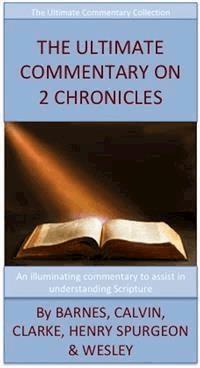
We are to read the Bible in order to understand God’s message to us. He speaks to us in plain language but there are times we need a helping hand in what we read. Commentaries are not just for preachers or seminary students. They are for us all. The Ultimate Commentary Collection is designed to bring you a variety of thoughts and insights from theologians of high renown and reputation. Their study of the Bible is of great help to us. We are presenting to you the studies and thoughts of 6 of the Church’s greatest minds: Albert Barnes – John Calvin – Adam Clarke – Matthew Henry – Charles H. Spurgeon – John Wesley. Their commentaries will help you understand, enjoy and apply what God’s word says to you. In addition to these commentaries you will also find all of Spurgeon’s sermons on this particular book of the Bible. This volume is the ULTIMATE COMMENTARY ON 2 CHRONICLES.
Das E-Book können Sie in Legimi-Apps oder einer beliebigen App lesen, die das folgende Format unterstützen:
Veröffentlichungsjahr: 2018
Ähnliche

















CHAPTER ONE
2 Chronicles
2 Chronicles Contents
2 CHRONICLES CONTENTS
Chapter Two - Albert Barnes
Chapter Three - Adam Clarke
Chapter Four - Matthew Henry
Chapter Five - Charles H. Spurgeon
Chapter Six - Sermons Of Spurgeon
Chapter Seven - John Wesley
2 Chronicles Contents
Bible Study Guide
Other Publications
Main Contents
CHAPTER TWO
Albert Barnes
2 Chronicles Contents
2 CHRONICLES CONTENTS
2 Chronicles Introduction
2 Chronicles Chapter 1
2 Chronicles Chapter 2
2 Chronicles Chapter 3
2 Chronicles Chapter 4
2 Chronicles Chapter 5
2 Chronicles Chapter 6
2 Chronicles Chapter 7
2 Chronicles Chapter 8
2 Chronicles Chapter 9
2 Chronicles Chapter 10
2 Chronicles Chapter 11
2 Chronicles Chapter 12
2 Chronicles Chapter 13
2 Chronicles Chapter 14
2 Chronicles Chapter 15
2 Chronicles Chapter 16
2 Chronicles Chapter 17
2 Chronicles Chapter 18
2 Chronicles Chapter 19
2 Chronicles Chapter 20
2 Chronicles Chapter 21
2 Chronicles Chapter 22
2 Chronicles Chapter 23
2 Chronicles Chapter 24
2 Chronicles Chapter 25
2 Chronicles Chapter 26
2 Chronicles Chapter 27
2 Chronicles Chapter 28
2 Chronicles Chapter 29
2 Chronicles Chapter 30
2 Chronicles Chapter 31
2 Chronicles Chapter 32
2 Chronicles Chapter 33
2 Chronicles Chapter 34
2 Chronicles Chapter 35
2 Chronicles Chapter 36
2 Chronicles Contents
Bible Study Guide
Other Publications
Main Contents
2 Chronicles Introduction
2 CHRONICLES INTRODUCTION
Introduction to 1 and 2Chronicles
1. Like the two Books of King, the two Books of Chronicles formed originally a single work, the separation of which into two “books” is referable to the Septuagint translators, whose division was adopted by Jerome, and from whom it passed to the various branches of the Western Church. In the Hebrew Bibles the title of the work means literally “the daily acts” or “occurrences,” a title originally applied to the accounts of the reigns of the several kings, but afterward applied to general works made up from these particular narratives.
The Septuagint translators substituted one which they regarded as more suitable to the contents of the work and the position that it occupies among the historical books of the Bible. This was Paraleipomena, or “the things omitted “ - a name intended to imply that Chronicles was supplementary to Samuel and Kings, written, i. e., mainly for the purpose of supplying the omissions of the earlier history.
The English title, “Chronicles,” (derived from the Vulgate) is a term primarily significative of time; but in practical use it designates a simple and primitive style of history rather than one in which the chronological element is peculiarly prominent.
2. The “Book of Chronicles” stands in a position unlike that occupied by any other book of the Old Testament. It is historical, yet not new history. The writer traverses ground that has been already trodden by others.
His purpose in so doing is sufficiently indicated by the practical object he had in view, namely, that of meeting the special difficulties of his own day. The people had lately returned from the captivity and had rebuilt the temple; but they had not yet gathered up the threads of the old national life, broken by the captivity. They were therefore reminded, in the first place, of their entire history, of the whole past course of mundane events, and of the position which they themselves held among the nations of the earth. This was done, curtly and drily, but sufficiently, by genealogies, which have always possessed a special attraction for Orientals. They were then more especially reminded of their own past as an organized nation - a settled people with a religion which has a fixed home in the center of the nation‘s life.
It was the strong conviction of the writer that the whole future prosperity of his countrymen was bound up with the preservation of the temple service, with the proper maintenance of the priests and Levites, the regular establishment of the “courses,” and the rightful distribution of the several ministrations of the temple among the Levitical families. He therefore drew the attention of his countrymen to the past history of the temple, under David, Solomon, and the later kings of Judah; pointing out that in almost every instance temporal rewards and punishments followed in exact accordance with the attitude in which the king placed himself toward the national religion. Such a picture of the past, a sort of condensed view of the entire previous history, written in the idiom of the day, with frequent allusions to recent events, and with constant reiteration of the moral intended to be taught, was calculated to affect the newly returned and still unsettled people far more strongly and deeply than the old narratives. The Book of Chronicles bridged over, so to speak, the gulf which separated the nation after, from the nation before, the captivity: it must have helped greatly to restore the national life, to revive hope and encourage high aspirations by showing to the nation that its fate was in its own hands, and that religious faithfulness would be certain to secure the divine blessing.
3. That the Book of Chronicles was composed after the return from the captivity is evident, not only from its closing passage, but from other portions of it.
The evidence of style accords with the evidence furnished by the contents. The phraseology is similar to that of Ezra, Nehemiah, and Esther, all books written after the exile. It has numerous Aramaean forms and at least one word derived from the Persian. The date cannot therefore well be earlier than 538 B.C., but may be very considerably later. The very close connection of style between Chronicles and Ezra, makes it probable that they were composed at the same time, if not even by the same person. If Ezra was the author, as so many think, the date could not well be much later than 435 B.C., for Ezra probably died about that time. There is nothing in the contents or style of the work to make the date 450-435 B.C. improbable; for the genealogy in 1 Chronicles 3:23-24, which appears to be later than this, may be a subsequent addition.
4. The writer of Chronicles cites, as his authorities, works of two distinct classes:
(a) His most frequent reference is to a general history - the “Book of the Kings of Israel and Judah,” This was a compilation from the two histories constantly mentioned in Kings - the “book of the chronicles of the kings of Israel,” and the “book of the chronicles of the kings of Judah,” which it had been found convenient to unite into one.
(b) The other works cited by him were 12-part or 13-part histories, the works of prophets who dealt with particular portions of the national annals. Of none of these works is the exact character known to us; but the manner in which they are cited makes it probable that for the most part they treated with some fullness the history - especially the religious history - of the times of their authors. They may be regarded as independent compositions - monographs upon the events of their times, written by individual prophets, of which occasionally one was transferred, not into our “Books of Kings,” but into the “book of the kings of Israel and Judah;” while the remainder existed for some centuries side by side with the “Book of the Kings,” and furnished to the writer of Chronicles much of the special information which he conveys to us.
There is also ample proof that the writer made use of the whole of the earlier historical Scriptures, and especially of the Books of Samuel and Kings, such as we have them. The main sources of 1 Chronicles 18, are the earlier Scriptures from Genesis to Ruth, supplemented by statements drawn from private sources, such as the genealogies of families, and numerous important points of family history, carefully preserved by the “chiefs of the fathers” in almost all the Israelite tribes; a main source of 1 Chronicles 1027 is Samuel; and a source, though scarcely a main source, of 2 Chronicles 136 is Kings (compare the marginal references and notes). But the writer has always some further authority besides these; and there is no section of the Jewish history, from the death of Saul to the fall of Jerusalem, which he has not illustrated with new facts, drawn from some source which has perished.
5. The indications of unity in the authorship preponderate over those of diversity, and lead to the conclusion that the entire work is from one and the same writer. The genealogical tendency, which shows itself so strongly in the introductory section 1 Chronicles 19, is remarkably characteristic of the writer, and continually thrusts itself into notice in the more purely historical portions of his narrative. Conversely, the mere genealogical portion of the work is penetrated by the same spirit as animates the historical chapters, and, moreover, abounds with phrases, characteristic of the writer.
That the historical narrative (1Chr. 102 Chronicles 36) is from one hand, can scarcely be doubted. One pointedly didactic tone pervades the whole - each signal calamity and success being ascribed in the most direct manner to the action of Divine Providence, rewarding the righteous and punishing the evil-doers. There is everywhere the same method of composition - a primary use of Samuel and Kings as bases of the narrative, the abbreviation of what has been narrated before, the omission of important facts, otherwise known to the reader; and the addition of new facts, sometimes minute, and less important than curious, at other times so striking that it is surprising that the earlier historians should have passed them over.
6. The abrupt termination of Chronicles, in the middle of a sentence, is an unanswerable argument against its having come down to us in the form in which it was originally written.
And the recurrence of the final passage of our present copies of Chronicles at the commencement of Ezra, taken in conjunction with the undoubted fact, that there is a very close resemblance of style and tone between the two books, suggests naturally the explanation, which has been accepted by some of the best critics, that the two works, Chronicles and Ezra, were originally one, and were afterwards separated: that separation having probably arisen out of a desire to arrange the history of the post-captivity period in chronological sequence.
7. The condition of the text of Chronicles is far from satisfactory. Various readings are frequent, particularly in the names of persons and places; omissions are found, especially in the genealogies; and the numbers are sometimes self-contradictory, sometimes contradictory of more probable numbers in Samuel or Kings, sometimes unreasonably large, and therefore justly suspected.
The work is, however, free from defects of a more serious character. The unity is unbroken, and there is every reason to believe that we have the work, in almost all respects, exactly as it came from the hand of the author.
8. As compared with the parallel histories of Samuel and Kings, the history of Chronicles is characterized by three principal features:
(a) A greater tendency to dwell on the externals of religion, on the details of the temple worship, the various functions of the priests and Levites, the arrangement of the courses, and the like. Hence, the history of Chronicles has been called “ecclesiastical,” while that of Samuel and Kings has been termed “political.” This tendency does not detract from the credibility, or render the history undeserving of confidence.
(b) A marked genealogical bias and desire to put on record the names of persons engaged in any of the events narrated; and
(c) A more constant, open, and direct ascription of all the events of the history to the divine agency, and especially a more plain reference of every great calamity or deliverance to the good or evil deeds of the monarch, or the nation, which Divine Providence so punished or rewarded.
There is no reason to regard Chronicles as less trustworthy than Samuel or Kings. A due consideration of disputed points, the “Levitical spirit,” contradictions, alleged mistakes, etc., does not, speaking generally, impugn the honesty of the writer or the authenticity of his work. The book may fairly be regarded as authentic in all its parts, with the exception of some of its members. These appear to have occasionally suffered corruption, though scarcely to a greater extent than those of other books of equal antiquity. From blemishes of this kind it has not pleased God to keep His Word free. It will scarcely be maintained at the present day that their occurrence affects in the very slightest degree the authenticity of the rest of the narrative.
The style of Chronicles is simpler and less elevated than that of Kings. Excepting the psalm of David in 1 Chronicles 16 and the prayer of Solomon in 2 Chronicles 6, the whole is prosaic, level, and uniform. There are no especially striking chapters, as in Kings; but it is less gloomy, being addressed to the restored nation, which it seeks to animate and inspirit. The captive people, weeping by the waters of Babylon, fitly read their mournful history in Kings: the liberated nation, entering hopefully upon a new life, found in Chronicles a review of its past, calculated to help it forward on the path of progress, upon which it was entering.
ALBERT BARNES COMMENTARY CONTENTS
2 Chronicles Chapter 1
CHAPTER 1
Verses 2-6
The narrative here corresponds with 1 Kings 3:4; but is very much fuller. We learn from the present passage:
(1) that Solomon‘s sacrifice at Gibeon was a great public festivity, to which he collected vast numbers of the people;
(2) that it was made upon the brass altar of Bezaleel, which
(3) stood before the tabernacle; and
(4) that Solomon‘s vision was on the night of his sacrifice. Consult the marginal references
2 Chronicles 1:5
Sought unto it - i. e., “frequented it” - “were in the habit of making use of it.”
Verses 7-12
The verbal differences between this passage and the corresponding one of Kings 1 Kings 3:5-14 are very considerable, and indicate the general truth that the object of the sacred historians is to give a true account of the real bearing of what was said: not ordinarily to furnish us with all or the exact words that were uttered. The most important point omitted in Chronicles, and supplied by Kings, is the conditional promise of long life made to Solomon 1 Kings 3:14; while the chief point absent from Kings, and recorded by our author, is the solemn appeal made by Solomon to the promise of God to David his father 2 Chronicles 1:9, which he now called upon God to “establish,” or to perform.
2 Chronicles 1:12
I will give thee riches, and wealth, and honor - Remark that the writer says nothing of any promise to Solomon of “long life,” which, however, had been mentioned in 2 Chronicles 1:11 among the blessings which he might have been expected to ask. The reason for the omission would seem to lie in the writer‘s desire to record only what is good of this great king. Long life was included in the promises made to him; but it was granted conditionally; and Solomon not fulfilling the conditions, it did not take effect (1 Kings 3:14 note).
Verse 13
From his journey - These words are not in the original text, which is thought to be corrupt. It is best to correct the text, and then simply to translate: “And Solomon came from the high place that was at Gibeon to Jerusalem.”
Verses 14-17
This passage is very nearly identical with 1 Kings 10:26-29.
ALBERT BARNES COMMENTARY CONTENTS
2 Chronicles Chapter 2
CHAPTER 2
Verse 3
Huram, the form used throughout Chronicles (except 1 Chronicles 14:1) for the name both of the king and of the artisan whom he lent to Solomon 2 Chronicles 2:13; 2 Chronicles 4:11, 2 Chronicles 4:16, is a late corruption of the true native word, Hiram (marginal note and reference).
Verse 4
The symbolic meaning of “burning incense” is indicated in Revelation 8:3-4. Consult the marginal references to this verse.
The solemn feasts - The three great annnual festivals, the Passover, the Feast of Weeks (Pentecost), and the Feast of tabernacles Leviticus 23:4-44; Deuteronomy 16:1-17.
Verse 5
See 1 Kings 6:2 note. In Jewish eyes, at the time that the temple was built, it may have been “great,” that is to say, it may have exceeded the dimensions of any single separate building existing in Palestine up to the time of its erection.
Great is our God … - This may seem inappropriate as addressed to a pagan king. But it appears 2 Chronicles 2:11-12 that Hiram acknowledged Yahweh as the supreme deity, probably identifying Him with his own Melkarth.
Verse 6
Save only to burn sacrifice before him - Solomon seems to mean that to build the temple can only be justified on the human - not on the divine - side. “God dwelleth not in temples made with hands;” He cannot be confined to them; He does in no sort need them. The sole reason for building a temple lies in the needs of man: his worship must he local; the sacrifices commanded in the Law had of necessity to be offered somewhere.
Verse 7
See 1 Kings 5:6, note; 1 Kings 7:13, note.
Purple … - “Purple, crimson, and blue,” would be needed for the hangings of the temple, which, in this respect, as in others, was conformed to the pattern of the tabernacle (see Exodus 25:4; Exodus 26:1, etc.). Hiram‘s power of “working in purple, crimson,” etc., was probably a knowledge of the best modes of dyeing cloth these colors. The Phoenicians, off whose coast the murex was commonly taken, were famous as purple dyers from a very remote period.
Crimson - כרמילkarmı̂̂yl the word here and elsewhere translated “crimson,” is unique to Chronicles and probably of Persian origin. The famous red dye of Persia and India, the dye known to the Greeks as κόκκοςkokkos and to the Romans as coccum, is obtained from an insect. Whether the “scarlet” שׁניshânı̂y of Exodus (Exodus 25:4, etc.) is the same or a different red, cannot be certainly determined.
Verse 10
Beaten wheat - The Hebrew text is probably corrupt here. The true original may be restored from marginal reference, where the wheat is said to have been given “for food.”
The barley and the wine are omitted in Kings. The author of Chronicles probably filled out the statement which the writer of Kings has given in brief; the barley, wine, and ordinary oil, would be applied to the sustenance of the foreign laborers.
Verse 11
Josephus and others professed to give Greek versions of the correspondence, which (they said) had taken place between Hiram and Solomon. No value attaches to those letters, which are evidently forgeries.
Because the Lord hath loved his people - Compare the marginal references. The neighboring sovereigns, in their communications with the Jewish monarchs, seem to have adopted the Jewish name for the Supreme Being (Yahweh), either identifying Him (as did Hiram) with their own chief god or (sometimes) meaning merely to acknowledge Him as the special God of the Jewish nation and country.
Verse 12
The Lord … that made heaven and earth - This appears to have been a formula designating the Supreme God with several of the Asiatic nations. In the Persian inscriptions Ormazd is constantly called “the great god, who gave” (or made) “heaven and earth.”
Verse 13
Of Huram my father‘s - A wrong translation. Huram here is the workman sent by the king of Tyre and not the king of Tyre‘s father (see 1 Kings 5:1 note). The words in the original are Huram Abi, and the latter word is now commonly thought to be either a proper name or an epithet of honor, e. g., my master-workman.
Verse 14
To find out every device - Compare Exodus 31:4. The “devices” intended are plans or designs connected with art, which Huram could invent on any subject that was “put to him.”
Verse 17
The strangers are the non-Israelite population of the holy land, the descendants (chiefly) of those Canaanites whom the children of Israel did not drive out. The reimposition of the bond-service imposed on the Canaanites at the time of the conquest Judges 1:28, Judges 1:30, Judges 1:33, Judges 1:35, but discontinued in the period of depression between Joshua and Saul, was (it is clear) due to David, whom Solomon merely imitated in the arrangements described in these verses.
Verse 18
On the numbers, see the 1 Kings 5:16 note.
To set the people a work - Or, “to set the people to work” - i. e., to compel them to labor. Probably, like the Egyptian and Assyrian overseers of forced labor, these officers carried whips or sticks, with which they quickened the movements of the sluggish.
ALBERT BARNES COMMENTARY CONTENTS
2 Chronicles Chapter 3
CHAPTER 3
Verse 1
Where the Lord appeared unto David - The marginal rendering, or “which was shown to David,” is preferred by some; and the expression is understood to point out to David the proper site for the temple by the appearance of the Angels and the command to build an altar 2 Samuel 24:17-25; 1 Chronicles 21:16-26.
In the place that David had prepared - This seems to be the true meaning of the passage, though the order of the words in the original has been accidentally deranged.
Verse 3
The marginal “founded” gives a clue to another meaning of this passage, which may be translated: “Now this is the ground-plan of Solomon for the building, etc.”
Cubits after the first measure - i. e., cubits according to the ancient standard. The Jews, it is probable, adopted the Babylonian measures during the captivity, and carried them back into their own country. The writer notes that the cubit of which he here speaks is the old (Mosaic) cubit.
Verse 4
The height was an hundred and twenty cubits - This height, which so much exceeds that of the main building 1 Kings 6:2, is probably to be corrected by the reading of the Arabic Version and the Alexandrian Septuagint, “twenty cubits.” But see 2 Chronicles 3:9.
Verse 5
The greater house - i. e., the holy place, or main chamber of the temple, intervening between the porch and the holy of holies (so in 2 Chronicles 3:7).
He cieled with fir tree - Rather, “he covered,” or “lined.” The reference is not to the ceiling, which was entirely of wood, but to the walls and floor, which were of stone, with a covering of planks (marginal reference). The word translated “fir” bears probably in this place, not the narrow meaning which it has in 2 Chronicles 2:8, where it is opposed to cedar, but a wider one, in which cedar is included.
Palm trees and chains - See 1 Kings 6:29. The “chains” are supposed to be garlands or festoons.
Verse 6
Precious stones for beauty - Not marbles but gems (compare 1 Chronicles 29:2). The phrase translated “for beauty” means “for its beautification,” “to beautify it.”
Parvaim is probably the name of a place, but what is quite uncertain.
Verse 8
The most holy house - i. e., the sanctuary, or holy of holies. On the probable value of the gold, see 1 Kings 10:14 note.
Verse 9
The upper chambers - Compare 1 Chronicles 28:11. Their position is uncertain. Some place them above the holy of holies, which was ten cubits, or fifteen feet lower than the main building (compare 1 Kings 6:2, 1 Kings 6:20); others, accepting the height of the porch 120 cubits 2 Chronicles 3:4, regard the “upper chambers” or “chamber” ὑπερῷονhuperōon Septuagint), as having been a lofty building erected over the entrance to the temple; others suggest that the chambers intended are simply the uppermost of the three sets of chambers which on three sides surrounded the temple (see 1 Kings 6:5-10). This would seem to be the simplest and best explanation, though we cannot see any reason for the rich ornamentation of these apartments, or for David‘s special directions concerning them.
Verse 10
The word translated “image work,” or, in the margin, “moveable work,” occurs only in this passage, and has not even a Hebrew derivation. Modern Hebraists find an Arabic derivation, and explain the word to mean “carved work.”
Verse 11-12
The wings of the cherubims - Compare 1 Kings 6:24-27.
Verse 13
Their faces were inward - literally, as in the margin. Instead of looking toward one another, with heads bent downward over the mercy Seat, like the cherubim of Moses Exodus 37:9, these of Solomon looked out from the sanctuary into the great chamber (“the house”). The cherubim thus stood upright on either side of the ark, like two sentinels guarding it.
Verse 14
This is an important addition to the description in Kings, where the veil is not mentioned. It was made of exactly the same colors as the veil of the tabernacle Exodus 26:31.
Verse 15
Of thirty and five cubits - See 1 Kings 7:15 note. Some suppose that there has been a corruption of the number in the present passage.
Verse 16
As in the oracle - This passage is probably corrupt. Our translators supposing that a single letter had fallen out at the beginning of the word translated “in the oracle,” supplied “as.” But we have no reason to suppose there were any “chains” or “festoons” in the “oracle” or most holy place.
ALBERT BARNES COMMENTARY CONTENTS
2 Chronicles Chapter 4
CHAPTER 4
Verse 1
The supplementary character of Chronicles is here once more apparent. The author of Kings had omitted to record the dimensions of the brass altar. It stood in the great court 2 Chronicles 6:12-13.
Verse 3
For “oxen” we find in 1 Kings 7:24, “knops” or “gourds.” An early copyist, not comprehending the comparatively rare word here used for “gourd,” and expecting to hear of oxen, as soon as the molten sea was mentioned, changed the reading.
Verse 5
Three thousand baths - See 1 Kings 7:23 note. It is quite possible that either here or in Kings the text may have been accidentally corrupted.
Verse 7
According to their form - Rather, “after their manner” (compare 2 Chronicles 4:20). There is no allusion to the shape of the candlesticks, which were made, no doubt, after the pattern of the original candlestick of Moses.
Verse 8
The number of the tables (see 2 Chronicles 4:19) and of the basins, is additional to the information contained in Kings.
Verse 16
Huram his father - Or, “Huram his master-workman” (2 Chronicles 2:13 note).
Verse 17
Zeredathah - Or, Zarthan (marginal reference). The writer of Chronicles probably uses the name which the place bore in his own day.
Verse 19
The tables - A single table only is mentioned in 1 Kings 7:48; 2 Chronicles 29:18. It is supposed that Solomon made ten similar tables, any one of which might be used for the showbread; but that the bread was never placed on more than one table at a time.
Verse 22
The entry of the house - The text is, by some, corrected by 1 Kings 7:50, “the hinges” of the doors of the house, etc.
ALBERT BARNES COMMENTARY CONTENTS
2 Chronicles Chapter 5
CHAPTER 5
Verse 1
This chapter contains one important addition only to the narrative of Kings (see the marginal references); namely, the account of the circumstances under which the manifestation of the Divine Presence took place 2 Chronicles 5:11-13.
Verse 4
The Levites took up the ark - i. e., such of the Levites as were also priests (compare 2 Chronicles 5:7; 1 Kings 8:3).
Verse 9
From the ark - Or, according to a different reading here and according to 1 Kings 8:8, some read, “the ends of the staves were seen from the Holy place.”
There it is unto this day - This should be corrected as in the margin.
Verse 13
Even the house of the Lord - Or, according to another reading (Septuagint), which removes the superfluousness of these words - “The house was filled with a cloud of the glory of the Lord.”
ALBERT BARNES COMMENTARY CONTENTS
2 Chronicles Chapter 6
CHAPTER 6
Verses 1-39
Compare Kings (marginal references).
Compare Kings (marginal references).
Verses 40-42
In Kings, a different conclusion takes the place of these verses. The document from which both writers copied contained the full prayer of dedication, which each givcs in a somewhat abbreviated form.
2 Chronicles 6:41
Thy resting place - i. e., the holy of holies. Solomon follows closely the words of David his father, spoken probably when he brought the ark into Jerusalem. See the marginal references.
2 Chronicles 6:42
Turn not away the face of thine anointed - i. e., make him not to hide his face through shame at having his prayers rejected (compare the 1 Kings 2:16 note).
The mercies of David - i. e., “God‘s mercies toward David.”
ALBERT BARNES COMMENTARY CONTENTS
2 Chronicles Chapter 7
CHAPTER 7
Verse 1
The fire came down from heaven - As in the time of Moses on the dedication of the tabernacle Leviticus 9:24 The fact is omitted from the narrative of Kings; but omission is not contradiction.
Verse 8
Solomon kept the feast - i. e., Solomon kept at this same time, not the Feast of the Dedication only, but also the Feast of tabernacles. The former lasted seven days, from the 8th of Tisri to the 15th, the latter also seven days, from the 15th to the 22nd. On the day following the people were dismissed 2 Chronicles 7:10.
Verse 11
The narrative now runs parallel with 1 Kings 9:1-9, but is more full, and presents less of verbal agreement. 2 Chronicles 7:13-15 are additional to the earlier record.
Verse 12
An house of sacrifice - This expression does not elsewhere occur. Its meaning, however, is clear. God declares that Solomon‘s Temple is the place whereunto all Israelites were commanded to bring their burnt-offerings and sacrifices (see Deuteronomy 12:5-6).
Verse 15
The prayer that is made in this place - literally, as in the margin. The unsual phrase includes the two cases of prayers offered in 2 Chronicles 6:24 and toward 2 Chronicles 6:34, 2 Chronicles 6:38 the sanctuary.
ALBERT BARNES COMMENTARY CONTENTS
2 Chronicles Chapter 8
CHAPTER 8
Verse 1
Compare the references to 1Kings.
Verse 2
The cities which Huram had restored to Solomon - These cities had not been mentioned previously by the writer of Chronicles, who, however, seems to assume that the fact of their having been given by Hiram to Solomon is known to his readers. See 1 Kings 9:11-13.
Verse 3
Hamath-zobah - Usually identified with the “great Hamath” Amos 6:2; the capital of Coele-Syria; but probably a town of Zobah otherwise unknown, which revolted from Solomon, and was reduced to subjection.
Verse 5
Built - “Rebuilt,” or “repaired” (as in 2 Chronicles 8:2). The two Beth-borons were both ancient cities (see Joshua 10:10 note).
Verse 10
On the number compare 1 Kings 5:16 note.
Verse 11
Of Pharaoh - Here again the writer of Chronicles assumes in his reader a knowledge of the facts recorded in the marginal references
Verse 14
The man of God - This phrase, so common in Kings (see the introduction to Kings, 4th note), is rare in Chronicles, and is applied only to Moses 1 Chronicles 23:14, David, and one other prophet 2 Chronicles 25:7, 2 Chronicles 25:9.
Verse 18
It has been supposed that these ships were conveyed from Tyre to Ezion-geber, either
(1) round the continent of Africa, or
(2) across the isthmus of Suez.
But the writer probably only means that ships were given by Hiram to Solomon at this time, and in connection with the Ophir enterprise. These vessels may have been delivered at Joppa, and have been there carefully studied by the Jewish shipwrights, who then preceeded to Ezion-geber, and, assisted by Phoenicians, constructed ships after their pattern.
Four hundred and fifty talents - “Four hundred and twenty talents” in Kings 1 Kings 9:28. One or other of the two texts has suffered from that corruption to which numbers are so especially liable.
ALBERT BARNES COMMENTARY CONTENTS
2 Chronicles Chapter 9
CHAPTER 9
Verses 1-12
The narrative here is parallel with that in marginal reference, from which it varies but little, and to which it adds nothing.
2 Chronicles 9:11
Terraces - Rather, as in the margin, “stairs” (see the 1 Kings 10:12 note).
2 Chronicles 9:12
Beside that which she had brought unto the king - It is difficult to assign any sense to these words as they now stand in the Hebrew text. A slight alteration will give the meaning: “Beside that which the king had brought for her;” which is in conformity with 1 Kings 10:13.
The narrative here is parallel with that in marginal reference, from which it varies but little, and to which it adds nothing.
2 Chronicles 9:11
Terraces - Rather, as in the margin, “stairs” (see the 1 Kings 10:12 note).
2 Chronicles 9:12
Beside that which she had brought unto the king - It is difficult to assign any sense to these words as they now stand in the Hebrew text. A slight alteration will give the meaning: “Beside that which the king had brought for her;” which is in conformity with 1 Kings 10:13.
Verse 15-16
Comparing 1 Kings 10:16-17, it follows from the two passages together that the “pound of gold” was equal to 100 shekels.
Verse 18
The footstool (not mentioned in Kings) was an essential appendage to an Oriental throne; it appears everywhere in the Egyptian, Assyrian, and Persian sculptures.
Verse 23
All the kings of the earth - Rather, “all the kings of the land:” all the monarchs, that is, whose dominions were included in So omon‘s empire (see 1 Kings 4:21).
Verse 28
And out of all lands - An addition to the words in Kings. The principal countries would no doubt be Arabia and Armenia - the former always famous for its excellent breed; the latter mentioned in Ezekiel Ezekiel 27:14 as trading with horses in the fairs of Tyre.
Verse 29
The book of Nathan … - On the “books” here mentioned, see the introduction to Chronicles, the second note.
We hear nothing of Iddo in Kings: but he is mentioned below twice 2 Chronicles 12:15; 2 Chronicles 13:22. In the latter of these passages he is called not “the seer,” but “the prophet.” He seems to have been the author of three works:
(1) Visions against Jeroboam;
(2) A book of genealogies; and
(3) A commentary or history.
According to some, he was identical with Oded, the father of Azariah, who prophesied in the reign of Asa (see the 2 Chronicles 15:1 note).
ALBERT BARNES COMMENTARY CONTENTS
2 Chronicles Chapter 10
CHAPTER 10
Verses 1-11
The narrative of Kings (marginal reference) is repeated with only slight verbal differences.
ALBERT BARNES COMMENTARY CONTENTS
2 Chronicles Chapter 11
CHAPTER 11
Verse 5
Rehoboam was between two dangers: on the north he might be attacked by Jeroboam, on the south by Jeroboam‘s ally, Egypt. From this side was the greater peril, and therefore out of the 15 cities fortified, all but three were on the southern or western frontier, where Egypt would be most likely to attack.
Verse 6-7
See Joshua 15:33-36, notes; Joshua 15:48-51, notes; Joshua 15:58-59, notes.
For Adullam see 1 Samuel 22:1 note. It was in the near neighborhood of Socoh Joshua 15:35; but its site cannot be actually fixed. It was a place of great antiquity Genesis 38:1.
Verse 8
For Gath, see Joshua 13:3 note. Its native king, Achish 1 Kings 2:39, is to he regarded, not as an independent monarch, but as one of the many vassal-kings over whom Solomon reigned 2 Chronicles 9:23. For Mareshah, see Joshua 15:44, for Ziph, Joshua 15:55.
Verse 9-10
The site of Adoraim is uncertain. For Lachish, see Joshua 10:3; Azekah, Joshua 10:10; Zorah, Joshua 15:33; Aijalon, Joshua 10:12; Hebron, Joshua 14:15. No one of the cities was really within the limits of the tribe of Benjamin. The writer uses the phrase “Judah and Benjamin” merely as the common designation of the southern kingdom (compare 2 Chronicles 11:12 and 2 Chronicles 11:23).
Verse 14
Jeroboam probably confiscated the Levitical lands for the benefit of this new priesthood. Under these circumstances the priests and Levites emigrated in large numbers to the southern kingdom; an act which was followed by a general emigration of the more pious Israelites 2 Chronicles 11:16.
Verse 15
The high places - i. e., the two sanctuaries at Dan and Bethel.
For the devils - literally, “for the goats:” probably the word is used (as in Leviticus 17:7) for objects of idolatrous worship generally.
Verse 17
Three years - i. e., during the first three years of Rehoboam‘s reign. In the fourth year an apostasy took place, which neutralized all the advantages of the immigration (marginal reference). In the fifth the apostasy was punished by the invasion and success of Shishak 2 Chronicles 12:2.
Verse 18
This is probably an extract from the “genealogies” of Iddo 2 Chronicles 12:15.
As Jerimoth is not mentioned among the legitimate sons of David 1 Chronicles 3:1-8; 1 Chronicles 14:4-7, he must have been the child of a concubine.
Abihail was probably the “grand-daughter,” not “daughter,” of Eliab 1 Samuel 16:6; 1 Samuel 17:13; 1 Chronicles 2:13.
Verse 20
Maachah the daughter of Absalom - Rather, “grand-daughter” (see the 1 Kings 15:2 note).
Verse 22
Jeush was probably the oldest of Rehoboam‘s sons, and should naturally and according to the provisions of the Law Deuteronomy 21:15-17 have been his heir. But Rehoboam‘s affection for Maachah led him to transgress the Law.
Verse 23
Rehoboam‘s wisdom was shown:
(1) In dispersing his other sons instead of allowing them to remain together in Jerusalem, where they might have joined in a plot against Abijah, as Adonijah and his brothers had done against Solomon 1 Kings 1:5-10;
(2) In giving his sons positions which might well content them and prevent them from being jealous of Abijah.
He desired many wives - (Compare 2 Chronicles 11:21). Some prefer to connect the words with the preceding words. If so, they denote another point in which Rehoboam was careful to please his sons.
ALBERT BARNES COMMENTARY CONTENTS
2 Chronicles Chapter 12
CHAPTER 12
Introduction
This chapter runs parallel with Kings (see the marginal reference), but considerably enlarges the narrative.
Verse 1
All Israel with him - i. e., “all Judah and Benjamin” - all the Israelites of those two tribes.
Verse 2
Shishak … came up … because they had transgressed - The writer speaks from a divine, not a human, point of view. Shishak‘s motive in coming up was to help Jeroboam, and to extend his own influence.
Verse 3
twelve hundred chariots - This number is not unusnal (compare Exodus 14:7; 1 Kings 10:26). Benhadad brought 1,200 chariots into the field against Shalmaneser II; and Ahabhad at the same time a force of 2,000 chariots (compare the 1 Kings 20:1 note).
The Lubims or “Libyans” Daniel 11:43, were a people of Africa, distinct from the Egyptians and the Ethiopians dwelling in their immediate neighborhood. They were called Ribu or Libu by the Egyptians. See Genesis 10:13.
Sukkiims - This name does not occur elsewhere. The Septuagint, who rendered the word “Troglodytes,” regarded the Sukkiim probably as the “cave-dwellers” along the western shore of the Red Sea; but the conjecture that the word means “tent-dwellers” is plausible, and would point rather to a tribe of Arahs (Scenitae).
Verse 4
See 1 the Kings 14:25 note.
Verse 6
They said, The Lord is righteous - i. e., they acknowledged the justice of the sentence which had gone forth against them 2 Chronicles 12:5.
Verse 7
Compare the repentance of Ahab (marginal reference) and that of the Ninevites Jonah 3:5-10 which produced similar revocations of divine decrees that had been pronounced by the mouth of a prophet.
Some deliverance - Rather, “deliverance for a short space” (see the margin). Because of the repentance, the threat cf immediate destruction was withdrawn; but the menace was still left impending, that the people might be the more moved to contrition and amendment.
Verse 8
That they may know my service, and the service of the kingdom - i. e., that they may contrast the light burthen of the theocracy with the heavy yoke of a foreign monarch.
Verse 14
He prepared not his heart … - See the margin. Rehoboam‘s sin was want of earnestness and consistency.
ALBERT BARNES COMMENTARY CONTENTS
2 Chronicles Chapter 13
CHAPTER 13
Verse 1
The history of Abijah‘s reign is here related far more fully than in Kings (marginal reference), especially as regards his war with Jeroboam.
Verse 2
See the 1 Kings 15:2 note.
Verse 3
It has been proposed to change the numbers, here and in 2 Chronicles 13:17, into 40,000,80,000, and 50,000 respectively - partly because these smaller numbers are found in many early editions of the Vulgate, but mainly because the larger ones are thought to be incredible. The numbers accord well, however, with the census of the people taken in the reign of David 1 Chronicles 21:5, joined to the fact which the writer has related 2 Chronicles 11:13-17, of a considerable subsequent emigration from the northern kingdom into the southern one. The total adult male population at the time of the census was 1,570,000. The total of the fighting men now is 1,200,000. This would allow for the aged and infirm 370,000, or nearly a fourth of the whole. And in 2 Chronicles 13:17, our author may be understood to mean that this was the entire Israelite loss in the course of the war, which probably continued through the whole reign of Abijah.
Verse 9
Seven rams - “A bullock and two rams” was the offering which God had required at the original consecration of the sons of Aaron Exodus 29:1; Leviticus 8:2. Jeroboam, for reasons of his own, enlarged the sacrifice, and required it at the consecration of every priest.
Verse 17
Slain - The word means strictly “pierced,” and will include both the killed and the wounded. It is translated “wounded” in Lamentations 2:12.
Verse 18
Brought under - “Humbled” or “defeated,” not reduced to subjection.
Verse 19
Jeshanah is probably identical with the “Isanas” of Josephus, where a battle took place in the war between Antigonus and Herod; but its situation cannot be fixed. For Ephrain, see Joshua 18:23 note.
Verse 20
Jeroboam‘s death was a judgment upon him for his sins. Chronologically speaking, his death is here out of place, for he outlived Abijah at least two years (compare the marginal reference and 1 Kings 15:9); but the writer, not intending to recur to his history, is naturally led to carry it on to its termination.
ALBERT BARNES COMMENTARY CONTENTS
Lesen Sie weiter in der vollst?ndigen Ausgabe!
Lesen Sie weiter in der vollst?ndigen Ausgabe!
Lesen Sie weiter in der vollst?ndigen Ausgabe!
Lesen Sie weiter in der vollst?ndigen Ausgabe!
Lesen Sie weiter in der vollst?ndigen Ausgabe!
Lesen Sie weiter in der vollst?ndigen Ausgabe!
Lesen Sie weiter in der vollst?ndigen Ausgabe!
Lesen Sie weiter in der vollst?ndigen Ausgabe!
Lesen Sie weiter in der vollst?ndigen Ausgabe!
Lesen Sie weiter in der vollst?ndigen Ausgabe!
Lesen Sie weiter in der vollst?ndigen Ausgabe!
Lesen Sie weiter in der vollst?ndigen Ausgabe!
Lesen Sie weiter in der vollst?ndigen Ausgabe!
Lesen Sie weiter in der vollst?ndigen Ausgabe!
Lesen Sie weiter in der vollst?ndigen Ausgabe!
Lesen Sie weiter in der vollst?ndigen Ausgabe!
Lesen Sie weiter in der vollst?ndigen Ausgabe!
Lesen Sie weiter in der vollst?ndigen Ausgabe!
Lesen Sie weiter in der vollst?ndigen Ausgabe!
Lesen Sie weiter in der vollst?ndigen Ausgabe!
Lesen Sie weiter in der vollst?ndigen Ausgabe!
Lesen Sie weiter in der vollst?ndigen Ausgabe!
Lesen Sie weiter in der vollst?ndigen Ausgabe!
Lesen Sie weiter in der vollst?ndigen Ausgabe!
Lesen Sie weiter in der vollst?ndigen Ausgabe!
Lesen Sie weiter in der vollst?ndigen Ausgabe!
Lesen Sie weiter in der vollst?ndigen Ausgabe!
Lesen Sie weiter in der vollst?ndigen Ausgabe!
Lesen Sie weiter in der vollst?ndigen Ausgabe!
Lesen Sie weiter in der vollst?ndigen Ausgabe!
Lesen Sie weiter in der vollst?ndigen Ausgabe!
Lesen Sie weiter in der vollst?ndigen Ausgabe!
Lesen Sie weiter in der vollst?ndigen Ausgabe!
Lesen Sie weiter in der vollst?ndigen Ausgabe!
Lesen Sie weiter in der vollst?ndigen Ausgabe!
Lesen Sie weiter in der vollst?ndigen Ausgabe!
Lesen Sie weiter in der vollst?ndigen Ausgabe!
Lesen Sie weiter in der vollst?ndigen Ausgabe!
Lesen Sie weiter in der vollst?ndigen Ausgabe!
Lesen Sie weiter in der vollst?ndigen Ausgabe!
Lesen Sie weiter in der vollst?ndigen Ausgabe!
Lesen Sie weiter in der vollst?ndigen Ausgabe!
Lesen Sie weiter in der vollst?ndigen Ausgabe!
Lesen Sie weiter in der vollst?ndigen Ausgabe!
Lesen Sie weiter in der vollst?ndigen Ausgabe!
Lesen Sie weiter in der vollst?ndigen Ausgabe!
Lesen Sie weiter in der vollst?ndigen Ausgabe!
Lesen Sie weiter in der vollst?ndigen Ausgabe!
Lesen Sie weiter in der vollst?ndigen Ausgabe!
Lesen Sie weiter in der vollst?ndigen Ausgabe!
Lesen Sie weiter in der vollst?ndigen Ausgabe!
Lesen Sie weiter in der vollst?ndigen Ausgabe!
Lesen Sie weiter in der vollst?ndigen Ausgabe!
Lesen Sie weiter in der vollst?ndigen Ausgabe!
Lesen Sie weiter in der vollst?ndigen Ausgabe!
Lesen Sie weiter in der vollst?ndigen Ausgabe!
Lesen Sie weiter in der vollst?ndigen Ausgabe!
Lesen Sie weiter in der vollst?ndigen Ausgabe!
Lesen Sie weiter in der vollst?ndigen Ausgabe!
Lesen Sie weiter in der vollst?ndigen Ausgabe!
Lesen Sie weiter in der vollst?ndigen Ausgabe!
Lesen Sie weiter in der vollst?ndigen Ausgabe!
Lesen Sie weiter in der vollst?ndigen Ausgabe!
Lesen Sie weiter in der vollst?ndigen Ausgabe!
Lesen Sie weiter in der vollst?ndigen Ausgabe!
Lesen Sie weiter in der vollst?ndigen Ausgabe!
Lesen Sie weiter in der vollst?ndigen Ausgabe!
Lesen Sie weiter in der vollst?ndigen Ausgabe!
Lesen Sie weiter in der vollst?ndigen Ausgabe!
Lesen Sie weiter in der vollst?ndigen Ausgabe!
Lesen Sie weiter in der vollst?ndigen Ausgabe!
Lesen Sie weiter in der vollst?ndigen Ausgabe!
Lesen Sie weiter in der vollst?ndigen Ausgabe!
Lesen Sie weiter in der vollst?ndigen Ausgabe!
Lesen Sie weiter in der vollst?ndigen Ausgabe!
Lesen Sie weiter in der vollst?ndigen Ausgabe!
Lesen Sie weiter in der vollst?ndigen Ausgabe!
Lesen Sie weiter in der vollst?ndigen Ausgabe!
Lesen Sie weiter in der vollst?ndigen Ausgabe!
Lesen Sie weiter in der vollst?ndigen Ausgabe!
Lesen Sie weiter in der vollst?ndigen Ausgabe!
Lesen Sie weiter in der vollst?ndigen Ausgabe!
Lesen Sie weiter in der vollst?ndigen Ausgabe!
Lesen Sie weiter in der vollst?ndigen Ausgabe!
Lesen Sie weiter in der vollst?ndigen Ausgabe!
Lesen Sie weiter in der vollst?ndigen Ausgabe!
Lesen Sie weiter in der vollst?ndigen Ausgabe!
Lesen Sie weiter in der vollst?ndigen Ausgabe!
Lesen Sie weiter in der vollst?ndigen Ausgabe!
Lesen Sie weiter in der vollst?ndigen Ausgabe!
Lesen Sie weiter in der vollst?ndigen Ausgabe!
Lesen Sie weiter in der vollst?ndigen Ausgabe!
Lesen Sie weiter in der vollst?ndigen Ausgabe!
Lesen Sie weiter in der vollst?ndigen Ausgabe!
Lesen Sie weiter in der vollst?ndigen Ausgabe!
Lesen Sie weiter in der vollst?ndigen Ausgabe!
Lesen Sie weiter in der vollst?ndigen Ausgabe!
Lesen Sie weiter in der vollst?ndigen Ausgabe!
Lesen Sie weiter in der vollst?ndigen Ausgabe!
Lesen Sie weiter in der vollst?ndigen Ausgabe!
Lesen Sie weiter in der vollst?ndigen Ausgabe!
Lesen Sie weiter in der vollst?ndigen Ausgabe!
Lesen Sie weiter in der vollst?ndigen Ausgabe!
Lesen Sie weiter in der vollst?ndigen Ausgabe!
Lesen Sie weiter in der vollst?ndigen Ausgabe!
Lesen Sie weiter in der vollst?ndigen Ausgabe!
Lesen Sie weiter in der vollst?ndigen Ausgabe!
Lesen Sie weiter in der vollst?ndigen Ausgabe!
Lesen Sie weiter in der vollst?ndigen Ausgabe!
Lesen Sie weiter in der vollst?ndigen Ausgabe!
Lesen Sie weiter in der vollst?ndigen Ausgabe!
Lesen Sie weiter in der vollst?ndigen Ausgabe!
Lesen Sie weiter in der vollst?ndigen Ausgabe!
Lesen Sie weiter in der vollst?ndigen Ausgabe!
Lesen Sie weiter in der vollst?ndigen Ausgabe!
Lesen Sie weiter in der vollst?ndigen Ausgabe!
Lesen Sie weiter in der vollst?ndigen Ausgabe!
Lesen Sie weiter in der vollst?ndigen Ausgabe!
Lesen Sie weiter in der vollst?ndigen Ausgabe!
Lesen Sie weiter in der vollst?ndigen Ausgabe!
Lesen Sie weiter in der vollst?ndigen Ausgabe!
Lesen Sie weiter in der vollst?ndigen Ausgabe!
Lesen Sie weiter in der vollst?ndigen Ausgabe!
Lesen Sie weiter in der vollst?ndigen Ausgabe!
Lesen Sie weiter in der vollst?ndigen Ausgabe!
Lesen Sie weiter in der vollst?ndigen Ausgabe!
Lesen Sie weiter in der vollst?ndigen Ausgabe!
Lesen Sie weiter in der vollst?ndigen Ausgabe!
Lesen Sie weiter in der vollst?ndigen Ausgabe!
Lesen Sie weiter in der vollst?ndigen Ausgabe!
Lesen Sie weiter in der vollst?ndigen Ausgabe!
Lesen Sie weiter in der vollst?ndigen Ausgabe!
Lesen Sie weiter in der vollst?ndigen Ausgabe!
Lesen Sie weiter in der vollst?ndigen Ausgabe!
Lesen Sie weiter in der vollst?ndigen Ausgabe!
Lesen Sie weiter in der vollst?ndigen Ausgabe!
Lesen Sie weiter in der vollst?ndigen Ausgabe!
Lesen Sie weiter in der vollst?ndigen Ausgabe!
Lesen Sie weiter in der vollst?ndigen Ausgabe!
Lesen Sie weiter in der vollst?ndigen Ausgabe!
Lesen Sie weiter in der vollst?ndigen Ausgabe!
Lesen Sie weiter in der vollst?ndigen Ausgabe!
Lesen Sie weiter in der vollst?ndigen Ausgabe!
Lesen Sie weiter in der vollst?ndigen Ausgabe!
Lesen Sie weiter in der vollst?ndigen Ausgabe!
Lesen Sie weiter in der vollst?ndigen Ausgabe!
Lesen Sie weiter in der vollst?ndigen Ausgabe!
Lesen Sie weiter in der vollst?ndigen Ausgabe!
Lesen Sie weiter in der vollst?ndigen Ausgabe!
Lesen Sie weiter in der vollst?ndigen Ausgabe!
Lesen Sie weiter in der vollst?ndigen Ausgabe!
Lesen Sie weiter in der vollst?ndigen Ausgabe!
Lesen Sie weiter in der vollst?ndigen Ausgabe!
Lesen Sie weiter in der vollst?ndigen Ausgabe!
Lesen Sie weiter in der vollst?ndigen Ausgabe!
Lesen Sie weiter in der vollst?ndigen Ausgabe!
Lesen Sie weiter in der vollst?ndigen Ausgabe!
Lesen Sie weiter in der vollst?ndigen Ausgabe!
Lesen Sie weiter in der vollst?ndigen Ausgabe!
Lesen Sie weiter in der vollst?ndigen Ausgabe!
Lesen Sie weiter in der vollst?ndigen Ausgabe!
Lesen Sie weiter in der vollst?ndigen Ausgabe!
Lesen Sie weiter in der vollst?ndigen Ausgabe!
Lesen Sie weiter in der vollst?ndigen Ausgabe!
Lesen Sie weiter in der vollst?ndigen Ausgabe!
Lesen Sie weiter in der vollst?ndigen Ausgabe!
Lesen Sie weiter in der vollst?ndigen Ausgabe!
Lesen Sie weiter in der vollst?ndigen Ausgabe!
Lesen Sie weiter in der vollst?ndigen Ausgabe!
Lesen Sie weiter in der vollst?ndigen Ausgabe!
Lesen Sie weiter in der vollst?ndigen Ausgabe!
Lesen Sie weiter in der vollst?ndigen Ausgabe!
Lesen Sie weiter in der vollst?ndigen Ausgabe!
Lesen Sie weiter in der vollst?ndigen Ausgabe!




