


139,99 €
Mehr erfahren.
- Herausgeber: John Wiley & Sons
- Kategorie: Wissenschaft und neue Technologien
- Sprache: Englisch
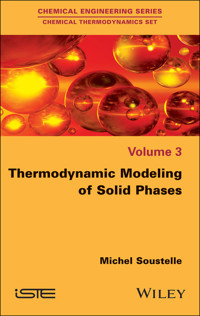
This book offers advanced students, in 7 volumes, successively characterization tools phases, the study of all types of phase, liquid, gas and solid, pure or multi-component, process engineering, chemical and electrochemical equilibria, the properties of surfaces and phases of small sizes. Macroscopic and microscopic models are in turn covered with a constant correlation between the two scales. Particular attention is given to the rigor of mathematical developments. This book focuses on solid phases.
Sie lesen das E-Book in den Legimi-Apps auf:
Seitenzahl: 274
Veröffentlichungsjahr: 2015
Ähnliche
















Table of Contents
Cover
Title
Copyright
Preface
Notations and Symbols
1: Pure Crystalline Solids
1.1. Characteristic values of a solid
1.2. Effect of stress and Young’s modulus
1.3. Microscopic description of crystalline solids
1.4. Partition function of vibration of a solid
1.5. Description of atomic solids
1.6. Description of molecular solids
1.7. Description of an ionic solid
1.8. Description of a metallic solid
1.9. Molar specific heat capacities of crystalline solids
1.10. Thermal expansion of solids
2: Solid Solutions
2.1. Families of solid solutions
2.2. Order in solid solutions
2.3. Thermodynamic models of solid solutions
2.4. Thermodynamic study of the degree of order of an alloy
2.5. Determination of the activity of a component of a solid solution
3: Non-stoichiometry in Solids
3.1. Structure elements of a solid
3.2. Quasi-chemical reactions in solids
3.3. Equilibrium states between structure elements in solids
3.4. Thermodynamics of structure elements in unary solids
3.5. Thermodynamics of structure elements in stoichiometric binary solids
3.6. Thermodynamics of structure elements in non-stoichiometric binary solids
3.7. Representation of complex solids – example of metal oxy-hydroxides
3.8. Determination of the equilibrium constants of the reactions involving structure elements
4: Solid Solutions and Structure Elements
4.1. Ionic solid solutions
4.2. Thermodynamics of equilibria between water vapor and saline hydrates: non-stoichiometric hydrates
APPENDICES
Appendix 1: The Lagrange Multiplier Method
A.1.1. Statement of the problem
A.1.2. Solution by the multiplier method
A.1.3. Determination of the values of the multipliers
Appendix 2: Solving Schrödinger’s Equation
Bibliography
Index
End User License Agreement
Guide
Cover
Table of Contents
Begin Reading
List of Illustrations
1: Pure Crystalline Solids
Figure 1.1. Cylindrical test tube a) under traction; b) under compression
Figure 1.2. Strain/stress curve under traction
Figure 1.3. Frequency distribution according to Debye
Figure 1.4. Frequency distributions: a) Born and Karman; b) Blackman
Figure 1.5. Born–Haber cycle for a compound A
a
B
b
Figure 1.6. Energy distribution of the free electrons in a metal at 0 K
Figure 1.7. Diagrammatic representation of a one-dimensional metal
Figure 1.8. Combination of levels into bands
Figure 1.9. Diagram of bands for metals, insulators and semi-conductors
Figure 1.10. Energy band structure in a metal
Figure 1.11. Distribution of states of s and p bands, with overlap, for a centered cubic crystal (data from [FOW 49])
Figure 1.12. Occupation of states in a) a monovalent metal; b) a divalent metal; c) a semi-conductor; d) an insulator
Figure 1.13. Comparison of the curves of the Einstein and Debye contributions for the specific heat capacity
Figure 1.14. Debye curve and specific heat capacities at constant volume for a number of atomic solids
Figure 1.15. Potential energy curves for a) the harmonic oscillator, and b) an anharmonic oscillator
Figure 1.16. Shape of the curve of the expansion coefficient with temperature in the context of the Debye approximation
Figure 1.17. Grüneisen parameter for a few alkali halides (data from [WHI 65])
Figure 1.18. Variation of the Grüneisen parameter for copper with the volume (data taken from [GIR 00])
Figure 1.19. Expansion of copper at low temperature, according to [PER 70]
2: Solid Solutions
Figure 2.1. Insertion sites in a compact lattice: a) octahedral site and b) tetrahedral site
Figure 2.2. Octahedral sites in a cubic lattice with centered faces
Figure 2.3. Tetrahedral sites in a cubic system with centered faces
Figure 2.4. Octahedral sites in a centered cubic system
Figure 2.5. Tetrahedral sites in a centered cubic system
Figure 2.6. Octahedral sites in a hexagonal compact structure
Figure 2.7. Tetrahedral sites in a hexagonal compact lattice
Figure 2.8. Diagrammatic representation: a) completely disordered solution; b) ordered solution and; c) solution with single-component clusters
Figure 2.9. Order in the alloy CuAu
Figure 2.10. Order in the alloy Fe
3
Al
Figure 2.11. Comparison of the excess Gibbs energy values
Figure 2.12. Variation of the degree of order as a function of the composition of a binary solution in the quasi-chemical model (data taken from [DES 10])
Figure 2.13. Variations in Helmholtz energy as a function of the degree of order, according to the GBW model for a solid AB with different values of the ratio –w
AB
/2k
B
T
Figure 2.14. Variations of the degree of order with temperature: a) solid of type AB and b) solid of type A
3
B
Figure 2.15. Dependence of pairs situated on four sites adjacent to a plane
Figure 2.16. Comparison of the models with experiments
Figure 2.17. Critical temperature as a function of the composition. Comparisons between models and experience. a) Case of CuZn and b) case of Fe
3
Al (according to [SYK 37])
Figure 2.18. Specific heat capacity (per atom) of CuZn – comparison of the models and the experimental results [SYK 37]
Figure 2.19. Determination of Henry’s constant
Figure 2.20. Determination of the equilibrium constant between carbon, CO and CO
2
Figure 2.21. Obtaining the activity of an element of an alloy
3: Non-stoichiometry in Solids
Figure 3.1. Representation of the electron reaction on the band diagram
Figure 3.2. Representation of ionization reactions in the band diagram
Figure 3.3. Representation of a Kröger–Vink diagram
Figure 3.4. 2D representation of the crystal, showing a) the relaxation of the ions around the vacancy; b) Mott and Littleton’s calculation zones
4: Solid Solutions and Structure Elements
Figure 4.1. Diagram of potassium chloride a) in the pure state and b) doped with calcium ions
Figure 4.2. Concentrations of vacancies in calcium-doped potassium chloride
Figure 4.3. Diagram of iron oxide a) in the pure state and b) doped with lithium
Figure 4.4. Kröger-Vink diagrams for lithium-doped zinc oxide
Figure 4.5. Equilibrium isotherm between water vapor and a) a stoichimetric hydrate and b) a non-stoichiometric hydrate
Figure 4.6. Pressure–temperature diagram for a stoichiometric hydrate
Figure 4.7. Equilibrium isotherms between water vapor and a non-stoichiometric hydrate with non-localized water molecules
Figure 4.8. Isothermal curves showing the equilibrium between water vapor and a non-stoichiometric hydrate with localized water molecules
Figure 4.9. Domain of divariance limited by precipitation of the inferior hydrate into a new solid phase
Pages
Cover
Content
iii
iv
ix
x
xi
xiii
xiv
xv
xvi
xvii
xviii
xix
xx
xxi
xxii
xxiii
xxiv
xxv
xxvi
xxvii
1
2
3
4
5
6
7
8
9
10
11
12
13
14
15
16
17
18
19
20
21
22
23
24
25
26
27
28
29
30
31
32
33
34
35
36
37
38
39
40
41
42
43
44
45
46
47
48
49
50
51
52
53
54
55
56
57
58
59
60
61
62
63
64
65
66
67
68
69
71
72
73
74
75
76
77
78
79
80
81
82
83
84
85
86
87
88
89
90
91
92
93
94
95
96
97
98
99
100
101
102
103
104
105
106
107
108
109
110
111
112
113
114
115
116
117
118
119
120
121
122
123
124
125
126
127
128
129
130
131
132
133
134
135
136
137
138
139
140
141
142
143
144
145
146
147
148
149
150
151
152
153
154
155
156
157
158
159
160
161
162
163
164
165
166
167
168
169
170
171
172
173
174
175
176
177
178
179
180
181
182
183
184
185
186
187
188
189
190
191
192
193
195
196
197
198
199
200
201
202
203
204
205
206
207
208
209
210
211
212
213
214
215
217
219
220
221
223
224
225
227
228
229
231
232
233
Thermodynamic Modeling of Solid Phases
Chemical Thermodynamics Set
Volume 3
Michel Soustelle
First published 2015 in Great Britain and the United States by ISTE Ltd and John Wiley & Sons, Inc.
Apart from any fair dealing for the purposes of research or private study, or criticism or review, as permitted under the Copyright, Designs and Patents Act 1988, this publication may only be reproduced, stored or transmitted, in any form or by any means, with the prior permission in writing of the publishers, or in the case of reprographic reproduction in accordance with the terms and licenses issued by the CLA. Enquiries concerning reproduction outside these terms should be sent to the publishers at the undermentioned address:
ISTE Ltd27-37 St George’s RoadLondon SW19 4EUUKwww.iste.co.uk
John Wiley & Sons, Inc.111 River StreetHoboken, NJ 07030USAwww.wiley.com
© ISTE Ltd 2015The rights of Michel Soustelle to be identified as the author of this work have been asserted by him in accordance with the Copyright, Designs and Patents Act 1988.
Library of Congress Control Number: 2015944961
British Library Cataloguing-in-Publication DataA CIP record for this book is available from the British LibraryISBN 978-1-84821-866-6
Preface
This book – an in-depth examination of chemical thermodynamics – is written for an audience of engineering undergraduates and Masters students in the disciplines of chemistry, physical chemistry, process engineering, materials, etc., and doctoral candidates in those disciplines. It will also be useful for researchers at fundamental- or applied-research labs dealing with issues in thermodynamics during the course of their work.
Lesen Sie weiter in der vollständigen Ausgabe!
Lesen Sie weiter in der vollständigen Ausgabe!
Lesen Sie weiter in der vollständigen Ausgabe!
Lesen Sie weiter in der vollständigen Ausgabe!
Lesen Sie weiter in der vollständigen Ausgabe!
Lesen Sie weiter in der vollständigen Ausgabe!
Lesen Sie weiter in der vollständigen Ausgabe!
Lesen Sie weiter in der vollständigen Ausgabe!
Lesen Sie weiter in der vollständigen Ausgabe!
Lesen Sie weiter in der vollständigen Ausgabe!
Lesen Sie weiter in der vollständigen Ausgabe!
Lesen Sie weiter in der vollständigen Ausgabe!




