


19,99 €
Mehr erfahren.
- Herausgeber: John Wiley & Sons
- Kategorie: Geisteswissenschaft
- Sprache: Englisch
In this book Jürgen Habermas offers a wide-ranging reflection on his life and work and on the factors that shaped the development of his thought. He discusses the motives behind his work, the circumstances under which it emerged and the changes it has undergone over the course of his long and productive career. He speaks about the events and the texts that played a decisive role in his thinking and he recounts key encounters with colleagues. The image that emerges is that of a richly intertwined network of relationships which covers large swathes of the intellectual map of the twentieth century and reaches through to the present day.
Looking back at the development of his thought, Habermas discusses the specific historical circumstances that shaped his generation, identifies key experiences with his intellectual mentors, explores recent historical tendencies and political beliefs and talks about his own scholarly works and their reception. Time and again we see the normative impulse that lies behind so much of Habermas’s work: ‘I view the attempt to make the world even the tiniest bit better, or even just to be part of the effort to stave off the constant threats of regression that we face, as an utterly admirable motive.’
This autobiographical self-reflection by one of the greatest philosophers of our time will be of interest to a wide readership.
Sie lesen das E-Book in den Legimi-Apps auf:
Seitenzahl: 276
Veröffentlichungsjahr: 2025
Ähnliche

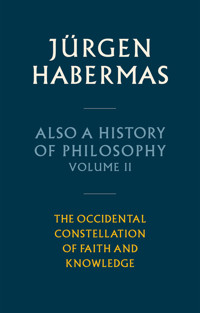
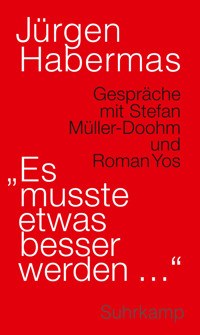




Table of Contents
Cover
Title Page
Copyright Page
1 Beginnings of an Academic Biography
Notes
2 Frankfurt, a New World and the Old Heidelberg
Notes
3 From the Critique of Positivism to the Critique of Functionalist Reason
Notes
4 Postmetaphysical Thinking and Detranscendentalized Reason
Notes
5 Looking Back on
Also a History of Philosophy
Notes
6 In Philosophical Discourse with Friends and Colleagues
Notes
Editors’ Note
Notes
Index
End User License Agreement
Guide
Cover
Table of Contents
Begin Reading
Pages
iii
iv
1
2
3
4
5
6
7
8
9
10
11
12
13
14
15
16
17
18
19
20
21
22
23
24
25
26
27
28
29
30
31
32
33
34
35
36
37
38
39
40
41
42
43
44
45
46
47
48
49
50
51
52
53
54
55
56
57
58
59
60
61
62
63
64
65
66
67
68
69
70
71
72
73
74
75
76
77
78
79
80
81
82
83
84
85
86
87
88
89
90
91
92
93
94
95
96
97
98
99
100
101
102
103
104
105
106
107
108
109
110
111
112
113
114
115
116
117
118
119
120
121
122
123
124
125
126
127
128
129
130
131
132
133
134
135
136
137
138
139
140
141
142
143
144
145
146
147
148
149
150
151
152
153
154
155
156
157
158
159
160
161
162
163
175
176
177
178
179
180
181
182
183
184
185
186
187
Things Needed to Get Better
JÜRGEN HABERMAS
Conversations with Stefan Müller-Doohm and Roman Yos
Translated by Wieland Hoban
polity
Copyright Page
Originally published in German as “Es musste etwas besser werden...” Gespräche mit Stefan Müller-Doohm und Roman Yos © Suhrkamp Verlag AG Berlin 2024. All rights reserved by and controlled through Suhrkamp Verlag AG Berlin.
This English translation © Polity Press, 2026.
Polity Press
65 Bridge Street
Cambridge CB2 1UR, UK
Polity Press
111 River Street
Hoboken, NJ 07030, USA
All rights reserved. Except for the quotation of short passages for the purpose of criticism and review, no part of this publication may be reproduced, stored in a retrieval system or transmitted, in any form or by any means, electronic, mechanical, photocopying, recording or otherwise, without the prior permission of the publisher.
ISBN-13: 978-1-5095-6727-0
Library of Congress Control Number: 2025937683
A catalogue record for this book is available from the British Library.
by Fakenham Prepress Solutions, Fakenham, Norfolk NR21 8NL
The publisher has used its best endeavours to ensure that the URLs for external websites referred to in this book are correct and active at the time of going to press. However, the publisher has no responsibility for the websites and can make no guarantee that a site will remain live or that the content is or will remain appropriate.
Every effort has been made to trace all copyright holders, but if any have been overlooked the publisher will be pleased to include any necessary credits in any subsequent reprint or edition.
For further information on Polity, visit our website: politybooks.com
1BEGINNINGS OF AN ACADEMIC BIOGRAPHY
Mr Habermas, you once said that one must do something in life that follows one’s basic intentions. What are your basic intentions, and to what extent did they determine your development as a theorist and your career path? More specifically: what led you to enrol at the University of Göttingen to study philosophy in 1949?
In 1949, my generation could look back at the end of the Second World War as a turning point, a time of historical transformation. By the time I began my studies, we had had four years to realize how profound a caesura the period of Nazi rule had been, and to understand what lay behind the everyday normality in which we had grown up and lived our lives. That was easier for us than for many of our seniors, because – through no achievement of our own – our age made us sensitive to the darkness behind the apparent normality that was now in the past. We didn’t have to account for any actions or omissions of our own – we had no memories of being implicated in misdeeds, which potentially led us to reject any acknowledgement of guilt. Helmut Kohl summed that up when he spoke of the ‘mercy of late birth’. Even those who were only slightly older had different experiences to process. In that respect, by the way, I always found the generational differences between the parties involved in the historians’ dispute very revealing. In the midst of a national milieu that had become thoroughly questionable, the younger generations’ desire for orientation and clarification, their desire to know, was unaffected by any personal psychological obstacles. It was an intuitive understanding that separated the critical part of our generation from the entrenched mentality all around us: the Nazis had not been a foreign body in the fabric of an ‘essentially healthy’ culture – not some horrible episode that was fortunately over now. Rather, they were able to draw on that darkest legacy of our culture that even great minds of the nation such as Thomas Mann had mobilized at the start of the First World War against the ‘spirit of 1789’. That was the only thing that could explain how virulent Nazi ideology was, even when people were in the air raid shelters. There were a few impulses in the magazines and literature of the early post-war years, until the currency reform, to account for the rupture of civilization, though it wasn’t referred to as such back then. So the idea to study philosophy suggested itself to me automatically, one might say. Of course, that also required a family background that could support it and a father who was happy to pay for it.
But one shouldn’t make too much of the choice of subject, although one couldn’t expect to take up any particular occupation when one studied philosophy – definitely not to become a professor, only to satisfy one’s interest. In 1949, five per cent of each generation went to university, today it’s fifty per cent. One had more liberties as a student than one does now. One didn’t just study a degree subject; it was more a case of focusing on particular topics and themes that one could learn more about within the framework of the philosophy department. In the course of such self-curated studies, as it were, one then selected – without ever taking an intermediate exam – the two subsidiary subjects required for the doctoral examination. I had already decided to study philosophy before taking my final school examinations.
How did you reach that decision? We’re interested to hear about your general situation at the time, especially about your path to philosophy. Were there particularly formative experiences? Because you wanted to be a doctor when you were a boy, didn’t you?
My original desire to become a doctor, and generally my intensive occupation with human anatomy and my decision at the age of twelve to train as an army surgeon in the Jungvolk – all that was probably connected more to pubescent unease caused by the problem of my cleft palate, which I had suddenly become self-conscious about. Until then, I had had a fairly sheltered, more or less naive childhood and youth together with my friend Jupp Dörr, despite a few upsetting experiences in the school yard. But those medical interests shifted to the theoretical realm after the end of the war, partly under the influence of biology lessons. The teacher who aroused my interest at the time had returned to our school from a Napola1 (!) after the war – so he must have been a Nazi. But he introduced us to genetics and Darwinian evolutionary theory very knowledgeably, and with a scientific standard now purged of any obvious connotations of ‘racial biology’. However, my interest then expanded beyond biology into the anthropological domain. For example, I stumbled on a book by Schultz-Hencke,2a kind of textbook for psychoanalysis adapted to the Nazis, and during my last two years of secondary school I was allowed to subscribe to the journal Psyche. So it was these broadly anthropological interests that were combined with reading Kant’s and Herder’s philosophy of history in the years leading up to my final school exams. I also – through a book by an old Nazi like Otto Friedrich Bollnow, as it happens – came into contact with the existentialist philosophy of Sartre, whose plays in particular kept everyone in my generation in suspense, then of course the Marxist literature from the communist bookshop in Bahnhofstrasse in Gummersbach, and – as a kind of antidote – the ordoliberalism of Walter Eucken and Wilhelm Röpke, which was popular in my father’s social circles.
I processed all of that in half-baked private ‘essays’ with which I pestered and thoroughly got on the nerves of our Latin teacher Klingholz, an impressive personality and someone I admired, one of the few non-Nazis among our teachers in Gummersbach. My uncle Peter Wingender, a senior schoolmaster who also taught philosophy, ensured with Kant’s Prolegomena and other ‘serious’ reading recommendations that this mass of exciting things didn’t just lose itself in the realm of the interesting. Living in a world like that, assailed by an avalanche of intellectual stimuli, it didn’t take any conscious decision or ‘basic intention’ for me to want to study philosophy. Of course, I was aware of the material risks one takes by choosing a subject like that. That feeling of material insecurity accompanied me for a long time. And when I did manage to become a professor after all, contrary to expectations, I was far from sure of my abilities and achievements, my profession. It was only in my last period in Frankfurt in the eighties and nineties that I gradually gained the feeling of having halfway mastered my profession as a university professor and researcher.
But wasn’t there something like an ‘inward’ motivation for your choice of subject, such as a need to come to terms with your own value orientation?
That’s more of a Platonic self-conception of philosophy, which I’ve never shared. That’s why I’ve always suspected myself of not being a ‘real’ philosopher, someone who – if you’ll forgive the cliché – proceeds from a contemplation of their own life situation and strives for profound, metaphysically valid insights. I could identify my motives more in Marxism and pragmatism. To me, the motive of striving to make the world a tiny bit better, or merely contributing to warding off the constant threat of regression, is one that should not be scorned. So I’m quite content to be described as a ‘philosopher and sociologist’.
You’d find it dubious only to be called a ‘philosopher’?
For a long time that was just a feeling. Now that I’m almost the only one left of my small circle of colleagues, I sometimes think about it. Certainly no one followed one of the great metaphysicians, Thomas, as unabashedly – though not unreservedly – as Robert Spaemann, whose ability to strike sparks through a close reading of seminal texts reminds me of Leo Strauss. But even among my close colleagues, the different theoretical conceptions, for all their sobriety, are guided by motives rooted more or less in the tradition of ‘great philosophy’. If you’ll allow me to simplify things greatly: with Karl-Otto Apel, the passion for an ultimate justification of morality already reveals that he was convinced we shouldn’t overdo it with our post-metaphysical thinking – and that was the core of our disagreement. With Dieter Henrich, the original metaphysical motive is obvious: assuring oneself of a pre-reflective familiarity with oneself opens up our consciousness to the supporting origin from the all-encompassing. Michael Theunissen struggled with religious motives throughout his life – first following on from Kierkegaard, then via an intersubjectivist, Young Hegelian-inspired interpretation of Hegel, and finally with his attempt to return to late Heidegger, though I found that less productive. And even the most philosophically clear and sober of us all, Ernst Tugendhat, understood his philosophy of language as a translation of Aristotle. And the metaphysical ambitions of Tugendhat’s conceptions of ethics are all the more evident in his late turn towards mysticism, where only an immersion in the overwhelming observation of the cosmos can break the egocentrism of the subject that insists on its interests; this was the only way he saw to save Kant’s universalist concepts of justice and reason-based freedom. There aren’t any similarly ‘profound’ motives in my work. What drives me is the problem of how a social coexistence that is fragile and has kept tearing apart until now can actually succeed. Is one’s own death a philosophical motive? The dependency of humans on nature is also rather anthropocentric, I would say: in relation to the evolutionary leap to a completely new mode of linguistic socialization. My ‘final’ motive, if you like, the liberating power of the word, which can only take full effect in the reciprocal, egalitarian conditions of recognition in a completely individuated socialization. Proximity and distance, yes and no, emancipation and regression, agreement and dissent, self-being and dependency – these are all communicative experiences of individuals that only become themselves by means of socialization, and which can only maintain themselves in the balance between opposite poles if they are located in somewhat socially integrated circumstances. I draw this intuition, which is the starting point for my philosophy and my social theory, by following on from philosophers who, after Kant, Fichte, Schelling and Hegel, did not hesitate to transform a religious intuition completely into a secular one. With this intention of a successful individuation through socialization, not a misguided one, I’m thinking more from a biblical perspective than a Greek one.
That does sound rather like a fundamental intuition.
Since we’re on the subject, let me add something sober. The intuition of a successful, not a misguided form of social integration inspired me to a theory of communicative action and explains my interest in the linguistic turn. It wasn’t clear to me from the start that only the idea of the linguistic constitution of the human mode of existence as developed from Humboldt to Wittgenstein, i.e. the form of life of ‘Homo sapiens’, gives the linguistic turn the meaning of a paradigm shift. For leading analytic philosophers such as Carnap, Quine or Davidson, on the other hand, it only had a methodological meaning. In addition, it was only through the equiprimordiality brought into play by the pragmatists George Herbert Mead and William James, as well as the reciprocal enablement of individuation and socialization, that the paradigm gained the dialectical element which inheres in the dynamic web of tensions in the relationships between first, second and third person. The I–thou relationship establishes itself in the context of a we-relationship between acting subjects saying ‘yes’ and ‘no’, who – in an awareness of their shared linguistic background and the space of reasons opened up by it – relate in an objectifying way to something in the world in order to come to an understanding about it. I call this relationship ‘dialectical’, in an intuitively convincing sense – so not yet one that is in crisis – because young people only experience themselves as ‘I’ and develop self-consciousness to the extent that they learn under the gaze of a second person, to which they relate as a respective ‘thou’, to adopt this gaze and direct it at themselves. It is not only self-consciousness, however, that is mediated by the relationship with the Other. Reaching understandings via communicative action and discourse aims for agreement via a mutual criticism of validity claims, and is thus itself literally a dialectical process. At the same time, this process forces the subjects of communicative action to give ‘yes’ or ‘no’ responses for which they bear individual responsibility. And at biographically significant points, this responsibility not only reinforces the awareness of individual independence and unrepresentability, but also develops the characteristics of individual unmistakability.
Back to your life story and your ‘first’ university, as it were: why Göttingen?
After graduating from school, my choice of where to study simply came from the fact that at the time, Martin Heidegger and Nicolai Hartmann were considered the two leading philosophers with whom ‘one’ had to study. I didn’t know, for example, that there was a university in Frankfurt.
A reason not to go to Freiburg was clearance work that was still obligatory there after the war – after the school year ‘lost’ through the war would have ‘cost’ me further months, perhaps even an entire semester, whereas in Göttingen I only had to complete an ‘interview’ with Hartmann. If I remember correctly, all I had to do was tell the somewhat disinterested examiner something about my readings of Rilke. Incidentally, my first semester coincided with the election campaign for the first German Bundestag; and although my reactions to the crimes of the Nazi period – during which we had grown up, after all – were initially more moral than political, I suppose I had become sufficiently politicized during my final school years from the war’s end until graduation that I went to almost every election event in Göttingen. I vividly remember the radical disappointment of a young man who had primarily gained his notion of democracy from books until then; my first head-on encounter with actual democracy was a shock. The shock didn’t come from encountering Otto Ernst Remer, the colonel who had arrested the conspirators in Berlin on 20 July 1944 and was now appearing as chairman of the far-right German Socialist Reich Party. What upset me were the protagonists of the BHE,3 the German Party and the CDU [Christian Democratic Union of Germany], because they were just as extremist in their manner. It was Oberländer, Seebohm and Merkatz that I first experienced as opinionated and disgruntled party speakers who were protesting against the occupying powers – and who all turned up again in the first Adenauer cabinet not much later! Their unscrupulous tirades showed no awareness whatsoever of the necessity of breaking with the Nazi period. I can still hear the jeering that broke out when they launched into the first verse of the national anthem and I stormed out of the hall. Didn’t everyone have the same thought that I did – that for twelve years, that same national anthem had merged indivisibly with the Horst Wessel Lied, the National Socialist Party’s anthem? That misuse caused a degree of unease about our national anthem, whose historical origins are fairly unproblematic. I have retained a general aversion to national anthems to this day. Even at the Federal Assembly in 1994, when Johannes Rau ran against Roman Herzog and lost, I asked Peter Glotz, who was sitting next to me and was familiar with the closing ritual, to give me a sign in time for me to leave the hall before the German anthem began. When I recall the experiences of my first semester, it reawakens the sense of political self-evidence that infused the intellectual need for philosophical enlightenment: things needed to get better, and it was down to us whether the world would change for the better.
What image of post-war philosophy did you have at the time? Would you agree with Dieter Henrich, who thought the post-1945 philosophers had a specific generational profile, one of whose features was a specific view of the present?
I share Henrich’s sense of belonging to a generation, but I find it a little difficult to set philosophers apart from colleagues in other disciplines in this regard. My wife and I found a very similar mentality in our friendships with sociologists and historians our age. I think a joint generational profile developed among the more alert and prominent minds in all the humanities. After the corruption of one’s own traditions, everything was under suspicion of having been poisoned and had to pass through the filter of scepticism, distrust and critique. As professors of philosophy, we saw to it that the solemn gesture of the Platonic tradition was replaced by a sober, unpretentious understanding of our professional role, especially an awareness of the fallibility of our statements and theories. Claiming privileged access to the truth, the kind that Heidegger continued to celebrate, was simply ridiculous. In philosophy, many of us also tried to acquire the method and spirit of analytic philosophy. Soon, even the much-maligned pragmatism enjoyed a career in Germany. This unreserved opening westwards also thoroughly changed philosophical work in Germany. And I feel a little pride in the fact that my generation opened the doors for that.
The philosophical friends I felt closest to – each for different reasons – were Karl-Otto Apel, who had been in the war, Ernst Tugendhat, Dieter Henrich and Michael Theunissen. Each of us developed a project of our own until the late sixties or early seventies. In retrospect, I would assume that we all watched each other with a certain curiosity. Blumenberg was a loner. I only met Jacob Taubes in the early sixties. I saw the colleagues in Münster whom I found somewhat interesting, especially Spaemann, Lübbe and Marquard, primarily in terms of their belonging to the Ritter School. I was in closer contact with the ‘Erlangen School’ of Paul Lorenzen, especially the ‘Constancers’, Friedrich Kambartel and Jürgen Mittelstrass, and later with Peter Janich as well. That generation of philosophers also included Albrecht Wellmer, of course. He was my first ‘student’, though he had already studied mathematics before he came to Heidelberg to study philosophy, and he and I were soon on very friendly terms; as in other cases, that also extended to our respective families. Albrecht’s many years teaching at the New School were also consequential. There he inspired the students who – alongside Thomas McCarthy and his students – became central for the establishment of Critical Theory in the USA. Today, the Frankfurt tradition is more alive there than it is in Germany. For me, the friendships in the USA from the early seventies onwards with Dick Bernstein, Dick Rorty and especially Tom McCarthy, with whom I developed a close working connection that has continued to this day, formed the start of numerous other contacts.
If we first look at the time before ‘68’, what do you find particularly noticeable in the circles of German colleagues from your generation?
I can see in retrospect what, in post-war Germany, determined whether relationships with department colleagues were friendly and close or somewhat distanced, aside from intellectual and personal qualities: the political element of one’s philosophical orientation. In my view, there was a political divide in our generation between those who wanted a more or less radical break with the past, a new beginning, and those – Hermann Lübbe is a perfect example – who completely supported the prevailing anti-communism and saw people like me as a potential danger for a ‘healthy’ or ‘fortified’ democracy. The people in Münster had resumed contact with Carl Schmitt fairly quickly in the spirit of reluctant modernism. In the tense climate of the Cold War, but most of all in the course of the polarizing 1968 movement, our declared commitment to the letter of the constitution did not prevent the right wing from suspecting left-wing colleagues of being internal enemies; and we weren’t squeamish in how we worded our replies either. But the public dispute, which ultimately revolved around different attitudes to the Nazi past, only truly erupted in the context of the student movement. In philosophy, as in many other humanities subjects, this conflict, which was also fuelled by the Frankfurter Allgemeine Zeitung and its editor Joachim Fest,4 was waged more by the members of my generation than by our teachers. It was very different in sociology, where returned émigrés now faced former Nazis.
Here the ‘Young Sociologists’, who had been meeting in Frankfurt every year since the second half of the fifties under Ludwig von Friedeburg’s guidance with a focus on industrial sociology, were not the only ones who defined themselves as a connected and cooperative generation distinct from the more politically and science-politically oriented factions in Münster, Cologne and Frankfurt. What made this de-dramatization of differences between the ‘schools’ all the easier was that, although the factional dispute was coloured by people’s personal political fates, its essence certainly wasn’t only based on politics. In my profession, I developed closer relationships over the years with Heinrich Popitz and Ralf Dahrendorf, Renate Mayntz and Rainer Lepsius, and for a while also Plessner’s students Christian von Ferber and Christian von Krockow, and of course Niklas Luhmann, though he was something of a recluse. And through my friend Ulrich Wehler, Ute and I – these friendly collegial relations usually included the spouses too – also ended up in a small circle of historians who occupied themselves with matters of recent political or social history, such as Hans and Wolfgang Mommsen, Jürgen Kocka or Heinrich August Winkler.
All the colleagues our age, whatever their subjects, were influenced by the fact that they had experienced a historical rupture in their youth. Now, although a generation is constituted through such a shared experience, its members differ in how they react to that experience. This is a subject our contemporary historians have not dealt with, as shown by the publications on the hundredth birthday of Reinhart Koselleck, for example – which is not to say that I didn’t learn anything about his innovative contributions to history and historical theory. The drive towards a new beginning that felt inescapable, along with the critical awareness that German traditions could no longer be continued unfiltered, were simply found mostly among liberals and leftists.
But what was special about the situation of young philosophers after the war compared to later decades (and to the present day)?
You’re insisting on your question about the generational profile of young post-war philosophers. I don’t think it differs so clearly from the profile of the subsequent generation, that of our ‘students’, if you will. Perhaps our training process was even more homogeneous; specialization hadn’t advanced as far. People were still reading the same books. So we saw the same great texts as relevant, since we had learned from the philosophical heroes of the twenties. Alongside the tradition of German Idealism, phenomenology, hermeneutics and philosophical anthropology were obligatory – from Kant and Hegel to Dilthey, from Husserl and Heidegger to Scheler, Plessner and Gehlen. That was something we still took for granted for understanding the spirit of the last era in which German philosophy was a world philosophy. As I already mentioned, though, we were the first generation that gave up that expectation. We left behind the solemnity of the great idealistic ambition of our teachers, from the attitude of holding the keys to philosophy. We not only scaled down our thinking, but also worked and taught with a more self-critical consciousness. One could even see this difference in mentality when comparing the new generation to leftist and liberal teachers like Adorno and Gadamer – less so in the one case, more glaringly in the other. It was also clear to us that the genuinely German curriculum was lacking something. We had a great deal to learn from Anglo-American philosophy in particular – the analytical style of argumentation, the value of the fallibilist consciousness, the sensitivity to the weight of empiricism, opening up towards the social sciences and so on. The pacemakers for our learning processes, which we underwent more or less on our own initiative, were the reception of Carnap and the Vienna Circle on the one hand and that of late Wittgenstein on the other. And for some of us, Peirce and pragmatism were ground-breaking. Not only in politics, and accordingly political theory; in the heart of philosophy too, there was an opening towards the West.
After two semesters in Göttingen and one in Zurich, you spent the majority of your studies in Bonn until you completed your doctorate. In retrospect, was there anything particular that set apart your philosophy studies there?
A biography consists of many contingencies and only few consciously chosen paths. In Göttingen I had been bored by Nicolai Hartmann and, most importantly, failed to find any contacts, and the Rhenish Bonn felt more familiar than the frosty north. I was attracted by what Manfred Hambitzer, an acquaintance from Gummersbach who became a friend in Bonn, told me about the lively discussions in his Bonn theatre group. This time the choice of where to study was based on personal reasons. But Erich Rothacker was certainly a well-known philosopher, though I only had a vague notion of his writings. And although he was also a Nazi from the first – one only found out these things gradually – my largely coincidental decision proved to be a serendipitous one: in personal terms, because that was where I met Ute, who has been central to my life ever since, but also in academic terms, because Rothacker’s Wednesday seminar turned out to be an unusually stimulating and instructive discursive environment. I didn’t learn any philosophical theories from Rothacker himself, who was also a professor of psychology. But his lectures introduced me to the broad spectrum of the scholarly German historical school, and it was in his psychological seminars that I first heard about the rich empirical research on which the discussions in philosophical anthropology had been based since the twenties. But most importantly, it was in the philosophical seminar that the thought itself was set in motion, as it were – my interest in the philosophy of language came partly from the discussions there. I wasn’t yet considering sociology as a subject at the time.
That was where you met your long-standing intellectual companion Karl-Otto Apel, who, for all the differences between your respective theories, was influenced by very similar reading and systematic formulations of problems.
At first it was a very asymmetrical relationship; he was older and already had a doctorate, and had also experienced the entire war as a soldier. Once we got to know each other better – as a doctoral student I later had a room next to his – he was like a mentor, I learned from him. Most importantly, he showed me a Kantian interpretation of Being and Time, with an existentialist inflection, that greatly spoke to me. I had already read that book in Göttingen, of course. Apel was never an especially political man, but he was the first person I encountered who embodied, in a sense, how philosophy can express present-day world- and self-understanding. Philosophy should offer orientation in life. However, Apel’s diagnosis of the time was still rather far away from the provocative daily events that my critical morning read of the FAZ – a student subscription from the Bouvier Bookshop – kept me abreast of. It was only when I read Heidegger’s Introduction to Metaphysics, which Apel handed to me one weekend in the summer of 1953, that the wall between my philosophy studies and the urgency of political events – Heinemann versus Adenauer! – was suddenly knocked down.5
Can you give us some insight into your collegial and personal relationship with Apel, which came about early on, lasted for a long time and seems to have grown very intense again in the 1980s, when you were both engaged in your respective elaborations of discourse ethics?
To give a brief outline of what was indeed a long and complex relationship, and to respond to your suspicion that there is far too much Apel and Kant in me for a ‘Frankfurter’, one has to distinguish between the student–mentor relationship in Bonn and the three subsequent phases of a relationship that was not only collegial in the formal sense, but also a friendship. I had lost sight of Apel after getting my doctorate in 1954. I went to Frankfurt, and Apel was working on his habilitation thesis with health-related interruptions. It was more or less by chance that the broken thread was taken up again. I had recommended Apel for a philosophical lecture that I had been invited to give, but had turned down because by then I saw myself in the role of a sociologist. At any rate, that led to a correspondence about our philosophical work which the two of us pursued after becoming colleagues, first between Heidelberg and Kiel in the sixties. It’s a pity that only a selection of those letters, some of them handwritten, has survived. They could have reflected the – as I see it – reciprocal influence we had on each other during a phase in which each of us was pursuing his own ideas and projects. That was the time in which Apel and I were closest in the intentions of our work. That applies on the one hand to the theory of knowledge interests, which results in a mode of reflection for which the psychoanalytical conversation acted as a model. Apel seems to have gone through analysis himself, whereas my interest in psychoanalysis, which had already been piqued by reading Psyche as a school student, was reawakened by the Frankfurt lectures on Freud.6




