


0,49 €
Niedrigster Preis in 30 Tagen: 2,49 €
Niedrigster Preis in 30 Tagen: 2,49 €
Mehr erfahren.
- Herausgeber: Booksell-Verlag
- Kategorie: Geisteswissenschaft
- Sprache: Englisch
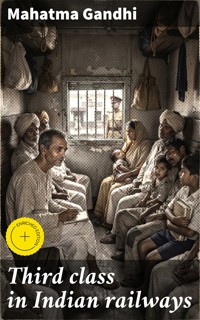
In "Third Class in Indian Railways," Mahatma Gandhi employs a keen observational style to expose the stark realities of travel in India during the British colonial era. This work navigates beyond mere critique; it offers a profound exploration of social classes, caste disparities, and the impact of colonialism on everyday life. Through vivid descriptions and personal anecdotes, Gandhi paints a poignant picture of the everyday struggles faced by the lower classes, engaging readers with both his narrative and philosophical insights. The book acts as a social commentary, emphasizing the need for reform and the dignity of the marginalized. Mahatma Gandhi, known primarily for his role as a leader in India's struggle for independence, was deeply influenced by his experiences and background. His formative years in early 20th-century India exposed him to the inequities wrought by British rule. Influenced by his legal education in London and experiences in South Africa, Gandhi's emerging philosophy focused on nonviolent resistance and social justice, making "Third Class in Indian Railways" a critical early manifestation of these ideals. This book is highly recommended for those interested in understanding the socio-political landscape of India under British colonialism, as well as for readers curious about Gandhi'Äôs formative thoughts on social equity and justice. It is a compelling invitation to reflect on the intersections of class, society, and the human condition. In this enriched edition, we have carefully created added value for your reading experience: - A succinct Introduction situates the work's timeless appeal and themes. - The Synopsis outlines the central plot, highlighting key developments without spoiling critical twists. - A detailed Historical Context immerses you in the era's events and influences that shaped the writing. - An Author Biography reveals milestones in the author's life, illuminating the personal insights behind the text. - A thorough Analysis dissects symbols, motifs, and character arcs to unearth underlying meanings. - Reflection questions prompt you to engage personally with the work's messages, connecting them to modern life. - Hand‐picked Memorable Quotes shine a spotlight on moments of literary brilliance.
Das E-Book können Sie in Legimi-Apps oder einer beliebigen App lesen, die das folgende Format unterstützen:
Veröffentlichungsjahr: 2019
Ähnliche









Third class in Indian railways
Table of Contents
Introduction
This single-author collection gathers four short works by Mahatma Gandhi under the title “Third class in Indian railways.” It is presented as a small, affordable set—priced at six annas each in the original listing—meant for wide circulation rather than select readership. The purpose of bringing these texts together is not to create a single continuous narrative, but to place side by side several representative pieces that move between public life and daily experience. Read as a group, they show how Gandhi used brief, direct writing to address concrete conditions, civic questions, and the moral demands of social change.
The scope of the volume is intentionally compact: it collects the complete text of each item named in the list—“National Dress,” “Behind the Bars,” “Third Class in Indian Railways,” and “In Round Table Conference”—rather than offering excerpts or summaries. The arrangement encourages a comparative reading, where themes that appear in one work can be traced across the others. Because the titles point to distinct settings and concerns, the collection offers more than a single topic; it offers a cross-section of Gandhi’s public-minded prose as it confronts questions of social practice, confinement and discipline, travel and ordinary hardship, and participation in formal political discussion.
The genres represented are best described as short prose pieces written for public reading: essays or pamphlet-like discussions, and related forms of reflective, argumentative writing. These works are not presented as novels, plays, or fictional stories; their force depends on plain statement, moral reasoning, and attention to lived realities. The collection therefore foregrounds Gandhi as a writer of civic prose—someone who treats writing as a form of action and persuasion. Across the pieces, one encounters the characteristic aims of such texts: to describe conditions that demand attention, to propose standards by which to judge them, and to summon readers to responsibility.
“Third Class in Indian Railways,” the title work, signals one of the collection’s central methods: the use of a specific, everyday context to illuminate larger social questions. Travel in third class is not merely a backdrop; it is a vantage point from which readers can consider how institutions treat ordinary people and how a society measures dignity in practice. The piece belongs to a recognizable kind of writing in Gandhi’s corpus: grounded observation joined to moral critique. Its presence at the center of this set invites readers to take the mundane seriously, and to see how social and political issues are revealed in ordinary arrangements.
“National Dress” brings the discussion to the plane of custom and public meaning. Dress is at once personal habit and collective signal; it touches labor, economy, identity, and the ethics of consumption. In collecting this piece alongside the others, the volume suggests that seemingly small choices can carry civic weight. Gandhi’s approach, as reflected by the title and by the kind of writing he is known for, is to treat cultural practice as subject to examination rather than mere inheritance. The reader is asked to consider how outward forms relate to inward discipline, and how shared standards may serve—or hinder—social reform.
“Behind the Bars” introduces a different setting: confinement, restriction, and the experience of life under imposed limits. Without presuming details beyond the title, the work’s placement in the collection broadens the field from public spaces like trains and public customs like dress to the realities of detention and discipline. It thereby connects the political to the personal and tests ideas under pressure. Such a text belongs naturally within a body of civic prose, because it reminds readers that institutions are not abstractions; they shape daily life. Its inclusion helps the collection address the costs of conflict, dissent, and authority.
“In Round Table Conference” points toward formal politics and negotiated public debate. The Round Table Conferences are a recognizable element of India’s constitutional discussions in the early twentieth century, and the title indicates a text oriented to that arena rather than to a private or purely local scene. Placed alongside essays on travel, dress, and confinement, this piece shows how Gandhi’s writing moves across levels of public life—from the immediate and physical to the procedural and diplomatic. It also underscores a continuity of concern: whether in an international forum or a crowded carriage, questions of justice and human worth remain central.
Taken together, these works are unified by a focus on the conditions of ordinary people and the ethical responsibilities of public life. The collection does not ask the reader to admire complexity for its own sake; it asks the reader to examine habits, systems, and decisions as matters of conscience. A consistent theme is the insistence that reform begins with attention—attention to how people are housed, carried, clothed, confined, and represented. The texts share an orientation toward practical realities and toward change that is not merely rhetorical. Their unity comes from a moral seriousness that treats daily arrangements as a test of a society’s principles.
The stylistic hallmarks that emerge from this gathering are clarity, directness, and an aversion to ornament that might distract from the argument. These pieces, as a set, exemplify writing that aims to be accessible and usable: language that meets readers where they are and invites them to deliberate rather than to merely consume. The brevity implied by the individual pricing and pamphlet-like presentation suits a mode of address designed for circulation, discussion, and rereading. In such writing, persuasion depends on plain reasoning, concrete reference, and the steady linking of observation to ethical judgment.
Another unifying feature is the way the works bridge personal conduct and collective arrangements. The titles alone indicate that Gandhi’s subject matter is not confined to high policy or to interior meditation; it ranges across practices that can be adopted or challenged by individuals as well as by institutions. The collection therefore reads as a coherent invitation to civic self-scrutiny. It suggests that large political outcomes are influenced by the texture of daily life, and that public ideals must be tested against routine experiences. By coupling the domestic, the infrastructural, the carceral, and the diplomatic, the volume maintains a single moral horizon across diverse scenes.
The significance of the collection also lies in its implied audience. Priced for broad access and composed of short, self-contained pieces, it reflects an intent to reach readers beyond academic or elite circles. Such works function as tools for public reasoning, designed to be shared and debated. Even when the immediate circumstances change, the method remains instructive: to look closely at common institutions, to identify how they affect the least advantaged, and to articulate standards for improvement. The collection thus preserves not only particular arguments but a model of engaged writing rooted in everyday evidence and ethical demand.
As an introduction to Gandhi’s prose, this set offers a coherent entry point without requiring the reader to navigate an entire archive. It shows how one author can treat multiple subjects with a consistent sense of purpose and an unmistakable voice. The reader encounters civic writing that is neither detached nor merely polemical, but oriented toward reform through reasoned appeal and moral discipline. By gathering these four works in one place, the collection highlights the breadth of Gandhi’s concerns while maintaining focus on a single question: how public life should be organized so that human dignity is not a slogan but an experienced reality.




