


Erhalten Sie Zugang zu diesem und mehr als 300000 Büchern ab EUR 5,99 monatlich.
- Herausgeber: Crown House Publishing
- Kategorie: Bildung
- Sprache: Englisch
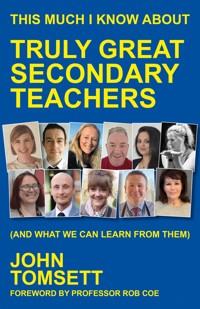
Foreword by Professor Rob Coe Through a set of in-depth case studies, This Much I Know About Truly Great Secondary Teachers (and what we can learn from them) by John Tomsett brings to life how eleven outstanding secondary teachers cultivate great learning in their classrooms. Covering a range of school types, social contexts, pupil ages and subjects, each detailed vignette is based on observing the teachers teach, and discussions with them, their colleagues and pupils. The conversations that form the heart of this book provide a picture of not just what these teachers do, but why they do it: the choices and adaptations they make, and the pedagogic and philosophical principles that guide them. Each teacher is unique in the way they teach and in how they talk about teaching, but they also have some common behaviours and attitudes that make them truly great. John draws together these characteristics, summarising what we can all learn from their utter dedication, enthusiasm and commitment to preparing the next generation for a bright future. Essential reading for all secondary school teachers, school leaders, teacher trainers and education researchers.
Sie lesen das E-Book in den Legimi-Apps auf:
Seitenzahl: 496
Veröffentlichungsjahr: 2025
Das E-Book (TTS) können Sie hören im Abo „Legimi Premium” in Legimi-Apps auf:
Ähnliche











Praise for Truly Great Secondary Teachers
This is exactly what I needed to read before embarking on any further school improvement work. As always, John weaves together theory, research and practice to focus on what really matters: getting teaching and learning right in the classroom. We’ve worked with John for several years now. He has supported us in school improvement with pragmatic wisdom and wit! He never loses sight of what matters: the children and the quality of their learning through expert teaching. As with John’s previous books, TrulyGreatSecondaryTeacherscombines a genial warmth with astute observations. The warmth radiates off the pages: both John’s warmth towards the teachers he profiles and the teachers’ warmth towards their charges which permeates each case study. Most importantly, his portraits of teachers at the top of their game provide incredibly important learning for all of us interested in schools.
Samantha McMonagle, Executive Lead for School Improvement, Central Regions Schools Trust
The power of story to help us to understand how the world works is well-documented. The power of story to draw us in to new and unfamiliar territories is an underestimated element of professional learning. What we find in these wonderful accounts of stunning practitioners are insights, strands of gold and subtle nuances that invite us to reflect on our own practice. TrulyGreatSecondaryTeachersis such a joy to read, to reflect on and to marvel at. Wherever we are in our professional lives, we will take some inspiration from these incredible colleagues, who have managed to get to the heart of the matter, bring their students with them, get great results and continue to be fascinated by the craft of teaching. Truly transformational.
Mary Myatt, educational consultant
There are few things more valuable to those of us in the world of education than hearing first-hand about the nuances, complexities and contradictions of truly excellent teaching. In Truly Great Secondary Teachers, John Tomsett has done us all a hugely valuable service – he’s found 10 expert practitioners who can tell us what makes a great teacher – not in the simplistic language of data and outcomes, but in the delicate and subtle language of real classroom experience.
Sammy Wright, Head Teacher, Southmoor Academy, author of Exam Nation B
I have always believed our great profession is packed full of expert teachers. Indeed, as John Tomsett says in the introduction to Truly Great Secondary Teachers, there are ‘thousands of them’ in our classrooms up and down the country. In this book, the author has brilliantly embodied that expertise through a series of detailed teacher profiles; each one contains a strong balance of theory and practical ideas to use in the classroom, whilst being packed full of personal connections and anecdotes. The tips and reflections from serving practitioners are profound, and the evidence base behind the claim that these colleagues are ‘truly great’ is extensive. The author also recognises all of the truly great teachers who could have been included if there were enough pages. I am already looking forward to This Much I Know About Truly Great Secondary Teachers 2!
Nigel Whittle, Principal, Waltham Toll Bar Academy
A brilliant book to inspire teachers, parents, pupils and the wider public at a time when we urgently need more people to enter – andstayin– the teaching profession. Being a ‘truly great teacher’ is about so much more than the mechanical delivery of results and ticking boxes. It requires a complex range of skills, joy and, above all, belief and interest in young people and how they learn. TrulyGreatSecondaryTeachersreminds us that if we want to have a really equitable and excellent education system, attracting and developing the very best people, into what should be a life-enhancing career, must be a priority.
Fiona Millar, school governor and Guardian columnist
We can all name a teacher that stands out. Getting excellent results for the young people will always be one of the reasons why they are memorable, but TrulyGreatSecondaryTeachersclearly shows that results are only part of the picture. John Tomsett’s book shows why the Ofsted approach to quantifying teaching will never truly work. How do we measure how well a teacher connects with their students in the classroom? How do we put a number on a teacher’s ability to see a group of learners struggling with a concept and know instantly what they need to do to get over that learning barrier? It is quite simple … we can’t! I loved reading about every teacher in this book and every one of them made me want to go and teach my next lesson a little better, with a bit more conviction and in a way that makes it memorable. Read TrulyGreatSecondaryTeachers, be inspired and find your own way of doing the same.
Vic Goddard, author of The Best Job in the WorldC
TrulyGreatSecondaryTeachersis full of insights into what makes a truly great teacher. With a deep respect for the teachers profiled in this book, John Tomsett does a fantastic job of highlighting the key features of effective teaching. The lesson visits, student feedback and testimonials offer a powerful sense of the impact that a great teacher can have on young lives. The author’s reflections on his own experience of great teachers are particularly compelling. The key elements are identified: high expectations, meticulous planning, good behaviour management, relentlessness and consistency. But, above all else, a deep commitment to young people is the key attribute that every outstanding teacher shares. This book is an inspiring and informative read for anyone interested in becoming a great teacher.
Brenda Landers, Executive Head Teacher, Swanlea School
John Tomsett’s latest work is an extraordinary celebration of teaching, exploring what truly defines greatness in the classroom. Through captivating case studies of 11 diverse and deeply inspiring educators, Tomsett dismantles the notion of a one-size-fits-all metric for teaching excellence. Instead, he invites us to see teaching as an art form, powered by individuality, passion and humanity. The featured teachers are vibrant personalities whose enthusiasm, love for teaching and commitment to their students leap off the page. Tomsett’s analysis is astute, identifying nine common traits that these educators share – from clarity and high expectations to the ability to build positive relationships. These characteristics form a practical yet profound guide for anyone in the profession. TrulyGreatSecondaryTeachersis a must-read for teachers and leaders alike, reminding us that great teaching is as varied and rich as the students it serves. It’s inspiring, thoughtful and deeply affirming.
Patrick Cozier, Head Teacher, Highgate Wood School and Sixth Form Centre D
E
F
G
This book is dedicated to Tom Sherrington, who has taught me more about the frustratingly complex process of teaching and learning than he would ever know!H
Foreword by Professor Rob Coe
I suspect this book may have come into being partly because of a misunderstanding, a failure of communication. As John describes in the introduction, it arose from a presentation Raj Chande and I gave about our National Institute of Teaching project to try to estimate value-added scores for individual teachers (anonymised) in order to learn more about what great teaching is and how it develops. John was in the audience and something about the idea of reducing the rich complexity of teaching to a single number seemed to grate with him – perhaps not unreasonably. He asked a question that I interpreted as challenging, and I am sorry to say I responded a bit confrontationally, trying to put him down and close down the challenge. As a result, I missed the opportunity to find common ground, to understand his concerns and to explain why what we were trying to do was not quite what he thought. My bad. But from that bad, came a brilliant thing: a pair of books.
ThisMuchIKnowAboutTrulyGreatSecondaryTeachers(andwhatwecanlearnfromthem), alongside its accompanying title ThisMuchIKnowAboutTrulyGreatPrimaryTeachers(andwhatwecanlearnfromthem), is a wonderful celebration of the complex and beautiful art of classroom teaching. It brings to life the ways great teachers coordinate great learning in classrooms with a set of vivid case studies. The chosen examples cover a range of school types, social contexts, pupil ages and subjects. Each teacher is unique in the way they teach, and in how they talk about teaching; each has found their own way; each is brought to technicolour life in John’s vignette. But they also have some common characteristics and behaviours, as John draws together, summarising what we can learn from them in the final chapter.
I first started thinking in a systematic way about what great teachers do when writing the report WhatMakesGreatTeaching?in 2014.1 The iiSutton Trust and Gates Foundation had co-organised a conference in Washington DC at which they wanted to bring together some of the best teachers and school leaders from around the world. Lee Elliot Major had asked me to lead on creating the report that became WhatMakesGreatTeaching?and to present it at the conference. I first knew John as one of the early edu-bloggers and through Twitter, and by that point was working with him directly as part of an Education Endowment Foundation (EEF)-funded project to evaluate the impact of training school research leads to interpret and apply research evidence, led by Huntington School where he was the head teacher (Research leads Improving Students’ Education – RISE).2 I think I nominated John to be invited to Washington as part of a small group of outstanding school leaders from England. My memory is that the report and its messages had a somewhat luke-warm reception in Washington. Although our hand-picked delegates from England liked it, the majority of teachers there were from the US and other places where the role of research evidence in teaching was not yet established. WhatMakesGreatTeaching?went on to become the Sutton Trust’s most downloaded research report, by some margin, and has since featured in the recommended reading for all trainee teachers in England through the InitialTeacherTrainingandEarlyCareerFramework.3
In the report we defined effective teaching by its impact on valued student outcomes, acknowledging that a range of different outcomes could be valued (for example, academic attainment in examinations, future education and career trajectories, along with impacts on students’ attendance, behaviours and attitudes). We also considered in some detail other approaches to evaluating the quality of teaching, including: classroom observations, by peers, principals or external evaluators; student ratings surveys; principal (or head teacher) judgement; teacher self-reports; analysis of classroom artefacts; and teacher portfolios. We presented the evidence about the convergence iiiof these different approaches and concluded that ‘their predictive power is usually not high’. To illustrate the strength of the relationships typically found in the best research studies, we gave a hypothetical example: ‘If we were to use classroom observation ratings to identify teachers as “above” or “below” average in their impact on student learning we would get it right about 60% of the time, compared with the 50% we would get by just tossing a coin. It is better than chance, but not by much.’
Part of the reason classroom observation correlates only weakly with student progress measures is that observing classrooms is a lot harder than it seems. Most teachers and school leaders have a clear idea what great teaching looks like. When they watch a lesson, they have a strong sense that they can interpret what they see and hear, and that they can judge how good it is. In my experience, it is very hard to convince them that their judgements may not be as accurate as they intuitively feel. And yet, these judgements are mostly wrong.4
Among the reasons why it is so hard to judge effectiveness from observation is that many of the things that make a difference to students’ learning are not visible, and even those that are may not be on display in any particular lesson. This creates a challenge for any researcher who wants to develop an evidence-based protocol for lesson observation and it applies to all the existing instruments (some of which we reviewed in WhatMakesGreatTeaching?). But for teachers and school leaders, who are not trained and accredited in using a validated protocol and rely on their intuitive judgements, there is a further reason: different teachers do not completely agree about what great teaching is. As we said in the report, ‘It might seem obvious that this is already well known: we surely know what great teaching looks like … In fact, there is some evidence that an understanding of what constitutes effective pedagogy – the method and practice of teaching – may not be so widely shared, and even where it is widely shared it may not actually be right.’ A small section of the report pointed out some examples ivof ‘popular teaching practices not supported by research evidence’ to illustrate that describing great teaching is not just common sense. But the press release led with ‘many common practices can be harmful to learning and have no grounding in research’5 and I recall doing multiple radio and television interviews explaining the dangers of ‘lavish praise for students’.
All of this is perhaps a slightly long-winded way of saying that identifying great teachers is tricky and trying to describe what they do that makes them great even more so. Many excellent researchers over the last 50 or more years have tried to do both, and yet our knowledge remains partial and uncertain. It is one of those questions about which practitioners will mostly feel frustration that researchers are making it so complicated. Surely, we know what great teaching is and is it really that hard to describe it? To which researchers may reply that, certainly, it is not hard to do it badly, but doing it well is very hard indeed.
WhatMakesGreatTeaching?reviewed and quality-assured a wide range of research evidence about the components of teaching quality and presented an outline framework to summarise it. When I started working for Evidence Based Education in 2019, we thought it would be useful to update the review. But we soon realised that a summary of research findings about effective teaching, however authoritative and accessible, is not enough to help teachers to do more of it, more faithfully, more sustainably, more effectively, and at greater scale. For that, we needed a more diverse set of tools to support a coherent approach to professional development, hence the GreatTeachingToolkit. Nevertheless, the foundation of that Toolkit is an updated Evidence Review.
vThe GreatTeachingToolkit:EvidenceReviewsets out a model for great teaching, based on the best currently available evidence.6 The highest-level summary clarifies that great teachers do four fundamental things:
1 Understand the content they are teaching and how it is learnt
2 Create a supportive environment for learning
3 Manage the classroom to maximise opportunity to learn
4 Present content, activities and interactions that activate their students’ thinking
Each of these four broad dimensions is then split into a total of 17 elements:
1 Understanding the content
1.1. Deep and fluent content knowledge
1.2. Curriculum knowledge: sequencing
1.3. Knowledge of tasks, assessments and multiple explanations
1.4. Knowledge of student thinking: misconceptions
2 Creating a supportive environment
2.1. Relationships with students and cultural sensitivity
2.2. Student–student relationships and climate
2.3. Promoting learner motivation
2.4. High expectations, challenge and trust
3 Maximising the opportunity to learn
3.1. Managing time and resources to maximise productivity
3.2. Clear and consistent rules, expectations and consequences
vi3.3. Preventing and responding to disruption and showing awareness
4 Activating hard thinking
4.1. Structuring: matching tasks, scaffolding and signalling objectives
4.2. Explaining: presenting and connecting ideas and modelling examples
4.3. Questioning: promoting hard thinking and assessing
4.4. Interacting: giving, receiving and responding to feedback
4.5. Embedding: practising, reinforcing and spacing learning
4.6. Activating: building independence and supporting metacognition
Of course, these are just headlines, very abbreviated descriptions of complex practices that are, at best, inadequately captured in words. To be well-defined, in addition we need exemplification (rich and varied examples and non-examples) and operationalisation (clear processes for assessing whether an example represents the target practice). A big challenge with descriptors is that we can think we mean the same things by the same words when we actually have quite different understandings in practice, especially when the descriptors are quite abstract and general, as they inevitably must be.
The purpose of sharing this framework here is twofold. The first is to note that there is a lot of overlap between what the evidence suggests are the practices most associated with effective teaching and the practices described in the following chapters. John summarises ten behaviours of truly great teachers in the last chapter and I would say they are all represented in the model, and that other features of their teaching, described in the individual chapters, are also represented. Overall, I would say we are in pretty close agreement about what great teachers do.vii
The second reason is that each detailed vignette, based on an observation of one lesson and discussions with the teacher, their colleagues and pupils, brings these characteristics to life in a way no general framework can. We are left with a much richer picture of not just what these teachers do, but why: the choices and adaptations they make and the principles that guide them. In short, we need both: a generic, research-grounded framework, and specific, detail-rich descriptions of real examples.
So, does a single, numerical value capture everything that is worth knowing about great teaching? Of course not; no one has ever claimed it could or should. This might be an example of the perfectionist fallacy, that because something is not perfect it must be useless. Of course, most things are in-between. The key is to understand what uses and interpretations are valid.
In the assessment, measurement and psychometric tradition in which I was trained as a researcher, validity is not seen as a property of a particular score or measure. Instead, validity applies to specific uses and interpretations of that measure. Before we can judge whether it is appropriate to use assessment data (from a variety of commercial, bought-in assessments, school-made assessments, and national assessments and examinations) to estimate the impact of a teacher on pupils’ learning, we need to know the purpose: what will it be used for, and what caveats are attached to its interpretation?
In the presentation that provoked John to put down a marker for truly great teaching, we were perhaps not as clear about this as we could have been. In our project, teacher value-added scores will be used for research purposes only, with fully anonymised data. We have a clear agreement with the teachers, schools and trusts who have provided the data that no consequences (good or bad) can be linked with these value-added scores. Moreover, the analysis we have done so far makes it clear that, even if people wanted to use the scores for things like selection, reward, or performance management, scores for individual teachers are mostly not really accurate enough to support those uses. Scores are probably accurate enough for us to find large-scale statistical viiipatterns, which is what we have set up the project to do. We want to learn more, in a systematic and rigorous way, about what great teachers (i.e. those who help their students to learn more) do, know and believe and about how they became great, and how we can help all teachers to be more like them.
The teachers whose work is celebrated in the chapters of this book also contribute to the wider project. Not only do they spend their days doing the most inspiring, challenging and important job in the world, educating the next generation, but by sharing their practice with us in these pages, they illuminate the world of truly great teachers. Most of them seem to think that they are nothing special, that they just do their job and that many others do the same. While the last part of this may be true – there are many more truly great teachers who could have been featured – the first part is not: they are truly special, awe-inspiring individuals, and we all have a lot to learn from them.
Rob Coe
1 R. Coe, C. Aloisi, S. Higgins and L. Elliot Major, What Makes Great Teaching? Review of theUnderpinning Research (London: Sutton Trust, 2014). Available at: https://www.suttontrust.com/wp-content/uploads/2014/10/What-Makes-Great-Teaching-REPORT.pdf.
2 See: https://educationendowmentfoundation.org.uk/projects-and-evaluation/projects/the-rise-project-evidence-informed-school-improvement.
3 Department for Education, Initial Teacher Training and Early Career Framework (January 2024). Available at: https://assets.publishing.service.gov.uk/media/661d24ac08c3be25cfbd3e61/Initial_Teacher_Training_and_Early_Career_Framework.pdf.
4 See, for example, R. Coe, Classroom observation: it’s harder than you think, CambridgeInsight [blog] (9 January 2014). Available at: https://www.cem.org/blog/classroom-observation.
5 Sutton Trust, Many popular teaching practices are ineffective, warns new Sutton Trust report [press release] (30 October 2014). Available at: https://www.suttontrust.com/news-opinion/all-news-opinion/many-popular-teaching-practices-are-ineffective-warns-new-sutton-trust-report/.
6 R. Coe, C. J. Rauch, S. Kime, and D. Singleton, TheGreatTeachingToolkit:EvidenceReview (Sunderland: Evidence Based Education, 2020). Available at: https://evidencebased.education/great-teaching-toolkit-evidence-review/.
Preface
In order to write the teacher profiles that comprise this book, I visited each teacher’s school during the autumn term of 2024 and the spring term of 2025. The schedule of visits was completely random, but what I learnt about these truly great teachers built over time. Consequently, I have ordered the profiles chronologically. They can be read one-by-one as individual narratives, or from beginning to end to give a more holistic sense of how my understanding of the professional behaviours common to these teachers grew.x
Acknowledgements
In my experience, teachers are naturally modest. They usually focus upon what they feelthey are getting wrong in the classroom, rather than what they are doing right. Consequently, persuading a teacher to feature in a book that celebrates how well they teach is difficult. Sincere thanks goes, then, to the teachers whose stories I tell here – Dave Williams, Suzy Marston, Michelle Goodger, Garry Littlewood, Chris McGrane, Tom Fraser, Louise Booth, Jack Bream, Jen Lewis, Mary Cawley and Mariam Sankar – for taking a metaphorical deep breath and agreeing to let me into their working lives, to see what they do so well. Inevitably, my words are an inadequate representation of their truly great teaching.
Over the years, Professor Rob Coe’s impact upon my thinking has been immense. As the narrative of this book reveals, our challenging conversation about how best to judge teacher effectiveness at the researchED national conference in September 2024 spawned this book and its accompanying title, ThisMuchIKnowAboutTrulyGreatPrimaryTeachers(andwhatwecanlearnfromthem). Without Rob, neither book would have been written. For him, then, to agree to write the books’ forewords reflects huge generosity of spirit on his part. I cannot thank Rob enough.
I could not have written these books without the cooperation of the teachers’ head teachers, colleagues and pupils. It has been fun zipping about the country, visiting such a range of diverse schools in such a short time. I felt welcome everywhere I’ve been, for which I am very grateful and my conversations with the pupils will, especially, stay with me for a long time.
It is good to be back at Crown House again, a decade after my first book with them. I am keen to thank publicly David Bowman and his colleagues for having faith in me and accepting my pitch for this project. His team have worked tirelessly with me to prepare these books for publication, particularly Beverley Randell.xii
Finally, I must thank my wife Louise for tolerating all those evenings I was unavoidably absent, either holed up in a hotel in a far-flung corner of these Isles, or next door in my office tapping away on my laptop.
Contents
xv
‘This job of teaching is so hard that one lifetime isn’t enough to master it.’
Dylan Wiliam1
xvi
1 Speaking at The Schools Network (then known as the SSAT) National Conference 2010.
Introduction
The genesis of this book, and its accompanying title (ThisMuchIKnow About Truly Great Primary Teachers), is rooted in a conversation with Professor Rob Coe. At the national researchED conference in September 2024; I had listened to Rob and his colleague, Dr Raj Chande, talk about their quest to establish a single value-added progress score for a teacher’s students to determine that teacher’s effectiveness in the classroom.
What Rob and Raj want to do is find a reliable, easily accessible metric to assess teacher quality. In 2014 I went to Washington DC with Rob and several others, including luminaries like Professor Lee Elliot Major, to launch the Sutton Trust’s publication, WhatMakesGreatTeaching?, in which Rob et al. defined ‘effective teaching as that which leads to improved student achievement using outcomes that matter to their future success’.1 It’s logical, in the light of that sensible definition, to choose one student value-added progress score if you are searching for a single metric.
I first met Rob over a decade ago when Alex Quigley, Stuart Kime and I ran a project for the Education Endowment Foundation.2 We spent several afternoons in my office discussing how to set up the project. Rob made my head hurt. He genuinely transformed my professional outlook. He just kept asking the question, ‘How do you know?’ And most times, I couldn’t answer him.
When we were chatting about his single value-added progress score project, I said to Rob that I thought there were other things they might do to determine how to measure teacher quality, rather than pursue a 2single, numeric pupil progress data point. Rob conceded that I might have a point, but then he asked me, ‘Well, what should we be doing?’
I said that I would think about it. And I have. A lot.
My counter to Rob and Raj’s argument is that being a truly great teacher goes way beyond value-added scores. The characteristics of truly great teachers will, in my experience, result in their pupils making great academic progress. But the impact this teacher can make upon their students’ lives is surely measured in myriad ways, beyond the single metric Rob and Raj want to establish.
As you may already have realised, dear reader, the single metric Rob and Raj are pursuing sticks in my craw. Sammy Wright’s remarkable book, ExamNation, asks, amongst many things, how our education system became so obsessed with the single output measure of pupils’ academic progress.3 Don’t get me wrong, examination success gives young people a choice about how they live their lives; that said, without wanting to provoke cries of ‘the soft bigotry of low expectations’, surely there are other measures of success which matter just as much, but in different ways. If we pursue a single value-added measure as the onlyoutcome of education that reallymatters, then we have, perhaps, missed the point. As Bernard Andrews wrote in his provocative essay, ‘How “efficiency” derailed education’, ‘if school encourages and enables students to be brave, kind, wise and so on, and if it does so with prudence, then it is time and money well spent.’4
If Rob and Raj did one thing, they got me thinking … about all the colleagues I worked with over 33 years, and about the hundreds of teachers I have had the privilege of watching teach as a peripatetic consultant since stepping down from headship. In answer to Rob’s question, ‘Well, what should we be doing?’ I have concluded that we should try to ascertain what it is that truly great teachers do that makes 3them truly great. Consequently, I identified 19 teachers – eight primary and ten secondary colleagues, and a special school colleague – who I think could be described as truly great teachers and constructed a profile for each one of them. In the following pages you will find profiles of the ten secondary teachers. The primary teachers’ profiles can be found in the sister book, ThisMuchIKnowAboutTrulyGreat PrimaryTeachers(andwhatwecanlearnfromthem). I have included our special school colleague in both books, as the learning from her profile is educative irrespective of phase, making it eleven teacher profiles in all in TrulyGreatSecondaryTeachers.
When it comes to pupils’ attainment and progress, I too want pupils in the classes of truly great teachers to make brilliant progress and attain amazing examination grades. But any data on pupils’ progress needs triangulating with other evidence. Consequently, to assure you that they are truly great, each teacher profile contains the following elements:
A conversation with their head teacher/principal (if possible)Lesson observation reflectionsInterviews with pupilsAn interview with meTestimonials from colleagues, pupils and parentsA summary of the traits that make them exceptionalPupil progress and attainment dataHaving been involved in education, in one guise or another, for 54 of my 60 years on earth, I knew I couldn’t include all the tremendous teachers I’ve known in that time. I would have featured more, but even eleven is probably too many. So, my sincere apologies to all those truly great teachers I could have included, but didn’t because there just weren’t enough pages to go round.
It wasn’t so hard finding eleven truly great teachers – there are thousands of them in our country’s classrooms. The challenge was to 4persuade them to let me include them in the book. Truly great teachers are a modest lot. They took some convincing to take part. And when a school leader asked me what I meant by a ‘truly great teacher’, I replied: Nothingscientific…ateacherwhoyouthinkistrulygreat,whoreallyknowstheirstuff,whoteachesgreatlessons,day-in,day-out,whosepupilsgetgreatoutcomes and who is just consistently great in every sense. Consequently, the teachers featured in this book are not intended to be representative of anything. They are merely a small group of teachers I happen to know or who have been recommended to me by people I know and trust. In the words of Sir David Carter, they teach ‘consistently good lessons that are well planned and progress sequentially from the previous lesson’.5 And that’s it.
In the final chapter of this book, I identify the professional behaviours common to the teachers I have featured. I contextualise my conclusions within research findings from Barak Rosenshine.6
Now, I am acutely aware of the problem with labelling anyone a trulygreatteacher. No teacher is flawless. Anyteacher can teach poorly, simply because the essential raw materials of a lesson are flesh and blood, not wood and steel. In every lesson there are literally hundreds of variables, each one of which can make any teacherlook anything but truly great. As Chris Husbands so elegantly argues, ‘it’s teaching, not teachers, which matters.’7
That said, if I had focused upon teachingrather than teachersin the book’s title, it would have not represented the content of the book, nor what motivated me to write it. The book is about teachers, and how those teachers teach in a way that means their students learn. If the book was entitled, ‘This Much I Know About Truly Great Secondary Teaching’, it would have suggested that it’s about me and what I might 5think about secondary teaching, when the book is about truly great secondary teachers and, crucially, what we can learn from them.
Beyond that important semantic nuance, I wanted to stress the humanityof the teaching and learning process. Focusing upon the teachers and what they actually do in the classroom in detail, underlined how teaching and learning is such a messy, joyful, human process. And I wanted, ultimately, to celebrate some of the best teachers I know, as I near the end of my professional career and hand the baton on to the truly great colleagues featured here.
I am both delighted and hugely grateful that Professor Rob Coe agreed to write the foreword to this book. He provides a brilliant, forensic counterpoint to my qualitative approach. It may be that any teacher whose pupils make extraordinary progress, only make that progress because that teacher exhibits the professional behaviours shared by the eleven truly great teachers featured here. The behaviours and the progress data are, perhaps, just two sides of the same coin.
The conversations that form the heart of this book have been genuinely inspiring. Gadamer said that, ‘No one knows in advance what will “come out” of a conversation … a conversation has a spirit of its own, and the language in which it is conducted has a truth of its own so that it allows something to “emerge” which henceforth exists.’8 We live in a world of binary intransigence. So, in the spirit of collaboration, I hope that the conversations you’ll find in the following pages spark limitless discussions in schools across the country, and from those discussions clarity and truth emerge as we all work to provide our young people with the richest classroom experiences imaginable.
________________
Of the eleven teachers, one is no longer practising his craft in the classroom. He is my own favourite teacher, Dave Williams.
6After I was chucked out of school during my first term of A levels, I spent two fruitless years in pursuit of a career in golf. When that project failed, I returned to school. First time round, I’d made a science-centric choice of A levels. On my return, I chose mathematics, because I could do maths, economics because you didn’t need the O level (the precursor to the GCSE) and, scratching around in some desperation for a third, chose English literature.
But Marion Greene and Dave Williams taught me how to read texts closely and how to write about texts critically. Without them, I wouldn’t have studied English at university. Without them, I wouldn’t have taught.
My memory recalls that Dave was firm, fair and fierce. He knew his stuff. He never once wandered round the room. We never did group work, or presentations. He explained every page of TheReturnoftheNative and Mill on the Floss, every line of The General Prologue and TheWifeofBath’sTale, every nuance of Shakespeare’s dense comedy LoveLabour’sLost, and we dutifully made notes in our copies of the text, which still sit on my bookshelf.
Dave marked every essay in detail, gave us fabulous, witty feedback and never once failed to return them within the week. I still have those essays in my loft. You did the work because you wanted to reciprocate his commitment and, frankly, if you didn’t, the consequences were dire. You have the right to be (mock) angry if your students aren’t doing the work because you genuinely care about them doing the work. We cared because Dave cared.
And Dave was the funniest teacher I was ever taught by, bar none. We laughed a lot. I am still in frequent contact with him some 43 years since he began teaching me, and if I want 30 minutes of conversation that is astrologically predestined to make me chuckle non-stop, I’ll give him a ring. Being taught by Dave Williams was both a joy and a challenge.
It was Dave who had the most influence upon my teaching style. Everything about the way he taught spoke to me. When I began 7teaching, after a less than educative PGCE, I mimicked much of Dave’s pedagogic approach. It makes sense, then, to begin this book with an interview with David Eric Williams, who taught me over 40 years ago, and remains my very own truly great teacher …8
1 R. Coe, C. Aloisi, S. Higgins and L. Elliot Major, What Makes Great Teaching? Review of the Underpinning Research (London: Sutton Trust, 2014). Available at: https://www.suttontrust.com/wp-content/uploads/2014/10/What-Makes-Great-Teaching-REPORT.pdf.
2 See: https://educationendowmentfoundation.org.uk/projects-and-evaluation/projects/the-rise-project-evidence-informed-school-improvement.
3 S. Wright, Exam Nation: Why Our Obsession with Grades Fails Everyone – and a Better Way toThink About School (London: Vintage Publishing, 2024).
4 B. Andrews, How ‘efficiency’ derailed education, TES (25 February 2025). Available at: https://www.tes.com/magazine/teaching-learning/general/how-efficiency-derailed-education.
5 In a private conversation with the author.
6 B. Rosenshine, Teaching Behaviours and Student Achievement, no. 1 (IEA studies) (Slough: National Foundation for Educational Research, 1 November 1971).
7 C. Husbands, Great teachers or great teaching? Why McKinsey got it wrong, IOE blog (10 October 2013). Available at: https://blogs.ucl.ac.uk/ioe/2013/10/10/great-teachers-or-great-teaching-why-mckinsey-got-it-wrong/.
8 H. Gadamer, translated by J. Weinsheimer and D. Marshall, TruthandMethod(New York: The Crossroad Publishing Corporation, 1991).
A Truly Great English Teacher: Dave Williams
Dave Williams taught English at Uckfield Community College from 1979 until he retired in 2016. He taught me A level English literature from 1982 to 1984.
IRL1: Dave Williams
JohnTomsett(JT):Didyouteachanywhereelsebeforeyou beganatUckfield?
DaveWilliams(DW):No. I did my English degree at Cardiff, and then my one-year postgraduate training at Cheltenham. I left my application too late to do teacher training at Cardiff, so I 10went to Cheltenham for the racing! I did a teaching postgraduate course because my girlfriend at the time decided she wanted to teach. I wanted a career in journalism. I applied for the Centre for Journalism Studies in Cardiff and got put on the reserve list. I spoke to some people who said I’d be better off just going straight to a newspaper. But I wasn’t ready to go into the world of work, so did the postgrad.
I had a couple of teaching practices; the first was at Churchdown School, which was good preparation for Uckfield because it was similar – rural, comprehensive, similar catchment, similar size, similar location. The other teaching practice was a bit of a waste of time – Denmark Road High School for Girls, which was in the middle of Gloucester, and a proper old school. There was only one other bloke on the premises, and that was the caretaker. The pupils were brilliantly behaved. It was just a waste of a teaching practice. There was a little bar in the staff room with a couple of optics. If you wanted a drink, you helped yourself, any time of day, and just put the money in a bowl.
JT:Amazing.IrememberwhenIdidmytrainingatLewesPrioryin1987,theyhadafull-sizedsnookertableinthestaffroom.So,thefirstschoolyoutaughtatwasverysimilartoUckfield?
DW:Yeah. Churchdown Comprehensive. It was midway between Cheltenham and Gloucester. I can’t remember an awful lot about it … on one occasion, a fight broke out in one of my classes, and I just didn’t know how to deal with it. I think I eventually went in and got between them. That made a bit of an impact on me. It was something that encouraged me to be reasonably firm about behaviour in my classroom. I had six or seven weeks there, which was a good grounding. And while I say the girls’ grammar school was a waste of time, what it diddo was cement further my love of teaching English literature. There was a lot of teaching proper, old-school, English literature 11there. The students just wrote everything down and did everything you wanted, and I enjoyed that.
When I was appointed at Uckfield in May 1979, I remember during the interview the head teacher asking me, ‘How would you plan to teach a class of mixed ability, 3rd years (Year 9 in today’s money)?’ I was so green, Tommo! I knew nothing. I replied, ‘Give me the job, and I’ll show you in 6 weeks.’ It was an answer born of desperation and cluelessness, and he thought it was a really smart response! Oh, dear …
JT:IwasinYear10whenyoujoinedthere.IfirstmetyouintheEnglishcorridor.MymateBrophywasbangingthelockersoutsideyourroom,andyoucameoutandaccusedhimofbeingJohnBonham(LedZeppelin’sdrummer),andwewerequiteimpressedbyyourmusicalknowledge.Youreallybollockedusandsentusoutintotherain.
DW:Down with the kids! Marilyn Kellett, my career-long head of department, encouraged the firmness in me. When she died last autumn, a few of us did pieces for the local radio in her memory. I said that she saw something in me that I thought was never actually there, but fair play, she persevered with me. I was very young. I was 22 and, you know, didn’t have much idea. She encouraged me to have this quite fierce persona, which I was only too happy to go along with.
Pat Wager, the head of PE, helped me a bit because he spread some rumour that I was an ex-Wrexham footballer called Dougie Williams. So, a lot of the ne’er-do-well 5th years (Year 11s) gave me instant respect for that. I don’t know whether Pat did it to help me or whether it was a bit of a laugh. I’d been given the Year 12 O level resit class. So those kids would have been nearly 17 when I was teaching them, and I was just 22. I felt more affinity with the students, to be honest, than I did the staff. Because a lot of the staff seemed bloody ancient to me! And the staff room! We’re talking about 1979. When you opened the 12door into the staff room, this huge cloud of cigarette smoke just rolled out! They called it ‘The Smokers’ Corner’. It’s like saying you’re only allowed to pee in one end of the swimming pool! ‘It’s okay. They only smoke overthere…’
JT:Irememberneverwantingtogotothestaffroomtoaskforateacher.Never.Itwasterrifying.Youknockedonthedoorandabsolutelycrappedyourself.
DW:The default position for any member of staff answering the door would be put-uponexasperation: ‘Yes? What?’
JT:Exactly.So,whendidyoustartfeelingitwasitwasworkingintheclassroom?Whendidyoubegintofeelmoresecureinthejob?
DW:Good question. Those days, the bad days where you’re driving home and you’re thinking, ‘Yeah, I’m not good at this.’ You know? ‘Perhaps I wasn’t prepared enough. Perhaps I can’t control the kids.’ But you have those days all the way through your career. Keeps you honest, and I think as long as you’ve got that, that self-criticism and self-awareness and realisation that if it hasn’t gone well, whose fault is it? ‘Well yeah, it’s myfault’, you’ll be OK.
I can remember Marilyn telling me early on, ‘Get them writing, get the students with their heads down, just writing. And walk around the classroom.’ That was it. I sort of grew into that. Once you’ve got the control, it gets easier. It’s important. It’s the analogy about riding a horse. Have the reins absolutely tight. The horse can’t move its head and then gradually, just imperceptibly, loosen the reins and, in the end, you don’t need the reins at all.
It’s also about relationships. I remember, early on in my career, putting the word ‘w-h-o-l-e’ on the board as an example of a homonym. I pronounced it ‘hoole’, which you do in North Wales and some kid said, ‘What’s that word, sir? Say it again?’ I realised they were having a pop at how I speak! I remember 13going in early one morning and writing on the chalkboard all the lyrics to ‘Career Opportunities’ by The Clash, because it tied in with something I was teaching. Little bits and pieces like that helped. So, just like me referencing the drummer with Brophy, keying into the students’ culture, and always being aware of the kinds of things that would help me build those relationships. Like politicians, Sir Keir with his supporting Arsenal. It’s always good to be ofthepeople, isn’t it? Always good to know that stuff.
JT:It’ssoimportant.IusedtoremoveallthenaughtyYear10ladsfromalltheEnglishclasses,makethemintoasingleclassformyself,andteachthemEnglishGCSE.WhenManUnitedlosttheleaguetoCityinthefinalkickoftheseasonin2012,IhadthemfirstthingMondayinthelibrary.WhenIwentin,they’dallmadetheefforttogetthereearlyandwerestoodinalinewiththenewspaperswideopenwiththebacksofthenewspapersfacingme.ItwasjustawallofCitylightblue.Itwasabsolutelybrilliant!Theycompletelystitchedmeup,andtheylovedit.They’reworking-classkidsandiftheythinkyou’reontheirside,they’lldoanythingforyou.
DW:It sounds very cheesy and very corny, but it’s about mutual respect. Even when I was being fierce with youngsters, it was all part of the drama, the role play. You know, one of my rules was always to return work properly marked, quickly. If I’m saying, you’ve got a week in which to do it, then I’ve got a week in which to return it. Later on in my career, a class might ask, ‘Have you marked our stuff, sir?’ And I’d say, ‘I haven’t quite, and I should have done by now. If it’s not ready for the next lesson, I’ll give each of you a pound.’ I never had to do it because I’d set the alarm for quarter past 2 in the morning and do it.
JT:Obviously.
DW: Obviously. 14
JT:So,whenyouhadatexttoteach,whatwasyourapproach?WhatwasyourthinkingabouthowtoteachsomethinglikeMacbeth?
DW:HenryIVpart1was my text. I started teaching that in my first year, in 1979, and it must have been on the syllabus for a good many years because I almost knew it off by heart. To begin with, I would familiarise myself with the exam paper and make sure I knew where we were heading from that standpoint.
So, with things like Shakespeare the language would be intimidating. They’d try to read it aloud and make a dog’s dinner of it, and I’d say, ‘Right, so this is difficult, but I know all this. I’m the font of all wisdom here. I know it inside out …’
JT:Thatresonates!It’s42yearssinceyoutaughtme…Every.Single.Page.Of.Mill.On.The.Floss…[laughing].
DW:So, I would get to grips with the text. Know every word. I don’t think, in the early years, I read many critical essays about the texts. As A level became more embedded in my teaching timetable I read more around the text.
I always try and get them interested, try and find things of historical interest or, as you know, bits of humour. I mean, even if you teach flipping King Lear, you can find plenty of humour … ‘What washe thinking?’ [severalsecondsofunfetteredlaughter]. ‘It’s obvious. He deserved all he got!’ [morelaughter]. With Shakespeare, it’s about how damned cool Shakers was. He knew how we work. By the time we had studied the play, the students realised that he’s writing about ordinary people. It’s just the language is different. That’s the thing … his understanding of people. That’s the big selling point for Shakespeare, and all the other writers, I guess.
JT:Didyouseelotsofchangeacrossyourcareer?Ifyoulookatthatlistoftextsthatyoutaughtme–Chaucer,Hardy,GeorgeEliot,Shakespeare–they’reextraordinaryintermsoftheliterarycanoncomparedtowhat15theyteachnowatAlevel.TheKiteRunner’sfine,butit’snotapatchonTheReturnoftheNative,Idon’tthink.
DW:By and large, with GCSE and certainly at A level, I tended to teach texts from the literary canon, traditional texts. In my very last year, they gave me a new GCSE Year 10 class, so I had a whole new syllabus to learn there, and they gave me Year 12 as well, which was, I think, a new syllabus and new texts. I suppose they knew I’d get stuck in. I had to prepare a lot. I said to Mandy (Dave’s wife) this morning, ‘Tommo’s going to interview me. I hope he’s not going be disappointed’ …
JT:Notatall.
… because I was never someone who read manuals on how to teach. Sometimes you would go to a course, or somebody would come into the school and tell you stuff, and sometimes you’d think it’s a bit interesting. But, I don’t know … it was never arrogance. I just felt, ‘I know what I’m doing. It seems to work’. The results were always good. Then there’s the honesty of working hard and always making sure you’re properly prepared and, therefore, the students are properly prepared. I think my mantra right the way through, especially with A level, was: ‘Any answer that is rooted in the text will always be a good answer.’ Make sure you have banks of quotations. That was the style. It didn’t change in 40 odd years, and, thankfully, the results didn’t change. They were always good.
JT:Summarising then, you worked really hard, you knewthetextsinsideout,youhadgreatcontroloftheclassroom,youhadenoughtimetohavesomefun,youcommandedrespectfromthestudents,yourespectedthemandyoutreatedthemfairly.Andovertime,notmuchchangedbecausethatformulaworked.
DW:Yeah, and highexpectations[with emphasis] both of myself and the students. In every sense. Like with the marking. I always gave personalised feedback. No short cuts. Even when we all 16had to do PIN (praise, improvements, next) – marking at Uckfield, I’d do that, but you’d always get the individualised comment from me. I always used their initials or their full name, which was something I picked up from my A level English teacher. He was an Oxford graduate, A. T. Jones. He looked like the bulldog in TomandJerry; heavy jowls. He was a lovely guy. He would break off in the middle of the double lesson and say, ‘I’m just off to the staff room for a smoke. You can amuse yourselves.’ He called everybody by their full name. I was always David Eric Williams. Like him, I always wore very formal clothes – suit and jacket – because I was so young, I had to create an older persona for myself.
Like I say, I would blame myself if the students didn’t understand what I’d taught them, but if I knewI’d taught something well, and the class hadn’t done terribly well as a whole because they hadn’t made the effort, I’d call them out on it. I’d say, ‘Look. I’ve done my bit here. I know what I’m doing. You do your bit.’ I would tell them how good I was and how hard I worked, so I expected the same of them.
JT:Youwerealwaystheexpertintheroom,Willie. Unashamedly,theexpertintheroom.
DW:But I was always very encouraging if a youngster, whatever age, made a good observation in their homework or in class. I’d say, ‘Flipping heck, I would never have thought of that!’ That kind of honesty or just that openness is key.
JT:You’regivingthestudentsthatfaithinyou.
DW:Beginning of every new term in September, any new class, my line was always, ‘In this room, if you do what I tell you, you will do all right. You will be fine. I will make you better at English. I will get you through.’ Perhaps a bit of kidology, but it really worked because you’re older and they’re younger. It’s a performance. You play the role. 17
JT:So,tellmeaboutoneortwothingsyouremember,anygreatmoments.
DW:What? A great lesson or a great moment in my career? I don’t think I can remember great lessons. I can remember great classes, relationships. Not so much that was down to me, but maybe the mix of youngsters, the dynamic of the youngsters in the class. Sometimes they never gel, but most times they would. I’m not just talking about the bright classes. Towards the end of my career, I would give myself a few challenging classes, which were very rewarding. Mainly lads from the lower set English groups. It’s more the atmosphere and the class dynamics that I remember. There was one GCSE class – I think a lot of them stayed on and did English literature A level – who were easy to teach. The standards they reached were fantastic. There were some individual students in maybe my last 5 or 6 years, at A level, where the quality of what they were writing was remarkable, and sometimes I’d think, ‘You’ve done a bit of this, mate. You’ve helped them write this.’ I didn’t hide the praise for them. I would write in the comments, ‘This is as fine a sixth form essay as I think I’ve ever encountered.’
I sometimes bump into the kids. You must get it too because you still live in the town where you taught. I went down the pub maybe 3 or 4 weeks ago. There were a couple of lads there, in their forties, rough and ready types, builders, and they spoke very affectionately of me and Brown (our mutual friend, Lloyd Brown) and their time in our lessons. I just love the fact that you can go into the pub and there’re kids who are in their late fifties who say, ‘Hello, sir.’ Always, always about relationships. But, that would’ve been in whatever job I’d have done. It’s about how you interact with other people, isn’t it? Always. 18
JT:Always.Thatpresenceinthecommunityisimportant.Imean,youtaughtme,mybrother,mysister,andmynieces,andmybrother-in-law.Wholegenerations.
DW:Blimey … I’ll tell you something just before you come to the end. Jerry Gunn (Dave’s colleague and my old PE teacher) popped in a couple of nights ago. His son Raff is on the senior team in his school, and he’s all caught up with the kind of slogany stuff, all the jargon. I said to Gunners, when I look back on the teaching now, what I remember is just the teaching and the relationships with the students and the colleagues. All those thousands and thousands of hours in meetings and I don’t remember any of it. My career is distilled down to what it really was, the classes and the relationships.
And Tommo, I’d like to think that you as a head, you valued the staff and you would clear away a lot of the pretence. I never subscribed to the guff. It was never that I didn’t think people’s opinion mattered. It was just that what worked for me seemed to work for me, and I could have presented that was being a thing, but it was just what I did.
JT:Youcould’vesaidthatyouhadchosenawarm/strictapproach–that’saphrasecurrentlyintheedu-ether–butyoudidn’tneedtolabelit.Youwerereallystrict,butyouhadsomefun.It’scommonsense.It’snothard.
DW:Common sense is a tricky one. Because one’s opinion of what it is, might not be another’s. It’s not common. When it comes to teaching, you should get established, create your platform, and then it’s natural … just be yourself.
JT:There’sagreatlinebyGandhithatsaysthathappinessiswhenwhatyousay,whatyoudo,andwhatyouthinkarecompletelyaligned.Iusedtosay,‘Look.I’mgoingtospend12hoursinthisbuildingtoday.I’mnotgoingtobeanybodyelsebutme.Right?’Ialwayssayto 19deputieswhenthey’reapplyingforheadship,‘Don’tpretendtobesomeoneelseoninterviewbecauseonceyou’rethehead,you’vegottobethepersonathey’veselected,notyourself,allthetime.Don’tpretendtobeanythingelse.Andifyoudon’tgetthejob,itwasn’ttherightfitforyou.’For33years,including18asahead,Iwasa roundpeg ina round hole.Just lovedit. I wenttoworkasthoughitwasn’tworkandhadalotoffun.
DW:In my last year or so of teaching, I was getting a bit older, getting a bit tired. I was director of sixth form. I never stinted. Ever. I don’t think a lot of colleagues realise – even colleagues within the department – how long it takes if you mark properly. Think of how many years of my life I have spent marking. I don’t begrudge it, but it’s just quite a lot. So, I think the enjoyment element of my work was down to about 8 out of 10 in the last year. It got aslowas 8 out of 10. The rest of it was 10. That’s pretty good, isn’t it?
You wouldn’t remember a lady called Chris, the sixth form administration assistant? She had two sons, much younger than you. This moment would have been 15 years ago. I don’t know what was on my mind … something. So, I would’ve been in my early fifties, and we were having a bit of a chat, and I said to her, ‘Is it a life well lived, Chris?’ I had the utmost respect for her. She was a bright woman who just hadn’t bothered with her career after having the children. She replied, ‘What do you mean?’ I said, ‘Well, I’ve been in this school all my working life. I don’t know anything else. Should I not have gone to a different school? Should I not have tried something else?’ She was a wise woman and she said to me, ‘Well, have you enjoyed it? Are you still enjoying it?’ I said, ‘God, yeah!’ So, she replied, ‘Well, there’s your answer.’ Simple as that. Sometimes it’s nice for somebody to state the bleeding obvious to you, isn’t it?
JT:It’sthatmomentwhenyourealiseallthatyearningforsomethingelseispointless.Thereisn’tsomething 20else.Itiswhat we have. ‘Days are where we live’, asLarkinsaid.
DW:When Chris retired, she got me a little book, Don’tSweattheSmallStuff.2 For somebody like me – I’m on the spectrum, Tommo … the way I used to study those texts and go through them meticulously. Well, sometimes I would get a little bit overwrought about something pretty inconsequential, and here is my sixth form administration assistant putting me right. She was so lovely. I’d go in and chat to her about a bit of work, and then somehow, I’d start talking about this, that, and the other, and probably attempt a bit of humour. She’d sit there, and she’d look at me, and she’d have a little smile on her face, and she’d wait until I finished, and then she’d say, ‘Off you go.’




