


2,99 €
Mehr erfahren.
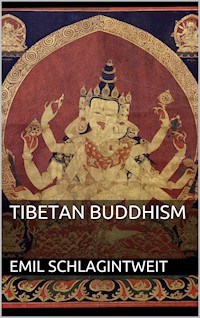
- Herausgeber: Emil Schlagintweit
- Kategorie: Religion und Spiritualität
- Sprache: Englisch
THE religious systems of all ages--paganism in its rudest form perhaps excepted--have undergone changes and modifications which, if not materially affecting their principles, have at least exercised a certain influence upon their development. Buddhism may be considered a remarkable illustration of this; for not only have the rites suffered notable changes, but even the dogmas themselves have, in the course of time, become much altered. Although plain and simple in the earlier stages of its existence, it was in time greatly modified by the successive introduction of new doctrines, laws, and rites; so-called reformers arose, who assembled around them a greater or less number of followers; and these by degrees formed schools, which by-and-by developed into sects.
The present work has for its object the description of Buddhism as we now find it in Tibet, after an existence in this country of upwards of twelve centuries.
Das E-Book können Sie in Legimi-Apps oder einer beliebigen App lesen, die das folgende Format unterstützen:
Veröffentlichungsjahr: 2014
Ähnliche















EMIL SCHLAGINTWEIT
Tibetan Buddhism
Table of contents
PREFACE
CHAPTER I SKETCH OF THE LIFE OF SÂKYAMUNI, THE FOUNDER OF BUDDHISM
CHAPTER II GRADUAL RISE AND PRESENT AREA OF THE BUDDHIST RELIGION
CHAPTER III THE RELIGIOUS SYSTEM OF SÂKYAMUNI
CHAPTER IV THE HÎNAYÂNA SYSTEM
CHAPTER V THE MAHÂYÂNA SYSTEMS
CHAPTER VI THE SYSTEM OF MYSTICISM
CHAPTER VII HISTORICAL ACCOUNT OF THE INTRODUCTION OF BUDDHISM INTO TÍBET
CHAPTER VIII THE SACRED LITERATURE
CHAPTER IX VIEWS ON METEMPSYCHOSIS
CHAPTER X. DETAILS CHARACTERISTIC OF THE RELIGION OF THE PEOPLE.
CHAPTER XI TRANSLATION OF AN ADDRESS TO THE BUDDHAS OF CONFESSION
CHAPTER XII THE TIBETAN PRIESTHOOD
CHAPTER XII RELIGIOUS BUILDINGS AND MONUMENTS
CHAPTER XIV REPRESENTATIONS OF BUDDHIST DEITIES
CHAPTER XV WORSHIP OF THE DEITIES, AND RELIGIOUS CEREMONIES
PREFACE
THE religious systems of all ages--paganism in its rudest form perhaps excepted--have undergone changes and modifications which, if not materially affecting their principles, have at least exercised a certain influence upon their development. Buddhism may be considered a remarkable illustration of this; for not only have the rites suffered notable changes, but even the dogmas themselves have, in the course of time, become much altered. Although plain and simple in the earlier stages of its existence, it was in time greatly modified by the successive introduction of new doctrines, laws, and rites; so-called reformers arose, who assembled around them a greater or less number of followers; and these by degrees formed schools, which by-and-by developed into sects. The shifting of its original seat also exercised a considerable influence: the difference between a tropical and a cold and desert region, and between the physical character of tribes separated by the distinctive marks of the Arian and Turanian races, had to be smoothed over, partly at least, and obliterated by the influence of time. The present work has for its object the description of Buddhism as we now find it in Tibet, after an existence in this country of upwards of twelve centuries. The information obtained by my brothers Hermann, Adolphe, and Robert de Schlagintweit, when on the scientific mission undertaken between the years 1854-58, which gave them the opportunity of visiting various parts of Tibet and of the Buddhist countries in the Himálaya, has been the chief source on which I have drawn for my, remarks and descriptions. The reports of former travellers have also been consulted and compared with the contributions received from my brothers. Not less important for my subject, as enabling one to judge of the fundamental laws of Buddhism, and their subsequent modifications, were the researches of the oriental philologists and intelligent writers on Buddhist doctrines, amongst whom Hodgson and Burnouf have so successfully led the way to the analysis of the original native works. For the greater part of the objects here treated of and for most of the native explanatory remarks, I am indebted to my brother Hermann. He had engaged in Síkkim the services of Chibu Lama, a very intelligent Lepcha, then a political agent of the Râja of Síkkim at Darjíling. Through this personage he was enabled to obtain numerous objects which had come from Lhássa, the centre of the Buddhist faith in Tibet. Mr. Hodgson and Dr. Campbell, besides giving him much valuable information, were also so kind as to present him with various articles of interest for this subject. In Western Tibet, it was particularly at the monastery of Hímis and in Leh, the capital of Ladák, that Hermann's wishes were the most readily accomplished. In Gnári Khórsum Adolphe, who was at that time accompanied by Robert, succeeded in persuading the Lamas of Gyúngul and Mángnang to sell him even objects which he had seen treated with the greatest respect and awe. The folio atlas of twenty plates, two feet high and one and a half broad, contains facsimiles of representations of deities and of objects used for keeping off evil spirits. The originals were reproduced by means of transfer-paper, a method which has the great advantage that the alterations are entirely avoided which the artists are but too willing to make. The drawings being mechanically copied, retain entirely the stamp of foreign art. The details in reference to the method employed for the reproduction are given in the introduction to the atlas. The plates have been printed in the lithographic establishment of Dr. C. Wolf and Son at Munich. For the illustrations accompanying the text I selected those of a more scientific nature in preference to those of a descriptive character. They consist of copies taken from original woodcuts, and of prints in Tibetan characters of the texts translated. These tables have been executed in the imperial printing office at Vienna. Their correct execution was kindly undertaken by Mr. de Auer, the director of this institution, so well known for its excellence in typographical and artistical reproductions. In my studies of Tibetan I have been greatly assisted by Mr. A. Schiefner at St. Petersburg, to whose publications I shall often have occasion to allude. This gentleman also afforded me the welcome opportunity of laying the verbal explanatory details of the priests in loco a second time before a Lama, the Buriat Galsang Gombojew, who is engaged at St. Petersburg as teacher of Mongolian; he made for me, besides, various abstracts from books contained in the imperial oriental libraries having a bearing upon these objects. I may be allowed to mention that I had the honour of presenting to the Royal Academy of Munich the Address to the Buddhas of Confession (contained in Chapter XI.); a sacred imploration, of which a translation in German was inserted in the Proceedings of this Institution.
CHAPTER I SKETCH OF THE LIFE OF SÂKYAMUNI, THE FOUNDER OF BUDDHISM
ORIGIN.--THE PRINCIPAL EVENTS IN HIS LIFE.--HIS ATTAINMENT OF THE PERFECTION OF A BUDDHA.--PERIOD OF HIS EXISTENCE.
ALTHOUGH the numerous legends respecting the life and works of Sâkyamuni, the reputed founder of the Buddhist faith, contain much that is fabulous, yet most of the incidents mentioned therein, when deprived of the marvellous garb with which early historians invariably used to embellish their tales, seem to be based on matters of fact. At present scientific researches have put Sâkyamuni's real existence beyond a doubt;[1] but the period in which he lived will ever remain somewhat vaguely defined.
[1. See for details the biographies published by Csoma de Körös, "Notices of the life of Shakya," in the Asiatic Researches, Vol. XX., pp. 285-318; Hardy, "Manual of Buddhism," pp. 138-359; Schiefner, "Eine tibetanische Lebensbeschreibung Sâkyamuni's," in the "Mémoires des Savants étrangers," Vol. VI., pp. 231-332. For Tibetan and Singhalese traditions about the Sâkya race, see Foe koue ki, English translation, Calcutta, 1848, p. 203.]
Sâkyamuni was born at Kapilavastu in Gorakhpúr. The legends tell us that his father, the king Suddhodana (in Tibetan Zastang), requested one hundred and eight learned Brahmans to inform him of his son's destiny; the Brahmans, the legends say, after a careful examination of the prince's body, expressed their conviction that, "if he remained a layman during his lifetime, he would become a powerful monarch of vast territories; but in the event of his turning recluse, he would enter the state of a supreme Buddha or wise man: and in solemn assembly they declared that this prince would hereafter prove a blessing to the world, and that he himself would also enjoy great prosperity." It was in consequence of this answer, that the prince received the name of Siddhârtha, "the establisher."[1] Siddhârtha proved to be endowed with extraordinary faculties, and the legends even go so far as to assert that, when he was about to be taught his letters, he could already distinguish them, and his eminent qualities were manifest, not only in his mental, but also in bodily perfection. It is added as particularly characteristic that already in his youth he was inclined to retirement and [1. In the sacred legends he is generally characterised by other names. Those of Sâkyamuni--in Tibetan Shakya Thub-pa, "Sâkya, the mighty"--Gautama, or Sramana, Gautama, "the ascetic of the Gautamas," refer alike to his family and career. The names of Bhagavat, "the fortunate," Sugata, "the welcome," Buddha, "the wise," designate his supreme perfection. A name which is very frequently given to the Buddhas in sacred books is Tathâgata, in Tibetan Dezhin, or Dezhin shegpa, "he who has gone in the manner of his predecessors." See Abel Rémusat, "Note sur quelques épithètes descriptives de Bouddha." Journ. des Savans, 1817, p. 702. Burnouf "Introduction," p. 70 et seq. Barthélemy St. Hilaire, "Le Bouddha et sa Religion", p. 75.] solitude: he abandoned his gay, playful comrades and buried himself in the dark recesses of dense forests, where he gave himself up to profound meditation. Suddhodana, the father, however, wished his son to become rather a powerful monarch, than a lonely ascetic. When, therefore, after a renewed consultation with the Brahmans, he learned that Siddhârtha would certainly leave his magnificent palace and become an ascetic, in the event of his seeing four things, viz. decrepitude, sickness, a dead body, and a recluse, he placed guards on all sides of the palace, in order that these, dreaded objects might not come near his beloved son. Moreover, in order to weaken his love of solitude and meditation, he married him to Gopâ (in Tibetan Sa Tsoma), the daughter of Dandapâni, of the race of the Sâkyas, and gave orders that he should be provided with every kind- of pleasure. But all these precautions proved futile. Siddhârtha, though living in the midst of festivities and in the enjoyment of all wordly {sic} pleasures, never ceased to reflect upon the pains which arise from birth, sickness, decay, and death; upon their causes, and upon the remedies to be used against them. He found that existence is the real cause of these pains, that desire produces existence, and that the extinction of desire causes cessation of existence. He then determined--as he had already done a hundred times before-to lead human beings to salvation--by teaching them the practice of virtues :and by detaching them from the service of the world. Although he had hitherto often hesitated, his resolution to renounce the world and to become an ascetic was, finally put into execution, when he happened, on his walk to a garden in the vicinity of the palace, to meet at four different periods an old man, a leper, a dead body, and a man in a religious garb. He had attained the age of twenty-nine years, when he left his palace, his wife, and the infant son to whom she is said to have given birth at the very moment of her husband's meeting with the recluse.[1] Siddhârtha began his ascetic life by assiduously studying the doctrines of the Brahmans and by becoming the disciple of the most learned of them. Being, however, dissatisfied with their theories and practices, which, he declared, did not offer the true means of salvation, he left them altogether, and gave himself up during the next six years to earnest meditation and the exercise of great austerities; the latter, however, he soon renounced, perceiving from his own experience, that the mortifications practised by the Brahmans were not of a nature to lead to the attainment of perfection. The six years past, he proceeded to the holy spot Bôdhimanda, where the Bôdhisattvas become Buddhas; and it was here, that, having seated himself upon a couch of grass of the kusa species, he arrived at supreme perfection, which became manifest by his remembering the exact circumstances of all human beings that had ever existed; by his obtaining [1. It is more probable, says Wassiljew, in his "Buddhismus," p. 12, that Sâkyamuni was led to view existence as the cause of pain and sorrow in consequence of a war in which the Sâkya tribe was defeated, and which obliged him to wander about, rather than by his seeing the four dreaded objects mentioned; for there is a legend which says that the Sâkya race was almost entirely exterminated during the life of the Buddha.] the divine eye, by the aid of which he could see all things within the space of the infinite worlds, and by his receiving the knowledge that unfolds the causes of the ever-recurring circle of existence. Sâkyamuni being now endowed with all these wonderful and marvellous faculties, became the wisest man, the most perfect Buddha. But having arrived at this state of perfection, he still hesitated whether he should make known his doctrines and propound them to men, his principles being, in his opinion, opposed to all those then adhered to. He was, at first, afraid of being exposed to the insults of animated beings, who are unwise and filled with evil designs. But, moved by compassion, and reflecting, that there would remain nevertheless many beings who would understand him and be delivered by him from existence--the cause of pains and sorrows--he at once resolved to teach the law that had been revealed to him.[1] Sâkyamuni died, the books say, after having attained an age of eighty years. The data contained in the sacred books as the year of this event, differ considerably, the most distant periods mentioned being the years 2422 and 544 B.C. Lassen, in his examination of these materials, gives preference to the literature of the southern Buddhists, which places his death in 544 or 543 B.C. Westergaard, however, in a recent essay on this subject, believes even this epoch to be by far too early, and calculates his death to have taken [1. Barthélemy St. Hilaire, "Le Buddha et sa Religion," p. 32.] place in the period from 370 to 368 B.C., or about one generation before Alexander the Great took the throne.[1] [1. Lassen "Indische Alterthumskunde," Vol. II., p. 51. Westergaard, "Ueber Buddha's Todesjahr;" German translation, p. 94.]
CHAPTER II GRADUAL RISE AND PRESENT AREA OF THE BUDDHIST RELIGION
DEVELOPEMENT {sic} AND DECLINE IN INDIA.--EXTENSION OVER VARIOUS PARTS OF ASIA.--COMPARISON OF THE NUMBER OF BUDDHISTS WITH THAT OF CHRISTIANS.
SCARCELY had Sâkyamuni begun to teach his new religion in India, when he obtained a great many followers. His system had an extraordinary success both on account of its simplicity and of the abolition of castes; the Buddha admits to the blessings of which he is the dispenser the highest classes of man (Brahmans) as well as the lowest. Already at his death the number of Buddhists seems to have been very considerable; and about the middle of the third century B.C., during the reign of Asoka, Buddhism began to spread all over India. It then continued to flourish for eight hundred years (till the fifth century of our era), when a series of violent persecutions was commenced (instituted by Brahmanical sectaries, particularly by the adherents to the
worship of Siva) which almost caused the extirpation of Buddhism. Hiuen Thsang, a Chinese pilgrim who had passed much of his life in India during extensive travels between the years 629 and 645 A.D., mentions numerous Buddhist temples, monasteries, and monuments, which in his time were already deserted, and even fallen into ruins--buildings which, two centuries before, Fa Hian, another Chinese traveller, had found in the most prosperous condition. Nevertheless, in many parts of India, Buddhists were still in existence, and in Benáres, now again a centre of Brahmanism, they are reported to have been the prevalent sect until the eleventh century, and in the northern parts of Gujrát even as late as, the twelth {sic}. After that period, Buddhism ceased to exist in India, by reason of a combination of circumstances, amongst which the jealousy of the various schools and the invasion of the Mussalmáns are to be mentioned as perhaps the most important.[1] As present the area of Buddhism includes vast territories, from Ceylon and the Indian Archipelago in the south to the Baikal Lake in Central Asia, and from the Caucasus eastward to Japan; and the number of its adherents may be considered as being at least equal to, if it does not exceed, that of the followers of the Christian religion, as will be seen from the following data.[2] [1. Compare Mountstuart Elphinstone's "History of India," Vol. I., p. 212. Lassen, "Ind. Alterthumskunde," Vol. IV., p. 707. 2. Prof. Neumann of Munich has computed the number of Buddhists in China, Tibet, the Indo-Chinese countries, and Tartary at 369 millions. Ungewitter, "Neueste Erdbeschreibung," Vol. I., p. 51, estimates the total of {footnote p. 11} Buddhists at 325 millions. Colonel Sykes, whose accuracy in every branch of science, especially, however, in statistics, is so well known, also considers it certain that the Buddhists out-number the followers of any other creed: see his essay "On Indian Characters." London 1859.]
The late Professor Dieterici, in his well-known compilation of the census of the globe,[1] estimates the population of China at four hundred millions, of Japan at thirty-five; and for the Indo-Chinese Peninsula he gives fifteen millions as the number of inhabitants in the independent territories. The data for the Indian dependencies in the peninsula are of great variety. Thornton's "Gazeteer" gives for Arrakán, Pégu, and Tenásserim a population of about one million; but in a note contained in Allens Indian Mail, 1861, the inhabitants of Pégu alone are calculated to amount to one million. An average of two millions for these three provinces is, perhaps, most in accordance with their area when compared with the remainder of the peninsula.[3] The inhabitants of the Indo-Chinese Archipelago are set down by Dieterici at eighty millions, of which twenty belong to the Dutch and Spanish possessions. The population of Ceylon, which is all Buddhist, exceeds, according to McCarthey, two millions.[3] In India Properthere are scarcely any Buddhists at all. For these regions of Asia we obtain, therefore, according [1. "Die Bevölkerung der Erde," in Petermann's "Geographische Mittheilungen," 1859, p. 1. 2. Thornton's "Gazeteer." Allen's Indian Mail, 1861, p. 802. 3. Report of the Proceedings of the fourth Session of the International Statistical Congress; London, 1861, p. 84. Compare Hardy, "Eastern Monachism," p. 310.] {p. 12} to these calculations an approximate total of 534 millions of inhabitants. At least two-thirds of this population may be considered to be Buddhists; the remainder includes the followers of Confucius and Lao-tse, the adherents of religions prevalent among the inhabitants of China Proper,[1] the Mussalmáns (numerous in Chinese Tartary), and the Pagan tribes of the Chinese peninsula and the Archipelago; the numbers of the latter are comparatively small, since in their districts the population is very thin. We may therefore estimate the total of Buddhists to amount to 340 millions. The contribution to this number from other parts of the globe is comparatively small, but nevertheless it seems to amount to more than a million. The eastern provinces of the Russian Empire contain some 400,000 Buddhists, viz. 82,000 Kirghises and 119,162 Kalmuks inhabiting Europe,[2] and the Buriats (to the number of about 190,000 souls) living in Sibiria, these are almost all followers of Buddhism.[3] There are still to be added for the Himálaya and Western Tibet, independant of China, the inhabitants of Bhután, to the number of 145,200, the whole of them, according to Pemberton, [1. For China, Gützlaff states the Buddhists to be "the most popular and numerous sect," adding "that their religious establishments may be estimated at two-thirds of the whole of the religious edifices throughout China." R. As. Soc., Vol. XVI., p. 89. Schott, "Buddhaismus," p. 23, was of the opinion (in 1844) that the Buddhists were the minority. 2. Notices taken from P. v. Köppen's memoir "Ueber die Anfertigung der ethnographischen Karte des europäischen Russlands." Bulletin hist.-phil. de l'Académie de St. Pétersbourg, Vol. IX., Table to face p. 336. 3. Latham, "Descriptive Ethnology," Vol. I., p. .306. The same was told me by Gombojew, a Buriat of Selenginsk.] belonging to the Buddhist faith.[1] The population of Síkkim, together with the Buddhist inhabitants of Nepál, which chiefly include those of Tibetan origin, I estimate at 500,000 to 550,000.' The Buddhist province of Spíti, under English protection, was found, according to the census made by Major Hay in the year 1849, to have a population of 1,607.[3] Ladák, now a province of the kingdom of Kashmir, is reported by Cunningham to be inhabited by 178,000 souls; the native population is exclusively Buddhist, but since the annexation to Kashmir some Hindu members of the administration and some Mussalmán merchants have settled there. The total of this group would amount even to one million and a quarter.[4] For the sake of comparison I add that Prof. Dieterici found the total number of Christians spread over [1. Report on Bhután, p. 151. A recent estimate by Hughes, quoted by the Allgemeine Zeitung, Jan. 1862, gives 1,500,000 inhabitants, a number which appears to be somewhat too large. 2. Hughes estimates Nepál to contain 1,940,000 inhabitants, of which 500,000 Buddhists. This number will not appear too high, if we remember that the actual professed Buddhists in Nepál are divided into four sects, and that Buddhist doctrines have passed to a great extent into the primitive creed of the various tribes of Tibetan origin inhabiting this kingdom. See Hamilton, as quoted by Ritter. "Asien," Vol. III., pp. 120, 123, 125, 129; Hodgson, "Languages," &c.; As. Res., Vol. XVI., p. 435; the same on the Aborigines of the Sub-Himalayan in "Records of the Govt of Bengal," p. 129. 3. Report on the valley of Spíti, in Journ. As. Soc. Beng., Vol. XIX., p. 437. 4. Buddhism had also become known in Mexico by Chinese priests in the fifth century A.D., and had followers in that country until the thirteenth century; but the victorious Azteks, who took possession of Mexico in the beginning of that century, put an end to Buddhism. See Lassen, "Ind. Alterth.," Vol. IV., pp. 749 et seq.] the globe to be 335 millions, of which 170 millions are Roman Catholics, 89 millions Protestants, and 76 millions belong to the Greek church; their numerical strength appears therefore to be five millions less than the average estimate of Buddhists given above.
CHAPTER III THE RELIGIOUS SYSTEM OF SÂKYAMUNI
THE FUNDAMENTAL LAW.--THE DOGMA OF THE FOUR TRUTHS, AND THE PATHS LEADING TO SALVATION.
Lesen Sie weiter in der vollständigen Ausgabe!
Lesen Sie weiter in der vollständigen Ausgabe!
Lesen Sie weiter in der vollständigen Ausgabe!
Lesen Sie weiter in der vollständigen Ausgabe!
Lesen Sie weiter in der vollständigen Ausgabe!
Lesen Sie weiter in der vollständigen Ausgabe!
Lesen Sie weiter in der vollständigen Ausgabe!
Lesen Sie weiter in der vollständigen Ausgabe!
Lesen Sie weiter in der vollständigen Ausgabe!
Lesen Sie weiter in der vollständigen Ausgabe!
Lesen Sie weiter in der vollständigen Ausgabe!
Lesen Sie weiter in der vollständigen Ausgabe!




