


Erhalten Sie Zugang zu diesem und mehr als 300000 Büchern ab EUR 5,99 monatlich.
- Herausgeber: Kohlhammer Verlag
- Kategorie: Religion und Spiritualität
- Sprache: Englisch
This commentary sets the ancient Jewish story of Tobit within a broad tradition-historical context, analyzing the conceptions of angels and demons it contains, as well as its notions of ancient medicine, together with its understanding of the Torah. Presented along with this is a synchronically oriented interpretation of the whole text, which shows that the narrative should ultimately be understood in terms of historical theology. It reveals how, in the days of Hellenistic rule, ancient Judaism was able to cope with the threat from the aggressive politics of the empires. Within this context, the elderly Tobit's hymn of praise at the end of the narrative in Tob 13 opens a vista of hope for its addressees.
Sie lesen das E-Book in den Legimi-Apps auf:
Seitenzahl: 1005
Veröffentlichungsjahr: 2025
Das E-Book (TTS) können Sie hören im Abo „Legimi Premium” in Legimi-Apps auf:
Ähnliche











International Exegetical Commentary on the Old Testament (IECOT)
Edited by:
David M. Carr, Christl M. Maier, Walter Dietrich, Irmtraud Fischer, Shimon Gesundheit, Bernard M. Levinson, Ed Noort, William A. Tooman, Helmut Utzschneider and Beate Ego (Apocrypha/Deuterocanonical books)
Cover:
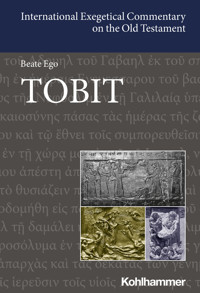
Top: Panel from a four-part relief on the “Black Obelisk of Shalmaneser III” (859–824 BCE) depicting the Israelite king Jehu (845–817 BCE; 2 Kings 9f) paying obeisance to the Assyrian “King of Kings.” The vassal has thrown himself to the ground in front of his overlord. Royal servants are standing behind the Assyrian king whereas Assyrian officers are standing behind Jehu. The remaining picture panels portray thirteen Israelite tribute bearers carrying heavy and precious gifts. Photo © Z.Radovan/BibleLandPictures.comBottom left: One of ten reliefs on the bronze doors that constitute the eastern portal (the so-called “Gates of Paradise”) of the Baptistery of St. John of Florence, created 1424–1452 by Lorenzo Ghiberti (c. 1378–1455). Detail from the picture “Adam and Eve”; in the center is the creation of Eve: “And the rib that the LORD God had taken from the man he made into a woman and brought her to the man.” (Gen 2:22)Photograph by George ReaderBottom right: Detail of the Menorah in front of the Knesset in Jerusalem, created by Benno Elkan (1877–1960): Ezra reads the Law of Moses to the assembled nation (Neh 8). The bronze Menorah was created in London in 1956 and in the same year was given by the British as a gift to the State of Israel. A total of 29 reliefs portray scenes from the Hebrew Bible and the history of the Jewish people.
Beate Ego
Tobit
Verlag W. Kohlhammer
Translated by David OrtonEditorial collaboration: Renate Klein (German), Jonathan M. Robker (English)
1. Edition 2025
All rights reserved
© W. Kohlhammer GmbH, Stuttgart
Production: W. Kohlhammer GmbH, Heßbrühlstr. 69, 70565 Stuttgart, GERMANY
Print:
ISBN 978-3-17-020444-7
E-Books:
pdf: ISBN 978-3-17-042555-2
epub: ISBN 978-3-17-042556-9
All rights reserved. This book or parts thereof may not be reproduced in any form, stored in any retrieval system, or transmitted in any form by any means—electronic, mechanical, photocopy, recording, microfilm/microfiche or otherwise—without prior written permission of W. Kohlhammer GmbH, Stuttgart, Germany.
Any links in this book do not constitute an endorsement or an approval of any of the services or opinions of the corporation or organization or individual. W. Kohlhammer GmbH bears no responsibility for the accuracy, legality or content of the external site or for that of subsequent links.
This commentary sets the ancient Jewish story of Tobit within a broad tradition-historical context, analyzing the conceptions of angels and demons it contains, as well as its notions of ancient medicine, together with its understanding of the Torah. Presented along with this is a synchronically oriented interpretation of the whole text, which shows that the narrative should ultimately be understood in terms of historical theology. It reveals how, in the days of Hellenistic rule, ancient Judaism was able to cope with the threat from the aggressive politics of the empires. Within this context, the elderly Tobit’s hymn of praise at the end of the narrative in Tob 13 opens a vista of hope for its addressees.
Prof. Dr. Beate Ego teaches exegesis and theology of the Old Testament at Ruhr-University Bochum.
Content
Editors’ ForewordAuthor’s PrefaceIntroductionStructure of this commentaryIntroductionThe Text’s TransmissionSynchronic Aspects of the Tobit NarrativeThe Narrative’s Arrangement and StructureGenre(s)Narrative StylePlot CharactersImportant Themes: Key Words, Significant Motifs and Motif FieldsDiachronic Aspects of the Tobit NarrativeOn Literary CriticismDate and Place of OriginBiblical and Extrabiblical References and Tradition-Historical AspectsBiblical ReferencesAncient Jewish Extrabiblical TraditionsOther TraditionsGeneral InterpretationText-Historical AspectsCanonicity and Reception HistoryCanon-Historical AspectsReception HistoryThe Book’s Title: Tobit’s Background and Exile (1:1–2)Notes on Text and TranslationSynchronic AnalysisStructure and ContentDetailed AnalysisInternal ReferencesDiachronic AnalysisSynthesisExposition: Tobit’s and Sarah’s Suffering, Their Prayers, and the Sending of the Angel (1:3–3:17)Pious Tobit’s Way of Life, His Despair, and His Prayer (1:3–3:6)Notes on text and translationSynchronic AnalysisStructure and ContentDetailed InterpretationInternal ReferencesDiachronic AnalysisSynthesisSarah’s Suffering and Prayer (3:7–15)Notes on Text and TranslationSynchronic AnalysisStructure and ContentDetailed ExegesisInternal ReferencesDiachronic AnalysisSynthesisPrayers Are Answered and the Angel Raphael Is Sent (3:16–17)Notes on Text and TranslationSynchronic AnalysisStructure and ContentDetailed ExegesisInternal ReferencesDiachronic AnalysisSynthesisMain Section: The Journey with the Angel and the Healings (4:1–14:1a)Planning the Journey and Tobit’s Teaching (4:1–21)Notes on Text and TranslationSynchronic AnalysisContent, Structure, and Genre/FormsDetailed AnalysisInternal ReferencesDiachronic AnalysisSynthesisSearch for a Travel Companion, Arrangements, and Farewell (5:1–6:1)Notes on Text and TranslationSynchronic AnalysisStructure and ContentDetailed ExegesisInternal ReferencesDiachronic AnalysisSynthesisFrom Nineveh to Ecbatana: A Significant Catch and Preparation for the Meeting with Sarah (6:2–18)Notes on Text and TranslationSynchronic AnalysisStructure and ContentDetailed ExegesisInternal ReferencesDiachronic AnalysisSynthesisThe Reception by Sarah’s Family in Ecbatana and the Wedding Preparations (7:1–17)Notes on Text and TranslationSynchronic AnalysisStructure and ContentDetailed InterpretationInternal ReferencesDiachronic AnalysisSynthesisCasting Out the Demon and a Happy Wedding (8:1–21)Notes on Text and TranslationSynchronic AnalysisStructure and ContentDetailed AnalysisInternal ReferencesDiachronic AnalysisSynthesisRaphael Fetches the Silver from Gabael in Rages (9:1–6)Notes on Text and TranslationSynchronic AnalysisStructure and ContentDetailed InterpretationInternal ReferencesDiachronic AnalysisSynthesisThe Approaching Journey Home (10:1–13)Notes on Text and TranslationSynchronic AnalysisStructure and ContentDetailed InterpretationInternal ReferencesDiachronic AnalysisSynthesisThe Return Home: Tobit’s Healing and Sarah’s Arrival (11:1–18)Notes on Text and TranslationSynchronic AnalysisStructure, Content, and Defining MotifsDetailed InterpretationInternal ReferencesDiachronic AnalysisSynthesisRaphael’s Farewell: Remuneration, Admonitions, and Self-Revelation (12:1–22)Notes on Text and TranslationSynchronic AnalysisStructure, Content, and GenreDetailed InterpretationInternal ReferencesDiachronic AnalysisSynthesisTobit’s Song of Praise for God’s Mercy and the New Jerusalem (13:1–14:1a)Notes on Text and TranslationSynchronic AnalysisStructure and ContentDetailed InterpretationImportant Internal ReferencesDiachronic AnalysisSynthesisThe Epilogue: Tobit’s Legacy and his Fulfilled Life (14:1b–15)Notes on Text and TranslationSynchronic AnalysisIntroduction, Structure, and ContentDetailed AnalysisInternal ReferencesDiachronic AnalysisSynthesisAppendixAbbreviationsBibliography1. Tobit: Editions and Commentaries1.1 Editions1.2 Selected Commentaries on Tobit2. Further Sources and Resources3. Other Research LiteratureIndicesIndex of Selected Biblical SourcesOld TestamentNew TestamentIndex of Selected Extrabiblical SourcesIndex of Greek WordsKeywordsPlan of VolumesEditors’ Foreword
The International Exegetical Commentary on the Old Testament (IECOT) offers a multi-perspectival interpretation of the books of the Old Testament to a broad, international audience of scholars, laypeople and pastors. Biblical commentaries too often reflect the fragmented character of contemporary biblical scholarship, where different geographical or methodological sub-groups of scholars pursue specific methodologies and/or theories with little engagement of alternative approaches. This series, published in English and German editions, brings together editors and authors from North America, Europe, and Israel with multiple exegetical perspectives.
From the outset the goal has been to publish a series that was “international, ecumenical and contemporary.” The international character is reflected in the composition of an editorial board with members from six countries and commentators representing a yet broader diversity of scholarly contexts.
The ecumenical dimension is reflected in at least two ways. First, both the editorial board and the list of authors includes scholars with a variety of religious perspectives, both Christian and Jewish. Second, the commentary series not only includes volumes on books in the Jewish Tanach/Protestant Old Testament, but also other books recognized as canonical parts of the Old Testament by diverse Christian confessions (thus including the deuterocanonical Old Testament books).
When it comes to “contemporary,” one central distinguishing feature of this series is its attempt to bring together two broad families of perspectives in analysis of biblical books, perspectives often described as “synchronic” and “diachronic” and all too often understood as incompatible with each other. Historically, diachronic studies arose in Europe, while some of the better known early synchronic studies originated in North America and Israel. Nevertheless, historical studies have continued to be pursued around the world, and focused synchronic work has been done in an ever greater variety of settings. Building on these developments, we aim in this series to bring synchronic and diachronic methods into closer alignment, allowing these approaches to work in a complementary and mutually-informative rather than antagonistic manner.
Since these terms are used in varying ways within biblical studies, it makes sense to specify how they are understood in this series. Within IECOT we understand “synchronic” to embrace a variety of types of study of a biblical text in one given stage of its development, particularly its final stage(s) of development in existing manuscripts. “Synchronic” studies embrace non-historical narratological, reader-response and other approaches along with historically-informed exegesis of a particular stage of a biblical text. In contrast, we understand “diachronic” to embrace the full variety of modes of study of a biblical text over time.
This diachronic analysis may include use of manuscript evidence (where available) to identify documented pre-stages of a biblical text, judicious use of clues within the biblical text to reconstruct its formation over time, and also an examination of the ways in which a biblical text may be in dialogue with earlier biblical (and non-biblical) motifs, traditions, themes, etc. In other words, diachronic study focuses on what might be termed a “depth dimension” of a given text—how a text (and its parts) has journeyed over time up to its present form, making the text part of a broader history of traditions, motifs and/or prior compositions. Synchronic analysis focuses on a particular moment (or moments) of that journey, with a particular focus on the final, canonized form (or forms) of the text. Together they represent, in our view, complementary ways of building a textual interpretation.
Of course, each biblical book is different, and each author or team of authors has different ideas of how to incorporate these perspectives into the commentary. The authors will present their ideas in the introduction to each volume. In addition, each author or team of authors will highlight specific contemporary methodological and hermeneutical perspectives—e.g. gender-critical, liberation-theological, reception-historical, social-historical—appropriate to their own strengths and to the biblical book being interpreted. The result, we hope and expect, will be a series of volumes that display a range of ways that various methodologies and discourses can be integrated into the interpretation of the diverse books of the Old Testament.
Fall 2012 The Editors
Author’s Preface
The story of Tobit has increasingly attracted the attention of scholarly research in recent decades. The publication of the Dead Sea Scrolls by Joseph Fitzmyer in 1995 has been an important factor in this. A further milestone was the publication of the medieval Jewish Aramaic and Hebrew texts of Tobit by Stuart Weeks, Simon Gathercole, and Loren Stuckenbruck (2004). This work set scholarly research on the text of Tobit on a new foundation. As such themes and motifs as “Jewish identity and the Diaspora,” “magic and traditional medicine,” “angels and demons,” “Torah,” and “prayerful piety” play an important role in the Tobit account, it also has a key position in discussions in the context of ancient Jewish religious history. I myself am pleased to have been able to participate in research on this text since the early 1990s and to have been able constantly to discover new things while doing so.
As this commentary finds its conclusion and reaches the end of a long journey, it is appropriate to express my thanks. First and foremost I would like to mention the Volkswagen Foundation (VolkswagenStiftung), which granted my application for the project “Historical-critical commentary of the Tobit narrative in its ancient Jewish, early Christian, and medieval Jewish versions” in the context of the Opus Magnum support grant. Its financing of a secondment allowed me to concentrate fully on work on this commentary for two years (10/2016–9/2018). Private lecturer Dr. Kathrin Liess, of Munich, substituted for me so comprehensively in teaching duties during this period that classes in my department were able to continue without any restrictions. Thanks are also due to the Ruhr-Universität Bochum’s Department of Protestant Theology and to the board of the university for their generosity in accommodating such a long “absence” from everyday university life. I would like to thank the Deutsche Bibelgesellschaft, Stuttgart, for permission to use the text of Tobit from “Septuaginta Deutsch. Das griechische Alte Testament in deutscher Übersetzung, ed. Wolfgang Kraus and Martin Karrer, © 2009, Deutsche Bibelgesellschaft, Stuttgart” as the basis for my work in the German original edition of this commentary.
My thanks also goes to all those who participated in the progress of the work itself, first and foremost my student aids Sophia Daniel, Natalie Gabisch, Richard Jamison, Leonie Stör, and Isabel Wolf; special thanks goes to Karina Krainer, who saw the project through from beginning to end with great perseverance and care. Thanks is also due to the chief editor of the IEKAT (IECOT) series, Prof. Dr. Walter Dietrich, for his commitment in supervising this commentary as well as Florian Specker of the editorial department of Kohlhammer Verlag for his patience and encouragement in the preparation of the manuscript. In regard to the careful assistance for the English translation (provided by David Orton), my special thanks goes to Andrea Häuser from Kohlhammer Verlag and PD Dr. Jonathan M. Robker of Münster/Weißenhorn.
Finally, I would like to thank everyone who took an interest in Tobit and his family, in Sarah and Asmodeus and the angel Raphael, over the course of this commentary’s long preparation and everyone who inspired me in my work through their questions and their stories, as well as through invitations to workshops and lectures. My work on this narrative was led by fascination with a text in which many different motifs of the ancient Jewish imagination flow together and whose tradents constantly revealed new facets of its material that imbued both Jewish and Christian traditions with meaning.
Introduction
Structure of this commentary
The Tobit narrative is attested in both Hebrew and Aramaic (in the fragmentary transmission of the Qumran texts) as well as in three Greek (GI, GII and GIII) and two Latin versions (“Vetus Latina” and “Vulgate”). Given the fragmentary character of the Qumran texts, a commentary that aims to do justice to the narrative as a whole has to begin with the Greek tradition. As the long form GII, attested mainly by Sinaiticus, represents the oldest and almost complete version of the narrative and the sections missing there, 4:7–19b and 13:6c–10 can be relatively easily reconstructed with the aid of the short text GI and the Vetus Latina,1 GII is the version that will be used as the starting point for the present commentary.2 Unless otherwise indicated, references are thus to the long text GII; the missing verses, 4:7–19b and 13:6c–10, have been reconstructed accordingly. Chapter and verse numbers follow the edition of the Septuagint by Robert Hanhart (1983).
The individual sections of the commentary are structured as follows: After a translation of the text according to GII, notes on text and translation are given including brief references to the short text GI as well as to the Qumran tradition and the Vulgate, focusing on those variants relevant to the content of the story. The translations of the Qumran texts and of GI, as well as of the Vulgate are my own. To keep the scope of this commentary within reasonable bounds, reference must be made to the following readily accessible publications for a detailed presentation of these texts and their relevant translations: A comprehensive presentation of all the Qumran texts with a philological focus is given by Joseph Fitzmyer3 and Michaela Hallermayer4. Fitzmyer in his commentary (2003) presents parallel translations of both GII and GI.5 An English translation of the Vulgate version can be found in Skemp’s work on that version.6
Further discussion of the text follows the IECOT series format and makes a clear differentiation between synchronic and diachronic ways of looking at the texts.7 Under the heading “Synchronic analysis,” the first main part of each commentary section looks mainly at what the text reveals directly about its structure, its narrative style, significant motifs, and its theological stance. Another main part then examines diachronic aspects of the text. Since a commentary on the narrative as a whole has to work with a translation, the transmission of the book allows for only limited literary-critical conclusions. Given this background, the present work does not provide a detailed literary analysis in its commentary sections, but offers some basic information on this aspect and a “large-scale” model for the book’s literary history, especially in the introduction. However, references to older biblical texts and the work’s tradition-historical contexts are particularly informative for the diachronic structure of the tradition. Each chapter concludes with a synthesis giving a concise summary of the preceding discussion.
The most important insights on the development from long text GII to short text GI, the Vulgate, and post-antiquity Jewish traditions are presented in the Introduction so as not to expand the scope of the commentary unduly. A continuous commentary on the Vulgate, as well as a detailed presentation of the post-antiquity texts and their textual developments must be left for later studies.
Thus, the focus of the commentary itself—in addition to a synchronic view—is on the book’s tradition history. The introductory section, however, deals with important developments in the textual history with reference to matters of content besides the more customary “introductory questions”.
Since the publication of the fragments from Qumran, interest in Tobit has grown steadily.8 In order to keep this commentary within manageable bounds, it was not possible for me to engage in a detailed discussion and evaluation of all the numerous works on Tobit. I would like to take this opportunity to thank all my colleagues for their contributions, even though it was not always possible to discuss their work extensively.
Introduction
The book of Tobit tells the story of the pious and righteous Tobit, who, following the Assyrian conquest, has to live in the Diaspora. There, he is blinded through no fault of his own, and miraculously healed by divine help, mediated by an angel. This plot line is set parallel to the story of Sarah, who is also in dire straits: an evil demon has already killed seven men who wanted to marry her before the wedding, so that she is now exposed to shame and mockery. God sends the angel Raphael, appearing as a young man named Azariah. Raphael/Azariah instructs Tobias, Tobit’s son, to use the heart, liver and gall of a fish to free Tobit and Sarah from their sufferings. Tobias and Sarah even become a romantic couple and can thus fulfill the commandment of endogamy, which, for the narrator, is an important part of the Mosaic Law. Ultimately, however, the return to the Holy Land and the magnificently built city of Jerusalem is expected. The individual fate of the protagonists serves as a paradigm for the nation’s destiny and serves as an exemplar for its salvation.
The Text’s Transmission
Overview The history of the text’s transmission is complex. In addition to the Hebrew and Aramaic Qumran fragments, there are three different Greek text forms (the so-called short text GI, the long text GII, and a mixed form, GIII). Besides the Syrian, Sahidic, Ethiopic, and Armenian versions, there are also two Latin versions among the earlier translations: the Vetus Latina and Jerome’s Vulgate. While the Vetus Latina displays considerable similarities to the long text GII, Jerome’s translation, though close to the Vetus Latina, has its own distinctive character. There are, furthermore, five later Hebrew versions of the text as well as an Aramaic one, which can be traced back to the Middle Ages. These are translations of Greek or Latin texts back into Hebrew resp. Aramaic, which freely reshape the tradition.9
Qumran The Qumran discoveries showed clearly that the narrative was originally written in a Semitic language. In 1952, numerous individual fragments of the text in Aramaic and Hebrew were found in Cave 4. In total, fragments of four Aramaic-language scrolls are preserved (1–4) as well as a fragmentary manuscript in Hebrew (5):
1. 4QpapToba ar (4Q196) is written on papyrus in late-Hasmonean script and dated to about 50 BCE. Here, twenty fragments of different lengths could be identified; thirty parts are unidentified.
2. 4QTobb ar (4Q197) is written on brown leather fragments. This copy was written in early-Herodian formal script and can be dated to the period between about 25 BCE and 25 CE. Five fragments of this copy have been identified; two remain unidentified.
3. 4QTobc ar (4Q198) consists of two fragments on thin tanned leather. The script can be classified as a late-Hasmonean or early-Herodian “book hand” with some semicursive elements and can be dated to around 50 BCE. The two fragments appear to contain parts of Tob 14; however, the second fragment is difficult to place with any certainty.
4. 4QTobd ar (4Q199) is represented by two single fragments on brown leather. The text is written in the Hasmonean script and can be dated to about 100 BCE. This is the oldest preserved text of Tobit.
5. 4QTobe hebr (4Q200), the only fragment in Hebrew, consists of nine individual fragments on leather. The script may be described as an early-Herodian formal hand, datable to between about 25 BCE and 25 CE. Altogether, eleven fragments are preserved; the identification of two fragments is uncertain.
Overview of the Qumran fragments 4Q196–200
4QpapToba ar4QTobb ar4QTobc ar4QTobd ar4QTobe hebr1 1:172 1:19–2:23 2:34 2:10–115 3:51 3:6–81 3:66 3:9–151 ii 3:10–117 3:178 4:29 4:52 4:3–910 4:711 4:21–5:12 4:21–5:13 5:212 5:93 5:12–1413 6:6–84 i 5:19–6:1214 i 6:13–184 ii 6:12–1814 ii 6:18–7:64 iii 6:18–7:101 7:1115 7:135 8:17–9:44 10:7–95 11:10–1416 12:117 i 12:18–13:66 12:20–13:417 ii 13:6–127 i 13:13–1418 13:12–14:31 14:2–67 ii 13:18–14:219 14:72 14:10 (?)2 14:108 ?20–49 ?6–7 ?9 3:3–4Finally, there is a fragment of Schøyen Ms. 5234 for Tob 14:3–6.
The Qumran fragments have some characteristics typical of Qumran scribal practice. The Aramaic is classified as Middle Aramaic, similar to other non-biblical texts from Qumran, such as the Genesis Apocryphon or the Targum of Job, and datable to the period between the second century BCE and the beginning of the second century CE. The language of the Hebrew fragment, on the other hand, is an example of a late postexilic Hebrew.
A much-discussed problem since the discovery of these fragments is the question of which text form—the Aramaic or the Hebrew—is to be regarded as the original. A decision is complicated by the fact that although twenty percent of the Aramaic text is preserved, only six percent of the Hebrew text is extant, with only a few overlaps between the two traditions, making a direct comparison of longer passages impossible. The general tendency in recent years has been to assume that the narrative was first written in Aramaic and then translated into Hebrew. An important argument favoring this understanding recognizes the narrative as part of a broader corpus of Aramaic texts from the Second Temple period containing numerous parallel motifs.10 The translation of the text into Hebrew then lent the book greater authority.11
The Greek versions The Greek versions of the story can be taken as a further stage of the textual history, namely in
– GI—represented by Codex Vaticanus (fourth c.), Codex Alexandrinus (fifth c.), and Codex Venetus (eighth c.) and a number of minuscule manuscripts;
– GII—represented by Codex Sinaiticus (fourth c.; missing 4:7–19b and 13:6i–10b) as well as minuscule 319 (3:6–6:16),
– GIII—represented by manuscripts 106 and 107 (limited to 6:9–12:22).12
Since the discovery of Codex Sinaiticus in the mid-nineteenth century, the question of the relationship between GI and GII has been one of the central topics in Tobit research. After much discussion,13 in recent years the consensus has become increasingly established that GII is the older form of the text, which was revised in GI. This is given that the Qumran texts essentially correspond to the form of the long text. The basic tendency of this linguistic revision shortened and smoothed the text, transforming the highly Semitizing language of GII into more fluid Greek. GIII, in turn, can be defined as a text form that is tertiary to GI and GII, attributable basically to GII, but which has also adopted elements of the text of GI.14 However, there are also cases where the Qumran tradition matches the tradition of GI. This indicates that the texts of version GII we now possess do not represent the oldest Greek version but are already a later copy of an original that no longer exists, with small changes creeping in over the process of transmission. Whether this earlier Greek version had a Hebrew or an AramaicVorlage cannot be decided because of the limitations of the textual witness.15
Latin versions The Greek texts in turn form the basis for the Latin versions.
Vetus Latina The Vetus Latina, for which no critical edition is currently available, presupposes GII as a Vorlage16 and therefore plays an important role in the reconstruction of GII. Important old manuscripts include Codex Regius 3564, the Alcalà Bible and Codex Reginensis 7.17
Vulgate A further Latin translation to be mentioned is the Vulgate of Jerome, from 404 CE. According to his own testimony, which he provides in the accompanying preamble, this translation came into being in a single day. An interpreter translated the text orally from Aramaic into Hebrew, which Jerome then translated into Latin. This account explains the periphrastic character of the text, which frequently displays major differences from both the Aramaic texts from Qumran and the Greek versions. However, as the Vulgate often shows considerable proximity to the Vetus Latina, it is clear that Jerome also used this as a Vorlage for his work.18
Other ancient translations Besides the Greek and Latin translations there are also a number of old translations into Syriac, Coptic, Ethiopic, Armenian, Georgian, and Arabic. The Syriac version is a mixed text from all three Greek versions, in some cases from completely independent traditions.19 GI plays an important role as a model for the other traditions, but other variants (GIII and also GII) were influential as well.20
Later Jewish traditions Finally, there are several Hebrew versions as well as an Aramaic version of the narrative from medieval or even later times, namely “Hebraeus Münster” (1542; based on ms. Constantinople 1516), “Hebraeus Fagius” (1542; following ms. Constantinople 1519), “Hebraeus Londini” (ed. Gaster 1897; following the British Library ms., Add. 11639, thirteenth cent.); “Hebrew Gaster” (ed. Gaster 1897, following a lost fifteenth-century manuscript created by Gaster himself [Codex Or. Gaster 28]), and Otsar ha-Qodesh (printed Lemberg 1851, manuscript unknown) as well as an Aramaic version (ed. Neubauer 1878; following Bodleian Hebrew ms. 2339).21 These texts, which do not represent direct continuations of the old Semitic-language tradition, but rather are free translations from Greek and Latin, display midrashic expansions as well as periphrastic abbreviations and omissions.22
Synchronic Aspects of the Tobit Narrative
The Narrative’s Arrangement and Structure
As long text GII presents the oldest and most complete version of the narrative available to us, it will form the basis for the present commentary. The story can be divided into book title, exposition, main section, and epilogue:
1:1–2 The Book’s Title: Tobit’s Background and Exile
1:3–3:17 Exposition: Tobit’s and Sarah’s Suffering, Their Prayers and the Sending of the Angel
1:3–3:6 Pious Tobit’s way of life, his despair, and his prayer
1:3 Tobit’s motto: Truth, righteousness, and mercy
1:4–9 Tobit’s Torah-faithful life in his homeland
1:10–2:1a Tobit’s acts of mercy in exile and his persecution
2:1b–10 The burial of a compatriot and Tobit’s blindness
2:11–14 The dispute with Anna and the mockery of Tobit
3:1–6 Tobit’s despair and prayer
3:7–15 Sarah’s suffering and prayer
3:7–10 Sarah’s fate: Afflicted by the demon and mocked by one of her maids
3:11–15 Sarah’s despair and prayer
3:16–17 Prayers are answered and the angel Raphael is sent
4:1–14:1a Main section: The Journey with the Angel and the Healings
4:1–21 Planning of the journey and Tobit’s teaching
4:1–2 Tobit remembers the silver left with Gabael in Media
4:3–21 Tobit’s life lessons
5:1–6:1 Search for a travel companion, arrangements, and farewell
5:1–17a Search for a travel companion and arrangements for the journey
5:17b–6:1Farewell and Anna’s pain
6:2–18 From Nineveh to Ecbatana: A significant fish catch and preparation for the meeting with Sarah
6:2–9 On the Tigris: A significant catch
6:10–18 The conversation about the meeting with Sarah: Marriage and casting-out of the demon
7:1–17 The welcome by Sarah’s family in Ecbatana and the marriage preparations
7:1–9a Arrival and welcome by Sarah’s family
7:9b–17 Preparations for an extraordinary marriage
8:1–21 The casting-out of the demon and a happy wedding
8:1–18 The wedding night with the casting-out of the demon
8:19–21 The betrothal banquet
9:1–6 Raphael fetches the silver from Gabael in Rages
10:1–13 The journey home is approaching
10:1–7a In Nineveh: Tobit’s and Anna’s concern for their son
10:7b–13 In Ecbatana: Tobias and Sarah’s farewell
11:1–18 The return home: The healing of Tobit and the arrival of Sarah
11:1–15 Tobias’s reunion with his parents and the healing of Tobit
11:16–18 Sarah’s reception and the wedding celebration
12:1–22 Raphael’s farewell: Remuneration, admonitions, and self-revelation
12:1–5 The remuneration of the traveling companion
12:6–22 Raphael’s farewell speech and his revelation
13:1–14:1a Tobit’s song of praise for God’s mercy and the New Jerusalem
13:1–8 Praise for God’s mercy among the nations
13:9–14:1a Rejoicing in the New Jerusalem
14:1b–15 The Epilogue: Tobit’s Legacy and Fulfilled Life
14:1b–11 Tobit’s farewell speech, death, and burial
14:12–15 Up to the death of Tobias: The end of the exile is near!
In its main section, the narrative displays a concentric structure:
Superscription1:1–2Book of the story of …; Tobit’s genealogy
Exposition1:3–3:17Tobit’s and Sarah’s distress and God’s plan of salvation
A 4:1–21 Tobit’s life lessons for Tobias as a farewell speech before his journey to retrieve the money from Gabael
B 5:1–6:1 Search for a traveling companion, payment agreements, and farewell
C 6:2–8:17 On the way from Nineveh to Ecbatana, catch of fish, expulsion of the demon and the betrothal banquet with Sarah
D 9:1–6 Raphael retrieves the money from Gabael
C’ 10:1–11:19 Conversations about the return, return journey from Ecbatana to Nineveh, healing of Tobit, and wedding celebration
B’ 12:1–22 The remuneration offer for the traveling companion and the angel’s self-introduction
A’ 13:1–14:1a Tobit’s song of praise
Epilogue 14:1b–15 Fulfillment of life and legacy23
Genre(s)
The story can be described as a strongly didactic narrative in a novelistic form.24 In the central section, Tob 2–12, it displays numerous folkloric and humorous elements;25 its framing by Tob 1, 13, and 14, however, makes the tone much more serious. The artistic interweaving of narrative threads and the romantic motif of bringing two lovers together is reminiscent of the genre of the Hellenistic novel. Unlike the classical examples of this genre, however, the narrative is very reserved in terms of the representation of sexuality. The theme of the bringing lovers together also differs: as a characteristic feature of the Hellenistic novel, the lovers separate before reuniting after surviving many adventures and dangers.26
This complex narrative in turn contains other literary forms that are built into the narrative: The first of these is Tobit’s testament (4:3–19), which consists of a collection of wise admonitions and maxims, as well as—and in a quite similar vein—the angel’s revelatory speech (12:6–20). Tobit’s words shortly before his death (14:3–11) are similarly testament-like, although here, in addition to the wise admonitions to works of mercy (with the reference to Ahiqar as a kind of exemplar) (14:8–11), there is an eschatological perspective (14:4–7).
Prayers and hymns of thanksgiving (3:2–6, 11–15; 8:5–8, 15–17; 13:1–18; see on “significant motifs” below) appear as a separate genre, being integrated into the plot and characterizing the protagonists. The hymn thanksgiving (13:1–18), which in turn consists of two parts (diaspora and Jerusalem), has special significance because of its extent and its prominent position at the end of the narrative.
Narrative Style
The style of episodic storytelling, consisting mainly of shorter dialogues, dominates most of the story. This style often blends narrated time with narrative time, quickly drawing readers into the action. In addition, the narrative also contains longer speech units (3:1–6; 4:3–21; 12:6–20; 13:1b–18; 14:3–11).27 The framing sections of Tob 1:3–22 and 14:1–15 have a more summary character in that they present a broad overview of Tobit’s life. The change of narrator is striking. After the title (1:1–2), the book begins with the elderly Tobit’s narrating in first person (from 1:3) and then, as the material requires, changes into the third person with the story of Sarah (3:7). This perspective is maintained until the end of the book. Some have thought they might explain this change in terms of literary criticism (see the diachronic analysis, below); however, the change of narrator is not a feature in common literary-critical models. Moreover, other early Jewish narratives (such as Ezra, Neh, GenAp) also feature a change of narrator.28
From Tob 3:7 onwards, a narrator speaks who has a clear knowledge advantage over his characters, but the characters’ voices can often be heard through the episodic narrative style. They are unaware of the metaphysical background to the events, so as a whole the story displays an ironic component—especially when the text speaks of Tobias’s being accompanied by a “good angel” (cf. 5:22). The central narrative of Tob 2–12 in particular contains such ironic moments, which include the episode of the grave digging during the wedding night (8:9–10).29
The narrative evinces a special kind of tension, which has been called “anticipatory suspense.” In contrast to the “suspense of uncertainty,” in which the outcome of the events still seems open, from Tob 3:16–17 on, with the news of the dispatching of the angel, it is clear that the story will end with the healing of Tobit and Sarah. Also as yet undecided, however, is how all this will happen—and this again, of course, creates suspense—and the interlinking of the threads of Tobit’s and Sarah’s stories is an important aspect of the narrator’s art.30
It is also typical of the book’s narrative style that certain events that occur simultaneously are placed side by side. The best example of this is the “parallel switching” of the fortunes of Tobit and Sarah, both of which culminate in their respective prayer (1:3–3:6; 3:7–15) and which are associated with the sending of the angel (3:16–17). In addition, the wedding night is also narrated from both an internal and an external perspective (8:1–18), and finally, in 10:1–13, Tobias’s return home is narrated from both his parents’ and the bride’s parents’ point of view. The artistic interweaving of the various narrative strands and their merging can be understood as a stylistic device that expresses the divine ordering of the event.31 The narrator also happily provides insight into the sensitivities and emotions of the protagonists and thus offers the potential for identification in terms of reception aesthetics, enabling readers to participate mentally in the event.32
Plot Characters
At the center of the story are the characters Tobit, Sarah, and Tobias, whose destinies are closely connected. Other important characters featuring throughout the action include Anna, Tobit’s wife, the bride’s parents Raguel and Edna, and Gabael in Media. Ahiqar and his nephew Nadab are also named. With references to the Assyrian kings Shalmaneser V (726–722 BCE; see 1:2, 13, 15), Sennacherib (704–681 BCE; see 1:15), and Esarhaddon (680–669 BCE; see 1:21–22), the narrator establishes a system of coordinates that places the events within a temporal framework. Other actors are God, the angel Raphael, and the demon Asmodeus. Important figures not mentioned by name are the person who informs the king about Tobit’s burying of the dead (1:19), the neighbors who mock him (2:8), Tobit’s co-exiled brothers/siblings who take pity on him (2:10), Sarah’s maidservants (3:8–9), the inhabitants of Nineveh, and the Jews who are amazed at Tobit’s healing and rejoice with the family on Sarah’s arrival (11:16–17; see there for the term “Jews”).
Tobit, Tobias, and Sarah Particularly important for characterization are the characters’ own voices, as the narrator himself does not make any explicit statements characterizing the protagonists in the narrator’s voice. The character Tobit plays a special role in this, as the narrative form in the first person at the beginning of the book (1:3–3:6) enables a clear insight into his pious nature and emotional make-up. Sarah’s prayer (3:11–15) is significant for her portrayal. Throughout the entire narrative, Tobias is portrayed as an obedient son who sees his father’s command as his top priority. A very personal depiction is given of Anna, as she deals with her husband’s conduct and destiny (2:11–14) and also expresses her pain and sorrow at her son’s fate (5:18–20; 10:4–7a). The narrator repeatedly draws attention to the world of the female characters and their emotional state;33 however, it is noticeable that women play a rather passive role in comparison with the male protagonists.34
God as a character In the narrative’s depiction of God in Tobit, God works in secret; nowhere are we told that God directly intervenes in the events. God can bring suffering, which is understood as punishment or chastisement (μαστιγόω—so 11:15), but ultimately hears the protagonists’ prayers and sends the angel Raphael, who brings them help and comes to their rescue (3:16–17). Thus, the narrative leaves no doubt that God has mercy on the righteous (8:16–17; 11:17) and has brought about all the good things that befall the protagonists (10:13; 11:17; 12:22). God’s action otherwise still appears in the context of the story, as God can punish or correct God’s people in justice (μαστιγόω—13:2, 5, 9; cf. also 3:5 with reference to God’s acts of judgment); but here too, God’s merciful care has the last word (ἐλεέω—13:2, 5, 9).
In this context, passive wording also appears, which can be understood as a passivum divinum (see, e.g., 13:10; 14:4). While in the numerous sections in which the characters’ voices speak (whether directly or indirectly), God is mentioned relatively frequently (see in particular the prayers and Tobit’s wise life lessons in 4:3–19, but also in 10:13; 11:16); God rarely appears in the passages in which the narrator speaks directly (only 3:16–17). Most mentions of God occur in the last three chapters in the angel’s farewell speech (12:6–20), in Tobit’s prayer of praise (13), and in his farewell speech (14:3–11). The hymn in Tob 13 mentions God especially frequently. According to Schöpflin, it is almost exclusively the narrative’s characters that speak about God, be it in their monological narrating, be it in conversations with each other or in prayers. Therefore, this gives talk of God a personal touch and expresses the quality of confession about the deity. The characters’ speaking from and to God can be described as an exemplary model.35
In GII, the following are the most common divine names and titles: “God,” “Lord,” “God/Lord of Heaven,” “God of Israel,” “Most High,” as well as “King,” “(Holy) Name,” and “our Father.”
– The most common divine name is ὁ θεός, “God.” In GII, the term appears more than fifty times, usually with the definite article (see 3:11 and 8:15 in the vocative).36
– In second place is the divine name κύριος, with almost thirty instances.37 In about half of the cases, this word is combined with the definite article;38 five of the occurrences, always without the article, are in the vocative form κύριε.39
– κύριος and ὁ θεός can also be combined, in which case the second word θεός has the article.40
– Sometimes both divine names are associated with the following genitive attribute τοῦ οὐρανοῦ41 or τοῦ οὐρανοῦ καὶ τὴς γής42 (“Lord/God of heaven [and earth]”). In this context, we also find an instance of the combination ὁ θεὸς τῶν πατέρα ἡμῶν, “God of our fathers” (8:5).
– GII also has one instance of ὁ θεὸς τοῦ Ισραηλ, “the God of Israel” (13:18). In addition, there is the combination with personal pronouns in the genitive.43
– The divine name ὕψιστος, “Most High,” appears only once (1:13).
– Other divine names are βασιλεύς, “King” (strikingly common in ch. 13),44 as well as τὸ ὄνομα τὸ ἅγιον, “the Holy Name”45 or τὸ ὄνομα, “the Name.”46 Finally, the divine name “our Father” is also attested (13:4).47
Karin Schöpflin points out that all the divine names originate from secular language and—with the exception of the term “the Name”—in each case describe top positions within a social structure and are thus relationship terms. Even if the texts speak of the name of God, it never names it, such that God remains nameless, strictly speaking.48
Raphael The work of the angel Raphael, who becomes the medium for divine rescue, covers a variety of functions. He appears in very different roles: as a prayer mediator (12:12), a throne angel (12:15; see also 3:16), a guiding and guardian angel (5–11 passim), a revealer of medical knowledge (6:5, 7–9; 11:4, 7–8), a suitor (7:9), an exorcist (8:3), and as an instructor in the Torah (6:10–18) and a teacher of wisdom and a teacher of true worship of God (12:6–15, 17–20).49
Asmodeus Raphael’s opponent is the demon Asmodeus. This figure also has different facets: With the killing of the husbands, Asmodeus initially acts as a destroying demon, whose aggressiveness is not explained in detail (3:8). The Hebrew name “Ashmodai” also points in this direction (a name which, however, is not preserved in the Qumran fragments and appears only in later texts), as it evokes associations with the Hebrew term שׁמדhiph., “eradicate, destroy.”50 If his removal or releasing in the context of Raphael’s mission can be understood as healing (so 3:17), then the demon seems to embody a kind of disease. Asmodeus can be understood as symbolizing an infectious disease: While Sarah, though infectious, is asymptomatic, the disease is fatal to the afflicted men. This explains the statement that Asmodeus is in a romantic relationship with Sarah (so 4Q196 14 i 4; ms. 319; 6:15 GI) and does not harm her but her future husbands (6:14); moreover, this evokes the notion of an incubus51. Such demons appeared in nocturnal sexual dreams, which in turn could be regarded as the cause of sickness. When the demon prevents Sarah’s endogamous marriages, which in the imaginative world of the narrative would accord with the commandments of the Torah, he opposes a Torah-observant life and acts as an enemy of Israel. The demon can be driven out with incense (6:8, 14–15, 17; 8:2–3); furthermore, it is then bound by Raphael to prevent it causing any further harm (8:3).52
Important Themes: Key Words, Significant Motifs and Motif Fields
The narrative contains various keywords. These can in turn be grouped into motifs and ultimately also motif fields, pointing to its central themes. These fields can be contiguous or even overlap. Although they have different narrative functions and meanings (which would require further differentiation elsewhere), they nonetheless run through the entire narrative.
“Exile vs. Jerusalem” A motif that appears right at the story’s beginning is that of captivity or exile. The key terms here are αἰχμαλωσία, “captivity,” αἰχμαλωτεύω/αἰχμαλωτίζω, “take into captivity,” and αἰχμάλωτος, “captive.” Tobit belongs to the group of Israelites whom Shalmaneser (726–722 BCE) led into exile in Nineveh (1:2). Tobit performs many acts of charity for his “brothers/siblings” in exile and reaps persecution, expropriation, and social disgrace in return (1:3, 10–20; 2:1–7; for the term see 1:3, 10). Over its course, the core narrative repeatedly refers to the experience of exile: In his prayer, Tobit explains the exile as resulting from his own sins and those of his people (3:3–6; for the term see 3:4). In her prayer, Sarah also speaks of being in the “land of captivity” (3:15); in addition, when she is introduced in the house of Raguel, Tobias and his traveling companion refer to their being among the exiles (7:3).
The connection between the people’s sins and the exile also appears in Tobit’s hymn at the end of the book under the rubric διασπείρω (13:3) or διασκορπίζω (13:5), meaning “disperse, scatter.” Tobit’s hymn makes it clear that exile is the place where God’s mighty acts are declared to the nations. Israel thus becomes a witness to its God in the world of the gentiles (13:1–6). In the New Jerusalem, the captives too will be delighted (13:10). In his historical prospective, Tobit looks at the Babylonian exile (14:4). The book ends with the fall of Nineveh. So in the end, it is the proud kingdom of the Assyrians themselves that must bear the shame and suffering of exile (14:15).53
The direct opposite of the experience of exile is life in the land and in Jerusalem. This motif (and thus the tension “exile vs. land”) is introduced right at the outset: The narrator explicitly refers to Tobit’s background in northern Galilee and then has the protagonist report in the first person about his life in the land before his exile, when he went on regular pilgrimages to Jerusalem (1:4–8). Here a connection is made with the motif of the “Law of Moses” (1:8: νόμος Μωσῆ and ἐντολή; 1:6: πρόσταγμα αἰώνιον).
The reminder of Tobit’s pilgrimage to Jerusalem also appears in the conversation with his son’s future traveling companion (5:14). The theme is an integral part of the hope for the future. Thus, the commandment of endogamy is connected with the giving of the land (4:12), and at the end of the book, the motif of the return to Jerusalem appears as a broad theme: in his hymn, Tobit sings of the New Jerusalem as a city of jubilation, in which the captives will rejoice and into which the nations will stream with their gifts (13:8–18). In his historical retrospect, too, shortly before his death, Tobit refers to the return of the entire Golah and the building of Jerusalem (14:5–7).54 Tobit’s pilgrimage to Jerusalem can thus be seen as anticipating the eschatological Jerusalem pilgrimage; however, the hoped for events in this time of salvation will outshine everything that has gone before.
Acts of mercy, poverty, and wealthThe narrative presupposes a well-to-do environment, and Tobit seems to have been a wealthy man, at least in his good years. Had he not had a certain affluence, he would not have been able to support his compatriots in their need (1:16–20; 2:2–7); and exhortations to almsgiving (4:6–11, 16–17) or pleas for fair pay for an employee (4:14) make sense only if they are addressed to an audience that at least has some financial leeway. The description of his meal also points to this aspect (2:1–2). An important element of the plot, which is connected with the family’s wealth, is the fortune deposited with Gabael in distant Media (1:14), which, as a result of Tobias’s successful trip, comes back into the family’s direct possession (cf. 4:1, 20; 5:3, 6; 9:1–6; 10:2; 11:15; 12:3; often with explicit forward and backward references).55 His marriage to Sarah also positively impacts the family’s wealth (8:21; 10:10; 14:13).
But even Tobit’s kinship relations give the impression of prosperity. For Ahiqar this is quite obvious (1:22), and Sarah’s family must have a degree of financial liberty for there to be plentiful food on the table (7:9; 8:19–20; 9:6) and for there to be servants and mounts or beasts of burden available for the bridal party’s journey (9:2, 5).
The theme of wealth resonates in the very name “Tobit,” since it evokes associations with the family of the Tobiads—a wealthy noble family in late postexilic Judaism (see on 1:1).
But the story also displays wealth’s downsides. Thus, Anna’s words after her son’s departure (“silver should not come to silver …”; 5:19–20) clearly criticize attaching too much importance to wealth, and Tobit’s own fate demonstrates the fragility of wealth and possessions. After Sennacherib (704–681 BCE) comes to power, the lack of safety on the roads severely restricts Tobit in his work as a traveling merchant, impeding his pursuit of gainful employment (1:15); when he is prosecuted for burying his compatriots, he loses his fortune (1:20), and after his blinding he is no longer able to provide for himself and his family (implied in 2:10 and 2:11). In these situations, Tobit depends on the solidarity of his relatives (i.e. Aram. Ahiqar 1:22; 2:10) or his wife (2:11).
Within this broad biographical framework, the appreciation of action on the basis of solidarity has an important role to play. The terms ἀλήθεια, “truth,” δικαιοσύνη, “righteousness,” and ἐλεημοσύνη, “mercy” or “alms,” run like a thread through the narrative and can be regarded as keywords.56 All three terms appear right at the beginning (1:3) and recur both in the narrative sections and in a whole range of speeches. However, the terms from this triad can also appear individually. The various occurrences produce a dimension of meaning that spans the entire narrative. The terms are introduced programmatically at the beginning, then confirmed by the action, before being echoed in the angel’s speech at the end of the story with an eye to the future.57 In particular, the giving of alms (a possible translation of the term ἐλεημοσύνη in this context58) is addressed in Tobit’s farewell speech (4:6–11, 16–17). Also clear in this context is an explicit connection with the divine commandments and teachings (cf. the framework in 4:5 and 4:19). In addition, obedience to the commandment is combined with the phrase “remember the Lord” (4:5–6).59 The subject returns in the angel’s speech (12:8–10; here again, all three terms) and at the end of the narrative, where we read that Tobit continued to perform acts of mercy even after going blind (14:2). Through Tobit’s speech before his death, the call to such action is passed on to the next generation (14:8–9, all three terms again) effecting a kind of perpetuation of this attitude.60
Tobit is presented as a model of such acts of solidarity (cf. the programmatic introduction in 1:3), who cannot be swayed from practical acts of mercy even in situations of extreme crisis. Making use of his secure status, he extends many acts of mercy to his co-exiles by feeding, dressing, and burying them (1:16–20; 2:2–7; cf. ἐλεημοσύνη see 1:16). Despite his personal crisis, in which his wife maintains that his attitude of mercy and righteousness has been useless (cf. 2:11–14 with ἐλεημοσύνη and δικαιοσύνη), he remains faithful to his ideals. In his prayer, he comes to terms with his situation and emphasizes God’s righteousness and mercy (3:1–6), and then exhorts his son to a life in righteousness and truth (4:5–6).
The entire set of motifs implies a narrative discourse on the link between deeds and consequences. In Tobit’s prayer (3:1–6) it becomes clear that “mercy,” “righteousness” (here as an adjective), and “truth” are not just human ideals but also agents of the divine (3:2). Given that God’s work with Tobit can be summarized as merciful activity (11:17: ἐλεέω) and also that Tobit regains his prosperity at the end of his life (14:2), the entire set of motifs is situated in the context of a functioning link between deeds and consequences: Anyone who extends acts of mercy to their neighbor will also experience God’s mercy. A sub-plot about the figure of Ahiqar illustrates this connection. He serves as an example of charitable activity ultimately being rewarded (14:10–11).61 At the end of the story, the spiritual dimension of wealth resonates in the description of the “New Jerusalem” with its radiant splendor (13:11; see also 13:16–17)
Death and burialA special example of acts of mercy is burial. Tobit buries his people’s dead, victims of persecution, as an expression of loving one’s neighbor (1:17–19; 2:3–8). Initially, however, this behavior brings him nothing but misfortune, as the king persecuted him (1:19–20) and his neighbors (2:8) and even his wife (2:14) mocked him. Finally, Tobit is blinded in the immediate context of such an act of charity (2:9–10). In his will, he orders his son to bury him and his mother honorably in a double grave (4:3–4). Tobias appeals to this order to bury his parents to justify his wish not to risk his life by marrying Sarah (6:15). The motif is given an ironic twist on the wedding night, when the bride’s father Raguel, fearing that his future son-in-law might suffer the same misfortune as his predecessor, has a grave dug (8:9–10). Fortunately it is not needed, so he can fill the pit in again unused (8:18). Finally, at the end of the story, Tobias indeed buries his elderly father (14:1, 11), his mother (14:12), and his parents-in-law (14:13) in compliance with Tobit’s own teachings (4:3). The motif is not only significant for demonstration of Tobit’s piety, but it also shows that God ultimately rewards this piety—it is, after all, this action that leads the angel Raphael to take Tobit’s prayer to God (12:12). In the angel’s speech, the negative consequences of the burial of the dead are interpreted as a test. In following the command to bury his parents, which was included in his father’s wisdom teaching, Tobias is also showing himself to be an obedient and model son.62
Roads and journeysAnother focus is on the motif field of “roads and journeys,” represented by the terms ὁδός, “road, way,” πορεύομαι, “travel, walk, go” and εὐοδόω, “have success, be on the right path.” The term πορεύομαι also appears at the beginning of the story for the pilgrimage to Jerusalem (1:6–7), for Tobit’s journey into exile (1:10), for his trading trips to Media (1:14–15), and his trip to the physicians after he is blinded (2:10). But the term is also used for Tobias’s search in the city for a needy man to eat with his father (2:3). The main focus, however, is on the statements with πορεύομαι, which refer to the journey to Ecbatana (5:2–6, 9–10, 16–17, 21; 6:1, 6, 18) or Rages (9:2, 5) and the return journey from there (11:4), or the entire journey (10:1, 5–6; 11:6; 12:1).63 Combinations with ὁδός are common. However, the term may also appear in isolation and refer directly to the actual road on which Anna eagerly awaits her son (11:5). Finally, πορεύομαι can even be used for Tobit’s carefree striding toward the city gate after his healing (11:16).
The word εὐοδόω plays a special role. In a conversation with his wife, Tobit expresses his conviction that their son’s journey will be successful (5:22), and in the end Tobias (10:13) and Tobit praise God for the journey’s successful outcome.64 In addition, the term εὐοδόω attests a figurative meaning, in that Raguel wants God to make the marriage of Tobias and his daughter a success (7:12; 10:11).
These specific details of travel and roads are accompanied by a metaphorical use of the term. Tobit walks on the paths of mercy, righteousness, and truth (1:3), but declares in his prayer that the people (“we”) have not walked in truth in God’s ways (3:5). In his farewell address, Tobit tells his son that he should not walk in the ways of unrighteousness (4:5) and that he should ask God to grant success to his plans (4:19). Those who act in truth will succeed in their works (4:6).
Sickness and healingAnother word field is dedicated to the theme of “sickness” and “healing.” First of all, we must consider Tobit’s blindness. Tobit 2:10 tells of his becoming blind, and after his prayer Raphael is sent to heal him (3:17). Since Tobit does not know of God’s work in the background, he laments his condition when he meets Azariah (5:10). Implicitly, the motif of blindness resonates in the catching of the fish and the removal of its innards, in that Raphael can speak of a medication for blindness in this context (6:9). Then, on greeting Tobias and Azariah, Raguel explicitly refers to Tobit’s blindness (7:7). The circle is complete when, upon his son’s return, Tobit is healed and praises God (11:8, 10–17). In Tob 12:3 Tobias refers explicitly to his father’s healing; Tobit 12:13–14 interprets Tobit’s blindness not as an unfortunate accident, but as a divine test. Tobit 14:2, finally, looks at the integration of Tobit’s blindness into his biography: He was 62 years old when he lost his eyesight.65
The narrative uses two different terms for healing, namely ἰάομαι and θεραπεύω. The term ἰάομαι can be found in the sending of the angel Raphael (3:17) and in his words (see the promise to Tobit in 5:10 and the retrospect by the angel in 12:14). Θεραπεύω, by contrast, appears in the context of Tobit’s attempt to get help from the physicians (2:10), as well as Tobias’s review of the events (12:3). It is clear, then, that the healing process is being highlighted from two perspectives: ἰάομαι stands for healings that occur in the context of divine rescue, whereas θεραπεύω does not have such a frame of reference or it is not apparent to the speaker.66
Tobit 3:17 (ἰάομαι) and 12:3 (θεραπεύω) show that the casting-out of the demon (an “evil spirit”) that encounters (ἀπάντημα) a person (6:8) is also understood as an act of healing.
Further terms from the word field of “healing” are φάρμακον as well as the associated fish innards, heart, liver, and gall, from which the incense against the demon and the eye salve for the father are made (6:4, 7; 11:8, 11; see also 2:10 generally as medication for eye diseases). In Tob 2:10 the physicians (ἰατρός) are also mentioned.
The healings themselves are described in very different ways. The eye salve was to be smeared (ἐγχρίω), breathed (ἐμφυσάω) (6:9), or sprinkled (ἐμπλάσω) on the eyes, for it to shrink (ἀποστύφω) the white spots and peel them off (ἀπολεπίζω) (11:8). In the healing act itself Tobias breaths (ἐμφυσάω) into his father’s eyes, applies (ἐπιβάλλω) the salve, and hands it to him (ἐπιδίδωμι), then the white spots are peeled off (ἀπολεπίζω) by hand (11:11–13). These differences between the individual sections could indicate that the narrator had no precise notion of the sequence of the actions.
The exorcising of the demon is to be effected by “releasing” (ἀπολύω) (3:17). In the actual exorcism (although the term ἰάομαι does not appear there), the demon is held at bay by the smell (κωλύω) and escapes (ἀποτρέχω) to Egypt, where it is bound (δέω) (8:3).
FamilyAn important motif in the narrative is that of the family. The importance of family structures is already indicated in the detailed family tree at the beginning of the book (1:1).67 The value of the family is then also expressed in Tobit’s conversation with his son’s future traveling companion, as he asks about his exact background and is overjoyed that he knows the young man’s family (see 5:11–14). The welcome scenes with their sometimes highly emotionally charged accounts also underline the importance of family structures (Tobias with Raguel and Edna—7:1–8; Gabael at the meal with Raguel—9:6; Tobit and Sarah—11:17). The father and mother’s farewell to Sarah is in a similar context (10:12). A special form of family bond is expressed in Anna’s concern for her son, although material aspects may also be involved here, in addition to a mother’s love (5:18–20; 10:4–7a). Finally, at the end of the story, the theme comes into play once again, when Tobit instructs his son and his children on future events, the history of their people, and the significance of acts of mercy (14:8–9).68 In addition to the father Tobit (see also 4:3–21), the ancestors appear as well, whether the patriarchs (4:12) or specific family ancestors (1:8: Deborah), as important authorities.




