


Erhalten Sie Zugang zu diesem und mehr als 300000 Büchern ab EUR 5,99 monatlich.
- Herausgeber: Temple Lodge Publishing
- Kategorie: Religion und Spiritualität
- Sprache: Englisch
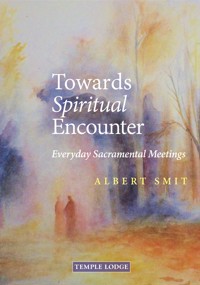
In his general practice as a doctor, Albert Smit observed numerous psychological issues in his patients – issues that often caused an existential crisis for the individual concerned. These experiences led Smit to change his career and to begin a path of research to discover how genuine inner healing could be achieved. In this succinct and inspiring study, the author offers a clear way forward that allows for individual and social transformation. Smit points to a statement by Rudolf Steiner, that human relationships could become something of a social art. We can begin on this work today, through free and conscious choice. Engaging the forces of the heart, we can meet our fellow human beings as true individuals – as equals – and ultimately as brothers and sisters. Such work could help to heal the individual alienation and social divisions of our time. Eventually, human encounter could evolve into a spiritual event – even a sacramental act! Towards Spiritual Encounter is a valuable text for meditation and reflection. 'The basis for all free religious feeling that will unfold in humanity in the future will be the acknowledgement – not merely in theory but in actual practice – that every human being is made in the likeness of the Godhead. … For then every meeting between one person and another will of itself be in the nature of a religious rite, a sacrament.' – Rudolf Steiner
Sie lesen das E-Book in den Legimi-Apps auf:
Seitenzahl: 81
Veröffentlichungsjahr: 2024
Das E-Book (TTS) können Sie hören im Abo „Legimi Premium” in Legimi-Apps auf:
Ähnliche












TOWARDS SPIRITUAL ENCOUNTER
Everyday Sacramental Meetings
Albert Smit
With an Introduction by Margarete van den Brink Translated from Dutch by Philip Mees
Temple Lodge Publishing Ltd.Hillside House, The SquareForest Row, RH18 5ES
www.templelodge.com
First published in English by Temple Lodge Publishing, 2024
Originally published in Dutch under the title Op weg naar priesterlijk handelen by Adventum (Nearchus CV), Assen, Netherlands in 2021
© Estate of Erven Albert Smit 2024
This book is copyright under the Berne Convention. All rights reserved. Apart from any fair dealing for the purpose of private study, research, criticism or review, no part of this publication may be reproduced, stored in a retrieval system, or transmitted in any form or by any means, electronic, electrical, chemical, mechanical, optical, photocopying, recording or otherwise, without the prior written permission of the copyright owner.Inquiries should be addressed to the Publishers
The right of Erven Albert Smit to be identified as the author of this work has been asserted in accordance with sections 77 and 78 of the Copyright, Designs and Patents Act, 1988
A CIP catalogue record for this book is available from the British Library
ISBN 978 1 915776 19 8
Cover by Morgan Creative featuring ‘Autumn Mood’ by David NewbattTypeset by Symbiosys Technologies, Visakhapatnam, IndiaPrinted by 4Edge Ltd., Essex
Contents
Introduction
1.The spiritual has to be borne down from the spirit world by human beings
2.The way toward heaven begins in yourself
3.Be yourself the change you want to see in the world
4.How do we bring spirituality into life today?
5.We are not at the end, but at the beginning of Christianity
6.The creation is imperfect. Only when the creation of the Creator becomes itself creative is it perfect
7.As the old world once came into being out of the World Word, from the Human Word that is cleansed and brought to life by Christ the new world will come into being
Notes
Introduction
The little book lying before you came into being out of the course ‘Steps Toward Priestly Encounter’* that Albert Smit gave a number of years ago. The participants in this course were professional therapists and social workers. The course consisted of seven meetings in which a specific theme was worked on each time. These themes proved to be so relevant for our time that it was decided to publish the seven texts that were developed from them. You will find them as the seven chapters in this little book.
Albert Smit was an anthroposophical physician, teacher, and biographical counsellor. He began his working life as a tropical physician in Zambia and subsequently worked in The Netherlands as a general physician and in a nursing home. In the second half of his life he left this work and became a counsellor and teacher of the human condition at a number of professional training institutes.
The reason for this change was that he observed how profound the soul pain of human beings is in our time. He saw how they are bowed down by problems and wrestle with questions regarding their lives, their own existence, and their relations with other people. He wanted to make a positive contribution to this with the aid of anthroposophical insights and personal encounter.
At the same time, in view of the magnitude of the need, he also wanted to train other persons, helpers who, out of a profound feeling of shared humanity, could offer help.
It was clear to him that the problems and existential questions we humans have to cope with are connected with the gigantic spiritual change that is taking place in our time. In this little book he expresses this in clear terms. An old world, led hierarchically by the divine world that we call the God-the-Father world, is pulling back and making room for an entirely new world that has its origin in the souls of human beings. This new world began when two thousand years ago the unique, awe-inspiring cosmic event was enacted which Rudolf Steiner called the Mystery of Golgotha.
During that event, the Son God, the Logos, Christ, descended to the earth and to human beings, and connected himself with them. This sacrifice made it possible that the divine, creative power of Christ was able to work in and through human beings. Thus the basis was laid for a new connection of humanity and the earth with the world of the divine. A new foundation was laid that leads to a gradual change in which the old world becomes transformed into a new world, and therefore makes a future possible.
The deed on Golgotha made a whole new phase in the evolution and development of humanity possible. It is this cosmic change, this cosmic transformation—and all the changes it entails—that causes the problems in human souls and their existential questions of today.
Ever since the beginning of time, the forces from the God-the-Father world have led us to an autonomous existence in the earthly, material world. This gave us our own I-consciousness and a certain independence. Now, in our time, we have to establish, as human beings who have become conscious of themselves, the connection with the power of consciousness of the spiritual world in us, our own spiritual Self.
Only thus will we reach the condition of the new world in which we, now out of insight and the discovery of truth, will learn to give guidance to the true, the good in us. If that happens, we will collaborate actively toward the new spiritual reality on earth, which has its source in the world of the spirit.
The divine power who makes this transformative process inwardly possible and carries and leads us in it, is the power of Christ, who since Golgotha lives and works in the soul of every human being on earth.
For Albert Smit this insight meant that in helping our fellow human beings we have to meet them in such a way that the power of Christ is able to work in their inner being. This is possible if those who give the help or attention, continually purify their own soul and strengthen their own spirit. This means that they time and again go through their own thinking, feeling, and acting to examine, cleanse, and develop them, in order to connect anew time and again through prayer and meditation with the healing, strengthening power of Christ in their own soul. Only this creates the conditions to make it possible to awaken the forces of the new world in the other person.
Albert Smit had the motto (which came from Rudolf Steiner): Es ist der Mensch der heilt—It is the human being who heals. This became the title above all his later courses. What he meant to say was: the human being works as a healer in interpersonal contact if the power of Christ is active in him or her. The power of Christ works on the one hand if a person, out of a feeling of connectedness, enters into conversation with another about the latter person’s questions or problems while, on the other hand, out of this same connectedness, the other observes the person freely, listens, understands what is said, and expresses the insights that arise in the interaction.
A person who acts in this way, acts in a priestly way. Why is that so?
Traditionally, the priest is the person who acts as mediator between God, the angels, and human beings, and who connects these with each other. This happens principally through the ritual, the Mass.
In the context of this little book, the word priestly is used in a new sense, namely as a certain inner disposition that enables a person—whether a helper or otherwise—out of their own inner Christ power, to have the kind of conversation with the other that enables the latter to connect with their own inner being. Thus, in the new insights and the increased strength and harmony that grow from this, the latter meets their own spiritual being. The means that are used here are therefore not the church ritual, but the truly profound conversation from human being to human being.
Albert Smit points in this connection to a statement by Rudolf Steiner that this new relationship with each other will one day exist in the future. This will happen if and when we humans have taken the Christ power more deeply and consciously into ourselves, and live and act out of it. The priesthood in churches will then no longer be the guiding principle, but the encounter from human being to human being. Through the working of Christ in the inner being each encounter between people will become a religious act, yes, even a sacramental event. In other words, it will have the character of an initiation. And therefore it will have a priestly character.
It was this insight that led Albert Smit to the title of his last course: ‘Steps Toward Priestly Encounter’. In it he made a distinction between the professional side of the helper: physical therapist, music therapist, eurythmist, social therapist, physician, coach, counsellor, etc. on the one hand, and their being human on the other. If these persons develop in such a way that the Christ power can work in them, they will be of true help and assistance. For it is this power, working through the human being, that is the active principle in the helping contact.
Since what counts is the human




