


8,64 €
Mehr erfahren.
- Herausgeber: BroadStreet Publishing Group, LLC
- Kategorie: Religion und Spiritualität
- Sprache: Englisch
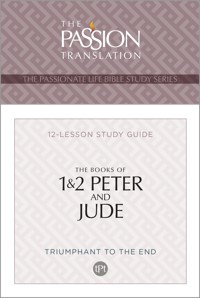
Triumphant to the End. The books of 1 & 2 Peter and Jude proclaim the triumph of hope, grace, and truth amid persecution. Gain the boldness to defend the faith against false teachers and learn the joys of our glorious salvation. This 12-lesson study guide on the books of 1 & 2 Peter and Jude, designed for both individual and group study, provides a unique and welcoming opportunity to immerse yourself in God's precious Word as expressed in The Passion Translation®. Begin your journey with a thorough introduction that details the authorship of 1 & 2 Peter and Jude, date of composition, first recipients, setting, purpose, central message, and key themes. The lessons then walk you through every portion from the books and include features such as notable verses, historical and cultural background information, definitions of words and language, cross references to other books of the Bible, and character portraits of figures from the Bible and church history. Enrich your biblical understanding of the books of 1 & 2 Peter and Jude, experience God's love for you, and share his heart with others.
Das E-Book können Sie in Legimi-Apps oder einer beliebigen App lesen, die das folgende Format unterstützen:
Veröffentlichungsjahr: 2025
Ähnliche


BroadStreet Publishing® Group, LLC
Savage, Minnesota, USA
BroadStreetPublishing.com
TPT: The Books of 1 and 2 Peter and Jude: 12-Lesson Bible Study Guide
Copyright © 2026 BroadStreet Publishing Group
9781424570720 (softcover)
9781424570737 (ebook)
All rights reserved. No part of this publication may be reproduced, distributed, or transmitted in any form or by any means, including photocopying, recording, or other electronic or mechanical methods, without the prior written permission of the publisher, except in the case of brief quotations embodied in critical reviews and certain other noncommercial uses permitted by copyright law. No portion of this book may be used or reproduced in any way for the purpose of training artificial intelligence technologies. As per Article 4(3) of the Digital Single Market Directive 2019/790, BroadStreet Publishing reserves this work from the text and data mining exception.
Unless otherwise indicated, all Scripture quotations are taken from The Passion Translation®. Copyright © 2017, 2018, 2020 by Passion & Fire Ministries, Inc. Used by permission. All rights reserved. ThePassionTranslation.com. Scripture quotations marked NIV are taken from The Holy Bible, New International Version® NIV®. Copyright © 1973, 1978, 1984, 2011 by Biblica, Inc.™ Used by permission. All rights reserved worldwide. Scripture quotations marked ESV are taken from the ESV® Bible (The Holy Bible, English Standard Version®). Copyright © 2001 by Crossway, a publishing ministry of Good News Publishers. Used by permission. All rights reserved. Scripture quotations marked NKJV are taken from the New King James Version®. Copyright © 1982 by Thomas Nelson. Used by permission. All rights reserved. Scripture quotations marked NLT are taken from the Holy Bible, New Living Translation. Copyright © 1996, 2004, 2015 by Tyndale House Foundation. Used by permission of Tyndale House Publishers, Carol Stream, Illinois 60188. All rights reserved.
General editor: Brian Simmons
Managing editor: William D. Watkins
Writer: Andrew P. Kauth
Cover and interior by Garborg Design Works | garborgdesign.com
Printed in China
26 27 28 29 30 5 4 3 2 1
Contents
From God’s Heart to Yours
Why I Love the Letters of Peter and Jude
Lesson 11 Peter: Hope Is the Treasure
Lesson 2Standing Out in a Crowd
Lesson 3Living Under Authority
Lesson 4Virtuous Living
Lesson 5Beyond Intimidation and Fear
Lesson 6Be Humble…Hang Back!
Lesson 72 Peter: Peter’s Ladder
Lesson 8Truth Confirmed
Lesson 9False Teachers
Lesson 10Mockers and Last-Days Christians
Lesson 11Jude: You Can Handle the Truth!
Lesson 12Perseverance
Endnotes
From God’s Heart to Yours
“God is love,” says the apostle John, and “Everyone who loves is fathered by God and experiences an intimate knowledge of him” (1 John 4:7). The life of a Christ-follower is, at its core, a life of love—God’s love of us, our love of him, and our love of others and ourselves because of God’s love for us.
And this divine love is reliable, trustworthy, unconditional, other-centered, majestic, forgiving, redemptive, patient, kind, and more precious than anything else we can ever receive or give. It characterizes each person of the Trinity—Father, Son, and Holy Spirit—and so is as limitless as they are. They love one another with this eternal love, and they reach beyond themselves to us, created in their image with this love.
How do we know such incredible truths? Through the primary source of all else we know about the one God—his Word, the Bible. Of course, God reveals who he is through other sources as well, such as the natural world, miracles, our inner life, our relationships (especially with him), those who minister on his behalf, and those who proclaim him to us and others. But the fullest and most comprehensive revelation we have of God and from him is what he has given us in the thirty-nine books of the Hebrew Scriptures (the Old Testament) and the twenty-seven books of the Christian Scriptures (the New Testament). Together, these sixty-six books present a compelling and telling portrait of God and his dealings with us.
It is these Scriptures that The Passionate Life Bible Study Series is all about. Through these study guides, we—the editors and writers of this series—seek to provide you with a unique and welcoming opportunity to delve more deeply into God’s precious Word, encountering there his loving heart for you and all the others he loves. God wants you to know him more deeply, to love him more devoutly, and to share his heart with others more frequently and freely. To accomplish this, we have based this study guide series on The Passion Translation of the Bible, which strives to “reintroduce the passion and fire of the Bible to the English reader. It doesn’t merely convey the literal meaning of words. It expresses God’s passion for people and his world by translating the original, life-changing message of God’s Word for modern readers.” It has been created to “kindle in you a burning desire to know the heart of God, while impacting the church for years to come.”1
In each study guide, you will find an introduction to the Bible book it covers. There you will gain information about that Bible book’s authorship, date of composition, first recipients, setting, purpose, central message, and key themes. Each lesson following the introduction will take a portion of that Bible book and walk you through it so you will learn its content better while experiencing and applying God’s heart for your own life and encountering ways you can share his heart with others. Along the way, you will come across a number of features we have created that provide opportunities for more life application and growth in biblical understanding.
Experience God’s Heart
This feature focuses questions on personal application. It will help you live out God’s Word and to bring the Bible into your world in fresh, exciting, and relevant ways.
Share God’s Heart
This feature will help you grow in your ability to share with other people what you learn and apply in a given lesson. It provides guidance on using the lesson to grow closer to others and to enrich your fellowship with others. It also points the way to enabling you to better listen to the stories of others so you can bridge the biblical story with their stories.
The Backstory
This feature provides ancient historical and cultural background that illuminates Bible passages and teachings. It deals with then-pertinent religious groups, communities, leaders, disputes, business trades, travel routes, customs, nations, political factions, ancient measurements and currency…in short, anything historical or cultural that will help you better understand what Scripture says and means.
Word Wealth
This feature provides definitions for and other illuminating information about key terms, names, and concepts, and how different ancient languages have influenced the biblical text. It also provides insight into the different literary forms in the Bible, such as prophecy, poetry, narrative history, parables, and letters, and how knowing the form of a text can help you better interpret and apply it. Finally, this feature highlights the most significant passages in a Bible book. You may be encouraged to memorize these verses or keep them before you in some way so you can actively hide God’s Word in your heart.
Digging Deeper
This feature explains the theological significance of a text or the controversial issues that arise and mentions resources you can use to help you arrive at your own conclusions. Another way to dig deeper into the Word is by looking into the life of a biblical character or another person from church history, showing how that man or woman incarnated a biblical truth or passage. For instance, Jonathan Edwards was well known for his missions work among native American Indians and for his intellectual prowess in articulating the Christian faith, Florence Nightingale for the reforms she brought about in healthcare, Irenaeus for his fight against heresy, Billy Graham for his work in evangelism, Moses for the strength God gave him to lead the Hebrews and receive and communicate the law, and Deborah for her work as a judge in Israel. This feature introduces to you figures from the past who model what it looks like to experience God’s heart and share his heart with others.
The Extra Mile
While The Passion Translation’s notes are extensive, sometimes students of Scripture like to explore more on their own. In this feature, we provide you with opportunities to glean more information from a Bible dictionary, a Bible encyclopedia, a reliable Bible online tool, another ancient text, and the like. Here you will learn how you can go the extra mile on a Bible lesson. And not just in study either. Reflection, prayer, discussion, and applying a passage in new ways provide even more opportunities to go the extra mile. Here you will find questions to answer and applications to make that will require more time and energy from you—if and when you have them to give.
As you can see above, each of these features has a corresponding icon so you can quickly and easily identify them.
You will find other helps and guidance through the lessons of these study guides, including thoughtful questions, application suggestions, and spaces for you to record your own reflections, answers, and action steps. Of course, you can also write in your own journal, notebook, computer document, or other resource, but we have provided you with space for your convenience.
Also, each lesson will direct you toward the introductory material and numerous notes provided in The Passion Translation. There each Bible book contains a number of aids supplied to help you better grasp God’s words and his incredible love, power, knowledge, plans, and so much more. We want you to get the most out of your Bible study, especially using it to draw you closer to the One who loves you most.
Finally, at the end of each lesson you’ll find a section called “Talking It Out.” This contains questions and exercises for application that you can share, answer, and apply with your spouse, a friend, a coworker, a Bible study group, or any other individuals or groups who would like to walk with you through this material. As Christians, we gather together to serve, study, worship, sing, evangelize, and a host of other activities. We grow together, not just on our own. This section will give you ample opportunities to engage others with some of the content of each lesson so you can work it out in community.
We offer all of this to support you in becoming an even more faithful and loving disciple of Jesus Christ. A disciple in the ancient world was a student of her teacher, a follower of his master. Students study, and followers follow. Jesus’ disciples are to sit at his feet and listen and learn and then do what he tells them and shows them to do. We have created The Passionate Life Bible Study Series to help you do what a disciple of Jesus is called to do.
So go.
Read God’s words.
Hear what he has to say in them and through them. Meditate on them.
Hide them in your heart.
Display their truths in your life.
Share their truths with others.
Let them ignite Jesus’ passion and light in all you say and do.
Use them to help you fulfill what Jesus called his disciples to do: “Now wherever you go, make disciples of all nations, baptizing them in the name of the Father, the Son, and the Holy Spirit. And teach them to faithfully follow all that I have commanded you. And never forget that I am with you every day, even to the completion of this age” (Matthew 28:19–20).
And through all of this, let Jesus’ love nourish your heart and allow that love to overflow into your relationships with others (John 15:9–13). For it was for love that Jesus came, served, died, rose from the dead, and ascended into heaven. This love he gives us. And this love he wants us to pass along to others.
Why I Love the Letters of Peter and Jude
In a world brimming with uncertainty, persecution, and moral confusion, few portions of Scripture speak as directly and compassionately to the believer as the epistles of 1 Peter, 2 Peter, and Jude. These letters are short, yet they are saturated with divine wisdom, encouragement, and sobering truth. What makes me love these books deeply is not merely their theology or their literary beauty but the way they unveil the tender and fierce heart of God for his people living in difficult times.
1 Peter: The Shepherding Heart of God
First Peter was written to believers scattered and suffering—people who had been marginalized, oppressed, and misunderstood. Right from the start, Peter reminds them of their identity: chosen by God, sanctified by the Spirit, and sprinkled with the blood of Jesus Christ (1 Peter 1:2). In the midst of their trials, Peter does not offer shallow comfort. He doesn’t tell them to escape hardship, but instead he lifts their gazes toward a living hope through the resurrection of Jesus (v. 3). This hope is not an abstract idea; it is an inheritance that is “imperishable, undefiled, and unfading, kept in heaven” (v. 4).
What I find especially moving about 1 Peter is its pastoral tone. Peter—once impulsive and brash—has become a tender shepherd, just as Jesus commanded him to be (John 21:15–17). He writes to strengthen the faith of Christians who feel like exiles, reminding them that even in their suffering, they are a holy priest-hood, called to declare the excellencies of God (1 Peter 2:9). This letter reveals the heart of our divine Father who does not abandon his children in suffering but walks with them, refining their faith like gold tested by fire (1:7).
The call to holiness, submission, and love in 1 Peter is not a burden but an invitation to reflect the character of the God who is both holy and compassionate. This letter reminds me that God sees, God cares, and God strengthens. In the face of ridicule or persecution, it affirms that suffering for righteousness is not a sign of abandonment—it is a mark of fellowship with Christ.
2 Peter: God’s Patience and the Call to Remain Steadfast
If 1 Peter offers comfort to the suffering, 2 Peter issues a clarion call to remain rooted in truth amid deception. I love 2 Peter because it reveals another aspect of God’s heart: his patience and his unwavering commitment to truth. Peter opens the letter by reminding believers that God has given us “everything we need for life and godliness” (2 Peter 1:3). That includes not just strength to endure but also discernment to recognize what is true in a world full of lies.
One of the most powerful verses in this book is 3:9: “The Lord is not slow to fulfill his promise as some understand slowness, but is patient with you, not wanting anyone to perish, but everyone to come to repentance.” Here we see a God whose delay in judgment is not apathy but mercy. In a time when scoffers questioned the return of Christ and moral decay was rampant, Peter’s words provided assurance: God’s justice will come, but so will his grace, extended as long as possible to a rebellious world.
What I cherish about 2 Peter is how it urges believers to grow—to supplement their faith with virtue, knowledge, self- control, and love (1:5–7). In other words, spiritual stagnation is not an option. This letter reminds me that in troubled times, faithfulness is not passive endurance but active pursuit. It gives me confidence that God equips his people not just to survive in dark days but also to shine.
Jude: Contending for the Faith with Mercy
The book of Jude, though brief, is one of the most powerful and urgent calls to spiritual vigilance in the New Testament. I love Jude because it holds together two essential truths: the fierce call to contend for the faith and the gentle mandate to show mercy. Jude begins with a stunning affirmation: believers are “called, beloved in God the Father and kept for Jesus Christ” (Jude 1). In those few words, we see the security and affection God has for his people.
Jude’s tone is bold as he exposes false teachers and urges believers to stand firm. Yet, his letter never descends into anger or cynicism. Instead, it radiates the holiness of God and the compassion that comes from understanding the human struggle. “Have mercy on those who doubt,” Jude says (v. 22). In a time when deception ran rampant, God still had compassion for the confused, the weak, and the wavering.
The doxology at the end of Jude may be one of the most beautiful in Scripture: “Now to him who is able to keep you from stumbling and to present you blameless before the presence of his glory with great joy” (v. 24). These words make my heart sing. They remind me that God is not only able to protect me from error and sin, but he also delights to present me before himself with joy. That is a glimpse into the very heart of God—a God who saves, sanctifies, and rejoices over his people.
Hope That Abounds
I love 1 and 2 Peter and Jude because they do not flinch in the face of hardship, heresy, or heartache. They tell the truth about suffering, deception, and spiritual warfare. But more than that, they reveal a God who shepherds his people with tenderness, equips them with power, and keeps them by his mercy. In these letters, I find hope, courage, and an unshakable assurance that in troubled times, God is near, God is working, and God is coming again.
Brian Simmons
General Editor
LESSON 1
1 Peter: Hope Is the Treasure
(1 Peter 1:1–12)
It’s nearly impossible to talk about the apostle Peter, let alone begin a study of any text related to him, without recalling Jesus’ specific words regarding Peter in Matthew 16. After Peter’s confession of Jesus as the “Anointed One” (the Christ, or Messiah) in verse 16, Jesus gave Peter his new name and stated the importance of Peter’s confession in verse 18: “I give you the name Peter, a stone. And this rock will be the bedrock foundation on which I will build my church—my legislative assembly, and the power of death will not be able to overpower it!”
Truly, Peter’s confession that Jesus was the promised Messiah, “the Son of the living God” (v. 16), is the “bedrock foundation” (v. 17) for the church.2 It was God the Father who revealed this foundational truth to Peter (v. 17). And while Peter was not without his faults, his faith was unparalleled: from immediately following Jesus when called (4:18–20), to stepping out of a boat in the midst of a storm to walk on water with Jesus (14:28–30), to preaching the gospel to thousands of Jews in Jerusalem on Pentecost (Acts 2:14–41), Peter demonstrated, time and again, not only his faith but also how much he loved Jesus. What a blessing to have his words preserved for all believers today—words that will no doubt leave your faith encouraged and strengthened!




