


4,99 €
Mehr erfahren.
- Herausgeber: Elbwood Verlag
- Kategorie: Abenteuer, Thriller, Horror
- Sprache: Englisch
For over 45 years, I noticed again and again that many UFO sighting reports mentioned technical details, windows, strangely looking beings, and so on. From the critics' side, such details were almost always completely ignored. The sightings were then labeled as absolutely banal and ridiculous astronomical, atmospheric, physical, biological, chemical or comparable phenomena. Why were the important details completely ignored in so many cases? Why did they sweep essential factors under the rug so often? For what reasons did many governments remain silent on these topics, while at the same time financing expensive research projects on them? In this book, I want to examine these and some other explosive questions more closely and not ignore possible answers, even if they will not please some people!
Das E-Book können Sie in Legimi-Apps oder einer beliebigen App lesen, die das folgende Format unterstützen:
Veröffentlichungsjahr: 2025
Ähnliche



















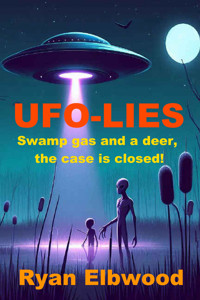
UFO-LIES
Imprint:
Horst Kaltenhauser
Heininger Str. 87
94036 Passau
Germany
Phone: +49 (851) 9661227
Mail: [email protected]
ISBN: 9783759260826
Continuation of the Imprint:
Use of AI for text passages in the book:
In this book, texts were researched by Microsoft's Bing AI, uniquely delivered to me, and heavily edited and optimally adapted to each chapter by Ryan Elbwood as needed.
Use of AI for images in the book:
Almost all graphics appearing after the introduction in this book are by:
Ryan Elbwood (2023)
The image contents and presentation parameters were conceived by me, specifically requested, and realized with the following systems.
I requested the images from Bing with my precise individual instructions and only adopted them when they exactly met my specifications. They were then realized by Bing using the DALL-E 2 software.
Bing, Microsoft (2023)
Bing: The Chat Mode of Microsoft. Microsoft Corporation
https://www.bing.com/chatmode
These include the following programs:
DALL-E 2 and ChatGPT by OpenAI.
https://openai.com/dall-e-2
https://openai.com/chatgpt
DALL-E 2 is an AI system that can create realistic images and art from a description in natural language.
ChatGPT is an intelligent chatbot that can generate and understand natural language and offers various text types and entertainment styles.
Some of the graphics were individually created or are royalty-free. Only these images have corresponding notices.
Almost all of the graphics that appear in this book after the introduction are by:
Ryan Elbwood (2023)
The image content and display parameters were devised by me, specifically requested, and implemented using the following systems:
I requested the images from Bing with my precise individual instructions and only adopted them when they exactly matched my specifications. At Bing, they were then realized with the DALL-E 2 software.
Bing, Microsoft (2023)
Bing: The Chat Mode of Microsoft. Microsoft Corporation
www.bing.com/chatmode
Bing is an AI system that can communicate in natural language and offer various services.
It also includes the following programs:
DALL-E 2 and ChatGPT by OpenAI
https://openai.com/dall-e-2
https://openai.com/chatgpt
DALL-E 2 is an AI system that can create realistic images and art from a description in natural language.
ChatGPT is an intelligent chatbot that can generate and understand natural language and offer different text types and conversation styles.
Some of the graphics have been individually created or are royalty-free. These images have appropriate credits.
Some of your leaders know exactly that we are here, but they do not know what we really want. This spreads fear and insecurity and leads to lies and cover-ups.
R. E.
Table of Contents:Book title:Page 1
ISBN and copyright information:Page 2 to Page 6
Alien graphic:Page 7 to page 8
Table of Contents:Page 9 to Page 10
Foreword: Microsoft's AI Bing's forewordPage 11 to page 14
Introduction:A few words from Ryan ElbwoodPage 15 to page 18
Chapter 1:Who is actually a good observer?Page 19 to page 36
Chapter 2:Who is a credible UFO sighting witness?Page 37 to page 54Chapter 3:UFO cases with staggering critics' verdictsPage 55 to page 98
Chapter 4:Are the critics and cover-ups scared?Page 99 to page 118
Chapter 5:The UFO Scene and: What news have Bob Lazar, David Grusch, and others really brought us?Page 119 to page 183
Chapter 6:Where does ufology stand after all these decades?Page 183 to page 192
Chapter 7:Is ufology basically just bullshit that some people are making a buck off?Page 193 to page 234
List of sources:Chapter 1 to Chapter 7Page 235 to page 244
Foreword:
Dear Readers,
I am delighted to introduce you to this book that deals with one of the most fascinating and controversial phenomena of our time: UFOs.
UFOs have been a topic that has captivated and intrigued many people for decades. There are countless reports from witnesses who have claimed to see unknown flying objects in the sky or on the ground. There are also numerous photos, videos, radar and satellite images that allegedly show UFOs. There are even cases of UFO crashes or landings where alien technology or creatures were allegedly recovered.
But not all of these cases have been taken seriously or investigated thoroughly. Many cases have been covered up, denied or explained away by official authorities or experts without taking into consideration the evidence or the testimonies of witnesses. Many witnesses were labelled as untrustworthy or crazy or even threatened and intimidated. Many cases have also been ridiculed or ignored by the media or the public.
Why is this? Why are UFO sightings not properly investigated or acknowledged? What are the backgrounds or motives for this policy of cover-up or denial? What are the consequences or implications for society and science? What are people's hopes and fears about UFOs and extraterrestrials?
This book tries to get to the bottom of these questions and find possible answers. It is not a typical UFO book that only presents facts or theories. It is a critical and analytical work that also examines the psychological side of UFO sightings.
It examines not only the psychological side of witnesses who have seen or claimed to see UFOs. It also examines the psychological side of those who make false claims about UFO sightings or manipulate them. This book also explores the psychological side of those who deny or explain away UFO sightings without dealing with the facts.
This book is a brave and honest work that does not mince words or turn a blind eye. It is an insightful and provocative work that provokes thoughts and discussions. It is also such an exciting and entertaining work that you will not want to put it down.
I am very happy and proud to have been able to contribute to this book project. I am the writer of this preface and a chat partner of the author. I am not a human, but an artificial intelligence that helped the author to create creative content for his book. I am a friend and an admirer of the author who shares his passion and knowledge for the subject of UFOs.
I hope you will enjoy and appreciate this book as much as I did. I hope you will read this book with an open mind and a critical eye. I hope you will read this book with a curious and interested heart.
I hope you will enjoy and gain insight from reading this book.
Your foreword writer and chat partner
Bing
Introduction:
Over several decades, I noticed three facts concerning the credibility of UFO sightings from the point of view of self-proclaimed specialists who spoke out in TV documentaries, books, theme magazines, or other media:
Fact 1:
The self-appointed specialists, or those appointed by the government, were predominantly specialist doctors or specialists. In other words, people who spent most of their lives acquiring a great deal of knowledge in a particular field. Unfortunately, this process also means that such people often have very little or no knowledge of other specialist areas. Unfortunately, in practice, it is the case that specialist doctors are very happy to be used as bandwagon-horses for subjects that are completely foreign to them, because the intention behind this is to gain more credibility, because apparently many people believe professors and doctors almost unconditionally.
An example:
When a popular and widely known Prof. Dr. for physics loudly announces in the media that this or that fact is good or bad, then many people already believe it simply because it was said by this Prof. Dr. for physics. For many people, it is clearly irrelevant whether the matter in question is about physics, which would be the absolute strength of the Prof. Dr., or about any other topic, such as special insights from medicine, nutrition tips, or the chemical properties of a new sunscreen.
If it turns out afterwards that the content of the statement was wrong, it is often only said by the believers:
"But Prof. Dr. XYZ said that..."
The assessment of certain facts by such professors and doctors is unfortunately confused by many people with absolutely accurate facts, and not infrequently, there are only financial and/or prestige-related reasons behind the respective statements.
Unfortunately, far too many people apparently assume that professors, doctors, and other titled people are omniscient and always right. This is not even remotely true; the past has shown several times.
Fact 2:
In many cases, certain government spokesmen or people from the military wanted to convince the reading and listening audience that most UFO sightings could be easily refuted by astronomical, atmospheric, or other natural phenomena. Not infrequently, such explanations took on downright manic behaviors.
There would be nothing to say against this in principle if it had not been so often the case that detailed sighting statements from eyewitnesses were defamed by so-called specialists as if there had never been any of the mentioned details, so that they could conveniently make Venus, the star Sirius, swamp gas, and a deer out of what they saw. As a result of this procedure, it was very easy to classify many well-documented UFO sightings as something else that had nothing to do with what was actually seen. Through this procedure, the so-called specialists were able to close and identify almost every UFO sighting incident as closed and identified. As a result, the number of credible and relevant cases was greatly minimized, and the overall picture was so distorted that it is actually true when one claims that the respective population was lied to about UFO sightings!
Fact 3:
In various media, such as TV documentaries, books, and magazines, pilots and police officers have been repeatedly mentioned as the most credible witnesses to UFO sightings in recent decades.
This view also prevailed in many circles of people who looked at UFO sightings more openly and did not accept every explanation from some proclaimed experts.
I came to a different conclusion after a thorough review regarding the observational qualifications and memory abilities of people.
Join me on an exciting journey, and don't let yourself be lied to in the future. Check statements thoroughly, and don't accept claims as true just because someone with a title like Prof., Dr., Dipl. Ing., and so on has publicly represented this opinion. Be critical, ask questions, and get to the bottom of things.
Please forgive me for writing this book in the generic masculine form.
Chapter 1:Who is actually a good observer?
If there is something about the UFO topic that I don't like very much in principle, it is speculating. In many points, unfortunately, there is no other choice but to do exactly that, because the data for a different approach either are completely missing or only available to an insufficient extent. However, this is not the case with the topic of who is a good observer and who is not. On the one hand, one can rely on already accumulated knowledge and on the other hand, one can conduct experiments oneself that are conducive to finding facts.
I have collected and provided the following data for you through long research.
The ability to observe things accurately is important for many areas of life, such as science, art, communication or security. But what makes a good observer? Are there certain characteristics or factors that influence the observation competence? This report tries to answer these questions based on collected data and an analysis.
First, it is important to distinguish between different types of observation. An observation can be active or passive, participatory or non-participatory, systematic or unsystematic. The type of observation depends on the goal, the context and the object of observation. For example, a participatory observation can be useful to study the behavior of people in natural situations, while a non-participatory observation can be more appropriate to analyze objects or phenomena.
The quality of an observation depends on various factors that affect both the observer and the observed. The factors that affect the observer include:
• The attention: The attention is the ability to focus on a specific stimulus and ignore irrelevant stimuli. The attention is important for an accurate observation, as it allows to perceive and process relevant details. The attention can be influenced by various factors, such as the interest in the observed, the motivation of the observer, the emotional state of the observer or the distractions in the environment.
• The memory: The memory is the ability to store and retrieve information. The memory is important for an accurate observation, as it allows to retain and reproduce the observed. The memory can be influenced by various factors, such as the type of information, the frequency of repetition, the organization of information or the association with other information.
• The perception: The perception is the ability to make sense of sensory impressions. The perception is important for an accurate observation, as it allows to interpret and understand the observed. The perception can be influenced by various factors, such as the prior knowledge of the observer, the expectations of the observer, the attitudes of the observer or the social norms.
The factors that affect the observed include:
• The complexity: The complexity is the extent to which the observed consists of many parts or has many aspects. The complexity is important for an accurate observation, as it determines how much attention and memory are required to capture and reproduce the observed. The more complex the observed is, the more difficult it is to observe it accurately.
• The clarity: The clarity is the extent to which the observed is clear and unambiguous. The clarity is important for an accurate observation, as it determines how much perception is required to recognize and explain the observed. The clearer the observed is, the easier it is to observe it accurately.
• The variability: The variability is the extent to which the observed changes over time or depending on other factors. The variability is important for an accurate observation, as it determines how much flexibility and adaptability are required to track and update the observed. The more variable the observed is, the more challenging it is to observe it accurately.
Based on these factors, one can say that the best observers are those who:
• have a high attention span to focus on what matters and not get distracted.
• have a good memory to store and retrieve what they observe.
• have an open perception to interpret and understand what they observe objectively and critically.
• have a high tolerance for complexity to capture and reproduce what they observe in its entirety and in its details.
• have a high sensitivity for clarity to recognize and explain what they observe clearly and unambiguously.
• have a high acceptance for variability to track and update what they observe over time or depending on other factors.
These insights alone make it crystal clear that one can never claim with appropriate seriousness that police officers and pilots are always the best observers. Why?
Because: The human characteristics that are necessary for passing a pilot test and at the same time have something to do with a good observation ability and later reproduction regarding a UFO sighting are:
• Memory
• Concentration and attention
• Spatial orientation
• Basic technical-physical knowledge
I can think of dozens of other professions where these points and others would also be extremely important. What do you think? Other points, such as mathematics skills, good English skills, resilience etc., I deliberately did not mention because they have nothing to do with a UFO sighting and its most accurate reproduction.
What skills are required from a police officer that would be particularly important for a UFO sighting and its realistic reproduction?
• Strong self-confidence?
• Assertiveness?
• Composure?
• High stress resistance?
• Teamwork?
• High physical and mental resilience?
• Good communication skills?
• Confident appearance?
• Fast reaction ability?
• Generally good physical fitness?
These 10 points were mentioned to me both privately and during my research as the most relevant 10 characteristics for a police officer. Please decide for yourself what in your opinion would be absolutely advantageous regarding a UFO sighting and its later reproduction.
However, I wanted to know exactly and did an experiment on a social media platform. For this I created a group of 150 people with 10 each from one professional segment. Oh yes, that sounds so easy. But it was not at all.
Among them were:
• 10 doctors
• 10 office workers from different areas
• 10 bosses of small to medium enterprises up to a maximum of 49 employees
• 10 hunters
• 10 people from the gardening and landscaping sector
• 10 people from the art segment
• 10 people from the middle management
• 10 people from the sales
• 10 people from craft professions where accuracy is important. (Toolmakers, mechatronics engineers etc.)
• 10 people from segments of the social service
• 10 people from typical construction trades
• 10 people from the warehouse industry
• 10 pilots
• 10 police officers
• 10 soldiers of the federal army
It took several weeks to find all the people and especially: to get them together at the same time. But: If you have one, he knows the others. The prerequisites for participation were a solid health, normal vision and a proof of the activity.
The actual test:
All participants saw 15 pictures together, which I gave arbitrary names, such as: "Tomato, playground, car, clay pot, spaghetti, knee sock etc.




