


0,49 €
Mehr erfahren.
- Herausgeber: Quickie Classics
- Kategorie: Gesellschafts- und Liebesromane
- Sprache: Englisch
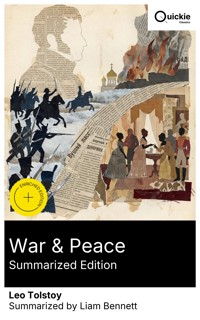
War & Peace is a panoramic chronicle of Russia during the Napoleonic invasions (1805–1812), interweaving the fortunes of the Rostov and Bolkonsky families with the spiritual education of Pierre Bezukhov. Tolstoy marries minute realist observation—salon chatter, cavalry charges, domestic tenderness—with audacious historiographical essays that question causal explanations of history. Through battles such as Austerlitz and Borodino, and scenes of Moscow's burning, he deploys free indirect discourse, shifting focalization, and counterpointed plots to dissolve boundaries between private life and public catastrophe, thereby enlarging the aims of nineteenth‑century Russian realism. An aristocrat who fought in the Crimean War and managed the Yasnaya Polyana estate, Tolstoy brought soldierly experience, archival study, and rural intimacy to his subject. Skeptical of "great man" narratives—after reading Thiers and others—he conceived a vision of history as collective, unconscious motion, aligning his ethical inquiries into conscience, family, and labor with a critique of political hero-worship. This magisterial novel rewards patient readers seeking both story and inquiry: sumptuous social scenes, unforgettable characters, and a sustained meditation on agency, chance, and time. For lovers of historical fiction, philosophical reflection, or the classic realist tradition, War & Peace remains an inexhaustible companion and a touchstone of narrative possibility. Quickie Classics summarizes timeless works with precision, preserving the author's voice and keeping the prose clear, fast, and readable—distilled, never diluted. Enriched Edition extras: Introduction · Synopsis · Historical Context · Author Biography · Brief Analysis · 4 Reflection Q&As · Editorial Footnotes.
Das E-Book können Sie in Legimi-Apps oder einer beliebigen App lesen, die das folgende Format unterstützen:
Veröffentlichungsjahr: 2026
Ähnliche








War & Peace (Summarized Edition)
Table of Contents
Introduction
An immense portrait of how private hopes and fears meet the vast, indifferent machinery of history, War and Peace traces the friction between the desire for personal meaning and the forces—battle, bureaucracy, fashion, and chance—that seem to shape destinies beyond individual design, asking whether courage, love, and moral choice can redirect the currents that sweep families, cities, and empires along, while showing that the front lines of experience run as keenly through the drawing room as through the ranks in the field, and through memory and storytelling that strive to make sense of chaos.
War and Peace, by Leo Tolstoy, is a monumental historical novel first published in 1869. Set in Russia during the Napoleonic Wars of the early nineteenth century, it unfolds across St. Petersburg, Moscow, provincial estates, and European battlefields. Tolstoy combines invented lives with documented events and figures, situating intimate dramas within the public convulsions of invasion and resistance. The book belongs to the realist tradition while extending it into philosophical inquiry, marrying a social panorama with meditations on history, power, and time. The result is an expansive, meticulously grounded narrative that anchors its epic scale in the textures of daily life.
The premise is introduced with Russian aristocratic and military worlds on the brink of continental upheaval. Young men prepare for service or seek direction; young women navigate family expectations and social ceremony; elders calculate inheritances, alliances, and reputations. Among the central figures are Pierre Bezukhov, Prince Andrei Bolkonsky, and Natasha Rostova, whose intersecting paths illuminate questions of duty, aspiration, and love. As campaigns gather momentum and rumors ripple through salons and barracks alike, the novel follows these lives without revealing outcomes, portraying how decisions made under pressure and uncertainty reverberate through households, friendships, and the broader fabric of society.
The reading experience is at once panoramic and intimate. Tolstoy’s omniscient narration moves with unforced authority from crowded assemblies and hunts to councils of war and the chaos of retreat, balancing sweeping description with close psychological attention. Scenes are braided with reflective passages that consider the nature of causation in history and the limits of human knowledge. The tone ranges from satirical sparkle to grave contemplation, and the prose favors concrete detail over ornament. Extended set pieces and sudden, crystalline moments alternate, producing a rhythm that invites immersion, patience, and an alertness to small gestures that carry moral or emotional weight.
War and Peace explores themes that remain central to the human condition: the tension between freedom and necessity, the search for ethical action amid confusion, the bonds and burdens of family, and the costs—material and spiritual—of organized violence. It questions simplistic explanations for vast events, emphasizing contingency, multiplicity of motives, and the modest scale on which most lives are actually lived. The novel insists that clarity about the past grows from attention to ordinary choices, not only to headlines or commanders, and it treats love, forgiveness, and perseverance as forms of intelligence rather than mere sentiment.
For contemporary readers, the book matters because it resists the allure of single causes and singular heroes, modeling a way to think about crises that honors complexity without surrendering hope. It offers a vocabulary for living through uncertainty: how to act when information is partial, how to value community when institutions falter, how to maintain integrity when outcomes cannot be controlled. Its pages illuminate how misinformation spreads, how leadership can mislead or steady, and how empathy cuts through political noise. By dramatizing the everyday labor of decency, it speaks to polarized times with unusual breadth and steadiness.
Approached today, War and Peace is less a hurdle than an invitation to inhabit a capacious moral and historical imagination. Its scale allows emotional registers to mature, revealing growth that quick plots cannot sustain; its patience rewards reflective reading; its skepticism toward grand theories encourages humility. Without demanding specialized knowledge, it enlarges the sense of what a novel can hold: action and aftermath, spectacle and silence, ideas and appetites. That breadth, yoked to unsparing honesty about suffering and a durable belief in renewal, explains why this work continues to challenge, console, and clarify more than a century after its first publication.
Synopsis
Leo Tolstoy’s War and Peace, first serialized between 1865 and 1867 and published in 1869, unfolds across Russia during the Napoleonic era, chiefly 1805 to 1812. The narrative interlaces the fortunes of several aristocratic families—the Rostovs, Bolkonskys, and Bezukhovs—against the shifting backdrop of salons, estates, and battlefields. Opening in St. Petersburg society, it introduces Pierre Bezukhov, uneasy heir presumptive; Prince Andrei Bolkonsky, restless and ambitious; and Natasha Rostova, lively and impressionable. Tolstoy places personal desire, family duty, and social expectation in tension with the larger movements of history, establishing a canvas where intimate choices and public events constantly refract one another.
As war resumes in 1805, Andrei leaves domestic frustrations to serve on the staff of General Kutuzov, seeking purpose in military distinction. At the same time, Pierre unexpectedly inherits vast wealth upon his father’s death, drawing opportunists and magnifying his moral uncertainty. The Rostovs’ hospitable world—hunts, music, and balls—shows a warmer counterpoint, though their finances are fragile. At Austerlitz, Tolstoy depicts confusion in command and the stark emotional reckoning that follows battle. The interleaving scenes of front and home establish contrasts central to the book: courage and vanity, extravagance and simplicity, hope and disenchantment, and the uneasy commerce between personal ambition and national crisis.
Returning from early campaigns, Andrei confronts upheavals within his family’s severe household, where his father’s discipline governs every gesture and his sister Marya lives a life of conscientious piety. Pierre, drawn into St. Petersburg’s glittering but cynical circles, makes a socially advantageous marriage that intensifies his inward turmoil. Pressures from Prince Vasili Kuragin and his clan expose the cost of status-seeking. In a rash moment, Pierre fights a duel, and the shock of violence compounds his search for meaning. Throughout, Tolstoy examines how impulse, habit, and self-regard can bend lives more forcefully than proclamations or plans, foreshadowing later spiritual and ethical reckonings.
In Moscow’s more intimate milieu, Natasha’s grace brings her into contact with Andrei, whose revived hopes meet resistance from his formidable father and the conventions of rank. Delays and conditions strain the couple’s understanding. Meanwhile, unstable desires swirl around the Kuragins, culminating in an attempted elopement that throws Natasha’s world into scandal and self-reproach. Tolstoy treats these tensions without melodrama, attentive to the hesitations, misread signals, and pride that carry people toward decisions they barely control. The Rostovs’ mounting debts and the Bolkonskys’ stern codes show class ideals under pressure, while Pierre’s continued restlessness keeps the question of authentic purpose unresolved.
Pierre’s spiritual inquiries lead him through Freemasonry and charitable impulses, yet his convictions remain unsettled as Europe convulses. With Napoleon’s 1812 invasion, political abstractions become immediate. The novel widens to show regiments in motion, councils of war, refugee columns, and estate managers improvising relief. Nikolai Rostov serves with the cavalry and witnesses the discipline, camaraderie, and mismanagement of campaigns. Kutuzov, aging yet imperturbable, emerges as a counter-figure to heroic myth, embodying patience and an acceptance of necessity. As armies and civilians converge on Moscow, private dilemmas meet collective peril, and the book’s alternating rhythms of domesticity and combat tighten into relentless succession.
From Smolensk to Borodino, Tolstoy’s battlefield chapters emphasize fog, exhaustion, and the limits of command, showing how confusion rather than clarity rules decisive hours. Andrei returns to active duty, carrying both idealism and disillusion into the line. Pierre, drawn by a half-formed resolve to be of use, travels into zones of danger and sees war at close range. The portrayal of Kutuzov’s strategy stresses restraint over theatrical brilliance, aligning leadership with endurance more than audacity. Through soldiers’ routines and civilians’ flight, the narrative studies how necessity constrains choice, even as individuals search for a fragment of agency amid overwhelming circumstances.
The evacuation and burning of Moscow mark a civic catastrophe and a moral crucible. Pierre remains in the occupied city and encounters the random currents of fear, opportunism, and pity that follow conquest. In captivity among ordinary people, he observes small acts of kindness and the stubborn persistence of dignity. The French army’s presence exposes illusions about honor and utility; hardship forces a reckoning with what sustains hope. Tolstoy’s focus on common experiences—hunger, fatigue, rumor—balances the grand chronicle. The city’s ordeal becomes a stage on which philosophical questions turn concrete: what is freedom when choices are narrowed to survival?
As the invaders withdraw under pressure and attrition, the story tracks partisans, staff officers, and villagers whose choices compound into historical movement. The winter campaign foregrounds endurance over spectacle, with logistics, weather, and morale eclipsing grand designs. On the home front, families take stock: estates must be managed or salvaged, reputations repaired, and debts reckoned. Marya’s sense of duty expands into practical leadership; Natasha’s suffering matures into steadier compassion; Nikolai confronts the limits of bravado. Tolstoy dwells on reconciliation with daily labor and responsibility, suggesting that renewal grows less from triumphs than from a patient reordering of values after loss.
Interwoven essays on history frame the story’s close. Tolstoy questions the notion that great men determine events, arguing instead for countless small causes that shape outcomes. He tests ideas of free will and necessity against lived moments—hesitation, habit, sudden generosity—suggesting that meaning arises in modest, enduring commitments rather than in dramatic gestures. War and Peace endures because it links private conscience to public time, showing how love, duty, and humility persist within contingency. Without relying on decisive revelations, the novel’s final movement affirms a broader perspective: that understanding history and oneself requires attention to the ordinary, where change quietly takes root.
Historical Context
War and Peace is set primarily in the Russian Empire between 1805 and 1812, with some aftermath, when St. Petersburg served as imperial capital and Moscow as a historic, cultural center. Russia was an autocracy under Emperor Alexander I, supported by the nobility and the Russian Orthodox Church. The Table of Ranks structured civil and military service, while serfdom tied millions of peasants to noble estates. Among aristocrats, French was widely spoken and Western European manners shaped salons and education. This world of court protocol, estate management, and regimented service forms the social stage onto which the upheavals of the Napoleonic Wars intrude.
The broader European context was dominated by Napoleonic expansion. Russia joined the Third Coalition in 1805 alongside Austria and Britain. The campaign culminated at Austerlitz on 2 December 1805, where Napoleon decisively defeated the Russo-Austrian army, exposing weaknesses in allied coordination and doctrine. Subsequent conflicts led to the Treaties of Tilsit in 1807 after the battle of Friedland, creating a temporary Franco-Russian rapprochement and aligning Russia with Napoleon’s Continental System against Britain. Economic strain, diplomatic friction, and divergent interests over Poland and trade eroded that arrangement, setting the stage for renewed confrontation and shaping the political calculations depicted around court, army headquarters, and society.
In 1812 Napoleon invaded Russia with the Grande Armée after disputes over the Continental System and Russia’s trade policies. Russian forces, first under Mikhail Barclay de Tolly and then Mikhail Kutuzov, conducted a strategic withdrawal, trading space for time and stretching French supply lines. The Battle of Borodino on 7 September 1812 was one of the war’s bloodiest single days, yielding no decisive tactical victor but heavy losses. Moscow was evacuated; fires consumed much of the city during French occupation. With supply shortages, disease, and mounting harassment by Cossacks and irregulars, the French retreated, suffering catastrophic losses during the autumn and winter.
Russia’s military system combined professional regiments with provincial mobilization. Recruitment quotas drew primarily from the peasantry, and terms of service were extremely long, reflecting the state’s reliance on massed infantry and discipline. In 1812 the government raised the opolchenie, a militia complementing the regular army. Command debates pitted proponents of offensive action against advocates of attrition and delay. Figures such as Barclay de Tolly emphasized strategic retreat, while Kutuzov’s leadership embodied prudence and preservation of forces. Staff work and logistics often struggled to keep pace with operational demands, a reality mirrored in correspondence, orders, and the daily frictions that shaped campaigns and garrison life.
Aristocratic society revolved around salons, balls, and patronage networks in St. Petersburg and Moscow, where French language and Enlightenment-influenced education coexisted with Orthodox piety and imperial service. Estate economies depended on serf labor, with household serfs and field serfs supporting the lifestyles of landowners. Household management, dowries, and inheritance law affected marriages and family strategies. Freemasonry attracted some nobles with promises of moral improvement and philanthropy, while charitable committees and patriotic subscriptions emerged during wartime. Censorship and surveillance tempered public discourse, yet journals and translations circulated ideas. This social fabric provides the backdrop for depictions of etiquette, fortune, philanthropy, and obligations across rank.
The 1812 campaign became a foundational episode in Russian national memory, often called the Patriotic War. The state and church framed resistance as a sacred duty; Orthodox clergy blessed standards and called for unity. Partisan actions by irregulars and Cossack detachments, along with peasant resistance, supplemented regular operations, feeding a narrative of broad social participation. Subsequent diplomacy at the Congress of Vienna in 1814–1815 confirmed Russia as a major European power and inaugurated the Holy Alliance. Monuments, memoirs, and histories proliferated in the decades that followed, shaping public remembrance and offering sources that later writers consulted to reconstruct events and mentalities.
Leo Tolstoy composed War and Peace in the 1860s, publishing installments in The Russian Messenger and issuing the complete book in 1869. He had served as an artillery officer in the Crimean War and drew on firsthand knowledge of military life, while immersing himself in archives, memoirs, and official histories of 1805–1812. The novel emerged amid the Great Reforms of Alexander II, including the 1861 emancipation of the serfs, judicial and military reforms, and expanding public debate. Within a realist literary movement, Tolstoy questioned prevailing historiography that credited events to singular leaders, investigating instead the interplay of institutions, chance, collective action, and moral choice.
Against this backdrop, the work juxtaposes court ceremony, estate routines, and battlefield disorder to interrogate power and responsibility in history. It portrays the constraints of autocratic bureaucracy, the fragility of rational plans in war, and the everyday endurance of soldiers and civilians under conscription, evacuation, and loss. The text embeds essays on causation and leadership that critique hero-worship and challenge explanations centered on willful individuals. By attending to language, ritual, and material conditions—French-speaking salons, Orthodox rites, recruitment rolls, supply convoys—it reflects its era’s structures while urging readers to see national triumph and catastrophe as products of innumerable small decisions and circumstances.
Author Biography
Leo Tolstoy (1828–1910) was a Russian novelist, short-story writer, and moral philosopher whose work reshaped the possibilities of prose narrative and public intellectual life. Writing across the later decades of the Russian Empire, he combined psychological realism with panoramic social vision, producing books that became touchstones of world literature. His reputation rests above all on War and Peace and Anna Karenina, but his output also includes influential essays, diaries, and pedagogical texts. Tolstoy’s inquiries into ethics, religion, and social responsibility made him a prominent critic of violence and coercion. His literary mastery and public advocacy ensured a global influence that extended far beyond the Russian-speaking world.
Raised on an estate at Yasnaya Polyana in the Tula region, Tolstoy received a broad education from tutors before entering Kazan University in the 1840s. He studied Oriental languages and later law, leaving without a degree but continuing an intense program of self-education. In the capitals and on his estate he read widely in European and Russian traditions, absorbing classical history, ethics, and contemporary fiction. The realist movement, the example of writers such as Pushkin and Gogol, and the moral inquiries of thinkers including Rousseau shaped his early outlook. From the outset, he pursued a demanding standard of artistic truthfulness tied to questions of conscience and social duty.
In the early 1850s Tolstoy served as an army officer in the Caucasus and later at Sevastopol during the Crimean War. These experiences furnished material for the Sevastopol Sketches, noted for their unflinching depictions of fear, courage, and confusion in combat. Around the same time he began the autobiographical trilogy Childhood, Boyhood, Youth, establishing a reputation for keen psychological observation. His diaries and notebooks reveal a disciplined effort to analyze motives, refine style, and craft scenes from lived experience. By the mid‑1850s he was recognized as a major new voice in Russian letters, combining moral seriousness with an innovative approach to narrative perspective.
During the 1860s and 1870s Tolstoy composed his two vast masterpieces. War and Peace interweaves family life, historical inquiry, and meditations on agency and chance, while Anna Karenina probes desire, social judgment, and the search for integrity. Both were published in parts before appearing in book form, and both were hailed for their scope, formal daring, and human depth. Alongside them he wrote shorter fiction such as The Cossacks, and later returned to themes of conflict and honor in Hadji Murad, completed near the end of his life and published posthumously. His craft blended meticulous detail with philosophical reflection without sacrificing narrative momentum.
From the late 1870s Tolstoy underwent a searching spiritual reorientation, described in A Confession. He developed a Christian ethics centered on nonresistance to evil, simplicity of life, and rejection of institutional violence. These ideas informed works such as The Kingdom of God Is Within You and What Is Art?, which questioned state authority, property, and the cultural canon. His religious writings brought him into conflict with ecclesiastical authorities, culminating in excommunication in 1901. His advocacy of nonviolence influenced figures such as Mohandas K. Gandhi, who drew on Tolstoy’s arguments for ethical resistance. The resulting debates amplified his public standing at home and abroad.
Education and social reform remained central to his practice. At his estate he experimented with progressive, student-centered schooling for rural children and wrote primers, including The ABC Book and a revised New ABC, in accessible prose. He organized famine relief in the early 1890s and used literary earnings to support charitable causes. In fiction he turned to concentrated moral dramas—The Death of Ivan Ilyich, The Kreutzer Sonata, Master and Man, and Resurrection—works that pressed questions of conscience, mortality, sexuality, and legal injustice. Although some writings faced censorship, translations multiplied, and arguments over his doctrines kept literature at the center of civic discussion.
In his final years Tolstoy sought greater consistency with ideals of simplicity and nonpossession, a tension that drew public attention to his household and publications. In 1910 he left his home and died shortly afterward at the railway station of Astapovo. By then his stature was international: novelists, philosophers, educators, and activists drew on his example, and readers encountered a model of prose that joined storytelling with ethical reflection. His legacy endures in the realist tradition, in discussions of nonviolent resistance, and in the continuing vitality of his fiction, which remains widely read and reinterpreted across cultures, languages, and media.
War & Peace (Summarized Edition)
BOOK ONE: 1805
"Well, Prince, Genoa and Lucca are Buonaparte family estates; defend that Antichrist again and you cease to be my friend! But how are you? Sit down and tell me the news." July 1805: Anna Pavlovna Scherer, ill with grippe, hosts her salon. Prince Vasili Kuragin arrives in embroidered uniform, stars on his head. "Heavens, what a virulent attack!" he laughs, kissing her hand. He asks her health; she sighs, "Can one be well while suffering morally?" She begs him to stay; he cites the English ambassador’s fete; she doubts it. "And Novosiltsev’s dispatch?" she urges. "Buonaparte burned his boats; we may burn ours," he answers.
Anna’s eyes flash; "Oh, don’t speak to me of Austria! Russia alone must save Europe; our noble Emperor will crush the hydra!" She denounces England’s haggling, Prussia’s traps, and places her hope in God. The prince smiles, "Had you gone instead of Wintzingerode you’d have stormed the King into consent. May I have some tea?" She promises tea and announces the Vicomte de Mortemart and Abbé Morio. Casually he asks, "Is it true the Dowager Empress wants Baron Funke for Vienna?" She shuts her eyes. "Her Majesty esteems him greatly." With that rebuke delivered, she brightens: "Your daughter is enchanting; Anatole I dislike.
The prince bows. "Lavater would say I lack the bump of paternity." She warns, "Your younger son was pitied at court." He shrugs, "I did my best; Hippolyte is a quiet fool, Anatole an active one, and he costs me forty thousand rubles a year." She considers. "Why not marry the prodigal? Your cousin Princess Mary Bolkonskaya is unhappy with her father." He brightens, "Is she rich?" "Very; her stingy father, the retired general called the King of Prussia, hoards millions. Her brother Prince Andrei, lately married, comes tonight." Squeezing her hand, he murmurs, "Arrange it and I am your most devoted slafe.
With practiced nonchalance Prince Vasili lifted the maid-of-honor’s hand, kissed it, swung it playfully while lounging in his chair and gazing elsewhere. “Attendez,” Anna Pavlovna mused, “I’ll speak to Lise, young Bolkonski’s wife, tonight; on your family’s behalf I begin my career as old maid.” Evening came; her drawing room slowly filled with Petersburg’s highest society—beautiful Helene in ball dress and badge, pregnant Princess Bolkonskaya, Hippolyte and Mortemart, the Abbe Morio, many more. To every newcomer Anna intoned, “You haven’t met my aunt,” led them to a tiny lady in bow-trimmed cap, introduced the names, then slipped away. Guests dutifully repeated courtesies on Her Majesty’s health.
Radiant Lise, la femme la plus séduisante de Petersbourg, floated to the sofa, velvet workbag swinging. “I’ve brought my embroidery,” she laughed, spreading her gray, short-waisted dress, “and you told me this would be a tiny party—see how plain I am!” “Soyez tranquille, Lise, you’ll always outshine everyone,” Anna answered. Lise appealed to a general, “My husband is deserting me, off to be killed. What is this wretched war for?” then drifted to Helene. “Charming creature!” Prince Vasili sighed. Pierre Bezukhov entered, large, spectacled, curious. Anna welcomed him; he bowed to Lise, escaped the aunt, and detained his hostess debating Abbe Morio’s chimerical peace.
While Anna flitted like a mill foreman, still watching the unruly Pierre, the reception settled into three circles: men about the abbe, youth around Helene and rosy, plump Lise, diplomats near Mortemart and their hostess. The door yielded an elegant vicomte, smooth-faced and certain of his celebrity; Anna served him, and then the abbe, as delicacies to be tasted. Conversation turned to the Duc d’Enghien’s murder[1]; the vicomte declared the prince fell through his own magnanimity and Buonaparte’s spite. “Ah, yes, contez-nous cela, Vicomte,” Anna purred, arranging attentive listeners. She beckoned, “Come here, Helene, dear,” eager to garnish her tableau.
Helene rises, her dazzling smile unchanged, white gown rustling with ivy trim, diamonds flashing on glossy hair and bare shoulders. Without meeting any eye yet smiling at all, she glides between the men, carrying ballroom radiance to Anna Pavlovna’s circle. None can restrain admiration; “How lovely!” murmurs the room, and the vicomte drops his gaze, half startled, when she seats herself before him. “Madame, I doubt my ability before such an audience,” he bows. She rests a round arm on a table, deems reply needless, and during his tale studies arm, necklace, and folds, mirroring Anna Pavlovna’s expressions before returning to her radiant smile.
The Princess Lise leaves the table, chirps, “Wait, I’ll fetch my work—Hippolyte, the bag!” Laughing with everyone she settles, needle poised. Her brother drags a chair close, lorgnette before a face like Helene’s yet ugly. “It isn’t a ghost story, is it?” “Why no, my dear fellow,” the vicomte replies; Hippolyte declares he hates such tales. The Frenchman continues: Duc d’Enghien surprises Napoleon fainting at Mlle George’s, spares him, later dies for it. Ladies gasp, whisper “Charming!” Anna Pavlovna, noticing Pierre disputing with the abbe about the balance, interrupts, asks about Russian climate; the abbe waxes sweet, and she herds them into the circle.
Prince Andrew enters, kisses Anna Pavlovna’s hand, confirms, “General Kutuzov has taken me as aide-de-camp; Lise goes to the country.” She gaily repeats the vicomte’s tale; he turns away. Pierre grips his arm, the prince’s frown softens; supper is arranged with a silent squeeze. Prince Vasili rises, apologizing that the ambassador’s fete summons him, keeps the vicomte seated, and Helene sweeps past, dazzling. “Very lovely,” Andrew says. “Very,” Pierre sighs. In the anteroom Princess Drubetskaya clings to Vasili, pleading for a Guards transfer for her son Boris; he impatiently tells her to petition Rumyantsev, and she masks anxiety with a hopeful smile.
"Listen to me, Prince," she pleaded. "I never begged you before and never will again. For God's sake, help my son and I shall forever count you a benefactor." Tears glittered as she forced a smile. "Papa, we shall be late," Princess Helene called, head turned over her perfect shoulder while she waited at the door. Vasili felt the tug of duty and convenience: influence, like money, vanishes if spent on everyone. Yet Anna Mikhaylovna's persistence, and the memory of her father's aid to his own career, stirred a reluctant pang that would not be quieted deep within him.
With weary familiarity he yielded. "My dear Anna Mikhaylovna, it is almost impossible, yet to honor your father's memory I will do the impossible: Boris shall enter the Guards. Agreed?" She seized his hand. "My benefactor! Wait—one word. Once he's in the Guards you're friendly with Kutuzov; recommend Boris as adjutant and I can rest." Vasili smiled. "That I won't promise. Ladies besiege him for their sons." "Promise! I won't let you go!" she cried. "Papa, we shall be late," Helene repeated. "Au revoir—tomorrow I'll speak to the Emperor, but not about Kutuzov." She flirted, he departed, her face hardened, and she rejoined the circle.
In the salon Anna Pavlovna cried, "What of this new comedy—the Milan coronation, Genoa and Lucca petitioning Monsieur Buonaparte on his throne? The world has gone mad!" Prince Andrew met her gaze and quoted with a biting smile, "'Dio mi l'ha dato, guai a chi la tocchi!'" She hoped the sovereigns would endure no more. The vicomte retorted that they had abandoned the Bourbons, even sending envoys to flatter the usurper, and sighed. Meanwhile Hippolyte, lorgnette aloft, pivoted, asked for a needle, and solemnly traced the Condé coat of arms on the tabletop, delighting the little princess.
The vicomte warned that another year of Bonaparte would ruin society; Anna Pavlovna quoted Alexander’s pledge to leave France free to choose its ruler. "Too late," Prince Andrew said. Pierre, flushing, claimed the aristocracy had joined Napoleon; the vicomte shrugged, Andrew echoed Napoleon’s "I opened my antechambers..." The Duc d’Enghien’s murder arose. "A political necessity, showing greatness," Pierre declared. Exclamations burst, Hippolyte applauded, the princess recoiled. Pierre lauded liberty, equality, the Revolution; vicomte and hostess attacked, citing Brumaire[2] and African shootings. Lost amid voices, he offered a childlike smile, grew quiet, and the vicomte saw he was harmless.
"How can he answer everyone at once?" Prince Andrew asks, adding, "Separate the man, the general, the emperor." Pierre eagerly agrees. Andrew continues: "Napoleon was great on Arcola’s bridge and at Jaffa when he grasped plague victims’ hands, but some deeds are hard to excuse." To spare Pierre, he rises and signals his wife. Prince Hippolyte leaps up, begs silence, and, in halting Russian, begins his Moscow tale: a miserly lady orders her giant maid, "Girl, wear livery and ride behind." Wind rips off the maid’s hat, hair streams, "and the whole world knew—" Hippolyte explodes in laughter; smiles follow and talk shifts to balls.
Party disperses. Pierre, stout and absent-minded, grabs the general’s hat before returning it; Anna Pavlovna nods, "I hope to see you again—and to see your opinions change, dear Monsieur Pierre." He bows with a smile. In the hall Prince Andrew ignores his wife’s chatter while Hippolyte flatters the princess, praises the ball, and lingers with her shawl as though embracing her. She steps away and looks at her sleepy husband. "Are you ready?" he asks. Outside Andrew says, "Allow me, sir," to Hippolyte, then adds, "I’m expecting you, Pierre." Wheels clatter off; Hippolyte and the vicomte ride away laughing about the "princess" and her husband.
Pierre arrives, lies on sofa with a book. Andrew enters: "What have you done to Mlle Scherer?" Pierre waves it off, praises abbe and "perpetual peace." Andrew interrupts: "Decide—Guards or diplomacy." Pierre dislikes both, refuses to fight England and Austria against "that man." Andrew says, "If men fought on conviction there’d be no wars." "Splendid," Pierre replies. Andrew sighs, "Impossible." Asked why he goes, he mutters, "This life doesn’t suit me." A skirt rustles; he stiffens. The princess enters, Andrew seats her. She laughs, "How can Annette stay single? You have no sense, Monsieur Pierre!" He smiles, "Asking why your husband wants war." She reddens.
"Ah, I keep telling him! Why must men fight when women want peace? He’s an aide-de-camp; isn’t that enough?" Pierre, seeing Andrew stiffen, asked, "When are you starting?" "Don’t speak of it!" she cried. Andrew: "What are you afraid of, Lise?" "Egotists! He leaves me alone in the country." "With family." "Alone the same…" She shook; he advised bed. She flared, "Why have you changed? You pity me not!" His "Lise!" stopped her; Pierre tried to soothe. She sobbed, "He thinks of himself," then, subdued by a second "Lise!", whispered "Mon Dieu," kissed his forehead, and left. "Good night, Lise," he said, kissing her hand.
They sat silent until Andrew sighed, "Let us have supper," and led Pierre to the glittering new dining room. Mid-meal he dropped his elbows on the table; his thin face quivered. "Never, never marry, my dear fellow! Wait until you’ve done everything you can and ceased to love her, or you’ll ruin yourself. Marry old—or all that’s noble in you will be wasted on drawing rooms beside lackeys and idiots. Yes, yes!" He raged that Bonaparte moved freely toward greatness while a husband is chained to gossip, balls and vanity. "Women—selfish, vain, stupid, trivial! Don’t marry, my dear fellow
Pierre removed his spectacles and stared in wonder. "It seems strange that you call yourself ruined; everything lies before you," he began, admiring the will and knowledge he lacked in his friend. Andrew smiled wearily. "My part is played out; speak of yourself." Blushing, Pierre said, "What am I? An illegitimate son—without name or means, yet free. I wanted counsel." Andrew’s affectionate eyes still held a sense of superiority. "You’re the one live man among us; you’ll be all right anywhere. But give up the Kuragins’ debauchery." Pierre shrugged, "Women, my dear fellow; women!" "Those women and wine—I don’t understand," Andrew replied, thinking of Anatole.
“Do you know,” Pierre suddenly exclaimed, “I’ve been thinking… I can’t go on like this. He asked me for tonight, but I won’t go.” Andrew pressed, “Give me your word you won’t?” “On my honor!” Past one, Pierre left. The pale northern sky looked like dawn, and he ordered a cab home, yet the quiet brightness kept sleep away. He remembered Anatole Kuragin expecting cards, drink, and other diversions Pierre loved. He recalled his pledge but, craving old excess, argued that a promise meant little when tomorrow might never come—and that he had already promised Anatole first. He turned the cab toward Kuragin’s house.
He entered the lighted porch; cloaks, bottles, overshoes littered the anteroom, spirits hung in the air. A footman, gulping dregs, fled as Pierre stepped into the dining room. From beyond came laughter, a bear’s growl, frantic betting. Shirt open, coatless Anatole ruled the crowd. “Here’s Petya—good man!” he shouted, handing Pierre a brimming glass. “Drink first!” Glass followed glass until Pierre pulled free to see what excited them. At the open third-floor window eight men ringed Dolokhov and an English sailor named Stevens. The wager: Dolokhov would sit outside on the narrow ledge and drain a full bottle of rum without touching anything for support.
Anatole smashed a pane; Pierre ripped out the frame so no one could accuse Dolokhov of holding on. “I bet fifty imperials—make it a hundred if you like,” Dolokhov declared in French. Stevens agreed. “If anyone meddles, I’ll throw him down,” Dolokhov warned. Candles flared; dawn glimmered beyond. On the sill he tipped the bottle, head arched back, free hand spread for balance. Silence thickened; one guest sobbed into a sofa, Pierre peered between fingers. Liquid sank, arm trembled, body slid, then steadied. At last he rose, face pale and shining. “It’s empty.” Cheers erupted, the Englishman counted gold, and Pierre climbed onto the sill.
"Gentlemen, who wishes to bet with me? I'll do the same thing!" Pierre suddenly roared. "Even without a bet—there! Bring me a bottle!" Dolokhov smiled: "Let him do it, let him do it." Voices protested, "Have you gone mad? You grow dizzy on a staircase!" Pierre hammered the table: "I'll drink it! Let's have rum!" He clambered toward the window; the men seized his arms, but he flung them off. Anatole laughed, "You'll never manage him. Tomorrow I'll take your bet; for now we're all going to ——'s." "Come on! We'll take Bruin!" Pierre hoisted the bear and whirled about the room.
Prince Vasili fulfilled his promise to Princess Drubetskaya: the Emperor allowed her son Boris into the Semenov Guards[3] as cornet[4], though no staff place followed. Soon Anna Mikhaylovna returned to Moscow, lodging with her wealthy cousins the Rostovs while Boris finished equipping before marching. On St. Natalia’s day, six-horse carriages streamed to the Povarskaya mansion, congratulating the countess and her youngest Nataly. The weary mother and her beautiful eldest daughter received callers in the drawing room; Anna Mikhaylovna assisted. The jovial count met each guest, repeating, "My dear, be sure to dine with us!" then strode off to oversee footmen laying an eighty-place table.
The footman announced, "Marya Lvovna Karagina and her daughter!" The countess sighed, took snuff, and admitted them. Dresses rustled, voices overlapped about Count Bezukhov’s illness and his unruly son Pierre. "Poor count," sighed the visitor. Anna Mikhaylovna added, "Pierre, Anatole Kuragin, and Dolokhov have suffered: Dolokhov reduced to the ranks, Pierre expelled to Moscow." The lady described how the trio seized a bear, tied a policeman to it, and launched both into the Moyka. The count shook with laughter. Discussion turned to Bezukhov’s fortune: forty thousand serfs, millions of rubles, perhaps Pierre’s, perhaps Prince Vasili’s. "So do come and dine with us!" the count boomed.
Silence followed; the countess smiled, hoping her guests would rise. Her daughter smoothed her gown, but footsteps and a toppled chair burst from the next room, and thirteen-year-old Natasha, hiding a doll in her muslin folds, skidded to a halt. The count lurched up, spreading his arms. “Ah, here she is! My pet, whose name day it is!” “Ma chere, there is a time for everything,” the countess chided. The visitor wished Natasha many happy returns and called her charming. Breathless, curls flying, the girl hid against her mother, laughing, gasping, “Do you see… my doll… Mimi… you see…,” until everyone joined her laughter.
“Now then, go away and take your monstrosity with you,” the mother said, pushing the laughing child aside. Natasha peeked through tears of mirth, then buried herself again. The visitor, striving to join in, asked, “Tell me, my dear, is Mimi a relation? A daughter, I suppose?” Natasha, offended by the tone, stared silently. Boris, Nicholas, Sonya and little Petya settled with restrained grins. Boris, tall and fair, joked that he had known Mimi before her nose broke and her skull cracked; Nicholas blushed, Petya shook with laughter, and Natasha fled; Boris went after her, the plump boy scowling as he followed.
In the drawing room only Nicholas and Sonya remained with Julie Karagina. The count pointed: “For friendship’s sake he leaves the Archives and joins the hussars.” “They say war is declared,” the visitor noted. “It’s not friendship,” Nicholas cried, “the army is my vocation.” The count shrugged: Colonel Schubert dines today and will take the boy. Nicholas flirted with Julie; Sonya’s eyes burned, and she slipped out weeping, Nicholas hurrying after. Anna Mikhaylovna murmured, “Cousinage—dangereux voisinage.” When the sparkle vanished, the countess sighed about anxious years; the visitor praised Natasha, “a volcano,” and the count boasted, “She’ll be a singer, a second Salomoni—never too young
“She’s in love with Boris already—just imagine!” the countess whispered, smiling. “If I forbade it they’d scheme in corners, but this way she repeats every word to me. Maybe I spoil her, yet it’s best; I was stricter with her elder.” “Yes, I was educated quite differently,” Vera said. Her practiced smile chilled the room, and everyone stared. “People always overdo the first child,” remarked the visitor. “True, our countess was too clever with Vera,” laughed the count, winking at his daughter. The guests rose, promised to return for dinner, and once they’d gone the countess sighed, “What manners! I thought they would never leave.
Natasha slipped into the conservatory, listened, stamped, then hid among the tubs when Boris’s tread approached. He brushed his sleeve, admired himself, and departed. “Let him hunt,” she smiled. Sonya burst in weeping; Nicholas followed. “Sonya, what’s wrong?”—“Nothing; leave me!” He caught her hand, murmured, “You alone are everything,” and kissed her. “Lovely,” thought Natasha, and she beckoned Boris. In the greenery she commanded, “Kiss the doll.” He hesitated. She seized his cuffs—“And me?” Suddenly she mounted a tub, arms around his neck, kissed him. “I love you, but in four years I’ll ask for your hand.” She counted, beamed, “Settled—forever!” and led him out.
Tired, the countess bade the porter invite all congratulators to dinner, then drew Princess Anna close. “Vera,” she said, “have some tact; leave us.” Vera smiled and went, but halted when she saw Nicholas copying verses for Sonya and Boris whispering with Natasha. She snatched the inkstand: “What secrets can children have? It’s nonsense.” Natasha flushed. “We don’t meddle with you and Berg. You’ve no heart—Madame de Genlis!” Nicholas hustled the girls away, yelling the nickname; Vera, unruffled, arranged her scarf. In the salon the countess sighed over debts; Anna told how, as a widow, she hounded men with notes and visits until they yielded.
"Well, whom did you see about Bory?" the countess asks. "Your son’s in the Guards, mine goes as a cadet." Anna Mikhaylovna beams: "Prince Vasili, he agreed at once and laid it before the Emperor." The countess wonders if he has aged, recalling old flirtations; Anna says he is unchanged and quotes his apology for doing "so little." Then she sighs over her lawsuit, shows one twenty-five-ruble note, weeps that outfitting Boris needs five hundred. Only Count Cyril Bezukhov, his godfather, can help. She resolves to visit him immediately, calls Boris, murmurs, "Wish me luck." The count adds, "Invite Pierre; tonight’s dinner will outshine Orlov’s
Carriage rattles over straw to Bezukhov’s gate. Anna grasps Boris’s arm: "Be warm; your future depends on him." He nods. They pass statues; the porter warns, "His Excellency is worse and sees no one." "We may as well go back," Boris mutters. "My dear!" she pleads and asks for Prince Vasili. Bell rings; she smooths her dress, climbs, whispering reminders. Prince Vasili dismisses Doctor Lorrain with "Humanum est errare." Anna greets him sadly, presents Boris. He indicates little hope and orders, "Serve well." Learning Boris lodges with Rostov, he scoffs, "How could Nataly marry that gambler?" Anna excuses Rostov and asks about the doctors.
She murmurs, "Bory is his godson," eyes on the prince, who frowns at possible rivalry. She declares her devotion, notes that only the young princesses attend the count, and that his soul needs preparing. "We women know how to speak; I must see him, whatever the pain." Vasili suggests waiting for the evening crisis; she answers, "One cannot delay when Christian duty calls." The door opens; the tall niece enters and says, "Still the same, but this noise…" glaring at Anna. Anna approaches: "I’m ready to nurse Uncle." Ignored, she removes her gloves, settles firmly in an armchair, and invites Prince Vasili to sit.
"Boris," Anna Mikhaylovna smiles, "go to Pierre and deliver the Rostovs’ dinner invitation." She asks Prince Vasíli whether Pierre will come; he shrugs: "On the contrary, relieve me of that man—here he is and the count hasn’t once asked for him." A footman leads Boris off. Pierre, expelled from Petersburg for tying a policeman to a bear, greets his three half-sisters; the two elders stare, the youngest hides a giggle. He asks to see his father; the eldest retorts, "If you want to kill him outright—" then sends Olga for beef tea. Next day Prince Vasíli bans Pierre from the room, so he stays upstairs.
Pierre paces upstairs, fencing imaginary foes and condemning Pitt when the handsome young officer enters. He stops; hearty as ever, he grasps the visitor’s hand. “Do you remember me?” Boris asks pleasantly. “Count Rostov invites you to dinner.” Pierre, puzzled, cries, “Ah, Count Rostov! then you are Ilya?” Boris smiles, “No, I am Boris, son of Princess Anna Mikhaylovna; Rostov’s son is Nicholas; I never knew Madame Jacquot.” Pierre flails in confusion, then extols Napoleon’s Boulogne expedition; Boris answers that Moscow lives on gossip, especially about the count’s fortune. He coolly declares neither he nor his mother will ask a kopeck.
Pierre reddens, grasps Boris’s elbow, apologizes, laughs, calls him “a wonderful fellow.” Boris repeats the invitation; Pierre accepts, presses his hand, and they return to Napoleon until a footman says the princess is leaving. Boris departs; Pierre paces, glowing, sure they will be friends. Prince Vasíli escorts tearful Anna Mikhaylovna to her carriage; she vows to watch the dying count and find a way to prepare him. Driving off she tells Boris everyone guesses at the inheritance and, since they are poor, their fate depends on it; he demurs, she sighs, “How ill he is!” At the Rostovs, the countess weeps alone and rings.
"What is the matter with you, my dear?" the countess snapped when the maid delayed. "Don’t you wish to serve me? I’ll find you another place."—"Sorry, ma’am." She called her husband; he waddled in, exclaiming, "What a sauté! The thousand rubles for Taras were well spent!" She tapped the stain on his waistcoat, sighed, "I need five hundred rubles."—"Oh, countess!" He grabbed his pocketbook and yelled, "Dmitri, bring seven hundred clean notes for the countess."—"Yes, immediately," Dmitri replied. Once he left, the count kissed her hand. Later she drew money from a handkerchief. "Annette, don’t refuse me—this is for Boris’s outfit." They embraced and wept.
In the smoky study the count showed off Turkish pipes, repeating, "Hasn't she come yet?" Conversation shifted to the war while he sat between two smokers, urging them on. Shinshin drawled, "Vous comptez vous faire des rentes sur l’état?" Lieutenant Berg replied, "Consider my position: in cavalry I’d earn two hundred; in the Foot Guards I receive two hundred thirty, save a little, and promotion is quicker if the captain falls." He blew rings. "La balance y est," Shinshin winked, and the count roared. Guests gathered; Shinshin patted him: "You’ll get on anywhere—foot or horse." Berg beamed as the count returned to the ladies.
The drawing room bristled with hunger and politeness, everyone shifting while awaiting zakuska and formidable Marya Dmitrievna. Pierre, just arrived, planted himself on the first chair and blocked the traffic, spectacles roaming as the countess prodded, "You have only lately arrived?"—"Oui, madame."—"You have not seen my husband?"—"Non, madame."—"Paris must be interesting."—"Very." She exchanged a helpless glance with Anna Mikhaylovna, who spoke of his father; he answered in more monosyllables. Around them flitted fragments—"The Razumovskis… charming… Countess Apraksina…" The countess slipped to the ballroom door. "Marya Dmitrievna?" she called. A deep voice barked, "Herself!" and the terrible dragon strode in as dinner finally loomed.
All the unmarried and most married women rose. Marya Dmitrievna, stout, gray-curled, surveyed them, adjusting her sleeves. In ringing Russian she blessed: “Health and happiness to the name-day lady and her children!” She teased the count—no hunting in Moscow, and his girls must have husbands—then beckoned Natasha. “Well, my Cossack!” She patted the fearless girl and handed her ruby earrings. Turning, she summoned Pierre: “Come nearer, friend.” Sleeves higher yet, she said she alone told his father the truth. “A fine lad! Your father lies dying and you mount a policeman on a bear—shame! You’d better go to war.” Laughing, she called them to table.
The count led Marya Dmitrievna; the countess followed with the hussar colonel, then Anna Mikhaylovna and Shinshin, Berg and Vera, Julie and Nicholas, the others in pairs, children last. Chairs scraped, the band played, footmen moved; soon clatter of knives replaced music. At one end sat the countess with Marya Dmitrievna and Anna Mikhaylovna, at the other the count, the colonel, Shinshin; midway the young adults, opposite them the children, tutors, governesses. The count filled glasses, the countess answered with glances. Women chatted steadily, men louder. Berg whispered to Vera that love was heavenly, Boris listed guests to Pierre, who tried soup, dish, and wine.
Talk at the men’s end flared. The colonel announced Petersburg had declared war; Shinshin scoffed, “Why fight Bonaparte?” The German bristled, quoted the Emperor’s duty to save alliances, drained his wine, and cried, “Fight to the last drop!” Nicholas flamed up: “We Russians must die or conquer!” Julie praised him, Sonya reddened, Pierre murmured approval. The colonel thumped the table; Marya Dmitrievna boomed from afar, “Why all the noise? Are the French here?” She and the count mentioned sons and will, then chatter resumed. Suddenly Natasha stood, daring, “Mamma, what sweets are we going to have?” “Cossack!” scolded Marya, while the children burst laughing.




