110,00 €
Mehr erfahren.
- Herausgeber: Vandenhoeck & Ruprecht
- Kategorie: Religion und Spiritualität
- Serie: Refo500 Academic Studies (R5AS)
- Sprache: Englisch
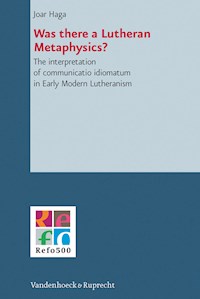
Joar Haga traces the Lutheran doctrine of communicatio idiomatum, the exchange of properties between the natures of Christ, as it developed in some important controversies of the 16th and the early 17th Century. Regarding it as the nerve of his soteriology, Luther stressed the intimacy of the two natures in Christ to such a degree that it threatened to end the peaceful relationship between theology and philosophy. At the same time as the Wittenberg reformers broke with certain strains of their philosophical heritage, they would insist that the continuation of Christ's bodily presence was a reality in sacrament and nature (!), irreducible to a sign or to a memory. On the other hand, they did not want to be ignorant of the claims of reason. By rejecting the classic framework for a peaceful coexistence of philosophy and theology on the one hand, and insisting on Christ's bodily reality on the other, the quest for a new concept of how philosophy and theology related was implicitly stated.Earlier research identified two traditions of Lutheran Christology: One train of thought follows Luther in emphasising the difference between philosophy and theology. This can be seen in the Tübingen solutions where Johannes Brenz and Theodor Thumm are the most interesting thinkers. Another train of thought can be found in the conservative pupils of Melanchthon, where Martin Chemnitz and Balthasar Mentzer are the most prominent theologians. This research does not merely group the thinkers within the confines of a tradition, but underlines their individual contributions to an open-ended history.
Das E-Book können Sie in einer beliebigen App lesen, die das folgende Format unterstützt:
Veröffentlichungsjahr: 2012