


Erhalten Sie Zugang zu diesem und mehr als 300000 Büchern ab EUR 5,99 monatlich.
- Herausgeber: TSB
- Kategorie: Geisteswissenschaft
- Serie: What Ho! P. G. Wodehouse
- Sprache: Englisch
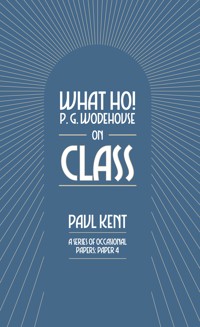
"I am not very well up in the Peerage. I seldom read it except to get a laugh out of the names." P. G. "Plum" Wodehouse rarely stood on ceremony, and the snooty English class system was a favourite target for his satire. A demolisher of privilege, pretension and snobbery, Plum presents us with a cavalcade of potty peers, dotty dowagers and perfidious plutocrats who anatomize the nation's social hierarchy more successfully than the fieriest political orator could ever manage – and all the while making us laugh. The fourth of Paul Kent's occasional essays on matters Wodehousean takes us on a hilarious tour round 20th-century English society, proving time and again that in Plum's world rank is but a guinea stamp, and kind hearts are always worth more than coronets.
Sie lesen das E-Book in den Legimi-Apps auf:
Seitenzahl: 64
Veröffentlichungsjahr: 2024
Das E-Book (TTS) können Sie hören im Abo „Legimi Premium” in Legimi-Apps auf:
Ähnliche











1Praise for Paul Kent’s Trilogy: Pelham Grenville Wodehouse: Volumes 1, 2 and 3
Volumes 1 & 2 “This is Jolly Old Fame” and “Mid-Season Form”
“Despite Wodehouse’s antipathy towards critics, Kent’s first volume demonstrates just how much the thick-skinned of us have to explore in his work. It is therefore excellent news that we await two more volumes of his work that can help us to unpick that poetry and try to better understand the source of that “sunlit perfection”.
Eliza Easton in the Times Literary Supplement (TLS)
“I have been enthralled while reading it … [Kent’s] accounts of Plum himself, and so many of his major characters, are consistently masterful and compelling, bringing time and again new and fascinating insights into their backgrounds, characters and motivations. The book is indeed a masterpiece”.
Sir Edward Cazalet, PGW’s grandson
“Kent displays an encyclopaedic knowledge of the minutiae of Wodehouse’s oeuvre and presents his arguments in a lively and engaging prose style that treads a delicate balance between academic rigour and readability. We read Wodehouse because he was a master of words. We can read Kent for the same reason”.
Stewart Ferris, Wooster Sauce, Journal of the P G Wodehouse Society (UK)
“[A] whole new perspective on Wodehouse”.
Peter van Nieuwenhuizen, The Netherlands Wodehouse Society
“Brilliant. The breadth of Wodehouse and wider references [Kent brings] in is staggering. And again, it’s about the writing: hooray! Kent is forging the new path in the way I hope writing about Wodehouse will go”.
Tim Andrew, Chairman, The P G Wodehouse Society (UK)
“Some fascinating insights into Plum’s work. Tends to make you think about Wodehouse; what you have read and what you think/thought you know/knew. As Abbie Hoffman said: “Steal this book””.
Ken Clevenger, Fans of PG Wodehouse Facebook site
“Vol. 2, which I have just finished has really blown me away. It gave me a warm glow of happiness”.
David Salter, The P G Wodehouse Society (UK) member
Volume 3 “The Happiness of the World”
“This is a magnificent book. Kent’s erudition, scholarship and easy turn of phrase makes it a must read for Wodehouse fans young and old. By placing the man, his character and his writing so effortlessly and brilliantly into the context of his times he gets to the nub of his greatness in a way others haven’t. Reading this book was an utter joy.”
David Cazalet, PGW’s great grandson
“Paul’s books are extraordinarily well researched, detailed, sometimes complex - and extremely readable, so I could review [Volume 3] in six words: ‘Engaging, engrossing, entertaining – and hugely important’”.
Wooster Sauce, Journal of the P G Wodehouse Society (UK)2
WHAT HO! P. G. WODEHOUSE ON … CLASS
A Series of Occasional Papers Paper 5
TSB LONDON AND NEW YORK
7
Wodehouse on… Class
“Those haughty English aristocrats are like that. Tough babies. Comes of treading the peasantry underfoot with an iron heel.”
Summer Moonshine
“We Earls step high,” Lord Ickenham assured her.
“It must be great being an Oil.”
“It’s terrific. I often lie awake at night, aching with pity for all the poor devils who aren’t.”
“Though I suppose you know you’re an anachronistic parasite on the body of the State?”
Uncle Dynamite
These times in which we live are not good times for Earls. Theirs was a great racket while it lasted, but the boom days are over.
Spring Fever
His lordship was like a fallen country with a glorious history.
A Gentleman of Leisure
Contents
What Ho! P. G. Wodehouse on Class
If his novels and stories are anything to go by, Pelham Grenville (“Plum”) Wodehouse must have detested snobs and snobbery. Snobs always seem to come off worse in their small wars with those who are more egalitarian and open-minded, as in the following scene from the 1933 Blandings novel, Heavy Weather, in which Clarence, Ninth Earl of Emsworth, scores a rare victory over his formidably-opinionated sister Constance Threepwood. Baulking at the idea of her nephew Ronnie Fish marrying the lowly chorus-girl Sue Brown, she sounds off:
“I think the whole thing deplorable. I am not a snob …”
“But you are,” said Lord Emsworth, cleverly putting his finger on the flaw in her reasoning.
Lady Constance bridled.
“Well, if it is snobbish to prefer your nephew to marry in his own class …”
“Galahad would have married her mother thirty years ago if he hadn’t been shipped off to South Africa.”
Lord Emsworth isn’t usually one for speaking 9truth to power, particularly when that power is his overbearing sister, but on this occasion, you’d swear he meant those remarks to sting.
Nipping Connie’s haughty flow in the bud with just three blunt and incontestable monosyllables, he stops her case for the prosecution in its tracks. Unaccustomed to resistance, particularly from her mentally negligible brother, she is brought up short and already on the back foot in her response. Sensing this, Clarence moves in for the kill with only his second utterance: if their brother Galahad hadn’t been the victim of the same brand of family snobbery that is being perpetuated by Connie, the lovely Sue would now be her niece – for Gally was once desperately in love with Sue’s mother Dolly Henderson, also a stage performer, whom he would have married had the family not shipped him off to the colonies to cool his ardour. At which point Connie realizes she has lost the argument, petulantly remarking that “the only thing I have to say about Miss Brown’s mother is that I wish she had never had a daughter.” It’s a small but telling triumph. Clarence likes Sue, not on account of where she’s from, who she is, where she lives, how she earns a living or who her parents were. He focuses instead on the simple reason that she, like him, is “extremely sound on pigs” – and that’s a perfectly good enough basis on which to build a friendship and accept her into the family.
As we’ll be seeing, Plum created several peers 10of the realm who aren’t prone to lording it over their social inferiors, somewhat unusual for a writer in a class-ridden country where just about everyone was looking down on (or up to) someone else. Or, if they were middle class, both at the same time. Even the railways had three tiers of carriage, as we are helpfully informed in Chapter 5 of Something New:
In English trains the tipping classes travel first [class]; valets, lady’s maids, footmen, nurses, and head stillroom maids, second; and housemaids, grooms, and minor and inferior stillroom maids, third. But for these social distinctions, the whole fabric of society would collapse and anarchy stalk naked through the land – as in the United States.
You won’t find this passage in the British edition of the novel (entitled Something Fresh); Wodehouse was having a bit of satirical fun at the old country’s expense, explaining this arcane aspect of British culture for those who may not have experienced such particular discrimination. As for his joke about anarchy in the U.S. resulting from an absence of “social distinctions”, the sarcasm appears to be covering his embarrassment, amusement, and impatience at the behaviour of his fellow countrymen. 11
And yet for the distinguished political writer and novelist George Orwell – and others since – Wodehouse and his fictional world were part and parcel of the problem. In his 1945 essay ‘In Defence of P. G. Wodehouse’, we find the following paragraph:




