


1,90 €
Mehr erfahren.
- Herausgeber: Lebooks Editora
- Kategorie: Religion und Spiritualität
- Sprache: Englisch
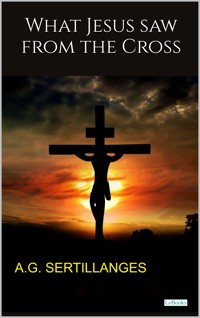
What Jesus Saw from the Cross is a deeply meditative and spiritually profound work that invites readers into the inner experience of Christ during His Passion. Written by French Dominican priest Antonin Sertillanges, the book blends historical insight, theological reflection, and imaginative contemplation to reconstruct the view from the cross—both physically and spiritually. Sertillanges vividly explores what Jesus would have seen: the city of Jerusalem, the Roman soldiers, the mocking crowds, the grieving loved ones, and, ultimately, the fallen world He came to redeem. More than a devotional text, What Jesus Saw from the Cross is a study in divine compassion and redemptive suffering. Sertillanges uses the Passion narrative to highlight themes such as forgiveness, human frailty, and the triumph of love over hatred. With scholarly rigor and poetic depth, he invites the reader not only to observe the crucifixion but to enter into its meaning from Christ's perspective—emphasizing interior transformation and personal identification with the suffering Savior. Since its publication, the book has been widely acclaimed for its unique approach to meditating on the Passion of Christ. Its blend of emotional intimacy and theological depth has made it a beloved spiritual classic. The enduring power of What Jesus Saw from the Cross lies in its ability to guide readers toward a deeper understanding of sacrificial love and to inspire a more intimate relationship with Christ, even amidst the trials of everyday life.
Das E-Book können Sie in Legimi-Apps oder einer beliebigen App lesen, die das folgende Format unterstützen:
Seitenzahl: 343
Veröffentlichungsjahr: 2025
Ähnliche






Antonin Sertillanges
WHAT JESUS SAW FROM THE CROSS
Original Title:
“Ce que Jésus voyait du haut de la Croix”
Contents
INTRODUCTION
WHAT JESUS SAW FROM THE CROSS
EPILOGUE
INTRODUCTION
Antonin Sertillanges
1863 – 1948
Antonin Sertillanges was a French Catholic priest, philosopher, and Dominican friar, renowned for his contributions to Thomistic philosophy and for his widely influential work on intellectual life. Deeply rooted in the tradition of St. Thomas Aquinas, Sertillanges sought to reconcile faith and reason, offering guidance not only on abstract metaphysical questions but also on the practical conduct of a life devoted to study and contemplation.
Early Life and Education
Antonin-Dalmace Sertillanges was born in Clermont-Ferrand, France. He joined the Dominican Order at a young age and pursued theological and philosophical studies with great dedication. He quickly distinguished himself for his deep understanding of Thomistic thought, eventually becoming a professor of moral philosophy and theology. Sertillanges spent much of his academic career teaching and writing in Paris, where he became a prominent voice in the revival of Thomism in the early 20th century, particularly within Catholic intellectual circles.
Career and Contributions
Sertillanges is best known for his book The Intellectual Life: Its Spirit, Conditions, Methods (1921), a practical and spiritual guide for scholars, students, and thinkers seeking to live a life dedicated to truth. The work emphasizes discipline, humility, and the integration of intellectual pursuits with a life of virtue and faith. In clear and elegant prose, Sertillanges lays out the moral and spiritual prerequisites of the scholar’s vocation, stressing that intellectual work should not be separated from the pursuit of holiness and the love of God.
In addition to this seminal work, Sertillanges wrote extensively on St. Thomas Aquinas, including La Philosophie Morale de Saint Thomas d’Aquin, in which he systematizes Aquinas’s moral thought and makes it accessible to a modern audience. He contributed to the neo-Thomist movement, advocating for a return to the principles of classical philosophy as a way of engaging with contemporary issues. His writings covered a wide array of topics, from metaphysics and ethics to aesthetics and social philosophy.
Impact and Legacy
Sertillanges played a crucial role in the Catholic intellectual revival of the early 20th century. His accessible and profound treatment of intellectual life influenced not only theologians and philosophers but also artists, writers, and lay readers seeking a deeper understanding of the relationship between thought and spiritual life. The Intellectual Life became a classic, translated into several languages and widely read across both religious and secular communities.
While he remained faithful to the scholastic tradition, Sertillanges was attuned to the challenges of modernity. His work provided a bridge between medieval thought and contemporary concerns, offering a model of intellectual engagement grounded in discipline, clarity, and moral responsibility. He encouraged thinkers to cultivate silence, focus, and integrity in their pursuit of knowledge—virtues that remain strikingly relevant in today’s distracted and fragmented world.
Antonin Sertillanges died in 1948, leaving behind a legacy of scholarship, spiritual guidance, and intellectual mentorship. Though less widely known than some of his contemporaries, his work continues to resonate among those who seek to balance intellectual rigor with a life of inner depth and ethical commitment.
Today, Sertillanges is remembered not only as a scholar but as a spiritual guide for all who dedicate their lives to thought. His vision of the intellectual life—as a vocation rooted in love, truth, and service—remains a powerful reminder of the dignity and responsibility of those who seek to understand the world and illuminate it for others.
About the work
What Jesus Saw from the Cross is a deeply meditative and spiritually profound work that invites readers into the inner experience of Christ during His Passion. Written by French Dominican priest Antonin Sertillanges, the book blends historical insight, theological reflection, and imaginative contemplation to reconstruct the view from the cross—both physically and spiritually. Sertillanges vividly explores what Jesus would have seen: the city of Jerusalem, the Roman soldiers, the mocking crowds, the grieving loved ones, and, ultimately, the fallen world He came to redeem.
More than a devotional text, What Jesus Saw from the Cross is a study in divine compassion and redemptive suffering. Sertillanges uses the Passion narrative to highlight themes such as forgiveness, human frailty, and the triumph of love over hatred. With scholarly rigor and poetic depth, he invites the reader not only to observe the crucifixion but to enter into its meaning from Christ’s perspective—emphasizing interior transformation and personal identification with the suffering Savior.
Since its publication, the book has been widely acclaimed for its unique approach to meditating on the Passion of Christ. Its blend of emotional intimacy and theological depth has made it a beloved spiritual classic. The enduring power of What Jesus Saw from the Cross lies in its ability to guide readers toward a deeper understanding of sacrificial love and to inspire a more intimate relationship with Christ, even amidst the trials of everyday life.
WHAT JESUS SAW FROM THE CROSS
PROLOGUE
St. Paul exhorts us to put on Jesus Christ, and his words, understood in the spiritual sense in which he intended them, are of immeasurable importance. But there is perhaps another sense in which it is not impossible, nor without its importance, to put on Jesus Christ.
We may put on Jesus Christ in imagination, placing ourselves, not at the foot of the cross, nor before it, but upon it ; with head bowed beneath the inscription, wearing the crown of thorns, pierced by the nails, feeling the cold, rough wood between our shoulders ; in a word, making our own the sphere of vision and the emotions that were His, seeing with His eyes and feeling with His heart, remembering, judging and foreseeing with Him so that, still in this same sense of imagining that we have changed places with Him, it is no longer we who live but Christ who lives in us.
It was in Jerusalem that this thought came to me, whilst I stood — as I frequently did — on a spot which is uniquely suggestive of such reflections.
On the terrace of the Greeks overlooking the atrium of the Holy Sepulchre, a few paces from the great dome, is a small stone cupola surmounted by a cross. It can be reached quite easily, and you may stand there and linger. If you now face Jerusalem, which is spread before your eyes, you are confronted with the same panorama, making allowances for the changes operated by time, as met the gaze of the divine Master. According to the most careful calculations and on the authority of one who knows the archaeology of the Holy Places better than anyone at the present day, the iron cross which you are touching there marks, within a few inches, the level and the place once occupied by the divine countenance. A striking thought, which recalls the words of St. Cyril of Jerusalem as he preached at the Holy Sepulchre : ‘ How many others are able only to hear, while we can see and touch ! ’
The scene of the crucifixion is to-day changed beyond recognition ; the mere mention of my observation post would be sufficient to show this. But it is possible to reconstruct it without any great difficulty. A few doubtful points remain to be settled ; and torturing those doubts are — for it is not easy to reconcile ourselves to the regrettable fact that we cannot at this moment with certainty trace out the Way of the Cross. But the remainder of the sacred site is happily known to us. Its general lines are indicated for us by the hills that encircle Golgotha ; the knolls, the valleys, partly filled but plainly discernible, still remain ; the roads are determined by the formation of the ground and by immutable directions. The ruins visible here and there, the excavations made in recent times, the comparative study of texts and of facts enable us to recognise and even to establish with precision the theatre of the drama. We may feel the thrill of reality.
Let us, then, without further delay open our eyes with Jesus Christ : the eyes of our body and the eyes of our intelligence. As we ‘ put on ’ Jesus Christ let us wed ourselves to His mind and His heart. So it may be that the invisible world in which His soul moves will appear more vividly to us : perhaps we may be granted the grace of a more intimate union with Him.
Jerusalem,
The evening of Maundy Thursday.
CHAPTER I – THE OBSERVATION POST
It is about twelve o’clock, in Jerusalem the sultriest hour of the day, when Jesus leaves the praetorium. It is spring-time — March 20 at the earliest, April 17 at the latest — but spring in Palestine has none of the charm of our April. Spring is the season of uncertain weather ; one day will be beautiful, the next may bring snow or stifling heat. It is the season of the Khamsin, the hot, depressing wind from the south-west.
Jesus is carrying His cross. To His neck, probably, is attached the placard two feet square, whitened with chalk, which will be nailed to the cross to advertise the nature of His crime. He is preceded by a mounted centurion and escorted by a band of soldiers ; for company He has two thieves whom they have decided to execute with Him ; in front, behind and around Him is an inquisitive or hostile mob.
For some 200 yards in a direct line, but rather more through the network of narrow streets, their way lies down-hill through the town. Then the road slopes upwards, always winding, bringing the total distance to 500 yards. The procession thus reaches the Gate of Ephraim, otherwise called the Gate of the Square because it opens upon a square esplanade, bounded by a right-angled corner in the walls. This was later to become the Roman forum.
The Gate of Ephraim is a redan gate ; that is, it forms a salient angle ; so that the entrance is from north to south and the exit from east to west. It is interesting to note that in a Greek convent near by an ancient step is preserved upon which Jesus may have trod as He carried His cross.
Immediately after crossing the threshold Jesus stood face to face with His tomb.
There was nothing gloomy about the prospect, in spite of the tombs, which were a common feature of the rich properties of the period. The gate between that of Ephraim and that of Jaffa was called the Gate of Gardens ; and in fact all the slopes of Gareb, the hill opposite, were under cultivation. Olives formed the chief part of the vegetation ; but there were also citrons, figs, nuts and pomegranates. Many birds made their nests in the branches of these trees, swallows and martins making merry in the spring-time, with sparrows, lapwings, cuckoos, thrushes and turtle-doves. Nor was there any lack of flowers. The place was carpeted with cyclamens, the flower of rocky ground, wild daffodils, irises, fennel, poppies and daisies ; and expecially the red anemone — perhaps the lily of the field that vies with the glory of Solomon — a flower which glitters like a stained-glass window when the sun shines upon it, but in the shade has the dull hue of dried blood.
There, too, were the famous flowers of Calvary : those tiny blossoms that seem never to die, sprouting to-day in the same places as yesterday. Jesus, who loved them, mingled His blood with their crimson drops ; and the robin red-breast of legend, the meditative dove of the psalm, and perhaps the owl, too, attracted by the great darkness, were there to soothe Him in death.
Once on a Good Friday about three o’clock in the afternoon, I was in my favourite spot — on the terrace which I mentioned above — when I saw the air suddenly filled with a cloud of swallows flying thickly together and filling the surrounding space with their cries. The little iron cross which now stands in the place of the great gibbet was caught in the network of their lines of flight ; to and fro the shrill and fleeting cries crossed and recrossed one another ; it was a festival, and it was a reminder of death. Who knows but that Jesus in the depths of His agony heard and welcomed with a sad smile another such exquisite canticle ?
* * *
We have spoken of Calvary, and we have not yet located this ‘ mountain ’ which occupies so important a place in our thoughts. It is difficult enough to locate it by our account, and the pilgrim on the spot, unless forewarned, would find it still more difficult to place it, near the mediaeval parvis that leads to it.
The fact is that Calvary is not a mountain at all ; it is not even a hill, unless you would dignify by that name what is little more than a knoll in a field. If the esplanade of 60 yards in front of the Gate of Ephraim had not yet been levelled — and had it been, in point of fact ? — the ascent to Calvary would have been almost imperceptible. This chalky mound stood not more than 16 feet above the roads which wound round its base ; it rose rather abruptly from the western side, but quite gradually from the east and south-east, the way by which Jesus approached it.
However, Our Lord’s observation post dominates the town. When the gibbet has been erected its highest point will be another ten feet above the level of the ground, and the gaze of the Crucified may range over the whole horizon.
In front of Him Jesus will see the Gate of Ephraim at a distance of 80 yards, the Temple at a quarter of a mile, the tower Antonia at 400 yards, and at 700 yards the great south-eastern corner, or the ‘ pinnacle ’ from which Satan had wanted Him to cast himself down.
Then He will see the surrounding country. Northnorth-east, almost due north, are the slopes of Nabi-Samouel, the ‘ high place ’ of Gabaon where Solomon had his dream of wisdom, where the unhappy Respha protected her sons against the vultures ; then Maspha, where the faithful Machabees worshipped while awaiting their entry into Jerusalem.
To the north-east exactly is Mount Scopus, where Alexander once quailed before the majesty of the high priest ; where Cestius Gallus and Titus encamped when the days of Israel were accomplished ; where later the soldiers of Godfrey de Bouillon made their advance — a solemn approach to the city, which since the days of Nabuchodonosor, Sennacherib and Tiglath-Palasar has been ever an object of delight or of desire.
To the east is the Mount of Olives, which holds a predominant place in the life of Jesus in consequence of the memories evoked by its lower reaches, its slopes, its summit, its surroundings, its villages and its roads. And therefore we shall dwell upon it in these pages.
To the right of the Mount of Olives, across the brook Cedron, is a strip of burnt and arid desert, behind which you can smell the Dead Sea and see the unbroken line of the mountains of Moab, with the fringe of mist at their base which rises from those heavy waters.
Here are memories of the great fast, of the Baptism and the voice from heaven ; here is Mount Nebo, whence Moses saw the Promised Land from afar ; here is Machasrus, with the head of John the Baptist lying in its plate as in a halo ; here are the caves which gave refuge to the scapegoat, hunted for the crimes of Israel, as Jesus is for ours.
Nearer, and still due east, is Mount Moriah, the pedestal of the Temple, with its southward extension bordered by the Tyropoean Valley and the valley of Josaphat, the site of the ‘ City of David.’
On the horizon of this strip of immortal land is the village of Siloe, the ancient burial place of the Jews, and behind it the Mount of Scandal, where the ancient ‘ abominations ’ were perpetrated.
To the west high hills close in the view, hills that lead up to what to-day is called Mount Sion, and bound the curving valley of Hinnon, or Gehenna.
Such is the place where Jesus went to meet His death.
At the moment the prospect was fair and pleasing ; but we know that soon a dark cloud spread over the earth. During spring in Palestine night often falls thus suddenly after hours of radiant sunshine. When the dreaded wind of the desert blows, the smoky clouds gather, beaten up by the heavy wings of the demon of the Assyrian Styx, and in the heights a war is waged between the west wind, damp and cool, and the warm breath of the Nedj'ed. And for a time darkness reigns : an image of what befell, by an intervention of divine Providence, at the moment of the Great Death.
* * *
And here is the cross. It is a square-hewn beam, with a cross-piece. It is probably ten feet high ; Rome likes to make an exhibition of her condemned criminals, for the sake of example. Jesus alludes to this when He says : ‘ If I be lifted up from the earth I will draw all things to myself. What is intended for His infamy He makes an instrument of glory.
The length of the beam had to be limited, because it had to be thick, and yet the criminal must carry it. There must therefore be a limit to the weight. Moreover, certain conditions were imposed by balance and handling. It was possible to engage the shoulder against the cross-piece ; but to drag the wood on the ground behind would have been out of the question.
The gibbet was probably provided with a wooden projection at some height above its base ; this, the antenna, formed a sort of saddle and was designed to prevent the hands and feet from being torn under the weight of the body ; but this detail is not certain.
The feet of Christ are sometimes represented as resting upon a sloping foot-rest : this is a pious invention for which there is no authority. Jesus must have been nailed with His legs drawn up high enough for His feet to rest flat against the beam : a frightful position, but for that very reason the more probable.
What kind of tree was privileged to provide the wood upon which the world’s most precious fruit should hang ? It is not certain. In all probability it was a coniferous tree. A legend fixes a valley to the southwest of the city, belonging to the Greek monastery of the Holy Cross, as the place where the tree was cut; but so many childish legends flourish in that place that it is difficult to take this seriously. As a matter of fact, it is hard to see how anyone can be certain on this point. A prsctorium contained a whole collection of crosses ; but they bore no labels to indicate whence they came.
The liturgy is better inspired when it abstracts from the material origin of a wood which is so permeated with spiritual significance :
‘ Faithful cross, O tree all beauteous, Tree all peerless and divine, Not a grove on earth can show us Such a flower and leaf as thine.
Sweet the nails and sweet the wood Laden with so sweet a load.
These tender mystical reflections have a greater charm than any stories of Lot planting a tree, and of the Queen of Sheba finding the tree used to make a threshold in the temple of Solomon, and similar fantasies.
When we speak of the cross as a piece of wood, we do not think of its growth nor of its situation. Its situation is the universe ; its growth dates from the ‘ Sixth Day ’ ; unless you would rather say that it exists and grows in the heart of the Christian when he unites himself to his divine Master. The cross is necessary for the salvation of the world : happy the land, happy the soul willing to pay the price of it !
* * *
Having established the site of Calvary and described the cross, the question still remains, in what direction was the Sufferer facing ? There are mystical authors who orientate the cross to the west — that is to say, they ‘ disorientate ’ it. Their idea is that the look which
regenerates is turned towards us, Israel and the Old Law being forsaken. This theory, besides being a priori and not free from partiality, finds no confirmation in the situation of Calvary.
As you pass out of the Gate of Ephraim you are facing Mount Gareb, of which Calvary is a small foothill : to turn the gibbet to the west would be to make it face the hills and to hide it from the people. The idlers of the gate and the loiterers of the esplanade, the passers-by who met in great numbers at the crossroads, the folk that clustered everywhere about, the dwellers in the tents set up in the open air for the feast, all these would have been foiled ; the public example made of the victim would have been stultified ; the erection of the gibbet and the management of the execution would have been made difficult ; in every way it would have been a bad arrangement.
No, Jesus faced the gate by which He had come forth, through which came His insuiters and those who were greedy for a spectacle ; He offered himself to those who hated and mocked Him ; He lent himself to the convenience of His executioners ; and, if reasons of appropriateness must be added, the new Man looked towards the beginnings, towards the end of the earth from which came civilisation, together with the light ; He faced as the apse of a church faces, having before His eyes the rampart of a world beyond which He had passed, though He had not forsaken it; His final glance saluting the Temple, His Father’s house, and the rising sun.
And so now the cross is erected in its proper place, facing in the right direction, according to all the rules. The chalky soil offers a good grip ; the beam holds ;
and now the inscription surmounts the gibbet. He who is to die has been stripped of His garments, first bound to the cross, and then nailed to it. His crown has been left upon His head, presumably intended as a commentary upon the derisive inscription, but in truth consecrating Jesus as king of hearts and king of the universe.
The first spasms shake a body already mercilessly torn by the scourging and by a night of torment ; the victim has been raised roughly upon His gibbet ; the blood flows in thin streams from His hands and feet, oozes from His forehead and stripes His breast and members along the marks of the lashes. The cruelly strained position allows no movement; but the soul is unfettered, and the great shudders that rack the body leave the mind in full possession of its powers.
There is still a little more of this great life to be lived, a life which in the narrow confines of Judaea embraces all the world. A cry or two more, and a few more words of sovereign power. One more lament that asks compassion of earth and heaven ; of earth, to recompense it with mercy to us, of heaven, to grant us its blessings. And through it all, that glance which sees beyond all things, that glance which we shall follow as far as our sight can reach. But it goes infinitely beyond our vision, for it passes from the world visible and invisible and penetrates to their source, to the very depths of God.
After the cross has been erected, Calvary stands still for a moment, shocked into immobility by the spectacle of supreme pain. The inevitable reaction affects even the executioners. But above all it affects the Sufferer. After the terrible jolt with which the cross fell into the rocky hole, sending a shudder through the beam and through the members of the victim, the Crucified welcomes as a sort of relief the dull, continuous agony which now ensues and will only later reach its paroxysm.
The noises of the city make themselves heard fitfully through this furtive silence : the cries of donkeydrivers fill the void left by the silenced blasphemers ; camels pass with majestic tread, carrying their loads back to Jaffa or Damascus. In the distance the wind raises arid clouds from the sand-hills ; Moab is shrouded in a mist of mauve ; the fig-trees give forth their honeyed scent ; at the foot of the cross the red blossoms slowly increase and multiply. The hand of death, for a moment hesitating, relaxes its pitiless hold on the breast of Jesus.
THE MASTER OPENS HIS EYES
CHAPTER II – SION
Everything that meets His first glance speaks to Jesus of His Father’s work and of the beginnings of His own. But there is one place, I think, a place full of mystery, which especially attracts and holds His attention ; for it provided a starting-point in the course of ages.
There beyond the ramparts and the esplanade of the Temple, between the present mosque El-Aksa and Gehenna, is a steep narrow strip of land called Ophel (a hill or mound). It occupied an area of about twenty acres, twelve of which extended from the foot of the hill to Gihon, the present Fountain of the Virgin. Now this last piece of land, or to be more accurate the chief part of it, which formed a citadel, bore a name three thousand years ago which was destined to reach to the ends of the earth, and, according to one of the meanings attaching to it, was to have an eternal significance. It was called Sion.
Yes, the ‘ City of David,’ as it was called after Joab’s exploit, the ‘ metropolis of the King of ages,’ as St. John Chrysostom called it later, was less than 200 yards wide in its inner enclosure. Its only water supply was the spring of Gihon, and to ensure that in case of siege this indispensable fountain, situated outside its borders, should not be cut off, a sinnor, or secret channel, had been bored. It was by this way that a single man, allured by David’s promises, succeeded in capturing the tiny ‘ impregnable ’ fortress.
It is sometimes a very little thing that bears a great name. The name of Sion belonged at first only to this small citadel, being later extended to the town — if, indeed, you could give the title of town to five acres of land covered by a heap of huts indistinguishable from the slopes on which they were erected, a number of grey hovels on grey earth, an ant-hill without the glory of a meadow.
The reader need not be surprised or disappointed. Life in those far-off days, and in those regions even to-day, is not what our western civilisation leads us to imagine. People here live in the open air ; they meet at the gate to transact their business ; they disperse to their work on the slopes or in the valley ; they sleep beneath the stars or in the shelter of a rock, in natural caves or even in old tombs. Only from time to time do they enter their houses, unless the weather is bad, and then they shut themselves in.
Accommodation in the modern sense of the word is provided only for the social authorities and for the divinity. These occupy the citadel, which is at one and the same time a temple and a palace. Under such conditions little space is needed. When nature is favourable and lends herself, as she does in these parts, to the convenience of human beings, you regard your house less as a dwelling-place than as a refuge. The country is open ; and so the hut, being little used, is reduced to the minimum. The desert is wide ; and so the lion’s den need only be small.
Behold, then, Master ! Behold the land wherein was planted the root of Jesse from which you were to come forth. See it now, humbled and hidden beneath the magnificent erections of Herod. The history that began there was to have no end ; in its course it would take up your cross to carry it to the ends of the earth, even to God himself. We make the sign of the cross in the name of the Father and of the Son and of the Holy Ghost ; the cross sets the world’s history into the course of God’s.
Truly that little hill has a greatness all its own ; like David’s gesture, that childish cast of the sling to which a giant succumbed. From Sion, a point almost without extension, a vibration was to be set up that would fill the whole of space and time.
Greatness is not measured only by dimensions. The Parthenon, Agrippa’s Pantheon, the Cour des Lions, the Sainte Chapelle, take up very little space. Pascal’s Pensees occupy little room on a bookshelf. Sanzio’s ‘ Vision of Ezechiel ’ is a canvas not more than 14 inches square. Sion, from the moment that the Son of Man is foretold there, from the moment that the cross with its ‘ tender burden ’ casts its shadow upon her, becomes the city of the universe and the focus of religious hearts in all ages.
Little land greater than the world, you contain and give us eternity.
* * *
From any point of the city of David, dominated by Mount Moriah and the terraces of Solomon, it was possible to see the house of Yahweh, just as from the foot of an Alpine glacier you can see the lofty peaks that crown it with towers. Of Sion the pious Israelite used to say : ‘ God is in the midst thereof’ I and as its conquest by the son of Jesse had caused it to be called the city of David, so its conquest by Yahweh gave it the name of the City of God. Hence the Psalmist joyfully exclaims : ‘ With the joy of the whole earth is Mount Sion founded, on the sides of the north, the city of the great King.
Israel is conscious of being the people of God, enriched with promises which she ill understands, which she often interprets in a material sense, though chosen souls — and at times even those of the poorer sort — perceive their spiritual meaning.
This is the key to the history of Israel, that paradoxical history of a tiny people that radiates power over the entire human race. Even the unbeliever finds it hard to elude the mystery of Israel. It is a story traversed by a current, directed to a goal unknown ; it knows not whither it goes, but as it goes it tells us whither it is tending, yet not knowing the meaning of what it foretells. In this history a humble event assumes a moral significance so lofty that it becomes an eternal symbol ; in it heaven and earth meet unceasingly ; the childish and the cruel that we meet at every turn are allied with the sublime and the miraculous ; and, even when to all appearance it is sunk in the depths of horror, it is a ‘ sacred history.’
Every kind of contradiction will be found in this series of events, because these antinomies are inherent in the human principle which God is using as His instrument and whose nature He does not change. A people at once fearless, turbulent, restless, violent and weak ; a nation of idealists and a nation of rebels ; a nation of merchants and priests, of small moneylenders and heroes ; a people enslaved and kingly, creatures of routine yet pioneers of new lands ; realists yet in quest of an Eden ; narrow and world-wide ; sordid yet protectors of the poor ; mean yet superhumanly proud ; prophetic yet killing the prophets ; venerating their oracles yet slaying those who uttered them ; faithless in the name of an inflexible faith in their destiny ; often friends to their slaughterers and always slaughterers of their friends : such are the people of Israel.
With a firm and tenacious belief in her high mission Israel is false to it again and again ; indomitable to the point of heroism, none can be more servile or abject in submission. Israel is essentially a conservative people ; she does not develop, she says always the same things, makes always the same gestures ; she will string contradictory statements together rather than lose a single sentence of her books ; she uses always the same rites, private and public, is guided by the same few sentiments. And yet she believes in a golden age to come. While others see it only in the past, Israel sees a golden age in the future as well ; and that hope is the inspiration of her heroic deeds and of her song.
Israel is the custodian of monotheism ; yet she is constantly falling into idolatry, and toying with those very cults of neighbouring peoples which she has scourged with her prophecies, conscious that her national and moral salvation depends on Yahweh alone. From the time of Solomon, out of complaisance to that sensual monarch, Israel tolerated centres of pagan worship near her place of burial ; the Mount of Scandal is a proof of it to this very day. There, despite the repeated protests of the prophets, were the sscred gardens with their prayer slabs, their ritual trees, with niches in the rock to receive the pagan images.
Yet, notwithstanding pantheists, polytheists and fetichists on every side, Israel preserved her faith in the one true God. She transmitted that faith intact to posterity ; her very prevarications only served to emphasise the mission she had to fulfil, only called forth from her spokesmen clearer and more definite pronouncements. She promulgated the law, the promises and the hopes. Conscious of the covenant, breaking it and renewing it, finally unfaithful, Israel is the mediator of an eternal pact which, absorbing her in the rest of humanity, is destined to embrace the whole world.
* * *
It is a remarkable fact that the whole of the history of the cross and its consequences is written in the Hebrew books. Sion is not only the place of preparation, but also that of prophecy. Israel foresees and foretells ; her religious genius has a spirit unshackled by the bonds of time, and her Yahweh speaks close to her ear.
Under the pen of prophets, psalmists, chroniclers, sages and law-givers, the history of this day, and of the eternal day that is its outcome, is anticipated and set forth sentence by sentence, phrase by phrase, without apparent coherence or plan, yet in such a manner that when the event happens, recalling these memories and co-ordinating them, there arises a complete and striking description to vindicate those voices of long ago. . , . . . .
The coming of the Messias, His characteristics, His work, His life and death, His resurrection, His glory, His eternal rule over the elect, are described clearly in a few rapid sentences. Some texts will suffice in illustration :
‘ The sceptre shall not be taken away from Juda, nor a ruler from his thigh, till he come that is to be sent : and he shall be the expectation of nations.’ (Gen. xlix, io.)
‘ And thou, Bethlehem Ephrata, art a little one among the thousands of Juda : out of thee shall he come forth unto me that is to be the ruler in Israel ; and his going forth is from the beginning, from the days of eternity.’ (Mic. v, 2.)
‘ A virgin shall conceive and bear a son ; and his name shall be called Emmanuel (God with us).’ (Isa. vii, 14.)
‘ For a child is born to us, and a son is given to us, and the government is upon his shoulder ; and his name shall be called Wonderful, Counsellor, God the Mighty, the Father of the world to come, the Prince of Peace.’ (Isa. ix, 6.)
‘ Behold I send my angel and he shall prepare the way before my face. And presently the Lord whom you seek, and the angel of the testament whom you desire shall come to his temple. Behold he cometh.’ (Mal. iii, 1.)
‘ The people that walked in darkness have seen a great light.’ (Isa. ix, 2.)
‘ Then shall the eyes of the blind be opened, and the ears of the deaf shall be unstopped. Then shall the lame man leap as a hart, and the tongue of the dumb shall be free.’ (Isa. xxxv, 5-6.)
‘ Behold my servant : I will uphold him. My elect : my soul delighteth in him. I have given my spirit upon him ; he shall bring forth judgement to the Gentiles. He shall not cry nor have respect to person, neither shall his voice be heard abroad. The bruised reed he shall not break, and smoking flax he shall not quench.’ (Isa. xlii, 1-3.)
‘ Rejoice greatly, O daughter of Sion, shout for joy, O daughter of Jerusalem ; behold thy king will come to thee, the just and saviour. He is poor and riding upon an ass and upon a colt, the foal of an ass.’ (Zach, ix, 9-)
‘ For even the man of my peace, in whom I trusted, who ate my bread, hath greatly supplanted me.’ (Ps. xl, 10.)
‘ And they weighed for my wages thirty pieces of silver. And the Lord said to me : Cast it to the statuary, a handsome price, that I was prized at by them. And I took the thirty pieces of silver and I cast them into the house of the Lord, to the statuary.’ (Zach, xi, 12-13.)
‘ Unjust witnesses rising up have asked me things that I knew not; they repaid me evil for good.’ (Ps. xxxiv, 11-12.)
‘ I have given my body to the strikers, and my cheeks to them that plucked them. I have not turned away my face from them that rebuked me and spit upon me.’ (Isa. 1, 6.)
‘ They gave me gall for my food ; and in my thirst they gave me vinegar to drink.’ (Ps. Ixviii, 22.)
‘ All they that saw me have laughed me to scorn : they have spoken with the lips and wagged the head : He hoped in the Lord, let him deliver him ; let him save him seeing he delighteth in him. ... I am poured out like water, and all my bones are scattered. . . . The council of the malignant hath besieged me. They have dug my hands and feet. They have numbered all my bones. And they have looked and stared upon me. They parted my garments amongst them, and upon my vesture they cast lots.’ (Ps. xxi, 8-19.)
‘ Surely he hath borne our infirmities and carried our sorrows ; and we have thought him as it were a leper, and as one struck by God and afflicted. But he was wounded for our iniquities, he was bruised for our sins. The chastisement of our peace was upon him ; and by his bruises we are healed.’ (Isa. liii, 4-5.)
‘ Thou wilt not leave my soul in hell; nor wilt thou give thy holy one to see corruption. Thou wilt make known to me the ways of life.’ (Ps. xv, 10-11.)
‘ Sit thou at my right hand, until I make thy enemies thy footstool.’ (Ps. cix, 1.)
‘ Therefore will I distribute to him very many, and he shall divide the spoils of the strong ; because he hath delivered his soul unto death and was reputed with the wicked.’ (Isa. liii, 12.)
‘ Arise, be enlightened, O Jerusalem : for thy light is come and the glory of the Lord is risen upon thee. For behold darkness shall cover the earth and a mist the people ; but the Lord shall arise upon thee and his glory shall be seen upon thee. And the Gentiles shall walk in thy light, and kings in the brightness of thy rising. Lift up thy eyes round about and see ; all these are gathered together, they are come to thee.’ (Isa. lx, 1-4.)
‘ I beheld therefore in the vision of the night, and lo, one like the son of man came with the clouds of heaven. And he came even to the Ancient of days ; and they presented him before him. And he gave him power and glory and a kingdom ; and all peoples, tribes and tongues shall serve him. His power is an everlasting power that shall not be taken away ; and his kingdom that shall not be destroyed.’ (Dan. vii, 13-14.)
It is certain that Jesus thought of these things as He hung upon the cross. His cry of anguish : ‘ My God, my God, why hast thou forsaken me ? ’ is the first sentence of a long prophetic psalm from which several of the above passages have been taken. Jesus lives upon these ancient prophecies ; He proclaims them, He comments upon them in the synagogues, He explains them to His disciples, and at Emmaus He weaves them all into one discourse. And just as He associates himself with the prophecies of which His mission is the fulfilment, so also He gazes forward into the mysteries of the future. The time that is to come appears to Him as though it were present. Both past and future meet Him as He walks His path, for His path is set in eternity. All that He has to do and to suffer is already written in the book of God, and men also had written it on earth. But the consequences that are to come are no less foreseen. These, too, He sees with the seers ; and in His turn He prophesies what is to come.




