


Erhalten Sie Zugang zu diesem und mehr als 300000 Büchern ab EUR 5,99 monatlich.
- Herausgeber: One Media iP Group
- Kategorie: Geisteswissenschaft
- Sprache: Englisch
Over the course of human history there have been many men who have stood out amongst the crowd. Whether writers of fiction, great physicians or even politicians, these men may in fact share a common purpose, regardless of the age in which they lived. What Wise Men Do analyses various great men such as: Paracelsus Grand Master Pinto of the Knights of Malta Sir Arthur Conan Doyle Jules Verne H. G. Wells Bram Stoker Bob Kane the creator of Batman In this series of investigations, a thread of truth is discovered, revealing an inner yearning linked to our own evolutionary path and shared by each and every one of the individuals in question. This book investigates concepts of magic as seen in each age and questions the truth of the statements against modern science and even theoretical science. In each case some new and startling discovery is made, making this compelling book a revelation from chapter to chapter.
Sie lesen das E-Book in den Legimi-Apps auf:
Seitenzahl: 283
Veröffentlichungsjahr: 2023
Das E-Book (TTS) können Sie hören im Abo „Legimi Premium” in Legimi-Apps auf:
Ähnliche







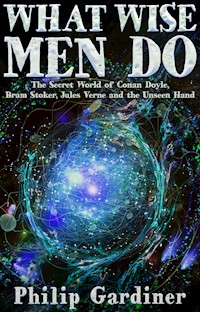
What Wise Men Do
The Secret World of Conan Doyle, Bram Stoker, Jules Verne and the Unseen Hand
By Philip Gardiner
Table Of Contents
Introduction 5
Chapter 1 – Paracelsus – The Sign of the White Horse 8
Chapter 2 – Religion and Alchemists 14
Pinto 17
Cagliostro 19
The Modern Era of the Knights 23
Chapter 3 – H. G. Wells – The Man on the Moon 26
War of the Worlds 28
The Time Machine 29
Beliefs 30
Influence 30
Chapter 4 – Jules Verne and the Power of Imagination 34
Jules Verne 34
The Works 38
Hetzel 44
The Circle 45
Epilogue 46
Chapter 5 – Bram Stoker – Beware of Invasion 47
The Victorian Gothic World 47
Bram Stoker 49
Dracula 51
The Vampire 54
Other Clues 55
Conclusion 58
Notes 59
Chapter 6 – Bob Kane and the World of the Bats 60
The Tale of how Bob Kane originated Batman 61
History 63
The Vampire 65
Chapter 7 – Sir Arthur Conan Doyle – Even the Wise Get Confused 67
The Esoteric World of Conan Doyle 69
Fairies 72
So Who Was Sherlock Holmes and Why? 74
Ancient Wisdom 76
Notes 77
Chapter 8 – Magic, Mind, God 78
Crystal 83
Chapter 9 – A Message from the Past 89
Notes 91
Conclusion 92
A Way Out – Life and its Meaning 95
Help! 98
Bibliography 101
Introduction
The title of this book may at first appear to be slightly sexist, What Wise Men Do, as opposed to what wise ‘people’ do. Anybody who knows me will understand that I am not sexist at all and that I would have good reason for choosing such a title. That reason is quite simple, quite apart from the ‘men’ simply meaning humans in this respect the majority of the people we shall be discussing in this book are men and lived in a time that was very much a man’s world. Women did not have the vote, and if they did, then they were very often guided by their husbands. These same husbands held the purse strings, were the main workers, the business leaders, the politicians and the priests. Women, in general, were regarded as almost second-class citizens. Thankfully things have changed, albeit not totally to the satisfaction of all, but we can thank those women of history who stood their ground for the feminine cause.
So this book is sexist in respect of the fact I have chosen men from periods when women had little hope of rising through any kind of ranks. There were many women who were highly influential and did create literary works that hold great interest. The mystic, Madame Blavatsky, was one such influential character and we shall in fact be discussing her later in the book. Blavatsky stands out as a strong-willed character who certainly caused changes in society and using knowledge from within secret traditions. And this is steering me closer to the point of this book. It may be that men have predominately written upon the esoteric, the occult, the hidden world, because the world of the secret society has traditionally been a male dominated arena. Freemasonry has for centuries been dominated by males and even today female membership is only accepted into specific Lodges and then governed by men. The same is true of many such organizations and some of them, such as the Church are not so secret.
The well-spring of ideas, knowledge, concepts and ultimately, wisdom, that emerges from being introduced and involved in the rituals and symbolism of ancient occult practices can often be overbearing for the creatively minded. Many individuals wish to express their new-found knowledge and yet are often restricted by the very membership of the organization to which they are attached and from where they have derived their knowledge. “It is not for the profound,” as one Freemason once told me. However, the creative mind can often discover ways and means of overcoming these restrictions and not least of these is the world of fiction.
There are many examples that can be used to express this as fact and that is the point of this work – that men who were either members of secretive organizations or were in the know, actually did find a way of producing works of great creativity which did express their knowledge. From the stories of King Arthur and the Holy Grail to the modern film series of the Matrix, esoteric and psychological concepts are discussed and portrayed in fiction and many scholars believe that this can often explain the longevity and success of such tales. The tales of the Grail dealt with the spiritual, political and psychological aspects of living in a specific time and the Matrix does precisely the same for today. The Middle Ages were a dark time for many people, with warfare, disease and social unrest rife. The only methods known for dealing with these issues and many more, was the Church and its concept of the next life. The only way of escaping the often terrible existence, full of sin and death, was to do the bidding of the spiritual masters, toe the line and achieve salvation – to be saved from this torment of hell. But there had been an underground and ancient method of self-enlightenment now, whilst alive and which had been sent underground by a jealous Church. Such legendary groups as the Gnostics and the Templars speak to us of this hidden message. This message was one of self-discovery and growth in this life, not necessarily awaiting the saviour in the next. The overarching element here is the strength of those in power. It was the Church which maintained almost Empirical control over the masses whilst their petty Kings and Queens squabbled over land. The Church collected taxes, land and the worship of the people and allowed the Kings and Queens to rule, by the authority of the Church’s God. Undermining this massive power-base was not tolerated and so ‘heretics’ such as the Cathars, who preached self-illumination and the divinity within (esoteric) as opposed to without (exoteric), were stamped out by the bully-boys of the Church.
Today many people would be surprised to discover that very little has in fact changed. There are still great powers in the world who need to control the mind and soul of the people and use the world of the media to do so. In times past the media was the Preacher, the stained glass windows and the few repetitive words sung hypnotically as hymns. Today it is the television, the internet, printed matter, mobile phones and radio. We are told that life can be good for us now, if only we buy product x. In-order to do so, we must work hard and toe the line – thus beginning a cycle that later in life the debt-ridden individual, even if enlightened, finds difficult to escape from. The question arises in the minds of those who have become aware of this massive amorphous scam, what do I do? Am I happy to remain part of this system, or should I opt out into a world I know to be true, but which may be fraught with danger because of those who control the system? This is the world of the Matrix and although that film is portrayed as fiction and many people simply see it as such, there are in fact incredible truths spoken of within it. The selection of the correct pill, red or blue, that Neo (new man) must decide upon is the choice we must all take. Let me use a few examples:
My son came home recently from school and was talking about how a large group of Gypsies had taken over a piece of common-land (land owned in common by the people). He explained how the other children had mocked them and even thrown cans at their mobile homes. All the usual ‘isms’ erupted from this small segment of society, revealing that the children were being ‘well-trained’ for their future life on the hamster’s wheel and as self-perpetuating guardians of the ‘correct order of society’. The Gypsies were thieves, homosexual or perverted, not ‘English’, dirty and a drain on society. The intense prejudice would be quite startling if it were not for the fact that it is unfortunately not a rarity.
I pointed out, in balance, the actual facts as we know them. These are humans just like you and I and have children, husbands and wives, friends, loves, concerns and indeed hates and prejudices. There is no evidence to suggest that the straight, white male who knifed a young girl in the city the previous night was a Gypsy. In fact he had a job, a mortgaged house, a new car and was a fully paid up member of society. What he did do was suffer from boredom standing in a fast food restaurant all day. His answer was to drink profusely, unable to deal with his own inner angst because nobody had ever taught him anything different than to buy goods and grow a field of debt, get a job and settle down. Nobody had ever mentioned philosophy to this child or told him that he was part of a wonderful intricate system far higher and much more profound than humanity’s – nature.
The evidence does not in fact reveal that Gypsies, nor any other kind of group to which we hurl prejudiced hatred, are any more prone to the deadly sins than individuals extracted from our own so-called wonderful society. Society is society – it is a reflection of the inner turmoil of the human mind and until we deal with this chaotic consciousness we shall never have a decent society upon which to build. Ancient psychological concepts of balance and nature have been fostered within the heart of some organizations and there have been men who have wished for this to nurture a new world. But the greed and chaos of the human mind seems to always overcome and eventually the rot sets in. The in-built and perfectly natural urge of prejudice is a function of protection and defence and understanding this helps the individual balance out his or her judgements. However, those in positions of power often have no intention of subduing prejudice because it can work for their own desired ends. One only has to look at Nazi Germany to understand that.
Unless fathers and mothers take the time to teach their children about such things then the cycle will continue forever and society as a whole will gradually lose all sight of balanced thought. As H. G. Wells once said, we teach our children about the philosopher, about when and where he lived, but we neglect to teach them about the philosophy. What is more important? Does it really matter when Socrates lived, or is it more important to stretch the mind of the young into processes of thought that will generate creative thinking for a better society? Our present method is almost as bad as teaching the medical student about when and where a medicine was discovered and neglecting to tell them how to administer it, let alone what it was for in the first place.
The Gypsies that my son saw were no better or worse than any other human, they just lived a different lifestyle. The police came within minutes of their arrival and they were moved on, because society could not accept them in their presence. And we watch the skies hoping to spot an alien craft? I know I wouldn’t land.
The knowledge and wisdom of firstly discovering the self and throwing off the cloaks of deceit we have taken on and then moving forward and understanding that no matter what we do in life, unless it makes you a good, balanced person then it is of little worth has been around for a long time. But society throws up many distractions for the masses and so it remains hidden. Films like The Matrix sent out a message to those who wondered and saw glitches in the world around them. But it is not about creating yet another new religion or building a religious home in Zion for man to stare in awe at. Zion is within each of us and we build it ourselves. Only then will society manifest the true nature and light of wisdom as a collective whole directly from the source of the energy of nature. Let me explain.
The universe is a charged energy system working on a set of ratios that have been discovered by mathematicians and scientists (and were hinted at by several ancient philosophers who intuitively knew). It is not ‘the’ universe, as if it were separate from ourselves, instead it is our womb, our kindergarten, our home. We came from it, into it and cannot be parted, no matter how much reductionism we apply. We are therefore walking, talking, mostly conscious elements of the universe itself. Think about that for a second. You are a conscious part of the universe, you express the mathematical ratios of ‘creation’ itself. Within you wells up the energy of evolution. This is not some New Age philosophy, nor is it religion, it is instead perfectly scientific fact, but it is also profound because we are aware of it. Because man has become aware of his own self within this remarkable thing we call the universe he has also become aware of his own fatality. This secondary issue to consciousness has caused the imaginations of man to run riot with speculation and hope for an answer to the loss of self at death. The creations from within the mind of man have then been used as tools against man by other men. If we can find rest in the knowledge of who we are and what we are part of and remember that so far, everything else seems to be conjecture, then we will remain relatively free. Accepting the fiction of others such as Heaven and Hell, will simply lead us up the garden path into the trap of control. As Conan Doyle discovered and as we shall see, accepting ‘not knowing’ does not come easily to anybody, even those with great minds such as Doyle.
So what do wise men do when they live in a system that is controlling, in a time that is prejudiced and they discover wisdom many years after stepping onto the hamster’s wheel? They try to help those that will follow them and hope that somebody somewhere in the future of mankind will begin to teach the children about the philosophies they leave, and not about the man who wrote them nor where they lived.
Chapter 1 – Paracelsus – The Sign of the White Horse
There are few men who have caused such extremes of outspoken support and hatred as Paracelsus. His life is one that revealed the duality of mankind. It highlighted the old and the new, the unimaginative and the dreamers. He was a man born on the rift of change as Mother Church underwent her reformation. Martin Luther opened the eyes of society to the words of the Bible and the jealous Latin of the hierarchy gave way to common tongue. And this was an example of the way the rest of society was thinking – why should we hold back progress for the sake of the clerics? Even the Pope was receiving bad press for his Pagan orgies and so the people needed new guidance. Explorers were scouring the globe and discovering new lands, people, riches, foods, medicines and influences. This was an exciting time for many, the birth pangs of a new era, but the old mother would have killed her new child had she been allowed.
Paracelsus was a man at the cutting edge of this new period. He had energy, whit and wisdom, but he was still vulnerable to the power of those stuck in a rut.
Born on the 11th November 1493 in Einsiedeln, Switzerland, Theophrastus Philippus Aureolus Bombastus von Hohenheim later gave himself the name Paracelsus, meaning ‘beside/better than or similar to Celsus’, the Roman physician of the 1st century AD. His father was a chemist and as a youth he worked as an analyst at a nearby mines where he discovered the wonder and science of geology, rocks and minerals. At the tender age of sixteen he began studying medicine at Basel University and then later on at Vienna, gaining a doctorate from the University of Ferrara. At the time chemistry and alchemy were little different and in fact were seen to be both the search for ultimate truth and the science of nature. In the search for these truths Paracelsus travelled extensively, visiting Egypt, Arabia, the Holy Land and Constantinople. He brought back to Europe a wealth of knowledge including medical treatments from the enlightened medieval Islamic world, which would bring him fame. On the face of it Paracelsus rejected Gnostic traditions, instead leaning towards Hermetic, Pythagorean and neoplatonic philosophies. However many scholars believe that his supposed rejection of Gnostic philosophies were not in fact substantiated due to his Aristotelian Hermetical reasoning’s. In fact the truth of the matter is simple. It was the magical elements of Agrippa and Flamel that Paracelsus was not in agreement with - seeing them as unreal, even though he was a practising astrologer. There is in fact a little contradiction in this reasoning for Paracelsus devoted several chapters in his book Archidoxes of Magic to talismans for various maladies according to the signs of the Zodiac – a very magical thing to do. This in addition to inventing an Alphabet for the Magi, used for engraving angelic names upon talismans.
Later on, following being virtually chased from Basel, he wandered the streets of Europe, Africa and Asia Minor in the search for hidden knowledge.
Physically there is some dispute over the emasculation of Paracelsus due to the fact that he is never pictured with a beard and the tradition that there had been some form of accident in his childhood. His skull was said to be in the proportions of a female. According to a later colleague, Oporinus of Basil University, as a youngster, Paracelsus was tied up with a horse at a three-ways by his nurse who was sick of him. The horse then proceeded to emasculate the young boy. Whatever the truth, the event may reveal why Paracelsus was not overtly loving of the female sex.
There is also confusion, fostered by the Theosophist, Dr. Franz Hartmann, and others over his grandfather. The official biographies state that George Bombast had been a Grandmaster of the Teutonic Order – a Catholic Order with a diverse history. The Theosophists had it that George had been Grandmaster of the Knights of St. John, today known as the Sovereign Military Order of Malta, but no evidence backs this up.
At the age of twenty Paracelsus traveled through Hungary and Germany, visiting mines and learning more about metals, gems and rocks. These were dangerous times for the young doctor and he records running from earthquakes, stone falls and floods and suffering from hunger, thirst and cataracts. He visited Russia and was taken captive by the Tartars who carried him to the great Khan, whom it appears he may have befriended – later traveling with the Khan’s son on diplomatic work to Constantinople at the age of twenty-eight. It is then claimed that he learned the secret of the Philosopher’s Stone from an unnamed Arabian, calling the prize Azoth. This Azoth was considered to be the universal cure-all and it’s symbol the serpentine Caduceus. Paracelsus himself makes no mention of this in fact and the only record comes from another alchemist known as Helmont (Jan Baptista van Helmont, 1580-1644). The fact remains however, that this long period in the lands of the East may not have only given him a unique insight into Arabian medical practices, but also the Eastern world of the Occult.
Following his time with the Tartars in Turkey, Paracelsus practiced medicine in the Italian Imperial Army, steadily growing a reputation as a great healer. All the time he gathered information, and marching with the Army the influence from across the regions was substantial. At the age of thirty-two he returned to Germany and assumed the title of medical doctor of both the internal and external, performing incredible acts of surgery relatively unseen in the West, but common in the East. His methods were at a tangent to the norm of Galen and even Hippocrates had not been translated, let alone read. In essence, his skills and success in healing, based outside of the norm and established methods was a threat to the existing infrastructure and right from the start tensions were high.
The existing methods dealt with the four temperaments or humors (choleric, melancholic, sanguine and phlegmatic), whereby human emotions were largely blamed for physical conditions and dealt with by venesection, purgation, vomiting and clysmata. With the spread across Europe of venereal disease, these ancient concepts were proving to be of no worth. One doctor, Jac Carpus of Bologne had tried and been successful in administering mercury to raise salivation – a secret he too had learned from Arabic sources on his journeys through Spain and Italy. Paracelsus had also learned of the use of mercury (which incidentally was also known as Azoth), according to some from Carpus himself, and prepared the medicine in pill form, thus achieving the same results, but in a much easier and gentler fashion than administering mercury. Using this same cure-all, Paracelsus claimed to cure leprosy, ulcers, gout and itching – all of which had been incurable under the Galenic method.
And so, Paracelsus grew in fame and fortune and the jealousy of his peers matched this growth. Nevertheless he was invited by the astutely political curators of Basil University to chair the professorship of medicine and philosophy. He accepted and pretty quickly insisted that the chemists and apothecaries should come under his watchful eye to ensure that they were preparing their goods to strict standards.
In addition to this shocking idea, at his very first lecture he solemnly burned the books of both Galen and Avicenna, claiming to have overcome them and that physicians should from that moment on, follow him.
In time, regardless of these bold statements, it is claimed that his lack of knowledge of Latin reduced his classes to almost nothing. I suspect that the powerful opposition he was stirring up also had a lot to do with it. Another professor, Oporinus even accused him of being constantly drunk and after only three years Paracelsus quit.
The truth may be that Paracelsus did drink, water at the time was extremely dangerous and pretty much only alcohol was safe to drink. But now he was on the road again, staying at taverns and inns, curing people across the land. He proceeded to do this for the last four years of his life, dying at an Inn in Saltzburg – The Sign of the White Horse.
During his life, Paracelsus published only four books, and yet, following his death and the realization that his methods were actually more beneficial than previously thought, volumes of books attributed to him were released. In this way the actual beliefs and thoughts of Paracelsus himself have become clouded and obscured by those so-called adherents of the man himself. Not least of these was Oporinus, who had sat and listened to Paracelsus for three years and who later benefited from it by his copious printings. Oporinus claimed that one of the unknown cures was in fact opium, delivered up as small ‘mouse’ pills and which would take away much pain. Although Oporinus seemed to have said many things against Paracelsus, he did in fact later defend his old tutor. In his work of nine books called Archidoxa Medicinæ, which contained the principles and maxims of the art, he stated, “I intended to have published my ten books of Archidoxa; but finding mankind unworthy of such a treasure as the tenth, I keep it close, and have firmly resolved never to bring it thence, till you have all abjured ARISTOTLE, AVICEN, and GALEN, and have sworn allegiance to PARACELSUS alone.”
In the end, Paracelsus was proven to have been an excellent physician of his time. He gathered knowledge and information from across the known world and delivered it back to the people in their own language. As Gustav Bord said in his 1908 book, La Franc-Maconnerie en France:
“The doctrine of Paracelsus was drawn from the Cabala, Hermetic Philosophy and alchemy. He claimed to know and expound the entire system of the Mysterious forces which act in nature and man… Man must unite himself to the forces required in-order to produce either physical or intellectual phenomena. The Universe was the Macrocosm, man was the Microcosm, and they were similar (as above, so below)…”
He countered the establishment, even if he did pay the cost when he had to flee Basil following the rise of the apothecaries and others against his diatribe towards them. But what of his spiritual side that is clung to by the modern Theosophists? What was it that their virtual goddess, Madame Blavatsky so adored in Paracelsus?
In truth, it was the very fact that this physician was a precursor to Theosophy. He had gone into the East and brought back wonders and secrets lost, hidden and destroyed by the Western Catholic Church. He was heroic in this respect. But they also saw other more esoteric aspects to Paracelsus within the few writings that can be attributed to him. To Blavatsky and others, these were deeply spiritual elements, but to the later psychoanalyst, Carl Jung, who lectured and wrote on Paracelsus, these were more in tune with modern psychology. What is the truth? To discover this, we have to visit the beliefs of Paracelsus and get inside his mind.
There is no doubt that Paracelsus believed in God and lived in a time when almost everybody did. This was a Christian God, a creator, filled with wonder, magic and mystery. Paracelsus said that everything that happens, does so via the Supreme and our very conscience comes to us because of God and we ought therefore to follow it. Similar ideas we shall discover in the mind of the atheist H. G. Wells with regard to Nature. Indeed, Paracelsus said that he praised Nature and Nature praised him, for he came from Her and followed Her. He who wants to study the book of Nature, says Paracelsus, must wander with his feet over its leaves.
He backed Luther, and stood side by side with his wish to allow the masses the revelation of God. In fact even before Luther, Paracelsus had publicly burned a Papal bull at the same time he had burned the books of Galen and Avicenna. He loved wisdom and did all he could to gain more. In his book, Paragranum he said:
“I went in search of my art, often incurring danger of life. I have not been ashamed to learn from that which seemed useful to me even from vagabonds, executioners, and barbers. We know that a lover will go a long way to meet the woman he adores; how much more will the lover of wisdom be tempted to go in search of his divine mistress!” LESSICO DEL PARAGRANUM DI THEOPHRAST VON HOHENHEIM DETTO PARACELSUS: I: INDICI. Lessico Intellettuale Europeo XLVII, by Massimo Luigi. Bianchi, Edizioni dell'Ateneo, (1988)
For Parecelsus, the book of Nature was the one that all should read, especially those who wished to be physicians, for God himself had created Her. Which Temple holds the truth, he asked, those of the scholars such as Galen and Avicenna, or the Temple of Nature? He had a sense, derived from his more Eastern leanings, that all things were one, that man was no different in many respects to the Universe. To put it simply, the patterns of the heavens mirrored the patterns of man himself, we were in the image of God, the starry host. The Universal Mind or God is what would be called the upper firmament, the individual mind of man was the lower firmament. It was the knowledge of the upper, which gave rise to understanding the knowledge of the lower and vice-versa. This was very much part and parcel of Hermetic and esoteric lore and often imaged as the interlaced triangles, one pointing upwards and one downwards as in the Seal of Solomon. This was also the secret of astrology in a time when it was believed to open gateways to new and also ancient knowledge, and yet deemed sinful by the Church.
This unique concept is actually Gnostic. The true self is within each of us and is the point when we realize our connection to Nature itself. Until we understand that we are not separate from Nature we cannot discover Her or our true selves. Once we have connected to this natural source, it was and is believed that the individual can know the secrets of Nature, for they will be one with Her. The adept will no longer need to seek out secrets in the world, for all answers will lay within. This kind of blasphemy and heresy was simply not accepted by the dogmatic Church.
Paracelsus said that he had reflected greatly on the magical powers of the soul of man and discovered the secrets of Nature. He said that only one who had undergone such training could become a true physician. All books could be burned, he said, and medicines thrown in the ocean for the mind in-tune with Nature no longer requires the physical substance, but instead perceives their goodness and recognizes the ‘signatum’ – the signature or message the substance is wishing to relay to the body. In essence, there is a great deal of psychological healing at play in these statements – replacing miracle and religious healing with the power of thought. But there was more to his system. The ‘relationships’ of the external world to the inner – the part needing healing – was profound to these people, who tried to discover correspondences between things. It was a perfectly logical thing to deduce. A few examples will help us understand by a sympathy between things. For instance, color was seen as being of incredible importance and each color had a corresponding star and plant or plants as well as curative power. Red was a stimulant, so find a red plant to stimulate the body, mind or senses; blue was soothing and good for the circulation of blood; yellow was poisonous and so was an excellent purgative. Various colored plants were found and prepared into medicines for use in the corresponding ailment. It was a little like discovering that water could put out a fire – it was a natural answer to a natural dilemma. Understanding and learning the correspondences between the anatomy of medicines and the anatomy of disease was the role of the physician and Paracelsus understood Nature so well that he almost intuitively discovered cures.
On the whole though, this remarkable synthesis between all things in the universe revealed to Paracelsus the hand of God and that was on the one hand, humbling, and on the other, empowering. He was humbled by the power of God and Nature and yet appeared to those who had no concept of this intuitive connection to nature as arrogant. Often our words can seem to get in the way of understanding and God is one of those words. I believe that God for Paracelsus was the ratio, mathematics, inspiration and energy behind existence. He was the architect behind all and so he was to be respected in that way. This energy of God, forming and destroying all things, forcing animal instincts as it forces planets to collide, was called by him the ‘soul’. The soul-essence of man, or the energy, was formed by the planets, the plants, the sun – these things man fed upon and these things therefore man was, in the same way that a seed is not a Tree until it has fed from the soil, the sun and been given water. A tree is soil, water and solar energy and so too is man plant, animal, solar energy and water. Our connection to Nature is not just connection – we are Nature, but our consciousness has separated us from it. This is why Paracelsus had no worry about his home, his status, items or belongings. Nature was where his home lay.




