


1,99 €
Mehr erfahren.
- Herausgeber: Quickie Classics
- Kategorie: Abenteuer, Thriller, Horror
- Sprache: Englisch
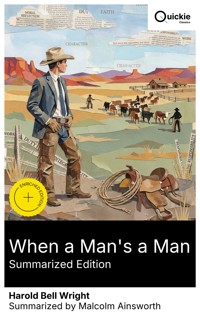
When a Man's a Man charts a tenderfoot's apprenticeship on a Southwestern cattle ranch, treating the range as a forge for moral character. Wright mixes brisk episodes—roundups, bronc-breaking, and bunkhouse debate—with plainspoken, sermon-tinged prose. In dialogue with Owen Wister's The Virginian yet more explicitly didactic, the novel refocuses Progressive-Era concerns about class and masculinity into a pastoral ethic where nature teaches discipline, community enforces honor, and useful work redeems wayward privilege. Harold Bell Wright, a former Disciples of Christ minister and one of America's first mass‑market bestsellers, drew on extended sojourns in the Southwest after illness pushed him westward. His friendships with ranchers and conviction that fiction should reform conduct shaped a method both pictorial and exhortatory. Following The Shepherd of the Hills and The Winning of Barbara Worth, he adapted his moral program to Western materials. Readers of classic Westerns, cultural history, and masculinity studies will find this novel both an engaging range tale and a revealing document of American ideals. Its swift action, clear moral arc, and affectionate portrait of ranch community make it a rewarding choice for thoughtful general readers. Quickie Classics summarizes timeless works with precision, preserving the author's voice and keeping the prose clear, fast, and readable—distilled, never diluted. Enriched Edition extras: Introduction · Synopsis · Historical Context · Brief Analysis · 4 Reflection Q&As · Editorial Footnotes.
Das E-Book können Sie in Legimi-Apps oder einer beliebigen App lesen, die das folgende Format unterstützen:
Veröffentlichungsjahr: 2026
Ähnliche















When a Man's a Man (Summarized Edition)
Table of Contents
Introduction
At the heart of Harold Bell Wright’s When A Man’s A Man lies the contest between wealth’s easy assurances and the unyielding demands of work, where the measure of a life is taken not by birth or polish but by courage, competence, and the willingness to shoulder responsibility in a land that forgives no pretense and rewards the stubborn learning of craft, loyalty, and restraint, so that the reader watches the ideal of manhood shift from appearance to action as the open skies, tough stock, and testing comradeships of the range press a raw ambition into something quieter, steadier, and real.
A novel of the American West that blends coming-of-age, workplace realism, and romance, When A Man’s A Man was first published in 1916, during the peak of Wright’s popularity with a broad American audience. Its setting is ranching country, where cattle work, horses, and the rhythms of seasonal labor form both backdrop and crucible. The book occupies a place between the mythic Western and the moral fable: it delivers action and outdoor spectacle while keeping its eye on character formation. The prose favors clarity and earnestness, drawn to panoramic description and direct moral commentary typical of early twentieth-century popular fiction.
The novel opens as a young man from an affluent, comfortable background leaves the security of the city to try himself on a working ranch. He accepts hard, unglamorous tasks and the low status of a beginner, learning under practical men whose respect must be earned through reliability rather than talk. The range exacts lessons in patience, teamwork, and judgment. Amid these trials, he encounters a community that challenges his assumptions about class and success, and he meets a woman whose independence complicates his sense of achievement. The story follows his apprenticeship without foreclosing its outcomes or prescribing easy victories.
Readers can expect straightforward narration with a steady, unhurried pace, punctuated by action sequences that arise organically from the work of the range. Wright’s omniscient voice moves confidently between exterior description and interior motive, offering moral glosses without becoming doctrinaire. Dialogue carries regional color and occupational jargon, yet remains accessible. Scenes of horses, branding, storms, and camp routine are rendered with practical detail, while courtship and rivalry unfold with a restrained sentiment that avoids cynicism. The book invites immersion in place and vocation, allowing competence and integrity to emerge as drama rather than as abstract lecture.
Central themes include the making of character through labor, the testing and tempering of masculinity, and the tension between privilege and earned standing. The novel explores mentorship and the ethics of leadership, showing how trust is built in communities that depend on one another for safety and livelihood. It weighs reputation against substance, and desire against duty. Nature’s instruction is constant: weather, animals, and distance do not negotiate. Wright also considers the appeal and cost of self-reinvention, asking whether the West offers escape or accountability. Beneath these concerns lies a consistent emphasis on honesty, stewardship, and quiet perseverance.
For contemporary readers, the book speaks to ongoing debates about what constitutes adulthood and responsibility in an age of performance and image. Its insistence that skill, service, and reliability carry moral weight engages current conversations about work, apprenticeship, and the value of practical knowledge. The portrayal of community standards and mutual dependence counters hyper-individualist fantasies while honoring personal agency. Environmental rhythms and material constraints offer a useful corrective to abstract ambition. As a formative text in the popular Western, it also provides a window onto early twentieth-century ideals that still shape American narratives about gender, class mobility, and the search for purpose.
Approached as both a period piece and a living argument, When A Man’s A Man rewards patient reading with a clarified sense of how stories anchor values. Newcomers to the Western will find its emphasis on work and earned respect a humane entry point, and experienced readers will recognize the genre’s foundational patterns reframed through moral inquiry. Attend to how ordinary tasks become stages for ethical choice, to the ways landscapes discipline feeling, and to the difference between acclaim and trust. Taken on these terms, Wright’s novel endures as an accessible, reflective exploration of aspiration reshaped into character.
Synopsis
When A Man's A Man by Harold Bell Wright is an early twentieth-century inspirational Western that follows a discontented young man who abandons an easy, privileged life in the East to test himself in cattle country of the American West. Seeking a standard of manhood not supplied by money or reputation, he arrives as a tenderfoot on a working ranch, where physical labor, spare conditions, and a strict code of conduct define daily life. Wright frames the move as both escape and pilgrimage, positioning the open range as a proving ground where self-respect must be earned under the eyes of practical, skeptical men.
At the ranch, the newcomer is given the lowest tasks and no special treatment, learning to ride hard, rope, brand, and keep night guard alongside seasoned hands. A firm but fair foreman and older cowboys insist on competence, punctuality, and quiet courage, and their tacit mentorship exposes his vanity and impatience. The work’s rhythm—early starts, long drives, sudden weather, and bruising mistakes—becomes the narrative’s engine, replacing talk with action. Wright uses these episodes to contrast bookish pride with practical knowledge, sketching a social order where respect is measured by reliability, endurance, and the willingness to shoulder dangerous, unglamorous jobs.
As he begins to belong, external pressures sharpen the story’s stakes. Threats of stock theft, range trespass, and simmering rivalries test loyalties within the outfit and across neighboring spreads. The protagonist’s early misjudgments—trust given too quickly or withheld through pride—carry real costs, forcing him to reconsider what leadership demands. Wright aligns personal growth with communal responsibility: a man’s character is proven not in speeches but in how he keeps his word, guards others’ property, and faces risk without complaint. The harsher realities of the range expose posturing, while the crew’s cohesion depends on truthfulness, restraint, and earned authority.
The novel broadens into the community beyond the bunkhouse, introducing ranch families, a few town figures, and a woman whose expectations help clarify the story’s moral horizon. Social gatherings, churchgoing, and neighborly obligations reveal a culture that prizes modest strength and mutual aid. Romantic interest develops, but Wright treats it as inseparable from questions of vocation and integrity: a future together requires the protagonist to be dependable among men before he can be trustworthy at home. The West’s courtesy and reserve temper sentiment, and the courtship scenes underscore that respect and self-command count more than showy bravado.
A central crisis draws scattered tensions into focus, demanding decisive, hazardous action on open ground. Whether sparked by human malice or natural peril, the emergency forces the novice-turned-cowhand to choose between safety and stewardship. He must prove he can follow orders when necessary, give them when appropriate, and hold steady when circumstances become chaotic. Wright choreographs the sequence to display practical competence, teamwork, and the quiet heroism of ordinary labor performed under strain. The protagonist’s choices here reveal how far he has traveled from pretense toward substance, and they establish a standard by which others in the community judge him.
In the aftermath, reputations are recalibrated, conflicts are reappraised, and opportunities for reconciliation and belonging open without facile triumphalism. The protagonist takes stock of the vanity he left behind and the humility he has yet to master. Relationships deepen, including the possibility of a future on the range and a life shared with someone who values constancy over polish. Wright keeps the outcome grounded in work rather than spectacle: acceptance is provisional, contingencies remain, and manhood is a practice renewed each day. The closing movement emphasizes gratitude, obligation, and the abiding discipline that holds a ranching community together.
Beyond its plot, When A Man’s A Man articulates an enduring ideal: manhood defined by service, workmanship, and moral steadiness rather than status or noise. As a popular Western of its period, the book melds frontier settings with didactic aims, using landscape and craft to shape character. Its vision of community—demanding but supportive, skeptical yet open to change—speaks to recurrent questions about how people earn trust and become useful to others. Without relying on sensational twists, Wright’s narrative suggests that freedom is inseparable from responsibility, and that the worth of a life emerges in tested habits more than in declarations.
Historical Context
When a Man’s a Man, published in 1916, belongs to Harold Bell Wright’s cycle of popular novels set in the American West. The story unfolds in Arizona’s cattle country during the years just after the territory achieved statehood in 1912, when ranches, small towns, and rail connections defined daily life. Wright, a former Protestant minister turned bestselling novelist, drew on time he spent in the Southwest to depict ranch labor, range etiquette, and local social hierarchies. The setting situates readers in a transitional West where traditional open-range practices coexisted with expanding federal oversight, growing towns, and the expectations of a modern, Progressive-era society.
Arizona’s cattle industry matured from late nineteenth-century booms into more regulated twentieth-century operations. After railroads reached the region in the 1880s, herds expanded rapidly, followed by overgrazing and drought that forced adjustments in stocking and range use. Barbed wire and windmills altered the open range, while the U.S. Forest Service, created in 1905, instituted grazing permits on national forests. Federal land policy culminated in the Stock-Raising Homestead Act of 1916, which opened 640-acre entries for grazing. Such policies, drought cycles, and market swings shaped ranch routines—roundups, trail work, and shipping—framing the book’s depiction of discipline, competence, and the ethics of stewardship.
Transportation and commerce underwrite the novel’s milieu. The Atchison, Topeka and Santa Fe crossed northern Arizona by the 1880s, and the Southern Pacific spanned the southern part of the state, enabling cattle shipments to distant packing centers. Telegraph and, increasingly, telephone service linked ranches and towns to regional markets. Mining centers—especially copper camps such as Bisbee, Jerome, and Morenci—drove Arizona’s economy in the 1910s, creating demand for beef and supplies. The ranching world Wright describes operates alongside this network: isolated enough to prize self-reliance, yet connected by railheads, freight wagons, and town banks whose credit, prices, and seasons influence daily decisions.
The book also registers Progressive Era debates about manhood and moral character. In the wake of rapid urbanization and white-collar employment, public figures such as Theodore Roosevelt promoted the “strenuous life,” celebrating outdoor labor, sport, and discipline. Muscular Christianity and the Social Gospel linked physical vigor to ethical purpose through churches, YMCAs, and civic reform. Wright, who had served as a Protestant pastor before devoting himself to fiction, wrote for a broad middle-class audience receptive to such ideals. His narrative of self-making through work reflects these conversations, presenting ranch labor as a proving ground for responsibility, courage, and community service.
Arizona’s ranch culture emerged from a blend of Indigenous, Mexican, and Anglo-American practices. The vaquero tradition shaped equipment, horsemanship, and vocabulary—terms like rodeo, lariat, and bronco attest to this heritage. Working ranches employed diverse cowhands, and cross-border trade and migration linked Sonoran and Arizonan communities. The Mexican Revolution (1910–1920) unsettled the borderlands and prompted U.S. military patrols along Arizona’s southern line, especially after 1916. While the novel focuses on interior cattle country rather than frontier skirmishes, the period’s multilingual, bicultural work settings and codes of honor inform its portrayal of cooperative crews, foremen’s authority, and everyday frontier lawfulness.
Conservation and reclamation framed land use in the Southwest during the novel’s timeframe. The Reclamation Act of 1902 established the federal Reclamation Service, which built the Roosevelt Dam on the Salt River, completed in 1911, transforming water storage in central Arizona. National forests brought scientific grazing management to high-country ranges under officials like Gifford Pinchot. Early range scientists promoted deferred grazing and sustainable stocking to curb erosion and overuse. These institutions created new expectations for stewardship and technical competence. Wright’s attention to water, forage, and sound stock handling aligns with contemporary reform currents that linked good husbandry to public responsibility.
Literary and media trends also shaped the book’s reception. Western fiction had surged in popularity after Owen Wister’s The Virginian (1902), and Zane Grey’s Arizona- and Utah-set novels dominated the 1910s. Wright, though often labeled sentimental by critics, was among the era’s best-selling American novelists, his Western settings offering moral drama accessible to general readers. The screen quickly amplified such stories; Hollywood’s move to California made Westerns a studio staple. When a Man’s a Man was adapted to film in 1935, starring George O’Brien, attesting to the narrative’s durable appeal and to the genre’s continued commercial strength across media.




