


1,99 €
Mehr erfahren.
- Herausgeber: Quickie Classics
- Kategorie: Gesellschafts- und Liebesromane
- Sprache: Englisch
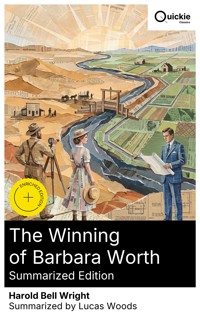
The Winning of Barbara Worth dramatizes the audacious attempt to reclaim the Colorado Desert and found the Imperial Valley, intertwining a triangle romance with the civic epic of irrigation. Wright choreographs surveying expeditions, capital campaigns, and the catastrophic Colorado River break with a blend of sentimental realism and melodramatic momentum, indicting speculative shortcuts while celebrating communal grit and Progressive‑Era engineering faith. Panoramic desert descriptions double as moral landscape, and the contest between Abe Lee and Eastern engineer Willard Holmes for Barbara's allegiance mirrors competing visions of frontier virtue and modern expertise. A former Disciples of Christ minister turned bestselling novelist, Harold Bell Wright brought Social Gospel conviction and firsthand western experience to the book. Health and vocation drew him from the Midwest to Arizona and southern California, where he observed reclamation projects and spoke with engineers and settlers. His populist moralism—suspicious of predatory finance yet respectful of practical skill—structures the novel's ethical drama. Readers of Western history, environmental studies, and popular romance will find this a revealing primary text of Progressive‑Era aspirations. It rewards those interested in the ethics of infrastructure, regional boosterism, and the perennial negotiation between individual desire and the public good. Quickie Classics summarizes timeless works with precision, preserving the author's voice and keeping the prose clear, fast, and readable—distilled, never diluted. Enriched Edition extras: Introduction · Synopsis · Historical Context · Brief Analysis · 4 Reflection Q&As · Editorial Footnotes.
Das E-Book können Sie in Legimi-Apps oder einer beliebigen App lesen, die das folgende Format unterstützen:
Veröffentlichungsjahr: 2026
Ähnliche












The Winning of Barbara Worth (Summarized Edition)
Table of Contents
Introduction
In Harold Bell Wright’s The Winning of Barbara Worth, the quest to turn an unforgiving desert into a home tests the boundary between vision and conscience, as engineering daring, financial hunger, civic hope, and a young woman’s hard-won independence converge to challenge the limits of what communities owe the land, what leaders owe their followers, and what love owes to truth when human designs attempt to redirect the stubborn courses of rivers, fortunes, and hearts, binding private choices to public outcomes in a landscape where failure can be fatal and success can be as perilous as the sand it tames.
First published in 1911, The Winning of Barbara Worth belongs to the broad tradition of the American Western while also operating as a novel of enterprise and community building. Its action unfolds in the desert Southwest, in a valley whose transformation by irrigation mirrors early twentieth-century efforts to reclaim arid lands. Harold Bell Wright, a widely read popular novelist of his era, uses this backdrop to explore how settlers, engineers, and financiers imagine a new kind of prosperity. The result is a story poised between romance and public drama, attentive to both the harsh beauty of the land and the ambitions it attracts.
At its core, the novel follows a community determined to build an oasis and a young woman whose future becomes intertwined with that civic experiment. Wright guides readers through surveying camps, fledgling towns, and boardrooms where calculations about water, risk, and return are as personal as they are technical. The voice is earnest and direct, moving from intimate character moments to panoramic scenes of work and weather. The tone favors moral clarity and uplift while allowing for suspense, humor, and tenderness. Without revealing outcomes, the opening stakes hinge on whether vision and character can withstand scarcity, pressure, and competing loyalties.
Among the novel’s abiding themes are the ethics of development, the responsibilities of leadership, and the fragile line separating mastery from stewardship. Wright dramatizes how capital can enable infrastructure yet distort priorities when profit outruns prudence, how expert knowledge can serve a community or isolate it, and how collective labor shapes identity. The desert is not merely a backdrop but a measure of character, demanding patience, cooperation, and respect. Romance, in this context, becomes a moral test rather than a diversion, tying private vows to public good. The book invites readers to consider what it means to build something that lasts.
For contemporary readers, the novel’s preoccupations resonate with ongoing debates about water scarcity, climate resilience, and the governance of large-scale infrastructure. Its depiction of speculative cycles and community risk speaks to the present-day interplay of finance, technology, and public need. The story asks who benefits, who pays, and how consent and accountability are earned when projects promise transformation. It also models a civic imagination rooted in cooperation across differences, without idealizing away conflict. In an era of rapid development, the book’s insistence that means matter as much as ends offers a steadying lens through which to examine new ventures.
Stylistically, Wright favors clear plotting, vivid scene-setting, and a cadence that alternates action with reflective passages, creating a narrative that reads swiftly yet lingers on questions of purpose. Descriptions of heat, wind, dust, and open sky supply a tactile sense of place, while dialogues move briskly through ethical and practical dilemmas. Characters are drawn in bold, recognizable lines that support the novel’s parable-like clarity without sacrificing human warmth. The overall effect is inviting rather than abstruse, designed to welcome readers who value story, hope, and consequence. The book balances uplift with credible hazard, letting effort and character carry suspense.
Approached on its own terms, The Winning of Barbara Worth offers a compelling intersection of romance, civic aspiration, and the problem of shaping a harsh environment without losing one’s bearings. Barbara’s presence concentrates the book’s questions about loyalty, fairness, and the kind of courage that builds rather than dominates. Around her, Wright assembles a portrait of a place coming into being, measured by the integrity of its builders as much as by canals and crops. That enduring vision—of progress accountable to people and land—helps explain why this early twentieth-century novel can still speak to readers charting uncertain futures.
Synopsis
Harold Bell Wright’s 1911 novel The Winning of Barbara Worth unfolds in the arid borderland where visionaries seek to make the desert bloom. The story begins with the rescue of an infant girl in the sands, a child who becomes Barbara Worth when adopted by Jefferson Worth, a reserved local financier. Raised amid survey stakes and wagon ruts, Barbara’s earliest loyalties form around the land and the people daring to settle it. The novel frames her coming-of-age alongside a grander ambition: diverting a great river to irrigate the waste and found stable communities, a project that will test ideals, capital, and character.
Years pass as a small settlement takes root, stitched together by homesteaders, teamsters, and a lean young surveyor named Abe Lee whose knowledge of the country is hard won. Jefferson Worth’s prudence and quiet determination help attract careful investment without surrendering local control, while Barbara matures into a figure of sympathy and resolve. Around them, dreamers promise prosperity if only water can be brought reliably across the shifting sands. The narrative patiently develops the routines of mapping, grading, and staking canals, showing how personal loyalties and frontier ethics underpin the fragile coalition required for an undertaking larger than any one ranch or town.
The balance tilts when an ambitious syndicate from the East arrives with sweeping plans and ample capital. Their chief engineer, Willard Holmes, brings technical authority and the confidence of established institutions, but little familiarity with desert temperaments or frontier bargaining. Contracts and right‑of‑way deals multiply, and with them come questions about whose risk, whose reward, and whose voice will steer the project. Barbara’s position at the intersection of settlers, her adoptive father’s caution, and the newcomers’ urgency makes her an attentive witness and occasional mediator, even as the prospect of success heightens tensions between those who view the valley as home and those who see an investment.
As crews push canals toward the thirsty basin, the work exposes fault lines. Survey errors have consequences, and the calendar of financiers does not match the calendar of the river. Abe Lee’s fieldcraft and loyalty to the settlers sometimes clash with Holmes’s efficiency and corporate directives. Beyond professional friction lies a quiet rivalry of ideals and affections, for Barbara’s regard carries moral weight within the community. Jefferson Worth, wary of speculative overreach, tries to keep the enterprise honest and solvent without stifling its momentum. The narrative weighs deadlines, payrolls, and promises against the unforgiving topography that magnifies every miscalculation.
Nature soon asserts the decisive vote. Seasonal floods swell the river, silt chokes carefully cut channels, and emergency bypasses tempt fate. A break threatens to unmake months of progress and to turn the lowland into a perilous sink, jeopardizing farms, livelihoods, and the very logic of settlement. With the water rising, hard choices confront every faction: whether to protect capital or communities, whether to gamble on untested fixes or retreat. The crisis compresses ambition into action, revealing the costs of earlier compromises and forcing engineers and financiers alike to measure their theories against the weight of a river in flood.
Under pressure, personalities harden or change. Holmes must reconcile pride in his training with the plainspoken realities of men who live by the weather report and the ditch level. Abe Lee’s steadiness becomes a rallying point in the field, even as loyalties are tugged by competing chains of command. Jefferson Worth finds his caution both questioned and vindicated in negotiations for rescue and repair. Barbara, unwilling to be merely a symbol, argues for fairness to workers and settlers while guarding her independence. The strand of romance remains intertwined with duty, but the novel keeps its focus on what integrity looks like when outcomes are uncertain.
Without disclosing late reversals, the book culminates in decisions that link private affection to public responsibility, tying Barbara’s fate to the future of the reclaimed land. Published amid early twentieth‑century reclamation efforts, The Winning of Barbara Worth reflects real struggles behind the transformation of the American Southwest, including the hazards of diverting the Colorado River. Its enduring resonance lies in the questions it poses about who benefits from development, how expertise should serve communities, and what it means to belong to a place that must be remade to be livable. The romance deepens the parable without diminishing its civic and environmental stakes.
Historical Context
The Winning of Barbara Worth (1911) takes place amid the transformation of the Colorado River borderlands where California meets Arizona and Baja California. At the turn of the twentieth century, promoters sought to convert the Salton Sink—an arid basin below sea level in the area promoted as the Imperial Valley—into farmland through large irrigation canals. County governments, land companies, surveyors, and the Southern Pacific Railroad shaped settlement patterns, while new towns were platted to attract settlers with the promise of irrigated homesteads. The setting reflects a region moving rapidly from sparsely populated desert to organized agricultural communities, dependent on canals, levees, and precarious control of the river.
American irrigation policy provides crucial context. The Desert Land Act of 1877 and the Carey Act of 1894 encouraged private and state-led reclamation, while the Reclamation Act of 1902 created the U.S. Reclamation Service to finance and build federal projects in the West. In the lower Colorado basin, this produced overlapping schemes: private corporations cutting canals from Mexico and federal engineers raising diversion works near Yuma, Arizona. Western water law—dominated by prior appropriation—rewarded those who diverted and used water first, intensifying competition among promoters, settlers, and governments. Wright’s narrative engages this contested landscape of institutions, titles, and water rights.
Between 1905 and 1907, the Colorado River broke through privately built intake works and poured unchecked into the Salton Sink, creating the Salton Sea. The California Development Company, seeking to flush silted canals, had opened a cut in Mexico; seasonal floods then overwhelmed controls and inundated farms and rails. After costly efforts led by Southern Pacific engineers, the break was closed in 1907. The episode was covered nationwide as a parable of risk, haste, and the power of the Colorado. Wright drew directly on this widely known disaster, using it to frame the stakes of irrigation, finance, and engineering competence.
Turn-of-the-century civil engineering was ascendant, with professional societies, specialized education, and large federal projects elevating its public standing. The U.S. Reclamation Service completed Laguna Dam near Yuma in 1909, and Roosevelt Dam on Arizona’s Salt River was dedicated in 1911, emblematic of technocratic ambition to stabilize arid landscapes. Survey parties mapped gradients, flumes, and headworks; debates focused on silt load, channel migration, and the reliability of embankments on alluvial soils. The novel’s engineers inhabit this professional milieu, one that promised mastery through measurement and design yet faced a river notorious for sudden floods, shifting banks, and prodigious sediment.
Economic debates of the Progressive Era form another backdrop. Railroads and large trusts dominated capital flows, while western development often relied on eastern financiers underwriting bonds and stock for canals and townsites. Federal antitrust enforcement intensified after 1904’s Northern Securities decision and culminated in the 1911 breakup of Standard Oil, signaling national skepticism of concentrated power. The Panic of 1907 had recently tightened credit and exposed fragile corporate structures. In California, the Southern Pacific influenced politics and infrastructure. Against this environment, visions of community development and public stewardship clashed with speculative promotion, undercapitalized enterprises, and the hazards of overpromising settlers.
The borderlands social context was equally significant. Prior to the creation of the U.S. Border Patrol in 1924, cross-border movement with Mexico was comparatively fluid, and early Imperial Valley agriculture relied heavily on Mexican laborers recruited for canal building and farm work. The Mexican Revolution, beginning in 1910, increased migration and instability along the line. Other immigrant groups, including Japanese farmers despite the 1907 Gentlemen’s Agreement limiting new arrivals, participated in regional agriculture. The period’s racial hierarchies and segregation shaped opportunity and conflict. Indigenous communities along the lower Colorado, such as the Quechan and Cocopah, experienced profound impacts from water control schemes.
Harold Bell Wright (1872–1944) was a former Disciples of Christ minister who became one of the United States’ best-selling novelists in the 1900s and 1910s. He spent significant time in the Southwest for health and research, observing desert reclamation efforts in California and Arizona before writing The Winning of Barbara Worth. His popular fiction carried a moral tone influenced by the Social Gospel, emphasizing community responsibility and ethical leadership. By drawing on contemporary journalism about the Colorado River and on-site observation, Wright crafted a recognizable landscape of boomtown promoters, engineers, and settlers that readers associated with the newest frontier of American development.
Published amid Theodore Roosevelt–era conservation and Progressive reform, the novel reflects its moment’s faith in public-spirited expertise while critiquing reckless promotion and opaque finance. It treats irrigation as nation-building—transforming wasteland into homesteads—yet acknowledges environmental limits and the consequences of flawed design. The work echoes debates over whether private syndicates or accountable public agencies should control water, land, and town growth. Its enduring visibility, later amplified by a 1926 film adaptation, came from dramatizing issues—engineering risk, corporate power, and community welfare—that defined early twentieth-century Western development and continue to inform discussions of the Colorado River and arid-lands reclamation.




