


Erhalten Sie Zugang zu diesem und mehr als 300000 Büchern ab EUR 5,99 monatlich.
- Herausgeber: Paraclete Press
- Kategorie: Religion und Spiritualität
- Sprache: Englisch
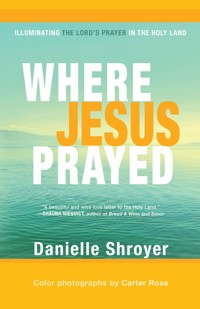
When Danielle Shroyer went on a pilgrimage to the Holy Land, she had one goal: to enjoy God, fully present to the presence of the Holy. Tired of her own wordy prayers and theological thoughts as a pastor, she wanted her prayers to be quiet listening rather than incessant speaking. When the Lord's Prayer came to mind in the midst of her silence, she welcomed the words of Jesus as the only words she needed. Thus began a rhythm that lasted for two weeks of pilgrimage, as she traveled, praying only the words Jesus taught. Immersed in a sense of place, she felt the prayer coming to life in new and unexpected ways. The Lord's Prayer has remained with us for two thousand years for many reasons. Here it returns to its place of origin, carried deep in the heart of a pilgrim traveler as she walks where Jesus walked and discovers within its words the depth, beauty and truth of the One who prayed them first. "For a while, my prayer was only breath, rhythmic and slow. Then, after a while, it seemed only fitting to pray the Lord's Prayer—nothing more, nothing less. Just Jesus's words of hope for this world and for these his children. Our Father, who art in heaven. . . ." —from the Introduction
Sie lesen das E-Book in den Legimi-Apps auf:
Seitenzahl: 191
Veröffentlichungsjahr: 2015
Das E-Book (TTS) können Sie hören im Abo „Legimi Premium” in Legimi-Apps auf:
Ähnliche


















ILLUMINATINGTHE LORD’S PRAYERIN THE HOLY LAND
WHERE
JESUS
PRAYED
Danielle Shroyer
Color photographs by Carter Rose
2015 First Printing
Where Jesus Prayed: Illuminating The Lord’s Prayer in the Holy Land
Copyright © 2015 by Danielle Shroyer
ISBN 978-1-61261-661-2
Unless otherwise indicated, Scripture quotations are taken from the New Revised Standard Version Bible, copyright 1989, 1993, Division of Christian Education of the National Council of the Churches of Christ in the United States of America.
Used by permission. All rights reserved.
The Paraclete Press name and logo (dove on cross) are trademarks of Paraclete Press, Inc.
Library of Congress Cataloging-in-Publication Data
Shroyer, Danielle, 1976–
Where Jesus prayed : illuminating the Lord’s Prayer in the Holy Land / Danielle Shroyer ; color photographs by Carter Rose.
pages cm
Includes bibliographical references.
ISBN 978-1-61261-661-2
1. Lord’s prayer. 2. Church buildings—Palestine. 3. Christian shrines—Palestine. 4. Christian antiquities—Palestine. I. Title.
BV230.S427 2015
263’.0425694—dc23
2015020612
10 9 8 7 6 5 4 3 2 1
All rights reserved. No portion of this book may be reproduced, stored in an electronic retrieval system, or transmitted in any form or by any means—electronic, mechanical, photocopy, recording, or any other—except for brief quotations in printed reviews, without the prior permi
Published by Paraclete Press
Brewster, Massachusetts
www.paracletepress.com
Printed in the United States of America
This book is lovingly dedicated to my fellow pilgrims
Joe Clifford, Renee Hoke, Charlie Johnson, Charles Luke, George Mason, Fran Patterson, Tom Plumbley, Michael Riggs, Taylor Sandlin, Phil and Stephanie Shepherd, Scott Shirley, Susan Sytsma-Bratt, and Karl Travis;
And to our beloved tour guides
Nabil Hazboun and Thaer Kaloti.
CONTENTS
INTRODUCTION
1Arbel Cliff
Galilee
2The Church of St. Peter’s House
Capernaum
3The Church of Multiplication
Tabgha
4The Church of the Beatitudes
Tabgha
5The Church of St. Peter’s Primacy
Tabgha
6Caesarea Philippi/Banias
7The Sea of Galilee
8Magdala
Galilee
9The Basilica of the Annunciation
Nazareth
10The Church of St. Joseph
Nazareth
11Megiddo
12Caesarea Maritima
Judea
13The Mount of Olives
Jerusalem
14The Church of All Nations
Gethsemane/Jerusalem
15The Church of St. Peter in Gallicantu
Jerusalem
16Via Dolorosa
Jerusalem
17The Church of the Holy Sepulchre
Jerusalem
18The Church of St. Anne
Bethesda/Jerusalem
19The Church of the Nativity
Bethlehem
20Shepherds’ Field
Bethlehem
ACKNOWLEDGMENTS
APPENDIX : A Brief Guide to the Via Dolorosa Stations of the Cross, Jerusalem
SELECTED BIBLIOGRAPHY
INTRODUCTION
I’ve been back from the Holy Land for less than one day. A twenty-seven-hour flight home and I’m seated in front of my computer, heart full, soul rested, inspiration replenished. Two weeks in the Holy Land, two weeks of walking where Jesus walked, traveling the roads of the earliest Christians and millions of Christians hence, two weeks of sojourning alongside other ministers I now count as dear friends. Two weeks of realizing that Jesus is more human, more real, more divine, and more beautiful than I have ever known before, and that there is no way for me to put in words the fullness of feeling his presence there, or anywhere. He is the one in whom we live and move and have our being.
I did not travel to the Holy Land with any intention of writing a book about it. In fact, one of my pilgrimage rules was to be, as much as possible, short on words. In my work as a pastor, words were so much a part of my life: writing sermons week after week, penning prayers, crafting liturgies, sharing thoughts with community members over coffee and dinner. In my life now as a writer and speaker, and as someone who reads theology for fun, I still find every last corner of my life crammed with words—particularly words about God. Much as I am fueled by the flurry of ideas, I also know that the perpetual flow of words keeps one in a continually occupied, noisy state of mind. I hoped the pilgrimage would afford me time to do less talking and more sensing, less thinking about ideas of God and more searching for the presence of God. Of course, my pilgrimage days were in many ways filled with deep conversations about theology and pastoral challenges and parenting difficulties and questions of faith and doubt—on the bus, over the many beautiful tables filled with food, by the fire in the lobby, at a pub in the heart of a bustling night in Jerusalem. I relished every conversation. But on the inside, my hope was to keep my mind open, to keep my head clear, to do far more listening to God than speaking to God. I wanted to enjoy God.
On our first full day in Tiberias, we hiked up to the top of the cliffs of Arbel, and we soon spread out, all fifteen of us finding our own rock or perching place to gaze upon the horizon of Galilee and consider the beginning of our pilgrimage. I had so many things I wanted to say to God, so many things I was thinking and pondering and wondering. Instead, I moved myself toward silence, in the hope of quieting my mind and grounding myself in the present. For a while, my prayer was only breath, rhythmic and slow. Then, after a while, it seemed only fitting to pray the Lord’s Prayer—nothing more, nothing less. Just Jesus’s words of hope for this world and for these his children.
Our Father, who art in heaven. . . .
Later that day when I found myself at the church in Capernaum, gazing into the house thought to have once been inhabited by Simon Peter, I anointed myself with water and found a pew. After a time of silence, again it seemed fitting to pray the Lord’s Prayer, and I was struck by the different tones and textures and thoughts that were brought to light in its praying.
. . . Hallowed be thy name. . . .
The prayer felt different here than it did on the cliff at Arbel. Immersed in a sense of place, I noticed the prayer coming to life in ways distinct from what I felt at home, or at church. I decided, rather unconsciously, that I would pray this way in every church in which I found myself over the next two weeks. And so I began a rhythm of entering a sanctuary, anointing myself with holy water, finding a seat and some silence, and praying the words of Jesus, over and over and over again. I could not have known at the beginning what a powerful practice this would be. . . .
Of course, this is why people of faith have practiced liturgy for thousands of years. In the repetition, we find fullness beyond measure. In allowing the same words to read us again and again, to form us and shape our understanding, we become, we hope, a people of deeper faith, people who can perhaps reflect a glimmer of the multivalence of God, whose song echoes without end.
And so, I write this as a love letter to the Holy Land and to all its pilgrims who travel there (in mind or in body) in hopes of seeing a deeper and truer glimpse of the One in whose steps we seek to follow. I write with the hope that these thoughts and reflections will in some small way enable you to enter into these places with a fuller sense of the unending person of Jesus, whose prayer of instruction to us, I believe, can bring meaning to all our days.
Whether you are reading as a fellow pilgrim to the Holy Land or as one who hopes to glimpse the Holy Land from wherever you are, I pray blessings upon your travels.
WHERE
JESUS
PRAYED
1
Arbel Cliff
Galilee
In lower Galilee, about six hundred feet above sea level, loom two towering cliffs: Mount Nitali to the northwest, and Mount Arbel to the southeast. A by-product of the Jordan Rift Valley, the two cliffs stand out prominently in Galilee’s terrain. Between the two lies the Valley of Doves, also called the Valley of Pigeons, which has served as a path between lower Galilee and the Sea of Galilee since ancient times. Most certainly, Jesus walked that path frequently while traveling through Galilee.
Psalm 121
A Song of Ascents
I lift up my eyes to the hills—from where will my help come?
My help comes from the LORD, who made heaven and earth.
He will not let your foot be moved; he who keeps you will not slumber.
He who keeps Israel will neither slumber nor sleep.
The LORD is your keeper; the LORD is your shade at your right hand.
The sun shall not strike you by day, nor the moon by night.
The LORD will keep you from all evil; he will keep your life.
The LORD will keep your going out and your coming in from this time on and forevermore.
I lift up my eyes to the hills.
This seems a fitting first official pilgrimage activity. We begin our two weeks with a trip to the cliff at Arbel, first by car, the soaring peak rising above the bus window, then by foot, hiking up the trail to the top, finding a spot among the honey-colored rocks to gaze out onto the terrain below.
Atop Arbel Cliff awaits a truly breathtaking view of Galilee, where Jesus spent so much of his ministry. Because of its sweeping vista, there is hardly a more perfect place to gain perspective and set a tone as you begin a pilgrimage into the land Jesus walked. From here you can see the Plain of Gennesaret, Tabgha, the Mount of Beatitudes, the shores of Capernaum. They are surprisingly close together, a welcome disorientation. Who knew the places in the Gospels were as close together in real life as they are in the Gospels’ feathery pages?! How lovely to picture Jesus flitting just from here to over there, traveling from Cana to Magdala through the Valley of the Doves, or walking along the seashore from Bethsaida back home to Capernaum. I never before pictured Jesus like a dancer light on his feet, moving so gracefully and quickly it’s difficult to tell precisely when he left or when he arrived. What an enchanting dance floor, this Galilee.
The ancient historian Josephus spoke favorably of the region in his History of the Jewish Wars when he said, “Its nature is wonderful as well as its beauty; its soil is so fruitful that all sorts of trees can grow upon it, and the inhabitants accordingly plant all sorts of trees there. . . . One may call this place the ambition of nature, where it forces those plants that are naturally enemies to one another to agree together. It not only nourishes different sorts of autumnal fruit beyond people’s expectation, but preserves them a great while.”1
“The ambition of nature”: a Christian might call this a holy purpose, or highest calling, or the end-goal of creation, this movement toward our enemy in such a way that transforms our enemy into a friend. It’s a way of being not only nourished by something beyond you, but preserved, too, as if your very life depends upon it. God indeed has preserved us a great while.
The psalmist attempted to capture this notion in Psalm 121, which is, fittingly, a song of ascent. Our help comes from the Lord, who will not sleep or slumber. The Lord will preserve our coming in and our going out, our ascending up and our traveling down. The Lord will keep our life. The Lord, we realize in our clearest moments, preserves us entirely. We are kept in him and through him and by him.
My friend Susan gathers us around and she reads us the psalm as our eyes indeed look up and out over the landscape of Galilee that stretches out in every direction. Our help comes from the Lord, who made heaven and earth. God preserves us, keeps us, holds us near.
Then we scatter to solitary places of introspection for the better part of the next hour, drinking in the terrain, grounding ourselves as we prepare to embark upon this holy pilgrimage. I set my eyes toward the northeast, looking in the direction of Capernaum. My prayer is wordless and full, a holy breathing, an inhalation of hope and an exhalation of joy.
The goal of pilgrimage-taking is manifold, but central is the practice of being present, of being alive in each now-moment, of attuning one’s soul to the fullness of sight and sound, touch and taste and smell. Be here, pilgrimage beckons. Stay right here, in this very moment. Do. Not. Miss. It. In being present to this place, we find holy moments await discovery.
Walking down the cliff, I breathe deeply, and realize something. The air in Galilee feels . . . FULL. Certainly, the air feels refreshingly abundant near sea level, but it feels full in more than just a physical sense, too. It’s as if the air has more energy in it, as if it’s got more oxygen packed in per molecule, making your heart feel like it can expand in every kind of way.
I wonder if that’s because Jesus’s imprint is still here, somehow, as if he left behind a trace of his own life-giving force that even two thousand years cannot erase.
I lift my eyes up to the hills. The pilgrimage ascent has begun.
1. Josephus, History of the Jewish Wars 3.10.
2
The Church of St. Peter’s House
Capernaum
The church in Capernaum that stands atop the home believed to be Simon Peter’s is run by the Franciscans, as are most churches in the Holy Land. The church’s floor has a beautiful glass opening at its center, and through it you can view the house from above. Its remains are a bit puzzling, as it seems to have experienced a number of iterations throughout the centuries. At first a simple home, it became a known house church in the fourth century according to Egeria, a nun whose travel journals have been preserved and whose name is one of many carved upon the interior walls of the church. Archaeologists believe that in the fifth to the sixth century, the church took on a more octagonal shape as it made room for its many visitors. From the open floor, remains of each of these iterations can still be seen.
The church itself is modern in design, its lines and octagonal shape inviting you into the history of the space rather than detracting from it. Scriptural verses and prayers in Latin adorn the walls, and windows in every direction give the space a sense of openness that seems only fitting for Galilee.
Now when Jesus heard that John had been arrested, he withdrew to Galilee. He left Nazareth and made his home in Capernaum by the sea.
MATTHEW 4:12–13A
They went to Capernaum; and when the sabbath came, he entered the synagogue and taught. They were astounded at his teaching, for he taught them as one having authority, and not as the scribes. Just then there was in their synagogue a man with an unclean spirit, and he cried out, “What have you to do with us, Jesus of Nazareth? Have you come to destroy us? I know who you are, the Holy One of God.” But Jesus rebuked him, saying, “Be silent, and come out of him!” And the unclean spirit, throwing him into convulsions and crying with a loud voice, came out of him. They were all amazed, and they kept on asking one another, “What is this? A new teaching—with authority! He commands even the unclean spirits, and they obey him.” At once his fame began to spread throughout the surrounding region of Galilee.
As soon as they left the synagogue, they entered the house of Simon and Andrew, with James and John. Now Simon’s mother-in-law was in bed with a fever, and they told him about her at once. He came and took her by the hand and lifted her up. Then the fever left her, and she began to serve them.
That evening, at sunset, they brought to him all who were sick or possessed with demons. And the whole city was gathered around the door.
MARK 1:21–33
Give us this day.
“Caphernaum: The Hometown of Jesus” boasts the sign on the gate. Jesus made his home here. And it’s not difficult to see why. Picturesque location by the sea, serene yet lively, far from the urban centers of power and politics, very near all his neighbors. Very near, indeed. Upon visiting, you get a sense of how small and compact that little city really is, so that it makes perfect sense to imagine when Mark tells us “the whole city was gathered around the door” to bring Jesus the sick. The whole city couldn’t have been much more than a hundred people. The first-century remains of Capernaum reveal a village that looks more like a collective, with basalt stone-wall homes abutting one another on either side, and a synagogue right alongside all the rest. They are mere steps from one to another. It’s surprising, and less prominent than one would have imagined, but it’s no less meaningful. In fact, Capernaum feels something like a small, beloved community. Like a rural church where everyone knows your name, and also your business. Jesus chose this to be his home. He was raised in Nazareth, but Capernaum is where he chose to live.
It isn’t difficult to imagine Jesus here, but it’s a much more human Jesus than many Christians spend their time imagining. The Jesus of Capernaum feels shockingly ordinary, like Tom Sawyer with a fishing pole and a smile. It’s just Jesus, walking along the nearby coastline and calling out to some guys here and there, saying, “Hey, leave those nets. Come with me and fish for people instead.” I find myself wondering if the disciples thought perhaps they were just going to have an adventure for the day and be finished with this people-fishing excursion by sundown. You know, a day’s shenanigans, for kicks. (People fishing?! Whatever could that mean?! Let’s go see.) It seems more likely than the idea that they willingly dropped their nets on a whim and handed their lives over on a three-year commitment. Maybe the first requirement of being a disciple is saying yes to adventure.
When they got to the synagogue and Jesus began teaching, the people of Capernaum had their first sure sign that something indeed was different about him. Mark says that “they were astounded at his teaching,” and whether “they” is primarily the disciples, or the whole town, the point is they didn’t expect him to say what he did. When a man in the synagogue began yelling at Jesus and called him “the Holy One of God,” nobody knew quite what to make of it. They asked each other, “What is this?!”
Jesus, of course, didn’t bother explaining himself, or even commenting on these events. Even in the midst of miracles, Jesus of Capernaum seems unflashy, as if healing were so integrally part of who he was that of course he spent time doing it here and there. When he learned Peter’s mother-in-law was sick, he merely offered his hand and helped her up out of bed. No words or incantations, no mud. He just gave her a hand. Mark’s Gospel tells us that the fever then left her, and she got up and began to serve. It seems an odd thing to record after a miracle, doesn’t it? He doesn’t tell us how she responded, or whether she asked Jesus a question about it, or what anyone else thought. The entire episode was as plain as day: she had a fever, Jesus got rid of it, she moved on. I wonder if the very ordinariness of it, the fact that she just got up and moved right along into normal life as if nothing had happened, was so surprising and noteworthy and different that he had to say it was like that or nobody would have believed it.
The simplicity of Jesus in a town where so many miracles happened is an odd juxtaposition indeed. But it fits, somehow, as you walk around the ruins and glance over to the sea. It’s just Jesus, same as he ever was.
No need to make a big fuss; healing just happens around Jesus. Bring your sick to him, just over there at Peter’s house. And the whole town crowds around the door, not in a panic, but like people cramming into a house for a party, eager to be part of the action, eager to see all that will happen. And miracles do happen, of course. People bring him their sick and Jesus heals them. Give us this day, we pray, and Jesus gives us the only kind of day he knows: one filled with healing, wholeness, renewal, strength, hope.
I thought of these miracles as I prayed in the chapel above Peter’s house. I thought of the people crowded by the door, their hearts filled with expectation as they brought him their loved ones. I also thought about what it might have been like when they all left, when all had been cured, when it was just Peter, Peter’s mom, and Jesus, perhaps Andrew and James and John. I imagined Jesus leaning up against a wall, laughing at a joke, chewing on a piece of bread. In those moments, the disciples were becoming Jesus’s friends. That, too, is a healing. That, too, is a miracle. Jesus, Son of God, makes us friends. Is there anything more holy than that?
It’s just a day with Jesus. And yet, it’s a beautiful day. A beautifully ordinary extraordinary day.
Give us this day. Nothing more, nothing less. We will receive it just as the gift it is: this day, to be lived with gratitude. This is the day that the Lord has made; we will rejoice and be glad in it. For in this day, in these moments, we come to know him. Just as Simon Peter and Andrew, James and John came to know Jesus: as a teacher, a leader, and ultimately, as a friend. Jesus will come to be known as the Savior, but for now, as he silences such titles the moment they’re spoken, he seems content to be Jesus, from Nazareth, who makes his home in Capernaum by the sea.
Give us this day. This day, warmth upon my face. This day, breeze across the courtyard. This day, in this small seemingly inconsequential fishing village where people gathered around to get to know a remarkable man named Jesus—a man who laughed here, who told stories and sat around talking and eating with friends, who listened and smiled and got sleepy.




