


Erhalten Sie Zugang zu diesem und mehr als 300000 Büchern ab EUR 5,99 monatlich.
- Herausgeber: Pushkin Press
- Kategorie: Gesellschafts- und Liebesromane
- Sprache: Englisch
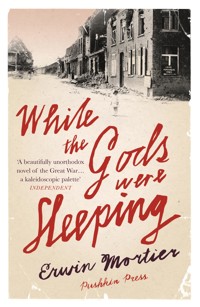
'It sounds dreadful,' I said to him one day. 'But actually the war is the best thing that ever happened to me.'Helena's mother always said she was a born poetess. It was not a compliment. Now an old woman, Helena looks back on her life and tries to capture the past, filling notebook after notebook with memories of her respectable, rigid upbringing, her unyielding mother, her loyal father, her golden-haired brother. She remembers how, at their uncle's country house in the summer of 1914, their stately bourgeois life of good manners, white linen and afternoon tea collapsed into ruins. And how, with war, came a kind of liberation amidst the mud and rubble-and the appearance of a young English photographer who transformed her existence. Lyrical and tender, filled with images of blazing intensity, While the Gods Were Sleeping asks how it is possible to record the dislocation of war; to describe the indescribable. It is a breathtaking novel about the act of remembering, how the past seeps into our lives and how those we have lost leave their trace in the present.
Sie lesen das E-Book in den Legimi-Apps auf:
Seitenzahl: 509
Veröffentlichungsjahr: 2014
Das E-Book (TTS) können Sie hören im Abo „Legimi Premium” in Legimi-Apps auf:
Ähnliche


















ERWIN MORTIER
WHILE THE GODS WERE SLEEPING
Translated from the Dutch by Paul Vincent
Contents
WHILE THE GODS WERE SLEEPING
I
IHAVE ALWAYS SHRUNK from the act of beginning. From the first word, the first touch. The restlessness when the first sentence has to be formed, and after the first the second. The restlessness and the excitement, as if you are pulling away the cloth beneath which a body rests: asleep or dead. There is also the desire, or the fantasy wish, to beat the pen into a ploughshare and plough a freshly written sheet clean again, across the lines, furrow after furrow. Then I would look back at a snow-white field, at the remnants the plough blade has churned up: buckets rusted through, strands of barbed wire, splinters of bone, bed rails, a dud shell, a wedding ring.
I’d give a lot to be able to descend into the subterranean heart of our stories, to be lowered on ropes into their dark shafts and see stratum after stratum glide by in the lamplight. Everything the earth has salvaged: foundations, fence rails, tree roots, soup plates, soldiers’ helmets, the skeletons of animals and people in hushed chaos, the maelstrom congealed to a terrestrial crust that has swallowed us up.
I would call it the book of the shards, of the bones and the crumbs, of the lines of trees and the dead in the hole down to the cellar and the drinking bout at the long table. The book of mud, too, of the placenta, the morass and the matrix.
I am grateful to the world for still having window sills, and door frames, skirting boards, lintels and the consolation of tobacco, and black coffee and men’s thighs, that’s all. One fine day you’re too old to carry yourself graveward hour after hour, to mutter the Dies irae in porches, on street corners or in squares for so many figures who have long since flaked away from you, decayed into a squelchy mess your toes sink into. As you get older you no longer see people around you, only moving ruins. Again and again the dead find back doors or kitchen windows through which to slip inside and haunt younger flesh with their convulsions. People are draughty creatures. We have memories to tame the dead until they hang as still in our neurons as foetuses strangled by the umbilical cord. I fold their fingers and close their eyes, and if they sometimes sit up under their sheets I know it’s enzymes or acids strumming their tendons. Their true resurrection is elsewhere.
When I was young such daydreams invariably awakened my mother’s irritation, if I was unwise enough to confide them to her. She cherished a sacred awe of limits and barriers. Freeing your imagination from the earth was considered a sign of a frivolous disposition. For her the most unforgivable thing a living person could inflict on the dead was to make them speak; they can’t defend themselves against what you put into their mouths. In her eyes the coin that the Ancient Greeks put under the tongue of their dead, as the fare for the ferryman who was to transport them to the far bank of the Styx, had a different purpose: it was hush money. If the dead had started chattering, they would immediately have choked on the coin. They have no right to speak, she said, which is why no one must be their mouthpiece.
I myself have my doubts, still. Everything that lives and breathes is driven by a fundamental inertia, and everything that is dead keeps its vanished opportunities to exist shut up in itself like a hidden shame.
*
She would be over 100 if she were still alive. Not that much older than me, and I do my best not to put anything in her mouth, not even a coin. For that matter I don’t often think of death any more. He thinks quite enough of me. Every morning after brushing my teeth I run my tongue over them, proud I still have a full set, and read in Braille the grin of the Death’s head in my flesh. That suffices as a memento mori.
There are nights when sleep thrusts me up like a remnant from its depths, until I wake with the cold, pull the covers closer and wonder why an image that can sometimes be decades old imposes itself on me with such clarity that I wake up. It’s never anything dramatic. It may be the sight of a room, a landscape, a look from someone I’ve known or an incident without much significance—such as that Sunday morning, a spring day in the 1940s, when I am standing with my daughter at my living-room window, waiting for lunch. We are looking out at the front garden and the road, which are strewn with white dots. The wind is blowing them out of the tame chestnut trees on the far bank of the river across the water, making them swirl in miniature tornados over the road as if it were snowing. The silence in the streets that morning, the pale light, the Sunday boredom, the smell of soup and roast veal, and my daughter saying: “I thought it would rain any day.”
Or I am back on the beach, the broad beach at low tide, near the promenade, in the first chill of autumn, one of those days when you can extract the last warmth from the wind. I took my husband and my brother out, or vice versa, to get some fresh air, rather than to be constantly breathing in that hospital smell. They are standing among the huts, out of the wind, in the sun, scarves round their necks, kepis on their heads, and around them the silver-white sand is sparkling. In a fit of humour they have pinned their medals on their pyjama tops and now they are giving each other a light, because I have brought cigarettes for them. They look pale, and frail, in that merciless light, full-frontal September light. Only their cheeks are flushed, bright red.
The scene would have something closed off about it, be for ever self-contained, except that my husband, my future husband, suddenly looks me straight in the eye, from behind the fingers of my brother, who is shielding the flame of the match with his hand: amused, roguish, sharp—a pleasure in which I immediately recognize the intelligence. Meanwhile my brother is peeping intently at my husband. He is not so much scanning his profile as absorbing it with his look. I suddenly realize that we were married to the same man.
When I turn round I don’t see my room, my legs wrapped in blankets, or the board with the pen and paper on my lap, but the beach, the wide beach at low tide: the wind whipping up the water in the tidal pools, the thin white line of the surf, the grey-green water, the underside of the clouds, a friendly emptiness that draws me to it.
“The angel of time carried me off,” I say to Rachida, the carer, when she helps me out of bed in the morning. I say it to her to see her laugh. “You know the angel of time, don’t you? It could be the angel of vengeance or the angel of victory. But it’s also the angel of sleep and Dürer’s Melencolia.”
“Yes, Mrs Helena. Your angels are complicated.”
I’m glad she laughs, always laughs. Every morning she comes in just as cheerfully, sits me up in bed and arranges the pillows behind my back. She doesn’t cut my bread into fussy little chunks, like the harpy who sometimes replaces her and stays sitting on the edge of the bed while I have breakfast, puffing audibly with impatience, before getting up to run the bath and put out the towels—the telegraphy of her impatience with me and my old age.
I’m also glad that Rachida takes care with my body when she frees me from my nightdress, that with equal quantities of devotion and routine she pulls my bony arms from my sleeves, and subjects my head as gently as possible to its daily birth through the narrow neck of my vest, while the other one, that pillar of salt, always manages to molest me with my own limbs. She hugs me to her like a lay figure and drags me across the floor to the bathroom to put me on the toilet. While I sit there until I’ve finished dripping she shakes up the sheets, pulls up the blinds and yanks the clothes hangers in the wardrobe as if she’s plundering the treasures of Rome. From the scourge of the Norsemen deliver us, O Lord.
“Her name is Christine,” says Rachida, and though she looks grave, she laughs.
Most images that visit me when I am half asleep are old, but clear as a mirage. They have never been completely tempered by language, which when we are young has still only flushed very shallow channels through the bed of thought in our minds. They are the purest images, which embody the questions by which I was absorbed in my early years and which now, as if the circle might one day close, preoccupy me again.
I can’t really call them memories, as I do nothing, they catch me unawares—unless the nature of remembering changes with the years. Sometimes, as I doze, the echo of my breathing in the room around me seems to awaken past acoustic impulses. Rooms which had been piled wall against wall backstage in the wings of oblivion again enclose me. Roof tiles zip themselves over rafters into a skin of stone scales. Bricks converge into their old order. Beneath my feet floors regain their solidity, each hollow, echoing step makes corridors and passages recognize their vaults and niches. Bewildered, almost baffled, I enter those manoeuvrable crypts, as if lost in a cave full of paintings that come to life by trembling candlelight.
When I was young I wanted to know where time came from, whether it was a substance, like water or ether, which you can collect and keep or filter from deep inside things, just as my mother scooped bunches of currants into a muslin bag in July to squeeze the juice out of the fruit. I also wanted to know why I was myself, and not someone else, in a different place, at a different time or, on the contrary, at this time, and in the same place—someone who lived my life, with my relations and my school friends, but was not me.
“Then you’d be your own brother or sister,” said my mother abruptly. For her everything was clear-cut. And yet in her life too time must have become less and less homogeneous as she grew older, with days that stretch out like twigs and double their inner volume; minutes in which scores of stories are concentrated, and the same number of dénouements and open endings. It would take centuries, and several universities, to understand the conversations between my mother and me in my childhood, to expose all the nuances and connotations vibrating in them, the presuppositions underlying the words, what we did not say or took for granted, all those fleeting essences, the unexpressed fear, concern, resentment and even love that travelled like stowaways in the belly of the words that we exchanged during our work.
For a long time I wondered why she is so curt when she visits my dreams, why only her voice is so direct and close. “The scissors, Helena!” she cries from a distance that sounds as long and narrow as an underground passage. While my father, sitting at the breakfast table, the table that I more or less recognize as the one in our summer residence, with the peaceful light of a cloudless morning in the bay window at his back, can be almost tangibly present.
He refills his cup or sits and reads the newspaper by his plate. On the walls the reflection of sunlight on water makes bobbing frescoes flow past.
Without looking up he turns to me. Unlike my mother, he speaks in whole sentences, but talks too fast, or too quietly, or too much under his breath, or has started to use a language that sounds Slavonic, with much passage of air between tongue and palate. I can hear him creating tension curves, pausing, laying down his sentences with such care that I become almost jealous of him for mastering the unsayable so fluently. If he were to be silent or say understandable inanities to me, I might wake up less upset.
I can see him before me fully formed, with all his traits and habits, his idiosyncrasies, his charm, as if the earth were summoning up from its mantles and products the material from which he was constructed and stacking him up in front of me again, at breakfast or knee-high in the surf, one day on holiday at the seaside, long ago. I hear the music of the beach as it was then, the women’s voices, screaming children, the calls of the pedlars and the snorting of the horses that pull the bathing carriages down to the waves—and there is the intense cold that splashes onto my shins from that sound landscape, the sharp taste of sea water, and his arm is placed over my belly and scoops me up, into the closeness of his body.
The sea water evaporates from the material of his bathing costume, making it rough with salt and releasing his body odour, at once sharp and sultry. When I press tight against his ribcage, out of the sea breeze, with my head on his shoulder and a hand on his ribs, I can immerse myself completely in his smell, and a miniature, private atmosphere surrounds me. I smell his skin, the sweaty hair in the nape of his neck, his sex, and when I hear him breathing in, his body becomes the sound box in which life resonated like nowhere else—because he is he and I am I.
There are people whose existence embodies a virtually pure note, or rather in whose existence life can be translated into sound with the sonority of a Stradivarius, lives that contain the mystery of what it is to be a human being, and there are others that will never produce much more than the shrill tooting of a tone-deaf child on the cheapest recorder. My father wasn’t a Stradivarius, nor was he a recorder. More and more often I think that an as yet unread universe would reveal itself if I could populate the stream of his monologues with my mother’s staccato vocabulary, his mumbling stories with the separate pebbles of her language.
In my mother’s eyes that would probably have amounted to the ultimate offence. In my teenage years she called me a born poetess because of my questions, and it wasn’t a compliment. It was considered normal for children to ask questions, with that slightly incongruous imagery that can easily be seen as poetic. Children still have that ability, I expect, but in my own childhood the grown-ups thought that the answers were set in stone, as firmly as their world. There was not much that needed thinking about. Things were as they were. Children’s questions were considered peculiar or at most amusing because the answers seemed so obvious.
I think, though, that I was more like an innocent philosopher or a little theologian—that might also have been possible—rather than a poetess. My mother regularly crowned me as a natural talent in some discipline or other, whenever she found it necessary to make fun of me and set both of my feet on the ground, as good mothers do when their offspring threaten to kick over the traces. She usually saved her deepest sarcasm for poets. She called them pseudo-athletes. In so doing she betrayed herself, without realizing it, as a kindred spirit of Plato, who also disliked poets, but my mother lacked Plato’s jealousy. She saw me reading and writing, and thought I should not lose myself in the process. But I did anyway.
Undoubtedly she would raise a sceptical eyebrow if she could now hear me say that the substance of the gods has not yet completely seeped out of a child.
“What grotesque self-glorification, Helena,” she would sigh, and I’m not putting words in her mouth. I’ve heard her repeat it often enough, without looking up from the sewing with which we filled the long winter evenings during the war.
Meanwhile I am older than she was when she died. She now shares with the gods the situation of being outside time—and I still believe that I am right about the godliness of children and the childlike nature of the gods. The existence of each has the character of a dreamlike game since they have no knowledge of death. Their cruelties are light-footed, their tendernesses brutal. Melt the infinity of the dead together with the uninhibitedness of the child and what you get is a gruesome godhead.
At this point—I have seen her do it more than once—she would abruptly lay aside her mending. With both hands she would pull apart the worn-out seam of a garment or accidentally prick herself on one of her pins. Then she would get up and move away from the pool of lamplight in which she always did her work, rinse off her bleeding finger and light the gas under the kettle to make tea. From somewhere near the draining board she would moan that I talk nonsense, but it seems to me most probable that she would not say anything. To some sophistries she found a piqued silence the best retort.
She had no patience with things that transcended the immediately tangible. For her I was a poetess because in her eyes poets floated in the air. “That’s true,” I said to her later. “But head downward.” I believe I meant it, though I may have dreamt it up on the spot so as to deny her the last word. I was gradually entering the school of rebelliousness.
Her sarcasm served a higher purpose. She wanted to thrust me into the everydayness of the word, squeeze my thoughts into sturdy winter clothes. Dreary but hard-wearing, and above all waterproof. For my mother trains of argument and items of clothing were one and the same: they must button up tight, while I liked nothing better than lazing about in the hanging gardens of Babylon in my open nightdress, proud of my blossoming curves, and climbing the ziggurats of books. I surrendered myself to the cadence of silent speech that rose from their spines, the Styx of sentences, in which here and there, like driftwood or drowning people, words and images floated, which I more or less already understood, alongside much else that was not much more than shadowy stains in a dark flood.
I still believe that books, like gods and children, inhabit a limbo in existence, a dimension in which effects can lead to causes and yesterdays crawl forth from tomorrows. It is impossible to make final judgements there: who deserves heaven and who hell. Everything is yet to happen and everything is already over; that is the essence of paradise.
As a child I regarded books as a kind of dead people, and actually I still do. Anyone who writes is organizing his own spirit realm. Books were filled with the same stillness as the stiff limbs of relatives on their deathbeds. True, they had more to say for themselves, but seemed like the dead to be yearning for a living spirit to linger in.
I liked the anonymous, the posthumous quality that every book carries in it. I found their titles and prefatory headings an unforgivable genuflection to vanity, or a kind of extenuation of the energy with which a story can take possession of you. That the writer should put his name on it for the benefit of the reader seemed to me almost as absurd as being assaulted by someone who first politely hands you their visiting card. I should have preferred to scratch the names off the covers and tear the title page from the body of the book. I even wanted to go further and liberate all those books from their static array on the shelves of the home library by giving them a home elsewhere, in other rooms, in the garden, among the beams of the shed, in the cellars, like Easter eggs or Christmas presents, nameless, indescribably vulnerable, their fate in the hands of whoever found them.
I have never been able to free myself from that fantasy, and have come to believe more and more firmly in it. Books should band together like feral dogs on street corners. They should have to sleep in piles in shop doorways under cardboard covers, beggars without much hope of alms. They should get soaked through with rain on park benches, or be scattered on the floor of the tram, in order to beguile or bore whoever picks them up, leave them indifferent or irritate them so much that they want to write a reply, which would then blow through the world just as namelessly. Somewhere that book will disturb an order, calm unrest, freeze happiness, commemorate the future or foretell the past, unidentified, announced at most by the rustling of the sheets—the only angels I more or less believe in.
Perhaps my mother’s lack of understanding of my questions issued from a dislike of what she considered unforgivably provisional. She was more Catholic than she felt herself to be. However agnostic she might be, the divine was set in her thinking like a plug in a bathtub. God was the dam that people had thrown up in order to prevent the fatal encounter with their own bottomless longing. Pull out the plug or breach the dam, and everything runs out. It’s far too late to ask her for clarification, but I know that she didn’t like giving up. “We can’t hang about hanging about,” was her favourite pronouncement. “We must get to work. If the chicken doesn’t lay, in the pot with it!” She liked exclamation marks and pronounced them audibly. They stood at the end of her sentences like gatekeepers with flaming swords: thus far and no farther.
I heed her battle cry, albeit reluctantly. A person will never be more than a rough version of themselves, a crude sketch on a sheet of paper that can be screwed up at any minute. Why should I get worked up about full stops at the end of a line, the place of a comma or exclamation marks—and why demarcate spaces, rooms, dwellings, bullet holes, craters? Sooner or later I pick gold coins out of the cold mouths of the dead, the mineral of time without time, and their voices burst out endlessly as if they are still alive.
“Time is the great soul of all things,” I wrote, aged about fourteen—the word adolescent didn’t really exist yet. “It fills its lungs without ever exhaling.” I don’t know if I find the formulation as bombastic as my mother definitely would have done if she had been able to read my most intimate writings, but now, almost a century later, I can hear time’s constant inhalation more clearly than before, and I am already half dissolved in the air, screaming through its bronchioles, the light-years-long blast of breath that forces its way through caverns of calcium and bone. Perhaps it will be possible, just before I disappear completely, to gain an overview of existence itself as if I have been peeled away from it.
I imagine that I would be able to see life, not just mine and yours, but life as such, down in the depths beneath my feet: churning, meandering. A hundred thousand Grand Canyons intertwined, an expansive tissue of rapids, pools, salt pans and waterfalls, shimmering in an endless night.
Perhaps I would be able to read the patterns unfolding in the fanning torrent, the motifs that develop in it and dissolve in it again, the completeness that it carries with it and the futility of human time that sinks into it. I would then feel as if, just before I vanish into oblivion, it is granted to me for a moment to see things through God’s eyes. I would be able to appropriate some of the fatalism through which a rodent fighting against the strangling grip of a snake embodies just as cosmic a tragedy as the fall of Troy—or conversely: the same banality.
A human being should not really think in these dimensions, I know. Life is not a play or painting, to be viewed from outside, but if I am honest I would never have written a word if I actually believed that, and don’t you kid yourself that you read for any other reason.
My mother would have lost all patience by now, reading this. “Pathetic,” she would giggle with a shake of the head. She would pour her tea in the kitchen and drink it by herself without realizing what a triumph I am granting her.
It doesn’t matter.
She’s dead.
As she gets up from her chair, her outlines fade in the lamplight and, with her outlines, the room.
“Life is simple,” she once said to me. “I don’t need any posh words for it. It’s doing the washing-up. A person makes plates dirty, washes them clean, wipes them dry, puts them away, takes them out of the cupboard again, makes them dirty, washes them clean, wipes them dry, puts them away, takes them out of the cupboard again, and one fine day the whole pile falls out of your hands.”
She fell silent, looked down and drank a mouthful of tea.
I had no answer, at the time.
She was a born poetess.
IT STRIKES ME that Rachida likes scouring or mopping downstairs while I am working upstairs, and a definite sisterly relationship is created between us as she clenches the brush in her fists. I should like to be able to send the pen in my fingers as easily across the paper as she sends her mop across the tiles—the gentle dragging calms me and smoothes my senses.
Except that she washes dirt away and wipes out traces. While I stain the paper with the staggering gait of a drunkard, my ecstasy of ink, she leaves things in their nakedness. She brings the blissful mongoloid smile of the world to the surface, the grinning, gleaming-wet Zen of dumb objects, the names of which she blows off like chaff. And I think: I shall never be able to reduce everything there is to such unrestrained silence in the word, the great night is better than 10,000 months.
“Did you say something, Mrs Helena? Did you call, do you need anything?”
She doesn’t whistle in the hall, like the other one, that standing stone, after she has plumped me down on the toilet like a bag of bones in the hope that it will make my bladder empty faster.
Rachida makes tea and fills the thermos. She checks whether my pens need ink and whether the side tables are close enough to the chair. She will soon leave me there until she returns in the afternoon to heat the food.
“We have angels too,” she says as she combs my hair and seems to be looking more at my hair than at me. She brushes my sparse locks up without her eye catching the mug with its mummy’s grin that laughs at me every morning in the bathroom mirror with my own yellowed teeth. That carcass that, ridiculously, still houses the lust of a girl and, at the sight of the window-cleaners in their cradle at the windows, still sneaks a look at their crotches like a teenager looks at a lolly.
“The same angels as you. Gabriel,” she says. “He’s your angel too, isn’t he?”
She does my nails, looks in the drawer of the dressing table to see what earrings match my blouse. She doesn’t find it too much to ask to hang a few carats of innocent dignity around my scraggy neck every day—unlike “her colleague”. That bloated cow would probably most like to smother me between her tits.
“Christine,” she laughs. “Her name is Christine.”
“She’s not an angel,” I say. “You are. But without wings.”
“The boss won’t let me. Too many feathers. I hang them up in my cupboard when I have to work, Mrs Helena.”
I’m glad that she’s laughing, that she takes me from my bed to my chair as if she is leading me onto the dance floor, that I can place my fingers in hers and put my feet in the spot where she has put hers.
She lowers me carefully into my chair.
She asks whether it is close enough to the window.
She lays my feet on the pouf.
She wraps my feet in an extra blanket.
Am I sitting comfortably?
Don’t I need an extra cushion behind my hips?
“I’ve poured the tea in the thermos, Mrs Helena. Would you like the paper first?”
When I shake my head she lays the board on my lap and says that there is enough ink in the pens.
Although she asks whether I’m feeling cold, as she asks she has already knelt down beside me. She rubs my fingers warm until they tingle. I’m glad she understands, understands so much, that she doesn’t overwhelm me with favours for which I first have to beg and that her gestures and grimaces do not spell out to me the thousands of connotations of the word parasite. As you get older you automatically calculate in nanograms and micrometres. You weigh friendship like gold dust on tiny scales and the merest grain of sand embodies the grossest humiliation.
She gets up. Looks down at me with satisfaction.
“They and the Spirit ascend to Him, on a Day whose length is 50,000 years.’
“What was that, Mrs Helena?”
“Nothing, child. Something about your angels…”
She always makes sure there is an extra notebook to hand, so that I have to get up as little as possible from my chair before noon. She never sighs when I ask: “Can you fetch me the red exercise book, and put the green one back on the shelf, if you would?” She will never chuckle sarcastically like the other one, that half gorilla, who in the evening grabs the exercise book out of my numb hands with a vicious grimace, flicks the pages through her fingers and shakes her head with a snigger. Then I brace myself for the umpteenth question, the umpteenth sneer—do I really have so many secrets that I have to write them all down before I kick the bucket, and can’t she put the ones on the top shelf into boxes? They’re gathering dust and you never reread them anyway.
I say to Rachida alone: “When I’m dead, take them with you and distribute them. Make sure the other one doesn’t get her hands on them, she’ll only take them to the dump, the rodent. When you distribute them: read them or don’t read them, and if you don’t read them, pass them on. Don’t say who I was, that isn’t of the slightest importance. I swear by my pen and what the angels dictate to me.”
She always seems pleased, childishly pleased, whenever I manage to fill one of the notebooks and she can put it in the cupboard. When I ask her to fetch a few of the old exercise books for me—“Take some from the top shelf, at the back, with the split bindings,” I say—she first goes over them with a dry cloth, places them in two measured piles on my board and opens the top one for me.
Then, standing by my chair for a moment, she can sometimes look down at the board and the old exercise book, the yellowed pages, and my very young handwriting, with her hands on the waist of her apron and the duster in her hand, as if glancing into a cradle or a sarcophagus, with the same compassion and tenderness that we reserve for the dead and newborn infants.
“Do you still remember writing all that down, Mrs Helena?” she asks cheerfully, always cheerful. Sometimes it is as if, through my fragile, almost transparent bones, she is addressing the child with the broad-brimmed straw hat and the long ribbons in her collar, skipping over the gaps in the paving stones holding her father’s hand—a game I invented myself to dispel the monotony of our walks.
I shake my head.
I never reread myself. Never ever. Never.
I open those exercise books to establish whether I have vanished sufficiently from the lines, faded with the walnut ink bleached by the years, and whether I have gradually become alien enough to find myself unreadable, reduced to score marks that I survey rather than read, as you study a painter’s brush strokes.
I follow the cadence of my handwriting and search for the silly lust, congealed in letters, of the girl I must have once been, the child who on the threshold of her adolescence pulled her writing as tight as the thin leather laces with which she tied her bootees—how she forced the flesh of the words into the whalebone of syntax, until her own flesh was full of wheals and she longed to break out! The lust of the flagellant and the libertine is equally insatiable. Lashes and love bites wound and soothe in equal measure. And no one, I say, Rachida, no one can ever escape from the almighty god of grammar.
She goes without shaking her head in disapproval, the angel. She knows when I am addressing her for her own sake and when I am focusing on her impersonal presence, which for me is another word for our soul. I’m glad that she senses when she must leave me alone, and that she lets me sleep when she brings me soup or fresh tea and finds me dozing off. She leaves the pen in my hand but puts the top on loosely to stop the nib drying out. Or she gives the glasses that have slipped out of my hands a polish and lays them on the board with their arms open.
Perhaps she takes the time to have a longer look at my strokes and my scrawl, the calligraphy of my intoxication or my irritation, set down at the time when my daughter was still a babe in arms and demanded all my waking hours, sucked my life dry, my existence—and the haste and the furious pleasure with which in a nocturnal half-hour I could let the ink splash raw from my pen for a moment like fountains of milk that welled up from my nipples the moment the little mite so much as stirred.
“Massage my feet, Rachida,” I ask, “Would you? Knead my soles with your thumbs to get my lazy blood flowing again. You have soft hands, soft and adept. You know that I don’t want to ask the other one, she always leaves me crippled, in worse agony than I’m already in.”
I’m glad at the natural pride she exudes. When she kneels down by the pouf on which my legs are resting, she gives off no air of servility, no subcutaneous arrogance which is usually the sour face of humility. A sovereign intentness flows from her fingers over my shins, my instep and my toes. Sometimes, with my ankles in her hands, she can look up and run her eyes over my calves and thighs, over my pelvis, my belly and breast. She can look me in the eyes with an almost amorous concentration and seems to peel the years away from me. Her look is the look of a woman. We understand each other. Under the eye of the woman every man becomes a little boy with a pop gun. Their love is so childlike.
Sometimes I see her looking at the exercise book resting in my lap, the fig leaf with writing on. For a second an embarrassed smile crosses her face, perhaps because my scribbles remind her involuntarily of pubic hair, the pubic hair that a child would draw, if we were to ask children something like that, just as we ask them:
draw a sun for me,
a house,
a tree,
a soldier, a horse.
From the moment she lays the board on my lap and opens the notebook, the delight of a child who sees the tin of chalks or watercolours being taken out of the cupboard wells up in me. The euphoria and expectation, the same earnest pleasure with which a child, the tip of its tongue between its half-opened lips, draws lines, recreates things, repeats the millennia-old ritual of the hunter summoning up the spirit of his prey on the wall of a cave. The world seems to be paying court to me: write me out, duplicate me. Trace my air strata, my earth strata, my cloaks and my sick memory, and all the gradations between being and non-being that only a human, the most excessive creature that crawled up from my slime, can bring to life.
If she were to wonder why I have never added a volume to the library room next door, when there were still books in there, I should probably reply: one must wait until one is dead before letting go of one’s writings. But that would be a lie, or at least an excuse. People who write are sneaky. You claim a space alongside time. A place where you can sit chuckling to yourself, that is what those who write want to hollow out for themselves, a room at the back. So be consistent, I think then, and wait until you’re dead.
I have finally got rid of all my books. I realized my childhood dream and gave away the whole library, boxes at a time. I don’t know where all those volumes are now. All I’ve kept are the exercise books. Shakespeare was allowed to stay too, out of a sense of duty. Like St Augustine, because of his nailed-shut doubt, very amusing. And Yoga for Your Dog and a few similar titles: titles that my husband brought back from his travels, or that friends have given me as presents because like him they knew that I’m crazy about absurd literature. I love the inexhaustible energy with which someone documents themselves for decades before leaving as a testament a Concise History of the Corset. I don’t make fun of them. To each his own monsters.
I have also kept the dictionaries. Not to find there, as in a herbarium, the arid pleasure I could experience in dictionaries as a girl, when their columns stretched out before my eyes as if they were gunpowder magazines. From their racks I stole the ammunition for the bursts of buckshot that I let loose on the world. Now I read dictionaries because they’ve gradually become the only novels I still like.
Daily I absorb a few pages, my way of reading a breviary. I mumble what I read aloud, the rows of words ordered from A to Z that are not able to gloss over their stupid coincidental nature. Word upon word, an eye for a tooth.
I run my finger over the page down the entries. Each word resounds like a cry for help, clawing up from the page like a drowning man’s hand; and see how the words, the other words, the ant words, the soldier words, rush to help that dying word, to support it with their lances, throwing rescue ropes towards it, hauling it ashore and forming behind it like a praetorian guard.
Morning roll-call for definition.
Salute the Flag.
Azalea and Azimuth.
The tumult of meaning bursts out from under my fingers.
For years I haven’t been able to listen to what people said. I heard them speaking, but I couldn’t listen. Everything sounded equally insignificant, charming and light-footed as the notes of songbirds in March on the first warm days. I couldn’t bring myself to speak, to chat, not in the restaurants and the cafés where we gathered, my brother, my husband, myself, the others. I submerged myself in the bustle. I let the surf of the hubbub wash over me. I looked around, took in the chandeliers, the fug of tobacco, the velour draught curtains, the palms in brass pots, the nodding ladies’ hats, the waiters with their aprons and the routine way they arranged cutlery on the table or cleared plates, carved roast meat, uncorked bottles, the choreography of the habitual cycles. And I thought: they’re like migrating birds. Landing after the great crossing, the survivors shake the dust out of their feathers and twitter melodies of relief.
When I read Proust for the first time after the war, it made me almost sick to my stomach. I didn’t hear time, great dead time roaring through his sentences—his Loire sentences, his Mississippi sentences, his grammatical River Congos and syntactic Nile deltas, pregnant with sediment.
I heard ambulances wailing,
the wheels of hospital beds scooting over uneven floor tiles,
the hurried steps of stretcher-bearers,
and tinkling scalpels and surgical clamps,
and the bunches of keys on the sisters’ belts,
and the hiss of sterilizers,
the calling and long-drawn-out groaning in the largest field hospital in literature,
where the great healer covers bones with periosteal membrane,
injects cavities with pulsing blood-red marrow,
and forces cartilage between joints, and attaches muscles to tendons,
and covers them with arteries and main arteries,
and folds up intestines in the hole in an abdomen,
and places the liver on top,
and moulds fat on it,
and connecting tissue, layers of skin;
dermis,
epidermis,
epithelium
—just put the lashes in the eyelid, sister,
with the tweezers.
For a long time I couldn’t put a sensible word on paper, furious as I was, a great sulking child that pressed its lips together and with a flushed face full of reproach gaped at the world in the hope of making an idiotic impression. Until I realized that writing is the only way of answering the world back with silence. Does each act of speaking then imply deep contempt?
Don’t look so worried, Rachida. I really do still have all my marbles. Speak French to me again. I like your French, it acquires ochre tints when you talk, whereas my mother’s sounded ceramic, not dull and not full.
I can deal better and better with sometimes hearing her voice unexpectedly and suddenly, in a flash, seeing an image of her, as she was, at about thirty-five. The moment of stasis on Sundays when she was completely made up to go strolling in the park and before she left the house, with her regal quantities of fur; the feathers in her hat and her parasol paused for a second in the hall and looked at my father to check that everything was in order.
I believe that I am only now capable of seeing the splendour of it all, the shimmering of the morning light on the marble in the hall, the awesomely fine textures of all the material with which the woman who was my mother clothes, decorates, arms herself.
The expectancy on her face seems to extend farther than the prospect of her weekly excursion, as if she suddenly knows she is free from my sarcasm and irritation, because for a long time I considered her a pitiful marvel of the petit-bourgeois fear of life, which was only distinguished from a fossil by the fact that it occasionally moved—but now, now, now…
When she suddenly turns up here and presses her cheeks, hidden behind the grey-white veil of one of her summer hats, against the cheeks of Tatante, my father’s younger sister, that is, and stretches out her arms, with her fingers in gloves of wide-meshed crochet work, as we said goodbye, that summer, when we left for our annual vacation with our relations in northern France…
If I suddenly remember her now, in the sepia light that the panes of the glass roof, which have become dulled by soot and dust, strew onto the platform, where the engine spews clouds of steam and hissing sounds from its joints, and the porters load the skips and cases that pursued us like a stream of associations whenever we made the journey, with my brother and me somewhere in between, reduced to luggage that must not be left behind…
Am I capturing her in these syllables, or are the words, which are never simply ours, making a place free in the great throng of things, a well-circumscribed empty space, in which she can here and now take up residence?
WHERE ELSE COULD SHE BE? None of the places where I spent my childhood still exists. I needn’t imagine that I can hear the crumbly earth crunching under the soles of my shoes again, on one of the country roads around the house where she was born, with on both sides the bright yellow stubble or newly mown barley under a blue sky from which memory has sifted all impurities, or that I can hear the drumming of the hail on the battered glass of the station concourse, when my brother Edgard and I returned to our town after years away—I can hear it whenever I want. Some travellers dived for cover when the hailstorm struck, but my brother took my hand in his and said, with unusual lyricism by his standards: “These are the wings of Nike.”
We went to see her side of the family every summer. I didn’t have a particularly weak constitution as a child, indeed I was reasonably robust, like my brother, but we lived in town, under the belching smoke of industry. It could do no harm, she felt, to build up our strength for a few months in the healthy air of her native region just over the border with France, where in the summer above the horizon in the west there hung the typical azure of sky over sea. I could look at it for ages, at the window of my room on the top floor of the house, which the local people had dubbed the Crooked Château.
It hung between two forms of living, between the utilitarian and the ostentatious, as if it had at some time got stuck in a difficult metamorphosis from farmstead to country house. But the eccentric combination of the living quarters, in their half-faded grandeur of pilasters and fluting and heavy pediments above the windows, with the much older sections of more sober stables and barns that surrounded them, marked off a spacious inner courtyard, partly planted with ash and beech, partly paved with hard bluestone, on which on August afternoons the sun could blaze down so fiercely that the heat came close to ecstasy.
“Child, for goodness’ sake go and sit in the shade,” I hear her call out, while in the cool under the trees she bends over the tub and with one of the maids puts the wash through the wringer.
I don’t listen. I am a crazy recluse in Sinai. I imagine I can hear the stones humming; their voice resonates as a deep buzzing at the bottom of the word aeons, which my father taught me. Every year he joins us in the hottest weeks of August, when our town is virtually deserted and his shops can do without his supervision.
According to him the slabs of stone, with their dark sheen that absorbs all heat, are nothing less than polished slivers of the bed of a long-vanished sea. He shows me the traces of molluscs in their surface. The calcified elegance of ammonites and sponges, the branches of coral loom bright white against the blue, like the dark on a photographic negative.
I am filled with pity for those creatures. At that time I follow an intuitive animism, of which my mother has her own opinion, which she doesn’t exactly keep to herself. I regard everything as animate, even the fossils of those uninhabited skeletons, congealed in the depths of their stone ocean. In those years I also hope that one night my mother’s people’s house will continue its stalled transformation and will afford me the pleasure of waking up one morning in a real palace. At the same time I have enough of my mother’s earthy nature in me to find the true reason for the ambiguous appearance of her birthplace at least as exciting. One of my ancestors, a farmer with money, had once cherished plans that turned out to extend far beyond his purse. He had wanted to build a sumptuous country house, scrape the smell of earth and dung from under his nails and start living the life of a grand seigneur.
My mother and her brothers still had a very cool attitude to his memory, which surprised me. My ancestor had been dead for almost 150 years, and, moreover, had been considerate enough to give up the ghost before all the money had been squandered on expensive stone and craftsmen. Yet I was never able to view his likeness, painted without much talent, anywhere except on the wall in the corridor between the dining room and the kitchen in our summer residence, in the tall, narrow servants’ passage, his place of exile. The portrait caught the steam from the ovens. The changing temperatures of the fires, stoked up in the mornings and dying down in the course of the day, warped the frame and with the frame the canvas. Varnish had been struck blind; the palette had faded, so that the man literally had a green laugh beneath his craquelé moustache. He regarded all who passed by in front of his eyes, with tureens of hot soup, dishes of roast meat, bowls of boiled vegetables and me too, empty-handed and curious, with a lofty stoicism that even then I thought ridiculous. He looked like statesman in the wings of power, in full regalia, tailcoat or gala costume, without suspecting a foreground role was no longer to be his. I found it easy to pity in those days.
What struck me about the world back then, but perhaps I should say: what strikes me about it only now is its unprecedented particularity, its details, its multiplicity of forms. I’m astonished by the little lead pellets in the linen cupboards that kept the ribbons of dresses or skirts or blouses free of creases through their weight, and by the door handles, solid brass in the best rooms but elsewhere, in the kitchens and in all places intended for those serving, good old iron—even doors seem to know their place.
Perhaps I used to be more observant, I don’t know, but I’m amazed by the fact that, now I close my eyes and wander through those vanished rooms, there were such things as button-backed boxes, just big enough to accommodate the velvety vulnerability of a peach, picked at the right moment, without bruising, and to deliver it unscathed via an unbelievably fine mesh of postal services and rail connections, if necessary within twenty-four hours, at the tradesman’s entrance of the residence of a nephew or niece in Paris. Or the fact that there was a cool room in the cellar, where water flowed down the whole length of the white-tiled walls, apart from the doorway, into a marble basin, channelled from a spring near the courtyard, which at the basin end came out of a zinc pipe and at the other end disappeared into a drain, together with the heat it had absorbed en route. And on the wide edges of the basin stood earthenware jugs for the milk, with high necks in which the cream could float to the top. And the cream was skimmed off with special scoops and kept in other, smaller, rounder jugs. And there were small baskets in which strawberries and other berries stayed fresh longer, and only up by the ceiling were there two narrow windows, sufficient to admit a bluish light. It reflected glacially on the smooth surface of the white stone cool block in the centre, on which butter was rolled into shape with spatulas and porridge, cakes or soft cheese were protected from going off too quickly.
In the kitchen there was sugar in hard cones on the surface of the long work table, held in a contraption with a wheel attached that you had to turn, whereupon a tool scraped sugar loose and it was caught in a dish. And there were mortars for coarse salt or peppercorns, and scores, hundreds, thousands of scoops and scrapers and hooks and clamps and forks and tongs and studs and screws… With an extensive range of instrumentation, from explosives to tweezers as fine as women’s hair, the world could be mined, melted, distilled, reforged, and with each way in which it was attacked, it revealed different facets of itself. Today you have to consult the physicists, or the astronomers with their arcane instruments, in order still to be able to experience the world as elemental; today’s world—a favourite saying of my mother’s—comes to us completely streamlined, while in my youth there were not yet any peaches grown which were able to travel round the world unscathed, even without padded boxes, because they never really ripen.
The house was like a termites’ nest, managed by workers whose queen had long since wasted away in her bridal chamber, but around whose absence a daily life still developed. A stubborn, possibly millennia-old matriarchy ruled over the seasons. In my early childhood this coincided with the stony contours of Moumou, my mother’s mother’s mother, over 100 when she finally died when I was about eight. I thought she was old enough, almost prehistoric, to bear the whole of humanity. The vast stretch of her existence took my breath away.
During the long autumn of her life the home in which she had borne her offspring contained her like a reliquary shrine. Deep in the heart of the house she lay for most of the day on a thick, eternally rustling mattress in an alcove right next to a chimney breast. When the shutters of her sleeping compartment were closed and she lay behind them snorting in her eternal slumber, I imagined that the alcove hid a basin in which a mysterious marine mammal was being kept alive. I imagined that every so often Moumou had expelled a hunk of slime and blood from her gigantic body which her older daughters had caught and rubbed clean with linen cloths, and in that way, as they rubbed, modelled into the more or less recognizable shape of a human being. At least that was what I saw happen in the stall, when a cow had given birth, and with her tongue piled the lump of membranes and blood into a calf.
On Sunday two of Moumou’s granddaughters put her into a dark-blue or black dress of a cut that had once, long before the Franco-Prussian War, been fashionable, manoeuvred her with some difficulty into a wheelchair with a woven seat and pushed the whole huge contraption into the large drawing room, where every so often I, the youngest, had to greet the matriarch, the oldest of all.
She was virtually deaf. Over one eye, no more than a chink in the geometrical pattern of wrinkles round her eye sockets, lay an alarming blue-grey membrane. The other eye was more like a point of light somewhere far off in the darkness of her skull. She carried the smell of wet cellar stones with her, the clamminess of crumbling walls.
Because she could hear almost nothing and could see less and less out of that single smouldering eye, I had to put my hands in her lap, after which she grasped my wrists with her hands, felt my palms at length, turned my hands over and rubbed my knuckles repeatedly with her scabby thumbs. Meanwhile the heavy heels of her shoes pressed harder and harder onto the wood of the wheelchair’s footrest, which began to creak ominously.
It was as if she was enjoying my youth. Cracks and splits appeared in her ancient Ice Age body. Fault lines seemed to grate against each other. Masses of earth shifted and threw up constantly changing mountain ridges in the heavy cotton of her dress. A copper necklace with a medallion showing Napoleon III en profil meandered from somewhere under her chin down though those newly formed valleys and came to rest on her navy-blue cummerbund. She bent her head forward and with her one eye seemed to be more grazing the light from my surface than examining me.
Finally, in the ravines of flesh on her cheeks, a mouth slowly opened, pink and completely toothless. Membranes of slime sprang open. From her throat something bubbled up that was midway between a laugh and a death rattle. One of her hands let go of me, tapped the fingers of one of her daughters, who was leaning listlessly with her arm on the back of the chair, waiting for the audience to end. From her sleeve, as if by magic, she produced some paper money and pushed it into Moumou’s hand.
Moumou lowered her hand again, with the other turned over my right hand, pressed the note, folded four or five times, into my palm and closed my fingers over it, as if she were entrusting me with her whole fortune.
In her one deep-brown iris I now read the same sadness, that apparently all-comprehending melancholy, which one day struck me to the core when my father sat me on his arm at a cage in the zoo. From a cliff of grey skin, grooved like a relief map, that glides past us apparently endlessly, an eye suddenly looks at me, for minutes on end, it seems, until it closes in a half-moon of lashes.
I hear my father say: “That is an elephant.”
But it wasn’t.
It was the Countenance of God.
“HELENA, CHILD,” my mother would moan if she could hear me. “Where is this leading to? You’re shooting off in all directions. There’s no line in what you’re saying. I can’t make head or tail of it, I’ve lost the thread.” Some things she couldn’t understand. Even if she’d lived to be 150, she didn’t want to, and there’s not much point in having her nod in agreement or making her angry here.
She constantly wanted to know why I said something in one way and not in another, why I didn’t use normal words or sentences, or didn’t simply get straight to the point. It was a habit she presumed to adopt when she not only was my mother but for a while wanted to play tutor, a role which gradually dissolved in that of her motherhood. I was never able to explain to her that you sometimes achieve much more by deliberately talking beside the point than by speaking with a precision that in any case will never be anything but illusory.
She was in the habit of giving me extra lessons during the holidays using the books in the house where she was born, but I had read them all, even the ones she thought unsuitable for me. For a change, to maintain my grammar, she would make me write letters, never to be sent, to relations deeper in France. I thought the whole business was unnatural, but not the imaginative side of things, I liked that. My mother was too sober to give me subjects for essays; she never liked novels or poetry, so she opted for the letter form, which I in turn found dreary. Eventually I started making up relations and I enjoyed it so much that I also wrote to real relations about incidents that had never taken place.
Writing for me has always been something paternal. At home it was my father who had me write letters, who commented on the legibility of my handwriting and laughed and chuckled at the jokes I made. He had a fine sense of the gradations of irony and for the moments when humour can tip over into something else, into sarcasm or devastating sadness, for example. That is why I cannot possibly imagine that a woman ever invented writing. Up to now no one has been able to talk me out of that stubborn prejudice.
Women talk, ceaselessly, and they always talk to themselves, including my mother, despite her pride in her unshakeable common sense. Day in, day out, like a music box whose cogs are worn out, she rattled off short commands, strictures or questions, which invariably carried an undertone of reproach or accusation. She went on pursuing me until her death, a shadow that kept tugging my sleeve or tapping me on the shoulder, and I only stopped getting annoyed when I realized that it was herself first and foremost whom she kept under her thumb—a remnant, not to say an enduring trauma, from the war years, when she was left to her own devices for almost all decisions—but by then she was no longer alive. It is terrible that I can only turn to welcome her ghost into the realm of the fallible, and with that same gesture grant myself absolution for the fact that I am a human being, now that she has been in her grave for years.
I can still picture the sarcastic frown when she asked for my “homework” and started reading. And my own scandalized




